Thursday, October 6, 2022

[Arachnida • 2022] Ibana gan • The First Record of the Thomisid Genus Ibana Benjamin, 2014 (Araneae: Thomisidae) from China, with the Description of A New Species


Ibana gan Liu & Li, 

in Liu, Li, Yao, et al., 2022. 

Abstract
Background
The genus Ibana Benjamin, 2014 was established, based on the type species Ibana senagang Benjamin, 2014 from Borneo, Malaysia. No species of this genus has been recorded from China.

New information
A new species of Ibana is described and illustrated, representing the first record of the genus for China. Ibana gan sp. n. differs from its congener by the yellowishbrown longitudinal band on the abdomen and the round, contiguous spermathecae. The distribution of the new species in Jiangxi Province is mapped.

Keywords: taxonomy, spiders, types, Jiangxi


Ibana gan sp. n., female.
A type locality in Huangyangjie Scenic Spot, Jinggang Mountain National Nature Reserve;
B–D photos of living specimen.

Ibana gan Liu & Li, sp. n.

Diagnosis: The new species can be distinguished from Ibana senagang Benjamin, 2014 (Benjamin 2014: 181, figs. 1G, 3A–C) by the transverse ridge of copulatory openings present (vs. absent), the copulatory ducts extending from anterolateral to posteromedial part of epigyne (vs. from medial to anteromedial) and the oval, contiguous spermathecae (vs. close touching) (Figs 2, 3).

Etymology: The specific name refers to the Chinese abbreviation for Jiangxi Province; noun in apposition.

Distribution: Known only from the type locality in Jiangxi Province, China


Keke Liu, Wenhui Li, Yanbin Yao, Congzheng Li and Shuqiang Li. 2022. The First Record of the Thomisid Genus Ibana Benjamin, 2014 (Araneae, Thomisidae) from China, with the Description of A New Species. Biodiversity Data Journal. 10: e93637. DOI: 10.3897/BDJ.10.e93637

[Botany • 2022] Liparis macrosepala (Orchidaceae: Epidendroideae) • A New Species from southwest China with its Phylogenetic Position


 Liparis macrosepala Z.W. Wang, Y. Zhang & W.C. Huang, 

in Wang, Zhang, Zhang, Li, ... et Huang, 2022. 
 大萼羊耳蒜  || DOI: 10.3897/phytokeys.210.87033

Abstract
A new orchid species, Liparis macrosepala, is illustrated and described from Yunnan Province, China, based on morphological and molecular analyses. This plant is characterised by the ovoid-fusiform, slightly compressed pseudobulbs with 4 or 5 leaves with slightly crisped margins on their apical half, dorsal sepal heart-shaped, lip with a bituberculate basal callus and a thickened folded lateral lobe on each side, centrally with one cavity with slightly raised margins, the column with a single pair of broadly triangular, obtuse wings. Maximum Likelihood and Bayesian Inference analyses of combined nrITS and plastid matK DNA sequences place this species in section Cestichis.

Keywords: Liparis section Cestichis, molecular phylogeny, morphology, matK, nrITS

Liparis macrosepala Z.W. Wang, Y. Zhang & W.C. Huang, sp. nov.  
 A flower, front view B flower, side view C lip, side view D inflorescence E column, side view F lip and column, side view G lip, back view H lip, front view I flowering plant J pollinia and anther cap K perianth dissection L column and ovary, oblique view M ovary, transection. 
Drawn by Lan Yan.

Morphology of  Liparis macrosepala Z.W. Wang, Y. Zhang & W.C. Huang, sp. nov. 
A plants in situ B flowering plant C pseudobulbs and leaves D inflorescence E flowers, front view F flowers, side view G perianth dissection H column from side I lip in oblique view J anther cap and pollinia.
 Photographs by Weichang Huang.


 Liparis macrosepala Z.W. Wang, Y. Zhang & W.C. Huang, sp. nov.
  Chinese name: 大萼羊耳蒜
 
Diagnosis: Liparis macrosepala is characterised by the ovoid-fusiform, slightly compressed pseudobulbs with 4 or 5 alternate leaves on their apical half, these with slightly crispate margins, dorsal sepal ovate with cordate base, broadly elliptic, ca. 4 mm long, 2 callus-shaped and thickened folds, base with 2 oblong lobes on both sides, centrally with 1 thickened, concave callus, column with a single pair of arcuate wings.

Distribution and habitat: It is found on tree trunks on a limestone ridge-top evergreen broad-leaved forest at an elevation of 1500–1700 m in Mengna County, Xishuangbanna Autonomous Prefecture, Yunnan Province, People’s Republic of China. The habitat presents a tropical monsoon climate.

Etymology: The species epithet refers to the large and conspicuous dorsal sepal of the flower.

 
Zhengwei Wang, Yi Zhang, Ze Zhang, Xiaochen Li, Zhijin Wu, Lan Yan, Aixian Lu, Chengzhi Xie, Chao Hu and Weichang Huang. 2022. Liparis macrosepala (Orchidaceae), A New Species from southwest China with its Phylogenetic Position. PhytoKeys. 210: 67-77.  DOI: 10.3897/phytokeys.210.87033


Wednesday, October 5, 2022

[Herpetology • 2016] Oligodon condaoensis • A New Species of Kukri Snake Genus Oligodon Fitzinger, 1826 (Serpentes: Colubridae) from Con Dao Islands, southern Vietnam


Oligodon condaoensis
Nguyen, Nguyen, Le & Murphy, 2016

Rắn khiếm Côn Đảo  ||  DOI: 10.11646/zootaxa.4139.2.9 

Abstract
We describe a new kukri snake, Oligodon condaoensis sp. nov., from Con Dao Islands, southern Vietnam based on the morphological characters of four specimens. It differs from other congeners by a combination of the following characters: medium size in adults (total length up to 552 mm); 17–17–15 dorsal scale rows; deeply forked hemipenes without spines and papillae, extending to subcaudal 13 or 14; 11–13 maxillary teeth, the posterior three being enlarged; cloacal plate undivided; head scalation complete; nasal divided; presubocular absent; 168–176 ventrals; 33–37 subcaudals; overall dorsal coloration dark gray, faint body stripes present or absent; and ventral coloration cream to dark gray without rectangular blotches. We also provide a list of 43 species of amphibians and terrestrial reptiles recorded from Con Dao Islands.

Keywords: Reptilia, Hon Ba, hemipenis, Indochina, maxillary teeth, Oligodon condaoensis sp. nov.

Oligodon condaoensis sp. nov.
 paratype ITBCZ 2597 in life, showing faint dorsal stripes.

Oligodon condaoensis sp. nov.

Diagnosis. Oligodon condaoensis sp. nov. is distinguished from all of its congeners by a combination of the following morphological characters: (1) medium size in adults (total length up to 552 mm); (2) dorsal scale rows 17–17–15; (3) deeply forked hemipenes without papillae and spines, extending to SC 13 or 14; (4) maxillary teeth 11–13, the posterior three being enlarged; (5) cloacal plate undivided; (6) head scalation complete; (7) nasal divided; (8) presubocular absent; (9) ventrals 168–176; (10) subcaudals 33–37; (11) overall dorsal coloration dark gray, faint body stripes present or absent; (12) venter cream to dark gray without rectangular blotches. 

Distribution. The new species is currently known only from Hon Ba Island, Con Dao District, Ba Ria–Vung Tau Prov., Vietnam.

 Etymology. The specific epithet condaoensis is derived from Con Dao Islands, where the new species was discovered.


 Sang N. Nguyen, Vu D. H. Nguyen, Son H. Le and Robert W. Murphy. 2016. A New Species of Kukri Snake (Squamata: Colubridae: Oligodon Fitzinger, 1826) from Con Dao Islands, southern Vietnam. 4139(2); 261–273.  DOI: 10.11646/zootaxa.4139.2.9
http://www.condaopark.com.vn/vnt_upload/news/08_2016/2016_Nguyen_et_al_Oligodon_condaoensis.pdf

[Paleontology • 2022] Lunataspis borealis • A New Species of the Ordovician (Late Sandbian) Horseshoe Crab Lunataspis from Kingston, Ontario, Canada


  Lunataspis borealis
Lamsdell, Isotalo, Rudkin & Martin, 2022

 
Abstract
Horseshoe crabs as a group are renowned for their morphological conservatism punctuated by marked shifts in morphology associated with the occupation of non-marine environments and have been suggested to exhibit a consistent developmental trajectory throughout their evolutionary history. Here, we report a new species of horseshoe crab from the Ordovician (Late Sandbian) of Kingston, Ontario, Canada, from juvenile and adult material. This new species provides critical insight into the ontogeny and morphology of the earliest horseshoe crabs, indicating that at least some Palaeozoic forms had freely articulating tergites anterior to the fused thoracetron and an opisthosoma comprising 13 segments.

Keywords: Xiphosura, Lunataspis borealis, development, ontogeny, Sandbian

    Lunataspis borealis sp. nov. specimens and interpretive drawings.
 (a) ROM IP 64616. (b) ROM IP 64617. (c) ROM IP 64618. (d) Interpretive drawing of ROM IP 64616. (e) Interpretive drawing of ROM IP 64617. (f) ROM IP 64618. Grey indicates preservation of organic cuticular material.
 All scale bars = 1 mm. Abbreviations: AN, axial node; CL, cardiac lobe; CN, cardiac node; FT, free tergites; LE, lateral eye; MR, marginal rim; OR, ophthalmic ridge; PT, pretelson.

 Systematic palaeontology
Chelicerata Heymons, Reference Heymons, 1901
Xiphosura Latreille, Reference Latreille, 1802
Xiphosurida Latreille, Reference Latreille, 1802

Lunataspis Rudkin, Young and Nowlan, Reference Rudkin, Young and Nowlan, 2008

Lunataspis borealis sp. nov.

Holotype. ROM IP 64616 (Fig. 1a, d), complete adult specimen in dorsal view preserving the dorsal prosomal carapace, thoracetron, postabdomen and telson.


Localities and horizon. Upper Member of the Gull River Formation, Simcoe Group, Upper Ordovician (Late Sandbian), in Kingston, Ontario, Canada (44° 15′ 52.7″ N, 76° 29′ 46.3″ W).

Diagnosis. Lunataspis with cardiac node positioned at base of cardiac lobe; lateral eyes located along middle of prosomal carapace length.

Etymology. The species name borealis is Latin for ‘northern’ and refers to the northerly latitude from which the species is known.


James C. Lamsdell, Phillip A. Isotalo, David M. Rudkin and Markus J. Martin. 2022. A New Species of the Ordovician Horseshoe Crab Lunataspis. Geological Magazine. First View, 1-5. DOI: 10.1017/S0016756822000875 

[Botany • 2022] Lagenandra peradeniyae (Araceae) • A New Species with Two Varieties from the Wet Zone of Sri Lanka


Lagenandra peradeniyae var. peradeniyae
and L. peradeniyae var. speciosa 

in Madola, Yakandawala et Yakandawala, 2022.
  
Abstract
Field based taxonomic revisions play an important part in unfolding new species. During such a revision of Sri Lankan members of the genus Lagenandra, we encountered a new Lagenandra species; Lagenandra peradeniyae with two infraspecific taxa; L. peradeniyae var. peradeniyae and L. peradeniyae var. speciosa. The new species with its infraspecific taxa were studied in detail and compared with the morphology of the other species described in the genus and based on field collected data conservation assessments were performed. A detailed description for the new species and the infraspecific taxa is presented and, a key for the identification of the two varieties of Lagenandra peradeniyae is given for easy identification. With the newly described species, the number of endemic members of Sri Lankan species of Lagenandra rises to twelve and global to twenty. The two recognized infraspecific taxa would be the first below species level taxa described under the genus. According to the IUCN red data category guidelines, Lagenandra peradeniyae qualifies for Critically Endangered category under Criterion B1ab (iii, v) + B2ab (iii, v) and C2 (a) (i).

Keywords: Biodiversity conservation, Critically endangered, Flora of Sri Lanka, Ornamental aquatics, Amphibious/Rheophytic plants, Monocots


Indrakheela Madola, Deepthi Yakandawala and Kapila Yakandawala. 2022. A New Lagenandra Species with Two Varieties from the Wet Zone of Sri Lanka. Phytotaxa. 567(2); 110-126. DOI: 10.11646/phytotaxa.567.2.1


Tuesday, October 4, 2022

[Herpetology • 2022] Caecilia goweri • A New Species previously confused with Caecilia pachynema (Günther, 1859) (Gymnophiona: Caeciliidae) from the Cordillera Central of Colombia


Caecilia goweri
Fernandez & Lynch, 2022
 

Abstract
Caecilia pachynema is a distinctively colored species known from western Ecuador and supposedly from a remote population in the northern Cordillera Central of Colombia. Previously it had been detected that the Colombian populations of "C. pachynema’’ were likely an undescribed species. Material gathered over the past twenty years allows us to describe this new species and restrict the known distribution of C. pachynema to Ecuador.

 Keywords: Caecilians, Fossorial, Neotropical, Sexual dimorphism, Taxonomy


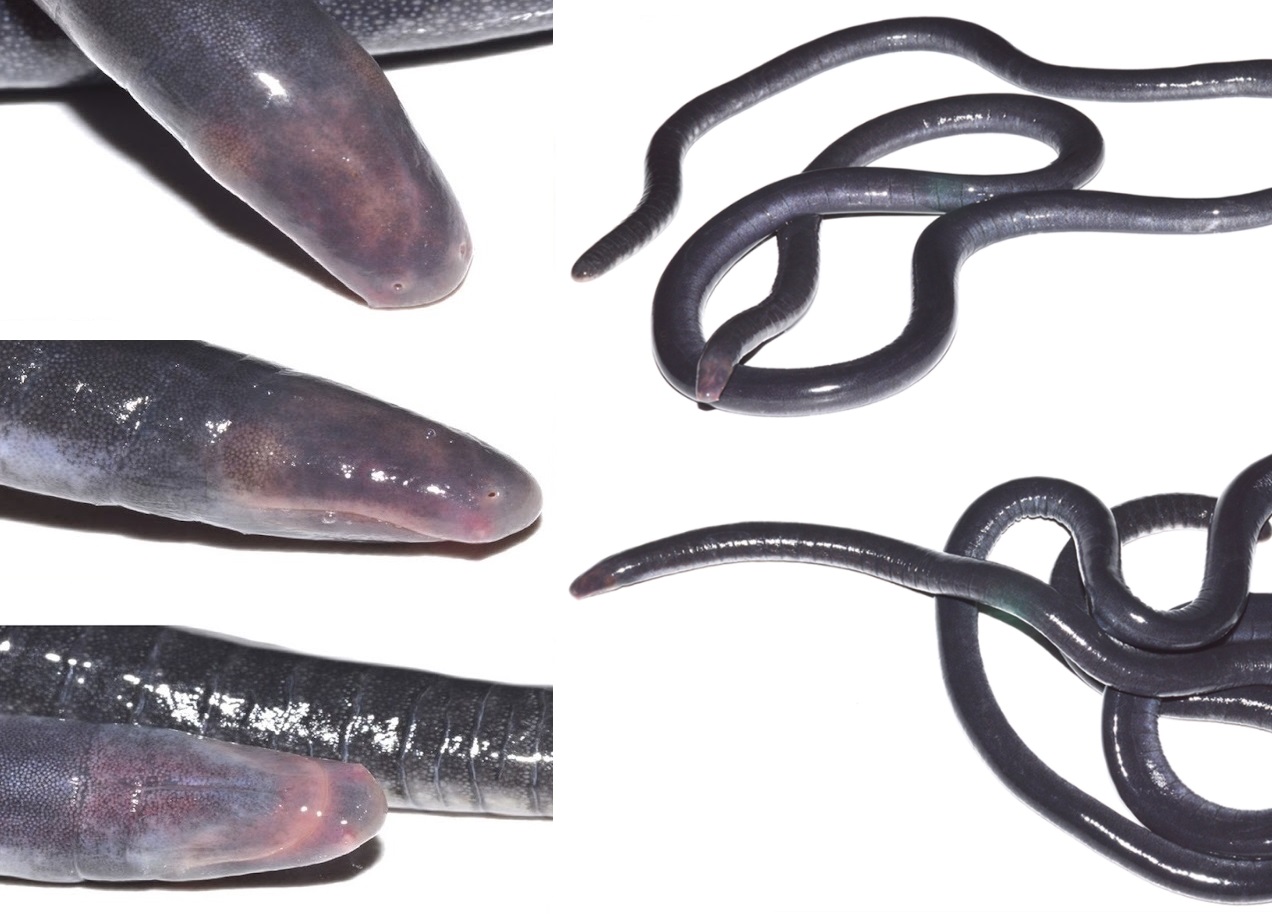
Head of Caecilia goweri (MHUA 8115) in (A) dorsal, (B) lateral, and (C) ventral views, in life.
Photographs by Dr. Juan Manuel Daza of MHUA.

Holotype of Caecilia goweri (MHUA 3241)
 (A) Ventral and (B) dorsal views, respectively, of whole specimen; scale bar equals 8 mm. (C) Lateral view of the head and (D) ventral view of the terminus and phallodeum; scale bar equals 3 mm.


Juan David Fernandez and John D. Lynch. 2022. A New Species previously confused with Caecilia pachynema (Günther, 1859) (Amphibia: Gymnophiona: Caeciliidae) from the Cordillera Central of Colombia.   Amphibians and Reptiles: Diversity and Natural History. DOI: 10.22201/fc.25942158e.2021.02.278
     

Monday, October 3, 2022

[Mammalogy • 2022] Myotis hayesi • From Greener Times: A New Species of Thick-thumbed Myotis (Chiroptera: Vespertilionidae) from Phnom Penh, Cambodia


Myotis hayesi
Csorba & Furey, 2022

Hayes’ thick-thumbed myotis  |  DOI: 10.17109/AZH.68.1.85.2022

Abstract
A new species of Myotis is described from Cambodia. The species is characterised by its fleshy, bicolored thumb, large foot sole, full dentition, relatively short rostrum, and high frontal part of skull. The species is currently only known from the city of Phnom Penh.

Keywords: Chiroptera, Cambodia, taxonomy, new species, Myotis sp. n.


Myotis hayesi sp. n.

Type locality – Phnom Penh, Cambodia, ... The holotype was collected in an urban area with scattered gardens planted with various species of palms and broad-leaved trees.

Diagnosis – A small species of Myotis (Table 2) with the forearm length of 33.8 mm and a skull length of 13.64 mm. The thumb, footpad, and calcar (including keel) are distinctly yellowish and contrast sharply with the overall brownish wing membranes. The thumb is shortened and thickened (Fig. 2). The sole of the hind foot is wide, smooth, and concave and its greatest width (measured at the base of the digits) exceeds the length of the longest digit (Fig. 3). The rostrum is relatively short, and the frontal part of the skull is elevated, although the braincase is not especially globose (Fig. 4). There are three upper and lower premolars, and the middle premolars are situated within the toothrow (Fig. 5).

 Etymology – Named after Benjamin Hayes, in recognition of his exceptional contributions to improving understanding and conservation of bats in Vietnam and Cambodia. The proposed English name is ‘Hayes’ thick-thumbed myotis’.


Gabor Csorba and Neil M. Furey. 2022. From Greener Times: A New Species of Thick-thumbed Myotis from Phnom Penh, Cambodia. Acta Zoologica Academiae Scientiarum Hungaricae. 68(1), 85-97.  DOI: 10.17109/AZH.68.1.85.2022

[Botany • 2022] Monopyle glutinosa (Gesneriaceae) • A New Species from the western slopes of the Ecuadorian Andes


Monopyle glutinosa J.L.Clark & Keene, 

in Clark, Tobar & Keene, 2022. 

Abstract
Exploratory field expeditions to the western slopes of the Ecuadorian Andes resulted in the discovery of a new species of Monopyle (Gesneriaceae). Monopyle glutinosa J.L.Clark & Keene, sp. nov. is described as a narrow endemic from lowland forests along the border of the Reserva Ecológica Los Illinizas in the Province of Cotopaxi. The new species is unique for the presence of glutinous or sticky trichomes on the calyx lobes and outer surface of the inferior ovary. Based on IUCN guidelines, a preliminary conservation status is assigned as Critically Endangered (CR).

Keywords: Ecuador, Gesneriaceae, Monopyle, taxonomy


Monopyle glutinosa J.L.Clark & Keene
 A lateral view of flower B front view of flower C inferior ovary and calyx lobes adhering to a finger from the sticky trichomes D dorsiventral habit
(A–D from J.L. Clark 16489). Photos by J.L. Clark.

 Monopyle glutinosa J.L.Clark & Keene, sp. nov.
 
Diagnosis: Similar to Monopyle ecuadorensis, differing in larger calyx lobes that reach 1.5 cm in length (vs. 0.5–1.0 cm long in M. ecuadorensis), larger campanulate corolla tube that exceeds 3.0 cm in length (vs. corolla tube less than 3 cm in M. ecuadorensis), and a uniformly dark purple corolla tube (vs. broad range of corolla tube colors from uniformly white to white suffused with blue in M. ecuadorensis).

Etymology: The trichomes on the calyx lobes and inferior ovary allow the flower to cling to an upside-down finger (Fig. 1C). This specific epithet reflects the sticky trichomes on the outer surface of the inferior ovary and calyx lobes.
 

John L. Clark, Franciso Tobar and Jeremy Keene. 2022. Monopyle glutinosa (Gesneriaceae), A New Species from the western slopes of the Ecuadorian Andes. PhytoKeys. 210: 15-21. DOI: 10.3897/phytokeys.210.89520

Resumen: Las expediciones a los bosques de las laderas noroccidentales de los Andes de Ecuador dieron como resultado el descubrimiento de una nueva especie: Monopyle glutinosa J.L.Clark & Keene, sp. nov., la cual es endémica de una reducida área en el borde de la Reserva Ecológica Los Illinizas en la provincia de Cotopaxi. La nueva especie es única por la presencia de tricomas glutinosos o pegajosos en los lóbulos del cáliz y la superficie externa del ovario ínfero. Basados en los criterios de la UICN, se asigna un estado de conservación preliminar de En Peligro Crítico (CR).

[Botany • 2021] Hyptis lavoisierifolia (Lamiaceae: Hyptidinae) • A New Species from the Noteworthy Hyptis subsect. Pachyphyllae endemic to Chapada dos Veadeiros Region, Goiás, Brazil


Hyptis lavoisierifolia A.Soares, J.F.B.Pastore & Harley,

in Soares, Pastore, Antar & Harley, 2021. 
 
Hyptis is a genus with about 151 species that belongs to subtribe Hyptidinae, a monophyletic and predominantly Neotropical group from Lamiaceae. The genus has gone through a series of taxonomic changes, especially sectional, since the early 19th century. Hyptis sect. Eriosphaeria subsect. Pachyphyllae, recent reestablished as subsection, is composed, until this paper, of four species, all endemic to the Chapada dos Veadeiros region, in Goiás state, Brazil. Here we report a novelty for the subsection.
 
Keywords: Brazilian flora, cerrado, endemism, Ocimeae, taxonomy, Eudicots


Hyptis lavoisierifolia A.Soares, J.F.B.Pastore & Harley:
A: Upper branch detail showing indumentum and inflorescence.; B: Mature individual.


Hyptis lavoisierifolia A.Soares, J.F.B.Pastore & Harley

Etymology:—The epithet is a reference to the plant genus Lavoisiera Candolle (1828:102), an endemic genus from Brazil, belonging to Melastomataceae Family, the leaves of which resemble the new species. 


Arthur de Souza Soares, José Floriano Barêa Pastore, Guilherme Medeiros Antar and Raymond Mervyn Harley. 2021. Hyptis lavoisierifolia, A New Species from the Noteworthy Hyptis subsect. Pachyphyllae (Lamiaceae—Hyptidinae) endemic to Chapada dos Veadeiros Region, Goiás, Brazil. Phytotaxa. 507(2); 175–182. DOI:  10.11646/phytotaxa.507.2.5

Sunday, October 2, 2022

[Herpetology • 2022] Hyloscirtus sethmacfarlanei • A Spectacular New Species of Hyloscirtus (Anura: Hylidae) from the Cordillera de Los Llanganates in the eastern Andes of Ecuador


Hyloscirtus sethmacfarlanei
Reyes-Puig​, Recalde, Recalde, Koch, Guayasamin, Cisneros-Heredia, Jost & Yánez-Muñoz, 2022

 Seth MacFarlane’s Torrent Frog | Rana de torrente de Seth MacFarlane  ||  DOI: 10.7717/peerj.14066
Photos: Lou Jost, Fausto Recalde, Juan P. Reyes-Puig.

Abstract 
We have discovered a spectacular new species of frog in the genus Hyloscirtus, belonging to the H. larinopygion species group. The adult female is characterized by a mostly black body with large bright red spots on the dorsal and ventral surface, extremities, and toe pads. The adult male is unknown. Small juveniles are characterized by a yellow body with variable black markings on the flanks; while one larger juvenile displayed irregular orange or yellow marks on a black background color, with light orange or yellow toe pads. Additional distinctive external morphological features such as cloacal ornamentation are described, and some osteological details are imaged and analyzed. The performed phylogeny places the new species as the sister to a clade consisting of ten taxa, all of which are part of the H. larinopygion group. We use genetic distances to fit the new species into a published time-calibrated phylogeny of this group; our analysis based on the published chronology suggests that the divergence of the new species from its known congeners pre-dates the Quaternary period. The new species is currently only known only from Cerro Mayordomo, in Fundación EcoMinga´s Machay Reserve, at 2,900 m in the eastern Andes of Tungurahua province, Ecuador, near the southern edge of Los Llanganates National Park, but its real distribution may be larger.


Comparison in life of Hyloscirtus sethmacfarlanei sp. nov. with six species of Hyloscirtus from the H. larinopygion group from the Andes of Ecuador.
 (A) Hyloscirtus sethmacfarlanei sp. nov., female holotype (DHMECN 14416). (B) H. sethmacfarlanei sp. nov., juvenile paratype (DHMECN 14549).
(C) Hyloscirtus princecharlesi (photographic record QCAZ). (D) Hyloscirtus larinopygion, photographic record QCAZ.
(E) Hyloscirtus lindae (DHMECN 12483 ). (F) Hyloscirtus pantostictus (photographic record QCAZ).
(G) Hyloscirtus psarolaimus (DHMECN 6493). (H) Hyloscirtus pacha (DHMECN 12111).
Photographs: Juan P. Reyes-Puig, Mario H. Yánez-Muñoz, Santiago Ron. QCAZ, Jorge Brito.

 Dorsal coloration of Hyloscirtus sethmacfarlanei sp. nov.
(A) Female holotype (DHMECN 14416). (B) Juvenile paratype (DHMECN 17554). (C) Juvenile paratype (DHMECN 14549).
 Photographs: Mario H. Yánez-Muñoz.

Hyloscirtus sethmacfarlanei sp. nov.
Proposed standard Spanish name: Rana de torrente de Seth MacFarlane
Proposed standard English name: Seth MacFarlane’s torrent frog

Diagnosis. Hyloscirtus sethmacfarlanei sp. nov. is a member of the Hyloscirtus larinopygion group as diagnosed by Duellman & Hillis (1990), Faivovich et al. (2005) and Weiens et al. (2005), and differs from other members of the group by the following combination of characters: discs of digits narrow; fleshy calcar present cloacal ornamentation with two thick well-defined parallel paracloacal grooves; a well-defined supracloacal fold reaching the vent; skin surrounding cloaca strongly areolate and granular; anterior border of sphenethmoid not in contact with nasal; nasal not in contact with maxilla; frontoparietals rugose; vomers not in medial contact, and with 12‒13 tooth loci; 54‒56 maxillary tooth loci; 10‒11 premaxillary tooth loci; zygomatic ramus of squamosal slightly longer than otic ramus, and otic ramus not in contact with prootic. The adult female, in its reproductive stage with internal sexual characters defined, is further characterized by black ground color covered with large bright red spots on both the dorsal and ventral surfaces, and red tips on all digits.

Distribution: Hyloscirtus sethmacfarlanei sp. nov. is known at the moment only from the type locality in Fundación EcoMinga’s Machay Reserve, Cerro Mayordomo, 2,970 m altitude, in the eastern cordillera of the central Ecuadorian Andes, in the northern side of the upper Rio Pastaza watershed near the southern border of Llanganates National Park in the province of Tungurahua.

Hyloscirtus sethmacfarlanei sp. nov., at the type locality and its habitat.
(A) Humid cloud forest with Guzmania sp. bromeliads at type locality. (B) Female Holotype (DHMECN 14416). (C) Juvenile paratype (DHMECN 14549). (D) Uncollected juvenile.
Photographs: Fausto Recalde, Juan P. Reyes-Puig.

Live individiuals of Hyloscirtus sethmacfarlanei sp. nov. in situ.
 (A) Female holotype (DHMECN 14416). (B) Juvenile paratype (DHMECN 14549). (C) Juvenile, not collected, in its natural habitat. (D) Same juvenile adopting defensive behavior.
Photos: Lou Jost, Fausto Recalde, Juan P. Reyes-Puig.


Natural history. The type locality consists of dwarf open mossy forest, covered with bryophytes and epiphytes, and saturated with humidity. All four known individuals of this species were found on a single narrow mountain ridge, in bromeliads of the genus Guzmania growing within 60–90 cm above the ground (Fig. 17). The holotype is an adult gravid female with a mass of eggs in early stage of development in March 2018. Adult male, tadpole and advertisement call remain unknown.


Etymology. The specific epithet sethmacfarlanei is a patronym in honor of Seth MacFarlane, American writer, director, producer, actor, artist, musician and conservationist, with an outstanding passion for science, biodiversity and the natural world.
 

 Juan P. Reyes-Puig​, Darwin Recalde, Fausto Recalde, Claudia Koch, Juan M. Guayasamin, Diego F. Cisneros-Heredia, Lou Jost and Mario H. Yánez-Muñoz. 2022. A Spectacular New Species of Hyloscirtus (Anura: Hylidae) from the Cordillera de Los Llanganates in the eastern Andes of Ecuador. PeerJ. 10:e14066 DOI: 10.7717/peerj.14066
Zoology Museum at the Pontifical Catholic University of Ecuador (QCAZ)


[Botany • 2022] Buchanania abrahamiana (Anacardiaceae) • A New Species from Kerala, India


Buchanania abrahamiana E.S.S. Kumar & Shareef, 
 
in Kumar & Shareef, 2022.

Abstract
Buchanania abrahamiana E.S.S. Kumar & Shareef sp. nova (Anacardiaceae) is described from Kerala, SW India. It resembles B. barberi and B. lanzan, but diffres from them by characters of the twigs, leaves, flowers and seeds. An identification key to the species of Buchanania in India is provided.


Ettickal Sukumaran Santhosh Kumar and Sainudeen Muhammed Shareef. 2022. Buchanania abrahamiana (Anacardiaceae), A New Species from Kerala, India. Annales Botanici Fennici. 59(1):23-27. DOI: 10.5735/085.059.0104
www.thehindu.com/news/national/kerala/rare-tree-species-spotted-in-district/article65440358.ece

[Paleontology • 2022] The Shishugou Fauna of the Middle-Late Jurassic Transition Period in the Junggar Basin of Western China


The Shishugou Fauna in the Junggar Basin of Western China

in Xu, Clark, Eberth & Currie, 2022. 
illustrated by Chuang ZHAO 
  
 Abstract
The Middle–Late Jurassic transition period is a critical period for the evolution of terrestrial vertebrates, but the global fossil record from this time is relatively poor. The Shishugou Fauna of this period has recently produced significant fossil remains of dinosaurs and other vertebrate groups, some representing the earliest known members of several dinosaurian groups and other vertebrate groups and some representing the best-known specimens of their group. These discoveries are significant for our understanding of the origin and evolution of several vertebrate lineages. Radiometric dating indicates that the fauna is aged approximately 159–164 Ma. Comparisons with other similarly-aged terrestrial faunas such as Shaximiao and Yanliao show both taxonomic similarities and differences between these faunas and indicate that the Junggar deposits might have preserved the most complete vertebrate fossil record for a Middle–Late Jurassic Laurasian terrestrial fauna.

 Keywords: Middle–Late Jurassic, Shishugou Fauna, Shishugou Formation, terrestrial ecosystem, Shaximiao, Yanliao, Junggar Basin


Xing Xu, James M. Clark, David A. Eberth and Philip J. Currie. 2022. The Shishugou Fauna of the Middle-Late Jurassic Transition Period in the Junggar Basin of Western China. Acta Geologica Sinica - English Edition. Special Paper for 100th Anniversary. DOI: 10.1111/1755-6724.14996

Shishugou Formation, China, 157 million years ago. 
Mamenchisaurus, Sinraptor, Guanlong, Limusaurus, Zuolong, ..