Thursday, January 6, 2022

[Botany • 2021] Begonia giganticaulis (Begoniaceae, section Platycentrum) • A New Species from southern Xizang (Tibet) of China


Begonia giganticaulis D.K.Tian & W.G.Wang, 

in Tian, Wang, Dong, ... et Ge, 2021. 

Abstract
Begonia giganticaulis, a huge new species in Begonia sect. Platycentrum of Begoniaceae from southern Xizang (Tibet) of China, is described. Morphologically, it is mostly similar to B. longifolia and B. acetosella, but clearly differs from the former mainly by its dioecious and taller plants, sparse hairs on abaxial veins, longer inflorescence, unique shape of fruits, and differs from the latter mainly by its late and longer flowering time, 6-tepals of female flower and 3-loculed ovary. The phylogenetic analyses also support the separation of the new species from other taxa. Based on the current data, its conservation status is assigned to Endangered (B2a) according to the IUCN Red List Categories and Criteria.

Keywords: Conservation status, molecular evidence, morphology, southern Tibet, taxonomy


Begonia giganticaulis D.K.Tian & W.G.Wang, sp. nov.

Diagnosis The new species is mostly similar to B. longifolia and B. acetosella, but clearly differs from the former mainly by its dioecious (vs. monoecious), taller (to 4 m vs. less than 2 m) plants, longer (vs. shorter) inflorescence, and unique shape of fruits, and differs from the latter mainly by its taller (to 4 m vs. less than 2 m) plants, late and longer (Jun. to Oct. vs. Mar. to Apr.) flowering time, longer (6–20 mm vs. 5–12 mm) pedicel, 6 (vs. 4) tepals of pistillate flower and 3 (vs. 4)-loculed ovary (Table 3, Fig. 3).
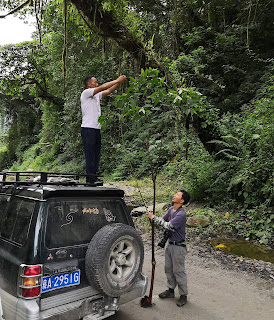


Etymology: The specific epithet refers to the huge (very tall and thick stem) plant size of the new species, which is the tallest begonia in Asia.

 
Dai-Ke Tian, Wen-Guang Wang, Li-Na Dong, Yan Xiao, Min-Min Zheng and Bin-Jie Ge. 2021. A New Species (Begonia giganticaulis) of Begoniaceae from southern Xizang (Tibet) of China. PhytoKeys. 187: 189-205. DOI: 10.3897/phytokeys.187.75854


Wednesday, January 5, 2022

[Botany • 2022] Globba philippinensis (Zingiberaceae) • A New Endemic Species from Western Visayas, Philippines


 Globba philippinensis Naive, J.A.G. Dalisay, Bangcaya & Sangvir.

in Dalisay, Naive, Bangcaya & Sangvirotjanapat, 2022.
Photos by J.A.G. Dalisay
 
Abstract
A new species, Globba philippinensis Naive, J.A.G. Dalisay, Bangcaya & Sangvir. from Antique Province, Philippines, is herein described and illustrated. A detailed description, colour plates, discussion of similar taxa, information on its distribution and habitat are provided. A preliminary conservation assessment is proposed and a key to the species of Globba section Nudae subsection Mediocalcaratae is amended.

Keyword: Antique Province, Philippine flora, section Nudae, subsection Mediocalcaratae, Zingiberales


Globba philippinensis Naive, J.A.G. Dalisay, Bangcaya & Sangvir.
A. Habit B. Leaves, scale bar: 10 cm C. Excavated rhizome D. Ligule E. Inflorescence F. Flower (front view), scale bar: 2 cm G. Flower (side view), scale bar: 2 cm H. Dissected flowers (fl: flower; ls: lateral staminode, scale bar: 5 mm; la: labellum (no decurrent and cornicula), scale bar: 5 mm; lcl: lateral corolla lobes, scale bar: 5 mm; o: ovary and calyx, scale bar: 1 mm; an: anther, scale bar: 2 mm) I. Fruit, scale bar: 2 cm J. Bulbil, scale bar: 10 mm.
 (Photos by J.A.G. Dalisay).

Globba philippinensis Naive, J.A.G. Dalisay, Bangcaya & Sangvir., sp. nov. 

Diagnosis: Globba philippinensis Naive, J.A.G. Dalisay, Bangcaya & Sangvir. is similar to G. campsophylla K.Schum. (Fig. S1A) and G. argyrocycnos Sangvir. & M.F.Newman (Fig. S1B) in floral structure and flower colour, respectively. Similar to Globba campsophylla K.Schum. in its decurrent labellum, base of filament with cornicula, and linear lateral staminodes but differs in its contrasting flower colour of yellowish orange (floral tube, corolla lobes, lateral staminodes, and labellum lobes) and white (filament and anther thecae) (versus flower pure white with yellow spot at labellum) and bulbils produced at peduncle (versus at tip of the inflorescence). Similar to Globba argyrocycnos Sangvir. & M.F.Newman in its contrasting flower colour of yellowish orange (floral tube, corolla lobes, lateral staminodes, and labellum lobes) and white (filament and anther thecae) but differs in its decurrent labellum base with cornicula (versus decurrent labellum base on filament without cornicula).

Flowers of A. Globba campsophylla K.Schum. B. Globba argyrocycnos Sangvir. & M.F.Newman.
Photos by M.A.K. Naive and (A) and Sunisa Sangvirotjanapat (B).

Ecology: This species found growing in the different type of habitats, such as in agroforestry plantations, along the trails and near creeks and streams from 10 to 100 m above sea level (Fig. S2).  

Etymology: Named after the country of origin, the Philippines, where the species was discovered and collected. 

Vernacular name: Known as “tabayag” by the local people of its type locality. 

Different habitat types of Globba philippinensis
A. Agroforest. B. By the creek. C. Along the trail. D. Near the streams.
Photos by J.A.G. Dalisay.


Jade Ann Grace P. Dalisay, Mark Arcebal K. Naive, Porferio S. Bangcaya and Sunisa Sangvirotjanapat. 2022. Globba philippinensis (Zingiberaceae), A New Endemic Species from Western Visayas, Philippines. Taiwania. 67(1); 25 - 29. DOI: 10.6165/tai.2022.67.25


[PaleoEntomology • 2019] Corethrella patula • A New Species of Fossil Corethrella (Diptera, Corethrellidae) from mid-Cretaceous Burmese Amber


Corethrella patula Baranov & Kvifte

in Baranov, Kvifte, Müller & Bernal, 2019.

Abstract
Frog-biting midges (Diptera: Corethrellidae) are hematophagous flies in which females feed on anuran blood using the mating calls produced by calling male frogs. This family is of large ecological, evolutionary and ethological interest, but its geological history is poorly known. We describe a new species of frog-biting midge (Diptera, Corethrellidae), Corethrella patula sp. nov., from mid-Cretaceous Burmese amber (ca. 99 Ma). This new species is distinct from Corethrella andersoni, known from the same deposit, differing in having more slender mid femora and a triangular bifid tarsal segment 5 without scales. These two species, however, share an apparent synapomorphy in the wing; R2 vein diverting from R2+3 at 75° angle in relation to R3. The well-preserved male genitalia of the new species suggest C. patula and C. andersoni are a distinct, early lineage not easily placeable within either of the described subgenera of Corethrella.

Keywords: Eavesdropping, Fossil, Frog-biting midges, Micropredator, Taxonomy

Speculative reconstruction of Corethrella patula sp. nov. as a micropredator of a hypothetical Alytoidea frog. Male in the foreground, females sitting at the frog.
Reconstruction and art by Gabriel Ugueto.

Corethrella patula Baranov & Kvifte, sp. nov.  


 Viktor Baranov, Gunnar M. Kvifte, Patrick Müller and Ximena E. Bernal. 2019. A New Species of Fossil Corethrella (Diptera, Corethrellidae) from mid-Cretaceous Burmese Amber. Cretaceous Research. 101; 84-91. DOI: 10.1016/j.cretres.2019.05.002  

[Herpetology • 2022] Noblella mindo • A New Species of the Genus Noblella (Amphibia: Strabomantidae) from Ecuador, with New Information for Noblella worleyae


 Noblella mindo 
 Reyes-Puig, Guayasamin, Koch, Brito-Zapata, Hollanders, Costales & Cisneros-Heredia, 2022


 Abstract
We describe a new species of terrestrial-breeding frog of the genus Noblella from the northwestern slopes of the Andes of Ecuador, in the province of Pichincha, Ecuador, and report a new locality for the recently described N. worleyae. We include a detailed description of the osteology of both species and discuss their phylogenetic relationships. The new species is differentiated from other species of Noblella by having discs of fingers rounded, without papillae; distal phalanges only slightly T-shaped; toes slightly expanded and rounded distally, without papillae; dorsum uniform brown with irregular suprainguinal dark brown marks; venter yellowish cream, ventral surfaces of legs and thighs reddish to brownish cream; and dark brown throat. The new locality for N. worleyae is located in Los Cedros Reserve, an area highly threatened by mining. We highlight the importance of protecting endemic species of small vertebrates in northwestern Ecuador.

Keywords: Frog, Los Cedros Biological Reserve, endemism, Imbabura, Mindo, Pichincha, phylogeny


Color patterns of Noblella mindo sp. nov. in life.
 (A, C) Dorso-lateral and ventral patterns of holotype, ZSFQ 050, adult female, SVL = 18.3 mm.
(B, D) Dorsolateral and ventral patterns of paratype, ZSFQ 051, adult male, SVL = 16.9 mm.
Photos by Matthijs Hollanders.


  Noblella mindo new species 

Etymology: The specific name “mindo” is a word of unknown meaning in Panzaleo, an extinct pre-Columbian language of northern Ecuador (Jijón y Caamaño 1940). It is used as a noun in apposition, and alludes to the valley of Mindo, where the type locality of the new species is located. The remnant forests of this emblematic valley protect several species of endemic amphibians and reptiles such as Pristimantis mindo, Noblella mindo, and Anolis proboscis.


Diagnosis: Noblella mindo sp. nov.(Figs. 3–8) presents the following characteristics: (1) skin of dorsum finely sha-green, skin on venter smooth, discoidal fold slightly defined, discoidal and thoracic folds absent; (2) tympanic annulus and membrane visible externally, supratympanic fold inconspicuous (Figs. 3, 4); (3) snout short (eye-to-nostril distance 57% of eye diameter), rounded in dorsal and lateral views (Fig. 3); (4) eyelids without tubercles; (5) dentigerous processes of vomers absent; (6) vocal slits and sac present, nuptial pads not visible; (7) fingers not expanded distally, finger tips rounded, without papillae (Fig. 3); Finger I shorter than Finger II (Fig. 3); (8) distal phalanges slightly T-shaped, phalangeal formula of hands: 2-2-3-3 (Fig. 7); (9) supernumerary pal-mar tubercles present (slightly visible) mostly at the base of the digits, ....

Distribution and Natural History: Noblella mindo sp. nov. is only known from El Cinto (0.09022°S, 78.81858°W; 1,673 m), Mindo, province of Pichincha, Ecuador (Fig. 2). Noblella mindo sp. nov. inhabits secondary cloud forests, with the presence of palmito (Bactris gasipaes) plantations and trees that have emerged after the massive logging of forests in the area. These forests have a high humidity index, dense leaf litter layer, and abundant epiphytes. It has a restricted distribution; sampling activities were carried out in a range up to 3km around the type locality, and no individuals nor calls of N. mindo sp. nov. were recorded. The gecko Lepidoblepharis conolepis was found in sympatry. The locality is surrounded by livestock areas and within the type locality forest, there are trails used by farmers to move their livestock. The population of Noblella mindo sp. nov. could be impacted if livestock activity or deforestion expands. Three individuals (ZSFQ 049–051) were found active during the day between 10:00 and 11:00 am; all frogs were on the ground in a 2-meter depth hole.


Carolina Reyes-Puig, Juan M. Guayasamin, Claudia Koch, David Brito-Zapata, Matthijs Hollanders, Melissa Costales and Diego F. Cisneros-Heredia. 2022. A New Species of the Genus Noblella (Amphibia: Strabomantidae) from Ecuador, with New Information for Noblella worleyae.  Acta Herpetologica. 16(2); 63-87. DOI: 10.36253/a_h-10742 


[Entomology • 2022] Ischnura praematura • A Species (Odonata: Zygoptera: Coenagrionidae) from Yunnan (China) whose Females Mate in the Teneral State


Ischnura praematura Sanmartín-Villar & Zhang,  

in Sanmartín-Villar, Lorenzo-Carballa, Zhang & Cordero-Rivera, 2021. 
All photos by I. Sanmartín-Villar.


Abstract

Ischnura praematura sp. nov. (Holotype ♂, China, Yunnan, Lijiang, 26º31´03.54”N, 100º13’38.89”E, 2396 m, 04 xii 2015, I. Sanmartín-Villar & H. Zhang leg.) is morphologically described, illustrated and compared with close species of the genus. Ischnura praematura can be mainly distinguished from its congeners I. aurora, I. rubilio and I. asiatica by its abdominal and thoracic morphology and colouration. The posterior lobe of the prothorax is elevated in I. praematura and the mesostigmal plates possess dorsal triangular protuberances. Ischnura praematura shows pointed paraprocts, internalised wide cerci and lacks a dorsal tuberculum in the tenth abdominal segment. The blue abdominal colouration is present in the last three segments (incomplete for segment eight and ten in some individuals). No female polychromatism was detected and all females observed possessed different colouration than male (gynochrome). Morphological distinctiveness of the species is supported by genetic analyses, which show that I. praematura forms a well-supported, monophyletic clade, with I. asiatica, I. ezoin and I. pumilio as the most closely related species. In the field, mature females show strong reluctance to mate, and males were observed mating with newly emerged females.

Key words: Asia, damselfly, integrative taxonomy, molecular markers, mitochondrial DNA, nuclear DNA


Ischnura praematura mature male (a) and female (b) as seen in the field, nearby Lijiang city. Note the pruinescence in the abdomen and legs of the mature female and the wing hardness in comparison with the females of the following pictures. Tandem (c) and mating (d) observed in the field between a mature male and a teneral female.
All photos by I. Sanmartín-Villar.


Ischnura praematura sp. nov. Sanmartín-Villar & Zhang 

Etymology. Specific name praematura (i.e. premature: occurring before a state of readiness or maturity has arrived) in reference to its reproductive behaviour, in which mature males mate with newly emerged females before they reach sexual maturity (see below).


Iago Sanmartín-Villar, M. Olalla Lorenzo-Carballa, Haomiao Zhang and Adolfo Cordero-Rivera. 2021. Ischnura praematura sp. nov. (Odonata: Zygoptera: Coenagrionidae): A Species from Yunnan (China) whose Females Mate in the Teneral State. Zootaxa. 5087(1); 59-74. DOI: 10.11646/zootaxa.5087.1.3


[Arachnida • 2022] Taksinus bambus • A New Genus of Bamboo Culm Tarantula (Araneae, Mygalomorphae, Theraphosidae) from Thailand


Taksinus bambus 
Songsangchote, Sippawat, Khaikaew & Chomphuphuang, 2022

บึ้งปล้องไผ่พระเจ้าตากสิน || DOI: 10.3897/zookeys.1080.76876

Abstract
Bamboo plays an important role in the animal world, including providing a nutritious food source, shelter, and habitat. Inside of bamboo culm, we discovered a new genus of tarantula, which we describe here as Taksinus gen. nov. (♂♀). Specimens of this new tarantula were collected from Mae Tho, Mueang Tak district, Tak province, in Thailand, making it geographically distant from any other arboreal genera. Genital morphology was used to diagnose its genus, which is supported by distributional data, natural history, morphological characters, and photographic illustrations of the male and female. Diagnosis of the new genus was determined by distinguishing its different characters from those of other arboreal theraphosid spiders distributed throughout Southeast Asia. This tarantula’s specialization is that it lives in the stalks of the Asian bamboo Gigantochloa sp.

Keywords: Arboreal theraphosid, Lampropelma, Melognathus, Omothymus, Phormingochilus, Taksinus

Taxonomy: 
Mygalomorphae Pocock, 1892
Theraphosidae Thorell, 1869
Ornithoctoninae Pocock, 1895

Included genera: Citharognathus, Cyriopagopus, Lampropelma, Melognathus, Ornithoctonus, Phormingochilus, Taksinus gen. nov.

 Taksinus Songsangchote, Sippawat, Khaikaew & Chomphuphuang, gen. nov.
 
Type species: Taksinus bambus Songsangchote, Sippawat, Khaikaew & Chomphuphuang, 2021
 from Tak, Thailand.

Diagnosis: The characteristics of Taksinus gen. nov. that differ from Ornithoctonus and Cyriopagopus are: a low caput, a clypeus that is less than the width of the median ocular quadrangle (Fig. 6A), and spermathecae with twin seminal receptacles (Fig. 7E, F) (Raven 1985; von Wirth and Striffler 2005; Smith and Jacobi 2015). The new genus differs from Citharognathus by the lack of incrassate tibia and metatarsus IV. Taksinus gen. nov. differs from Lampropelma by the absence of a dense brush of hair on the retrolateral side of the femora of the front limbs (von Wirth and Striffler 2005) and males by lack of apical embolus swelling (Fig. 5A–E; see Gabriel and Sherwood 2019: 143, figs 17, 18). Taksinus gen. nov. can be distinguished from Omothymus by male palpal bulb with a gently curved embolus with rounded embolic apex (Fig. 5A–E) vs palpal bulb steep angle embolus and apex with a sharp point in Omothymus (Fig. 5F–J; see Gabriel and Sherwood 2019: 139, figs 1–5). Taksinus gen. nov. differs from Phormingochilus by the lack of a single megaspine on the inside of the male tibial apophyses (Fig. 4A, B; see Smith and Jacobi 2015: 41, fig. 38; Gabriel and Sherwood 2019: 142, figs 14–16), a short embolus compared to palpal bulb length (1:1) (Fig. 5A–E), and the geographic distribution of Phormingochilus currently restricted to Borneo.

Etymology: The generic name was named Phraya Tak (governor of Tak province), which is in honor of Taksin the Great, king of the Thonburi Kingdom, in commemoration of his early career.

Taksinus bambus sp. nov. paratype ♀, TAK2 A dorsal view

Taksinus bambus sp. nov. paratype ♀, TAK2
 habitat in bamboo culm.


Taksinus bambus sp. nov. from Tak province, Thailand
A biotope, bamboo forests in mountainous slope areas B tarantula habitat in bamboo culm with entrance hole (below) and secondary entrance (upper)
 C, D tarantula in bamboo culm
 E tarantula building silk tube retreats on the cover culm F paratype ♀, TAK3 T. bambus alive.

 Taksinus bambus Songsangchote, Sippawat, Khaikaew & Chomphuphuang, sp. nov.

Etymology: The species name bambus refers to the species, which was discovered in a bamboo plantation and lives in Asian bamboo stalks. บึ้งปล้องไผ่พระเจ้าตากสิน 


Distribution and natural history: 
Specimens were collected from villages surrounding Tak province at approximately 1,000 m elevation. The biotope consists of a mixed deciduous forest dominated by bamboo that is rarely disturbed by human activity (Fig. 8A). The new arboreal tarantula shows a surprising specialization in that it lives in the stalks of Asian bamboo (Gigantochloa sp.) (Fig. 8B–E). All specimens were collected from bamboo internodes in mature culms, having nest entrances approximately 2–3 cm within a silk-lined tubular burrow at the entrance located in the branch stub or at the middle of the bamboo culms. Some specimens had a secondary entrance without silk at the hole (Fig. 8B). Tarantulas do not bore bamboo stems; instead, they depend on the assistance of other animals. Bamboo is attacked by numerous animals, the most common of which are insects from the orders Coleoptera, Lepidoptera, and Diptera (Varma and Sajeev 2015). Furthermore, we hypothesized that the tarantula might occupy the empty nest of insects, such as the bamboo-nesting carpenter bee Xylocopa, which creates a large hole. All the tarantulas living in the bamboo culms build silken retreat tubes that cover the stem cavity (Fig. 8C–E).


Chaowalit Songsangchote, Zongtum Sippawat, Wuttikrai Khaikaew and Narin Chomphuphuang. 2022. A New Genus of Bamboo Culm Tarantula from Thailand (Araneae, Mygalomorphae, Theraphosidae). ZooKeys. 1080: 1-19. DOI: 10.3897/zookeys.1080.76876

Monday, January 3, 2022

[Paleontology • 2022] Menucocelsior arriagadai • The Sauropod Record of Salitral Ojo del Agua: An Upper Cretaceous (Allen Formation) Fossiliferous Locality from northern Patagonia, Argentina


 Menucocelsior arriagadai 
 Rolando, Marsà, Agnolín, Motta, Rozadilla & Novas, 2022


Highlights: 
• A description of a new sauropod fauna from the Maastrichtian of Patagonia.
 • The publication of the new big-sized titanosaurid species.
• The publication of new bones of saltasaurid materials for the Later Cretaceous of Argentina.
• A detailed description of associated osteoderms assigned to titanosaurs or saltasaurines.
• The comparisons between the sauropod faunas from the different basins of Patagonia.

Abstract
The record of sauropods in the Upper Cretaceous of Patagonia is rich. However, there are still several blanks on this record. Here it is described a new sauropod assemblage coming from the Salitral Ojo de Agua Area, Río Negro province, northern Patagonia, Argentina (Allen Formation; Maastrichtian). Remains of indeterminate saltasaurines, aeolosaurines, as well as new specimens of the small saltasaurine Rocasaurus muniozi and the new eutitanosaur Menucocelsior arriagadai gen. et sp. nov., are described. The new eutitanosaur is represented by an incomplete caudal series and some appendicular bones that indicate that it does not belong to any previously recognized eutitanosaur clade (e.g, Colossosauria, Saltasaurinae, Aeolosaurini). The co-occurrence of several roughly coeval titanosaurs in a restricted area (as occur in Bajo de Santa Rosa, Salitral Moreno and Salitral Ojo de Agua sites) with different body plans, indicates that they probably occupied particular ecological niches and that probably competition for resources was limited, allowing the connivance of several taxa in a single locality and age. This pattern is not observed in other sites of the world. Based on these records and on the high diversity of osteoderm morphotypes recovered, it appears to be certain that palaeoecological conditions in the area were able to sustain and promote the flourishing of many species of titanosaurs.
 
Keywords: Titanosauria, Menucocelsior, Rocasaurus muniozi, Sauropod osteoderms, Maastrichtian, Patagonia


Menucocelsior arriagadai gen. et sp. nov.


Mauro Aranciaga Rolando, Jordi A. García Marsà, Federico L. Agnolín, Matías J. Motta, Sebastián Rozadilla and Fernando E. Novas. 2022. The Sauropod Record of Salitral Ojo del Agua: An Upper Cretaceous (Allen Formation) Fossiliferous Locality from northern Patagonia, Argentina. Cretaceous Research. 129, 105029. DOI: 10.1016/j.cretres.2021.105029

Saturday, January 1, 2022

[Herpetology • 2022] Acanthosaura meridiona กิ้งก่าเขาหนามสั้นใต้ • A New Short-horned Lizard (Squamata: Agamidae) from southern Thailand


 Acanthosaura meridiona
Trivalairat, Sumontha, Kunya & Chiangkul, 2021

 กิ้งก่าเขาหนามสั้นใต้  ||  DOI: 10.33256/32.1.3450 

Abstract
 A new short – horned lizard species of the genus Acanthosaura from southern Thailand, is described herein. The species was previously recognised as Acanthosaura crucigera and has been reported to present a wide distribution across mainland south-east Asia. The combination of modern morphological studies of Acanthosaura meridiona sp. nov. allows its separation from closely related species A. crucigera, on the basis of presenting more nuchal scales, more scales between diastema, more scales bordering rostral scales and more midline ventral scales. Mitochondrial DNA analysis also indicated a sister relationship between A. meridiona sp. nov. and A. crucigera with a 100 % probability according to Bayesian and maximum – likelihood analyses. The pairwise distance between A. meridiona sp. nov. and A. crucigera ranges from 9.9 – 11.1 %, while the distance between A. meridiona populations ranges from 0 – 0.9 %. This new discovery contributes to the redescription of the distribution of A. crucigera under Kra Isthmus and its replacement by A. meridiona sp. nov.

Keywords: crucigera complex, tropical rainforest, Thai – Malay Peninsula, ND2, taxonomy

Colour pattern variation within Acanthosaura meridiona sp. nov.
 (A – B) Adult female from Wang Nam Rab Resort Na Yong District, Trang Province.
 (C – D) Adult male from Wang Hip Dam, Thung Song District, Nakhon Si Tammarat Province.
 (E) Sub adult male from Wang Hip Dam, Thung Song District, Nakhon Si Tammarat Province.
(F) Juvenile from Wang Hip Dam, Thung Song District, Nakhon Si Tammarat Province.  

Acanthosaura meridiona sp. nov.

Diagnosis: A medium – sized species (maximum SVL 115.1 mm for males and 118.1 mm for females) with a single short conical spine above the posterior margin of the eye; small spine on the occiput between the tympanum and the nuchal crest; tympanum scaled, large, roundish; moderately developed gular pouch; small scales intermixed with medium keeled scales on the flanks with a random distribution; nuchal crest with slightly equal rows of 8 – 10 tiny semi – conical spines; large diastema of 10 – 16 scales between the nuchal and vertebral crests; vertebral crest composed of small equally sized saw – like scales beginning in the shoulder region and decreasing in size until the base of the tail; tail 1.07 – 1.61 of SVL; black collar and black eye patch present, extending posteriorly to reach the nuchal crest. Description of the holotype: Adult male. SVL 109 mm; TL 176 mm, tail complete; HL 20.8 mm; head is one – fifth the length of the body (HL/SVL 0.19), narrow (HW/SVL 0.15), moderately tall (HD/HL 0.60), triangular in dorsal and lateral views; snout moderately long (SL/HL 0.45); rostrum moderately wide (RW/RH 2.44), steeply sloping anteriorly; canthus rostralis prominent, forming a large projecting shelf extending above the eye, composed of 14 large scales; ....


Natural history: This species usually lives near streams, waterfalls or moist areas with rocks and logs and in areas covered with high trees shading evergreen rainforests (Fig. 6). It is active during the day on various substrates such as the ground, logs, rocks, ferns of approximately 0.5 m in height, or trees 1 – 2 m above the ground. It sleeps at night approximately 1 – 2 m above the forest floor, in a log holes or under rocks on the ground. When awakened by approach or provocation, the lizards quickly climb upward, while others may drop to the ground and seek refuge under rocks or hollow logs. Our observations showed that some individuals had eaten earthworms on the ground.

 Distribution. Acanthosaura meridiona sp. nov. occurs in southern Thailand according to personal field observations, including records in Na Yong District, Trang Province; Khao Bantad Wildlife Sanctuary, Trang – Phattalung Province; Krabi Province; Wang Hip River, Thung Song District, Nakhon Si Tammarat Province; Ton Lat Waterfall, Nathavee District, Songkhla Province. In addition, specimens were collected from Natural History Museum, National Science Museum, Technopolis, Pathum Thani Province at the following locations: Khanom Waterfall, Lan Saka District, Nakhon Si Tammarat Province; Tak Ta Khan, Ban Ta Khun District, Surat Thani Province; and Thale Ban National Park, Khuan Don District, Satun Province (Fig. 7). 

Etymology: The specific name meridiona comes from the Latin word meridionalis, meaning southern. It is a reference to the distribution of the species in the southern region of Thailand.
 We suggested the following common names: กิ้งก่าเขาหนามสั้นใต้ - kingka khaow naam sunn tai (Thai), southern short- horned lizard (English), süd-kurzhorn nackenstachler (German), and Acanthosaurus à cornes courtes du sud (French).


Poramad Trivalairat, Montri Sumontha, Kirati Kunya and Krittiya Chiangkul. 2021. Acanthosaura meridiona sp. nov. (Squamata: Agamidae), A New Short-horned Lizard from southern Thailand. Herpetological Journal. 32(1); 34-50. DOI: 10.33256/32.1.3450 

[Botany • 2021] Etlingera comosa (Zingiberaceae: Alpinioidea) • A New Species from Central Sulawesi, Indonesia


Etlingera comosa Ardiyani & Ardi, 

in Ardiyani, Ardi, Hutabarat & Poulsen, 2021.

Etlingera comosa Ardiyani & Ardi, a new and unusual species from Tentena, Central Sulawesi exhibiting terrestrial as well as epiphytic habit is described here. It is compared to the morphologically closest Etlingera sublimata A.D.Poulsen, but differs in having tufted sheath, bilobed and asymmetric ligule, loose peduncular bracts, densely pubescent fertile bracts and longer filament. Colour plates, notes on its conservation status and DNA barcode data for the new species are also provided.

Keywords: Acanthodes group, DNA barcode, epiphytic, Etlingera sublimata, Indonesia, Zingiberales


Etlingera comosa Ardiyani & Ardi spec. nov. 

Similar to Etlingera sublimata A.D.Poulsen by the spiny bracts and thecae dehiscent through their entire length but E. comosa differs from E. sublimata in having tufted sheath (vs. not tufted), bilobed, asymmetric ligule (vs. entire), peduncular bracts only loosely enclosing base of spike and partly exposed the axis (vs. peduncular bracts enclosing base of spike, peduncle axis not exposed), fertile bracts densely pubescent (vs. glabrous with ciliate margin), longer stamen (9 mm vs. 5 mm), longer filament (3.5–4.5 mm vs. 0.5 mm) and shorter anther (4 mm vs. 5–5.5 mm).  

Etymology. The epithet comosa refers to the tufted hairs of the sheath. 
 
 
  Marlina Ardiyani, Wisnu Handoyo Ardi, Prima Wahyu Kusuma Hutabarat and Axel Dalberg Poulsen. 2021. Etlingera comosa, A New Species (Zingiberaceae: Alpinioidea) from Central Sulawesi. Reinwardtia. 20(2); 63−68.  DOI: 10.14203/reinwardtia.v20i2.4243