Tuesday, July 9, 2019

[Botany • 2019] Magnolia yajlachhi (subsect. Talauma, Magnoliaceae) • Flower of the Heart, A New Species of Ceremonial, Medicinal, Conservation and Nurse Tree Relevance in the Zapotec Culture, Sierra Norte de Oaxaca, Mexico


Magnolia yajlachhi A.Vázquez & Domínguez-Yescas

in Domínguez‐Yescas & Vázquez‐García, 2019.
 DOI: 10.11646/phytotaxa.393.1.2 

Abstract
A new species of Magnolia from Sierra de Juárez, Oaxaca, Mexico, is described and illustrated. Magnolia yajlachhi belongs to sect. Talauma, subsect. Talauma, locally known as “yajlachhi” (flower of the heart, in Zapotec). It shares with M. lacandonica the subglobose mature fruit and the entirely white petals, but differs from the latter in having fewer carpels and stamens; more lateral leaf veins per side; and seeds orange vs. scarlet-red. It shares with M. zoquepopolucae the subglobose fruit but differs from the latter in having fewer carpels and stamens; petals entirely white vs. purplish in the upper portion (¾); more lateral leaf-veins per side; and seeds orange vs. scarlet-red. It shares with M. mexicana a similar number of carpels and stamens but it differs from the latter in having subglobose fruits to widely ovoid-depressed vs. widely ellipsoid; more leaf-veins per side; petals entirely white vs. adaxially purplish in the upper portion (¾); and seeds orange vs. scarlet-red. A key to Mexican species of sect. Talauma subsect. Talauma is provided. This species was assessed as Critically Endangered (CR). The species has a ceremonial and medicinal, conservation and nurse tree relevance in the Zapotecan culture.

Keywords: Magnoliids, medicinal use, nurse tree, Sierra de Juárez, Talauma. Zapotec

FIGURE 3. Magnolia yajlachhi at San Juan Juquila Vijanos, Oaxaca. 
A–B. Bernardo Domínguez Yescas and his wife, Ma. Luisa Pascual-Yescas, the family that transplanted and cared for seedlings for over a decade, until the trees flowered and turned out to be a new species. C. First documented (2010) open flower at male phase for this species. D. Flower bud flower of the heart, ready to be harvested for decoration, each tree producing up to 200 flower buds. E. Female phase (1:30 pm), with ca. perpendicular sepals, partially opened for beetle entrance, closing latter at night. F. Male phase (8:01 am) fully open flower, after pollen shedding 
(Photographs: A, D–F by J.A. Vázquez-García; B–C by R. Domínguez-Yescas).

FIGURE 4. Magnolia yajlachhi.
A. Leaves from a young shoot, found under shade. B. Leave exposed to direct sunlight. C. Spathaceous bract protecting the young flower bud. D. Heart shaped flower bud fully grown. E. Flowers at female phase, with sepals at an angle of ca. 30 degrees from the axis, barely opening for beetle entrance. F. Flower at female phase with perpendicular sepals, starting to close, usually with insects inside. G. Flower with reflexed sepals at an angle of ca. 80 degrees. H. Receptive gynoecium, female phase, with stamens. I. Receptive gynoecium (female phase, with stamens removed. J. Stamens. (Photographs: A, E and H–I by J. A. Vázquez-García; B–D, F–G and J by R. Domínguez-Yescas; G and H).


Magnolia yajlachhi A.Vázquez & Domínguez-Yescas, sp. nov.

Type:— MEXICO. Oaxaca: Mpio. San Juan Juquila Vijanos, Lachi-Luguiaj or Llano de Piedra, rare in coffee plantations that used to be cloud forest habitat in secondary Liquidambar-Pinus forest, property of Procoro Pascual, ..., 1269 m, 2 Sep 2018 (fr.), Pascual Domínguez 1 (holotype: IBUG!; isotypes: CORU!, ENCB!, HUAP!, MEXU!, OAX!, SERO!, XAL!). 

Magnolia yajlachhi shares with M. lacandonica the mature subglobose fruit and entirely white petals, but differs from the latter in having carpels less numerous (36–41 vs. 61–80) and marked vs. inconspicuously marked; stamens less numerous (166–175 vs. 198–248), leaf-veins per side more numerous (13–14 vs. 10–11); and seeds orange vs. scarlet. Magnolia yajlachhi shares with M. zoquepopolucae the subglobose fruit but differs from the latter in having carpels less numerous (36–41 vs. 46–56); stamens less numerous (166–175 vs. 200), petals entirely white vs. purplish in the apical portion (¾); lateral leaf-veins per side more numerous (13–14 vs. 10–11); and seeds orange vs. scarlet. Magnolia yajlachhi shares with M. mexicana a similar number of carpels and stamens but it differs from the latter in having shorter petals (7.5–7.7 vs. 9.0–10.0 cm) and entirely white vs. adaxially purplish in the apical portion (¾); fruits smaller (5.4–10.0 vs. 10.0–15.0 cm) and widely ovoid-depressed to subglobose vs. widely ellipsoid; leaf-veins per side more numerous (13–14 vs. 10–12); and seeds orange vs. scarlet (Table 1, Fig. 8).

FIGURE 7. A. Flower bud bouquet. B. Procession of Good Friday in San Juan Yatzona, using flower buds. C. Sculpture of Jesus on a donkey decorated with flower buds. D. Men of San Juan Yatzona decorating with Magnolia flower buds. E. Altar at San Juan Yatzona´s church decorated with flower buds and bromeliads. F. Tomb in cemetery adorned with Magnolia flower buds
(Photographs: A by J. Bautista-Vargas, B by D. Sánchez-Luna, C–D and E by S. A. Hernández-Merlín, F by J. A. Vázquez-García).


Reyna Domínguez‐Yescas and José Antonio Vázquez‐García. 2019. Flower of the Heart, Magnolia yajlachhi (subsect. Talauma, Magnoliaceae), A New Species of Ceremonial, Medicinal, Conservation and Nurse Tree Relevance in the Zapotec Culture, Sierra Norte de Oaxaca, Mexico. Phytotaxa. 393(1).1; 21–34. DOI: 10.11646/phytotaxa.393.1.2


Monday, July 8, 2019

[Crustacea • 2019] Geosesarma mirum • A New Species of Semi-terrestrial Sesarmid Crab (Decapoda, Brachyura) from central Taiwan


Geosesarma mirum
Shy & Ng, 2019

Abstract
A new species of semi-terrestrial sesarmid crab of the genus Geosesarma De Man, 1892, is described from central Taiwan. Geosesarma mirum sp. nov. is distinct in possessing a strong transverse crest on the inner surface of the male chela and a diagnostic male first gonopod which is relatively long and stout, with the distal chitinous part broad and spatuliform. Like most Geosesarma species, G. mirum sp. nov. has large eggs and direct development, contrasting with the only other species known from Taiwan, G. hednon Ng, Liu and Schubart, 2004, which has small eggs and planktotrophic larvae.

Keywords: Direct development, East Asia, freshwater, large eggs, Sesarmidae, taxonomy


Figure 1. Geosesarma mirum sp. nov. A, B male (9.9 × 8.6 mm) (NTOU F10396) C ovigerous female with eggs (specimen not collected) D brooding female with young crabs (specimen not collected).
 Photographs A–C J-Y Shy, D Peter Wang.

Figure 2. Geosesarma mirum sp. nov. holotype male (11.9 × 10.8 mm) (NTOU F10395), Taiwan
A overall dorsal view B dorsal view of carapace C frontal view of cephalothorax D anterior thoracic sternum and pleon.

Figure 6. Habitat of Geosesarma mirum sp. nov.
A Chilan River, Jhongpu, Chiayi County, Taiwan, B Lunziding Canal, Jhongpu, Chiayi County, Taiwan.

Family Sesarmidae Dana, 1851
Genus Geosesarma De Man, 1892

Type species: Sesarma (Geosesarma) nodulifera De Man, 1892, 
subsequent designation by Serène and Soh (1970).

Geosesarma mirum sp. nov.


Diagnosis: Carapace quadrate, slightly wider than long or subequal, adult width to length ratio 1.10–1.21, lateral margins gently sinuous, gently diverging posteriorly (Fig. 2A, B); dorsal surface with regions visible, anterior regions with small rounded granules on gastric regions, branchial regions with numerous striae (Fig. 2A, B); front distinctly deflexed, frontal lobes broad, with subtruncate margins in dorsal view; postfrontal, postorbital cristae prominent, rugose (Fig. 2A–C); external orbital tooth triangular to subtruncate, directed obliquely laterally, outer margin convex, shorter than inner margin, tip reaching lateral margin; second lateral tooth low, rounded, separated from external orbital tooth by deep notch (Fig. 2A, B). Merus of third maxilliped subovate, subequal to ischium; exopod slender, reaching to just before edge of merus, with long flagellum (Fig. 4A). Merus of cheliped with low ventral lobe with serrated margin, upper lobe relatively lower. Outer surface of palm of adult male covered with small rounded granules and striae; inner surface granulated, with distinct, high transverse granulated ridge; dorsal margin of dactylus with 11 or 12 low, non-chitinous tubercles on proximal two-thirds (Fig. 3). Ambulatory legs with relatively stout, short merus, with sharp subdistal spine on dorsal margin, surfaces rugose (Fig. 1A). Part of male thoracic sternite 8 exposed when pleon closed. Male pleonal locking mechanism formed by expanded posterior edge of thoracic sternite 4. Male pleon triangular; somite 6 wide, with convex lateral margins; telson triangular, not recessed into distal margin of somite 6, margins convex (Figs 2D, 4B). G1 relatively long, stout, gently curved outwards; outer margin of subdistal part of subterminal segment with subangular shelf-like structure (Fig. 4C, D), distal chitinous part broad, tip spatuliform, margin uneven (Fig. 4C–K). G2 short, ca. a third length of G1 (Fig. 4L).
....

Etymology: The name is derived from the Latin for “surprise”, alluding to the unexpected discovery of this species in Taiwan.


 Jhy-Yun Shy and Peter K.L. Ng. 2019. Geosesarma mirum, A New Species of Semi-terrestrial Sesarmid Crab (Crustacea, Decapoda, Brachyura) from central Taiwan.  ZooKeys. 858: 1-10. DOI: 10.3897/zookeys.858.35198

[Herpetology • 2019] Nidirana leishanensis • A New Species of the Asian Music Frog Genus Nidirana (Anura, Ranidae) from Southwestern China


Nidirana leishanensis
Li, Wei, Xu, Cui, Fei, Jiang, Liu & Wang, ​2019


Abstract 
The Asian music frog genus Nidirana is widely distributed in East and Southeastern Asia. Systematic profiles of the group remain on debate, and cryptic species are expected especially in the species with wide distributional range. Here, we describe a new species of the genus from Southwestern China. Phylogenetic analyses based on mitochondrial DNA and nuclear DNA supported the new species as an independent clade nested into the Nidirana clade and sister to N. hainanensis. Morphologically, the new species could be distinguished from its congeners by a combination of the following characters: a large body size in males (SVL > 49 mm); the presence of lateroventral grooves both on fingers and toes; relative finger lengths: II < IV < I < III; tibiotarsal articulation reaching the level between eye and nostril when leg stretched forward; a pair of subgular internal vocal sacs at corners of throat in males; nuptial pad present on the inner side of base of fingers I and II in males in breading season; webbing formula: I 2 –21/3 II 2 –22/3 III 31/2 –32/3 IV 32/3 –3V. The findings provided a better knowledge on phylogenetic assignments of the genus Nidirana, and indicated future deeper investigations necessarily for exploring systematic settings of the group.

Figure 1: Sampling localities in this study. Localities 1–5 were all in China: 1, Emei Mountain, Sichuan Province (Prov.); 2, Jiangcheng County (Co.), Yunnan Prov.; 3, Leigong Mountain, Leishan Co., Guizhou Prov.; 4, Diaoluo Mountain, Lingshui Co., Hainan Prov.; 5, Wuyi Mountain, Fujian Prov. Different species were denoted as different colors. Sample numbers (for information see Table 1) were labeled beside localities.

Figure 7: Photos of the holotype CIBLS20170727002 of Nidirana leishanensis sp. nov. in life.
 (A) Dorsal view. (B) Ventral view. (C) Ventral view of hand. (D) Ventral view of foot. (E) Nuptial pads on the first and second fingers. (F) Lateral view showing subgular external vocal sac. 1, nuptial pad on inner side of base of fingers I and II; 2, a pair of subgular internal vocal sac at corners of throat; 3, suprabrachial gland. Photographed by Shize Li.

Nidirana leishanensis sp. nov.

Diagnosis: 
Nidirana leishanensis sp. nov. is assigned to the genus Nidirana based on molecular data and the following morphological characters: disks of digits dilated, pointed; lateroventral grooves present on digits; feet full webbed or half webbed; dorsolateral folds distinct; the presence of large suprabrachial gland in males; nuptial pad present at the base of first finger in males; vocal sacs present in males.

Nidirana leishanensis sp. nov. could be distinguished from its congeners by a combination of the following characters: (1) a large body size in males (SVL > 49 mm); (2) the presence of lateroventral grooves both on fingers and toes; (3) relative finger lengths: II < IV < I < III; (4) tibiotarsal articulation reaching to the level between eye and nostril when leg stretched forward; (5) a pair of subgular internal vocal sacs at corners of throat present in males; (6) the presense of nuptial pad on the inner side of base of fingers I and II in males; (7) webbing formula: I 2 –2 13/ II 2 –2 2/3 III 3 1/2 –3 2/3 IV 3 2/3 –3V.


Figure 8: Color variations in Nidirana leishanensis sp. nov. in life.
 (A), (B) and (C) dorsolateral view of the male specimens CIBLS20150628001, CIBLS20150628005 and CIBLS20150628007, respectively. (D) and (E) dorsolateral view of the female specimens CIBLS20150627002 and CIBLS20150627003, respectively. (F) ventral view of the female specimen CIBLS20150627002. Photographed by Shize Li.

Figure 11: Habitats of Nidirana leishanensis sp. nov. in the type locality, Leigong Mountain, Leishan County, Guizhou Province, China.
(A) Landscape. (B) A paddy field with a Nidirana leishanensis sp. nov. in the water (insert). (C) A frog eating a small mollusk for food. (D) A tadpole swimming in the paddy field. Photographed by Shize Li.

Ecology: Nidirana leishanensis sp. nov. is currently known only from Leigong Mountain (26.25°N–26.53°N, 108.08°E–108.41°E) in Leishan County, Guizhou Province, China (Fig. 1). Nidirana leishanensis sp. nov. inhabited the paddy field or nearby the artificial trench where the water flows very slowly (Fig. 11A), at elevations from 650 to 1,300 m a. s. l., and the individuals could be found on the ridge of paddy field or in the paddy field (Figs. 11A–11C). The tadpoles of the species could be found in the water of ponding in the paddy (Fig. 11D). The species could eat some small mollusks for food (Fig. 11C). Two sympatric amphibian species, Microhyla fissipes (Boulenger, 1884) and Polypedates megacephalus (Hallowell, 1861 “1860”) were found in the type locality.

Etymology: This specific epithet “leishanensis” is a Latinize toponymic adjective that refers to Leigong Mountains, Leishan County, Guizhou Province, China, where the new species was collected. For the common name, we suggest Leishan Music Frog (English) and Lei Shan Qin Wa (Chinese).


Conclusion: 
We described a new species of the Asian music frog genus Nidirana (Amphibia, Anura, Ranidae) from Southwestern China, and confirmed its phylogenetic placements. Nidirana leishanensis sp. nov. is currently only known from Leigong Mountain, Guizhou Province of China, and inhabits still waters in the mountains at mid and low elevations similar to most music frogs. Although there were still a mass of unresolved systematic assignments and assumed underestimated diversity in the genus Nidirana, the findings here give a better knowledge on species diversity and phylogenetic assignments of the group. Future works are expected mainly on re-examination of the doubtful classifications of proposed-misidentified populations using credible molecular phylogenetic approaches and painstaking field surveys especially in the poorly investigated regions that harboring high species richness.


Shize Li, Gang Wei, Ning Xu, Jianguo Cui, Liang Fei, Jianping Jiang, Jing Liu and Bin Wang. ​2019. A New Species of the Asian Music Frog Genus Nidirana (Amphibia, Anura, Ranidae) from Southwestern China. PeerJ. 7:e7157.  DOI: 10.7717/peerj.7157


[Ichthyology • 2019] Enteromius pinnimaculatus • A New Species of Enteromius (Cypriniformes: Cyprinidae) from southern Gabon


Enteromius pinnimaculatus 
 Mipounga, Cutler, Mve Beh, Adam & Sidlauskas, 2019

  DOI: 10.1111/jfb.13995 

Abstract
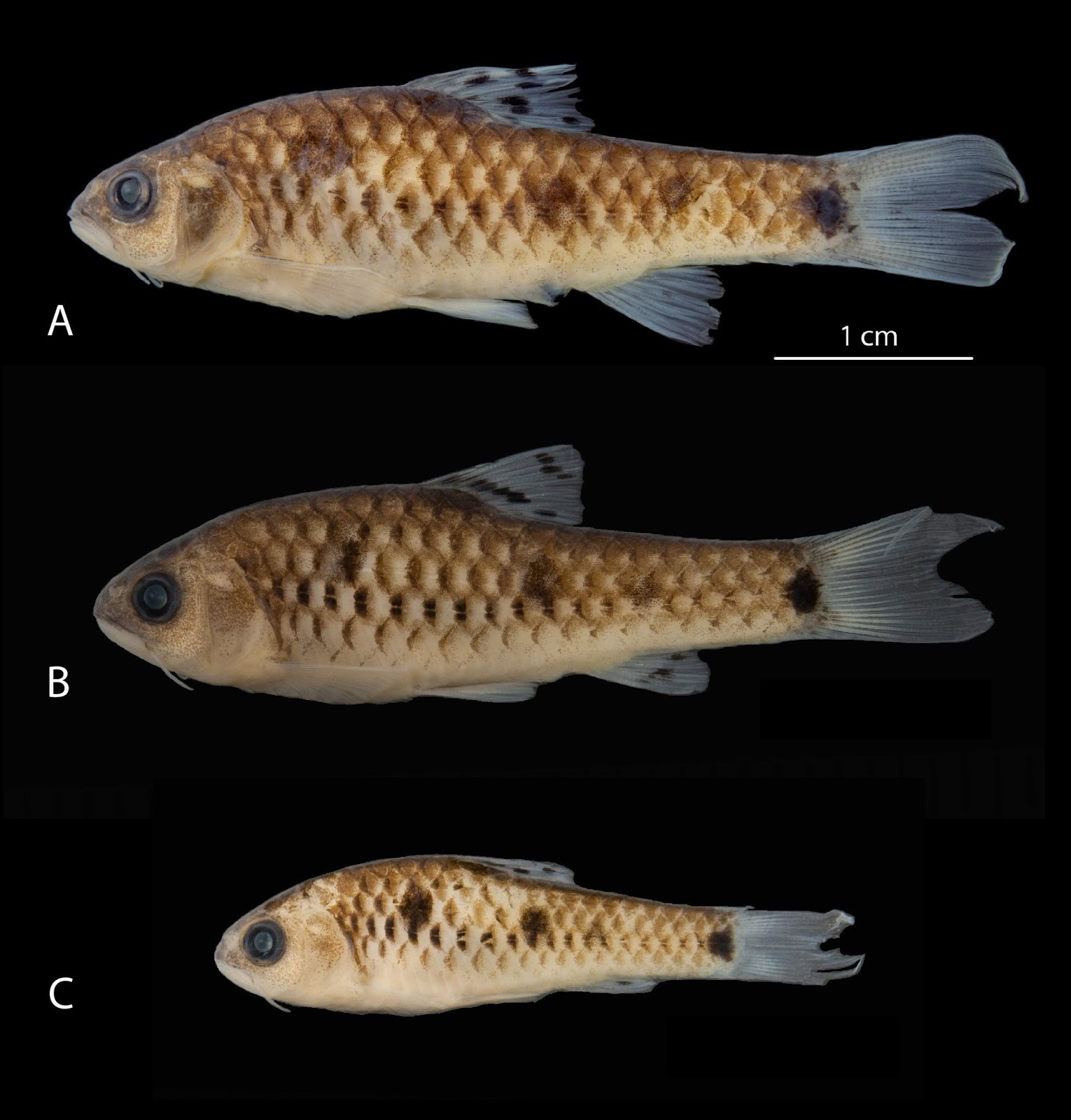
We present and describe a new species of Enteromius, adding to the 16 species of Enteromius currently recorded from Gabon, West Africa. This new species is distinguished from all other Gabonese Enteromius by the presence of several distinct spots on the dorsal fin in combination with three or four round spots on the flanks. In Africa, it is superficially similar to Enteromius walkeri and with which it shares an unusual allometry in that the proportional length of the barbels decreases as the fish grows. Nevertheless, one can distinguish these species by vertebral number, maximum standard length, the length of the anterior barbels, the length of the caudal peduncle and in most specimens, the number of lateral‐line and circumpeduncular scales. These two species also inhabit widely separated drainages, with E. walkeri occurring in coastal drainages of Ghana including the Pra and Ankobra Rivers and the new species occurring in tributaries of the Louetsi and Bibaka Rivers of Gabon, which are part of the Ogowe and Nyanga drainages, respectively. Despite extensive collections in those drainages the new species is known from only two localities, suggesting the importance of conservation of its known habitat.

Keywords: allometry, biodiversity, central Africa, conservation, endemic, morphometrics, systematics

FIGURE 1: Live coloration of Enteromius pinnimaculatus sp. nov. Uncatalogued specimen from swampy lowland tributary of the Bissina River, Nyanga River drainage, Gabon.

Figure 10: (a) Adult Enteromius pinnimaculatus sp. nov. holotype, tissue voucher GAB17‐486, 41.05 mm standard length (LS), Oregon State University, Department of Fisheries and Wildlife, Corvallis, Oregon specimen OS22149, (b) adult paratype, 37.6 mm LS (OS22153) and (c) smaller adult paratype, 27.0 mm LS (OS22152) prior to clearing and staining

Enteromius pinnimaculatus sp. nov.

Etymology: The specific epithet pinnimaculatus refers to the multiple small dark spots on the dorsal fin, which is a rare characteristic within Enteromius. An adjective in the nominative singular.


Hans Kevin Mipounga, Joseph Cutler, Jean Hervé Mve Beh, Benjamin Adam and Brian L. Sidlauskas. 2019. Enteromius pinnimaculatus sp. nov. (Cypriniformes: Cyprinidae) from southern Gabon. Journal of Fish Biology. DOI: 10.1111/jfb.13995  


Thursday, July 4, 2019

[Botany • 2019] Themeda palakkadensis (Poaceae: Panicoideae) • A New Species from Kerala State, India


Themeda palakkadensis Chorghe, K. Prasad & Lakshmin.

in Chorghe, Prasad & Lakshminarasimhan, 2019.

Abstract
Themeda palakkadensis, a new grass species from Kerala, India, is described and illustrated. The new species is similar to T. laxa in having pair of involucral spikelets arranged at same level and in inflorescence pattern but, differs in having densely rufous hairy sessile spikelets, lower lemma of sessile spikelet sparsely rufous hairy, lower glumes of pedicelled spikelets winged on keels, longer anthers and shorter caryopsis length.

Keyword: Andropogoneae, Anthistirineae, Panicoideae, Poaceae, Themeda palakkadensis, Western Ghats

Fig. 1. Themeda palakkadensis Chorghe, K. Prasad & Lakshmin. sp. nov. 
A. Habit, B. Raceme, C. Sessile spikelet and pedicelled spikelet; D–F. Involural spikelet: D. Lower glume, E. Upper glume, F. Lemma, G. Stamens; H–N. Sessile spikelet: H. Spikelet, I. Lower glume, J. Upper glume, K. Lower lemma, L. & M. Upper lemma, N. Caryopsis; O–R. Pedicelled spikelet: O. Spikelet, P. Lower glume, Q. Upper glume, R. Lemma.

Themeda palakkadensis Chorghe, K. Prasad & Lakshmin., sp. nov.

Diagnosis: Themeda palakkadensis is similar to T. laxa in having involurcral spikelets arranged at same level and spathe having 1–3 racemes arranged, but differs from it in having both the glumes of sessile spikelet densely rufous hairy (vs glabrous), lower lemma of sessile spikelet sparsely rufous hairy at apex (vs glabrous); anthers 4–5 mm long (vs 2–3 mm); caryopsis 2.5–3 mm long (vs 3.5– 4 mm long) and lower glumes of pedicelled spikelet winged on both the keels (vs wingless).

Etymology: The new species is named after Palakkad District of Kerala state.


Alok R. Chorghe, Kothareddy Prasad and Pakshirajan Lakshminarasimhan. 2019. Themeda palakkadensis (Poaceae: Panicoideae), A New Species from Kerala State, India. Taiwania. 64(3); 231-234. tai2.ntu.edu.tw/taiwania/abstract.php?type=abstract&id=1617  

[Paleontology • 2019] Vetusodon elikhulu • A New Large Cynodont from the Late Permian (Lopingian) of the South African Karoo Basin and its Phylogenetic Significance


Vetusodon elikhulu
Abdala, Gaetano, Smith & Rubidge, 2019

DOI: 10.1093/zoolinnean/zlz004 
Artwork by Gabriel Lio.  twitter.com/GabrielLuisLio

Abstract
The Karoo Basin of South Africa has the best global record of Lopingian (Late Permian) non-mammaliaform cynodonts, currently represented by five species. We describe Vetusodon elikhulu gen. et sp. nov., documented by four specimens from the Daptocephalus Assemblage Zone. With a basal skull length of ~18 cm, it is the largest Lopingian cynodont and is also larger than Induan representatives of the group. Vetusodon elikhulu has a cranial morphology that departs notably from that previously documented for Permo-Triassic cynodonts. It features a short and extremely wide snout, resembling that of the contemporaneous therocephalian Moschorhinus, and has large incisors and canines that contrast with the small unicusped postcanines, suggesting a more important role of the anterior dentition for feeding. The dentary is extremely long and robust, with the posterior margin located closer to the craniomandibular joint than in other Lopingian and Induan cynodonts (e.g. Thrinaxodon). The secondary palate morphology of V. elikhulu is unique, being short and incomplete and with the posterior portion of the maxilla partly covering the vomer. A phylogenetic analysis suggests that V. elikhulu is the sister taxon of Eucynodontia and thus the most derived of the Lopingian to Induan cynodonts yet discovered.

Keywords: anatomy, Changhsingian, epicynodont, Gondwana, phylogeny


Life reconstructions of Vetusodon elikhulu. 
Artwork by Gabriel Lio.  

Life reconstructions of Vetusodon elikhulu.
 Artwork by Gabriel Lio. 

Vetusodon elikhulu gen. et sp. nov.


Fernando Abdala, Leandro C. Gaetano, Roger M. H. Smith and Bruce S Rubidge. 2019. A New Large Cynodont from the Late Permian (Lopingian) of the South African Karoo Basin and its Phylogenetic Significance. Zoological Journal of the Linnean Society. zlz004. DOI: 10.1093/zoolinnean/zlz004
Vetusodon elikhulu: when the old has something modern conicet.gov.ar/vetusodon-elikhulu-when-the-old-has-something-modern


[Entomology • 2019] Lebinthus sandakan • Crickets of the Subfamily Eneopterinae (Orthoptera: Grylloidea) from Sandakan, Sabah: One New Species and Calling Songs of Cardiodactylus borneoe, A Sympatric Species


Lebinthus sandakan
Kai, Japir, Chung & Robillard, 2019


Abstract
Orthoptera from Sandakan, Sabah are relatively understudied compared to some other parts of Borneo, and lack of information of species there can impede our understanding of the origins and biodiversity of orthopterans in Borneo and, in general, Southeast Asia. Based on a recent orthopteran survey in Sandakan, one new species of Lebinthus Stål is described: Lebinthus sandakan sp. nov. The male calling song of this new species is also presented. The calling song of Cardiodactylus borneoe Robillard & Gorochov, 2014 is also described for the first time.

Keywords: Orthoptera, bioacoustics, Borneo, new species, Southeast Asia, taxonomy


Tan Ming Kai, Razy Japir, Arthur Y.C. Chung and Tony Robillard. 2019. Crickets of the Subfamily Eneopterinae (Orthoptera: Grylloidea) from Sandakan, Sabah: One New Species and Calling Songs of A Sympatric Species. Zootaxa. 4619(2); 347–363. DOI: 10.11646/zootaxa.4619.2.9

[Botany • 2019] Heterostemma ficoides (Apocynaceae: Asclepiodoideae) • A New Species with Fig-like Flowers from Northern Thailand


Heterostemma ficoides A.Kidyoo

in A. Kidyoo, 2019.

Heterostemma ficoides A.Kidyoo, a new species of Heterostemma sect. Oianthus with a fig-like flower discovered in northern Thailand is here described. Photographs, line illustrations and detailed comparison with the similar species, H. vasudevanii Swarupan. & Mangaly are provided. Heterostemma ficoides resembles H. vasudevanii in having a fleshy globose flower and the presence of the inner corona appendages, but clearly differs in leaf shape, leaf venation, presence of dense hairs on the outer and inner surfaces of the corolla, and apex of the staminal corona lobes. An identification key to the species of sect. Oianthus is presented.

Keywords: Ceropegieae, evergreen forest, inner corona appendages, sect. Oianthus


Fig. 2 Heterostemma ficoides. A habitat; B flowering branch; C inflorescence; D fruit; E longitudinal section of flower; F cross section of flower; G top view of gynostegium. Photos: Aroonrat Kidyoo.

Heterostemma ficoides A. Kidyoo sp. nov. 

Etymology. The specific epithet ‘ficoides’ alludes to the striking similarity of its flower to a fig of Ficus species.


Aroonrat Kidyoo. 2019. Heterostemma ficoides (Apocynaceae: Asclepiadoideae), A New Species with Fig-like Flowers from Northern Thailand. Kew Bulletin. DOI: 10.1007/s12225-019-9815-4


Wednesday, July 3, 2019

[Herpetology • 2019] Diasporus amirae • A New Species of Dink Frog, Genus Diasporus (Anura: Eleutherodactylidae), from the Caribbean foothills of the Cordillera de Talamanca, Costa Rica


Diasporus amirae
Arias, Chaves, Salazar, Salazar-Zúñiga & García-Rodríguez, 2019


Abstract
A new dink frog (Eleutherodactylidae: Diasporus) is described from the Tropical Wet Forest, in the northeastern foothills of Cordillera de Talamanca in Costa Rica at an elevation of ca. 1000 m. Analysis of DNA sequences of the 16S rRNA (16S) and cytochrome oxidase 1 (COI) mitochondrial genes revealed a distinct lineage within the genus Diasporus. Additional morphological, morphometric, and acoustic analyses support the differences of this lineage, which we recognize as a new species. This new taxon is distinguished from other members of the genus Diasporus inhabiting Isthmian Central America by its unique coloration: dorsum brown to brown-grayish and venter gray-bluish with pale blotches. The new species is distinguished from other members of the genus Diasporus by very significant genetic distances (higher than 5.6 % in 16S and 16.7 % in COI). The new taxon is most closely related to D. vocator from the south pacific of Costa Rica and to an unnamed taxon from western Panama.

Keywords: Amphibia, Brachycephaloidea, Isthmian Central America, Panama, Taxonomy, Terrarana


Diasporus amirae


Erick Arias, Gerardo Chaves, Stanley Salazar, José Andrés Salazar-Zúñiga and Adrián García-Rodríguez. 2019. A New Species of Dink Frog, Genus Diasporus (Anura: Eleutherodactylidae), from the Caribbean foothills of the Cordillera de Talamanca, Costa Rica. Zootaxa. 4609(2); 269–288.  DOI: 10.11646/zootaxa.4609.2.4 

En Costa Rica, están presentes otras cinco especies del género 'Diasporus'   ucr.ac.cr/noticias/2019/06/20/talamanca-le-revela-al-mundo-una-nueva-especie-de-rana.html