Friday, June 7, 2019

[Mammalogy • 2019] Rhynchomys labo & R. mingan • Two New Species of Shrew-rats (Rhynchomys: Muridae: Rodentia) from Luzon Island, Philippines


Rhynchomys labo R. mingan

Rickart, Balete, Timm, Alviola, Esselstyn & Heaney, 2019

Abstract
The murine genus Rhynchomys includes the large-bodied Philippine “shrew-rats,” highly specialized members of the vermivorous clade of Philippine murids. Four species are recognized, all of which are endemic to Luzon Island: R. soricoides from mountains within the Central Cordillera, R. isarogensis from Mt. Isarog on the Bicol Peninsula, R. banahao from Mt. Banahaw in south-central Luzon, and R. tapulao from Mt. Tapulao in the Zambales Mountains. Field surveys in 2006 and 2008 revealed two additional populations of Rhynchomys, one from Mt. Labo (1,544 m), a dormant stratovolcano at the base of the Bicol Peninsula, the other from Mt. Mingan (1,901 m), the highest peak in the central Sierra Madre of east-central Luzon. Assessment of external and craniodental features of available specimens from throughout Luzon support our description of the populations on Mt. Labo and Mt. Mingan as new species. All species of Rhynchomys are restricted to high-elevation, montane, and mossy forest habitats, separated by intervening lowlands. These discoveries highlight the importance of isolated highland areas in the historical diversification of Southeast Asian murines, and as current centers of endemism.

biogeography, Chrotomyini, conservation, distribution, ecology, morphology, oceanic islands, systematics

 Rhynchomys labo.
 Drawing by Velizar Simeonovski.

Rhynchomys labo, new species 
Labo shrew-rat 
Rhynchomys sp.: Balete, Heaney, Alviola, and Rickart, 2013a:71. 
Rhynchomys isarogensis: Heaney, Balete, and Rickart, 2016:160.


 Etymology.— The new species is named for Mt. Labo, where the specimens originated. The specific epithet is used as a noun in apposition. We propose “Labo shrew-rat” as the English common name.

Distribution.— Known only from forested areas on the north slope of Mt. Labo between 1,250 and 1,413 m elevation.

 Dorsal, ventral, and lateral views of cranium and lateral view of mandible of adult Rhynchomys
A) Rhynchomys labo (KU 165952, holotype). B) R. isarogensis (USNM 573575).

Rhynchomys mingan.
Drawing by Velizar Simeonovski.

Rhynchomys mingan, new species 
Mingan shrew-rat 
Rhynchomys sp.: Balete, Alviola, M. R. M. Duya, M. V. Duya, Heaney, and Rickart 2011:80. 
Rhynchomys sp.: Heaney, Balete, and Rickart, 2016:163.

 Etymology.— The new species is named for the Mingan Mountains where the specimens originated. The specific epithet is used as a noun in apposition. We propose “Mingan shrew-rat” as the English common name.

Distribution.— Known only from localities in old-growth montane and mossy forest on the southwestern slope of Mt. Mingan between 1,476 and 1,785 m elevation.


Eric A. Rickart, Danilo S. Balete, Robert M. Timm, Phillip A. Alviola, Jacob A. Esselstyn and Lawrence R. Heaney. 2019. Two New Species of Shrew-rats (Rhynchomys: Muridae: Rodentia) from Luzon Island, Philippines. Journal of Mammalogy. gyz066.  DOI: 10.1093/jmammal/gyz066
New Species Discovered in Philippines 
Two new species of ‘tweezer-beaked hopping rats’ discovered in Philippines @nhmu  sciglow.com/other/two-new-species-of-tweezer-beaked-hopping-rats-discovered-in-philippines 


[Botany • 2019] Oreocharis odontopetala (Gesneriaceae) • A New Species from Guizhou, China


Oreocharis odontopetala Q.Fu & Y.Q.Wang

in Fu, Xia, Guo, Huang & Wang, 2019. 

Abstract
A new species, Oreocharis odontopetala Q.Fu & Y.Q.Wang from Guizhou Province in southwest China, is described and illustrated, based on morphological comparison with existing species. It is morphologically most similar to O. elegantissima, but can be easily distinguished by its adaxially bullate leaf blade, abaxially conspicuous reticulate veinlets, brown-purple peduncles, triangular adaxial corolla lobes and abaxial corolla lobe margins bearing 4–10 long teeth, glabrous style and shorter stamens with confluent thecae at the apex, as well as leaf epidermal characters.

Keywords: Briggsia, endemism, leaf epidermis, morphology, new taxon, taxonomy


 Figure 2. Morphological comparison of (A) Oreocharis odontopetala and (B) O. elegantissima.
 -1 habitat and habit. -2 adaxial leaf surface. -3 abaxial leaf surface. -4 opened corolla, showering lip lobes and stamens with anthers cohering in pairs. -5 anthers. -6 thecae, showing confluence at apex (white arrowhead), or no confluence (black arrowhead). -7 immature pistil and disc, showing glandular pubescence (B) or absence (A).

Oreocharis odontopetala Q.Fu & Y.Q.Wang, sp. nov.
  
Diagnosis: Oreocharis odontopetala is most similar to O. elegantissima, having a similar shape of leaf blade, lanceolate sepals and bracts, stellate ring-like disc, pistil and fruits. Oreocharis odontopetala differs from O. elegantissima by its adaxially bullate leaf blade (vs. not bullate), with abaxially reticulate veinlets conspicuous (vs. veinlets inconspicuous); peduncles brown-purple (vs. green); adaxial corolla lobes triangular (vs. oblong) and abaxial corolla lobe margins with 4–10 long teeth (vs. margin nearly entire); style glabrous (vs. glandular pubescent) and stamens shorter (adaxial 0.5–1.4 vs. 2.0–2.6 cm, abaxial 0.8–1.8 vs. 2.3–2.7 cm) with confluent thecae at apex (vs. not confluent).
...


Figure 1. Oreocharis odontopetala. A habit; B flower; C opened corolla, showing lip lobes and stamens; D abaxial stamens (dorsal view); E cohering pair of anthers (anterior view); F adaxial stamens (dorsal view); G calyx, pistil and stigma; H bracts (ventral and dorsal view); I sepals (the two on the right showing ventral view and the three on the left showing dorsal view); J adaxial leaf surface; K abaxial leaf surface.
 Drawn by Ms Yun-Xiao Liu based on the holotype (WYQ-2018-112).

Etymology: The species is named after its abaxial strongly toothed corolla lobes.

Vernacular name: Chǐ Bàn Cū Tǒng Jǜ Tái (Chinese pronunciation); 齿瓣粗筒苣苔 (Chinese name).


 Qiong Fu, Ying Xia, Ying Guo, Rong Huang and Ying-Qiang Wang. 2019. Oreocharis odontopetala, A New Species of Gesneriaceae from Guizhou, China. PhytoKeys. 124: 1-9. DOI: 10.3897/phytokeys.124.34609


[Entomology • 2019] Cristalinaia vitoria • A New and Highly Distinctive Genus and Species of Euptychiina (Lepidoptera: Nymphalidae: Satyrinae) from the Brazilian southern Amazon


Cristalinaia vitoria  Mota, Zacca & Freitas

in Freitas, Mota, Zacca & Barbosa, 2019. 

Abstract
A new genus and species of Euptychiina (Satyrinae), Cristalinaia vitoria Mota, Zacca & Freitas gen. et sp. nov., is described based on three specimens collected in the region of the Cristalino River, Alta Floresta, Mato Grosso, Brazil. This rare species is known only from this region, where it flies inside the dense bamboo patches typical of that area. The last instar larva and the pupa are described; the larva was observed feeding on mature leaves of the common bamboo Guadua aff. paniculata Munro.

Keywords: Amazonia, Immature stages, Morphology, Molecular phylogeny, Taxonomy

Fig. 1. Habitat and holotype of Cristalinaia vitoria gen. et sp. nov. in the type locality at Cristalino Lodge, Alta Floresta, Mato Grosso, Brazil.
(A) A general view of the area; (B) a close view of the bamboo patch where the larva was found;
(C) male holotype of Cristalinaia vitoria sp. nov. (dorsal above, ventral below).


Cristalinaia Freitas, Barbosa & Zacca gen. nov.

Type species. Cristalinaia vitoria Mota, Zacca & Freitas sp.n.

Diagnosis. Cristalinaia gen. nov. differs from all other genera of Euptychiina by the VHW ocelli with very broad orange ocellar rings, reduced black ocelar spots with no pupils (Fig. 1C) and the male 8th abdominal tergite strongly sclerotized, except by the unsclerotized antero-dorsal region (Fig. 4B, C). The female is unknown.

Etymology. The generic name is derived from the Cristalino River, a river of dark translucent waters near which the specimens were collected (the word “cristalino” is Portuguese for “crystal clear”, alluding to the translucent waters of the river). It also alludes to the Reserva Particular do Patrimônio Natural Cristalino (Cristalino Private Reserve) and to the “Fundação Ecológica Cristalino” (Cristalino Ecological Foundation), both founded by Vitoria da Riva Carvalho. The gender of the name should be considered feminine.

Fig. 2. Lateral view of the head of Cristalinaia vitoria gen. et sp. nov.

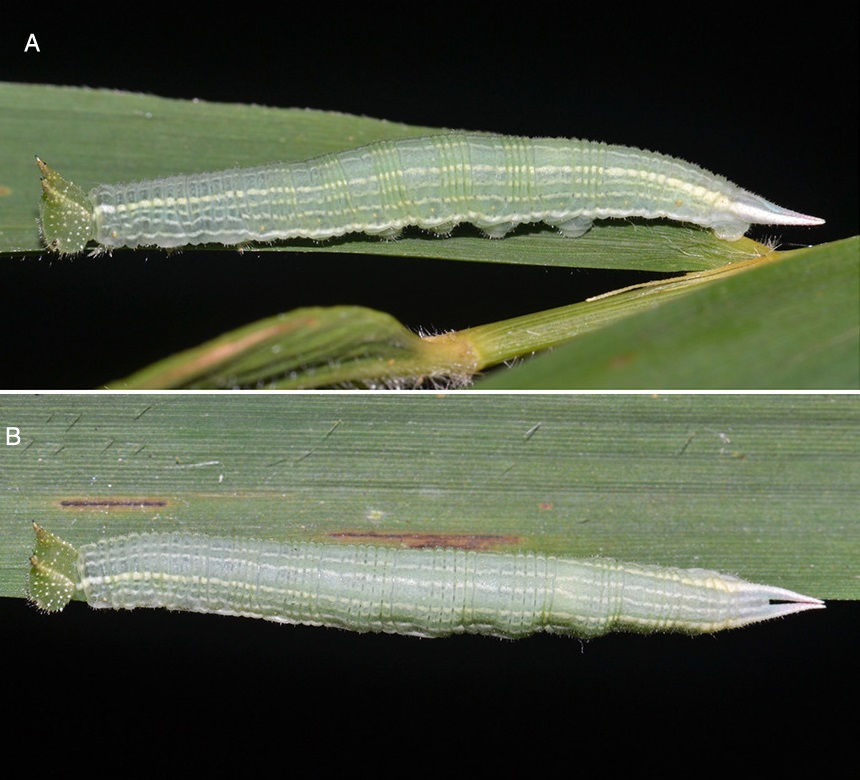
Fig. 5. Immature stages of Cristalinaia vitoria gen. et sp. nov. Last instar: (A) lateral, (B) dorsal, (C) frontal view of last instar head capsule. Pupa: (D) dorsal, (E) lateral.

Cristalinaia vitoria Mota, Zacca & Freitas sp. nov.

Diagnosis. Cristalinaia vitoria sp. nov. superficially resembles several other species of Euptychiina (e.g. Pareuptychia species, Pseudeuptychia species, Splendeuptychia toynei Willmott & Hall, 1995, S. aurigera (Weymer, [1911]), S. triangula (Aurivillius, 1929)) by the white ground color on the wings, but it can be easily distinguished from them by the incomplete median line and four tiny ocelli from M1 to CuA2 on the VFW, by the five VHW ocelli between M1 to 2A that have a very broad orange ocellar ring and black ocellar spot in the distal half of ring plus a very small ocelli in Rs-M1, and the broadened VHW reddish brown marginal line forming crescents in each cell.

Distribution. Cristalinaia vitoria sp. nov. is known only from its type locality in the region of Cristalino Lodge, Alta Floresta, northern Mato Grosso. The site is a private protected area (the “Reserva Particular do Patrimônio Natural Cristalino”).


Etymology. The specific name is after Vitoria da Riva Carvalho, in recognition of her pioneering work on the conservation of the southern Amazon, and founder of the Cristalino group (which includes the “Fundação Ecológica Cristalino”, Cristalino Lodge and Cristalino Private Natural Heritage Reserves). The specific epithet should be considered feminine and indeclinable in accordance to the Article 31.2.3 (ICZN, 1999).


 André V.L. Freitas, Luísa L. Mota, Thamara Zacca and Eduardo P. Barbosa. 2019. Description of A New and Highly Distinctive Genus and Species of Euptychiina (Lepidoptera: Nymphalidae: Satyrinae) from the Brazilian southern Amazon. Revista Brasileira de Entomologia. In Press. DOI: 10.1016/j.rbe.2019.05.004 

Wednesday, June 5, 2019

[Ichthyology • 2019] Luzonichthys kiomeamea • A New Species (Serranidae: Anthiadinae) from A Mesophotic Coral Ecosystem of Rapa Nui (Easter Island)


Luzonichthys kiomeamea 
 Shepherd, Pinheiro, Phelps, Perez-Matus & Rocha, 2019


Abstract
A new species in the anthiadine genus Luzonichthys Herre, 1936 is described from a specimen collected at a depth of 83 m in a mesophotic coral ecosystem at Rapa Nui (Easter Island). Luzonichthys kiomeamea n. sp. can be distinguished from the 7 other valid Luzonichthys species by anal-fin and pectoral-fin counts, the number of lateral-line scales, the number and arrangement of gill rakers, and coloration pattern. Mitochondrial DNA sequencing shows that the new species is more than 11% divergent in the COI sequence (and about equally distant) from Luzonichthys waitei, L. seaver, L. earlei (Hawai’i), and L. aff. earlei (Coral Sea). Given the isolation of the island, and the uniqueness of its fish fauna, we suspect that the new species is endemic to the mesophotic reefs of Rapa Nui.

 Key words: taxonomy, ichthyology, coral-reef fishes, endemism, South Pacific, Splitfin Anthias, Chile

Figure 1. Luzonichthys kiomeamea, sp. n., holotype, CAS 244640, 45.7 mm SL, shortly after death (L.A. Rocha).

Luzonichthys kiomeamea, n. sp. 
Rapa Nui Splitfin

Diagnosis. Dorsal-fin elements X,16; anal-fin elements III,7; pectoral-fin rays 22; lateral-line scales 64; gill rakers 12+26; body moderately elongate, depth 4.8 in SL; head length 3.6 in SL; snout 4.1 in HL; caudal fin forked and without filaments, length 4.3 in SL; caudal-fin concavity 6.3 in SL; pectoral-fin length 4.0 in SL; pelvic-fin length 5.0 in SL; color in life: body orange-red dorsally, silver-magenta ventrally, with alternating magenta, red, and orange lines along sides of body; dorsal fin yellow-orange with red-orange spots (Fig. 1).

Etymology. The specific epithet is from the Rapa Nui name; the phrase kio-meamea means “red fish that takes refuge in a cave”. Treated as a noun in apposition.

 Distribution and habitat. The new species is currently known only from Rapa Nui. The holotype was collected at a depth of 83 m in a rocky patch reef surrounded by a large sandy area (Fig. 4). It was caught by hand using hand nets and transported alive to the surface in a perforated-plastic collecting jar.

Figure 4. Luzonichthys kiomeamea in its natural habitat, 83 m, Hanga Piko, Rapa Nui (Easter Island), Chile (L.A. Rocha).


Bart Shepherd, Hudson T. Pinheiro, Tyler Phelps, Alejandro Perez-Matus and Luiz A. Rocha. 2019. Luzonichthys kiomeamea (Teleostei: Serranidae: Anthiadinae), A New Species from A Mesophotic Coral Ecosystem of Rapa Nui (Easter Island). Journal of the Ocean Science Foundation. 33; 17-27. OceanScienceFoundation.org/josf33c.html 

Tuesday, June 4, 2019

[Herpetology • 2019] Cnemaspis godagedarai • A New Species of Endemic Day Gecko (Reptilia: Gekkonidae: Cnemaspis) from A Wet Zone Forest in the Second Peneplain of Southern Sri Lanka


Cnemaspis godagedarai
Silva, Bauer, Botejue & Karunarathna, 2019


Abstract
A new day gecko species of the genus Cnemaspis Strauch, 1887 is described from a geographically separated forested area in Ensalwatte, Matara district, Sri Lanka. This species is medium (34–35mm SVL) in size and can be differentiated from all other Sri Lankan congeners by a suite of distinct morphometric, meristic, and color characters. The species is recorded from rock outcrop habitats in wet, cool, and shady forest with minimal anthropogenic disturbance at low-elevations (below 860 m). Existing data suggest this gecko is a point endemic. Being a rupicolous microhabitat specialist with a scansorial mode of life, this species is susceptible to both localized and widespread threats. Therefore, isolated forest patches warrant special conservation action, including habitat protection, in-depth research, and species-specific hands-on management practices. 

Keywords. Conservation, critically endangered, microhabitat, natural history, point endemic, redlist, Sri Lankan warrior, threats


Fig. 3. Cnemaspis godagedarai sp. nov. male holotype (NMSL 2019.09.01.NH) in life in situ. (A) Dorsolateral view of the full body displaying color pattern. (B) Lateral view with temporal coloration.
Photos: Chen Lee.

Cnemaspis godagedarai sp. nov. 

 Godagedaras’ Day Gecko (English) 
Godagedarage Diva-seri Hoona (Sinhala) 
Godagedaravin Pahalpalli (Tamil)

Diagnosis: Cnemaspis godagedarai sp. nov., can be readily distinguished from its Sri Lankan congeners by the following combination of morphological and meristic characteristics and color pattern: maximum SVL 35.5 mm; dorsum with homogeneous, smooth, granular scales; 2/2 supranasals; one internasal and 1/1 postnasal present; 26– 28 interorbital scales present; 14–15 supraciliaries, 11–12 canthal scales, 24–26 eye to tympanum scales; three enlarged postmentals; postmentals bounded by 5–6 chin scales; chin and gular scales smooth, juxtaposed granules; pectoral and abdominal scales smooth, subimbricate; 21– 23 belly scales across venter; 5–6 weakly developed tubercles on posterior fank; 101–106 paravertebral granules linearly arranged; precloacal pores absant in males, 12–13 femoral pores in males and 8–9 unpored interfemoral scales in males; 133–137 ventral scales; 98–102 midbody scales; subcaudals smooth, large subhexagonal, subequal in width, in a regular series forming a median row; 7–8 supralabials; 7–8 infralabials; 17–18 subdigital lamellae on digit IV of manus, and 20–21 subdigital lamellae on digit IV of pes.
....

Etymology: The specific epithet is an eponym Latinized (godagedarai) in the masculine genitive singular, honoring Sri Lankan warrior Godagedara Rate Adhikaram for his valiant feats in the Great Rebellion of 1817–1818, which was initiated in Uva-Wellassa.


Fig. 1. Currently known distribution of Cnemaspis godagedarai sp. nov. (Ensalwatte, star), and related species: C. gemunu (Haggala, circle), C. phillipsi (Gammaduwa, triangle), and C. scalpensis (Gannoruwa, square) in Sri Lanka.
Photos: Suranjan Karunarathna.

Habitat and ecology: The Ensalwatte forest area is a Mesua-Doona-dominated tropical evergreen rainforest ~150 ha in size (Gunatileke and Gunatileke 1990), located in the lowland wet zone of southern Sri Lanka (near Deniyaya, Mathara District, Southern Province). The area ... with an elevation range of 620–860 m (Fig. 4). The mean annual rainfall is 2,500–3,500 mm, received mostly during the southwest monsoon (May-September) season. The mean annual temperature is 22–25 ºC. Only six specimens (four females and two males) were found on scattered boulders. The new species was sympatric (at both local habitat and microsite scales) with several other micro-endemic geckos (Cnemaspis pulchra and Cyrtodactylus subsolanus). No eggs were found in the same habitat. These microhabitats were well-shaded (light intensity 0–587 Lux), relatively moist (relative humidity 73–88%) and cool (rock-surface temperature 25.3–27.5 °C).  

Remarks: Of its insular congeners, Cnemaspis godagedarai sp. nov. most closely resembles C. gemunu, C. phillipsi, and C. scalpensis. The type localities of these species are separated by ~60 km (Hakgala in Central highland), ~95 km (Kandy in Central highland), and ~100 km (Gammaduwa in Knuckles highland) airline distances, respectively, from Ensalwatte in Deniyaya (Fig. 1).  


 Anslem de Silva, Aaron M. Bauer, Madhava Botejue and Suranjan Karunarathna. 2019. A New Species of Endemic Day Gecko (Reptilia: Gekkonidae: Cnemaspis) from A Wet Zone Forest in the Second Peneplain of Southern Sri Lanka. Amphibian & Reptile Conservation 13(1) [General Section]: 198–208 (e177).

[Botany • 2019] Gymnosiphon queenslandicus (Burmanniaceae) • A New Addition to the Mycoheterotroph Flora of Tropical Rainforest in Australia


Gymnosiphon queenslandicus B.Gray & Y.W.Low

in Gray, Mahyuni & Low, 2019.
 DOI: 10.1071/SB18035 

Abstract
The mycoheterotrophic genus Gymnosiphon Blume is recorded for Australia for the first time after the recent discovery of plants at Mossman Gorge, Queensland. On the basis of examination of living plants in the field as well as materials preserved in spirit, the Mossman Gorge Gymnosiphon taxon is a novelty closely related to Gymnosiphon affinis J.J.Sm., which is known only from New Guinea. The new species is here described as Gymnosiphon queenslandicus B.Gray & Y.W.Low based on floral characteristics important for species distinction in the genus.

 Keywords: Dioscoreales, endemic, monocots, Queensland.


Bruce Gray, Ridha Mahyuni and Yee Wen Low. 2019. Gymnosiphon queenslandicus (Burmanniaceae), A New Addition to the Mycoheterotroph Flora of Tropical Rainforest in Australia. Australian Systematic Botany.  32(3) 139-145.  DOI: 10.1071/SB18035

[Herpetology • 2019] Gracixalus yunnanensis • A New Species of Gracixalus (Anura, Rhacophoridae) from Yunnan, China


Gracixalus yunnanensis
Yu, Hui, Wang, Rao, Wu & Yang, 2019


Abstract
A new species of the genus GracixalusGracixalus yunnanensis sp. n., is described based on a series of specimens collected from southwestern and southern Yunnan, China. This species is distinguished from all other known congeners by a combination of the following characters: relatively small body size in adult males (SVL 26.0–34.2 mm); dorsal surface yellow brown or red brown; distinctive conical asperities on dorsum; males with an external subgular vocal sac and linea masculina; throat, chest, and belly nearly immaculate; venter surface orangish with yellow spots, semi-transparent; snout rounded; supratympanic fold distinct; iris bronze; lack of white patch on temporal region; tibiotarsal projection absent; sides of body nearly smooth with no black blotch; finger webbing rudimentary; and toe webbing formula I1.5–2II1.5–2.7III.5–3IV2.5–1.5V. Genetically, the new species diverges from its congeners by 2.2%–14.1% (uncorrected p-distance) and is closest to G. guangdongensis. However, the new species can morphologically be separated from G. guangdongensis by distinctive conical tubercles on dorsum (versus absent), lateral surface nearly smooth with no black blotches on ventrolateral region (versus lateral surface rough, scattered with tubercles and black blotches on ventrolateral region), snout rounded (versus triangularly pointed), iris bronze (versus iris brown), and ventral surface orangish (versus throat and chest creamy white and belly light brown).

Keywords: Gracixalus yunnanensis sp. n., taxonomy, Rhacophoridae, southwestern China


Figure 4. Dorsolateral (a) and ventral (b) views of the holotype of Gracixalus yunnanensis sp. n. in life and dorsal (c) and ventral (d) views of the holotype of Gracixalus yunnanensis sp. n. in preservative. Linea masculina is pointed by arrow.

Gracixalus yunnanensis sp. n. 

Diagnosis: 
The new species is assigned to genus Gracixalus based upon molecular data and the following morphological characters: the presence of intercalary cartilage between terminal and penultimate phalanges of digits, tips of digits enlarged to discs bearing circummarginal grooves, vomerine teeth absent, inner (first and second) and outer (third and fourth) fingers non-opposable, and an inversed Y-shaped dark brown marking on dorsum (Fei 1999, Rowley et al. 2011, Chen et al. 2018). The new species is distinguished from its congeners by a combination of 1) SVL 26.0–34.2 mm in males; 2) dorsal surface yellow brown or red brown; 3) distinctive conical tubercles on dorsum; 4) males with an external subgular vocal sac; 5) throat granular; 6) finger webbing rudimentary; 7) linea masculina, a band of connective tissue between the rectus abdominus muscle and oblique abdominus muscle, present in males; 8) tibiotarsal articulation reaching eye; 9) snout rounded; 10) white patch absent on temporal region; 11) tibiotarsal projection absent; 12) supratympanic fold distinct; 13) ventral surface orangish, nearly immaculate, and semi-transparent; 14) nuptial pads present on finger I; 15) heels overlapping when legs at right angle to body; 16) iris bronze; and 17) body sides nearly smooth with no black blotch.


Figure 1. Map showing collection sites of Gracixalus yunnanensis sp. n. Star indicates the type locality (Xuelin) and circles indicate Fudong Township (1), Fazhanhe Township (2), Bada Township (3), Mt. Huanglian (4), Jinping (5), Lao Cai (6), Nghe An (7), and Houapan (8), respectively. Sequences of samples from sites 5–8 came from previous studies.

Distribution: In China, the new species is known from Yunnan (Lancang County, Menghai County, Lvchun County, and Jinping County). In addition, the new species also occurs in Laos (Houapan) and Vietnam (Lao Cai and Nghe An) because our molecular analyses revealed that samples from Houapan (KUHE 32453), Lao Cai (VNMN 4355, 4357, 4371), and Nghe An (AMS R173454) that were sequenced by previous studies also belong to the new species (Figs 2, 3). In Yunnan, specimens were found sitting on leaves of herbaceous plants (e.g., Amomum tsaoko and Eupatorium adenophorum). No eggs and tadpoles were found.

Etymology: The specific epithet yunnanensis refers to the distribution of this species in China, Yunnan Province.


 Guohua Yu, Hong Hui, Jian Wang, Dingqi Rao, Zhengjun Wu and Junxing Yang. 2019. A New Species of Gracixalus (Anura, Rhacophoridae) from Yunnan, China. ZooKeys. 851: 91-111. DOI: 10.3897/zookeys.851.32157


[Herpetology • 2019] Lerista anyara • A New Species of Lerista Bell, 1833 (Reptilia: Scincidae) from Cape York Peninsula, Queensland, belonging to the Lerista allanae Clade but strongly Disjunct from other Members of the Clade


Lerista anyara 
Amey, Couper & Wilmer, 2019


Abstract
 A species of the skink genus Lerista is described from Cape York Peninsula in Queensland.  The species is biogeographically interesting as it appears to be separated by at least 500 km from its nearest relatives, members of the Lerista allanae clade.  The role of Pleistocene sea level changes altering availability of suitable habitat for these sand specialists is discussed as a possible driver of isolation and speciation.

Keywords: Reptilia, Slider skink, Cape York Peninsula, Australia, Olkola country, monsoonal tropical savanna


Andrew P. Amey, Patrick J. Couper and Jessica Worthington Wilmer. 2019. A New Species of Lerista Bell, 1833 (Reptilia: Scincidae) from Cape York Peninsula, Queensland, belonging to the Lerista allanae Clade but strongly Disjunct from other Members of the Clade. Zootaxa. 4613(1); 161–171.  DOI 10.11646/zootaxa.4613.1.9

Monday, June 3, 2019

[Gastropoda • 2019] Laocaia simovi • A New Semislug of the Genus Laocaia (Pulmonata, Helicarionidae) from Vietnam


 Laocaia simovi Dedov & Schneppat

in Dedov, Schneppat, Vu & Huy, 2019. 

Abstract
A new species of the genus Laocaia Kuzminykh, 1999, Laocaia simovi Dedov & Schneppat, sp. nov., is described, which was collected from a single locality in northern Vietnam. Color pictures of living specimens are provided. For the first time, information on the ecology and biology of a representative of the genus Laocaia is presented.

Keywords: Helicarionidae, Laocaia, new species, Vietnam


Family Helicarionidae Bourguignat, 1877
Subfamily Helicarioninae Bourguignat, 1877
Genus Laocaia Kuzminykh, 1999

Type species: Laocaia attenuata Kuzminykh, 1999.

Diagnosis: small slugs with non-coiled visceral hump, rounded posteriorly, lying in V- shaped body groove; body cavity not extending into tail; shell very thin, non-spiral, internal, hemispheric, completely covering visceral hump, with small calcified part; penis short, bulbous, with large stimulator inside; epiphallus and flagellum absent; spermatheca entering atrium between vagina and penis (amended after Kuzminykh 1999).

Remarks: for the systematic position of the genus Laocaia, we here follow MolluscaBase (2018). The genus was originally placed in the family Ariophantidae by Kuzminykh (1999), which was followed by Bouchet et al. (2017). However, Schileyko (2002, 2011) transferred it to the family Helicarionidae.

Figure 3. Laocaia simovi Dedov & Schneppat, sp. nov. coloration of the body with the visceral hump and U-shaped dorsal groove.

Laocaia simovi Dedov & Schneppat, sp. nov.

Differential diagnosis
Externally, L. simovi Dedov & Schneppat, sp. nov. differs from L. attenuata and L. obesa by its coloration. The anterior body of L. attenuata is yellow, and its head and neck show three indistinct stripes, while the mantle is marbled with irregularly arranged black spots. The posterior part of the foot is uniformly grayish. In contrast, the body of L. obesa is whitish-grayish colored and covered with numerous white spots. On the visceral hump, the mantle of this species displays a pattern of irregularly arranged black spots (Kuzminykh 1999).

Anatomically, L. simovi sp. nov. differs from L. attenuata by the narrower base of the penis, as well as by its much more globular sarcobelum with a pointed, cone-shaped apical tip. The sarcobelum is not covered with numerous distinct papillae, but it shows very fine longitudinal striae. The striation is not well visible even under high magnification.

Laocaia simovi sp. nov. differs from L. obesa by its less voluminous penis and the narrower base of the penis. The inner wall of the penis is not covered with papillae, but with almost invisible, very fine granules. The bursa copulatrix of L. simovi sp. nov. is of almost globular shape, the pedunculus is long, slender and of the same diameter all along its length; its bursa copulatrix is more voluminous than the penis.

Figure 6. Laocaia simovi Dedov & Schneppat, sp. nov. pointed posterior end of the dorsum with the horn-like structure (A) and the coloration of the slime (B).

Derivatio nominis: 
This new species is named after our friend and biologist Dr. Nikolay Simov, NMNHS, Sofia, Bulgaria, who found the first specimen of the species.

Figure 1. Laocaia simovi Dedov & Schneppat, sp. nov. habitat picture, from the type locality near the peak of Fansipan. The black arrow points towards the epiphytic plants, in which the new species was found.


 Ivaylo Dedov, Ulrich Schneppat, Manh Quang Vu and Nguyen Quoc Huy. 2019. A New Semislug of the Genus Laocaia (Gastropoda, Pulmonata, Helicarionidae) from Vietnam. ZooKeys. 846: 19-30.  DOI: 10.3897/zookeys.846.34372

Sunday, June 2, 2019

[Herpetology • 2019] Litoria pterodactyla & L. vivissimia • Two New Species of Treefrog (Pelodryadidae: Litoria) from southern New Guinea elucidated by DNA Barcoding


Litoria vivissimia 
Oliver, Richards & Donnellan, 2019


Abstract
New Guinea is home to the world’s most diverse insular frog biota, but only a small number of taxa have been included in genetically informed assessments of species diversity. Here we describe two new species of New Guinea treefrog in the genus Litoria that were first flagged during assessments of genetic diversity (DNA barcoding) and are currently only known from the holotypes. Litoria pterodactyla sp. nov. is a large green species in the Litoria graminea species complex from hill forests in Western Province, Papua New Guinea and is the third member of this group known from south of the Central Cordillera. Litoria vivissimia sp. nov. is a small, spike-nosed species from mid-montane forests on the Central Cordillera. It is morphologically very similar to Litoria pronimia, but occurs nearly 1000 m higher than any known locality for that species. More extensive genetically informed assessment of diversity in New Guinea frogs seems certain to reveal many more as-yet-unrecognised taxa in complexes of morphologically similar species.

Keywords: Amphibia, Frog diversity, genetic diversity, Papua New Guinea, parachuting, rostral projection, species complex


 Litoria vivissimia sp. nov. SAMA R71127 from Tabubil, Western Province.
Photograph by S. Richards.


Paul M. Oliver, Stephen J. Richards and Stephen C Donnellan. 2019. Two New Species of Treefrog (Pelodrydidae: Litoria) from southern New Guinea elucidated by DNA Barcoding. Zootaxa. 4609(3); 469–484.  DOI: 10.11646/zootaxa.4609.3.4

Saturday, June 1, 2019

[Ichthyology • 2019] Parmaturus angelae • A New Species of Parmaturus (Carcharhiniformes: Scyliorhinidae) from Brazil, Southwestern Atlantic


Parmaturus angelae
 Soares, Carvalho, Schwingel & Gadig, 2019

 DOI: 10.1643/CI-18-152  
Abstract
A new Southwestern Atlantic species of Parmaturus, P. angelae, new species, is described from two specimens captured off Brazil. It is distinguished from congeners by the following characters: origin of the first dorsal fin anterior to pelvic-fin origin, presence of well-developed upper and lower caudal crests of denticles, dorsal fins subequal, lateral denticles teardrop-shaped and lacking lateral cusplets, denticles evenly spaced, proportional dimensions, and vertebral counts. Parmaturus angelae, new species, is the second species of the genus reported from the Atlantic Ocean and only the third species outside of the Indo-West Pacific region. Parmaturus remains rather poorly defined as only two species have been studied anatomically in any detail.

Fig. 2. Parmaturus angelae, new species, holotype, MZUSP 124000, female, 398 mm TL. Dorsal and lateral view. 

Parmaturus angelae, new species

Proposed common names: Brazilian Filetail Catshark,
 Ângela’s Catshark (Portuguese)


 Etymology.— The specific name angelae is dedicated to the last author’s granddaughter, Angela


Karla Diamantina De Araújo Soares, Marcelo Rodrigues De Carvalho, Paulo Ricardo Schwingel and Otto Bismarck Fazzano Gadig. 2019. A New Species of Parmaturus (Chondrichthyes: Carcharhiniformes: Scyliorhinidae) from Brazil, Southwestern Atlantic.  Copeia. 107(2); 314-322. DOI: 10.1643/CI-18-152