Thursday, December 4, 2014

[Herpetology • 2014] Paragehyra felicitae & P. austini • Morphology and Molecules reveal Two New Species of the poorly studied Gecko Genus Paragehyra (Squamata: Gekkonidae) from Madagascar


Paragehyra felicitae
Crottini, Harris, Miralles, Glaw, Jenkins, Randrianantoandro, Bauer & Vences, 2014

Abstract
We provide new morphological and genetic data on a poorly studied genus of geckos from Madagascar (Paragehyra) previously thought to be distributed only in the south-east and south-west of the island and discuss the biogeography and evolution of this genus. Two species (Paragehyra petiti and Paragehyra gabriellae) were formerly included in this genus, whose phylogenetic and biogeographical relationships remain unresolved. This morphological and molecular study enables the recognition of two new rock-dwelling species that are here formally described. Paragehyra felicitae sp. nov. has only been observed in the private Anja reserve and nearby areas (close to Ambalavao) on the southern central high plateau of Madagascar, whereas Paragehyra austini sp. nov. is known from only one locality on the western slopes of the Andohahela massif, around 60 km northwest of Tolagnaro. The four species differ from one another by a combination of several morphological characters, genetic divergence >5.2 % in a mitochondrial 16S ribosomal RNA (rRNA) gene fragment and nucleotide differences in analysed nuclear genes, as highlighted in the resulting phylogenetic reconstruction and haplotype network analysis. A further, hitherto unstudied Paragehyra population is known from the Tsingy de Bemaraha in central-western Madagascar. Preliminary information of its morphological differentiation are here provided and suggest that this undescribed species is closely related to P. petiti and P. felicitae sp. nov.

Keywords: Paragehyra felicitae sp. nov., Paragehyra austini sp. nov., Systematics, Phylogenetics. Taxonomy, Rock-dwelling geckos


Angelica Crottini, D. James Harris, Aurélien Miralles, Frank Glaw, Richard K. B. Jenkins, J. Christian Randrianantoandro, Aaron M. Bauer and Miguel Vences. 2014. Morphology and Molecules reveal Two New Species of the poorly studied Gecko Genus Paragehyra (Squamata: Gekkonidae) from Madagascar. Organisms Diversity & Evolution. DOI: 10.1007/s13127-014-0191-5
ResearchGate.net/publication/272350434_Morphology_and_molecules_reveal_two_new_species_of_the_poorly_studied_gecko_genus_Paragehyra_(Squamata_Gekkonidae)_from_Madagascar

Wednesday, December 3, 2014

[Invertebrate • 2014] Ctenostomatous Bryozoa from São Paulo, Brazil, with descriptions of twelve new species


FIGURES 75–83. Jebramella angusta n. gen. et n. sp., MZUSP 857, holotype, from Araçá, São Sebastião, São Paulo, Brazil.
75–78, fertile colony; note the yellow egg placed distally in the zooid; the eggs are elevated with expansion of tentacle crown (sequence of figures 75, 76, 77, 78 is about 2 seconds apart); 79, two expanded tentacle crowns; 80, fertile zooid with expanded campylonemidan tentacle crown and egg.
Scale bars: 75–78, 0.2 mm; 79, 0.5 mm; 80, 0.25 mm; 81, 0.2 mm; 82, 83, 0.05 mm.
DOI: 10.11646/zootaxa.3889.4.2 | Fullext

Abstract

This paper describes 21 ctenostomatous bryozoans from the state of São Paulo, Brazil, based on specimens observed in vivo. A new family, Jebramellidae n. fam., is erected for a newly described genus and species, Jebramella angusta n. gen. et sp. Eleven other species are described as new: Alcyonidium exiguum n. sp., Alcyonidium pulvinatum n. sp.,  Alcyonidium torquatum n. sp., Alcyonidium vitreum n. sp., Bowerbankia ernsti n. sp., Bowerbankia evelinae n. sp., Bowerbankia mobilis n. sp., Nolella elizae n. sp., Panolicella brasiliensis n. sp., Sundanella rosea n. sp., Victorella araceae n. sp. Taxonomic and ecological notes are also included for nine previously described species: Aeverrillia setigera (Hincks, 1887), Alcyonidium hauffi Marcus, 1939, Alcyonidium polypylum Marcus, 1941, Anguinella palmata van Beneden, 1845, Arachnoidella evelinae (Marcus, 1937), Bantariella firmata (Marcus, 1938) n. comb., Nolella sawayai Marcus, 1938, Nolella stipata Gosse, 1855 and Zoobotryon verticillatum (delle Chiaje, 1822).

Keywords: Alcyonidium, bryozoans, Bowerbankia, Ctenostomata, Jebramella, Jebramellidae, new combination, new family, new species, Nolella, Panolicella, Sundanella, taxonomy, Victorella


Vieira, Leandro M., Alvaro E. Migotto & Judith E. Winston. 2014. Ctenostomatous Bryozoa from São Paulo, Brazil, with descriptions of twelve new species. Zootaxa. 3889(4): 485–524. DOI: 10.11646/zootaxa.3889.4.2

Tuesday, December 2, 2014

[Ornithology • 2014] Cichlocolaptes mazarbarnetti | Cryptic Treehunter • A New Species of Cichlocolaptes Reichenbach 1853 (Furnariidae), the ‘gritador-do-nordeste’, an undescribed trace of the fading bird life of northeastern Brazil


Cichlocolaptes mazarbarnetti Barnett & Buzzetti, 2014
Cryptic Treehunter | gritador-do-nordeste

ABSTRACT

 A new species of treehunter, Cichlocolaptes mazarbarnetti sp. nov., is described from a specimen that for many years had been confused with Philydor novaesi. The morphology of this specimen, collected in 1986 at Pedra Branca, Murici, Alagoas, at 550 m elevation (currently the Murici Ecological Station), suggests its allocation in the genus Cichlocolaptes. The new species differs from P. novaesi by its considerably larger size, heavier body-mass, darker and more uniform forehead and crown, absence of buffy periocular-feathers, and a pale orange-rufous tail that contrasts with the rump and the rest of the dorsal plumage. It also has a flat-crowned appearance and a larger, deeper-based, and generally stouter bill. Behavioral specialization on bromeliads and vocal repertoire also suggest that the new species belongs in the genus Cichlocolaptes. The song of this species is markedly different from that of P. novaesi, and it closely matches that of Cichlocolaptes leucophrus. The new species is endemic to the ‘Pernambuco Center’ of endemism, where it inhabits dense, humid forests in hilly terrain. It is known from only two localities in northeastern Brazil, one each in the states of Alagoas and Pernambuco. Taken together, these areas contain less than 3,000 ha of suitable habitat for the species, where we estimate the population during our studies to have numbered no more than 10 individuals. We propose that this species should be categorized as Critically Endangered at a national and global level, and we consider the situation of its conservation to be critical in that it will require urgent action to avoid its global extinction.

Key Words: Atlantic Forest, Conservation, Ovenbirds, Philydor, Taxonomy, Treehunter.


Cichlocolaptes mazarbarnetti sp. nov.
Cryptic Treehunter | gritador-do-nordeste

Etymology: The second author dedicates the name of the new species to the first author, a good friend and colleague who suddenly passed away before this manuscript was finished, in recognition of his important contributions to the conservation of the Atlantic Forest in northeastern Brazil and its declining avifauna. For the English name we propose Cryptic Treehunter because it is difficult to find and, particularly, to separate from Philydor novaesi in the field. We propose naming this species gritador-do-nordeste in Portuguese. ‘Gritador’ (meaning ‘screamer’) is an apt name given the loudness of its vocalizations, but it also represents a figure in Brazilian folklore. The story of the ‘Gritador’ is that of two brothers who went hunting and one accidentally shot the other. In desperation, he shot himself, and now his soul sometimes can be heard as it wanders through the forest in the top of the hills, screaming in pain while searching for his brother. A parallel can be drawn with the story of the ‘Gritador’, as C. mazarbarnetti can be heard ‘screaming’ while wandering through the hilltop forest searching in vain for his ‘brothers’, in this case due to the scarcity of the species.


Juan Mazar Barnett & Dante Renato Corrêa Buzzetti. 2014. A New Species of Cichlocolaptes Reichenbach 1853 (Furnariidae), the ‘gritador-do-nordeste’, an undescribed trace of the fading bird life of northeastern Brazil. Revista Brasileira de Ornitologia. 22 (2), 75-94
http://www4.museu-goeldi.br/revistabrornito/revista/index.php/BJO/article/view/5702

Glauco Alves Pereira; Sidnei de Melo Dantas; Luís Fábio Silveira; Sônia Aline Roda; Ciro Albano; Frederico Acaz Sonntag; Sergio Leal; Mauricio Cabral Periquito; Gustavo Bernardino Malacco and Alexander Charles Lees. 2014. Status of the globally threatened forest birds of northeast Brazil. Pap. Avulsos Zool. (São Paulo). 54(14)
DOI: 
10.1590/0031-1049.2014.54.14

Monday, December 1, 2014

[Herpetology • 2014] Pholidobolus hillisi • A New Species of Pholidobolus (Squamata: Gymnophthalmidae) from the Andes of southern Ecuador


Fig. 4. Five species of Pholidobolus from Ecuador.
(A) P. affinis (white circles); (B) P. macbrydei (blue circles); (C) P. montium (green circles); (D) P. prefrontalis (orange circles); (E) Pholidobolus hillisi sp. nov. (red circles)
Photographs by OTC (A, B, C, D) and S. R. Ron (E)

Abstract
We describe a new species of Pholidobolus lizard from the Amazonian slopes of the Andes of southern Ecuador. Among other characters, the new species differs from other species of Pholidobolus in having a distinct diagonal white stripe extending from the fourth genial scale to the fore limb. We present a phylogeny based on mitochondrial DNA sequence data as additional evidence supporting delimitation of the new species, which is sister to all other species of Pholidobolus. Our phylogeny further supports the south-to-north speciation hypothesis proposed for other lizard clades from the northern Andes.

Key words. Clade Pholidobolus, DNA, lizard, phylogeny, South America, systematics


Omar Torres-Carvajal, Pablo J. Venegas, Simón E. Lobos, Paola Mafla-Endara and Pedro M. Sales Nunes. 2014. A New Species of Pholidobolus (Squamata: Gymnophthalmidae) from the Andes of southern Ecuador. Amphibian & Reptile Conservation. 8(1) [Special Section]: 76–88 (e84). 

Saturday, November 29, 2014

[Ichthyology • 2014] Porophryne erythrodactylus • A New Genus and Species of the Frogfish Family Antennariidae (Lophiiformes: Antennarioidei) from New South Wales, Australia, with a Diagnosis and Key to the Genera of the Histiophryninae


A Red-fingered Anglerfish, Porophryne erythrodactylus, at La Perouse, Botany Bay, New South Wales.
photo: Klaus Stiefel | FishesofAustralia.net.au

A new genus and species of the frogfish family Antennariidae, subfamily Histiophryninae, is described on the basis of three specimens collected near Kurnell and Bare Island in Botany Bay, New South Wales, Australia. It differs from all other antennariid genera in having a combination of features that includes a unique morphology of the first and second dorsal-fin spines, some or all fins fringed with red, and a unique combination of fin-ray and vertebral counts. The new genus is diagnosed, described, and compared to its sister genus, Kuiterichthys, using both molecular and morphological data. Notes on habitat and sponge mimicry, locomotion and defense, and reproduction and parental care are also provided as well as a diagnosis and a revised key to the known genera of the Histiophryninae.


Arnold, R.J., Harcourt, R. & Pietsch, T.W. 2014. A New Genus and Species of the Frogfish Family Antennariidae (Teleostei: Lophiiformes: Antennarioidei) from New South Wales, Australia, with a Diagnosis and Key to the Genera of the Histiophryninae. Copeia. 2014(3): 534-539. DOI: 10.1643/CI-13-155

Thursday, November 27, 2014

[Mammalogy • 2014] Hypsugo dolichodon • Canines make the Difference: A New Species of Hypsugo (Chiroptera: Vespertilionidae) from Laos and Vietnam


Hypsugo dolichodon
Görföl, Csorba, Eger, Son & Francis, 2014

Abstract
Hypsugo was regarded as a subgenus of Pipistrellus by many authors, but its generic distinctiveness is now widely accepted. According to recent taxonomic arrangements, nine species are known to occur in Southeast Asia. During the investigation of material recently collected from Lao PDR and Vietnam we identified an additional species and hence describe it here as Hypsugo dolichodon n. sp. It resembles H. pulveratus, but is larger with conspicuously long canines and differs considerably in the DNA barcode gene sequence.

Keywords: biodiversity, Indomalayan Region, pipistrelloid bats, taxonomy


Görföl, Tamás, Gábor Csorba, Judith L. Eger, Nguyen T. Son & C. M. Francis. 2014. Canines make the Difference: A New Species of Hypsugo (Chiroptera: Vespertilionidae) from Laos and Vietnam. Zootaxa. 3887(2): 239–250. DOI: 10.11646/zootaxa.3887.2.6

Wednesday, November 26, 2014

[Ornithology • 2014] Muscicapa sodhii | Sulawesi Streaked Flycatcher • A New Species of Muscicapa Flycatcher from Sulawesi, Indonesia


Sulawesi Streaked Flycatcher Muscicapa sodhii, whose discovery has just been confirmed 15 years after the first sighting in Indonesia, is distinguished by its mottled throat and short wings.
Photo by Martin Lindop | DOI: 10.1371/journal.pone.0112657.g001

Abstract

The Indonesian island of Sulawesi, a globally important hotspot of avian endemism, has been relatively poorly studied ornithologically, to the extent that several new bird species from the region have been described to science only recently, and others have been observed and photographed, but never before collected or named to science. One of these is a new species of Muscicapa flycatcher that has been observed on several occasions since 1997. We collected two specimens in Central Sulawesi in 2012, and based on a combination of morphological, vocal and genetic characters, we describe the new species herein, more than 15 years after the first observations. The new species is superficially similar to the highly migratory, boreal-breeding Gray-streaked Flycatcher Muscicapa griseisticta, which winters in Sulawesi; however, the new species differs strongly from M. griseisticta in several morphological characters, song, and mtDNA. Based on mtDNA, the new species is only distantly related to M. griseisticta, instead being a member of the M. dauurica clade. The new species is evidently widely distributed in lowland and submontane forest throughout Sulawesi. This wide distribution coupled with the species' apparent tolerance of disturbed habitats suggests it is not currently threatened with extinction.


Figure 1. Muscicapa sodhii (sp. nov.; Sulawesi Streaked Flycatcher; upper left and center)
in comparison to M. dauurica williamsoni (Asian Brown [Brown-streaked] Flycatcher; upper right), M. s. sibirica (Dark-sided Flycatcher; lower right), and M. griseisticta (Gray-streaked Flycatcher; lower left).
Original painting by Teo Nam Siang. doi:10.1371/journal.pone.0112657.g001


Etymology: The new species is named in honor of the late Professor Navjot S. Sodhi (1962–2011) for his monumental contributions to conservation biology and ornithology in Southeast Asia. Dr. Sodhi played a leading role in elucidating the effects of habitat disturbance on biodiversity, especially birds, across Southeast Asia. This research provided a fundamental understanding of the ecology of Southeast Asian forests and critical information required for conservation planning. In addition, Dr. Sodhi was an outstanding mentor for many students including D.L.Y. and J.B.C.H. for whom he was an honours and doctorate supervisor, respectively. The English name recognizes the endemic distribution of the species, with the descriptive term “Streaked” to avoid possible confusion with other endemic Sulawesi flycatchers.

J. Berton C. Harris, Pamela C. Rasmussen, Ding Li Yong, Dewi M. Prawiradilaga, Dadang Dwi Putra, Philip D. Round and Frank E. Rheindt. A New Species of Muscicapa Flycatcher from Sulawesi, Indonesia. PLoS ONE. 9(11): e112657. doi: 10.1371/journal.pone.0112657.g001


Monday, November 24, 2014

[Ornithology • 2014] A Comprehensive Multilocus Phylogeny of the Neotropical cotingas (Cotingidae, Aves) with A Comparative Evolutionary Analysis of Breeding System and Plumage Dimorphism and A revised Phylogenetic Classification


the “tree of life” shows nearly all the sizes, colors, and adaptations for the continga family of birds radiating outward from the center and its common ancestor. Both males and females are shown except where plumage for both is the same.
 from the Handbook of the Birds of the World. Vol. 9. Cotingas to Pipits and Wagtails,
Lynx Editions 2004 
| blog.allaboutbirds.org

Highlights
• We present the first multilocus species tree of the Neotropical cotingas.
• We confirm the monophyly of the cotingas.
• We present the first phylogenetic evidence for the placement of Phibalura flavirostris.
• We present the first hypotheses of phylogenetic relationships within the Cotinga, Lipaugus, Pipreola, and Procnias genera.
• We find that plumage color dimorphism and breeding system may be uncorrelated in the cotingas.


Abstract
The Neotropical cotingas (Cotingidae: Aves) are a group of passerine birds that are characterized by extreme diversity in morphology, ecology, breeding system, and behavior. Here, we present a comprehensive phylogeny of the Neotropical cotingas based on six nuclear and mitochondrial loci (∼7500 bp) for a sample of 61 cotinga species in all 25 genera, and 22 species of suboscine outgroups. Our taxon sample more than doubles the number of cotinga species studied in previous analyses, and allows us to test the monophyly of the cotingas as well as their intrageneric relationships with high resolution. We analyze our genetic data using a Bayesian species tree method, and concatenated Bayesian and maximum likelihood methods, and present a highly supported phylogenetic hypothesis. We confirm the monophyly of the cotingas, and present the first phylogenetic evidence for the relationships of Phibalura flavirostris as the sister group to Ampelion and Doliornis, and the paraphyly of Lipaugus with respect to Tijuca. In addition, we resolve the diverse radiations within the Cotinga, Lipaugus, Pipreola, and Procnias genera. We find no support for Darwin’s (1871) hypothesis that the increase in sexual selection associated with polygynous breeding systems drives the evolution of color dimorphism in the cotingas, at least when analyzed at a broad categorical scale. Finally, we present a new comprehensive phylogenetic classification of all cotinga species.

Keywords: Phylogenetics; Bayesian inference; Species-tree; Sexual selection; Polygyny; Monogamy


Jacob S. Berv, Richard O. Prum. 2014. A Comprehensive Multilocus Phylogeny of the Neotropical cotingas (Cotingidae, Aves) with A Comparative Evolutionary Analysis of Breeding System and Plumage Dimorphism and A revised Phylogenetic Classification. Molecular Phylogenetics and Evolution. (81) 120–136. DOI: http://dx.doi.org/10.1016/j.ympev.2014.09.001


New Cotinga Tree of Life Sheds Light on Evolution of Brilliant Colors
 "New 'tree of life' traces evolution of a mysterious cotinga birds." ScienceDaily. ScienceDaily, 14 October 2014. www.sciencedaily.com/releases/2014/10/141014152637.htm

Sunday, November 23, 2014

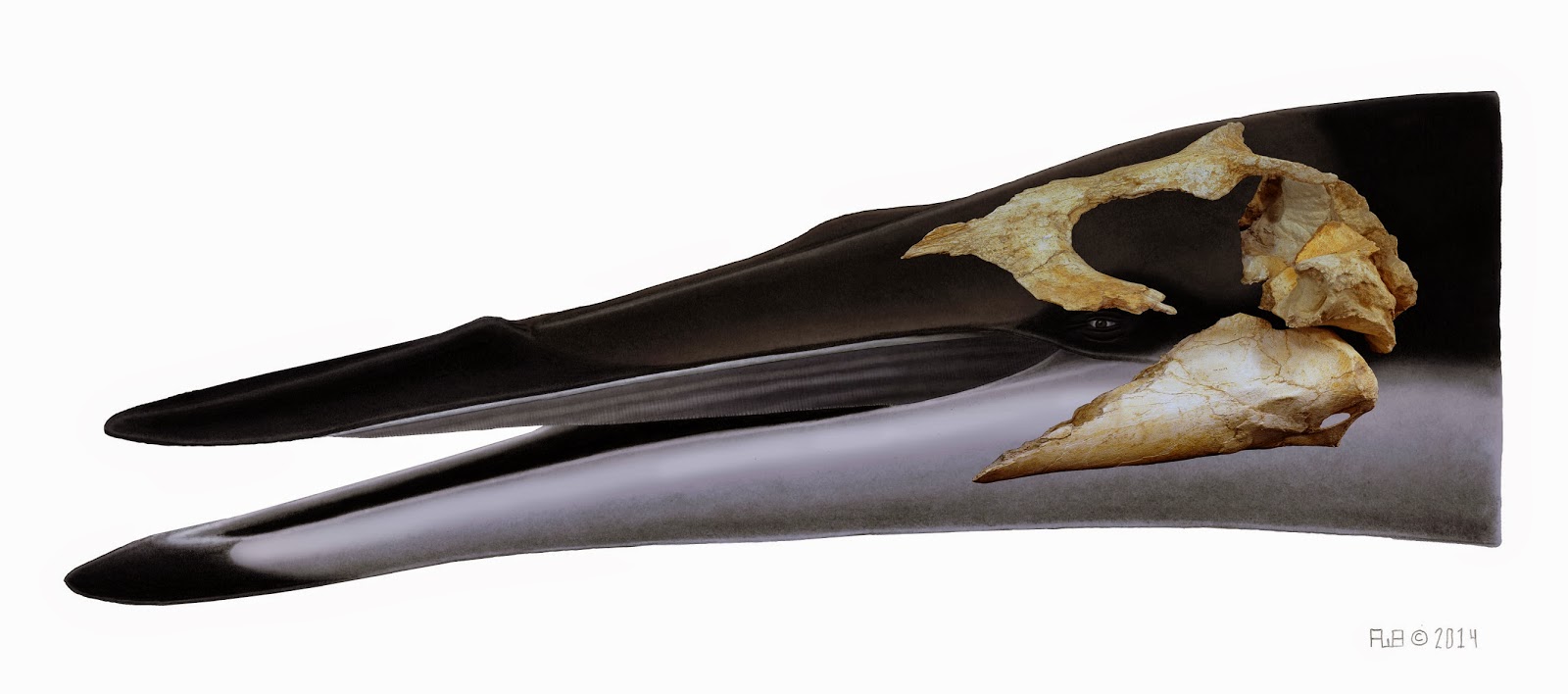
[PaleoMammalogy • 2014] Tohoraata raekohao • A New Eomysticetid (Mammalia: Cetacea) from the Late Oligocene of New Zealand and a re-evaluation of ‘Mauicetus’ waitakiensis


Tohoraata raekohao
Boessenecker & Fordyce, 2014

Abstract
The published Oligocene record of mysticetes (baleen whales) is dominated by toothed mysticetes in addition to the Eomysticetidae, the earliest known chaeomysticetes known only from the Oligocene. Formally recognized eomysticetids include examples from the Oligocene of South Carolina, USA (Eomysticetus), and Japan (Yamatocetus). A new fossil from the upper Oligocene Otekaike Limestone including a partial skull, periotic, tympanic bulla, mandible and some postcrania is here described as Tohoraata raekohao gen. et sp. nov. Tohoraata confirms the presence of an eomysticetid in New Zealand. Tohoraata raekohao is characterized by delicate frontal with numerous supraorbital foramina and sulci, relatively long exposure of the frontal and parietal along a transversely narrow intertemporal region, greatly enlarged temporal fossa, massive and anteriorly directed zygomatic process lacking a supramastoid crest, and a periotic with superior process reduced to a low ridge with anterior and posterior apices. Cranial and postcranial fusion of elements, development of muscle attachments and osteohistology demonstrate that the T. raekohao holotype is an adult or possible subadult. Features of the tympanic bulla including a relatively wide bulla with a medial lobe that is transversely much wider than the lateral lobe, and a slightly posterolaterally facing exoccipital, permit referral of the fragmentary ‘Mauicetus’ waitakiensis of Marples into the genus Tohoraata, resulting in Tohoraata waitakiensis comb. nov. Description of T. raekohao and resolution of the relationships of the hitherto problematic Tohoraata waitakiensis indicates that several eomysticetids were present in the Southern Ocean during the Late Oligocene.


Keywords: Eomysticetidae; Mysticeti; Cetacea; Oligocene; New Zealand


Robert W. Boessenecker and R. Ewan Fordyce. 2014. A New Eomysticetid (Mammalia: Cetacea) from the Late Oligocene of New Zealand and a re-evaluation of ‘Mauicetus’ waitakiensis. Papers in Palaeontology. in press. doi: 10.1002/spp2.1005

The scientists, from the University of Otago, have named the new genus Tohoraata, which translates as ‘Dawn Whale’ in Maori.

Tuesday, November 18, 2014

[Mammalogy • 2014] How Many Species of Paradoxurus Civets are there? New Insights from India and Sri Lanka

Paradoxurus m. musangus
Male relaxing on a thick liana at Sungei Relau, Taman Negara, Pahang, Peninsular Malaysia | photo: EcologyAsia.com

Abstract
Using molecular data and morphological features, we investigated the species limits and genetic diversity among populations of the Asian palm civets of the genus Paradoxurus. Our main objectives were to determine the number of species within Paradoxurus hermaphroditus and to test the validity of the newly proposed species within Paradoxurus zeylonensis. Fragments of two mitochondrial (Cytochrome b, Control Region) and one nuclear (intron 7 of the beta fibrinogen) markers were sequenced from 128 individuals of P. hermaphroditus, P. zeylonensis and Paradoxurus jerdoni. DNA sequences were analysed using phylogenetic and haplotype network methods. 

Our analyses confirmed that P. hermaphroditus comprises three major clades, which should be recognized as separate species: Paradoxurus hermaphroditus (Indian and Indochinese regions), Paradoxurus musangus (mainland Southeast Asia, Sumatra, Java and other small Indonesian islands) and Paradoxurus philippinensis (Mentawai Islands, Borneo and the Philippines). Furthermore, we have proposed that there are two subspecies within both P. musangus and P. philippinensis, and there might be at least two or three subspecies within P. hermaphroditus. We found a very low genetic diversity and no geographical structure within P. zeylonensis and did not find any support for splitting P. zeylonensis into several species nor subspecies. Finally, we confirmed that P. jerdoni and P. zeylonensis are sister species.

Keywords: Asia; taxonomy; palm civets; Paradoxurus; Viverridae; Molecular systematics


Paradoxurus m. musangus 'Toddy Cat' from MacRitchie forest, Singapore
photo: Francis Yap | BESGroup.org

Paradoxurus m. musangus from  Singapore Botanic Garden
photo: Chung Yi Fei KampungLife.wordpress.com

Géraldine Veron, Marie-Lilith Patou, Mária Tóth, Manori Goonatilake and Andrew P. Jennings. 2014. How Many Species of Paradoxurus Civets are there? New Insights from India and Sri Lanka. Journal of Zoological Systematics and Evolutionary Research. 1-14. doi: dx.doi.org/10.1111/jzs.12085.


 The common palm civet, Paradoxurus hermaphroditus, has been split into three species by a recent study (Veron et al., 2014). The name Paradoxurus hermaphroditus is restricted to the populations in India, southern China and Indo-china (henceforth as Indian palm civet). The form in Singapore, peninsular Malaysia, Sumatra and Java is Paradoxurus musangus (Sumatran palm civet), named by Sir Stamford Raffles in 1821 as Viverra musanga based on animals from Sumatra. Those in Borneo and the Philippines are Paradoxurus philippinensis (Philippine palm civet)

Marcus A. H. Chua & Fung Tze Kwan. 2014. Sumatran palm civet at Grange Road. Singapore Biodiversity Records. 2014. http://lkcnhm.nus.edu.sg/nus/images/pdfs/sbr/2014/sbr2014-295.pdf

[Ichthyology • 2014] Limatulichthys nasarcus • A New Species of Limatulichthys Isbrücker & Nijssen (Loricariidae, Loricariinae) from the western Guiana Shield


Limatulichthys nasarcus
Londoño-Burbano, Lefebvre & Lujan, 2014

Abstract
Limatulichthys nasarcus n. sp. is described as a new species based on 15 specimens from the Ventuari and Caura Rivers in Southern Venezuela. The new species can be distinguished from its only congener, L. griseus, by the presence of anterior abdominal plates half the size of those at center of abdomen (vs. plates similar in size); distinct spots less than half of diameter of naris across entire dorsum, including snout and head (vs. indistinct dorsal spots larger or equal than diameter of naris); lateral portions of head and opercle with dark well-defined spots larger than those on dorsum (vs. spots on lateral portions of head and opercle equal in size to those on remainder of body); snout profile in dorsal view broadly rounded (vs. acutely triangular); head longer (21.4–24.2 SL vs. 17.7–21.0%); and anal fin longer (15.7–18.0 SL vs. 13.7–15.6%). Distinctiveness of the two species is further supported by their non-overlapping distribution in multivariate morphospace. The disjunct distribution of L. nasarcus across both the Caura and Ventuari rivers exclusive of the main Orinoco River channel contributes to a growing body of evidence supporting the historical connection between headwaters of these drainages. The hypothesized existence of a ‘proto-Berbice’ paleodrainage provides one explanation for such a connection.

Keywords: Limatulichthys, Neotropics, taxonomy, Ventuari, Caura


Londoño-Burbano, A., Lefebvre, S.L. & Lujan, N.K. 2014. A New Species of Limatulichthys Isbrücker & Nijssen (Loricariidae, Loricariinae) from the western Guiana Shield. Zootaxa. 3884(4): 360–370.

[Ichthyology • 2014] Hirtella carinata • A Remarkable Sexually Dimorphic New Genus and Species of Neoplecostomine Catfish (Siluriformes, Loricariidae) from a Coastal Drainage of Eastern Brazil


Hirtella carinata
 Pereira, Zanata, Cetra & Reis, 2014

A new neoplecostomine genus and species is described from headwater tributaries of the lower Rio Pardo basin, a coastal drainage in Bahia, eastern Brazil. Hirtella carinata is a small loricariid with a maximum standard length barely reaching 50 mm. The new genus and species are diagnosed among all other loricariids by a unique, remarkable pattern of sexual dimorphism in which adult males have five conspicuous longitudinal rows of bristle-like hypertrophied odontodes on the head and along the lateral dermal plates of the body. Hirtella is further distinguished from most loricariids by the anterior position of the pelvic fin, which originates in a vertical anterior to the nuchal plate, and by the possession of an elongate keel formed by 15–17 azygous plates along the mid-dorsal line between the dorsal and the caudal fins. Hirtella is additionally distinguished from other members of the Neoplecostominae by having a medium sized palatine splint, never reaching the anterior border of the nasal fossa. Phylogenetic analysis indicates that Hirtella is the sister taxon of Pareiorhina. The description of this new genus raises to six the number of currently recognized genera in the Neoplecostominae.

Um novo gênero e espécie de neoplecostomíneo é descrito das cabeceiras de tributários do baixo Rio Pardo, drenagem costeira da Bahia, leste do Brasil. Hirtella carinata é um pequeno loricarídeo que atinge quase 50 mm de comprimento padrão. O novo gênero e espécie são diagnosticados de todos os demais loricarídeos por um único e notável padrão de dimorfismo sexual, em que os machos adultos possuem um conjunto de odontódeos hipertrofiados na cabeça e ao longo das placas laterais do corpo que formam cinco linhas longitudinais evidentes. Hirtella é também distinguido da maioria dos loricarídeos pela posição anterior das nadadeiras pélvicas, que se originam em uma vertical anterior a placa nucal e pela presença de uma longa quilha formada por 15–17 placas ázigas na linha média dorsal, entre as nadadeiras dorsal e caudal. Hirtella é ainda distinguido dos outros membros de Neoplecostominae por ter o palatine splint de tamanho médio, nunca alcançando a borda anterior da abertura nasal. A análise filogenética atual indica que Hirtella é o táxon irmão de Pareiorhina. A descrição desse novo gênero eleva para seis o número de gêneros atualmente reconhecidos em Neoplecostominae.


Edson H. L. Pereira, Angela Zanata, Maurício Cetra, and Roberto E. Reis. 2014. A Remarkable Sexually Dimorphic New Genus and Species of Neoplecostomine Catfish (Siluriformes, Loricariidae) from a Coastal Drainage of Eastern Brazil. Copeia. 2014(4):673-681. DOI: 10.1643/CI-14-075

Saturday, November 15, 2014

[Botany • 2014] Trachycarpus ravenii • A New Species (Arecaceae, Corypheae) from Vientiane province of central Laos


Trachycarpus ravenii Aver. & K. S. Nguyen
[left] Natural habitats of Trachycarpus ravenii sp. nov. in central Laos (Vientiane province, Kasi district). (a) primary intact semideciduous forest on steep slopes of Phachao Mountain at elevation 1650–1700 m a.s.l. (Namken village area) || photo by N. S. Khang 
[upper right] Male specimen, [lower right] Female specimen || photos by L. Averyanov
 DOI: 10.1111/j.1756-1051.2013.00304.x | rufford.org

A new species Trachycarpus ravenii discovered in Kasi district, Vientiane province of central Laos is described and illustrated. Morphologically, it is closest to T. oreophilus and T. princeps, but differs by having a shorter stem of mature plants; glabrous, dull green petiole; almost circular leaf blade, waxy bluish–white abaxially; narrow leaf segments with narrow free lobes densely adpressed to each other, as well as in oblique-round apices of median leaf segments.

Figure 1. Trachycarpus ravenii sp. nov.
Male specimen, d-exsiccates of Vietnamese flora 200/LA-VN 725.
All photos and design by L. Averyanov
Figure 2. Trachycarpus ravenii sp. nov.
Female specimen, d-exsiccates of Vietnamese flora 201/LA-VN 726.
All photos and design by L. Averyanov.

Figure 3. Natural habitats of Trachycarpus ravenii sp. nov. in central Laos (Vientiane province, Kasi district).
 (a) primary intact semideciduous forest on steep slopes of Phachao Mountain at elevation 1650–1700 m a.s.l. (Namken village area), (b) forestless mountain slopes with rocky limestone outcrops among secondary grasslands and open secondary scrub at elevation about 1700 m a.s.l. (Thong Mout village area).
All photos by N. S. Khang | DOI: 10.1111/j.1756-1051.2013.00304.x

Averyanov, L. V., Nguyen, K. S., Nguyen, T. H., Pham, T. V. and Lorphengsy, S. 2014. Trachycarpus ravenii sp. nov. (Arecaceae, Corypheae) from central Laos. Nordic Journal of Botany. 32(5); 563–568. doi: 10.1111/j.1756-1051.2013.00304.x

[Ichthyology • 2014] Mugilogobius hitam • A New Species of Freshwater Goby (Teleostei: Gobioidei: Gobiidae) from Lake Towuti, central Sulawesi, Indonesia


Black Towuti Goby | Mugilogobius hitam
Larson, Geiger, Hadiaty & Herder, 2014

Abstract
A new species of Mugilogobius is described from Lake Towuti, central Sulawesi, diagnosed by its possession of a distinct transverse sensory papilla pattern on the cheek, overall blackish colour on head, body and fins and relatively large adult size for the genus. Although it may superficially resemble the black goby Mugilogobius amadi from Lake Poso, M. hitam, new species, lacks the numerous predorsal scales (22–36 in M. amadi versus 17–19), high second dorsal fin ray count (I,9, usually I,10, versus I,7–8) and narrow head and protruding chin of M. amadi. Cytochrome c oxidase subunit 1 (COI) data provide clear support for the species status of M. hitam, new species,
indicate that all the Malili Lakes Mugilogobius may well represent a species flock and place M. sarasinorum from Lake Poso as its most likely sister taxon. In addition to the tectonic lake species, we report the occurrence of M. latifrons in streams of the Malili Lakes drainage.

Key words. Mugilogobius, Gobiidae, taxonomy, Sulawesi, Lake Towuti, freshwater fish, endemism


Helen K. Larson, Matthias F. Geiger, Renny Kurnia Hadiaty and Fabian Herder. 2014. Mugilogobius hitam, A New Species of Freshwater Goby (Teleostei: Gobioidei: Gobiidae) from Lake Towuti, central Sulawesi, Indonesia. RAFFLES BULLETIN OF ZOOLOGY. 62: 718–725. 


Mugilogobius fasciatus Larson, 2001
Mugilogobius filifer Larson, 2001 (Threadfin mangrove goby) 
Mugilogobius littoralis Larson, 2001 (Beachrock mangrove goby) 
Mugilogobius lepidotus Larson, 2001
Mugilogobius rexi Larson, 2001
Mugilogobius rivulus Larson, 2001 (Drain mangrove goby) 
Mugilogobius tigrinus Larson, 2001
Mugilogobius wilsoni Larson, 2001 (Wilson's mangrove goby) 

Mugilogobius nuicocensis V. H. Nguyễn & V. B. Vo, 2005 

Thursday, November 13, 2014

[Herpetology • 2014] Tylototriton shanorum • A New Species of Tylototriton (Amphibia: Urodela: Salamandridae) from Central Myanmar


Figure 3. Photograph of specimens of Tylototriton verrucosus verrucosus from Myanmar (A and B: dorsal and ventral views of CAS 230940 [male]; C: dorsal view of CAS 230933 [female]), dorsal view of male topotype of T. verrucosus verrucosus (D), and dorsal view of male holotype of T. uyenoi (E). Scale bar = 20 mm.
Figure 4. Photograph of dorsal head of specimens of Tylototriton verrucosus verrucosus from Myanmar (A: CAS 230940 [male]; B: CAS 230933 [female]), male topotype of T. v. verrucosus (C), and male holotype of T. uyenoi (D). Scale bar = 10 mm.

ABSTRACT
We describe a new species of Tylototriton from Taunggyi, Shan State, central Myanmar, based on molecular and morphological evidence. The new species, Tylototriton shanorum, is classified as a member of the subgenus Tylototriton. The species differs morphologically from all known congeners by having the combination of dull-colored markings, weakly protruding dorsolateral bony ridges on head, narrow and weakly segmented vertebral ridge, and narrow vomerine tooth series. The taxonomic relationship between T. verrucosus and T. shanjing is briefly discussed based on the molecular phylogeny obtained in this study.

Key words: Tylototriton, morphology, new species, Myanmar


 Kanto Nishikawa, Masafumi Matsui and Dingqi Rao. 2014. A New Species of Tylototriton (Amphibia: Urodela: Salamandridae) from Central Myanmar. The Natural History Bulletin of the Siam Society. 60(1):9-22.