Sunday, February 5, 2012

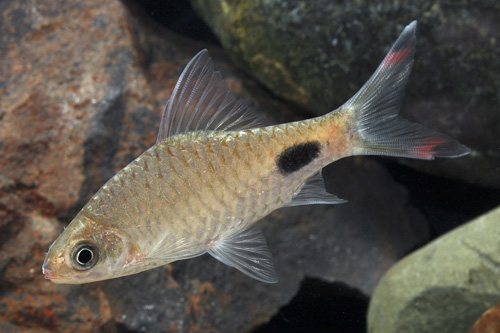
[Ichthyology • 2008] Puntius kelumi • a new species of cyprinid fish (Teleostei: Cyprinidae) from Sri Lanka


Puntius kelumi 
Pethiyagoda, Anjana Silva, Maduwage & Meegaskumbura, 2008


Puntius kelumi, new species, is described from south-western Sri Lanka. It is distinguished from all other Sri Lankan and Peninsular-Indian Puntius by having the last unbranched dorsal-fin ray smooth; body depth 28.6-35.5 % of SL; rostral barbels absent; maxillary barbels present, about as long as eye diameter; 20-23 lateral-line scales on body; .... scales in transverse line from mid-dorsum to pelvic-fin origin; and sides of head and body of breeding males rough, extensively tuberculated. Puntius layardi Günther is apparently a valid species from Sri Lanka, but has not been observed in the wild since 1868. Leuciscus binotatus Blyth, its replacement name Barbus tetraspilus Günther, and its junior objective synonym B. innominatus Day, remain species inquirendae.


Pethiyagoda R., A. Silva, K. Maduwage & M. Meegaskumbura. 2008. Puntius kelumi, a new species of cyprinid fish from Sri Lanka (Teleostei: Cyprinidae). Ichthyol. Explor. Freshwaters. 19(3), 201-214. http://www.pfeil-verlag.de/04biol/pdf/ief19_3_02.pdf

2008: A promising year for Sri Lanka's freshwater fish

[Ichthyology • 2008] Puntius kamalika • a new species of barb (Teleostei: Cyprinidae) from Sri Lanka | former Sri Lankan Puntius amphibius


Puntius kelumi 
Pethiyagoda, Anjana Silva, Maduwage & Meegaskumbura, 2008

Abstract
Since its first record from the island in 1912, the barb Puntius amphibius Valenciennes has regularly featured in Sri Lanka’s ichthyofaunal inventories. Recent work has shown, however, that the name P. amphibius should be reserved for a species originally collected from Bombay, India, and described by Achille Valenciennes in 1842, now known only from its lectotype. The Sri Lankan fish hitherto known by this name is an undescribed species. Puntius kamalika, new species, is distinguished from all Sri Lankan and peninsular-Indian congeners by having (in addition to a suite of mensural characters) ½4/1/2½ scales in transverse line between mid-dorsal scale row and pelvic-fin origin and lacking any prominent markings on fins and body in both living and preserved examples. The new species is widely distributed in the island’s wet-zone lowlands (rainfall > 2,500 mm/yr ), where it occurs in streams, rivers and marshes between the Kelani-River basin draining to the island’s west, and the Gin River basin to the south. It is locally common.

Key words: Puntius amphibius, Puntius mahecola, Puntius chola, India, Kerala


New fish named after AIDS activist


Silva, A, K Maduwage and R Pethiyagoda. 2008. Puntius kamalika, a new species of barb from Sri Lanka (Teleostei: Cyprinidae). Zootaxa .1824, pp. 55-64. http://www.mapress.com/zootaxa/2008/f/z01824p064f.pdf

[Ichthyology • 2008] Puntius reval • a new barb (Teleostei: Cyprinidae) from the Maha drainage, Sri Lanka


Puntius reval Meegaskumbura, Anjana Silva, Maduwage & Pethiyagoda, 2008

Abstract
Puntius cumingii, a Sri Lankan endemic, has long been known to be dichromatic. In one colour morph the dorsal, anal and pelvic fins are yellow, while in the other these fins are red. We show that P. cumingii in fact comprises two species. Puntius reval, new species, is distinguished from all other Sri Lankan and south Indian congeners by having the last unbranched dorsal ray serrated; lateral line incomplete, perforating 4-9 scales; scale rows above lateral line arranged in a distinctive pattern; dorsal, anal and pelvic fins red (pale yellow in the Kalu River population); body colour pattern consisting of two black bars, one behind gill pening and one above posterior extremity of anal-fin base; and by lacking barbels. The new species is further distinguished from P. cumingii by having a maximum standard length of 33.6 mm (vs. 41.2 mm); a smaller eye diameter (9.8-10.5, vs. 10.8-12.1 percent of standard length); 11+13 (vs. 11+15) vertebrae; cleithrum with a single spine (vs. smooth); and proximal arm of fifth ceratobranchial with an oval foramen of diameter less than (vs. greater than) basal diameter of teeth. The cytochrome b divergence between P. reval and P. cumingii is 2.0-2.5 %. Puntius reval is described from the Kelani drainage, though it ranges throughout the lowlands northwards to the Maha drainage, whereas P. cumingii is recorded from the more southerly Bentara and Gin drainages.


Puntius cumingii
New barb was confused with Puntius cumingii: 


Meegaskumbura M., Silva A., Maduwage K. & Pethiyagoda R. 2008. Puntius reval, a new barb from Sri Lanka (Teleostei: Cyprinidae), Ichthyol Explor. Freshwaters, 19(2), 141-152.

[Ichthyology • 2005] Puntius exclamatio from southern Kerala State of India • A review of the barbs of the Puntius filamentosus group (Teleostei: Cyprinidae) of Southern India and Sri Lanka


Puntius exclamatio, new species, described from the Kallada River, southern Kerala State of India


Abstract
The Puntius filamentosus (Valenciennes) group of medium-sized (< 115 mm SL) cyprinids from southern India and Sri Lanka is reviewed. The group is characterised by adult males of most species developing filament-like extensions to the branched dorsal-fin rays and the distinctive ontogenic colour pattern of three black bars on the side of the body. Puntius singhala (Duncker), P. arulius (Jerdon), P. srilankensis (Senanayake) and P. tambraparniei (Silas) are considered valid species within this group. The name Puntius assimilis (Jerdon), hitherto in the synonymy of P. filamentosus, is re-validated and P. lepidus Day, and P. maderaspatensis (Jerdon) are treated as junior synonyms of P. assimilis and P. filamentosus, respectively. A new species, P. exclamatio, is described from the Kallada River, southern Kerala State; adults of this species differ from all other Indian and Sri Lankan Cyprinidae by their unique colour pattern: a black blotch 2–3 scales wide commencing on and above scale 6 or 7 of lateral-line series; and another horizontally-elongate, black, tear-shaped blotch about 1½ scales high commencing on lateral line slightly anterior to or above anal-fin origin, on about lateral-line scale row 13 and continuing to base of caudal fin. Puntius filamentosus is shown to have a wide distribution throughout the lowlands of southern India, while P. assimilis is known from disjunct populations in the Netravati River, southern Karnataka State, and the Chalakudy and Kallada Rivers, Kerala State. Puntius singhala and P. srilankensis are endemic to Sri Lanka.

Key words: Puntius filamentosus, India, Sri Lanka, Kerala, Cyprinidae, taxonomy.


Pethiyagoda, R. & M. Kottelat. 2005. A review of the barbs of the Puntius filamentosus group (Teleostei: Cyprinidae) of Southern India and Sri Lanka. Raffles Bulletin of Zoology Supplement 12: 127-144.

[Ichthyology • 2005] The identity of the south Indian barb Puntius mahecola (Teleostei: Cyprinidae) • redescribe based on recent collections from Kerala, India


Puntius mahecola photo by segrestfarms.com

Abstract
Leuciscus mahecola Valenciennes has long been placed in the synonymy of Leuciscus filamentosus Valenciennes (both species are currently referred to Puntius Hamilton). An examination of the syntype series of P. mahecola together with specimens collected recently in Kerala, India, shows however, that it is a valid species that has been referred in the current literature to P. amphibius (Valenciennes). Puntius mahecola is distinguished from other southern Indian and Sri Lankan Puntius species by having the last simple dorsal ray smooth; body depth 27.2–32.0% SL; a single pair of (maxillary) barbels, about ½ eye diameter long; and a horizontally-elongate black blotch about 1½ times as wide as it is high across 3½ scales of the lateral line immediately behind the anal-fin base. Lectotypes are designated for Leuciscus mahecola and Capoeta amphibia, and the former species redescribed based on the type specimens and a recently-collected series. A lectotype is designated for Barbus melanostigma Day, which is a junior subjective synonym of P. mahecola.


Pethiyagoda, R. & M. Kottelat. 2005. The identity of the south Indian barb Puntius mahecola (Teleostei: Cyprinidae). Raffles Bulletin of Zoology Supplement 12: 145-152. http://rmbr.nus.edu.sg/rbz/biblio/s12/s12rbz145-152.pdf

Thursday, February 2, 2012

[Paleontology • 2009] Yacarerani boliviensis • Bizarre notosuchian crocodyliform with associated eggs from the Upper Cretaceous of Bolivia


Yacarerani boliviensis

Etymology— Generic name derives from two words of the Guarani Indian language, yacare´ (the South American crocodile), and rani (first). Specific epithet after the Republic of Bolivia.


FIGURE 2. Yacarerani boliviensis gen. et sp. nov., MNK-PAL5063. Skull and lower jaw

FIGURE 1. Location of fossil site (star) in Amboro National Park, Bolivia. Scale bar equals 200 km.

The Mesozoic record of fossil vertebrates from Bolivia (Fig. 1) was restricted heretofore to Campanian–Maastrichtian dinosaur footprints (e.g., Leonardi, 1989; Sua´rez Riglos, 1995; Lockley et al., 2002; McCrea et al., 2001; Meyer et al., 2001) and isolated and poorly informative dinosaur teeth and bones (Aguilera et al., 1989; Gutierrez and Marshall, 1994). Discovery of several, almost complete skeletons of a new notosuchian taxon constitutes the most important body-fossil discovery for the Mesozoic of
Bolivia, adding substantially to the meager record of this region of South America. At least two partially disarticulated skeletons and two complete eggs were found together in a small area, constituting one of the few available associations of skeletal remains and eggs for extinct crocodyliforms. In this paper we describe this material as a new genus and species. We consider only the skull morphology, because most of available postcranial remains are still under technical preparation. 

Institutional Abbreviation — MNK-PAL, Museo ‘Noel Kempff Mercado,’ Santa Cruz de la Sierra, Bolivia.


Yacarerani boliviensis illustrated by *IRIRIV

FIGURE 4. Unhatched eggs (arrows) found in association with Yacarerani boliviensis. 
Scale bars equal 2 cm.

FIGURE 5. Strict consensus of 70 most parsimonious trees depicting phylogenetic relationships of Yacarerani boliviensis within Notosuchia.A dataset of 234 characters and 51 taxa, modified from Pol and  Apesteguı´a (2005), was analyzed using TNT (Goloboff et al., 2003). Tree statistics: tree length = 749; consistency index = 0.37; retention index = 0.67. Values of Bremer support are shown beside the branches. See Supplementary Data 1 (http://www.vertpaleo.org/publications/JVPContent.cfm) for details. Hatched line indicates uncertainty in the stratigraphic placement of Yacarerani.


Novas, F. E.; Pais, D. F.; Pol, D.; Carvalho, I. D. S.; Mones, A.; Scanferla, A.; and Riglos, M. S. 2009. Bizarre notosuchian crocodyliform with associated eggs from the Upper Cretaceous of Bolivia. Journal of Vertebrate Paleontology 29 (4): 1316–1320. doi:10.1671/039.029.0409

[Paleontology • 2009] Barcinosuchus gradilis • The first crocodyliform from the Chubut Group (Chubut Province, Argentina) and its phylogenetic position within basal Mesoeucrocodylia


Fig. 1. Skull remains of Barcinosuchus MPEF-PV 3095.

Abstract
A new crocodyliform specimen is presented here found in the Cerro Castaño Member of the Cerro Barcino Formation (Chubut Group). The material consists of cranial and postcranial remains that represent a new taxon that has strong affinities with Peirosauridae, but also shares derived features present in Araripesuchus. The phylogenetic relationships of this new taxon were tested through a cladistic analysis depicting it as a member of the Peirosauridae. The inclusion of Barcinosuchus within this clade of basal mesoeucrocodylians is supported by the presence of hypapophyses up to the third or fourth dorsal vertebrae, anterolateral facing edge on postorbital, quadrate dorsal surface divided in two planes by a ridge; mandibular symphysis tapering anterirorly in ventral view, lateral surface of dentary convex anterior to mandibular fenestra, distal body of quadrate well developed, anteroposteriorly thin and lateromedially broad. The new specimen broadens the temporal and geographical distribution of Peirosauridae during the Cretaceous of Gondwana, representing the southern-most and the most ancient record of the group in Patagonia. The new material also provides insights on the postcranial anatomy of peirosaurids, a group that has been so far studied almost exclusively from cranial material.

Keywords: Crocodyliformes; Peirosauridae; Lower Cretaceous; Central Patagonia; Argentina


Fig. 8. Phylogenetic position of Barcinosuchus within the context of basal mesoeucrocodylians. This tree represents a summarized topology of the single most parsimonious tree. Numbered nodes: 1, Mesoeucrocodylia; 2, Notosuchia; 3, Araripesuchus; and 4, Peirosauridae.


Juan Martín Leardi and Diego Pol 2009. The first crocodyliform from the Chubut Group (Chubut Province, Argentina) and its phylogenetic position within basal Mesoeucrocodylia. Cretaceous Research 30 (6): 1376–1386. doi:10.1016/j.cretres.2009.08.002

[Paleontology • 2009] Armadillosuchus arrudai • An armadillo-like sphagesaurid crocodyliform from the Late Cretaceous of Brazil


Abstract
The Sphagesauridae is a family of Crocodyliformes exclusively known for the Brazilian Late Cretaceous Bauru Basin. This lineage reveals how diverse was the morphology and ecology of terrestrial Crocodyliformes during the Late Cretaceous of Gondwana. Here is described Armadillosuchus arrudai gen. et sp. nov., a sphagesaurid that presents some mammal-like morphological features, such as propalinal and alternate unilateral jaw occlusion pattern and heavy body armor, composed of a rigid shield and mobile-banded section as in extant armadillos (Xenarthra, Dasypodidae). These unusual morphological features contrast to the double row of osteoderms observed on the closest relatives of A. arrudai. As its mammal analogs, A. arrudai presents some evidence of fossoriality and an exclusive terrestrial life style in contrast to the extant alligatorids and crocodylids.

Keywords: Crocodyliformes; Sphagesauridae; Bauru Basin; Late Cretaceous; Brazil


Fig. 2. Armadillosuchus arrudai gen. et sp. nov. (UFRJ DG 303-R), skull, cervical shield and humerus in (a) dorsal view, (b) lateral left view. Armadillosuchus arrudai gen. et sp. nov. (MPMA-64-0001-04)


Life restoration of Armadillosuchus arrudai


Marinho, Thiago S.; and Carvalho, Ismar S. 2009. An armadillo-like sphagesaurid crocodyliform from the Late Cretaceous of Brazil. Journal of South American Earth Sciences 27 (1): 36–41.


[Paleontology • 2009] Morrinhosuchus luziae • a New Crocodylomorpha Notosuchia from the Bauru Basin (Upper Cretaceous), Brazil


Abstract 
Morrinhosuchus luziae, A new species of a Crocodylomorpha Notosuchia from the Bauru Basin, Adamantina Formation (Upper Cretaceous, Turonian-Santonian), Brazil is described. The fossil consists of the distal portions of skull and mandible. The posterior teeth present globoid crown  and circular cross-section. Among the notosuchians discovered in the Bauru Basin, only Mariliasuchus presents similar teeth, however, the arrangement of these teeth, besides other autapomorphies, allow the establishment of a new taxa. This fossil widens the number and diversity of Notosuchia, showing the success of this clade throughout Gondwana and several ecological niches during the Cretaceous.
  
Keywords: Crocodylomorpha, Notosuchia, Morrinhosuchus luziae, Adamantina Formation, Bauru Basin.


Iori, F.V.; and Carvalho, I.S. (2009). "Morrinhosuchus luziae, um novo Crocodylomorpha Notosuchia da Bacia Bauru, Brasil". Revista Brasileira de Geociências 39 (4): 717–725

[Paleontology • 2009] Coringasuchus anisodontis • A new crocodyliform from the Alcântara Formation (Cenomanian), Cajual Island, Brazil


Abstract
A new mesoeucrocodylian (Crocodyliformes) is described from the Laje do Coringa site, earliest Late Cretaceous (early Cenomanian) of the São Luís Basin, northeastern Brazil. Due to the likely hetorodonty indicated by distinct alveoli shapes, Coringasuchus anisodontis gen. et sp. nov. is tentatively referred to the Notosuchia and distinguished from other members of this clade by the presence of obliquely implanted teeth with the main axis directed anterolingually-toposterolabially and the presence of alveoli that are distinctively raised above the level of the dorsal margin of the dentary. The material further confirms the interpretation that the fossil concentration of the Laje do Coringa site is the result of multiple reworking events from previous deposits, but the degree of time-averaging was possibly higher than previously suspected.

Key words: Coringasuchus anisodontis, Mesoeucrocodylia, early Cenomanian, Maranhão, Brazil, Alcântara Formation, Laje do Coringa


Kellner, A.W.A.; Pinheiro, A.E.P.; Azevedo, S.A.K.; Henriques, D.D.R.; de Carvalho, L.B.; and Oliveira, G.R. 2009. A new crocodyliform from the Alcântara Formation (Cenomanian),Cajual Island, Brazil. Zootaxa 2030: 49–58.

[Paleontology • 2004] Uberabasuchus terrificus • a New Crocodylomorpha from the Bauru Basin (Upper Cretaceous), Brazil


Abstract
A new fairly complete and articulated skull of a Peirosauridae crocodylomorph from Bauru Basin (Late Cretaceous), Brazil, is described. The fossil is from a level of clayish sandstone within Serra do Veadinho sequence, Peirópolis, Uberaba County, Minas Gerais State. The sedimentary strata of Serra do Veadinho belong to the Marília Formation (Serra da Galga Member), Bauru Group, considered to be Campanian-Maastrichtian in age. The species -Uberabasuchus terrificus sp. nov. - is a peirosaurid with moderately narrow snout, large round orbits protected by supraorbital bones of triangular shape and an antorbital fenestra bounded posteriorly by a deep groove. This fossil resembles Peirosaurus tormini Price, 1955 in the size pattern of premaxillary teeth and by showing a similar wedge-like maxillary process in the premaxilla. It also shares some morphological features with the other species of the Peirosauridae, namely the crocodylomorph Lomasuchus palpebrosus Gasparini, Chiappe and Fernandez, 1991 from Argentina. Their common features comprise a moderately narrow snout and the deep lateral groove at the premaxilla and maxilla articulation for the reception of a large mandibular tooth. However, the nasal participates in the external nares and does not divide the nasal aperture, producing a “beak-like” structure at the extremity of the snout which is unique among peirosaurids. The stratigraphic setting suggests that the specimen was buried when a flash flood overflowed the shallow channels of a braided fluvial system.

Parsimony analysis of 183 morphological characters is performed for 23 crocodylomorphs. Analysis of the morphological data matrix resulted in three most parsimonious trees (374 steps, CI = 0.679; RI = 0.826). The new species is closely related to Mahajangasuchus and both, in addition to Peirosaurus and Lomasuchus, compose the Peirosauridae.

Key words: Crocodylomorpha; Peirosauridae


2004. Uberabasuchus terrificus sp. nov., a New Crocodylomorpha from the Bauru Basin (Upper Cretaceous), Brazil. Gondwana Research, 7(4): 975-1002.


Wednesday, February 1, 2012

[Paleontology • 2009] 'PancakeCroc' | Laganosuchus thaumastos & L. maghrebensis • Cretaceous Crocodyliforms from the Sahara


Abstract

Diverse crocodyliforms have been discovered in recent years in Cretaceous rocks on southern landmasses formerly composing Gondwana.  We report here on six species from the Sahara with an array of trophic adaptations that significantly deepen our current understanding of African crocodyliform diversity during the Cretaceous period.  We describe two of these species (Anatosuchus minor, Araripesuchus wegeneri) from nearly complete skulls and partial articulated skeletons from the Lower Cretaceous Elrhaz Formation (Aptian-Albian) of Niger. The remaining four species (Araripesuchus rattoides sp. n., Kaprosuchus saharicus gen. n. sp. n., Laganosuchus thaumastos gen. n. sp. n., Laganosuchus maghrebensis gen. n. sp. n.) come from contemporaneous Upper Cretaceous formations (Cenomanian) in Niger and Morocco.


Sereno, P.C.; Larsson, H.C.E. 2009. Cretaceous Crocodyliforms from the Sahara. ZooKeys 28: 1–143. doi: http://dx.doi.org/10.3897/zookeys.28.325.


[Paleontology • 2009] 'BoarCroc' | Kaprosuchus saharicus • Cretaceous Crocodyliforms from the Sahara


Abstract

Diverse crocodyliforms have been discovered in recent years in Cretaceous rocks on southern landmasses formerly composing Gondwana.  We report here on six species from the Sahara with an array of trophic adaptations that significantly deepen our current understanding of African crocodyliform diversity during the Cretaceous period.  We describe two of these species (Anatosuchus minor, Araripesuchus wegeneri) from nearly complete skulls and partial articulated skeletons from the Lower Cretaceous Elrhaz Formation (Aptian-Albian) of Niger. The remaining four species (Araripesuchus rattoides sp. n., Kaprosuchus saharicus gen. n. sp. n., Laganosuchus thaumastos gen. n. sp. n., Laganosuchus maghrebensis gen. n. sp. n.) come from contemporaneous Upper Cretaceous formations (Cenomanian) in Niger and Morocco.


Sereno, P.C.; Larsson, H.C.E. 2009. Cretaceous Crocodyliforms from the Sahara. ZooKeys 28: 1–143. doi: http://dx.doi.org/10.3897/zookeys.28.325.

[Paleontology • 2009] 'RatCroc' | Araripesuchus rattoides • 'DogCroc' • Cretaceous Crocodyliforms from the Sahara


Abstract

Diverse crocodyliforms have been discovered in recent years in Cretaceous rocks on southern landmasses formerly composing Gondwana.  We report here on six species from the Sahara with an array of trophic adaptations that significantly deepen our current understanding of African crocodyliform diversity during the Cretaceous period.  We describe two of these species (Anatosuchus minor, Araripesuchus wegeneri) from nearly complete skulls and partial articulated skeletons from the Lower Cretaceous Elrhaz Formation (Aptian-Albian) of Niger. The remaining four species (Araripesuchus rattoides sp. n., Kaprosuchus saharicus gen. n. sp. n., Laganosuchus thaumastos gen. n. sp. n., Laganosuchus maghrebensis gen. n. sp. n.) come from contemporaneous Upper Cretaceous formations (Cenomanian) in Niger and Morocco.


RatCroc — Araripesuchus rattoides Sereno & Larsson, 2009

Genus Araripesuchus
†A. gomesii Price, 1959 (type)
†A. wegeneri Buffetaut, 1981
†A. patagonicus Ortega et al., 2000
†A. buitreraensis Pol & Apesteguia, 2005
†A. tsangatsangana Turner, 2006
†A. rattoides Sereno & Larsson, 2009


DogCroc — Araripesuchus wegeneri Buffetaut, 1981


Sereno, P.C.; Larsson, H.C.E. 2009. Cretaceous Crocodyliforms from the Sahara. ZooKeys 28: 1–143. doi: http://dx.doi.org/10.3897/zookeys.28.325.

[Paleontology • 2003] 'DuckCroc' | Anatosuchus minor • A new notosuchian from the Early Cretaceous of Niger


Anatosuchus minor ("duck crocodile", for the broad, duck-like snout)


Skull of the crocodyliform Anatosuchus minor. Partial skull in articulation with the atlas and the anterior portion of the axis (MNN GAD17). A Lateral view. B Dorsal view. C Ventral view. Pink tone indicates restored snout margin. Scale bar equals 5 cm.


Sereno P.C., Sidor, C.A., Larsson H.C.E., Gado B. 2003. A new notosuchian from the Early Cretaceous of Niger. Journal of Vertebrate Paleontology. 23 (2): 477-482.