Monday, October 10, 2016

[Crustacea • 2016] Partial Redescription of Pontoniine Shrimps Cuapetes nilandensis (Borradaile, 1915) and Cuapetes seychellensis (Borradaile, 1915) (Decapoda: Palaemonidae: Pontoniinae) with Remarks on Taxonomic Status of Cuapetes Clark, 1919 and Kemponia Bruce, 2004


Cuapetes nilandensis (Borradaile, 1915)


Abstract

Pontoniine shrimps Cuapetes nilandensis (Borradaile, 1915) (the type species of the genus) and Cuapetes seychellensis (Borradaile, 1915) are re-described showing clear morphological difference from representatives of the genus Kemponia Bruce, 2004. Several specific morphological features show the validity of both pontoniine genera.

Keywords: Crustacea, Caridea, Decapoda, Palaemonidae, Pontoniinae, Cuapetes seychellensis, Cuapetes nilandensis, Kemponia, redescription


  Ivan Marin and Sergey Sinelnikov. 2016. Partial Redescription of Pontoniine Shrimps Cuapetes nilandensis (Borradaile, 1915) and Cuapetes seychellensis (Borradaile, 1915) (Decapoda: Palaemonidae: Pontoniinae) with Remarks on Taxonomic Status of Cuapetes Clark, 1919 and Kemponia Bruce, 2004.
Zootaxa.
 4173(6) DOI:  10.11646/zootaxa.4173.6.3

Friday, October 7, 2016

[Entomology • 2016] Sangpradubina thailandica • An Astonishing New Mayfly Genus from Thailand (Ephemeroptera: Leptophlebiidae: Atalophlebiinae)


Sangpradubina thailandica 
Boonsoong & Sartori, 2016 

ชีปะขาวแสงประดับ | DOI:  10.11646/zootaxa.4169.3.11

Abstract

A newly discovered representative of Leptophlebiidae is described and illustrated from Thailand as Sangpradubina thailandica, gen. nov. and sp. nov., based on larvae and reared adults. This new species presents an interesting transitional position, being close to Choroterpes s.l. in the winged stages, but closer to Thraulus s.l. in the nymphal stage.   Nymphs are differentiated from those of all genera of the Thraulus lineage by the combination of gill I consisting of only a single and slender lamella, gills II–VII being fimbriate only in the distal half, each mandible having a tuft of setae only in the middle of the lateral margin, each maxilla having a well-developed anterolateral projection, fore- and middle femora each having a row of long setae on the outer margin, as well as tarsal claws having 4 denticles at the base and 9 in the apical position. Adults of the new genus barely differ from any genera of the Choroterpes lineage. The egg chorionic structure of Sangpradubina also appears to be unusual in that KCT’s are concentrated on one pole.

Keywords: Ephemeroptera, Thailand, Thraulus, Choroterpes, new genus, new species


Etymology. The genus name is an arbitrary combination of letter to honour Prof. Narumon Sangpradub (Khon Kaen University) for her outstanding contributions to the ecology and taxonomy of aquatic insects in Thailand. The gender is feminine.

Distribution. Thailand (Ratchaburi province, Chanthaburi province). 


Boonsoong, Boonsatien and Michel Sartori. 2016. Sangpradubina, An Astonishing New Mayfly Genus from Thailand (Ephemeroptera: Leptophlebiidae: Atalophlebiinae). Zootaxa. 4169(3); 587–599.  DOI:  10.11646/zootaxa.4169.3.11
ResearchGate.net/publication/308386050_Sangpradubina_an_astonishing_new_mayfly_genus_from_Thailand_Ephemeroptera_Leptophlebiidae_Atalophlebiinae

สุดทึ่ง! นักวิจัย มก. พบแมลงชีปะขาวสกุลใหม่ของโลก ชี้ตัวบ่งบอกคุณภาพน้ำ: matichon.co.th/news/311682
 นักวิจัย มก. พบแมลงชีปะขาวสกุลใหม่ของโลก:  banmuang.co.th/news/education/64517


[Ichthyology • 2016] Cynoglossus nanhaiensis • A New Species of Tongue Sole (Pleuronectiformes: Cynoglossidae: Cynoglossus) from coastal waters of the South China Sea


Cynoglossus nanhaiensis 
Wang, Munroe & Kong, 2016

Abstract
A new tongue sole, Cynoglossus nanhaiensis, described from 21 specimens (101.0–133.7 mm SL) collected in coastal waters of the South China Sea, is distinguished from congeners by the following combination of characters: 3 ocular-side lateral lines; no blind-side lateral lines; 2 ocular-side nostrils; 8 caudal-fin rays; 49–51 total vertebrae; 64–73 scales in the midlateral line; 11–12 scales in diagonal series between midlateral and dorsal lateral lines; 99–108 dorsal-fin rays; 77–82 anal-fin rays; pores of lateral-line scales tubular, with conspicuously black tips posteriorly; and with light- to medium-brown ocular-side background coloration overlain by numerous, small, irregular, dark blotches forming a series of narrow, interrupted, longitudinal stripes, with many specimens also featuring two large, brown spots on their caudal region. Among congeners, C. nanhaiensis is most similar to C. maccullochi Norman, 1926, described from specimens taken off Queensland, Australia, but differs in its ocular-side pigmentation (conspicuous longitudinal series of irregular blotches and caudal spots absent in C. maccullochi) and body depth. Features of C. nanhaiensis are also reminiscent of those reported for C. dollfusi (Chabanaud, 1931), a poorly-known nominal species from the Red Sea, and C. itinus (Snyder, 1909), a better-known species occurring in marine waters off Japan and Southeast Asia. Cynoglossus nanhaiensis differs from both species in having two (vs. one) ocular-side nostrils. Cynoglossus itinus also lacks the series of conspicuous, darkly-pigmented, interrupted, longitudinal stripes on the ocular side that are characteristic of C. nanhaiensis. Cynoglossus nanhaiensis is further distinguished from C. dollfusi in having only a single pelvic fin (vs. two in C. dollfusi). Cynoglossus nanhaiensis occurs in coastal waters of the South China Sea off southern China and Viet Nam.

Keywords: Flatfish, Tonguefish, Cynoglossid tongue sole


Fig. 1. Cynoglossus nanhaiensis, new species, holotype (fresh condition), SCSMBC007425, male, 127.6 mm SL.
A. Ocular side. B. Blind side. (Photograph: Z.-M. Wang). 


Distribution.— Based on fishery landings, this species occurs in coastal waters off Sanya and Lingshui, Hainan Province; Zhanjiang, Guangdong Province, China; two specimens were collected off Viet Nam, one in the Gulf of Tonkin (20°46′29.99″N, 107°04′40.8″E) and the other off Phan Thiet (10°55′20″N, 108°06′34″E).

Etymology.— The name, nanhaiensis, is derived from the Chinese word, Nanhai, meaning South China Sea, in reference to localities where most specimens were collected.


Zhong-Ming Wang, Thomas A. Munroe and Xiao-Yu Kong. 2016. A New Species of Tongue Sole (Pisces: Pleuronectiformes: Cynoglossidae: Cynoglossus) from coastal waters of the South China Sea. Proceedings of the Biological Society of Washington. 129(1); 129-143. DOI: 10.2988/0006-324X-129.Q2.129 


[PaleoMammalogy • 2016] Dagonodum mojnum • A New Long-snouted Beaked Whale (Cetacea: Odontoceti) from the Late Miocene of Denmark: Evolution of Suction Feeding and Sexual Dimorphism in the Ziphiidae


Dagonodum mojnum 
Ramassamy, 2016 


Abstract

A new genus and species of Ziphiidae, Dagonodum mojnum gen. nov., sp. nov., from the upper Miocene Gram Formation (c. 9.9–7.2 Ma) represents the first occurrence of the family in Denmark. This long-snouted ziphiid is characterized by two pairs of mandibular tusks, the Eustachian outlet that approximately levels with the dorsalmost margin of the posterior portion of the involucrum, and the left trapezoid nasal with a posteromedial projection into the frontal. A phylogenetic analysis including 25 species and 69 characters was conducted. Dagonodum mojnum is placed in a basal ziphiid clade as the sister taxon of Messapicetus. The specimen is probably a male, because it has enlarged tusks. Alternatively, females could also be involved in fights and develop erupted tusks as in the extant Berardius. Although less well supported, this interpretation proposes that aggressive interactions were not restricted to males in stem-ziphiids. With a thickened thyrohyal and the presence of a precoronoid crest, D. mojnum was able to use suction feeding, but was less specialized to it compared to extant ziphiids. The elongated neck of D. mojnum less optimized to perform deep dives, and the shallow depth at which the Gram Formation was deposited corroborates the hypothesis that at least part of the stem-ziphiids were not regular deep divers.

 KEYWORDS: evolution – phylogeny – postcranial – systematics.

SYSTEMATIC PALAEONTOLOGY

ORDER CETACEA BRISSON, 1762
SUBORDER ODONTOCETI FLOWER, 1867

FAMILY ZIPHIIDAE GRAY, 1850

DAGONODUM GEN. NOV.
Type species. Dagonodum mojnum sp. nov.
Etymology of genus name. Dagon refers to the Canaanite divinity of crop fertility pictured as a fish-god and a fictive divinity related to the deep sea created by the American author H. P. Lovecraft.


DAGONODUM MOJNUM SP. NOV.

Holotype. MSM1001x, a partial skeleton including a fragmentary cranium, the left periotic and tympanic, both mandibles, 75 isolated teeth, five cervical vertebrae including the atlas and the axis, two thoracic vertebrae, several fragmentary ribs, the basihyal and left thyrohyal.

Diagnosis. Dagonodum mojnum is a medium-sized ziphiid with an elongated rostrum (approximately 70% of the total condylobasal length). It differs from all odontocetes except ziphiids in having the vertex bearing a strong premaxillary crest; the enlargement of the apical mandibular tooth, and the reduction of the dorsal keel on the posterior process of the periotic.
It shares with Anoplonossa forcipata and Berardius the presence of a pair of apical and subapical tusks; with the genera Messapicetus and Ziphirostrum the medial fusion of the premaxillae dorsal
to the mesorostral groove on the rostrum anterior to the premaxillary sac fossae; and with Aporotus, Beneziphius, Messapicetus and Ziphirostrum the presence of a prenarial basin laterally margined by the maxilla.  ......

 Etymology of species name. From the word ‘mojn’ meaning ‘morning’ in South Jutlandic. Originally of German origin, this is still used as a greeting for ‘hello’ and ‘goodbye’ in Southern Jutland.


CONCLUSION
The holotype of Dagonodum mojnum is a unique discovery in Europe due to the association of the cranium with the mandible, the numerous isolated teeth including the tusks, the earbones and some postcranial remains. It is dated to the mid- to late Tortonian (c. 9.9–7.2 Mya) and is one of the few welldated occurrences of the family Ziphiidae. Dagonodum mojnum is nested within the Messapicetus clade and, as such, expands our knowledge of the earliest diversification of the Ziphiidae.

Based on the presence of erupted tusks and surrounding structures on the mandible, MSM1001x is interpreted as a male, indicating that fights between males may occur in this species. An alternative hypothesis is also proposed in which aggressive intraspecific interactions would be more generalized, not only restricted to males as in the genus Berardius. Although less well supported, this hypothesis cannot be totally discarded in the case of D. mojnum.

The morphology of D. mojnum suggests that it was a predator that was less specialized to suction feeding than extant ziphiids. Its numerous interlocked teeth and its long rostrum with a less restricted lateral gape compared to extant ziphiids are more indicative of a ram-feeder. However, D. mojnum was probably also able to use suction feeding, as seen by its thickened thyrohyal and the laterally enclosed posterior part of the oral cavity due to the presence of a precoronoid crest. Lingual tooth wear of the most apical tusk may be the result of battle tooth raking along the opponent’s body during intraspecific fights and/or contact of the tooth with the seafloor.

Based on the present specimen alone, it is not possible to precisely assess if D. mojnum was able to perform deep dives, although like other long-snouted stem-ziphiids, D. mojnum was probably feeding in epipelagic foraging grounds

The Ziphiidae remain a poorly understood group. The use of independent proxies to assess their diving abilities or their diet might be a key to understand more precisely their evolution and the establishment of their specialization to deep diving.


Benjamin Ramassamy. 2016. Description of A New Long-snouted Beaked Whale from the Late Miocene of Denmark: Evolution of Suction Feeding and Sexual Dimorphism in the Ziphiidae (Cetacea: Odontoceti). Zoological Journal of the Linnean Society. 178(2); 381–409. DOI: 10.1111/zoj.12414

Mød Mojn-hvalen fra Gram
For ti millioner år siden svømmede den tandrige næbhval rundt i havet over Gram. Nu har en fransk Ph.d. studerende artsbestemt og navngivet den: Dagonodum mojnum - eller kort og godt: Mojn.
Ten million years ago swam the tooth rich beaked whale in the sea of Gram.  Now a French Ph.D. students being generic and named it: Dagonodum mojnum - or in short: Moin.

Thursday, October 6, 2016

[Ichthyology • 2016] Scomber indicus • A New Species of Mackerel (Scombridae: Scombrini) from Eastern Arabian Sea


Scomber indicus 
   Abdussamad, Sandhya & Arun, 2016
Indian Chub Mackerel  |  DOI: 10.21077/ijf.2016.63.3.59184-01 

ABSTRACT
Scomber indicus, a new species of mackerel is described based on the specimens collected from the eastern Arabian Sea. The species is differentiated from its nearest congener Scomber australasicus, in having 29-32 gill rakers on lower limb of first gill arch, posteriormost part of hypohyal blunt, with presence of a pit between the hypohyal and the ceratohyal and also in having a posteriorly directed haemal spine which is deeply curved in the basal region. Genetic differentiation and divergence between the newly described species and the 4 valid species of the genus Scomber viz., S. scombrus, S. japonicus, S. australasicus and S. colias were compared using cytochrome c oxidase 1 and cytochrome b gene sequences. The new species was found closest to S. colias followed by S. japonicus with Kimura 2 parameter (K2P) values of 1.4 and 1.8% respectively. In the phylogenetic tree, sequences of Scomber indicus sp. nov. formed a distinct well separated clade with significant bootstrap values as compared to the sequences of S. scombrus, S. japonicus, S. australasicus and S. colias indicating their distinctiveness and separate species status.

Keywords: Arabian Sea, Indian chub mackerel, New species, Scomber indicus


E. M. Abdussamad, Sandhya Sukumaran, Arun K. O. Ratheesh, K. Mohamed Koya, K. P. S. Koya, Prathibha Rohit, Sally Reader, K. V. Akhilesh and A. Gopalakrishnan. 2016. Scomber indicus, A New Species of Mackerel (Scombridae: Scombrini) from Eastern Arabian Sea. Indian J. Fish. 63(3); 1-10. DOI: 10.21077/ijf.2016.63.3.59184-01


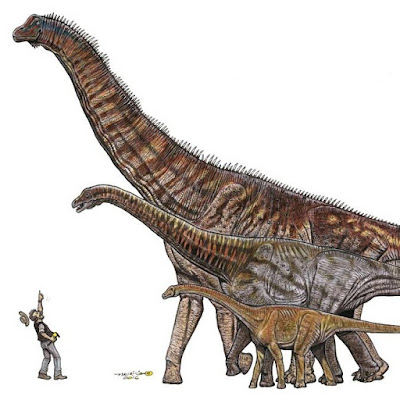
[Paleontology • 2016] Austroposeidon magnificus • A New Giant Titanosauria (Dinosauria: Sauropoda) from the Late Cretaceous Bauru Group, Brazil


Comparison between Brazilian dinosaurs, from highest: Austroposeidon magnificus (25 meters), Maxakalisaurus topai (13 meters) and Gondwanatitan fausto (8 meters).

Austroposeidon magnificus
Bandeira, Simbras, Machado, Campos, Oliveira & Kellner, 2016   


Abstract

Titanosaurian dinosaurs include some of the largest land-living animals that ever existed, and most were discovered in Cretaceous deposits of Argentina. Here we describe the first Brazilian gigantic titanosaur, Austroposeidon magnificus gen. et sp. nov., from the Late Cretaceous Presidente Prudente Formation (Bauru Group, Paraná Basin), São Paulo State, southeast Brazil. The size of this animal is estimated around 25 meters. It consists of a partial vertebral column composed by the last two cervical and the first dorsal vertebrae, all fairly complete and incomplete portions of at least one sacral and seven dorsal elements. The new species displays four autapomorphies: robust and tall centropostzygapophyseal laminae (cpol) in the last cervical vertebrae; last cervical vertebra bearing the posterior centrodiapophyseal lamina (pcdl) bifurcated; first dorsal vertebra with the anterior and posterior centrodiapophyseal laminae (acdl/pcdl) curved ventrolaterally, and the diapophysis reaching the dorsal margin of the centrum; posterior dorsal vertebra bearing forked spinoprezygapophyseal laminae (sprl). The phylogenetic analysis presented here reveals that Austroposeidon magnificus is the sister group of the Lognkosauria. CT scans reveal some new osteological internal features in the cervical vertebrae such as the intercalation of dense growth rings with camellae, reported for the first time in sauropods. The new taxon further shows that giant titanosaurs were also present in Brazil during the Late Cretaceous and provides new information about the evolution and internal osteological structures in the vertebrae of the Titanosauria clade.


Systematic Paleontology

Saurischia Seeley, 1887
Sauropodomorpha Huene, 1932

Sauropoda Marsh, 1878
Titanosauria Bonaparte and Coria, 1993

Austroposeidon magnificus gen. et sp. nov.


Austroposeidon new genus

Type species: Austroposeidon magnificus sp. nov., type by monotypy.

Etymology: “Austro”, meaning “Southern” in allusion to South America; and “Poseidon”, in reference to the Greek God responsible for earthquakes.


Austroposeidon magnificus new species

Etimology: The adjective “magnificus” (from the Latin), means “great, elevated, noble” in allusion to the large size of the specimen.

Holotype: MCT 1628-R, which is composed of two incomplete cervical vertebrae, one cervical rib, one dorsal vertebra, seven fragments of dorsal vertebrae and a fragment of a sacral vertebra.


Diagnosis: The new titanosaur is characterized by the following autapomorphies: 1) columnar-like centropostzygapophyseal laminae (cpol) in the last cervical vertebrae (Cv 13); 2) last cervical vertebra bearing a bifurcated posterior centrodiapophyseal lamina (pcdl); 3) first dorsal vertebra with the anterior and posterior centrodiapophyseal laminae (acdl/pcdl) curved ventrolaterally and with the diapophysis reaching the dorsal margin of the centrum; 4) the anteriormost portion of the spinoprezygapophyseal laminae (sprl) forked in the posterior dorsal vertebra.

The new species described here, can be further distinguished from other titanosaurs by the following combination of characters: presence of medial crest placed on the ventral surface of the last cervical centrum; presence of a suprapleurocoel lamina limiting the pleurocoel from the centrodiapophyseal fossae in the last cervical vertebrae; presence of developed centrodiapophyseal fossa in the posterior cervical vertebra; posterior cervical vertebrae with tall neural spines; presence of triangular centropostzygapophyseal fossae around the neural channel in the posterior cervical vertebra; robust spinoprezygapophyseal laminae in the anterior dorsal vertebrae; developed spinodiapophyseal laminae in the anterior dorsal vertebrae; strongly developed postzygaphophysis in the first dorsal vertebra; neural spine of the first dorsal vertebrae in vertical position and anteriorly located; prespinal lamina in the anterior dorsal vertebrae well developed until the base of the neural spine; diapophyses in the anterior dorsal vertebrae expanded anteroposteriorly and well inclined ventrolaterally; presence of well-developed pneumatizated camellae tissue in the cervical and dorsal vertebrae [43, 44]; absence of hyposphene-hypantrum articulation in the dorsal vertebra (sensu [45]); short and robust cervical ribs [46].

Horizon and locality: According to Campos and Castro [28], the material was found at the outskirts of the Presidente Prudente City, southwestern São Paulo State. According to the catalog of the Museu de Ciências da Terra (MCT—Museum of the Earth Sciences) the specimen was found at the Raposo Tavares road (BR-374), close to the Assis Chateaubriand Road (SP-425). The deposits of this region consist of sandstones and mudstones, and are referred to the Presidente Prudente Formation [29], which is considered Campanian-Maastrichtian in age [32]. One of us (FMS) tried to relocate the exact site from where this specimen was collected, but the area is nowadays urbanized.


Conclusions
The description of this new species, Austroposeidon magnificus, increases our knowledge of Brazilian titanosaurs, particularly the giant ones, which have not been reported previously in this country. Despite the fragmentary condition of the new species, a phylogenetic analysis shows that Austroposeidon magnificus is the sister group of Lognkosauria, a clade that comprises other giant titanosaurs. CT scan analysis reveals some new information about internal anatomic features of large titanosaurs, including potential growth patterns. Some of those internal structures are here observed for the first time and reinforce the importance of the CT scan studies in those giant dinosaurs.


Kamila L. N. Bandeira, Felipe Medeiros Simbras, Elaine Batista Machado, Diogenes de Almeida Campos, Gustavo R. Oliveira and Alexander W. A. Kellner. 2016.  A New Giant Titanosauria (Dinosauria: Sauropoda) from the Late Cretaceous Bauru Group, Brazil.
PLoS ONE.   DOI: 10.1371/journal.pone.0163373


Brasil descubre su propio dinosaurio gigante http://internacional.elpais.com/internacional/2016/10/05/america/1475693311_052090.html vía @el_pais

[Botany • 2016] Paepalanthus multistellaris • A Field Full of Green Stars: A New Species (Eriocaulaceae) from Minas Gerais, Brazil


Paepalanthus multistellaris 
 Andrino, Trovó & Sano, 2016

Abstract

We describe and illustrate Paepalanthus multistellaris, a remarkable new species of Eriocaulaceae from the northern Espinhaço Range in Minas Gerais, Brazil. The species is known from a single population growing between the campos rupestres and veredas in the municipality of Botumirim. This new species is placed into P. subsect. Actinocephaloides, and is characterized by its long, ascending stem, scapes arranged in a fasciculate, umbel-shaped inflorescence, and green involucral bracts surpassing the flowers. Illustrations, photos, and a detailed description, as well as comments on habitat, morphology, and affinities with similar species are provided. The species is considered Critically Endangered, according to the IUCN Red List categories and criteria.

Keywords: Endemism, Poales, campos rupestres, Critically Endangered species, Taxonomy, Eudicots


Caroline Oliveira Andrino, Marcelo Trovó and Paulo Takeo Sano. 2016. A Field Full of Green Stars: Paepalanthus multistellaris (Eriocaulaceae), A New Species from Minas Gerais, Brazil.   Phytotaxa. 278(1); 55–61. DOI:  10.11646/phytotaxa.278.1.6

Wednesday, October 5, 2016

[Ichthyology • 2016] Pseudochromis yamasakii • A New Species of Dottyback Fish (Pseudochromidae: Pseudochrominae) from Japan


Pseudochromis yamasakii 
Gill & Senou, 2016 

KPM-NR 90532A, underwater photo of individual in 18 m, Kushimoto, Kii Peninsula, Honshu, Japan.
photo by K. Yamasaki.  DOI: 10.11646/zootaxa.4173.3.8  

Abstract

Gill (2004) recognised fifty-seven species in the Indo-Pacific genus Pseudochromis Rüppell (1835) but noted that the genus is undiagnosed cladistically and effectively serves as a catch-all for species that can’t be placed in other pseudochromine genera (sensu Gill 2013). Since publication of Gill’s revision, 13 additional species of Pseudochromis have been described, mostly based on recent collections from the highly diverse Coral Triangle area of the West Pacific (Gill & Allen 2004, 2011; Allen et al. 2008; Gill et al. 2009, 2012a,b; Gill & Williams 2011; Gill & Zajonz 2011; Allen & Erdmann 2012). We herein describe an additional new species, which is known on the basis of a single specimen from Kii Peninsula, Honshu, Japan, and from several photographs from the Kii Peninsula and Izu Islands, Japan.

Keywords: Pisces, Teleostei, Pseudochromidae, Pseudochrominae


Pseudochromis yamasakii, sp. nov.
English common name: Dottybelly dottyback
New standard Japanese name: Haraten-nisesuzume

Etymology. This species is named for Kimihiro Yamasaki, a professional diver and excellent underwater photographer. Mr Yamasaki collected the holotype and provided photographs of the new species.

Habitat and distribution. Pseudochromis yamasakii is known only from Kushimoto (type locality) and Minabe on the Kii Peninsula of Honshu, and from Hachijo-jima in the Izu Islands (KPM-NR 70230, KPM-NR 8893, KPM-NR 8897). It has been recorded from reefs in 18–45 m.

FIGURE 4. Pseudochromis yamasakii, KPM-NR 166546, underwater photo of individual in 18 m, Kushimoto, Kii Peninsula, Honshu, Japan.
photo by K. Yamasaki 

Gill, Anthony C. and Hiroshi Senou. 2016. Pseudochromis yamasakii, New Species of Dottyback Fish from Japan (Teleostei: Pseudochromidae: Pseudochrominae).
 Zootaxa. 4173(3): 296–300.  DOI: 10.11646/zootaxa.4173.3.8

Tuesday, October 4, 2016

[Herpetology • 2013] Boiga flaviviridis • A New Species of Cat Snake (Serpentes: Colubridae: Boiga) from Dry Forests of eastern Peninsular India


Boiga flaviviridis  
Vogel & Ganesh, 2013 

Abstract
A new species of cat snake, related to Boiga beddomei (Wall, 1909), is described from the dry forests of eastern Peninsular India. It occupies a large geographic range from Berhampore (type locality), near the River Mahanadi in the northeast to Kaigal near the southern Eastern Ghats in the southwest. The new species is diagnosed by having the following combination of characters: 19 dorsal scale rows at midbody, a high number of ventral scales for the genus Boiga (248–259), a yellowish-green dorsal colouration with numerous faint black bands, an uniform, unpatterned yellow-coloured venter and a relatively short tail (0.180–0.200 of the total length).

Key words: Boiga flaviviridis sp. nov., B. beddomei, B. ceylonensis, Berhampore, Sriharikota, Kaigal, India


Vogel, Gernot and S. r. Ganesh. 2013. A New Species of Cat Snake (Reptilia: Serpentes: Colubridae: Boiga) from Dry Forests of eastern Peninsular India. Zootaxa. 3637(2): 158-168.

Monday, October 3, 2016

[PaleoOrnithology • 2016] Septencoracias morsensis • A Roller-like Bird (Coracii) from the Early Eocene of Denmark


Septencoracias morsensis  
Bourdon, Kristoffersen & Bonde, 2016 

Figure 3: Life reconstruction of Septencoracias morsensis gen. et sp. nov.
Salient diagnostic features of the new fossil relative to other rollers include the larger skull and the small, ovoid and dorsally positioned narial openings. Septencoracias is represented with a brownish and bluish plumage, because brownish and/or bluish feathers occur in all species of rollers and most species of ground-rollers, and are probably primitive within the Coracii.

Plumage pattern and colour are partly based on modifications from: Christian Svane (csv) - Own work, CC BY-SA 2.5, commons.wikimedia.org/w/index.php?curid=719240. Artwork by Estelle Bourdon.
 
DOI: 10.1038/srep34050

Abstract
The fossil record of crown group birds (Neornithes) prior to the Cretaceous-Paleogene boundary is scarce and fragmentary. Early Cenozoic bird fossils are more abundant, but are typically disarticulated and/or flattened. Here we report the oldest roller (Coracii), Septencoracias morsensis gen. et sp. nov. (Primobucconidae), based on a new specimen from the Early Eocene (about 54 million years ago) Fur Formation of Denmark. The new fossil is a nearly complete, three-dimensionally preserved and articulated skeleton. It lies at the lower end of the size range for extant rollers. Salient diagnostic features of Septencoracias relative to other Coracii include the proportionally larger skull and the small, ovoid and dorsally positioned narial openings. Our discovery adds to the evidence that the Coracii had a widespread northern hemisphere distribution in the Eocene. Septencoracias is the oldest substantial record of the Picocoraciae and provides a reliable calibration point for molecular phylogenetic studies.


Systematic Palaeontology

Coracii sensu Clarke et al. 
Primobucconidae Feduccia and Martin, 1976

Septencoracias morsensis gen. et sp. nov.

Etymology: From the Latin word ‘septentrio’ meaning north, and the genus name ‘Coracias’. The specific epithet refers to the Island of Mors, from where the fossil bird came.

Holotype: MGUH.VP 9509, 3-D preserved skeleton lacking sternum and most shoulder girdle elements.


Type locality and horizon: Moclay pit (Klovbakker), Island of Mors, north-western Jutland, Denmark (Fig. S1). Fur Formation, Ypresian, Early Eocene, ca. 54 MA; marine diatomite layer right above ash layer +30 in the mid part of the formation (Fig. S2).

Diagnosis: Septencoracias morsensis is a small roller that differs from all other Coracii (i.e., Primobucco, Paracoracias, Eocoracias, Geranopterus and crown group Coracii) in the small, ovoid and dorsally positioned narial openings (unknown in Geranopterus) and in the significantly larger skull. Septencoracias also differs from all Coracii except Paracoracias in the equal distal extent of major and minor metacarpals.

Septencoracias is assigned to the Primobucconidae based on the following derived characteristics: unossified nasal septum; strongly developed deltopectoral crest of humerus; alular claw present. Moreover, the morphology of the tarsometatarsus of Septencoracias matches well with that of the Primobucconidae. However, Septencoracias differs from Primobucco in many characters: culmen evenly curved; mandibular symphysis longer and more ventrally projected; triangular pygostyle with tall and craniocaudally narrow lamina; acromion of scapula smaller; deltopectoral crest of humerus more prominent; bicipital crest straighter and shorter in distal extent; terminal process of ischium shorter; first phalanx of hallux markedly longer.

Septencoracias differs from Eocoracias in the following characteristics: longer beak; hand skeleton longer relative to the other wing elements; femur shorter and tarsometatarsus longer relative to the tibiotarsus. Septencoracias differs from Paracoracias in the following features: extensor process of carpometacarpus larger; minor metacarpal thicker; first phalanx of hallux longer. Septencoracias differs from Geranopterus in the following characters: acromion of scapula not bifurcated; process on ventral side of proximal end of minor metacarpal smaller; plantarly projected metatarsal trochlea II.


Estelle Bourdon, Anette V. Kristoffersen and Niels Bonde. 2016. A Roller-like Bird (Coracii) from the Early Eocene of Denmark. Scientific Reports. 6, Article number: 34050. DOI: 10.1038/srep34050  @NHM_Denmark


[Ichthyology • 2016] Synchiropus sycorax • A New Species of Dragonet (Teleostei: Callionymidae) from the Philippines


Synchiropus sycorax 
Tea & Gill, 2016   

Abstract

Synchiropus sycorax n. sp. is described from six specimens (22.6–40.1 mm SL) collected from Jolo Island, Sulu Archipelago, Philippines. It appears to be most closely related to S. tudorjonesi, which ranges from the Maldive Islands through Indonesia and the Philippine Islands to southern Japan. The new species differs from S. tudorjonesi and other congeners in live coloration: head and body bright red, bright yellow ventrally, with prominent white spots on head (one spot or blotch over preopercular spine, two elongate spots behind middle of eye, and one spot behind upper part of eye at about 1 o’clock position) and body (in three rows, an uppermost row beginning below soft dorsal, tracking lateral line to caudal peduncle, a lowermost row extending from above anterior anal fin to caudal peduncle, and a middle row extending obliquely from above pectoral fin to anterior part of lowermost series of spots); males with pelvic fin and pelvic-pectoral membrane bright yellow with broad bluish or greenish grey to black submarginal band across distal third of fin.

Keywords: Pisces, Ichthyology; taxonomy; Jolo Island, Sulu Archipelago


FIGURE 3. Synchiropus sycorax, female, aquarium specimen from Jolo Island, Philippines. Specimen not retained; approximately 20 mm SL (Y.K. Tea). 

FIGURE 2. Synchiropus sycorax, male paratype in an aquarium, ZRC 54776, 40.1 mm SL, Jolo Island, Sulu Archipelago, Philippines (Y.K. Tea). 

Synchiropus sycorax n. sp.
Ruby Dragonet 

Holotype. AMS I.47200-001, 39.4 mm SL male, Philippines, Sulu Archipelago, Jolo Island, B. Pagkaliwagan, 29 November 2015.
Paratypes. AMS I.47200-002, 26.7 mm SL female; CAS 241566 , 34.8 mm SL male; USNM 438956, 35.5 mm SL male; ZRC 54776, 22.6 mm SL female, 40.1 mm SL male (all collected with the holotype). 

Diagnosis.Synchiropus sycorax differs from congeners in the following live coloration details: head and body bright red, bright yellow ventrally, with prominent white spots on head (one spot or blotch over preopercular spine, two elongate spots behind middle of eye, and one spot behind upper part of eye at about 1 o’clock position) and body (in three rows, an uppermost row beginning below soft dorsal, tracking lateral line to caudal peduncle, a lowermost row extending from above anterior anal fin to caudal peduncle, and a middle row extending obliquely from above pectoral fin to anterior part of lowermost series of spots); males with pelvic fin and pelvic-pectoral membrane bright yellow with broad bluish or greenish grey to black submarginal band across distal third of fin


Distribution and habitat. Synchiropus sycorax is currently known only from Jolo Island, Sulu Archipelago, Philippines (Figure 5). According to B. Shutman (pers. comm.) it occurs at depths of 20–38m in areas of broken coral rubble interspersed with outcrops of soft and stony corals. 

Etymology. The species is named after the red-robed and caped Sycorax warriors from the BBC sci-fi series Dr. Who, in showing similarities in both coloration and grandiloquence of their garb. The epithet sycorax is a noun in apposition.

 FIGURE 6. Synchiropus tudorjonesi, male aquarium specimen, collected from Bali, Indonesia. Specimen not retained; approximately 50 mm SL (Y.K. Tea).  

Tea, Yi-Kai and Anthony C. Gill. 2016. Synchiropus sycorax, A New Species of Dragonet from the Philippines (Teleostei: Callionymidae).
Zootaxa. 4173(1); 85–93.  DOI: 10.11646/zootaxa.4173.1.8

Saturday, October 1, 2016

[Ichthyology • 2016] Corydoras hephaestus • Wrapped in Flames: A New Remarkably Colored Species (Teleostei: Callichthyidae) from the Rio Madeira basin, Rondônia State, Brazil


Corydoras hephaestus 
Ohara, Tencatt & Britto, 2016

Abstract

A new species of Corydoras is described from the upper Rio Machado, Rio Madeira basin, Rondônia State, Brazil. The new species can be distinguished from its congeners by the absence of contact between the posterior process of the parieto-supraoccipital and the nuchal plate; a ventral laminar expansion of the infraorbital 1 conspicuously developed; and the posterior margin of the pectoral-fin spine with serrations along almost of its entire length, only lacking in the distal portion. Additionally, Corydoras hephaestus possesses dorsal and pectoral spines short, and exhibits an unusual color pattern in life. The conservation status of the new species and other endemic species are briefly commented.

Keywords: Pisces, Amazon, Corydoradinae, Fish, Endemism, Conservation


Etymology. The specific epithet hephaestus is from the Greek, Ἥφαιστος (or Hēphaistos), the Greek god of fire, metalworking, forges, and blacksmiths. Alluding to the red color of the body and fins. A noun in apposition.


Ohara, Willian M., Luiz F. C. Tencatt & Marcelo R. Britto. 2016. Wrapped in Flames: Corydoras hephaestus, A New Remarkably Colored Species from the Rio Madeira basin (Teleostei: Callichthyidae). Zootaxa. 4170(3): 539–552. DOI: 10.11646/zootaxa.4170.3.7


[Herpetology • 2016] Archipelago-wide Survey of Philippine Forest Dragons (Agamidae: Gonocephalus): Multilocus Phylogeny uncovers Unprecedented Levels of Genetic Diversity in A Biodiversity Hotspot


Abstract

We utilize robust geographical genetic sampling, and phylogenetic analysis of a new multilocus dataset to provide the first inference of relationships among Philippine Gonocephalus, combined with estimates of putative species diversity, in this almost unknown island radiation. Our results reveal startling levels of undocumented diversity, genetically partitioned at a number of geographical levels across the archipelago. We present the first survey of genetic lineage diversity, coupled with an archipelago-wide clarification of geographical structure in a unique archipelago-endemic radiation. Philippine Gonocephalus have previously escaped the attention of biogeographers as a result of the taxonomic confusion associated with low numbers of preserved specimens in museum collections. With new vouchered material and genetic sampling from a comprehensive, archipelago-wide vertebrate biodiversity inventory, our findings join many recent studies in highlighting the unprecedented faunal diversity in one of the world's most unique biodiversity conservation hotspots.

Keywords: biogeography; diversification; Islands; lizard; reptile


Luke J. Welton, Cameron D. Siler, L. L. Grismer, Arvin C. Diesmos, Jack W. Sites and Rafe M. Brown. 2016. Archipelago-wide Survey of Philippine Forest Dragons (Agamidae: Gonocephalus): Multilocus Phylogeny uncovers Unprecedented Levels of Genetic Diversity in A Biodiversity Hotspot.
Biological Journal of the Linnean Society. DOI: 10.1111/bij.12878