Showing posts with label Oviraptorosaur. Show all posts

Saturday, February 26, 2022

[Paleontology • 2022] Cranial Muscle Reconstructions Quantify Adaptation for High Bite Forces in Oviraptorosauria


in Meade & Ma, 2022. 

Abstract
Oviraptorosaurians are an unusual and probably herbivorous group of theropod dinosaurs that evolved pneumatised crania with robust, toothless jaws, apparently adapted for producing a strong bite. Using 3D retrodeformed skull models of oviraptorid oviraptorosaurians Citipati, Khaan, and Conchoraptor, along with the earliest diverging oviraptorosaurian, Incisivosaurus, we digitally reconstruct jaw adductor musculature and estimate bite force to investigate cranial function in each species. We model muscle length change during jaw opening to constrain optimal and maximum gape angles. Results demonstrate oviraptorids were capable of much stronger bite forces than herbivorous theropods among Ornithomimosauria and Therizinosauria, relative to body mass and absolutely. Increased bite forces in oviraptorid oviraptorosaurians compared to the earliest diverging oviraptorosaurian result from expanded muscular space and different cranial geometry, not changes in muscular arrangement. Estimated optimal and maximum possible gapes are much smaller than published estimates for carnivorous theropods, being more similar to the herbivorous therizinosaurian theropod Erlikosaurus and modern birds. Restrictive gape and high bite force may represent adaptation towards exploiting tough vegetation, suggesting cranial function and dietary habits differed between oviraptorids and other herbivorous theropods. Differences in the relative strength of jaw adductor muscles between co-occurring oviraptorids may be a factor in niche partitioning, alongside body size.


Luke E. Meade and Waisum Ma. 2022. Cranial Muscle Reconstructions Quantify Adaptation for High Bite Forces in Oviraptorosauria. Scientific Reports. 12: 3010. DOI: 10.1038/s41598-022-06910-4


Wednesday, December 22, 2021

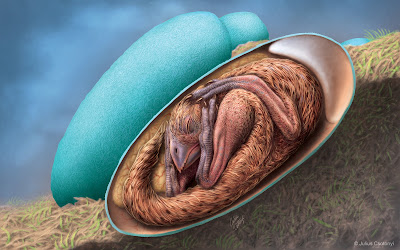
[Paleontology • 2021] An Exquisitely Preserved in-ovo Theropod Dinosaur Embryo sheds Light on Avian-like Prehatching Postures


in Xing, Niu, Ma, ... et Brusatte, 2021.

Artwork by Julius Csotonyi facebook.com/JuliusCsotonyi 

Highlights:
• A Late Cretaceous oviraptorid theropod dinosaur embryo is preserved in-ovo
• Its head lies ventral to the body, and the back curled along the egg's blunt pole
• Its posture is similar to that of a late-stage modern bird embryo
• Avian tucking behavior possibly originated among non-avian theropods

Summary
Despite the discovery of many dinosaur eggs and nests over the past 100 years, articulated in-ovo embryos are remarkably rare. Here we report an exceptionally preserved, articulated oviraptorid embryo inside an elongatoolithid egg, from the Late Cretaceous Hekou Formation of southern China. The head lies ventral to the body, with the feet on either side, and the back curled along the blunt pole of the egg, in a posture previously unrecognized in a non-avian dinosaur, but reminiscent of a late-stage modern bird embryo. Comparison to other late-stage oviraptorid embryos suggests that prehatch oviraptorids developed avian-like postures late in incubation, which in modern birds are related to coordinated embryonic movements associated with tucking — a behavior controlled by the central nervous system, critical for hatching success. We propose that such pre-hatching behavior, previously considered unique to birds, may have originated among non-avian theropods, which can be further investigated with additional discoveries of embryo fossils.


Lida Xing, Kecheng Niu, Waisum Ma, Darla K. Zelenitsky, Tzu-Ruei Yang and Stephen L. Brusatte. 2021. An Exquisitely Preserved in-ovo Theropod Dinosaur Embryo sheds Light on Avian-like Prehatching Postures. iScience.  DOI: 10.1016/j.isci.2021.103516

Friday, August 13, 2021

[Paleontology • 2021] Silutitan sinensis & Hamititan xinjiangensis • The First Dinosaurs from the Early Cretaceous Hami Pterosaur Fauna, China


 Silutitan sinensis & Hamititan xinjiangensis 
Wang, Bandeira, Qiu, Jiang, Cheng, Ma & Kellner, 2021


Abstract
The Early Cretaceous Hami Pterosaur Fauna in Northwest China preserves a large number of specimens of the sexually dimorphic pteranodontoid pterosaur Hamipterus tianshanensis, including 3D eggs and embryos. During the last decade, several more fossils have been collected in this area, including three somphospondylan sauropod specimens. The first is Silutitan sinensis gen. et sp. nov., which consists of an articulated middle to posterior cervical vertebrae series. The second, Hamititan xinjiangensis gen. et sp. nov., consists of an incomplete articulated caudal sequence that could be assigned to lithostrotian titanosaurs based on the strongly procoelous caudal vertebrae with lateral concave surface, as well as marked ventrolateral ridges. The third specimen consists of four sacral vertebral elements, apparently unfused, with exposed camellate internal bone and regarded as somphospondylan. Cladistic analyses based on different datasets recovered Silutitan sinensis as an euhelopodid closely related to Euhelopus and Hamititan xinjiangensis as a titanosaur. Besides the pterosaur Hamipterus and one theropod tooth, these dinosaurs are the first vertebrates reported in this region, increasing the diversity of the fauna as well as the information on Chinese sauropods, further supporting a widespread diversification of somphospondylans during the Early Cretaceous of Asia.

All specimens described in this paper shown in one outline of a generic titanosaur: preserved cervical elements of Silutitan sinensis gen. et sp. nov. (IVPP V27874) (red), preserved caudal elements of Hamititan xinjiangensis gen. et sp. nov. (HM V22) (yellow) and the preserved sacral elements (IVPP V27875) (green).
 Image credit: Maurílio Oliveira.

Map showing the fossil site where the new sauropod dinosaur specimens were collected (A,B), and the relative positions of these three specimens (C).

Systematic paleontology
SAUROPODA Marsh, 1878
NEOSAUROPODA Bonaparte, 1986
TITANOSAURIFORMES Salgado et al., 1997

SOMPHOSPONDYLI Wilson & Sereno, 1998
EUHELOPODIDAE Romer, 1956 (sensu D’Emic, 2012)


Silutitan gen. nov.

Type species. Silutitan sinensis sp. nov., type by monotypy.

Etymology. Silu” means the “Silk Road” in Chinese Mandarin pinyin, in memory the great trade routes which connected the East and West. “titan” means giant in Greek, symbolic of the large size of this genus.

Silutitan sinensis new species.

Etymology. "sinensis" refers to China, in Latin.

Holotype. An articulated series of six cervical vertebrae (IVPP V27874) with almost all cervical ribs, housed at IVPP (Figs. 2, 3; Table 1).

Locality and Horizon. Hami, Xinjiang, China; Lower Cretaceous Shengjinkou Formation (Tugulu Group).

Diagnosis. An euhelopodid sauropod exhibiting the following autapomorphies found in the cervical vertebrae: (1) ventrolaterally bifurcated postzygodiapophyseal laminae [PODL] in middle to posterior cervical vertebrae, (2) anteriorly bifurcated posterior centrodiapophyseal laminae [PCDL] on the four posterior-most cervical vertebrae, (3) parapodiapophyseal laminae [PPDL] forming developed ventral flanges, (4) contact surface of diapophysis and tuberculum in the middle and posterior cervical vertebrae constricted on anterior and posterior faces. It is further characterized by the following combination of characters: cervical vertebrae with developed epipophyses, prezygodiapophyseal laminae anteriorly projected, lateral pneumatic fossae on centra restricted anteriorly, neural arches with two fossae bordered by the epipophyseal-prezygapophyseal laminae, and the neural spines reduced anteroposteriorly.


SOMPHOSPONDYLI Wilson & Sereno, 1998
TITANOSAURIA Bonaparte & Coria, 1993

Hamititan gen. nov.

Type species. Hamititan xinjiangensis sp. nov., type by monotypy.

Etymology. Hami” refers to Hami city where the specimen was found, “titan”, from the giants of the Greek myths and commonly used to name titanosaur taxa.

Hamititan xinjiangensis new species.

Etymology. xinjiangensis”, refers to Xinjiang, China.

Holotype. An articulated series of seven anterior to middle caudal (HM V22), including the proximal portions of three chevrons, housed at Hami Museum (Figs. 2, 4; Table 2).

Locality and Horizon. Hami, Xinjiang, China; Lower Cretaceous Shengjinkou Formation (Tugulu Group).

Diagnosis. A titanosaur sauropod exhibiting the following autapomorphies: (1) tall neural arches with the neural arch higher than the height of the centrum, (2) neural arch on the anteriormost caudal sagittally expanded, (3) deep postzygapophyseal spinodiapophyseal fossa [POSDF] presenting inner open cavities on the anteriormost caudal vertebrae, (4) transverse processes on most anterior caudal vertebrae directed upwards, (5) abruptly change of orientation of the transverse processes from upward (see 3) to downwards. The new species is further characterized by the following combination of characters: prezygapophyses on the caudal vertebrae projecting mainly anterodorsally; and short transverse processes compressed anteroposteriorly and directed laterally.


Conclusions: 
The discovery of Silutitan sinensis and Hamititan xinjiangensis increased the sauropod diversity of Asia, particularly from an area where these vertebrates are not common. Silutitan sinensis is closely related to Euhelopus. The existence of a more inclusive clade of similar sauropods (Euhelopodidae) is still a matter of debate and pends on more detailed description of some putative euhelopodid.

Hamititan xinjiangensis is one of the few titanosaurian sauropod recovered from Asia, which shows an unusual combination of sauropod features. The presence of two somphospondylan species in the Tugulu Group novel information on somphospondylan evolution and provides further support for a widespread diversification of these sauropods during the Early Cretaceous of Asia.


Xiaolin Wang, Kamila L. N. Bandeira, Rui Qiu, Shunxing Jiang, Xin Cheng, Yingxia Ma and Alexander W. A. Kellner. 2021. The First Dinosaurs from the Early Cretaceous Hami Pterosaur Fauna, China. Scientific Reports. 11, 14962. DOI: 10.1038/s41598-021-94273-7
Xiaolin Wang, Alexander W.A. Kellner, Shunxing Jiang, ... et Zhonghe Zhou. 2014. Sexually Dimorphic Tridimensionally Preserved Pterosaurs and Their Eggs from China. Current Biology. DOI: 10.1016/j.cub.2014.04.054

Wednesday, December 30, 2020

[Paleontology • 2021] An Oviraptorid Preserved Atop An Embryo-bearing Egg Clutch sheds light on the Reproductive Biology of Non-avialan Theropod Dinosaurs


 an oviraptorid specimen [LDNHMF2008]
consisting of an adult skeleton preserved atop an embryo-bearing egg clutch. 

Bi, Amiot, Peyre de Fabrègues, ... et Xu, 2020.
 Artwork by Zhao Chuang. english.IVPP.cas.cn

 
Abstract
Recent studies demonstrate that many avialan features evolved incrementally prior to the origin of the group, but the presence of some of these features, such as bird-like brooding behaviours, remains contentious, in non-avialan dinosaurs. Here we report the first non-avialan dinosaur fossil known to preserve an adult skeleton atop an egg clutch that contains embryonic remains. The preserved positional relationship of the adult to the clutch, coupled with the advanced growth stages of the embryos and their high estimated incubation temperatures, provides strong support for the brooding hypothesis. Furthermore, embryos in the clutch are at different developmental stages, suggesting the presence of asynchronous hatching—a derived feature even among crown-group birds—in non-avialan theropods. These findings demonstrate that the evolution of reproductive biology along bird-line archosaurs was a complex rather than a linear and incremental process, and suggest that some aspects of non-avialan theropod reproduction were unique to these dinosaurs.

Keywords: Oviraptorosauria, Cretaceous, Clutch, Brooding, Embryos, Asynchronous hatching


Fig. 1. LDNHMF2008, an oviraptorid specimen consisting of an adult skeleton preserved atop an embryo-bearing egg clutch.
(a) Photograph. (b) Interpretive drawing with bones and gastroliths in white and eggs color-coded by ring (A, red; B, green; C, blue).
(c) Restoration (white indicates bones preserved in the adult skeleton).

Abbreviations: I, digit I; II, digit II; III, digit III; A#, egg in lowermost ring (A); as, astragalus; B#, egg in middle ring (B); C#, egg in uppermost ring (C); cav, caudal vertebra; ch, chevron; cv, cervical vertebra; di, manual digit; dr, dorsal ribs; dv, dorsal vertebra; em, egg known to preserve embryo; fe, femur; fi. fibula; ga, gastralium; gl, gastroliths; h, humerus; il, ilium; is, ischium; mt, metatarsal; O2, egg sampled for oxygen isotope analysis; pb, pubis; pp, pedal phalanges; ra, radius; sl, semilunate carpal; ti, tibia; ul, ulna. Note that C11 and C12 are not paired eggs. The eggs that would have been paired with C11 and C12 are probably not preserved, as is the case for some other eggs and skeletal elements.
 

An attentive oviraptorid theropod dinosaur broods its nest of blue-green eggs while its mate looks on in what is now Jiangxi Province of southern China some 70 million years ago.
 Artwork by Zhao Chuang.


 Shundong Bi, Romain Amiot, Claire Peyre de Fabrègues, Michael Pittman, Matthew C. Lamanna, Yilun Yu, Congyu Yu, Tzuruei Yang, Shukang Zhang, Qi Zhao and Xing Xu. 2020. An Oviraptorid Preserved Atop An Embryo-bearing Egg Clutch sheds light on the Reproductive Biology of Non-avialan Theropod Dinosaurs. Science Bulletin. In Press. DOI: 10.1016/j.scib.2020.12.018

Researchers Announce World’s First Dinosaur Preserved Sitting on Nest of Eggs that Includes Fossilized Babies

Wednesday, October 7, 2020

[Paleontology • 2020] Oksoko avarsan • A New Two-fingered Dinosaur sheds light on the Radiation of Oviraptorosauria


Oksoko avarsan
Funston, Chinzorig, Tsogtbaatar, Kobayashi, Sullivan & Currie, 2020

Illustration: Michael W. Skrepnick


Abstract
Late Cretaceous trends in Asian dinosaur diversity are poorly understood, but recent discoveries have documented a radiation of oviraptorosaur theropods in China and Mongolia. However, little work has addressed the factors that facilitated this diversification. A new oviraptorid from the Late Cretaceous of Mongolia sheds light on the evolution of the forelimb, which appears to have played a role in the radiation of oviraptorosaurs. Surprisingly, the reduced arm has only two functional digits, highlighting a previously unrecognized occurrence of digit loss in theropods. Phylogenetic analysis shows that the onset of this reduction coincides with the radiation of heyuannine oviraptorids, following dispersal from southern China into the Gobi region. This suggests expansion into a new niche in the Gobi region, which relied less on the elongate, grasping forelimbs inherited by oviraptorosaurs. Variation in forelimb length and manus morphology provides another example of niche partitioning in oviraptorosaurs, which may have made possible their incredible diversity in the latest Cretaceous of Asia.

Keywords: forelimb evolution, Theropoda, Late Cretaceous, Oviraptoridae, digit reduction


Figure 1. Holotype block of Oksoko avarsan MPC-D 102/110. (a,b) Holotype block with skeletons in ventral view. Colours distinguish different individuals; the holotype individual is in blue.

Figure 2. Skeletal anatomy of Oksoko avarsan.
(a) Skeletal reconstruction. (b,c) Skull of MPC-D 102/110.a in left lateral view. (d) Anterior cervical vertebra of MPC-D 102/12 in left lateral view. (e) Articulated sacrum and ilium of MPC-D 102/11 in ventral view, anterior is to the left. (f) Mid-caudal vertebra of MPC-D 102/12 in left lateral view. (g) Pygostyle vertebrae of MPC-D 102/12 in left lateral view. (h) Right scapulocoracoid of MPC-D 100/33 in lateral view. (i) Furcula of MPC-D 100/33 in anterior view. (j) Right and left sternal plates of MPC-D 100/33 in anterior view. (k) Articulated pelvis of MPC-D 102/11 in right lateral view. (l) Right femur of MPC-D 102/12 in posterior view. (m) Proximal metatarsus and distal tarsals of MPC-D 102/12 in proximal view. (n) Tibia, fibula and pes of MPC-D 102/11 in ventral view.
acr, acromion process; astr, astragalus; bt, biceps tubercle; calc, calcaneum; cor, coracoid; corf, coracoid foramen; cr, cervical rib; crtb, ceratobranchial; cs, caudosacral vertebrae; dent, dentary; dist, distal end; dor, dorsal vertebrae; ds, dorsosacral; dt III, distal tarsal III; dt IV, distal tarsal IV; epi, epipophysis; epic, epicleidum; fib, fibula; for, foramen; fr, frontal; glen, glenoid; gt, greater trochanter; h, head; hypc, hypocleidum; idpf, infradiapophyseal fossa; il, ilium; isc, ischium; I–IV, pedal digits I–IV; lat, lateral trabecula; mt II–IV, metatarsals II–IV; mx, maxilla; nas, nasal; ns, neural spine; p1–p3, pygostyle vertebrae 1–3; par, parietal; ?path, possible pathology; pbt, pubic boot; pdp, proximodorsal process; pl, pleurocoel; pmx, premaxilla; pop, popliteal fossa; post, postorbital; prox, proximal end; pub, pubis; q, quadrate; qj, quadratojugal; sac, sacral vertebrae; scap, scapula; spdf, supradiapophyseal fossa; stcp, sternocoracoidal process; tib, tibia; tp, transverse process.


Theropoda Marsh 1881 
Oviraptorosauria Barsbold 1976
Oviraptoridae Barsbold 1976
Heyuanninae (=Ingeniinae) Barsbold 1981

Oksoko avarsan gen. et sp. nov. 

Diagnosis. Oksoko avarsan is a small oviraptorid oviraptorosaur distinguished from other oviraptorosaurs by the following suite of autapomorphies (*) and other characters: apically thickened, dome-shaped cranial crest composed equally of nasals and frontals (figure 2)*; nasal recesses housed in a depression; postorbital with dorsally directed frontal process; cervical vertebrae with large epipophyses; functionally didactyl manus (figure 3)*; accessory ridge of brevis fossa of ilium*; anteriorly curving pubis; and large proximodorsal process of distal tarsal IV.

Etymology. Oksoko (pronounced ‘Oak-soak-oh') from the three-headed eagle of Altaic mythology, in reference to the fact that the holotype assemblage preserves three skulls; the specific name avarsan is from the Mongolian word ‘аварсан' (avarsan: rescued), reflecting their confiscation from poachers and/or smugglers.


Holotype. Institute of Paleontology, Mongolia (MPC-D) 102/110a, a nearly complete juvenile skeleton missing only the distal half of the tail (figures 1–3), preserved in an assemblage of four individuals.

Referred specimens. MPC-D 100/33, partial subadult postcranial skeleton; MPC-D 102/11, partial juvenile skeleton with skull; MPC-D 102/12, adult postcranial skeleton; MPC-D 102/110b, nearly complete juvenile skeleton; MPC-D 102/110c, partial juvenile postcranial skeleton (figures 1–3).

Localities and Horizon. Bugiin Tsav and Guriliin Tsav, Nemegt Basin. Nemegt Formation (lower Maastrichtian).

Figure 3. Forelimb elements of Oksoko avarsan.
 (a,b) Left humerus of MPC-D 100/33 in anterior (a) and lateral (b) views. (c) Right radius, ulna and manus of MPC-D 102/110.a in lateral view. (d) Left carpals and manus of MPC-D 102/110.a in dorsal (extensor) view. (e) Left metacarpal III of MPC-D 102/110.a in medial view. (f) Left manual phalanx III-1 of MPC-D 102/110.a in lateral (top), proximal (right), dorsal (bottom) and distal (left) views. (g) Semilunate carpal and sesamoid ossicles of MPC-D 102/110.a in proximal view. (h) Range of motion of digits I (white) and II (grey) of Oksoko avarsan based on manual manipulation, in full extension (top) and full flexion (bottom).
 dc, distal condyle; dist, distal end; dp, dorsal process; dpc, deltopectoral crest; ecte, ectepicondylar tuber; ente, entepicondylar tuber; h, head; I-1, manual phalanx I-1; I-2, manual ungual I-2; II-1, manual phalanx II-1; II-2, manual phalanx II-2; II-3, manual ungual II-3; III-1, manual phalanx III-1; mc I–III, metacarpals I–III; ole, olecranon; prox, proximal end; rad, radius; rade, radiale; sed, sediment; ses, sesamoid ossicles; slc, semilunate carpal; uln, ulna. Scale bars as indicated.


Gregory F. Funston, Tsogtbaatar Chinzorig, Khishigjav Tsogtbaatar, Yoshitsugu Kobayashi, Corwin Sullivan and Philip J. Currie. 2020. A New Two-fingered Dinosaur Sheds Light on the Radiation of Oviraptorosauria. Royal Society Open Science. DOI: 10.1098/rsos.201184
 
Newly Discovered Toothless, Two-Fingered Dinosaur’s Lost Digits Point to Spread of Parrot-Like Species


Friday, April 17, 2020

[Paleontology • 2019] Xingtianosaurus ganqi • A New Caudipterid from the Lower Cretaceous of China with Information on the Evolution of the Manus of Oviraptorosauria


Xingtianosaurus ganqi
Qiu, Wang, Wang, Li, Zhang & Ma, 2019

Illustration: Dmitry Tokalchik

Abstract
Caudipteridae is a basal clade of Oviraptorosauria, all known species from the Early Cretaceous Jehol Biota of northeastern China. They were one of the first feathered dinosaur groups discovered, and possessed avian-like pennaceous remiges and rectrices. Their discovery provided significant information on early oviraptorosaurian evolution and the origins of birds and feathers. Here we describe a new caudipterid species Xingtianosaurus ganqi gen. et sp. nov. from the Lower Cretaceous Yixian Formation of Liaoning Province, China. This new taxon differs from other caudipterids by a small pleurocoel close to the dorsal edge of the lateral surface of the dorsal vertebrate centrum, a humerus longer than the scapula, a proportionally long ulna, a relatively small radiale angle, and a relatively short metacarpal I. The phylogenetic results shows X. ganqi is an early diverging caudipterid. It exhibits a mosaic morphology, providing new morphological information on early manual evolution of Oviraptorosauria, and giving new light on the evolution of radiale angle among Coelurosauria.

Figure 1: The holotype of Xingtianosaurus ganqi gen. et sp. nov. (IVPP V13390).
(a) Photograph. (b) line drawing.
Scale bar: 100 mm. cdv, caudal vertebrate; dv, dorsal vertebrate; fe.l left femur; fe.r, right femur; fi.l left fibula; fi.r, right fibula; gas, gastralia; hu.l left humerus; hu.r, right humerus; il.l, left ilium; is.l left ischium; mcI.l left metacarpal I; mcI.r, right metacarpal I; mcII.l left metacarpal II; mcII.r, right metacarpal II; mcIII.l left metacarpal III; mcIII.r, right metacarpal III; mtI.l left metatarsal I; mtI.r, right metatarsal I; mtII.l left metatarsal II; mtII.r, right metatarsal II; mtIII.l left metatarsal III; mtIII.r, right metatarsal III; mtIV.l left metatarsal IV; mtIV.r, right metatarsal IV; mtV.l left metatarsal V; ph3d32.r, right phalanx II-3; ph3d3.r, right phalanx III-3; ph3d4.r, right phalanx III-4; pu, pubis; ra.l left radius; ra.r, right radius; sca.l, left scapula; st, sternum; ti.l left tibia; ti.r, right tibia; ul.l left ulna; ul.r, right ulna. 
(Photograph by Gao Wei, drawing by R.Q).

Systematic palaeontology
Oviraptorosauria Barsbold, 1976
Caudipteridae Zhou et Wang, 2000

Xingtianosaurus gen. nov

Etymology: XingTian, a Chinese deity recorded in Shanhaijing who continued to fight even after his head had been cut off, in reference to the skull-less holotype; saurus, Greek for lizard.

Type species: Xingtianosaurus ganqi

Diagnosis: A caudipterid dinosaur distinguished from other caudipterid taxa by the following combination of characters: small pleurocoel close to the dorsal edge of the lateral surface of the dorsal vertebral centrum, humerus longer than the scapula, proportionally long ulna (as long as humerus), relatively small radiale angle (39°, compared to >48° in other oviraptorosaurs with known radiale angle), extremely short metacarpal I (<40% length of the metacarpal II), small ligament pits on the manual phalanges.

Xingtianosaurus ganqi sp. nov.

Etymology: Ganqi, the weapon of Xingtian recorded in Shanhaijing.

Holotype: IVPP (Institute of Vertebrate Paleontology and Paleoanthropology) V13390 (Fig. 1). A partial skeleton, missing the skull, cervical vertebrae, anterior dorsal vertebrae and coracoids.

Locality and horizon: Wangjiagou, Yixian County, Liaoning Province. The Dakangpu Bed (same horizon to Dawangzhangzi Bed) of Yixian Formation, Lower Cretaceous (Fig. 2).


Rui Qiu, Xiaolin Wang, Qiang Wang, Ning Li, Jialiang Zhang and Yiyun Ma. 2019. A New Caudipterid from the Lower Cretaceous of China with Information on the Evolution of the Manus of Oviraptorosauria. Scientific Reports. 9, 6431. DOI: 10.1038/s41598-019-42547-6


Thursday, February 7, 2019

[Paleontology • 2019] Gobiraptor minutus • A New Baby Oviraptorid Dinosaur (Dinosauria: Theropoda) from the Upper Cretaceous Nemegt Formation of Mongolia


Gobiraptor minutus 
Lee, Lee, Chinsamy, Lü, Barsbold & Tsogtbaatar, 2019


Abstract
Recent discoveries of new oviraptorosaurs revealed their high diversity from the Cretaceous Period in Asia and North America. Particularly, at the family level, oviraptorids are among the most diverse theropod dinosaurs in the Late Cretaceous of Mongolia and China. A new oviraptorid dinosaur Gobiraptor minutus gen. et sp. nov. from the Upper Cretaceous Nemegt Formation is described here based on a single holotype specimen that includes incomplete cranial and postcranial elements. The most prominent characters of Gobiraptor are its thickened rostrodorsal end of the mandibular symphysis and a rudimentary lingual shelf on each side of the dentary. Each lingual shelf is lined with small occlusal foramina and demarcated by a weakly developed lingual ridge. This mandibular morphology of Gobiraptor is unique among oviraptorids and likely to be linked to a specialized diet that probably included hard materials, such as seeds or bivalves. The osteohistology of the femur of the holotype specimen indicates that the individual was fairly young at the time of its death. Phylogenetic analysis recovers Gobiraptor as a derived oviraptorid close to three taxa from the Ganzhou region in southern China, but rather distantly related to other Nemegt oviraptorids which, as the results of recent studies, are also not closely related to each other. Gobiraptor increases diversity of oviraptorids in the Nemegt Formation and its presence confirms the successful adaptation of oviraptorids to a mesic environment.

Fig 4. Postcranial elements of the holotype specimen (MPC-D 102/111) of Gobiraptor minutus gen. et sp. nov.
 (A) Skeletal reconstruction in left lateral view (missing and damaged portions of the bones in gray). (B) Left ilium in lateral view. (C) Proximal caudal vertebrae in left lateral view with close-up of the infraprezygapophyses. (D) Chevron in cranial view. (E-F) Right scapula in dorsal (E) and lateral (F) views. (G) Last sacral and the two proximalmost caudals in left lateral view. (H) Right pubis in medial view. (I) Right ischium in lateral view. (J) Right femur in distal view. (K) Left metatarsus and distal tarsals in proximal view. (L) Right femur in cranial view. (M-N) Left metatarsus in lateral (M) and dorsal (N) views. 

Abbreviations: acr, acromion process; ant, antitrochanter; ch, chevron; cv, caudal vertebra(e); diprf, dorsal infraprezygapophyseal fossa; dt, distal tarsal(s); fct, cranial trochanter of femur; fh, femoral head; gl, glenoid fossa; idf, infradiapophyseal fossa; lc, lateral condyle; mc, medial condyle; mep, medial epicondyle; miprf, middle infraprezygapophyseal fossa; mt II, metatarsal II; mt IV, metatarsal IV; mt V, metatarsal V; ns, neural spine; obp, obturator process; pra, preacetabular process; pup, pubic peduncle; sprf, supraprezygapophyseal fossa; sv, sacral vertebra; tfc, tibiofibular crest; tp, transverse process; viprf, ventral infraprezygapophyseal fossa. Scale bars equal 10 cm in (A); 1 cm in (B-N).

Systematic paleontology

Dinosauria Owen, 1842
Theropoda Marsh, 1881
Maniraptora Gauthier, 1986

Oviraptorosauria Barsbold, 1976
Oviraptoridae Barsbold, 1976

Gobiraptor minutus gen. et sp. nov.

Etymology: The generic name Gobiraptor is a combination of ‘Gobi’ which refers to the Gobi Desert where the holotype specimen was found and ‘raptor’ which is Latin for thief. The specific name ‘minutus’ is Latin for small and refers to the small size of the holotype specimen.

Holotype: The holotype specimen (MPC-D 102/111) (Figs 2–4, S2 and S3 Figs) consists of mostly incomplete cranial and postcranial elements including ventral parts of the premaxillae and maxillae, a tip of the right jugal, fused vomer, parts of articulated pterygoids and ectopterygoids, incomplete right palatine, central part of the left postorbital, partial right quadrate and quadratojugal, incomplete lower jaw, with most of its elements broken, the last sacral vertebra which is articulated with the two proximalmost caudal vertebrae, articulated but incomplete proximal caudal vertebrae, fragments of chevrons, partial right scapula and humerus, incomplete pelvic girdles, nearly complete both femora, complete left metatarsus with distal tarsals 3 and 4, incomplete left pedal digits I, III, and IV, and several unidentified fragments. MPC-D 102/111 was also found with other theropod skeletons including postcranial elements of alvarezsaurids and larger oviraptorids.


Type locality and horizon: Altan Uul III, Ömnögovi Province, Mongolia (Fig 1, S1 Fig). Upper Cretaceous Nemegt Formation.

Diagnosis: Gobiraptor minutus is an oviraptorid dinosaur diagnosed by the following unique set of characteristics (autapomorphies are marked with an asterisk): a flat articular surface for the quadratojugal on the quadrate*; rostrocaudally elongate dentary rostral to the external mandibular fenestra; extremely thickened rostrodorsal end of the mandibular symphysis with a caudal expansion of its dorsal surface *; a rudimentary lingual triturating shelf on each dentary bearing small occlusal foramina*; a weakly developed lingual ridge on each lingual shelf*; absence of any prominent symphyseal ventral process of the dentary; coronoid bone present; the rostral end of the coronoid bone wedging into the ventral surface of the dorsal ramus of the dentary*; cranial trochanter of the femur separated from the greater trochanter with a distinct furrow between them.
....


Conclusions: 
Gobiraptor minutus gen. et sp. nov. is a new derived oviraptorid represented by an incomplete skeleton including both cranial and postcranial elements. Gobiraptor is primarily distinguished from other oviraptorids by its dentary with the extremely thickened rostrodorsal end of the mandibular symphysis, lingual ridges and lingual shelves bearing occlusal foramina. The unique morphology of the mandible of Gobiraptor is probably closely related to a crushing-related feeding style and a specialized diet, which may have incorporated hard seeds or shelled organisms. Although Gobiraptor was recovered from the Nemegt Formation, its phylogenetic position showed a close relationship with three Ganzhou oviraptorids. The distant relationships among the Nemegt oviraptorids on the phylogenetic tree were reaffirmed in this study. Therefore, it is highly unlikely that the evolution of these unusually diverse animals was facilitated by a simple sympatric speciation. The presence of Gobiraptor in the Nemegt Formation, together with occurrences of other oviraptorids, also indicates that abundant oviraptorids lived in mesic environments and they were one of the most diverse and successful groups of dinosaurs in the Nemegt region.


 Sungjin Lee, Yuong-Nam Lee , Anusuya Chinsamy, Junchang Lü†, Rinchen Barsbold and Khishigjav Tsogtbaatar. 2019. A New Baby Oviraptorid Dinosaur (Dinosauria: Theropoda) from the Upper Cretaceous Nemegt Formation of Mongolia.  PLoS ONE. 14(2): e0210867. DOI: 10.1371/journal.pone.0210867

New oviraptorosaur species discovered in Mongolia phys.org/news/2019-02-oviraptorosaur-species-mongolia.html via @physorg_com