Showing posts with label Author: Suddee. Show all posts

Saturday, August 22, 2026

[Botany • 2026] Didymocarpus alboroseus, D. hongsonensis, D. mekongensis, D. niveus, ... • Ten New Species of Didymocarpus (Gesneriaceae: Didymocarpoideae) from Thailand


กระดิ่งดอยตุง Didymocarpus alboroseus Nangngam & de Bult; 
ข้าวก่ำภูวัว D. phuwuaensis Nangngam, D.J.Middleton & Suddee; 
ม่วงสามหมอก D. hongsonensis Nangngam, Punchay & Suksathan, 

in Nangngam, Middleton, Suksathan et Suddee. 2026.

Abstract
Ten new species of the genus Didymocarpus are described from Thailand: Didymocarpus alboroseus, D. flaviflorus, D. hongsonensis, D. kiewbangii, D. kwanjaiae, D. mekongensis, D. niveus, D. phuwuaensis, D. suchartii and D. vilaiwaniae. Full descriptions, distributions, ecology and colour plates are provided for all taxa. These additional new species increase the total number of Didymocarpus in Thailand to thirty-five species, and therefore, a key to the species of Didymocarpus in Thailand is also provided in this paper.

Keywords: Flora of Thailand, taxonomy, Didymocarpinae, Trichosporeae

Didymocarpus alboroseus Nangngam & de Bult:
A. habit showing leaves and dichasial cyme inflorescence; B. corolla shape; C. flower in bud and immature capsule.
Photographs: All by Thanakorn Wongsa.

Didymocarpus alboroseus Nangngam & de Bult, sp. nov.

Vernacular.— Krading doi tung (กระดิ่งดอยตุง)(Proposed here).

Etymology.— The specific epithet refers to the corolla colour with the white tube and lobes reddish brown to orange brownish inside.


Didymocarpus flaviflorus Nangngam, Suksathan & Rujich., sp. nov.

 This species is similar to Didymocarpus citrinus Ridl. in the corolla colour but they differ in corolla size (c. 3.5 cm long in Didymocarpus flaviflorus, 2–2.7 cm long in D. citrinus), calyx shape (tubular in Didymocarpus flaviflorus, lobes free in D. citrinus), and in leaf shape and margin (elliptic-oblong and denticulate in D. flaviflorus, ovate to ovate-lanceolate and serrate in D. citrinus).

Vernacular.— Krading lueang wiangchai (กระดิ่งเหลืองเวียงชัย) (Proposed here).
Etymology.— The specific epithet refers to the bright yellow corolla.


Didymocarpus hongsonensis Nangngam, Punchay & Suksathan:
A. habit and habitat; B. corolla front view and young fruits; C. corolla shape side view; D. opened flower showing stamens, staminodes and pistil; E. stamens showing anthers coherent.
Photographs: All by Kittiyut Punchay.

 Didymocarpus hongsonensis Nangngam, Punchay & Suksathan, sp. nov.

Vernacular.— Muang sam mok (ม่วงสามหมอก)(Proposed here).
Etymology.— The specific epithet refers to Mae Hong Son Province, the type locality.


Didymocarpus kiewbangii Nangngam & Suddee, sp. nov.

This species is similar to Didymocarpus insulsus Craib in general appearance and in having 5 free calyx lobes but differs in the leaf arrangement and a longer corolla (leaves opposite and corolla c. 3 cm long in D. kiewbangii, ternate and c. 2.5 cm long in D. insulsus).

Vernacular.— Muang si kieobang (ม่วงศรีเขียวบาง)(Proposed here).

Etymology.— The specific epithet is given in honour of Mr Wittawat Kiewbang, a former BKF staff member who has accompanied botanists to various parts of the country and contributed valuable photographs and specimens.


Didymocarpus kwanjaiae Nangngam & Suddee:
A. Habit and habitat; B. flower showing calyx and corolla shape; C. opened corolla showing stamens, staminodes and pistil; D. flower bud.
Photographs: All by Kwanjai Khammmongkol.

Didymocarpus kwanjaiae Nangngam & Suddee, sp. nov.

This species is similar to Didymocarpus middletonii Souvann., Soulad. & Tagane from Laos in the red corolla colour but differs in the calyx tube campanulate and glabrous (tube campanulate and glabrous in D. kwanjaiae, tube urceolate and with multicellular eglandular hairs in D. middletonii).

Vernacular.— Krading Daeng Phaseeda (กระดิ่งแดงผาสีดา)(Proposed here).

Etymology.— The specific epithet is given in honour of Dr Kwanjai Khammongkol, the former chief assistant of Phu Langka National Park and the collector of the known specimens.


Didymocarpus mekongensis Nangngam & Suddee, sp. nov.

 This species is similar to Didymocarpus biserratus Barnett in having a united and glabrous calyx tube and a funnelform and glabrous corolla but differs in having a symmetrical tubular white-cream and greenish-whitish calyx tube and a white corolla (asymmetrical green-maroon to purple campanulate calyx tube and dark violet corolla in D. biserratus). It is also similar to D. niveus in the white corolla but differs in the symmetrical calyx (asymmetrical in D. niveus) and corolla size (c. 2.5 cm long in D. mekongensis, c. 3.5 cm long in D. niveus).

Vernacular. — Krading Khao Lam Kong (กระดิ่งขาวลําโขง)(Proposed here).

Etymology.— The specific epithet refers to the Mekong Basin, the type locality.

Didymocarpus niveus Nangngam, Vidthay., Wongsa & Suddee:
 A. corolla front view; B. inflorescence, cyme 3–5-flowered; C. ovary and stigma. D. stamens showing anthers coherent and 2 longer staminodes.
Photographs: A–B by Pranee Nangngam; C by Thanakorn Wongsa.

Didymocarpus niveus Nangngam, Vidthay., Wongsa & Suddee, sp. nov.

This species is similar to Didymocarpus mekongensis Nangngam & Suddee in its white funnelform corolla but differs in having a longer calyx tube and corolla (calyx tube 8–10 mm long and corolla c. 3.5 cm long in D. niveus vs calyx tube c. 5 mm long and corolla c. 2.5 cm long in D. mekongensis).


Vernacular.— Krading Khao Khun Phawo (กระดิ่งขาวขุนพะวอ)(Proposed here).
Etymology.— The specific epithet refers to the snow-white colour of the corolla.


Didymocarpus phuwuaensis Nangngam, D.J.Middleton & Suddee:
 A. habit; B. capsules; C. inflorescence and front view of corolla; D. side view of corolla.
Photographs: All by Wittawat Kiewbang.

Didymocarpus phuwuaensis Nangngam, D.J.Middleton & Suddee, sp. nov.

  This species is similar to Didymocarpus formosus Nangngam & D.J.Middleton in the large paired bracts and funnelform corolla but differs in having bracts not embracing the calyx in bud, a ubular calyx tube, and a dark purple corolla (bracts embracing calyx in bud, campanulate calyx tube, and dark red maroon corolla in D. formosus).

Vernacular.— Khao kam phu wua (ข้าวกําภูวัว)(Proposed here).

Etymology.— The specific epithet refers to Phu Wua Wildlife Sanctuary, the type locality.


Didymocarpus suchartii Nangngam, Makerd & Suddee, sp.nov.

This species is similar to Didymocarpus megaphyllus Barnett in the corolla covered with multi-cellular glandular hairs but differs in having calyx lobes free, ovary with multicellular glandular hairs, corolla dark purple (calyx formed into a campanulate tube at base, ovary glabrous, corolla crimson-red in D. megaphyllus). Also similar to D. hongsonensisin having a dark purple funnelform corolla but differs in having calyx lobes free (formed into a tube at base in D. hongsonensis).

Vernacular.— Muang chan hom huan (ม่วงจันทร์หอมหวล)(Proposed here).
Etymology.— The specific epithet is given in honour of Mr Suchart Chanhomhual, who has contributed a lot to protecting plant diversity in Umphang District, and for his photographs and the type collection.


Didymocarpus vilaiwaniae Nangngam, Moungmaith. & Chamch., sp. nov.

This species is similar to Didymocarpus glandulosus (W.W.Smith) W.T.Wang var. minor (W.T.Wang) W.T.Wang from South China in general appearance and in having free calyx lobes and a salverform corolla but differs in leaf characters (leaves congested at the top of stem and silvery on upper surface in D. vilaiwaniae, scattered along stem and not silvery on upper surface in D. glandulosus var. minor).

Vernacular.— Muang Si Anusarn (ม่วงศรีอนุสาร)(Proposed here).

Etymology.— The specific epithet is given in honour of Associate Prof. Dr Vilaiwan Anusarnsunthorn, the founder of CMUB herbarium.


Pranee Nangngam, David J. Middleton, Piyakaset Suksathan and Somran Suddee. 2026. Ten New Species of Didymocarpus (Gesneriaceae: Didymocarpoideae) from Thailand. Thai Forest Bulletin (Botany). 54(2); 128-149. DOI: doi.org/10.20531/tfb.2026.54.2.13 [2026-08-19]

Friday, April 25, 2025

[Botany • 2025] Vrydagzynea suddeei (Orchidaceae: Goodyerinae) • A New Species from southeastern Thailand with field observations on its pollination biology


Vrydagzynea suddeei  Chuchuea & Seelanan

in Chuchuea et Seelanan, 2025.
เอื้องพรุสุดดี  ||  DOI: doi.org/10.11646/phytotaxa.698.1.2 

 Abstract
Vrydagzynea suddeei, a new species discovered at Trok Nong Nature Trail in Namtok Phlio National Park, Chanthaburi Province, Thailand, is described. Vrydagzynea suddeei is distinct from V. deliana in having larger, greyish-green leaves with a central silver stripe, and a labellum with entire apical margins, a minutely bilobed apex, and papillae on the upper surface. A detailed morphological description, illustrations, distribution, habitat, phenology, and a comparison with similar species are provided, along with a key to all known Vrydagzynea species in Thailand. Vrydagzynea suddeei employs females of sweat bee Lipotriches (Maynenomia) sp. as its pollinators, offers nectar as a reward, and is not capable of autonomous self-pollination or agamospermy.

Monocots, Cranichideae, endemism, floral reward, Halictidae, Orchidoideae, plant taxonomy, reproductive success


Vrydagzynea suddeei Chuchuea & Seelanan
เอื้องพรุสุดดี, เอื้องพรุตรอกนอง


CHANACHON CHUCHUEA and TOSAK SEELANAN. 2025. A New Species of Vrydagzynea (Orchidaceae: Goodyerinae) from southeastern Thailand with field observations on its pollination biology.  Phytotaxa. 698(1); 15-27. DOI: doi.org/10.11646/phytotaxa.698.1.2 [2025-04-22]


Saturday, November 30, 2024

[Botany • 2024] Chayamaritia sirindhorniana (Gesneriaceae) • A New Species from Northeastern Thailand


Chayamaritia sirindhorniana D.J.Middleton, Tetsana & Suddee, 

in Middleton, Tetsana, Puudjaa, Kerdkaew et Suddee, 2024.   
คำหยาดศรีสิรินธร  ||  DOI: doi.org/10.20531/tfb.2024.52.2.14 

Abstract
The new species Chayamaritia sirindhorniana (Gesneriaceae) is described from materials collected in Loei Province in Northeastern Thailand. As it is currently only known from the type locality, further exploration of the region is needed to assess its conservation status.

Keywords: Chayamaritia, Didymocarpoideae, Loei, new species


Chayamaritia sirindhorniana D.J.Middleton, Tetsana & Suddee

Chayamaritia sirindhorniana D.J.Middleton, Tetsana & Suddee, sp. nov.

Similar to Chayamaritia smitinandii (B.L.Burtt) D.J.Middleton in general appearance but differs in having the calyx completely covered by patent villous hairs except for the apex, lobes obtuse or rounded at apex (calyx densely appressed pubescent including at the apex, lobes acute or acuminate at apex in C. smitinandii), the corolla outside light purple, inside dark purplish red with 2 ventral yellow lines, distally light purple on lower lip (deep purple throughout, inside with 2 ventral yellow lines, distally deep to slightly paler purple on lower lip in C. smitinandii).

Etymology.— The specific epithet is given in honour of H.R.H. Princess Maha Chakri Sirindhorn for her dedication to, and encouragement of, the Flora of Thailand Project.


David J. Middleton, Naiyana Tetsana, Pachok Puudjaa, Orathai Kerdkaew, Somran Suddee. 2024. A New Species of Chayamaritia (Gesneriaceae) from Thailand. Thai Forest Bulletin (Botany). 52(2), 102–104. DOI: doi.org/10.20531/tfb.2024.52.2.14 


  ‘คำหยาดศรีสิรินธร’ พืชชนิดใหม่ของโลกนามพระราชทาน เทิดพระเกียรติกรมสมเด็จพระเทพรัตนราชสุดาฯ
 คำหยาดดอกม่วงเทิดพระเกียรติ ‘กรมสมเด็จพระเทพรัตนฯ’ ที่ทรงสนับสนุนโครงการพรรณพฤกษชาติประเทศไทย เผย ‘นักพฤษศาสตร์กรมอุทยานฯ’ ค้นพบร่วมกับทีมเจ้าหน้าที่ลาดตระเวนเขตรักษาพันธุ์ฯ ภูค้อ-ภูกระแต อ.หนองหิน จ.เลย ขึ้นบนเขาหินทราย ชี้เป็นพืชหายากควรค่าอนุรักษ์ เหตุประชากรขนาดเล็กพื้นที่จำเพาะ ...


Monday, November 4, 2024

[Botany • 2024] Thrixspermum anceps, T. bromeliforme, T. crassilabre, T. pardale, T. tortum, ... • Eleven Species of Thrixspermum (Orchidaceae: Vandeae: Aeridinae) newly recorded from Thailand


Thrixspermum anceps อื้องตะขาบเลื้อยเขานันT. bromeliforme เอื้องตะขาบลายเสือก้านยาว
T. duplocallosum เอื้องตะขาบขาวปากส้ม, T. merapohense อื้องตะขาบลิ้นยาว,
 T. pardale เอื้องเสือดาวน้อยT. patkaiense เอื้องตะขาบลายเสือT. pulchellum อื้องขาวอัญชลี

Thrixspermum crassilabre
 เอื้องตะขาบอินเดียT. lampongense อื้องแมงมุมเหลืองปากยาว, 
T. latisaccatum อื้องแมงมุมเหลืองกลีบม้วนT. tortum อื้องแมงมุมเลื้อยนรา

in Toolmal, Suddee, Culham, Utteridge et Schuiteman, 2024.

 Abstract

Eleven species of Thrixspermum are newly recorded from Thailand. Four belong to sect. ThrixspermumT. crassilabre (South-Western floristic region), T. lampongense (Eastern floristic region), T. latisaccatum (Peninsular), and T. tortum (Peninsular); and seven to sect. DendrocollaT. anceps (Peninsular), T. bromeliforme (of unknown provenance), T. duplocallosum (Peninsular), T. merapohense (Peninsular), T. pardale (Peninsular), T. patkaiense (Eastern), and T. pulchellum (Peninsular). Descriptions, photographs, and notes on distribution, ecology, phenology, vernacular names, and recognition are provided. Three names are lectotypified. Five species are considered to be uncommon in the wild: T. anceps, T. crassilabre, T. duplocallosum, T. patkaiense, T. tortum; and T. bromeliforme is known from cultivation and suspected to originate in Krabi Province, Peninsular Thailand.

Keyword: floristic regions, Indo-China, Indonesia, Malesia, Section Dendrocolla, Section Thrixspermum, taxonomy


Eleven species of Thrixspermum are newly recorded from Thailand. 

Sect. Thrixspermum
T. crassilabre (South-Western floristic region) เอื้องตะขาบอินเดีย
T. lampongense (Eastern floristic region) เอื้องแมงมุมเหลืองปากยาว, 
T. latisaccatum (Peninsular) เอื้องแมงมุมเหลืองกลีบม้วน
T. tortum (Peninsular) เอื้องแมงมุมเลื้อยนรา


Sect. Dendrocolla
T. anceps (Peninsular) อื้องตะขาบเลื้อยเขานัน
T. bromeliforme (of unknown provenance) เอื้องตะขาบลายเสือก้านยาว
T. duplocallosum (Peninsular) เอื้องตะขาบขาวปากส้ม
T. merapohense (Peninsular) เอื้องตะขาบลิ้นยาว
T. pardale (Peninsular) เอื้องเสือดาวน้อย
T. patkaiense (Eastern) เอื้องตะขาบลายเสือ
T. pulchellum (Peninsular) เอื้องขาวอัญชลี


Nopparut Toolmal, Somran Suddee, Alastair Culham, Timothy M.A. Utteridge and André Schuiteman. 2024. Eleven Species of Thrixspermum (Orchidaceae: Vandeae: Aeridinae) newly recorded from Thailand. Taiwania. 69(4); 506-521. taiwania.ntu.edu.tw/abstract/2030
 

Monday, October 14, 2024

[Botany • 2024] Microchirita radiata, M. simia, etc. • Four New Species of Microchirita (Gesneriaceae: Didymocarpoideae) from Thailand


หยาดอรทัย Microchirita orathaiae Suddee, D.J.Middleton, Tetsana & Puudjaa;
หยาดพระโพธิสัตว์ M. radiata D.J.Middleton, Daonurai, Poompayak & Suddee;
หยาดวานรพักตร์ M. simia D.J.Middleton, Thananth., Tetsana & Suddee

in Middleton, Tetsana, Puudja, Thananthaisong, Daonurai, Poompayak et Suddee, 2024. 

Abstract
Four new species of Microchirita (Gesneriaceae) from Thailand are described: Microchirita orothaiae, M. puglisiae, M. radiata and M. simia. With the addition of these species, 41 species are now recorded for Thailand.

Keywords: endemic, karst limestone, Microchirita purpurea, M. tubulosa, taxonomy

Microchirita orathaiae Suddee, D.J.Middleton, Tetsana & Puudjaa:
A. Habit; B. Inflorescence; C. Flower, front view; D. Flower, back view.
 Photos by Naiyana Tetsana. 

Microchirita orathaiae Suddee, D.J.Middleton,Tetsana & Puudjaa, sp. nov.

Similar to Microchirita purpurea D.J.Middleton & Triboun in general appearance but differs in the corolla tube pale yellow at the very base inside, dark bluish purple ventrally, somewhat dorsoventrally compressed making corolla mouth wider than high, lateral lobes strongly reflexed (dark purple throughoutor only slightly paler inside at base, not or only slightly dorsoventrally compressed with the corolla mouth mostly as wide as high, lateral lobes erect, not reflexed in M. purpurea) and anthers glabrous (anthers densely long pubescent near junction of upper anther locules and filaments in M. purpurea). 
Type: Thailand, Rayong, Khao Chamao District, ...

Etymology.— The specific epithet is given in honour of the botanical artist Mrs Orathai Kerdkaew, a long-time staff member at BKF.
Vernacular.— Yat o ra thai (หยาดอรทัย) (proposedhere).

Microchirita puglisiae D.J.Middleton, Daonurai, Poompayak & Suddee:
A. Habit; B. Inflorescences; C. Flower, side view; D. Flower, front view.
Photos by Kerkwit Poompayak.

Microchirita puglisiae D.J.Middleton, Daonurai, Poompayak & Suddee, sp. nov.

Differs from all other Microchirita species in the combination of densely tomentose leaves, few-flowered inflorescences, white corolla lobes and narrow corolla tube flaring gradually towards the mouth. 

Type: Thailand, Saraburi, Phra Phutthabat District, ...

Etymology.— The specific epithet is given in honour of Dr Carmen Puglisi (MO) for her contribu-tion to the taxonomy of Thai Gesneriaceae, including in the genus Microchirita.
Vernacular.— Yat tham kra bok (หยาดถ้ำกระบอก) (proposed here).

Microchirita radiata D.J.Middleton, Daonurai, Poompayak & Suddee:
A. Habit; B. Inflorescence; C. Flower, front view; D. Flower, side view.
Photos by Kerkwit Poompayak.
 
Microchirita radiata D.J.Middleton, Daonurai, Poompayak & Suddee, sp. nov.

Similar to Microchirita tubulosa (Craib) A.Weber & D.J.Middleton in general appearance and the large primarily white flowers but differs in the corolla tube orange inside, darker orange ventrally, with many radial brown lines dorsally and ventrally (white or very pale yellow inside, yellow ventrally, without brown lines or these only either side of yellow ventral stripe or rarely with additional very pale lines or dots ventrally in M. tubulosa) and the glabrous anthers (densely white pubescent in M. tubulosa). 

Type: Thailand, Saraburi, Kaeng Khoi District, ...

Etymology.— The specific epithet refers to the brown lines radiating from the narrow part of the tube into the widened upper tube.
Vernacular.— Yat phra pho thi sat (หยาดพระโพธิสัตว์) (proposed here).

Microchirita simia D.J.Middleton, Thananth., Tetsana & Suddee:
A. Habit; B. Flower, side view; C. Flower, front view with purple bar on lower lip; D. Flower, front view without purple bar on lower lip.
Photos by Naiyana Tetsana.

M. simia D.J.Middleton, Thananth., Tetsana & Suddee, sp. nov.

Similar to Microchirita purpurea D.J.Middleton & Triboun in the shape and size of the corolla but differs in the distinctive bright yellow and purple corollas (purple throughout in M. purpurea) and glabrous stamens (hairy at filament insertion in M. purpurea). 

Type: Thailand, Lop Buri, ...
 
Etymology.— The specific epithet is Latin for monkey, in reference to the monkey-like face when viewing the corolla from the front.
Vernacular.— Yat wa non pak (หยาดวานรพักตร์) (proposed here).


David Middleton, Naiyana Tetsana, Pachok Puudja, Theerawat Thananthaisong, Kunanon Daonurai, Kerkwit Poompayak and Somran Suddee. 2024. Four more New Species of Microchirita (Gesneriaceae: Didymocarpoideae) from Thailand. Thai Forest Bulletin (Botany). 52(2), 80–88. DOI: doi.org/10.20531/tfb.2024.52.2.11


Friday, October 11, 2024

[Botany • 2024] Sophora phulangkaensis (Fabaceae: Sophoreae) • A New Species from Thailand based on morphological and molecular evidence


Sophora phulangkaensis Mattapha, K.Khamm. & Suddee, 

  in Mattapha, Suddee, Khammongkol et Kiewbang, 2024. 
พิษนาศน์ภูลังกา  ||  DOI: 10.3767/blumea.2024.69.02.03 

Abstract 
Sophora phulangkaensis is illustrated and newly described here. The species shows similarities with its congener, S. exigua, by having an obovate terminal leaflet and up to 15 leaflets but differs in the floral parts. A morphological comparison between the two species is provided along with a discussion. The phylogenetic placement of the new species is presented and discussed based on molecular evidence by nuclear (ITS) and chloroplast markers (matK). The results suggest that the new species is nested into sect. Rubriflorae, which includes S. exigua and S. huamotensis. The circumscription of sect. Rubriflorae is expanded after being redefined by our findings. In addition, the updated key to species of the genus Sophora for the Flora of Thailand is given based on recent specimen observations. Additionally, lectotypes for S. exigua, S. tonkinensis, and S. violacea var. pilosa are designated.

Keywords: Fabaceae; Leguminosae; Nakhon Phanom; Phulangka; Sophora; lectotypification; molecular phylogeny

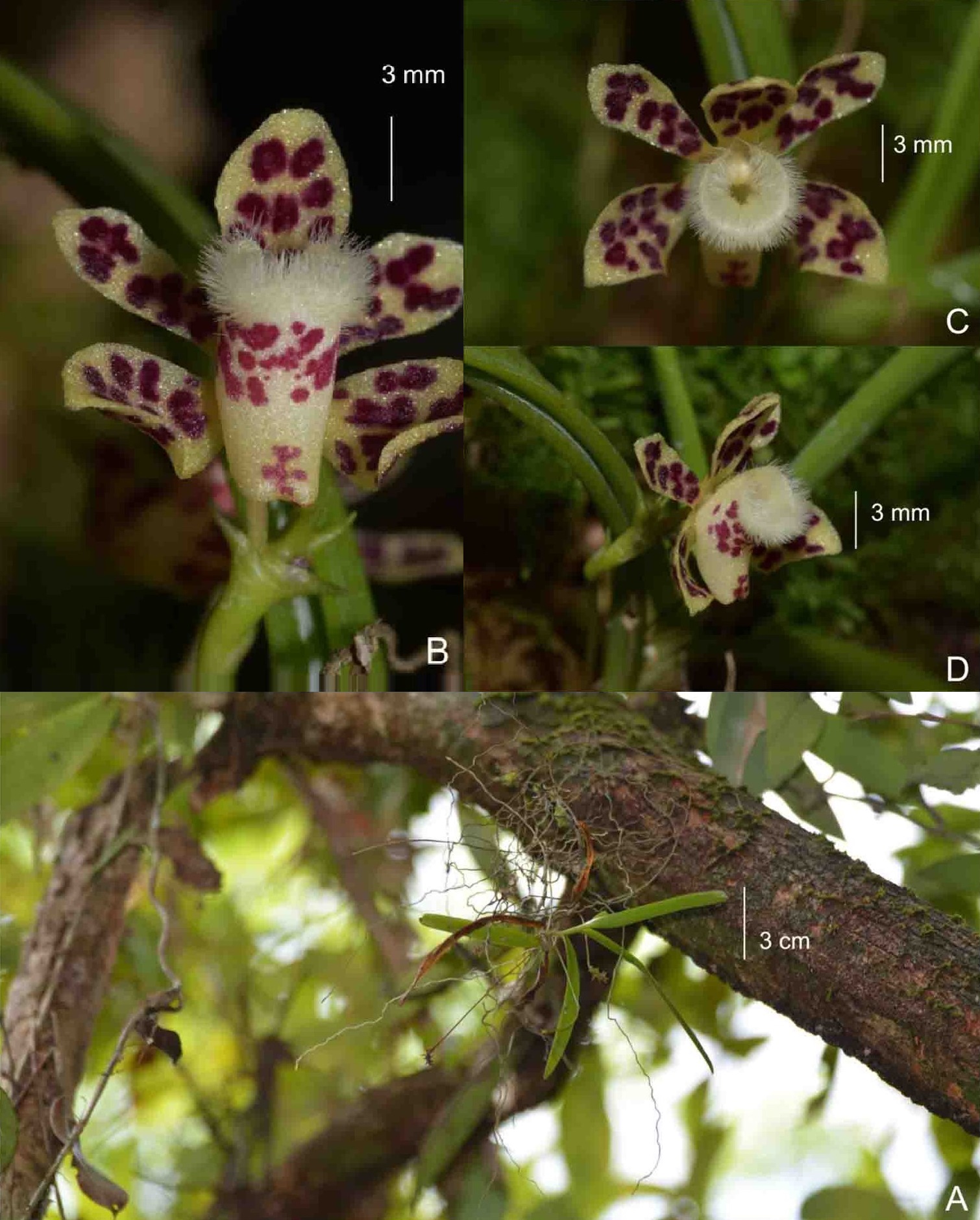
Sophora phulangkaensis Mattapha, K.Khamm. & Suddee.
a. Leaves at the flowering stage and inflorescence; b. flower; c. opened calyx showing outer surface; d. standard (side view); e. wing petals; f. keel petals; g. stamens; h. ovary; i. fruits
 (a–h: K. Khammongkol 211, BKF; i: S. Mattapha s.n., BKF, KKU). 
 Drawing by Orathai Kerdkaew.

Sophora phulangkaensis Mattapha, K.Khamm. & Suddee.
 a. Leaves and inflorescence; b. part of inflorescence; c. opened calyx; d. standard petals; e. wing petals; f. keel petals; g. stamens; h. ovary; i. infructescence and mature leaves.
 — Photographs by a. K. Khammongkol, b–h. W. Kiewbang, i. S. Mattapha.

Sophora phulangkaensis Mattapha, K.Khamm. & Suddee, sp. nov. 

 Closely related to S. exigua Craib, from which it differs by being a small shrub 0.5–2 m tall (vs undershrub up to 0.5 m tall in S. exigua), with sparse to dense hairs on midrib and margins of leaf blade (vs densely tomentose in S. exigua, particularly when young), presence of bracteoles (absent in S. exigua), the standard 15–16 mm long (18–20 mm long in S. exigua), filaments hairy at base with hairy anthers (glabrous in S. exigua), ovary densely strigose (tomentose in S. exigua) and longer pods (7–13 cm long vs 5–7 cm long in S. exigua). 

 Etymology. The specific epithet refers to the name of Phu Langka National Park, where the species was discovered.

 
  Mattapha, S.; Suddee, S.; Khammongkol, K. and Kiewbang, W. 2024. Taxonomic Notes on Sophora phulangkaensis, A New Species of Sophora (Fabaceae – Sophoreae) from Thailand based on morphological and molecular evidence.  Blumea - Biodiversity, Evolution and Biogeography of Plants. 69(2); 130–138. DOI: doi.org/10.3767/blumea.2024.69.02.03

พิษนาศน์ภูลังกา Sophora phulangkaensis Mattapha, K.Khamm. & Suddee 
พืชชนิดใหม่ของโลก จากภูลังกา จังหวัดนครพนม


Monday, August 26, 2024

[Botany • 2024] Dendrobium krabiense (Orchidaceae) • A New Species of Dendrobium sect. Crinifera from peninsular Thailand


Dendrobium krabiense P.O’Byrne ex H.A.Pedersen & Suddee, 

in Pedersen et Suddee, 2024.  

Abstract
A new species of Dendrobium sect. Crinifera is described from Thailand. The late Peter O’Byrne is appropriately credited for his important preparatory work for our study and for coining the name of the new species, D. krabiense. Apparently endemic to southern Thailand, D. krabiense is similar to D. pardalinum but differs in the lip mid-lobe being distinctly clawed and in the lip ornaments only consisting of two lateral keels that extend from near lip base to claw of mid-lobe. Dendrobium krabiense is also similar to D. phuketense but differs in having larger, spotted flowers with a proportionally longer mentum. The material here referred to D. krabiense was previously misidentified as Flickingeria pallens (now considered a synonym of D. pardalinum).

Keywords: Dendrobium krabiense, endemism, Flickingeria, Orchidaceae, systematics, taxonomy

Dendrobium krabiense P.O’Byrne ex H.A.Pedersen & Suddee.
A. Habit. B. Leaf tip. C. Inflorescence. D. Flower. E. Lip in side view. F. Lip in ventral view, side lobes artificially spread out.
Drawn from the type Seidenfaden & Smiti-nand GT 6465 (C), Seidenfaden & Smitinand GT 6327 (A–B) and Seidenfaden & Smitinand GT 6276 (D–F).
Illustration by Poul Juul; previously published in Dansk Botanisk Arkiv 34(1): 38 (1980).

Dendrobium krabiense P.O’Byrne ex H.A.Pedersen & Suddee, sp. nov.
 
Diagnosis: Dendrobium krabiense is similar to D. pardalinum but differs in the lip mid-lobe being distinctly clawed (vs. sessile) and in the lip having two lateral keels extending from near lip base to claw of mid-lobe (vs. one median and two lateral keels extending from near lip base to near mid-lobe apex). Dendrobium krabiense is also similar to D. phuketense, but differs in having larger, spotted flow-ers with a mentum that is proportionally longer in relation to the dorsal sepal.

Distribution: Apparently endemic to peninsular Thailand and small nearby islands (Fig. 3). However, as D. krabiense occurs close to Thailand’s southern border in Satun province, it should also be searched for in the northern part of Peninsular Malaysia.

Dendrobium krabiense P.O’Byrne ex H.A.Pedersen & Suddee. 
Flower of Seidenfaden & Smitinand GT 6461. 
Photograph by Gösta Kjellsson; previously published in Dansk Botanisk Arkiv 34(1): 96 (1980).

The known distribution of Dendrobium krabiense P.O’Byrne ex H.A.Pedersen & Suddee. 
Filled circles indicate individual occurrences documented by herbarium collections.


Henrik Æ. Pedersen and Somran Suddee. 2024. A New Species of Dendrobium sect. Crinifera (Dendrobieae) from Thailand. Lankesteriana: International Journal on Orchidology. 24(2), 199–203. DOI: 10.15517/lank.v24i2.61571


Monday, November 20, 2023

[Botany • 2016] Lysimachia kraduengensis (Primulaceae) • A New Species from northeastern Thailand


Lysimachia kraduengensis   Julius, Naiki & Tagane, 

in Julius, Naiki, Gutiérrez-Ortega, Suddee, Rueangruea, Yahara et Utteridge, 2016. 

Abstract
A new species of Primulaceae from Thailand, Lysimachia kraduengensis, is described and illustrated. It is morphologically similar to L. engleri, L. lancifolia, L. laxa and L. sikokiana in having solitary and axillary flowers, a yellow corolla, relatively long pedicels and basifixed anthers. The new species can be distinguished by the combination of its height, leaf texture, petiole, calyx and anther length, and brown coloration on the flowers. In addition, the conservation status, an updated key to Lysimachia species in Thailand, and discussion of the systematic placement of the new species based on the trnL-F marker of chloroplast DNA are provided.

Keywords: Eudicots, Ericales, Lysimachia, taxonomy, new species, molecular phylogeny, Indo-China, Loei Province


Lysimachia kraduengensis Julius, Naiki & Tagane sp. nov.


Avelinah Julius, Shuichiro Tagane Akiyo Naiki, José Said Gutiérrez-Ortega, Somran Suddee, Sukid Rueangruea, Tetsukazu Yahara and Timothy M. A. Utteridge. 2016. Lysimachia kraduengensis (Primulaceae), A New Species from northeastern Thailand. Phytotaxa. 289(1); 69–76. DOI:  10.11646/phytotaxa.289.1.5 
   

Wednesday, August 30, 2023

[Botany • 2023] Ehretia pranomiana (Boraginales: Ehretiaceae) • A New scrambler from Thailand


Ehretia pranomiana  Rueangs. & Suddee,

in Rueangsawang, Thananthaisong, Kaewmuan, Daonurai et Suddee, 2023.
"ก้อมอาจารย์น้อย"  DOI: 10.1111/njb.04010
 
Abstract
Ehretia pranomiana sp. nov. is illustrated and described from northern and south-western Thailand. The new species is similar to E. macrophylla and E. acuminata by having elliptic leaves with a serrate margin, but can be distinguished by being a scrambling shrub with densely hispid leaf blades, corymbose inflorescence with 4–10 flowers, corolla with erect lobes and calyx longer than fruit at maturity. An updated identification key to the species of Ehretia known from Thailand is provided.

Keywords: conservation, endemic, morphology, taxonomy


Ehretia pranomiana Rueangs. & Suddee
  "ก้อมอาจารย์น้อย" 


Kanokorn Rueangsawang,  Theerawat Thananthaisong,  Anusara Kaewmuan,  Kunanon Daonurai and  Somran Suddee. 2023. Ehretia pranomiana sp. nov. (Boraginales: Ehretiaceae), A New scrambler from Thailand. Nordic Journal of Botany. e04010. DOI: 10.1111/njb.04010
  facebook.com/DNP1362/posts/625491413097229
  thairath.co.th/news/society/2719251