Showing posts with label Author: M. Kottelat. Show all posts

Sunday, July 13, 2025

[Ichthyology • 2025] Sewellia pudens • A New Species of loach (Cypriniformes: Gastromyzontidae) from Dakchung Plateau, southern Laos


Sewellia pudens  
Kottelat, 2025
 
 Raffles Bulletin of Zoology. 73

Abstract
 Sewellia pudens, new species, is described from the Xe Kaman watershed on Dakchung Plateau, Sekong Province, southern Laos. It is distinguished from other species of the genus in having a yellowish brown body; no markings on the fins; in males, a patch of tubercles on the snout divided longitudinally by a deep groove; no modified pelvic-fin rays with dorsal bone extension. The mouth of Sewellia and the tubercles and ornamentation on the fins of several species are described; the ‘pelvic valve’ is figured. 

Key words. Cobitoidei, loach, pectoral fin, pelvic fin, tubercles, bony extensions

Sewellia pudens, MHNG 2799.022, holotype, 49.2 mm SL, male; Laos: Xe Kaman watershed, Dakchung Plateau. Tip of axillary pelvic lobe on left side damaged.

Sewellia pudens, new species
 
Diagnosis. Sewellia pudens is distinguished from all species of Sewellia by the poorly developed patterning of the body and fins. On the body, black pigments are present in a vague midlateral stripe and 3–8 small saddles on the back, especially on caudal peduncle. Some irregular markings are also present on the body of some specimens, but not forming a clear pattern. The fins of most specimens have no colour marks, except for thin black lining along rays in the dorsal, anal and caudal fins, and, rarely, 1 or 2 faint blotches along lower edge of the caudal fin. The pectoral and pelvic fins ...

Etymology. The Latin adjective ‘pudens’ means modest, humble, reserved, discreet. It refers to the absence of conspicuous pattern on the body and fins (compared to most other species of the genus) and the absence of ostentatious modification on pectoral- and pelvic-fin rays. Pudens is indeclinable.


MAURICE KOTTELAT. 2025. Sewellia pudens, A New Species of loach from Dakchung Plateau, southern Laos (Teleostei: Gastromyzontidae). Raffles Bulletin of Zoology. 73; 304–317.

Tuesday, July 1, 2025

[Ichthyology • 2025] Barbucca heokhuii • A New Species of loach (Teleostei: Barbuccidae) from central Borneo


 Barbucca heokhuii
 Kottelat, 2025
 
Raffles Bulletin of Zoology. 73

Abstract
 Barbucca heokhuii, new species, is described from the Kahayan drainage in central Borneo. It is distinguished from the other species of the genus by its miniature size (the largest known specimen is 21.5 mm SL), a truncate to rounded caudal fin, an incomplete lateral line, and a distinctive colour pattern made, among others, of five pairs of irregular bars on the flank, narrower than interspaces, many of which may be dissociated into several small blotches. It occurs in syntopy with B. diabolica. Sexual dimorphism is reported for the first time for a member of the family; in males, the 2nd to 4th branched pectoral rays are thicker than the others and with a patch of small tubercles along their posterior edge. 

Key words. Cobitoidei, loach, miniature fish, sexual dimorphism, black water, peat swamp forest

 Barbucca heokhuii, ZRC 66766, 16.2 mm SL; Borneo, Kalimantan Tengah: Kahayan drainage.
(Photographs by Tan H. H.).

Barbucca heokhuii, new species  

 Diagnosis. Barbucca heokhuiiis distinguished from the other named species of Barbucca by having: a smaller adult size (the largest known specimen is 21.5 mm SL, vs. 37.2 in B. diabolica and 34.3 in B. elongata), a deeper body (depth at dorsal-fin origin 17–21 % SL, vs. 14–18 in B. diabolica and B. elongata); a truncate to rounded caudal fin (vs. emarginated); the lateral line incomplete, reaching to below posterior half of dorsal fin (vs. complete); absence of large tubercles on head and body (vs. presence on posterior part of flank, between above the tip of the pelvic fins and the base of the caudal fin); anus about halfway between pelvic-fin base ...

Etymology. Named for Tan Heok Hui (LKCNHM) in appreciation for his work on Southeast Asian fishes, and especially fishes of peat swamp forests and loaches of Borneo, and for the long lasting friendship, collaboration and companionship in the field. 


MAURICE KOTTELAT. 2025. Barbucca heokhuii, A New Species of loach from central Borneo (Teleostei: Barbuccidae). Raffles Bulletin of Zoology. 73; 54–66.

Sunday, December 15, 2024

[Ichthyology • 2024] Kapuasia, A Genus Name for ‘Nemacheilusmaculiceps (Teleostei: Nemacheilidae) from the Kapuas Drainage on Borneo


Kapuasia maculiceps (Roberts, 1989)
 Kapuasia gen. nov.     

Kottelat & Tan, 2024   
  Raffles Bulletin of Zoology. 72   

 Abstract
 Kapuasia, new genus, is created to accommodate ‘Nemacheilus’ maculiceps, from the Kapuas drainage on Borneo. It is distinguished by the presence of a large suprapectoral flap above the pectoral fin, and its unique lip morphology. The lower lip has a continuous anterior edge, and its median part has 8–10 ridges on each side, radiating at the anterior extremity, across the whole lip, resulting in a crenulated inner edge of the lip. 

Key words. Cobitoidei, Nemacheilidae, Schistura, Borneo, stone loach


 Maurice Kottelat and Tan Heok Hui. 2024. Kapuasia, A Genus Name for ‘Nemacheilus’ maculiceps (Teleostei: Nemacheilidae). Raffles Bulletin of Zoology. 72; 105–109. 

Monday, December 18, 2023

[Ichthyology • 2023] Physoschistura mango • A New miniature Species of Loach (Cypriniformes: Nemacheilidae) from Myanmar


  Physoschistura mango
Conway & Kottelat, 2023
 
RAFFLES BULLETIN OF ZOOLOGY. 71

Abstract
 Physoschistura mango, new species, is described from Shan State, Myanmar. It is distinguished from congeners by having an extremely short and incomplete lateral-line canal on the body, with only 5–6 pores; several reductions in the cephalic lateral-line canal system; and by features of the colour pattern, including a dark black to brown horizontal stripe along body side combined with a bright orange-reddish background colour in mature males. With a maximum recorded length of 23.4 mm SL, it represents one of the smallest members of the family Nemacheilidae. 

Keywords. Cobitoidea, Shan State, scanning electron microscopy, miniaturisation

 Physoschistura mango, aquarium trade;
 A, TCWC 20684.01, male, 21.7 mm SL; B, female, not preserved, not measured.

Physoschistura mango, new species

Diagnosis. Physoschistura mango is distinguished from congeners by features of the adult sexually dichromatic colour pattern, comprising a solid dark brown to black horizontal stripe along body side (distinct in mature males only), and a series of small spots or irregular markings in females (vs. colour pattern not known to be sexually dichromatic, comprising a series of vertical bars, most obvious on posterior half of body), and by having a shorter lateral-line canal on the body (5–6 pores vs. 5–10 in Ph. brunneana, 29 in Ph. raoi, 56–57 in Ph. rivulicola, 16–37 in “Ph.” pseudobrunneana). It is further distinguished by a number of reductive features of the cephalic lateral-line canal system, including a shorter infraorbital canal, with 5–7 pores, restricted to a short series of ossicles associated with the ventral edge of the lachrymal (vs. ...

Etymology. Mango, the tree Mangifera indica in reference to the orange-yellow flesh of its fruit. A noun in apposition.

 
  Kevin W. Conway and Maurice Kottelat. 2023. Physoschistura mango, A New miniature Species of Loach from Myanmar (Teleostei: Nemacheilidae). RAFFLES BULLETIN OF ZOOLOGY. 71; 681–701. 

Saturday, November 4, 2023

[Ichthyology • 2023] Mystus celator • A New Species of Catfish (Siluriformes: Bagridae) from northern Myanmar


 Mystus celator
Ng & Kottelat, 2023


Abstract
Mystus celator sp. nov. is described from the Irrawaddy River drainage in northern Myanmar. It can be distinguished from congeners in having a combination of: three equally dark longitudinal stripes separated by two pale interspaces on sides of body; round, dark tympanic spot; ovoid, dark spot on caudal peduncle; length of adipose-fin base 18.0–23.3% SL; angle of predorsal profile 21–24°; posterior cranial fontanelle not reaching base of supraoccipital process; 25–30 rakers on the first branchial arch; and 35–36 vertebrae. The identity of Mystus pulcher is fixed with the designation of a lectotype.

Key words: Freshwater fishes, Irrawaddy River, Teleostei

 Mystus celator sp. nov., MHNG 2790.082, holotype, 80.6 mm SL;
Myanmar: Thein Lin Chaung at Thein Lin village.
Dorsal, lateral and ventral views.

Mystus celator sp. nov.
 
Diagnosis: Mystus celator sp. nov. is distinguished from congeners except for M. pulcher and M. rufescens in having a combination of three equally dark longitudinal stripes separated by pale interspaces on the sides of the body, a round, dark tympanic spot, and an ovoid, dark spot on the caudal peduncle (vs. at least one of these three features absent; Table 1). It differs from M. pulcher and M. rufescens in having a shorter adipose-fin base (18.0–23.3% SL vs. 27.5–49.1), with the following combination of characters further distinguishing it from congeners: angle between body axis and predorsal profile 21–24°, posterior cranial fontanel not reaching base of supraoccipital process, 25–30 rakers on the first branchial arch, and 35–36 vertebrae.

Etymology: The specific name comes from the Latin noun celator, meaning a concealer or hider, and is used in allusion to its close similarity to (and misidentification with) M. pulcher.


Heok Hee Ng and Maurice Kottelat. 2023. Mystus celator, A New Species of Catfish from northern Myanmar (Actinopterygii: Siluriformes: Bagridae). Vertebrate Zoology. 73: 981-990. DOI: 10.3897/vz.73.e110875


Wednesday, October 4, 2023

[Ichthyology • 2022] Nemacheilus pezidion • A New Species of Loach (Cypriniformes: Nemacheilidae) from southern Laos

 
Nemacheilus pezidion
Kottelat, 2022
 Nemacheilus pezidion, A 92-104. 


Abstract
Nemacheilus pezidion, new species, is described from the Xe Kong watershed, Mekong drainage, in Attapeu province, southern Laos. It is distinguished from all other Nemacheilidae in Southeast Asia by its unique colour pattern consisting of a black midlateral stripe and a middorsal row of 11–15 narrow saddles. Besides, the male has a globulous suborbital flap with tubercles along its posterior edge, and the pectoral fin with thickened anterior rays, and branched rays 1–4 and unculiferous pads behind them covered by small tubercles. It was found in habitats with moderate flow, on mud to gravel bottom. Nemacheilus pezidion was earlier misidentified as N. longistriatus.

Keywords: Pisces, Cobitoidei, Nemacheilus, Laos, Mekong, stone loach, sexual dimorphism

 
Nemacheilus pezidion, Laos: Xe Nam Noi: Xe Pian;
 a, MHNG 2787.088, holotype, 57.8 mm SL, male;
b, CMK 15687, paratype, 53.8 mm SL, female;
c, CMK 21330, paratype, 54.2 mm SL; female.


Nemacheilus pezidion, new species

Etymology. From the ancient Greek πεζίδιον (pezidion), a ribbon, reference to the black stripe along the flank. A noun in apposition.


Maurice Kottelat. 2022. Nemacheilus pezidion, A New Species of Loach from southern Laos (Teleostei: Nemacheilidae).  Zootaxa. 5129(1); 92-104. DOI: 10.11646/zootaxa.5129.1.5
 
https://wwfasia.awsassets.panda.org/downloads/wwf_greater_mekong_new_species_2021_2022_optimized.pdf
facebook.com/WWFMekong/posts/540740841604973

Friday, September 8, 2023

[Ichthyology • 2023] Schistura palma • A New Species of Loach (Cypriniformes: Nemacheilidae) from the Nam Ngiep Drainage, central Laos


 Schistura palma
 Kottelat, 2023

 RAFFLES BULLETIN OF ZOOLOGY. 71

Abstract
 Schistura palma, new species, is described from the middle Nam Ngiep drainage, central Laos. It is distinguished from all other species of Schistura in Southeast Asia by the combination of having a dorsal keel on the entire length of the caudal peduncle in small individuals that develops into a conspicuous crest in large ones; cheeks conspicuously swollen in large individuals; lips smooth or with short, shallow wrinkles, their free edge entire; 8½ branched dorsal-fin rays; 7–10 [commonly 8–9] uniformly dark brown bars on body; plain brown cheeks. It occurs in fast-flowing stretches of the main river and lower course of main tributaries.

 Key words. Cobitoidei, Schistura, Mekong basin, stone loach

 Schistura palma, new species, MHNG 2790.080, holotype, 63.5 mm SL;
 Laos: Saysomboune Province: Nam Ngiep watershed.

Schistura palma, new species

Diagnosis. Schistura palma is characterised among other named species of Schistura sensu lato in Indochina by the presence of a dorsal keel along the entire length of the caudal peduncle in small individuals, that develops into a conspicuous crest in large ones. A low keel or crest exists in some other species of the genus, but in these it is restricted to the posterior part of the caudal peduncle. Among Southeast Asian species, such a crest extending along the entire length of the caudal peduncle is known in S. porthos (Figs. 6, 7) from the Mekong drainage in northern Laos and Xishuangbanna in China, and in S. alticrista (Fig. 8) from the Salween drainage in Thailand.
...

Etymology. From the Latin palma, the blade of an oar, an allusion to the shape of the caudal peduncle and caudal fin in large adults. A noun in apposition.

 
Maurice Kottelat. 2023. Schistura palma, A New Species of Loach from the Nam Ngiep Drainage, central Laos (Teleostei: Nemacheilidae). RAFFLES BULLETIN OF ZOOLOGY. 71; 520–530.

Monday, February 27, 2023

[Ichthyology • 2023] Nemacheilus pullus • A New Species of Loach (Teleostei: Nemacheilidae) from central Laos


Nemacheilus pullus
 Kottelat, 2023

 RAFFLES BULLETIN OF ZOOLOGY. 71 

Abstract
 Nemacheilus pullus, new species, is described from the Nam Ngiep and Nam Xan watersheds, Mekong drainage, in central Laos. It was earlier misidentified as N. platiceps. It is distinguished from congeners in having an incomplete lateral line, with 23–57 pores, reaching between verticals of pelvic-fin origin and of anus; anterior nare at tip of a short tube; body plain yellowish grey in life in adults; a conspicuous suborbital flap in males; small tubercles on anterior pectoral-fin rays and on flank. It was found in habitats with moderate flow, usually small streams, on mud to stone bottoms. An informal platiceps group is recognised, including N. platiceps, N. cacao and N. pullus.

 Key words. Mekong, Nam Ngiep, Nam Xan

Nemacheilus pullus, Laos: Mekong drainage: Nam Ngiep watershed; before fixation;
a, CMK 27566, paratype, female, 51.9 mm SL;
b, CMK 27552, female, 54.6 mm SL.

Nemacheilus pullus, new species 
 
Diagnosis. Nemacheilus pullus is distinguished from all other species of the genus except N. platiceps and N. cacao in having an incomplete lateral line reaching between verticals of pelvic-fin origin and of anus, with 23–57 pores (vs. complete). Nemacheilus pullus is most easily distinguished from N. platiceps (Fig. 3) and N. cacao (Fig. 4) by its colour pattern, with a plain grey body when preserved (yellowish grey in life), but small specimens (less than about 45 mm SL) may have numerous faint, narrow and very irregular bars, darker along dorsal midline where they appear as small darker saddles. The patterning on the caudal peduncle and the dark saddles may remain, including in some of the largest specimens, especially females. In contrast, N. platiceps has 12–16 narrow bars on the flank, clearly distinct at all sizes; quite regular in juveniles (Fig. 3a), about as wide as interspaces; with increasing size they become wider and less regular, the median area becomes paler and in some specimens the bars even appear as two bars (Fig. 3d). In N. cacao adult males have a uniform dark brown body; in females, most bars are split and become fainter with increasing size, resulting in a pattern of numerous narrow grey bars along body and broader dorsal saddles.
...
 
Distribution and habitat. Nemacheilus pullus is presently known only from central Laos, in the Nam Ngiep and Nam Xan watersheds (Fig. 10). It was observed in a variety of habitats, from small forest streams to larger streams, in stretches with slow to moderate current, on substrate from mud to stones (Fig. 11). In larger rivers it was rarely observed, along shores, in shallow (less than 50 cm), sheltered areas close to shore vegetation, with little flow; it has not been collected in deeper waters and rapids. It was also present in open areas without canopy, and with signs of eutrophication and siltation.

Etymology. From the Latin pullus, meaning dark yellow to blackish. An adjective, -us, -a, -um.


  Maurice Kottelat. 2023.  Nemacheilus pullus, A New Species of Loach from central Laos (Teleostei: Nemacheilidae). RAFFLES BULLETIN OF ZOOLOGY. 71; 106–115.

Wednesday, September 30, 2020

[Ichthyology • 2020] Rasbora marinae • A New Species of Cyprinid Fish (Cypriniformes: Danionidae) from northwestern Borneo


 Rasbora marinae 
Tan & Kottelat, 2020

  RAFFLES BULLETIN OF ZOOLOGY. 68

Abstract
 Rasbora marinae, new species, is described from Brunei Darussalam and northern Sarawak, Borneo. It shares with R. cephalotaenia the colour pattern of a mid-lateral stripe from tip of snout to end of median caudal-fin rays and rows of black spots on the flank, including two rows along edges of the mid-lateral stripe; it differs from R. cephalotaenia in retaining the mid-lateral stripe in adults, and in the absence of a conspicuous black blotch at the middle of the caudal-fin base. 

Key words. Southeast Asia, biodiversity, taxonomy, Cypriniformes, peat swamps


Fig. 1. Rasbora marinae, ca. 60 mm SL; Sarawak: Tatau; freshly caught specimen; not preserved.

Fig. 2. Rasbora marinae, Brunei.
A, ZRC 51189, holotype, 97.1 mm SL;
B, ZRC 51190, paratype, 36.5 mm SL.

Fig. 3. Rasbora cephalotaenia, colouration of freshly caught specimens.
A, Kahayan basin, clear water stream, ca. 50 mm SL;
B, Sebangau basin, black water stream, ca. 60 mm SL.

Fig. 6. Distribution of Rasbora cephalotaenia (squares) and Rasbora marinae (circles) in Borneo and Belitung Island. Hollow symbols represent type localities.

Rasbora marinae, new species

Diagnosis. Rasbora marinae is differentiated from congeners by the following combination of characters: a mid-lateral black or dark brown stripe from the tip of the snout to the end of the median caudal-fin rays; rows of black spots on the flank, including two rows along the edges of the midlateral stripe; lateral line complete, with 30–31 + 1–2 scales; 12 circumpeduncular scale rows. Rasbora marinae is very similar to R. cephalotaenia from which it differs in retaining the mid-lateral stripe in adults (vs. stripe disappearing with increasing size, leaving only the 2 rows of black spots along its edges), and the absence of a conspicuous black blotch at the middle of the caudal-fin base (vs. presence).

Distribution. Rasbora marinae is currently found in Belait and Tutong Districts, Brunei Darussalam; and in Sarawak, north of Tatau basin including Lambir Hills, to Baram basin (see map in Fig. 6; Zakaria-Ismail, 1984; Parenti & Meisner, 1995; Sulaiman & Shahdan, 2003; Tan & Lim, 2007; unpublished data).

Etymology. This species is named for Marina Wong (Brunei Museum, retired) in appreciation of her contributions to the knowledge of the natural history of Southeast Asia and her generous help in organising fieldwork in Brunei for the first author and team.


Tan Heok Hui and Maurice Kottelat. 2020. Rasbora marinae, A New Species of Cyprinid Fish from northwestern Borneo (Teleostei: Danionidae). RAFFLES BULLETIN OF ZOOLOGY. 68: 750–758. DOI: 10.26107/RBZ-2020-0086
 

Thursday, May 30, 2019

[Ichthyology • 2019] Rhyacoschistura larreci • A New Genus and Species of Loach (Teleostei: Nemacheilidae) from Laos and Redescription of R. suber


 Rhyacoschistura larreci 
Kottelat, 2019


Abstract
Rhyacoschistura, new genus, belongs to a group of genera (Physoschistura, Mustura, Pteronemacheilus, Petruichthys) characterised by the modified branched pectoral-fin rays of males, with a very thick first ray, usually without membranes between some of the branches and/or rays, and anterior rays and/or membranes covered by small tubercles at maturity. Rhyacoschistura is distinguished from them by the combination of: presence of a suborbital flap; emarginate caudal fin; lower lip with a wide median interruption and connected to isthmus by a frenum; body depth about equal from behind head to caudal-fin base. Rhyacoschistura larreci, new species, is described from the Mekong drainage in Xayaburi Province, Laos. It is distinguished by details of the morphology of the pelvic fin, and its colour pattern (flank with numerous narrow slanted bars, very irregularly organised and shaped, more or less connected, or sometimes covering the whole flank). Schistura suber, from Nam Ngum watershed, is redescribed on the basis of adults and placed in Rhyacoschistura.

Keywords: Pisces, Schistura, Mustura, Physoschistura


Figure 4. Rhyacoschistura larreci, MHNG 2727.011, holotype, 57.1 mm SL; Laos: Xayaburi: Nam Houng watershed.
Figure 5. Rhyacoschistura larreci, CMK 28037, paratype, 57.8 mm SL; Laos: Xayaburi: Nam Houng watershed; immediately after fixation.

Rhyacoschistura, new genus 

Type species. Rhyacoschistura larreci, new species. 

Etymology. Rhyacoschistura is derived from the Greek word ῥύαξ, -κος (rhyax, meaning a rushing stream, a torrent) and the genus name Schistura (itself based on σχιστός [schistos; divided] and οὐρά [oura; tail]). In reference to the torrent and hill stream habitat of the species placed in the genus. Gender feminine.

Included species. Rhyacoschistura larreci and Rhyacoschistura suber (Kottelat, 2000).


Rhyacoschistura larreci, new species 

Etymology. Named for LARReC, Living Aquatic Resources Research Center, Vientiane, for its 20th anniversary, and appreciation to several of its staff for 20 years of collaboration in the field. Treated as a masculine noun in genitive, indeclinable. 


Maurice Kottelat. 2019. Rhyacoschistura larreci, A New Genus and Species of Loach from Laos and Redescription of R. suber (Teleostei: Nemacheilidae). Zootaxa. 4612(2); 151–170. DOI: 10.11646/zootaxa.4612.2.1

Rhyacoschistura larreci, a new genus and species of loach from Laos and redescription of R. suber (Teleostei: Nemacheilidae)  phakhaolao.la/en/publications/rhyacoschistura-larreci-new-genus-and-species-loach-laos-and-redescription-r-suber

Tuesday, March 13, 2018

[Ichthyology • 2018] Schistura kottelati • A New Species of Loach (Teleostei: Nemacheilidae) from the Phong Nha-Kẻ Bàng National Park in central Vietnam


 Schistura kottelati
 Tuan, Thao & Quang, 2018

 RAFFLES BULLETIN OF ZOOLOGY. 66 

Abstract

 Schistura kottelati, new species, is described from the Hung Dang Valley (Phong Nha-Kẻ Bàng National Park) in central Vietnam. It is distinguished from all other species of Schistura known from Vietnam and adjacent areas in Laos by a unique combination of characters, including features of lateral line and body pigmentation, counts of fin rays, and barbel and body measurements.

Key words. cypriniformes, taxonomy, morphology, Southeast Asia, karstic area


Schistura kottelati, new species

Diagnosis. Schistura kottelati differs from the other species of genus Schistura known from Vietnam and adjacent areas in Laos by the unique combination of the following characters: lateral line very short, with 5–14 pores; pelvic fin with 1 unbranched and 8 branched rays; a long maxillary barbel (reaching vertical through nape) and inner rostral barbel (reaching vertical through anterior margin of eye); body without obvious markings; caudal fin deeply forked (length of median ray 1.5–1.7 times in length of upper slobe); no external sexual dimorphism; caudal peduncle slender (its length 8.0–11.6% SL); a large eye (eye diameter 4.7–6.2% SL); and wide interorbital region (interorbital width 9.1–11.7% SL).

Etymology. The species is named for Maurice Kottelat, in appreciation for his research on Eurasian freshwater fishes, among others those of Vietnam. A noun in genitive.


 Ho Anh Tuan, Hoang Ngoc Thao and Ngo Xuan Quang. 2018. Schistura kottelati, A New Species of Loach from the Phong Nha-Kẻ Bàng National Park in central Vietnam (Teleostei: Nemacheilidae). RAFFLES BULLETIN OF ZOOLOGY. 66; 142–148.

Sunday, February 11, 2018

[Ichthyology • 2018] Exostoma sectile • A New Glyptosternine Catfish (Siluriformes: Sisoridae) from Northern Myanmar


Exostoma sectile  Ng & Kottelat. 2018


A new species of sisorid catfish in the genus Exostoma is described from the upper Irrawaddy River drainage in northern Myanmar. The new species can be distinguished from congeners by the condition of the posterior extremity of the adipose-fin base, the degree of tuberculation in the preorbital area, as well as morphometric data for the nasal barbel length, snout length, interorbital distance, adipose fin-base length, body depth at anus, caudal-peduncle length, and caudal-peduncle depth. The taxonomic status of congeners in the Irrawaddy River drainage is also discussed, and E. chaudhurii is revalidated as a distinct species.

Fig. 1. Exostoma sectile, holotype, MHNG 2767.061, 78.2 mm SL. Dorsal, lateral, and ventral views.

Exostoma sectile, new species

Distribution.— This species is known from a single locality near Putao in the upper Irrawaddy River drainage in northern Myanmar.

Etymology.— The specific epithet comes from the Latin adjective sectilis, -is-e, meaning cut or cleft. This is used in reference to the presence of a distinct incision or notch at the posterior extremity of the adipose-fin base in this species. 


Heok Hee Ng and Maurice Kottelat. 2018. A New Glyptosternine Catfish from Northern Myanmar (Teleostei: Siluriformes: Sisoridae). Copeia. 106(1);  63-69. DOI: 10.1643/CI-17-613

Monday, January 8, 2018

[Ichthyology • 2018] Amblyceps improcerum • A New Sisoroid Catfish (Siluriformes: Amblycipitidae) from Kachin State, Myanmar


Amblyceps improcerum
 Ng & Kottelat, 2018


Abstract 
A new species of amblycipitid catfish is here described from the Indawgyi Lake basin of the Irrawaddy River drainage in Kachin State, Myanmar as Amblyceps improcerum, new species. It can be distinguished from congeners in having a unique combination of the following characters: lower jaw longer than upper; head length 17.4–22.3% SL; head width 13.7–15.2% SL; head depth 9.0–11.7% SL; interorbital distance 31–39% HL; eye diameter 7–10% HL; 37–38 vertebrae; lateral line incomplete; predorsal length 25.5–30.7% SL; smooth posterior margin of pectoral spine; pectoral-fin length 13.5–16.8% SL; pelvic-fin length 9.6–13.4% SL; dorsal-to-adipose distance 25.2–28.7% SL; length of adipose-fin base 19.4–23.3% SL; adipose fin separate from dorsal procurrent caudal-fin rays; preanal length 62.1–66.9% SL; body depth at anus 9.8–12.8% SL; depth of caudal peduncle 10.1–12.6% SL; length of caudal peduncle 21.4–24.0% SL, post-adipose distance 15.8–17.8% SL; weakly-forked caudal fin with short broadly, rounded lobes (length of longest ray 1.3–1.5 times length of median rays); centrally projecting hooks on proximal lepidotrichia of median caudal-fin rays absent.

Keywords: Ostariophysi, Sisoroidea, Irrawaddy river, New species 


Fig. 1 Amblyceps improcerum, holotype, MHNG 2768.061, 53.2 mm SL; Myanmar: Kachin State: Lake Indawgyi basin. Dorsal, lateral and ventral views


Amblyceps improcerum, new species

Etymology: The specific epithet comes from the Latin adjective improcerus, −a, −um, meaning "not tall" or "undersized", in reference to the relatively short caudalfin lobes and adipose-fin base of this species when compared to nearly all congeners.


Heok Hee Ng and Maurice Kottelat. 2018. Amblyceps improcerum, A New Sisoroid Catfish from Kachin State, Myanmar (Teleostei: Siluriformes: Amblycipitidae). Environmental Biology of Fishes.  DOI: 10.1007/s10641-017-0712-0

Friday, September 8, 2017

[Ichthyology • 2017] Vanmanenia orcicampus • A New Species of Loach (Teleostei: Gastromyzontidae) from the Plain of Jars, central Laos


Vanmanenia orcicampus  Kottelat, 2017 

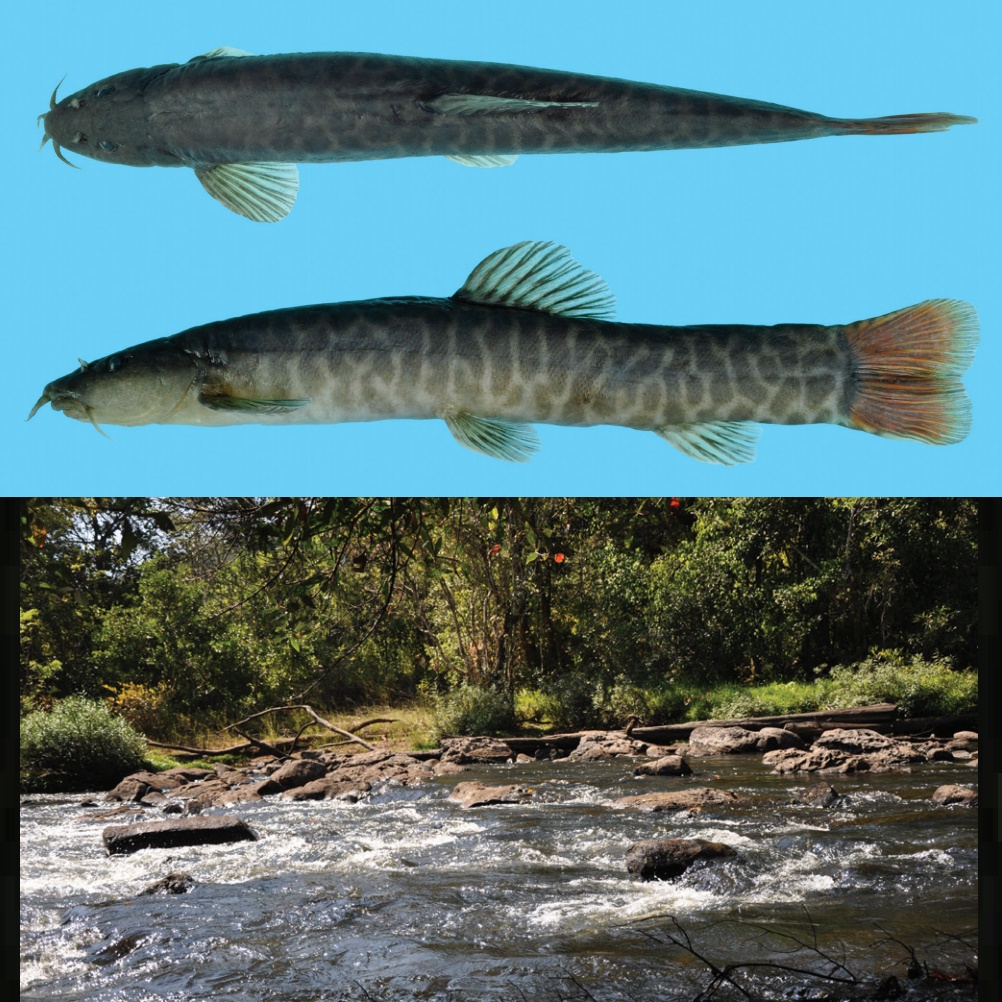
 Vanmanenia orcicampus, new species, is described from the Nam Ngum drainage on the Plain of Jars, central Laos. It is distinguished from its congeners by its colour pattern consisting of a midlateral row of six blotches, a middorsal row of six saddles and vermiculations between the rows of blotches and saddles and on the rest of the flank. Furthermore, it has a slender caudal peduncle (depth 1.5 times in its length, 2.5 times in body depth) and 12-14 branched pectoral-fin rays.

Fig. 1. Vanmanenia orcicampus, MHNG 2767.094, holotype, 47.5 mm SL; Laos: Nam Ngum on Plain of Jars. 


Maurice Kottelat. 2017. Vanmanenia orcicampus, A New Species of Loach from the Plain of Jars, Laos (Teleostei: Gastromyzontidae). Ichthyol. Explor. Freshwaters. 28(1); 87-95. 
Tuesday, August 22, 2017

[Ichthyology • 2017] Schistura thavonei • A New Species of Loach (Teleostei: Nemacheilidae) from northwestern Laos


 Schistura thavonei  Kottelat, 2017

RAFFLES BULLETIN OF ZOOLOGY. 65


  Abstract
 Schistura thavonei, new species, is described from the Nam Ma, Mekong drainage, in Louang Namtha Province, northwestern Laos. It is distinguished from all other Nemacheilidae by its unique colour pattern made of two broad dark brown stripes (one middorsal, one midlateral) and between them a pale yellowish-brown stripe (iridescent in life); a row of 12–24 short black bars are located increasingly lower on the flank from head to tail, posterior-most ones restricted to the lower half of the body or forming blotches along the ventral midline of the caudal peduncle. Besides, it has an elongate body with a hump immediately behind the head, 8+7 branched caudalfin rays; and 9–10 total pectoral-fin rays. It was found in riffles, over gravel to stone bottom. 

Key words. Cobitoidei, Schistura, Laos, Mekong basin, stone loach


Diagnosis. Schistura thavonei is distinguished from the other species of the genus by its unique colour pattern made of two broad dark brown stripes (one middorsal, one midlateral) and between them a pale yellowish-brown stripe (iridescent copper to orange in life) from the upper extremity of the gill opening to the upper half of the base of the caudal fin; overimposed to the midlateral stripe, a row of 12–24 short black bars, located increasingly lower on the flank from head to tail, posterior-most ones restricted to the lower half of the body or forming blotches along the ventral midline of the caudal peduncle. Additional characters useful for identification but not unique to the species are: body very elongate (depth 6.2–7.2 times in SL), with a marked hump behind the head; male without suborbital flap; 8+7 branched caudal-fin rays; 7½ branched dorsal fin rays; 9–10 pectoral-fin rays.


Notes on biology. A dissected female (CMK 25066, 46.6 mm SL) had unripe ovaries with white, irregular, not mature, ova about 1.0 mm diameter. The stomach of a 42.4 mm SL specimen was filled with insect larvae about 2–5 mm long. Schistura thavonei was observed in clear water [as expected for a benthic fish with bright coloration and contrasted pattern]. At all sites, S. thavonei has been collected in stretches of streams with riffles (in the sheltered parts with somewhat quieter current), over gravel to stone bottom (Fig. 7).

Distribution. Schistura thavonei is presently known only from the watershed of the Nam Ma in Louang Namtha Province, a tributary of the Mekong, in northeastern Laos (not to be confused with the Nam Ma in Houa Phan Province, which flows to Vietnam and enters the Gulf of Tonkin).

Etymology. The species is named for Mr. Thavone Phommavong, in appreciation for his help and companionship during several, and sometimes difficult, fish surveys in Laos. A noun in genitive.


Maurice Kottelat. 2017. Schistura thavonei, A New Species of Loach from northwestern Laos (Teleostei: Nemacheilidae). RAFFLES BULLETIN OF ZOOLOGY. 65: 395–403

Sunday, August 13, 2017

[Ichthyology • 2017] Schistura colossa & S. klydonion, Two New Species of Loaches (Teleostei: Nemacheilidae) from Bolaven Plateau, southern Laos


 Schistura colossa  Kottelat, 2017

 RAFFLES BULLETIN OF ZOOLOGY. 65; 341–356. 

Abstract
 Schistura colossa, new species, is described from the Xe Pian, Xe Set and Houay Champi on Bolaven Plateau in southern Laos. It is distinguished by its large size (up to at least 98 mm SL); the body has 16–21 bars, quite regularly shaped in juveniles and with increasing size becoming more irregular; in the largest individuals the bars on the caudal peduncle are broken up in irregular blotches. Schistura klydonion, new species, is described from the Xe Namnoy, also on Bolaven Plateau. It is distinguished by its relatively large size (up to at least 76 mm SL); the body has a midlateral row of 12–21 bars that do not reach the dorsal midline and that alternate with a middorsal row of saddles or small blotches, leaving a pale zigzag line between the two rows; the lips have a few sparsely-set pointed papillae. The topography of the plateau and the distribution of the endemic species suggest an earlier connection of the Houay Makchang Gnai and the Xe Katam with the Xe Pian instead of the Xe Namnoy. Both species are endemic to the Bolaven Plateau, have a limited distribution and are impacted by hydropower and agricultural activities.

 Key words. Cobitoidei, Schistura, Mekong basin, stone loach


Fig. 2. Schistura colossa, MHNG 2767.084, holotype, 98.0 mm SL; Laos: Xe Pian River on Bolaven Plateau.

Schistura colossa, new species

Distribution. Schistura colossa has been collected on Bolaven Plateau in the Xe Pian drainage, a tributary of the Xe Kong, in southern Laos (Fig. 9). A single specimen caught in the Champi and one caught in the Xe Set, both on Bolaven Plateau, cannot be distinguished from the samples from the Xe Pian.

 Etymology. The Latin adjective colossus (-a, -um) means giant. Allusion to the size of the species, a giant among Southeast Asian nemacheilids. 


Fig. 13. Schistura klydonion, MHNG 2767.085, 75.8 mm SL, holotype; Laos: Xe Namnoy on Bolaven Plateau (right side, reversed).

Schistura klydonion, new species

Distribution. Schistura klydonion has been observed only in the Xe Namnoy on the Bolaven Plateau, southern Laos. 

Etymology. From the classical Greek κλυδώνιον (klydonion) meaning small wave, ripple, undulation; allusion to the wavy stripe running along the flank between the row of saddles and the row of bars. A noun in apposition. 


Maurice Kottelat. 2017. Schistura colossa and S. klydonion, Two New Species of Loaches from Bolaven Plateau, southern Laos (Teleostei: Nemacheilidae).
 RAFFLES BULLETIN OF ZOOLOGY. 65; 341–356.