Showing posts with label Bulbophyllum. Show all posts

Sunday, January 11, 2026

[Botany • 2025] Bulbophyllum minhquanii (Orchidaceae: Epidendroideae)Bulbophyllum sect. Racemosae in Vietnam with the Description of the New Species and the new national record, B. albidostylidium


Bulbophyllum minhquanii  Vuong, Q.T.Truong & Aver.⁣, 

in Huynh, Averyanov, Maisak, Q. B. Nguyen, V. C. Nguyen, Dang, T. G. Nguyen, Q. T. Truong et B. V. Truong, 2025. 

Abstract
The paper provides a taxonomic assessment of Bulbophyllum section Racemosae in Vietnam, accompanied by an identification key for all species currently recognized in the country. Information on type specimens, distribution, habitat and phenology (when available), as well as relevant taxonomic notes are presented for each accepted species, accompanied by plates with analytical photos. Bulbophyllum minhquanii is described as new to science, and B. albidostylidium (identified earlier as B. putii) is reported as a new national record. In total, 14 species of B. sect. Racemosae, of which five are endemic, are documented for Vietnam based on previous and current studies. The occurrences of B. macrocoleum and B. morphologorum in Vietnam remain uncertain and require verification by additional collections.

Flora of Vietnam, Orchids, plant diversity, plant endemism, plant taxonomy, plant conservation, Monocots


Bulbophyllum minhquanii


HUU DUC HUYNH, LEONID V. AVERYANOV, TATIANA V. MAISAK, QUOC BAO NGUYEN, VAN CANH NGUYEN, VAN SON DANG, TRUONG GIANG NGUYEN, QUANG TAM TRUONG, BA VUONG TRUONG. 2025. Bulbophyllum sect. Racemosae (Orchidaceae) in Vietnam with the Description of the New Species, B. minhquanii and the new national record, B. albidostylidium.  Phytotaxa. 736(1); 12-32. DOI: doi.org/10.11646/phytotaxa.736.1.2 [2025-12-24] 


Tuesday, May 20, 2025

[Botany • 2025] Bulbophyllum bukitrayaense (Orchidaceae: Epidendroideae) • A New Species of section Macrocaulia from Mount Bukit Raya, Indonesia [Contributions to the Orchid Flora of Kalimantan II]


Bulbophyllum bukitrayaense  Yudistira & Mustaqim,  

in Yudistira, RANDI, JOHARUDIN et Mustaqim, 2025. 
 
Abstract
A new species of Bulbophyllum section Macrocaulia named Bulbophyllum bukitrayaense Yudistira & Mustaqim is described from the mid-montane forest zone of Mount Bukit Raya, Kalimantan Barat Province. It is similar to Bulbophyllum scabrum but differs in having the lower surface of the labellum with two times approaching margin undulation. The new species also have coarsely rugose upper ¼ surface of the labellum (vs smooth) and ovary covered by papillose-muriculate indumentum (vs glabrous). A full description, notes, and fresh photograph plates are given.

Bulbophyllum, endemic, epiphyte, taxonomy, West Malesia, Monocots


Bulbophyllum bukitrayaense (A) in its habitat alongside Bulbophyllum succedaneum J.J.Sm. (Smith 1927: 67).
Photographby Wendy A. Mustaqim.

 Bulbophyllum bukitrayaense Yudistira & Mustaqim sp. nov.


Yuda R. YUDISTIRA, Agusti RANDI, Didin JOHARUDIN and Wendy A. MUSTAQIM. 2025. Contributions to the Orchid Flora of Kalimantan II: A New Bulbophyllum sect. Macrocaulia from Mount Bukit Raya, Indonesia. Phytotaxa. 700(3); 251-256. DOI: doi.org/10.11646/phytotaxa.700.3.1 [2025-05-09] 

Tuesday, May 13, 2025

[Botany • 2017] Bulbophyllum yunxiaoense (Orchidaceae: Epidendroideae) • A New Species of Bulbophyllum sect. Cirrhopetalum from Fujian, China: Morphological and Molecular analyses


 Bulbophyllum yunxiaoense M.H.Li, J.F.Liu & S.P.Chen,

in Li, Yuan, D.-K. Liu, J.-F. Liu et Chen, 2017. 

Abstract
We have described and illustrated a new species, Bulbophyllum yunxiaoense (Malaxideae, Epidendroideae, Orchidaceae), from Fujian Province in southeast China. The size and overall floral morphology of the new species are similar to those of Bulbophyllum pingtungense, a species endemic to Taiwan Island on the southeast coast of China and its closest relative according to a cladistic analysis of nuclear (ITS) and plastid (matK, trnL-F, and atpI-atpH) DNA sequences. However, B. yunxiaoense is distinguishable from B. pingtungense by flower colour, shorter scape, and longer lateral sepal.

Keywords: Monocots, Asian orchids, Dendrobiinae, phylogenetics, Sect. Cirrhopetalum

 Bulbophyllum yunxiaoense M.H. Li, J.F. Liu & S.P. Chen. 
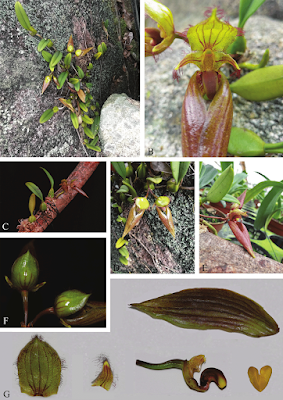
A. Habitat and habit. B. Flower, front view. C. Flowering plant. D. Flower, back view. E. Flower, side view. F. Dorsal sepal, back view. G. Anatomy of the flower.

 Bulbophyllum yunxiaoense M.H. Li, J.F. Liu & S.P. Chen.
A. Plant. B. Flower, side view. C. Flower, front view. D. Dorsal sepal, petal, lateral sepal (clockwise). E. Column and lip, side view. F. Pollinarium (Drawn by Li-Jun Chen).


Ming-He LI, Xue-Yan YUAN, Ding-Kun LIU, Jiang-Feng LIU and Shi-Pin CHEN. 2017. Bulbophyllum yunxiaoense sp. nov. (Orchidaceae: Epidendroideae: Malaxideae) from Fujian, China: Morphological and molecular analyses.  Phytotaxa. 332(1); 59–66. DOI: doi.org/10.11646/phytotaxa.332.1.6 [2017-12-15]

Friday, April 11, 2025

[Botany • 2025] Bulbophyllum sandfordiorum (Orchidaceae: Epidendroideae: Bulbophyllinae) • A New Species of section Papulipetalum from West Papua Province, Indonesia


Bulbophyllum sandfordiorum Saputra & Schuit., 

in Saputra, Schuiteman, Wanma, Jennings, Cahyo, Haryanto, Putri et Heatubun, 2025.  

Summary
A new species of Bulbophyllum from section PapulipetalumB. sandfordiorum Saputra & Schuit., is described based on a specimen from West Papua, Indonesia, and its sectional placement is discussed. A detailed morphological description and diagnosis, information on distribution and ecology and a preliminary conservation assessment are provided.

Key Words: Anggrek, Arfak Mountains, Jenis baru, New Guinea, Papua Barat


Bulbophyllum sandfordiorum Saputra & Schuit., sp. nov. 
(sect. Papulipetalum).

Etymology. The epithet sandfordiorum honours the late Elodie Sandford and her family, who inspired young explorers and amateur photographers to engage in adventurous and innovative projects. These projects highlight how photography can deliver a strong conservation message and bring benefit to the people, the environment, and biodiversity in general.


Reza Saputra, André Schuiteman, Jimmy F. Wanma, Laura Jennings, Yanuar I. D. Cahyo, Taufik Haryanto, Bianza F. Putri and Charlie D. Heatubun. 2025. Bulbophyllum sandfordiorum (Orchidaceae), A New Species of Bulbophyllum section Papulipetalum from West Papua Province, Indonesia.  Kew Bulletin. DOI: doi.org/10.1007/s12225-025-10259-y [25 March 2025]


Wednesday, February 19, 2025

[Botany • 2025] Bulbophyllum abuniorum (Orchidaceae: Epidendroideae) • A New Species of Bulbophyllum sect. Lepidorhiza from the Bird’s Head Peninsula, Indonesian New Guinea


Bulbophyllum abuniorum Saputra & Schuit.,

in Saputra, Schuiteman, Ulimpa, Fitrah Darwis, Junial, Nuburi et Santoso, 2025. 

Abstract
A new species of Bulbophyllum from section LepidorhizaB. abuniorum Saputra & Schuit., is described based on specimens from the Bird’s Head Peninsula, New Guinea. A detailed morphological description and diagnosis, information on distribution and ecology, and a preliminary conservation assessment are provided. A key to the species of Bulbophyllum section Lepidorhiza in New Guinea is also presented.

Keywords: Abun Tribe, Pegunungan Tambrauw, West Papua, endemic, indentification key


Bulbophyllum abuniorum Saputra & Schuit., sp. nov.

Diagnosis: Bulbophyllum abuniorum is similar to Bulbophyllum levyae Garay, Hamer & Siegerist (1995:176) especially in the shape of sepals and petals, the relatively long lip, and in the several simultaneously opening flowers (flowers usually opening one at a time in other species of sect. Lepidorhiza), but differs in having a slightly clawed lip at the base (vs. not clawed in B. levyae), densely irregular conical-subulate teeth all over the adaxial surface of the lip (vs. lip with papillae in the middle, smooth elsewhere), margin of lip laciniate basally, strongly serrate centrally, and crenate apically (vs. margin entire throughout).


Reza Saputra, André Schuiteman, Hormes Ulimpa, Fajar Fitrah Darmawan Darwis, Agaki Junial, Welem Nuburi and Johny Santoso. 2025. A New Species of Bulbophyllum section Lepidorhiza (Orchidaceae) from the Bird’s Head Peninsula, Indonesian New Guinea. Telopea. 29; 9-13.  DOI: 10.7751/telopea20323 


Sunday, February 16, 2025

[Botany • 2024] Bulbophyllum bonjolianum (Orchidaceae: Epidendroideae: Bulbophyllinae) • A New Species of section Macrocaulia from Sumatra, Indonesia


 Bulbophyllum bonjolianum Yudistira, Candra & Mustaqim, 

in Yudistira, Candra et Mustaqim, 2024. 

Bulbophyllum bonjolianum Yudistira, Candra & Mustaqim, a member of section Macrocaulia, is described here based on a specimen collected from the mountains of West Sumatra. It is similar to B. tristriatum Carr. and B. pyridion J.J.Verm. but differs in the morphology of the dorsal sepal, petal and labellum. A key to B. bonjolianum and morphologically similar species is presented.

Keywords. Endemic, epiphyte, Malesia, orchids, taxonomy


 Bulbophyllum bonjolianum Yudistira, Candra & Mustaqim.
 A. Plant habit with inflorescence. B. Flower top view. C. Median sepal, abaxial view. D. Median sepal, adaxial view. E. Lateral sepal, abaxial view. F. Lateral sepal, adaxial view. G. Petal, abaxial view. H. Petal, adaxial view. I. Labellum, lateral view. J, K. Labellum, abaxial and adaxial surface. L. Column stelidium. M. Anther cap, adaxial view. N. Anther cap, abaxial view. O. Pollinarium.
Drawing by Yuanito Eliazar.

 Bulbophyllum bonjolianum Yudistira, Candra & Mustaqim.
A. Plant habit. B. Inflorescence. C, D. Flower, lateral view, with close-up view showing basal node of the pedicel. E. Flower, front view without median sepal. F. Flower, view from above. G. Median sepal, abaxial and adaxial views. H. Petal, abaxial and adaxial views. I. Lateral sepal, abaxial, adaxial and side views. J. Labellum, adaxial, abaxial and side views. K. Column with stelidia, side view. L. Column stelidia, front view.
 ab = abaxial, ad = adaxial, sv = side view. (Photos: Y.R. Yudistira)

Bulbophyllum bonjolianum Yudistira, Candra & Mustaqim, sp. nov.

Bulbophyllum bonjolianum is morphologically similar to B. tristriatum Carr. and B. pyridion J.J.Verm., but differs in the dorsal sepals abruptly tapering from the middle upwards (vs gradually narrowing), pentagonal petal (vs elliptic-(ob)-ovate in B. tristriatum and elliptic in B. pyridion), and longer labellum (6.8–7 mm vs 3.5–5 mm in B. tristriatum and c. 3.2 mm long in B. pyridion) with the proximal adaxial surface coarsely papillose (vs smooth). The species is also similar to the Peninsular Malaysian species B. hodgsonii M.R.Hend., but the new species differs in its dorsal sepals abruptly tapering from the middle upwards (vs gradually narrowing), lateral sepals with 3 veins (vs 5), and the coarsely papillose adaxial surface of the labellum in the lower proximal part (vs smooth).

Etymology. The species is named in honour of Tuanku Imam Bonjol, a national hero of Indonesia from West Sumatra Province.   


Yudistira, Y.R., Candra, R. and Mustaqim, W.A. 2024. A New Species of Bulbophyllum (Orchidaceae: Bulbophyllinae) section Macrocaulia from Sumatra, Indonesia. Gardens' Bulletin Singapore. 76(1); 251 - 258.


Tuesday, August 13, 2024

[Botany • 2024] Bulbophyllum bokodense (Orchidaceae: Epidendroideae) • A New Species of Bulbophyllum sect. Polymeres from Benguet Province, Luzon Island, Philippines


Bulbophyllum bokodense M.N.Tamayo, Magtoto & R. Bustam., 

in Tamayo, Magtoto, Penales, Baquiran et Bustamante, 2024.
 
Abstract
A new species of orchid, Bulbophyllum bokodense, is herein described and illustrated from Benguet Province, Luzon Island, Philippines. It closely resembles Bulbophyllum rinkei endemic to New Guinea, but is distinct by having a broader leaf, a shorter inflorescence, an acute petal apex, glabrous auricles, a slightly canaliculate labellum, mid lobe and apex of labellum devoid of concavity, and a longer stelidia. A detailed description, photographs, and illustration are also provided. Preliminary conservation assessment of the new species following IUCN guidelines suggest a conservation status of data deficient (DD).

Monocots, Cordillera Central Range, Dendrobieae, endemic, epiphyte, Mt. Pulag


Bulbophyllum bokodense M.N.Tamayo, Magtoto & R. Bustam.


Maverick N. Tamayo, Liezel M. Magtoto, Patrick James F. Penales, Ethel Ruth A. Baquiran and Rene Alfred Anton Bustamante. 2024. Bulbophyllum bokodense (section Polymeres, Orchidaceae), A New Species from Benguet Province, Luzon Island, Philippines.  Phytotaxa. 662(2); 187-194. DOI: doi.org/10.11646/phytotaxa.662.2.7


Saturday, March 30, 2024

[Botany • 2024] Bulbophyllum gopalianum (Orchidaceae: Epidendroideae) • A New Species of Bulbophyllum sect. Lemniscata from Mizoram (India), the westernmost Region of the Indo-Myanmar Biodiversity Hotspot


Bulbophyllum gopalianum  

in Sâwmliana, Gogoi, Jalal et Kumar, 2024. 

Abstract
A new species, Bulbophyllum gopalianum, is described from the montane sub-tropical forest of Mizoram (India) in the westernmost area of the Indo-Myanmar biodiversity hotspot. The new species belongs to the section Lemniscata and shows close morphological affinity to B. suavissimum and B. shanicum. A detailed description, diagnosis, phenology, taxonomic notes and conservation assessment are presented. The new species is assessed as critically endangered (CR) based on its very small and restricted population size.

Keywords: Bulbophyllum shanicum, Bulbophyllum suavissimum, Critically Endangered, section Lemniscata, tribe Dendrobieae


Bulbophyllum gopalianum
Sâwmliana, M., K. Gogoi, J.S. Jalal and P. Kumar  


Mal Sâwmliana, Khyanjeet Gogoi, Jeewan Singh Jalal and Pankaj Kumar. 2024. Bulbophyllum gopalianum (Orchidaceae), A New Species from Mizoram (India), the westernmost Region of the Indo-Myanmar Biodiversity Hotspot. Nordic Journal of Botany. DOI: 10.1111/njb.04256

Thursday, February 29, 2024

[Botany • 2024] Bulbophyllum romklaoense (Orchidaceae: Epidendroideae) • A New Species of Bulbophyllum sect. Lemniscata from northern Thailand


Bulbophyllum romklaoense Pingyot & Thawara,  

in Thawara, Pingyot, Suksathan et Ruchisansakun, 2024. 
สิงโตร่มเกล้า  ||  DOI: 10.3897/phytokeys.238.114999
 
Abstract
Bulbophyllum romklaoense (B. sect. Lemniscata) from northern Thailand is described and illustrated as a species new to science. It is most similar to B. muscarirubrum and B. triste, but differs by having inflorescences with only 4–6 reddish-brown flowers, falcate-subovate lateral sepals that are connate only in the upper half along the interior margins, petals with erose to fimbriate margins and a lip with long cilia in the distal half on the lower surface. A comparison with other similar species in the section, as well as notes on ecology, phenology, conservation assessment and a key to B. sect. Lemniscata in Thailand are also provided.

Key words: Bulbophyllum sect. Lemniscata, critically endangered, Epidendroideae, Phitsanulok Province, Southeast Asia

Bulbophyllum romklaoense Pingyot & Thawara in vivo
 A habit (vegetative stage) B habit (flowering stage) C pseudobulb with inflorescence arising from the base D flower, front view E flowers, side view F lateral sepals.
Photographed by P. Suksathan.

Bulbophyllum romklaoense Pingyot & Thawara 
A habit B pseudobulb with inflorescence arising from the base C flower, front view D flower, side view (right petal and right lateral sepal removed) E floral bract F dorsal sepal G lateral sepals (flattened & indumentum removed) H petals J column, top part K lip L anther cap (from Inthakul N887-50).
Drawn by T. Pingyot.

 Bulbophyllum romklaoense Pingyot & Thawara, sp. nov.
 
Diagnosis: Bulbophyllum romklaoense resembles B. muscarirubrum Seidenf. and B. triste Rchb.f. Bulbophyllum romklaoense differs from both by having 4–6-flowered inflorescences (vs. 10–24(–50)-flowered inflorescences in B. muscarirubrum and B. triste), falcate-subovate lateral sepals (vs. narrowly ovate lateral sepals in B. muscarirubrum and B. triste), petals with erose to fimbriate margins (vs. petals with ± entire margins in B. muscarirubrum and B. triste) and a lip with long cilia in the distal half on the lower surface (vs. lip entirely glabrous in B. muscarirubrum and B. triste). Bulbophyllum romklaoense also differs from B. triste by having a peduncle which is about as long as the rachis (vs. peduncle longer than twice as long as the rachis in B. triste).

EtymologyNamed after its type locality at Ban Romklao (Romklao Village).


Nicha Thawara, Thitiporn Pingyot, Piyakaset Suksathan and Saroj Ruchisansakun. 2024. Bulbophyllum romklaoense (Orchidaceae), A New Species from Thailand. PhytoKeys. 238: 147-155. DOI: 10.3897/phytokeys.238.114999

นางสาวฐิติพร ปิงยศ และ ดร. ปิยเกษตร สุขสถาน จากสวนพฤกษศาสตร์สมเด็กพระนางเจ้าสิริกิติ์ ร่วมกับ นางสาวณิชา ถาวระ และ ผศ. ดร.สาโรจน์ รุจิสรรค์สกุล ภาควิชาพฤกษศาสตร์ คณะวิทยาศาสตร์ มหาวิทยาลัยมหิดล ตีพิมพ์กล้วยไม้สกุลสิงโตกลอกตาชนิดใหม่จากจังหวัดพิษณุโลก 
กล้วยไม้สิงโตร่มเกล้า 
Bulbophyllum romklaoense Pingyot & Thawara 
โดย B. romklaoense อยู่ใน section Lemniscata มีลักษณะดอกที่แตกต่างจากกล้วยไม้ชนิดอื่นๆมาก โดยในงานตีพิมพ์ชิ้นนี้ใช้เทียบกับ B. muscarirubrum และ B. triste ซึ่งก็ยังถือว่าหน้าตาต่างกันมากอยู่ กล้วยไม้สิงโตร่มเกล้าพบบนพื้นที่ความสูงประมาณ 1,300 ม. จากระดับน้ำทะเล โดยสถานะปัจจุบันคือ ใกล้สูญพันธุ์อย่างยิ่ง Critically Endangered (CR; B1+B2ab(iii,v)+C2a(i)) เนื่องจากไฟป่าและสภาพอากาศที่เปลี่ยนแปลงไป ปัจจุบันมีการอนุรักษ์กล้วยไม้ชนิดนี้นอกถิ่นอาศัยอยู่ที่สวนพฤกษศาสตร์สมเด็จพระนางเจ้าสิริกิติ์ อ. แม่ริม จ. เชียงใหม่ และสวนพฤกษศาสตร์บ้านร่มเกล้า อ.ชาติตระการ จ.พิษณุโลก ซึ่งการค้นพบนี้ทำให้เห็นว่าป่าของไทยยังเป็นแหล่งที่มีทรัพยากรธรรมชาติอยู่มากและหลายชนิดยังไม่ถูกค้นพบ ในขณะที่สถานการณ์ป่าปัจจุบันทั้งพืนที่และสภาพป่าอยู่ในสภาพที่น่าเป็นห่วง โดยปัจจุบันสวนพฤกษศาสตร์ต่างๆทั่วประเทศได้ทำหน้าที่เป็นแหล่งรวบรวมพรรณไม้และอนุรักษ์นอกถิ่นอาศัยในอีกทางหนึ่ง อย่างไรก็ตามการอนุรักษ์ป่าที่เป็นแหล่งอาศัยจริงก็ยังคงเป็นทางเลือกที่ดีที่สุดให้แก่สิ่งมีชิวิตหายากเหล่านี้

Thursday, January 25, 2024

[Botany • 2024] Bulbophyllum barcelonae & B. pelseri (Orchidaceae: Epidendroideae) • Two New Species of Bulbophyllum sect. Polymeres from Pantabangan-Carranglan Watershed Forest Reserve, Luzon Island, Philippines


Bulbophyllum barcelonae  Garrino & R. Bustam.,

in Garrino, Mansibang, Aumentado, Ang, Udasco, Diego, Altomonte, Tamayo, Magtoto et Bustamante, 2024. 
 
Abstract
Two new species of Bulbophyllum, B. barcelonae and B. pelseri are described here from the Pantabangan-Carranglan Watershed Forest Reserve, Luzon Island, Philippines. Bulbophyllum barcelonae resembles B. charisae, but differs by having smaller vegetative parts, ovate petals with a rounded apex, and a labellum with two ridges that are strongly angled outwards the adaxial surface, rounded proximal crests, and a canaliculate abaxial surface. Bulbophyllum pelseri resembles B. aureobrunneum but differs by having caducous sheath covering the pseudobulbs, punctulate leaf surface, shorter leaves, absence of transverse callus in median portion of labellum, median portion with short, rounded ridge, rounded apex, and triangular stelidia. These discoveries increase to 207, the known species of Bulbophyllum in the Philippines.

Keywords: Asparagales, biodiversity, Dendrobieae, Epidendroideae, Malesia, taxonomy


Abigail L. Garrino, Jayson A. Mansibang, Jamie Ann M. Aumentado, Yu Pin Ang, Leonardo C. Udasco Jr, Jean Marie Diego, John Charles Altomonte, Maverick N. Tamayo, Liezel M. Magtoto and Rene Alfred Anton Bustamante. 2024. Two New Species of Bulbophyllum (Orchidaceae, sect. Polymeres) from Pantabangan-Carranglan Watershed Forest Reserve, Luzon Island, Philippines. Nordic Journal of Botany, e04187. DOI: 10.1111/njb.04187

Friday, January 12, 2024

[Botany • 2023] Bulbophyllum parex (Orchidaceae: Epidendroideae) • A New Species of Bulbophyllum sect. Xiphyzusa from the Andean Region of Colombia


 Bulbophyllum parex J. Alvarez-Diaz & J.S. Moreno, 

in Sierra-Ariza, Alvarez Diaz et Moreno, 2023.

Abstract
A new species of Bulbophyllum, section Xiphyzusa, found in the Andean region of Colombia, in the department of Huila, is described and illustrated. The species is discussed in relation to its morphologically similar and closest relatives. Information on its distribution, ecology, and habitat is provided.

KEYWORDS: Huila, section Xiphyzusa, systematics, taxonomy, 

 Bulbophyllum parex J. Alvarez-Diaz & J.S. Moreno.
A, Habit; B, Flower; C, Dissected perianth; D, Lip and column lateral view; E, Column; F, Anther and Pollinia.
Illustration by A. J. S. Moreno based on the plant that served as the holotype.

 Bulbophyllum parex J. Alvarez-Diaz & J.S. Moreno.
A, Habit; B, Flower; C, Dissected perianth; D, Lip and column lateral view; E, Column; F, Anther.
LCDP by M. A. Sierra-Ariza, based on the holotype.

Bulbophyllum parex J.Alvarez-Diaz & J.S.Moreno sp. nov.

Bulbophyllum parex is morphologically closest to Bulbophyllum bidentatum (Barb.Rodr.) Cogn., from which it differs in having lanceolate petals with a ciliate margin (vs. ovate-lanceolate petals with a lacerate-ciliate margin), the labellum with slightly ciliate lateral lobes (vs. to entire lateral lobes), and the middle lobe oblong-elliptic (vs. linear-ligulate).

Etymology: The specific epithet, parex, is given in gratitude to Parex Resources company, for their financial and logistic support in the process of studying and publishing the new species.


Mario Alexei Sierra-Ariza, Jose Armando Alvarez Diaz and Juan Sebastián Moreno. 2023. A New Species of Bulbophyllum (Orchidaceae) from the Andean Region of Colombia. Harvard Papers in Botany. 28(1); 129-135. DOI: 10.3100/hpib.v28iss1.2023.n16
 
Se describe e ilustran una nueva especie para el género Bulbophyllum sección Xiphyzusa encontrada en la región andina de Colombia, en el departamento del Huila. La especie se discute con las especies morfológicamente más cercanas y se proporciona información sobre su distribución, ecología y hábitat.

Wednesday, November 22, 2023

[Botany • 2023] Bulbophyllum dresslerianum (Orchidaceae: Epidendroideae) • A New Species of Bulbophyllum sect. Tripudianthes from Southern Yunnan, China


 Bulbophyllum dresslerianum Z. D. Han & H. Wang, 

in Han, Ren, Jiang et Wang, 2023. 
 
Abstract 
Bulbophyllum dresslerianum Z. D. Han & H. Wang (Orchidaceae), a new species from southern Yunnan, China, is described and illustrated. The new species belongs to section Tripudianthes Seidenf., sharing some vegetative and floral traits with B. dickasonii, B. kanburiense, B. rugosisepalum and B. tripudians, but differs on the basis of a suite of floral characters. Globular papillae decorate the lip epichile with the abaxial side and margins bearing sparse short glandular hairs. In addition, its lateral sepals are brownish-yellow and glabrous. A key to B. dresslerianum and its related species is provided. Currently, this species is only found in one population, its conservation status requires further assessment.

Key words: New species; Bulbophyllum; Labellum/lip; Section Tripudianthes; Sourthern Yunnan

 Bulbophyllum dresslerianum.
A: Bract; B: Dorsal sepal; C: Petals; D: Plant; E: Sepals, petals, and lip; F: Flower (front view); G: Column with ovary; H: Lip (lateral view); I: Lip (dorsal view).
All photos from a flower of the holotype.

 Comparison of three related species with Bulbophyllum dresslerianum.
A: Plant of B. dresslerianum; B: B. dresslerianum; C: B. tripudians; D: B. dickasonii; E: B. rugosisepalum;
1: Flower (front view); 2: Dorsal sepal; 3: Petal; 4: Lip
(Drawn by Lan Yan and Lin Wang based on type photos of B. dresslerianum and B. dickasonii, and drawing of B. tripudians).

Bulbophyllum dresslerianum Z. D. Han & H. Wang sp. nov.  

Diagnosis: Bulbophyllum dresslerianum is similar to B. dickasonii, B. kanburiense, B. rugosisepalum, and B. tripudiansin terms of morphological structure of flowers. This new species can be distinguished from B. rugosisepalum by dorsal sepal ovate to narrowly ovate, lateral sepals absent rugose-papillae, and the margins and adaxial side of epichile with sparely short glandular hairs. It can be distinguished from B. tripudians with the epichile of lip with globular papillae. In addition, the new species can be distinguished from B. dickasonii and B. kanburiense with the margins of dorsal sepals irregularly fimbriated, the petal ovate-lanceolated and the margins of petal fimbriated.

Etymology: The species is named for the late Robert Louis Dressler (1927—2019), an authority on the taxonomy of Neotropical Epidendroideae (including the Malaxideae) and his contributions to the evolutionary ecology of the Orchidaceae.

Chinese vernacular name: 斯勒卷瓣兰(sī lè juǎn bàn lán)


Han Zhoudong, Ren Zongxin, Jiang Hong and Wang Hong. 2023. Bulbophyllum dresslerianum (Malaxideae: Orchidaceae), A New Species from Southern Yunnan, China. Journal of Tropical and Subtropical Botany. 31(2); 272-278.DOI: 10.11926/jtsb.4578

Wednesday, November 15, 2023

[Botany • 2020] Bulbophyllum trongquyetii (Orchidaceae: Epidendroideae) • A New Species from Vietnam


 Bulbophyllum trongquyetii  Vuong, Aver., R.Amsler, & V.S.Dang,

in Truong, Averyanov, Amsler, Nguyen, Tran, Maisak et Dang, 2020. 

Abstract
Bulbophyllum trongquyetii is described as new for science from Vietnam. Detailed morphological description, illustration, data on distribution, and phenology are provided. Described species resembles B. nipondhii but differs in the bigger size of plant, longer inflorescence, and uniform yellow or reddish-orange flowers. It can be also compared with B. thaiorum and B. farreri but easily distinguished by the bigger size of plant and flowers, as well as smooth or sparsely papillose lateral sepals.

Keywords: Bulbophyllum, endemism, eastern Indochina, plant diversity, plant taxonomy, Monocot

 Bulbophyllum trongquyetii.
A. Flowering plant; B. Leaves; C. Inflorescence at different views; D. Portion of inflorescence; E. Flower, ovary and pedicel at different views; F. Proximal portion of flower at different views; G. Flower with sepals removed, side view; H. Lateral sepals; I. Dorsal sepal; J. Petals; K. Lip at different views; L. Column and ovary at different views; M. Anther cap at different views; N. Pollinia at different views.
Photos by Truong Ba Vuong taken from the type specimen; 
correction and design by L. Averyanov and T. Maisak.


Bulbophyllum trongquyetii Vuong, Aver., R.Amsler, & V.S.Dang, sp. nov.  
 
Etymology: —The species is named after Mr. Phan Trong Quyet, an orchid enthusiast who cultivated and collected materials used for the preparation of the type specimen. 

 
Ba Vuong Truong, Leonid V. Averyanov, Roland Amsler, Van Canh Nguyen, Hop Tran, Tatiana V. Maisak and Van Son Dang. 2020. New Species, Bulbophyllum trongquyetii (Orchidaceae) from Vietnam. Phytotaxa. 464(4); 293–298. DOI: 10.11646/phytotaxa.464.4.3
 facebook.com/DalatNhoem/posts/3470804049608427
epharmacognosy.com/2020/10/new-species-bulbophyllum-trongquyetii.html