Showing posts with label Fiji. Show all posts

Tuesday, May 12, 2026

[Ichthyology • 2026] Solenostomus snuffleupagus • A hairy Ghost Pipefish (Syngnathiformes: Solenostomidae) from the Southwest Pacific, with an integrative comparison to S. paegnius


Solenostomus snuffleupagus
Short & Harasti, 2026   


Abstract
A new species of ghost pipefish, Solenostomus snuffleupagus sp. nov., is described from the Coral Sea based on specimens (18–34 mm SL) collected from coral reef habitats in Queensland, Australia. The species is diagnosed by the following combination of characters: abundant elongate integumentary filaments imparting a conspicuously shaggy appearance; 36 total vertebrae (vs. 32–34 in all congeners); compact body form with a short, deep pretrunk (11%–14% SL); sexually dimorphic supraoccipital crests (moderately elevated in females, strongly developed in males); and two modified anchor-like ossicles spanning the pterygiophores in both soft dorsal and anal fins. Micro-CT imaging reveals distinctive pretrunk ossicle configuration characterized by deep angular interspaces and absence of a ventral ossicle series. Mitochondrial COI sequences indicate an uncorrected p-distance of 22.0% from the superficially similar S. paegnius, a species with which it has long been confused in museum collections and citizen science databases. Field observations document consistent association with dense filamentous red macroalgae, with body coloration closely matching host substrate. The species is currently known from the southwest Pacific, including northeastern Australia (Coral Sea), Papua New Guinea, New Caledonia, Fiji and Tonga, representing a southwestern Pacific distribution.

Solenostomus snuffleupagus, in situ, Great Barrier Reef, Australia, 2022: (a) adult individual; (b) female specimen used for genetic analysis; (c) male specimen used for genetic analysis (photographs by David Harasti).

Micro-CT reconstructions (lateral view) of Solenostomus snuffleupagus:
(a) holotype, female, AMS I.33751-047; (b) paratype, male, NTM S.13600–047. DF, dorsal-fin; PF, pectoral-fin; sAF, soft anal-fin; sDF, soft dorsal-fin. Numbers 1 and 2 indicate the respective pterygiophores supporting the soft dorsal- and anal-fins.

 Taxonomy
Family Solenostomidae 

Genus Solenostomus Lacépède 1803 

 Solenostomus snuffleupagus, Short and Harasti, new species

Diagnosis: A species of Solenostomus distinguished from its congeners by the following combination of characters: body compact and vertically deep anteriorly; pretrunk deep (24.4%–29.2% SL); abundant, elongate integumentary filaments conferring a conspicuously shaggy appearance, particularly dense on snout, jaws, head and fin extremities; pretrunk ossicles are narrow and elongated, separated by deep angular interspaces, forming a distinctive compact lattice; There are total 36 vertebrae. The supraoccipital crest is elevated and rounded in females, but strongly pronounced in males. There are two modified anchor-like ossicles spanning the pterygiophores in both the soft dorsal fin (19–20 rays) and anal fin (18–19 rays). The soft dorsal fin has 19–20 rays, the anal fin has 18–19 rays, the pectoral fin has 27 rays, the caudal fin has 15 rays.

Etymology: The specific epithet snuffleupagus refers to the shaggy character Mr. Snuffleupagus, also known as ‘Snuffy’, from the children's television series Sesame Street™, in allusion to the species' distinctly shaggy, filamentous appearance and snout reminiscent of the character's covering and trunk. The name is treated as a noun in apposition (ICZN Article 31.1.2).

Solenostomus paegnius, in situ: (a) Indonesia (photograph by Richard Smith); (b) Philippines, male–female pair with the female positioned above the male in the water column (photograph by Lynn Funkhouser); (c) Philippines, male–female pair with the female positioned above the male in the water column (photograph by Alex Tyrrell @dive4photos).
 

Graham Short and David Harasti. 2026. Solenostomus snuffleupagus sp. nov., A hairy Ghost Pipefish (Teleostei: Solenostomidae) from the Southwest Pacific, with an integrative comparison to S. paegniusJournal of Fish Biology. DOI: doi.org/10.1111/jfb.70497 [10 May 2026]
 

Wednesday, June 25, 2025

[Ichthyology • 2025] Neotrygon romeoi • A New Blue-spotted Maskray Species (Myliobatiformes: Dasyatidae: Neotrygon) from Fiji


Live colouration of Neotrygon romeoi n. sp. from around Fiji:
(a) Lautoka, mixed rocky and sand habitat (©Leon Perrie, observed 1 July 2023, inaturalist.org); (b) Near South Sea Island, rocky reef, (©Jack Crosbie, 17 August 2023,  inaturalist.org); (c) Drawaqa Island, Yasawas on sand flat with some seagrass in ≃18 m of water, (©Robert Macfarlane, 7 January 2024, modified); (d) Suva foreshore, on seagrass in ≃0.2 m of water (©Tom Vierus, observed 24 March 2022, inaturalist.org); (e) Mana Island, over seagrass (©Floyd E. Hayes, observed 27 March 2018, inaturalist.org).

Glaus, White, O'Neill, Thurnheer & Appleyard, 2025

Abstract
Neotrygon romeoi n. sp. (Dasyatidae), a new species of blue-spotted maskray from Fiji, previously confused with Neotrygon kuhlii (Müller and Henle 1841) or Neotrygon trigonoides (Castelnau 1873), is described based on nine specimens (310–397 mm disc width) from Fiji. Neotrygon romeoi n. sp. is a large maskray with a broadly angled snout, long claspers in adult males and a median row of thornlets extending from the nape to the tail base. Fresh specimens have a brownish dorsal surface with dark mask-like marking covering across and between the eyes (sometimes indistinct), two large brown to black branchial blotches posterior to the spiracles, numerous black pepper-like spots mainly concentrated in masked area and the branchial blotches, and sometimes having small, dark-edged pale blue to whitish spots. The new species is further characterized by ocellated spots in the medial belt usually absent. Molecular analysis based on 570 bp of partial cytochrome c oxidase subunit 1 (COI) mitochondrial gene also supports that N. romeoi n. sp. is a distinct species from other congeners. The new species, known only from the Fiji Islands, may thus warrant inclusion in Fiji's Endangered and Protected Species Act.

Keywords: Fiji, endemic, new species, Oceania, South Pacific Ocean, species complex

Live colouration of Neotrygon romeoi n. sp. from around Fiji:
(a) Lautoka, mixed rocky and sand habitat (©Leon Perrie, observed 1 July 2023, modified, www.inaturalist.org/observations/171357979); (b) Near South Sea Island, rocky reef, (©Jack Crosbie, observed 17 August 2023, modified, www.inaturalist.org/observations/180044335); (c) Drawaqa Island, Yasawas on sand flat with some seagrass in ≃18 m of water, (©Robert Macfarlane, 7 January 2024, modified); (d) Suva foreshore, on seagrass in ≃0.2 m of water (©Tom Vierus, observed 24 March 2022, modified, www.inaturalist.org/observations/109579248); (e) Mana Island, over seagrass (©Floyd E. Hayes, observed 27 March 2018, modified, www.inaturalist.org/observations/99347812).

Neotrygon romeoi n. sp. 

 Etymology: The epithet is dedicated to the late Romeo Glaus, the father of the first author, in recognition of his lasting inspiration, enduring support and deep respect for nature. 
Vernacular: Fiji Maskray.


Kerstin Glaus, William T. White, Helen L. O'Neill, Sarah Thurnheer and Sharon A. Appleyard. 2025. A New Blue-spotted Maskray Species (Neotrygon, Dasyatidae) from Fiji. Journal of Fish Biology. DOI: doi.org/10.1111/jfb.70094 [09 June 2025]

Saturday, April 26, 2025

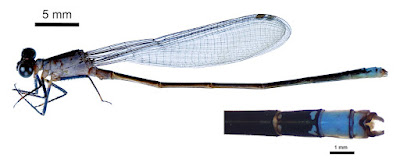
[Entomology • 2023] Nikoulabasis roseosticta • A New Species of Nikoulabasis (Odonata: Coenagrionidae) from Fiji

 
Nikoulabasis roseosticta
Beatty, Rashni, Cordero-Rivera & Marinov, 2023


Abstract
Nikoulabasis roseosticta sp. nov. (holotype ♂, Fiji, Vanua Levu Island, Navuturerega creek, 6 August 2009, Christopher Beatty leg.) is erected as a new taxon. Illustrations of key characters and a distribution map are provided.

Odonata, Vanua Levu, Pacific Odonata, taxonomy, nomenclature, new species


Nikoulabasis roseosticta sp. nov. 


Christopher D. BEATTY, Bindiya RASHNI, Adolfo CORDERO-RIVERA and Milen MARINOV. 2023. Nikoulabasis roseosticta, sp. nov. from Fiji (Odonata: Coenagrionidae).  Zootaxa. 5383(2); 135-152. DOI: doi.org/10.11646/zootaxa.5383.2.2 [2023-12-11] 

Monday, March 24, 2025

[Herpetology • 2025] Iguanas rafted more than 8,000 km from North America to Fiji


A Fijian crested iguana (Brachylophus vitiensis) resting on a coconut palm on the island of Fiji in the South Pacific. The four species of iguanas that inhabit Fiji and Tonga today are descended from ancestors that colonized the island within the past 34 million years, probably by rafting 5,000 miles across the Pacific Ocean from western North America.

in Scarpetta, Fisher, Karin, Niukula, Corl, Jackman et McGuire, 2025. 

Abstract
Founder-event speciation can occur when one or more organisms colonize a distant, unoccupied area via long-distance dispersal, leading to the evolution of a new species lineage. Species radiations established by long-distance, and especially transoceanic, dispersal can cause substantial shifts in regional biodiversity. Here, we investigate the occurrence and timing of the greatest known long-distance oceanic dispersal event in the history of terrestrial vertebrates—the rafting of iguanas from North America to Fiji. Iguanas are large-bodied herbivores that are well-known overwater dispersers, including species that colonized the Caribbean and the Galápagos islands. However, the origin of Fijian iguanas had not been comprehensively tested. We estimated the phylogenetic relationships and evolutionary timescale of the iguanid lizard radiation using genome-wide exons and ultraconserved elements (UCEs). Those data indicate that the closest living relative of extant Fijian iguanas is the North American desert iguana and that the two taxa likely diverged during the late Paleogene near or after the onset of volcanism that produced the Fijian archipelago. Biogeographic models estimate North America as the most probable ancestral range of Fijian iguanas. Our analyses support the hypothesis that iguanas reached Fiji via an extraordinary oceanic dispersal event from western North America, and which spanned a fifth of the earth’s circumference (>8,000 km). Overwater rafting of iguanas from North America to Fiji strengthens the importance of founder-event speciation in the diversification of iguanids and elucidates the scope of long-distance dispersal across terrestrial vertebrates.


A Fijian crested iguana (Brachylophus vitiensis) resting on a coconut palm on the island of Fiji in the South Pacific. The four species of iguanas that inhabit Fiji and Tonga today are descended from ancestors that colonized the island within the past 34 million years, probably by rafting 5,000 miles across the Pacific Ocean from western North America.
photo: Nicholas Hess

A map of the world 34 million years ago, showing hypothesized scenarios for the colonization of Fiji by Brachylophus. Based on new research, the most likely scenario is represented by the dark blue arrow from western North America to Fiji. The small red stars represent sites in North America where fossil iguanids have been found. The ranges of modern iguanids — in the Americas and Fiji and Tonga — are shown in light blue.


Simon G. Scarpetta, Robert N. Fisher, Benjamin R. Karin, Jone B. Niukula, Ammon Corl, Todd R. Jackman and Jimmy A. McGuire. 2025. Iguanas rafted more than 8,000 km from North America to Fiji. Proceedings of the National Academy of Sciences. 122 (12) e2318622122. DOI: doi.org/10.1073/pnas.2318622122 [March 17, 2025]

Iguanas floated to Fiji millions of years ago on an unprecedented raft journey, scientists say
https://www.universityofcalifornia.edu/news/iguanas-floated-fiji-millions-years-ago-unprecedented-raft-journey-scientists-say
 
Significance: Transoceanic dispersal to far-away islands is an important mechanism for the generation of new species lineages and biotas and has captivated scientists since at least the time of Darwin. Determining whether and how such events occur is challenging, particularly for hypothesized dispersals spanning thousands of kilometers. We addressed the enigmatic occurrence of Fijian iguanas via phylogenomic and biogeographic analyses, providing strong evidence that iguanas rafted >8,000 km from North America as early as the Paleogene. This represents the longest documented transoceanic dispersal in terrestrial vertebrates. Our findings elaborate on the importance of long-distance dispersal in the diversification of iguanids. Iguanid lizards display a propensity for overwater dispersal, which could stimulate further research into the predictability of these incredible biogeographic events.

Tuesday, May 28, 2024

[Mollusca • 2024] Symmetromphalus mithril, Symmetriapelta becki, & Symmetriapelta radiata • Integrative Taxonomy of New neomphaloidean Gastropods (Gastropoda: Neomphaloidea) from Deep-sea Hot Vents of the southwestern Pacific


Symmetromphalus mithril sp. nov.
Symmetriapelta becki sp. nov. &
 Symmetriapelta radiata sp. nov. 

Chen, Poitrimol & Matabos, 2024

Abstract
Neomphaloidean gastropods are endemic to chemosynthesis-based ecosystems ranging from hot vents to organic falls, and their diversity and evolutionary history remain poorly understood. In the southwestern Pacific, deep-sea hydrothermal vents on back-arc basins and volcanic arcs are found in three geographically secluded regions: a western region around Manus Basin, an eastern region around North Fiji and Lau Basins, and the intermediate Woodlark Basin where active venting was confirmed only recently, on the 2019 R/V L’Atalante CHUBACARC expedition. Although various lineages of neomphaloidean snails have been detected, typically restricted to one of the three regions, some of these have remained without names. Here, we use integrative taxonomy to describe three of these species: the neomphalid Symmetromphalus mithril sp. nov. from Woodlark Basin and the peltospirids Symmetriapelta becki sp. nov. from the eastern region and Symmetriapelta radiata sp. nov. from Woodlark Basin. A combination of shell sculpture and radular characters allow the morphological separation of these new species from their described congeners. A molecular phylogeny reconstructed from 570 bp of the mitochondrial cytochrome c oxidase subunit I gene confirmed the placement of the three new species in their respective genera and the superfamily Neomphaloidea. The finding of these new gastropods, particularly the ones from the Woodlark Basin, provides insights and implications on the historical role of Woodlark as a dispersing centre, in addition to highlighting the uniqueness of the Woodlark faunal community.

COI, deep-sea vents, Gastropoda, Indo-West Pacific, mitochondrial DNA, Mollusca, morphology, new species, phylogeny, taxonomy


Symmetromphalus mithril sp. nov.
Symmetriapelta becki sp. nov.,
Symmetriapelta radiata sp. nov. 

Chong Chen, Camille Poitrimol and Marjolaine Matabos. 2024. Integrative Taxonomy of New neomphaloidean Gastropods from Deep-sea Hot Vents of the southwestern Pacific. Zoological Journal of the Linnean Society. zlae064. DOI: 10.1093/zoolinnean/zlae064

Friday, April 19, 2024

[Entomology • 2024] Exanimus somniator, Fijixistra drobnaki, Gammonotus draudrau, Salomonotettix vincekae, etc. • Atlas of Fijian Pygmy Grasshoppers (Orthoptera: Tetrigidae) with New Taxa Descriptions and an Identification Key


Gammonotus draudrau,
Exanimus 
somniator, E. torviscriba,
Fijixistra tvrtkoviciF. drobnaki, F. teo,
 Salomonotettix vincekae
 Kasalo, Tumbrinck, Pavlović & Skejo, 2024

 
Abstract
Fiji is an archipelago in the South Pacific Ocean from which only four species in four genera of Tetrigidae had previously been reported. We report the results of our examination of the Fijian Tetrigidae from the Queensland Museum, Brisbane, and additionally the Nederlands Centrum voor Biodiversiteit (Naturalis Biodiversity Center, formerly Nationaal Natuurhistorisch Museum Naturalis), Leiden. The Fijian fauna is found to be similar to, and therefore likely derived from, the New Guinean fauna. The validity of Asian Metrodorinae is called into question. The following new taxa are described: tribe Exanimini trib. nov. including genera Exanimus gen. nov. (including E. somniator sp. nov. and E. torviscriba sp. nov.) and Fijixistra gen. nov. (including F. abbreviata (Bolívar, 1887) comb. nov. of Amphinotus abbreviatusF. drobnaki sp. nov., F. teo sp. nov., and F. tvrtkovici sp. nov.); tribe Fijitettigini trib. nov. including genera Fijitettix gen. nov. (including F. godeffroyi (Günther, 1939), comb. nov. of Salomonotettix godeffroyi) and Salomonotettix Günther, 1939 (including S. vincekae sp. nov.); genus Gammonotus gen. nov. including Gammonotus draudrau sp. nov. Exanimini trib. nov. and Fijitettigini trib. nov. are of uncertain taxonomic placement, Gammonotus gen. nov. is assigned to Cladonotini Bolívar, 1887, and Thyrsus tiaratus Bolívar, 1887 is transferred from Cleostratini Bolívar, 1887 to Clinophaestini Storozhenko, 2013.

KEYWORDS: Orthoptera, Melanesia, Cladonotinae, Metrodorinae, New Guinea, island biogeography
 

 The following new taxa are described: 
tribe Exanimini trib. nov. 
Exanimus gen. nov. (including E. somniator sp. nov. and E. torviscriba sp. nov.
Fijixistra gen. nov. (including F. abbreviata (Bolívar, 1887) comb. nov.F. drobnaki sp. nov., F. teo sp. nov., and F. tvrtkovici sp. nov.); 

tribe Fijitettigini trib. nov.
Fijitettix gen. nov. (including F. godeffroyi (Günther, 1939), comb. nov. of Salomonotettix godeffroyi) and Salomonotettix Günther, 1939 (including S. vincekae sp. nov.); 

Cladonotini Bolívar, 1887
Gammonotus gen. nov. including Gammonotus draudrau sp. nov. 

 Clinophaestini Storozhenko, 2013
 Thyrsus tiaratus Bolívar, 1887


Niko Kasalo, Josef Tumbrinck, Marko Pavlović, and Josip Skejo. 2024. Atlas of Fijian Pygmy Grasshoppers (Orthoptera: Tetrigidae) with New Taxa Descriptions and an Identification Key. Annales Zoologici. 74(1); 43-70. DOI: 10.3161/00034541ANZ2024.74.1.003

Tuesday, February 27, 2024

[Entomology • 2024] Hylaeus chuukensis, H. aureaviridis, H. derectus, H. navai, etc. • Canopy Specialist Hylaeus Bees (Hymenoptera: Colletidae) highlight Sampling Biases and resolve Michener’s Mystery


Hylaeus (P.) navai Dorey, Davies & Parslow
Mount Tomanivi is Fiji's highest peak at 1,324 m above sea level. It is home to unique bee species, although it has yet to be specifically sampled for new Hylaeus bees. 
photo: James Dorey Photography

in Dorey, Davies, Magnacca, Schwarz, Gilpin, ... et Parslow, 2024. 

Large parts of the Pacific were thought to host low bee diversity. In Fiji alone, our recent estimates of native bee diversity have rapidly increased by a factor of five (from 4 to >22). Here, we show how including sampling of the forest canopy has quickly uncovered a new radiation of Hylaeus (Hymenoptera: Colletidae) bees in Fiji. We also show that Hylaeus are more common across the Pacific than previously thought and solve one of Charles Michener’s mysteries by linking the previously enigmatic French Polynesian Hylaeus tuamotuensis to relatives in Fiji. We use systematic techniques to describe eight new Hylaeus species in Fiji (n = 6), French Polynesia (n = 1), and Micronesia (n = 1), and discuss impressive dispersal events by this genus. These clades also double the number of Hylaeus dispersals out of Australia from two to four. Our discovery highlights the severe impact of bee sampling methods on ecological interpretations and species discovery, specifically that canopy sampling is needed to correctly assess forest bee diversity even where there is a very long record of sampling. It further highlights the potential for forests to host higher-than-anticipated diversity and conservation value. This has broad methodological and regulatory impacts for land managers seeking to make choices about pollination services and diversity. The new species are Hylaeus (Euprosopoideschuukensis Dorey, Davies, and Parslow; H. (Prosopisteronalbaeus Dorey, Davies, and Parslow; H. (P.) apertus Dorey, Davies, and Parslow; H. (P.aureaviridis Dorey, Magnacca, and Parslow; H. (P.) breviflavus Magnacca; H. (P.) derectus Dorey, Davies, and Parslow; H. (P.) navai Dorey, Davies, and Parslow; and H. (P.) veli Dorey, Davies, and Parslow.


James B. Dorey, Olivia K. Davies, Karl N. Magnacca, Michael P. Schwarz, Amy-Marie Gilpin, Thibault Ramage, Marika Tuiwawa, Scott V. C. Groom, Mark I. Stevens and Ben A. Parslow. 2024. Canopy Specialist Hylaeus Bees highlight Sampling Biases and resolve Michener’s Mystery. Front. Ecol. Evol. 12; DOI: 10.3389/fevo.2024.1339446
[This article is part of the Research Topic: Opportunities and Challenges for Wild Bee Conservation]


Wednesday, January 25, 2023

[Mollusca • 2023] Nautilus vitiensis, N. samoaensis & N. vanuatuensis • Three New Species of Nautilus Linnaeus, 1758 (Cephalopoda: Nautilidae) from the Coral Sea and South Pacific


A, B Nautilus samoaensis sp. nov. 
C N. vanuatuensis sp. nov. D N. vitiensis sp. nov.

Barord, Combosch, Giribet, Landman, Lemer, Veloso & Ward, 2023

Abstract
Nautiloids are a charismatic group of marine molluscs best known for their rich fossil record, but today they are restricted to a handful of species in the family Nautilidae from around the Coral Triangle. Recent genetic work has shown a disconnect between traditional species, originally defined on shell characters, but now with new findings from genetic structure of various Nautilus populations. Here, three new species of Nautilus from the Coral Sea and South Pacific region are formally named using observations of shell and soft anatomical data augmented by genetic information: N. samoaensis sp. nov. (from American Samoa), N. vitiensis sp. nov. (from Fiji), and N. vanuatuensis sp. nov. (from Vanuatu). The formal naming of these three species is timely considering the new and recently published information on genetic structure, geographic occurrence, and new morphological characters, including color patterns of shell and soft part morphology of hood, and will aid in managing these possibly endangered animals. As recently proposed from genetic analyses, there is a strong geographic component affecting taxonomy, with the new species coming from larger island groups that are separated by at least 200 km of deep water (greater than 800 m) from other Nautilus populations and potential habitats. Nautilid shells implode at depths greater than 800 m and depth therefore acts as a biogeographical barrier separating these species. This isolation, coupled with the unique, endemic species in each locale, are important considerations for the conservation management of the extant Nautilus species and populations.

Keywords: Conservation, deep-sea, Nautilidae, Nautilus, taxonomy


Class Cephalopoda Cuvier, 1795
Order Ectocochliata Schwartz, 1894

Subclass Nautiloidea Agassiz, 1847

Family Nautilidae de Blainville, 1825

Genus Nautilus Linnaeus, 1758
 Nautilus pompilius Linnaeus, 1758 
(type species of Nautilus)

Underwater photos of living Nautilus
A, B Nautilus samoaensis sp. nov. C N. vanuatuensis sp. nov. D N. vitiensis sp. nov.

 Nautilus vitiensis sp. nov.

Etymology: The specific epithet, an adjective, refers to the type locality, the island of Viti Levu, Fiji, where the type specimen plus additional released specimens sampled for genetic work were collected.

Habitat and distribution: Nautilus vitiensis sp. nov. inhabits areas along the coast of Viti Levu, Fiji at Suva Harbour and Pacific Harbour. Specimens were collected and filmed (Suppl. material 1: video 1) at depths between 200–400 m (Tajika et al. 2022).


 Nautilus samoaensis sp. nov.

Etymology: The specific epithet, an adjective, refers to the type locality, American Samoa.

Habitat and distribution: Nautilus samoaensis sp. nov. inhabits areas near Pago Pago, American Samoa. Specimens were collected and filmed (Suppl. material 2: video 2) at depths between 200 and 400 m.


 Nautilus vanuatuensis sp. nov.

Etymology: The specific epithet, an adjective, refers to the type locality, Vanuatu, where all the known specimens have been collected.

Habitat and distribution: Nautilus vanuatuensis inhabits sites within Mele Bay, Vanuatu. Specimens were collected and filmed (Suppl. material 3: video 3) at depths of 200–400 m.


Conclusions: 
The three species, Nautilus vitiensis, N. samoaensis, and N. vanuatuensis represent populations of nautiluses on the easternmost edge of the overall habitat range of Nautilus. The designation of these three populations as distinct species provides insight into evolutionary radiation of the genus and clarification for future conservation practices.


Gregory J. Barord, David J. Combosch, Gonzalo Giribet, Neil Landman, Sarah Lemer, Job Veloso and Peter D. Ward. 2023. Three New Species of Nautilus Linnaeus, 1758 (Mollusca, Cephalopoda) from the Coral Sea and South Pacific. ZooKeys. 1143: 51-69. DOI: 10.3897/zookeys.1143.84427

Friday, December 17, 2021

[Entomology • 2021] Nesobasis rito • A New Species of Forest Damselfly (Zygoptera: Coenagrionidae) from Vanua Levu, Fiji


Nesobasis rito Rivas-Torres & Cordero-Rivera, 

in Rivas-Torres, Rashni, Waqa-Sakiti, Tuiwawa & Cordero-Rivera, 2021.

Abstract
Nesobasis rito sp. nov. (Holotype ♂, Fiji, Vanua Levu, Drawa, 31 v 2018, A. Rivas-Torres leg.) from the comosa group is here described, illustrated, diagnosed, and compared with morphologically close species of the genus. Nesobasis rito can be distinguished from its related congeners by the shape of the caudal appendages and the ligula. The most similar species are N. comosa and N. heteroneura, which, like N. rito, have the caudal appendages covered by dense setae (especially the first species), but the shape differs clearly in lateral view, with N. rito having longer and more slender appendages, and a basal tooth clearly seen in dorsal view, absent in other members of the comosa group. The specific status of the collected specimens is also supported by the results of genetic analyses, where N. rito appears as a well-supported monophyletic clade. Nesobasis rito also has a distinct distribution from its most similar congeners: it is found on Vanua Levu, while N. comosa is found on Viti Levu and the closely related N. heteroneura is found on Viti Levu and Ovalau. All species of this group are found in streams with native forest riparian vegetation on their respective islands.

Key words: Odonata, Zygoptera, Nesobasis, taxonomy, Vanua Levu, Fiji


Nesobasis rito sp. nov., holotype male; habitus
and dorsal view of S7–10, showing the blue spots and the caudal appendages.

Live specimens of Nesobasis rito sp. nov. and habitat.
(a) A young male from the type locality, Drawa River; (b) a pruinescent male and a mature male (c) from Navuturerega creek; (d–e) a female laying eggs in the Navuturerega creek, a section of which is shown in (f).
Pictures by Adolfo Cordero-Rivera.

Nesobasis rito sp. nov. Rivas-Torres & Cordero-Rivera

Differential diagnosis. According to its morphology, N. rito belongs to the comosa group as defined by Donnelly(1990), which includes N. comosa, N. heteroneura, N. aurantiaca, N. malcolmi and N. martina. Based on the phylogeny of Beatty et al. (2017) this is a highly supported clade. One unique feature of N. rito is a notch at around the middle from the posterior lobe of the prothorax that makes it somewhat bilobed (Fig. 2a). Nesobasis rito differs markedly in its appendages from N. malcolmi and N. aurantiaca, two species that have very short caudal append-ages. Nesobasis rito resembles N. comosa because the caudal appendages are covered by dense setae, although their shape differs clearly in lateral view: N. rito has longer and more slender appendages, and a basal tooth that can be seen in dorsal view (Fig. 2e) which is absent in N. comosa. The general body colouration and the cerci resemble also those of N. heteroneura, although, in N. rito, the cerci are longer, with more pilosity and differ also by the presence of the basal teeth. Furthermore, the blue spots of S8 are not mentioned in the description of N. heteroneura orN. comosa. The genital ligula in lateral view (Fig. 3a) is similar to that of N. comosa, but with the distal segment broader and the lateral lobes more pronounced (compared to Fig. 103, Donnelly, 1990). In ectal view (Fig. 3b) more elongated than the ligula of N. comosa and the lateral lobes clearly visible (compared to Fig. 104, Donnelly, 1990). Like N. heteroneura, the wings of N. rito have a single row of cells distal from the pterostigma but in N. comosawings have mostly double rows of cells (M. Marinov, personal communication).

Habitat and ecology. The species was found in shallow but wide streams (about 4–5 m wetted channel width, Fig. 5f), commonly in shaded areas, with native riparian vegetation, but in the open as well. Males perched both in the vegetation (Fig. 5b, c) and on stones in the middle of the stream (Fig. 5a). Females lay eggs alone and may go underwater to oviposit (Fig. 5d, e).  

Etymology. Named rito (noun in apposition) which in Spanish means ritual, to honour the local community rituals of Drawa village, which we enjoyed before finding the specimens, but also as an acronym of Rivas-Torres, as an appreciation of the first author to her family’s continuous support.


Anais Rivas-Torres, Bindiya Rashni, Hilda Waqa-Sakiti, Marika Tuiwawa and Adolfo Cordero-Rivera. 2021. Nesobasis rito sp. nov. (Zygoptera: Coenagrionidae), A New Species of Forest Damselfly from Vanua Levu, Fiji. Zootaxa. 5082(2); 101-117. DOI: 10.11646/zootaxa.5082.2.1

Tuesday, September 24, 2019

[Entomology • 2019] Review of the Bee Genus Homalictus Cockerell (Hymenoptera: Halictidae) from Fiji with Description of Nine New Species


Homalictus terminalis 
Dorey, Schwarz & Stevens, 2019


Abstract
The genus Homalictus Cockerell has not been taxonomically reviewed in the Fijian archipelago for 40 years. Here we redescribe the four known species and describe nine new ones, bringing the number of endemic Homalictus in Fiji to 13 species. We provide identifications keys to all species. Most of the species diversity (11 species) have their distributions over 800 m asl (meters above sea level; highlands), and with only two species under 800 m asl (lowlands). We highlight the vulnerability of the highland-restricted species to a warming climate, and document the potential extinction of one highland species. The new species described here are H. atritergus sp. nov., H. concavus sp. nov., H. groomi sp. nov., H. kaicolo sp. nov., H. nadarivatu sp. nov., H. ostridorsum sp. nov., H. taveuni sp. nov. H. terminalis sp. nov. and H. tuiwawae sp. nov..  

Keywords: Hymenoptera, DNA barcodes, Lasioglossum, Pacific Islands, taxonomy, Viti Levu


Taxonomy: 
Family Halictidae Thomson, 1869
Subfamily Halictinae Thomson, 1869
Tribe Halictini Thomson, 1869

Genus Homalictus Cockerell, 1919

Homalictus achrostus Michener, 1979

Homalictus fijiensis (Perkins & Cheesman, 1928) 

Homalictus versifrons (Perkins & Cheesman, 1928) 

Homalictus atritergus sp. nov. 

Etymology. T1 of both males and females of H. atritergus are black. The name H. atritergus is derived from the Latin adjective atri meaning ‘dark’ (genitive case of ‘ater’) and the noun tergus meaning ‘back’ or ‘rear’.


 Homalictus concavus sp. nov.

Etymology. The name concavus is Latin for ‘concave’ and refers to the concave posterior scutal margin in both the males and females of this species. 


Homalictus groomi sp. nov.

Etymology. Homalictus groomi is named after Dr. Scott V. C. Groom who initiated recent studies of Fijian bees and provided the first understandings of their origins and phylogenetics.


  Homalictus kaicolo sp. nov.

Etymology. The name H. kaicolo is a noun in apposition derived from the Fijian term “kai colo” (pronounced ky-thow-low) which means “from the hills”. H. kaicolo is named so because of its wider-distribution in the highland regions of Viti Levu, between 800 m asl and 1,100 m asl. 


Homalictus nadarivatu sp. nov.

Etymology. The name H. nadarivatu refers to the region that this species was discovered in, Nadarivatu (pronounced Nan-dari-vah-two) on the Fijian island of Viti Levu. 


Homalictus ostridorsum sp. nov. 

Etymology. Both the males and females of this species have a purple scutum. The name is derived from the Latin ostrum meaning ‘purple’ and dorsus meaning ‘back’. 


Homalictus taveuni sp. nov.

Etymology. The name H. taveuni refers to the island of Taveuni that this species appears to be restricted. 


Homalictus terminalis sp. nov.

Etymology. Homalictus terminalis has only been found within 95 m of the maximum elevation available to it. The Latin noun terminalis means limit or boundary indicating the upper elevational and thermal limit that H. terminalis inhabits and could ultimately result in its extinction with global climate warming. 

Homalictus tuiwawae sp. nov.

Etymology. Homalictus tuiwawae is named in recognition of Marika Tuiwawa, the herbarium curator at the Faculty of Science, Technology and Environment at the University of the South Pacific. Marika Tuiwawa has been a key facilitator for past and ongoing bee research in Fiji, contributing greatly to our ecological and behavioural studies, and the discovery of new species in Fiji.


James B. Dorey, Michael P. Schwarz and Mark I. Stevens. 2019. Review of the Bee Genus Homalictus Cockerell (Hymenoptera: Halictidae) from Fiji with Description of Nine New Species. Zootaxa. 4674(1); 1–46.  DOI: 10.11646/zootaxa.4674.1.1

Colorful New Bee Species Discovered in Fiji, but Extinction From Climate Change Feared - scitechdaily.com/colorful-new-bee-species-discovered-in-fiji-but-extinction-from-climate-change-feared/

Friday, June 8, 2018

[Ichthyology • 2018] Cryptocentrus nanus • A New Species of Dwarf Shrimpgoby (Teleostei: Gobiidae) from Fiji


Cryptocentrus nanus  Greenfield & Allen, 2018


Black Dwarf Shrimpgoby  ||  OceanScienceFoundation.org 
photo: Hiroshi Nagano

Abstract

A new species of alpheid-shrimp-associated goby is described from Fiji based on 9 specimens, 17.2-23.4 mm SL. Diagnostic features include an exceptionally small size at maturity, a uniform black color, possession of vomerine teeth, a rounded caudal fin, 65-81 scales in the longitudinal series, 0-15 predorsal scales, body depth at pelvic-fin origin 4.4-5.2 in SL, snout length 4.4-8.4 in HL, and caudal-peduncle depth 3.3-3.8 in HL.

Key words: taxonomy, systematics, ichthyology, coral-reef fishes, gobies, alpheid shrimp, symbiosis, Pacific Ocean, biogeography


Figure 5. Underwater photograph of small black shrimpgoby, possibly Cryptocentrus nanus, from Palau, Micronesia (photo: Hiroshi Nagano)
Figure 1. Cryptocentrus nanus, live holotype, CAS 244342, 23.4 mm SL female, Yadua Island, Fiji, aquarium photograph (photo: D.W. Greenfield). 

Cryptocentrus nanus, n. sp.
Black Dwarf Shrimpgoby

Diagnosis. Dorsal-fin elements IV-I,10; anal-fin elements I,8–I,9; pectoral-fin rays 16; scales in longitudinal series 65–81; predorsal scales 0–15; anterior scales cycloid, posterior scales ctenoid; anterior part of breast, prepelvic region, and pectoral-fin base naked; head naked except on side of nape and predorsal region, where scales extend anteriorly to about level of middle of operculum; body depth at pelvic-fin origin 4.4–5.2, mean 4.8; vomerine teeth present; gill opening extending forward to a vertical at posterior edge of preoperculum or slightly anterior; dorsal-fin spines progressively longer to fourth, longest 1.6–2.7 in HL; caudal fin rounded, 2.7–3.1 in HL; pectoral fins reaching level of anus or just beyond (3.7–4.7 in SL); pelvic fins reaching posteriorly to anus (3.6–4.3 in SL); live individuals black, fins black with clear distal margins; adults mature at 23.4 mm SL or less.  

Underwater photograph of small black shrimpgoby, possibly Cryptocentrus nanus, from Palau, Micronesia.
photo: Hiroshi Nagano

Etymology: The specific epithet is from both the Latin and Greek noun nanus (dwarf), referring to the new species’ particularly small size compared to other species in the genus. It is treated as a noun in apposition.

Distribution and habitat. The new species is currently known only from Fiji, but possibly occurs also at Palau based on a photograph by Hiroshi Nagano of a similarly colored goby (Fig. 5), illustrated as Cryptocentrus D in Myers (1999: 240, Plate 152J). The habitat consists of sand bottoms in 8.2–10.7 m depth. The alpheid-shrimp partner remains unidentified, but a specimen is deposited in the fish collection of CAS as CAS 244


David W. Greenfield and Gerald R. Allen. 2018.  Cryptocentrus nanus, A New Species of Dwarf Shrimpgoby from Fiji (Teleostei: Gobiidae).  Journal of the Ocean Science Foundation. 30; 28-38. OceanScienceFoundation.org/josf30c.html