Showing posts with label Limnonectes. Show all posts

Tuesday, April 28, 2026

[Herpetology • 2026] Limnonectes motijheel • A New mud-nesting Fanged Frog (Anura: Dicroglossidae) from Arunachal Pradesh with notes on L. longchuanensis from India


Limnonectes motijheel 
Boruah, Rajiv, Dutta & Das, 2026

 
Abstract
A new species of Limnonectes is described from Namdapha Tiger Reserve, Arunachal Pradesh, northeast India, based on differences in morphological characters and mitochondrial gene 16S rRNA. The genetic divergence of the new species with its congeners of the L. limborgi complex is 2.4–6.8% in the 16S rRNA gene. The new species can be easily differentiated from its congeners by adult snout-vent length range 23.3–35.9 mm, internarial distance greater than inter-upper eyelid width and upper eyelid width, an inverted “V” shaped dermal fold on dorsum, discontinuous dorsolateral folds on dorsum, dark-brown concave line on inter-upper eyelid space. Additionally, the new species exhibits a unique nesting behaviour, constructing mud nest under leaf litter. This study also formally reports L. longchuanensis from India. With the description of this new species and the report of L. longchuanensis, the number of species of the genus currently known from India increases to six.

Amphibia, Indo-Burma biodiversity hotspot, Namdapha Tiger Reserve, northeast India, taxonomy, phylogenetics


Limnonectes motijheel sp. nov.


BITUPAN BORUAH, N. V. RAJIV, SOURAV DUTTA and ABHIJIT DAS. 2026. A New mud-nesting Fanged Frog (Anura: Dicroglossidae) from Arunachal Pradesh with notes on L. longchuanensis from India.  Zootaxa. 5796(3); 551-571.3 DOI: doi.org/10.11646/zootaxa.5796.3.8 [2026-04-22]

Wednesday, October 15, 2025

[Herpetology • 2025] Limnonectes sirindhornae • A New Caruncle-bearing Limnonectes (Anura: Dicroglossidae) from the Phu Phan Mountain Range in Northeastern Thailand


Limnonectes sirindhornae  Rujirawan, Yodthong & Aowphol, 

in Rujirawan, Yodthong, Wanchai, Stuart et Aowphol, 2025.
กบเขาหินทรายเจ้าฟ้า || Tropical Natural History. Suppl. 8

Abstract
We describe a new species of dicroglossid frog in the genus Limnonectes from the Phu Phan Mountain Range, Sakon Nakhon Province, northeastern Thailand. Molecular phylogenetic analyses, based on the mitochondrial 16S ribosomal RNA gene, revealed that Limnonectes sirindhornae Rujirawan, Yodthong & Aowphol, sp. nov. is closely related to L. lauhachindai but has mean uncorrected pairwise genetic divergences of 4.25%. The new species can be distinguished from its congeners by having the combination of SVL 36.7–44.7 mm (n = 8) in adult males, 40.2–45.6 mm (n = 8) in adult females; adult males with hypertrophied heads; adult males with interorbital caruncle weakly developed, low-profiled, U-shaped, without free posterior margin; two enlarged odontoid processes on anterior margin of lower jaw, larger in males than in females; vocal sac opening in males absent; and yellowish coloration in life on ventral surfaces absent.

Keywords: phylogeny, morphology, fanged frog, Indochina, Khorat Plateau


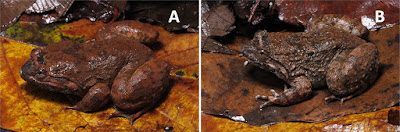
Paratypes of Limnonectes sirindhornae sp. nov. in life.
A. adult males B. adult females.

Limnonectes sirindhornae Rujirawan, Yodthong & Aowphol, sp. nov. 

Diagnosis.– Limnonectes sirindhornae sp. nov. is assigned to the genus Limnonectesbased on its phylo-genetic relationship (Fig. 2), the presence of fang-like odontoid processes on the lower jaw (Emerson et al., 2000; Lambertz et al., 2014), and adult males with hypertrophied heads (Lambertz et al., 2014). The new species can be distinguished from its congeners by having the following combination of characters: SVL 36.7–44.7 mm (40.8 ± 3.0; n = 8) in adult males, 40.2–45.6 mm (42.7 ± 2.2; n = 8) in adult females; adult males with hypertrophied heads; adult males with interorbital caruncle weakly developed, low-profiled, U-shaped, without free posterior margin; two enlarged odontoid processes on anterior margin of lower jaw, larger in males than in female; vocal sac opening in males absent; and yellowish coloration in life on ventral surfaces absent.

Etymology.–The specific epithet is a matronym in honor of Her Royal Highness Princess Maha Chakri Sirindhorn, recognizing her significant contributions to the conservation of Thailand's biodiversity and environment.

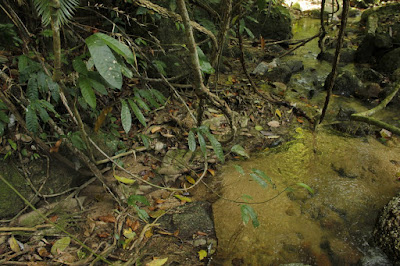
Habitat of Limnonectes sirindhornae sp. nov. at the type locality in Rai Subdistrict, Phanna Nikhom District, Sakon Nakhon Province, Thailand.
A. rocky stream and B. pool along side of intermittent stream in dry season (January) C. sandstone cave in wet season (October).


Attapol Rujirawan, Siriporn Yodthong, Pratyaporn Wanchai, Bryan L. Stuart and Anchalee Aowphol. 2025. A New Caruncle-bearing Limnonectes (Anura: Dicroglossidae) from the Phu Phan Mountain Range in Northeastern Thailand. Tropical Natural History. Supplement 8258-275. DOI: doi.org/10.58837/tnh.25.8.266987 [2025-10-14]


Thursday, July 17, 2025

[Herpetology • 2025] Limnonectes maanyanorum & L. nusantara • Two New Species of Fanged Frog (Anura: Dicroglossidae) from Southeastern Borneo, Indonesia


Limnonectes maanyanorum 
Gonggoli, Shimada, Matsui, Nishikawa, Sidik, Kadafi, Farajallah & Hamidy, 2025 
 
 
Abstract
Two new species of dicroglossid frog of the Limnonectes kuhlii complex are described from southeastern Borneo, Indonesia. These new species were previously confused with L. kuhlii, whose type locality is Java, but recognized to represent genetically distinct lineages. Here, we describe them based on molecular and morphological characteristics. The two new species, Limnonectes maanyanorum sp. nov. and Limnonectes nusantara sp. nov., can be distinguished from named species of the Limnonectes kuhlii complex from Borneo, Java, Sumatra, and Peninsular Malaysia by significant genetic distances in partial sequences of the 16S rRNA gene and combinations of morphological characters. These descriptions are an initiation step in taxonomic work to encourage studies of the L. kuhlii complex in Kalimantan, Indonesia.

Amphibia, Limnonectes, Meratus mountain range, morphology, partial 16s rRNA gene, taxonomy


Limnonectes maanyanorum


Ade Damara GONGGOLI, Tomohiko SHIMADA, Masafumi MATSUI, Kanto NISHIKAWA, Irvan SIDIK, Ahmad Muammar KADAFI, Achmad FARAJALLAH and Amir HAMIDY. 2025. Two New Species of Fanged Frog from Southeastern Borneo, Indonesia (Amphibia: Anura: Dicroglossidae). Zootaxa. 5575(3); 387-408. DOI: doi.org/10.11646/zootaxa.5575.3.3  [2025-01-24]

Wednesday, July 31, 2024

[Herpetology • 2024] Limnonectes cassiopeia • A Long Overlooked New Species of Fanged Frog, Genus Limnonectes (Anura: Dicroglossidae), from Luzon Island, Northern Philippines


Red circles on the map represent genetic sampling localities for Limnonectes cassiopeia, new species, blue diamonds represent genetic sampling for L. macrocephalus, and gray triangles represent genetic samples of L. woodworthi
Herr, Som & Brown, 2024


Abstract
We describe a new species of fanged frog (genus Limnonectes) from the foothills of two, inland, south-to-north oriented, parallel mountain ranges of Luzon Island of the northern Philippines. Although the new species broadly co-occurs with its closest relative at numerous localities within the Luzon Pleistocene aggregate island complex faunal region, it can be readily diagnosed from Limnonectes macrocephalus based on its unpigmented (white) ventral surfaces of terminal digital discs, its unexpanded or minimally expanded terminal digital discs, and an allometric growth pattern indicating evidence of sexual dimorphism at a smaller overall body size. The new species, which can also be identified by its divergent 16S ribosomal RNA mitochondrial gene sequence, possesses a curious distribution unlike the range of any Philippine endemic amphibian characterized to date: it is known from nine interior (inland) localities distributed between the two, parallel, south-to-north mountain chains (the Cordillera and Sierra Madre) which characterize mainland Luzon. We interpret the presence of two broadly sympatric, genetically divergent, strongly supported haplotype clades—which correspond to morphologically diagnosable phenotypes, using traditional discrete characters and allometric growth patterns—as prima facia evidence of two, independently evolving evolutionary lineages (species) of giant fanged frogs on Luzon. The description of another new species of large-bodied fanged frog on Luzon from multiple localities in close proximity to the capital city (Manila) emphasizes the degree to which even well-studied larger Philippine landmasses possess unrecognized and overlooked biodiversity.
 
Map of sampling locations on Luzon Island, Philippines (right) and ML phylogenetic tree (left). Red circles on the map represent genetic sampling localities for Limnonectes cassiopeia, new species, blue diamonds represent genetic sampling for L. macrocephalus, and gray triangles represent genetic samples of L. woodworthi. Maximum likelihood tree topology estimated in IQ-TREE. Only the Limnonectes clade E (sensu Evans et al., 2003) subtree is shown here (see inset; outgroups not shown: L. finchi, L. parvus, L. micrixalus, L. palavanensis, L. leytensis, L. acanthi, and L. beloncioi). ...

Limnonectes cassiopeia, new species 
 Cassiopeia Fanged Frog

Etymology.—We derive the specific epithet, used as a modern simple noun in apposition in the nominative case, from the name collectively given to the five stars of the constellation Cassiopeia—used in reference to the species’ five bright, ventrally unpigmented, cream to white toe disks (the principal diagnostic character state difference distinguishing it from Limnonectes macrocephalus). In the Philippines, the constellation Cassiopeia is most visible in clear night skies over central and northern Luzon in an area encompassing the known distribution of the new species. Suggested common name: Cassiopeia Fanged Frog.


Mark W. Herr, Hannah E. Som and Rafe M. Brown. 2024. A Long Overlooked New Species of Fanged Frog, Genus Limnonectes (Amphibia: Anura: Dicroglossidae), from Luzon Island, Northern Philippines.  Ichthyology & Herpetology. 112(2); 270-294. DOI: doi.org/10.1643/h2022094

Thursday, May 12, 2022

[Herpetology • 2022] Minervarya charlesdarwini • The Curious Case of Charles Darwin’s Frog, Rana charlesdarwini Das, 1998: Phylogenetic Position and Generic Placement, with Taxonomic insights on Other Minervaryan Frogs (Dicroglossidae: Minervarya) in the Andaman and Nicobar Archipelago


Minervarya charlesdarwini (Das, 1998),   

in Garg, Chandrakasan, Gokulakrishnan, ... et Biju, 2022. 
 Charles Darwin’s minervaryan frog  ||  DOI: 10.3897/vz.72.e79496 

Abstract
Since the description of Charles Darwin’s frog as Rana charlesdarwini in 1998, its generic placement has been a taxonomic enigma. Subsequent studies first transferred this species to the dicroglossid genus Limnonectes, and then considered it as a ceratobatrachid of the genus Ingerana, which has since been moved to the family Dicroglossidae. However, recent works have doubted this generic placement and also suggested the possibility of its sister relationship with the genus Liurana, within Ceratobatrachidae. Nonetheless, there have been no detailed investigations to ascertain the generic placement of this taxon by confirming its phylogenetic position or using integrative taxonomic approaches. Here, we provide the first molecular assessment of Ingerana charlesdarwini based on mitochondrial and nuclear DNA and reveal that it is nested in the dicroglossid genus Minervarya. A member of the Minervarya andamanensis species group, Minervarya charlesdarwini comb. nov. is sister taxon to M. andamanensis and shows relatively shallow genetic distances (2.8–3.6%) in the 16S gene. Both species are widely distributed, occur sympatrically, and exhibit high morphological variations, leading to long-standing confusions with other dicroglossid frogs reported from the region. Our combined morphological and molecular studies on dicroglossid frogs sampled across the known ranges of these species suggest that reports of Limnonectes doriae (Boulenger, 1887) and L. hascheanus (Stoliczka, 1870) from the Andamans are misidentifications of the former two, pointing to the absence of genus Limnonectes from the Andaman Islands. Our study also reveals the novel record of Minervarya agricola from the Andamans, a species that appears to have been confused with Fejervarya limnocharis and Minervarya keralensis in the literature and misidentified museum specimens, and is found to be widely distributed across these islands. We further find another congener from the Nicobar group of Islands, M. nicobariensis, to be closely related to M. charlesdarwini. Similar to the case of Andaman dicroglossids, our work emphasises on the need for further studies to ascertain the taxonomic identities and generic placement of Minervarya and Limnonectes species reported from the Nicobars.

Key words: Amphibia, Ingerana, integrative taxonomy, island biogeography, Limnonectes, sympatric species

Morphological variation in skin colouration and markings observed among individuals of Minervarya charlesdarwini in the Andaman Islands.
A–N Dorsolateral views. A SDBDU 2021.4212 (♂). B–C SDBDU 2019.4059 (♀). D Not preserved. E SDBDU 2019.4006 (♂). F SDBDU 2019.3975 (♂). G SDBDU 2021.4212 (♂). H SDBDU 2019.4005 (♀). I SDBDU 2019.3968 (♀). J SDBDU 2019.4004 (♂). K SDBDU 2021.4213 (♀). L SDBDU 2020.4165 (♀). M SDBDU 2019.3946 (♀). N SDBDU 2021.4214 (♀).
Photographs: S. D. Biju, G. Gokulakrishnan & Sonali Garg.


Minervarya charlesdarwini (Das, 1998), comb. nov.
Charles Darwin’s minervaryan frog
 
Distribution: Minervarya charlesdarwini is endemic to the Andaman Archipelago of India, where we find it to be widely distributed in all the major groups of islands: North and Middle Andamans (North Andaman Is., Interview Is., Middle Andaman Is., Baratang Is., and Long Is.), South Andamans (South Andaman Is., Neil Is., Havelock Is., Boat Is., Red Skin Is., Alexandra Is., Rutland Is., and Tarmugli Is.), up to the Little Andaman Island. This species has been observed between elevations of nearly sea level up to 600 m asl (Fig. 2; Table 2).


Morphological variation in skin colouration and markings observed among individuals of Minervarya andamanensis.  A–J Dorsolateral views.
A SDBDU 2021.4206 (♀). B SDBDU 2021.4207 (♀).
C–D Not preserved (♂). E SDBDU 2020.4179 (♀). F SDBDU 2010.4178a (♀). G SDBDU 2019.4011 (♂). H SDBDU 2020.4155 (♂). I Not preserved (♂). J SDBDU 2019.3956 (♂).
Photographs: S. D. Biju, G. Gokulakrishnan & Sonali Garg.


 Minervarya andamanensis (Stoliczka, 1870)
 Andamanese minervaryan frog

Distribution: Minervarya andamanensis is endemic to the Andaman Archipelago of India, where we find it to be widely distributed in all the major groups of islands: North and Middle Andamans (North Andaman Is., Landfall Is., East Is., Paget Is., Interview Is., Smith Is., Long Is., North Passage Is., North Reef Is., Baratang Is., and Middle Andaman Is.), South Andamans (South Andaman Is., Boat Is., Alexandra Is., Tarmugli Is., Rutland Is., Neil Is., and Havelock Is.), down to the Little Andaman Island. This species has been observed between elevations of sea level up to nearly 400 m asl (Fig. 2; Table 2).


Morphological variation observed among individuals of Minervarya nicobariensis in Nicobar Islands (all males).
 A SDBDU 2021.4250. B SDBDU 2021.4249.

Morphological variation observed among individuals of Minervarya agricola.
 A Not preserved (♂). B SDBDU 2020.4151 (♂).
 Photographs: S. D. Biju, G. Gokulakrishnan and Sonali Garg.

Minervarya agricola (Jerdon, 1853) from Andaman Islands

Distribution. Minervarya agricola is a widely distributed species of South and Southeast Asia, being found in India, Sri Lanka, Bhutan, Nepal, Bangladesh, Myanmar, Thailand, and southern China (Garg and Biju 2021). In the Andaman Archipelago of India, we provide new reports of this species from all the major groups of islands: North and Middle Andamans (North Andaman Is., Baratang Is., and Middle Andaman Is.), South Andamans (South Andaman Is., Neil Is., and Havelock Is.), up to the Little Andaman Island. This species has been observed between elevations of sea level up to elevations of nearly 130 m asl (Fig. 2; Table 2).


 Sonali Garg, Sivaperuman Chandrakasan, G. Gokulakrishnan, C. Gopika, Indraneil Das and S. D. Biju. 2022. The Curious Case of Charles Darwin’s Frog, Rana charlesdarwini Das, 1998: Phylogenetic Position and Generic Placement, with Taxonomic insights on Other Minervaryan Frogs (Dicroglossidae: Minervarya) in the Andaman and Nicobar Archipelago. Vertebrate Zoology. 72: 169-199.  DOI: 10.3897/vz.72.e79496


Monday, March 7, 2022

[Herpetology • 2021] Revisiting Linnaean and Wallacean Shortfalls in Mindanao Fanged Frogs: The Limnonectes magnus Complex (Anura, Dicroglossidae) consists of Only Two Species


in Abraham, Herr, Sterkhova, ... et Brown, 2021.  

Abstract  
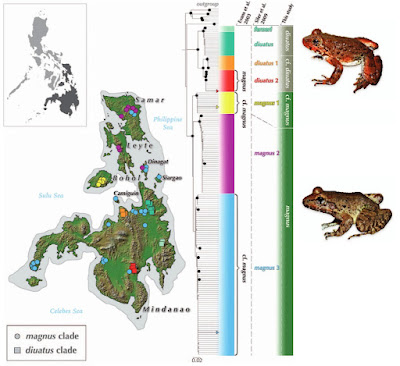
We revisit the question of species diversity among Mindanao Fanged Frogs of the Limnonectes magnus complex consisting of L. magnus, L. diuatus, L. ferneri, and a previously hypothesized putative new species, inferred in the first molecular phylogenetic studies of the genus almost 2 decades ago. Using a multilocus molecular deoxyribonucleic acid sequence data set and comprehensive sampling of 161 individuals from throughout the Mindanao Pleistocene aggregate island complex landmasses (a distinct faunal region of the southern Philippines) we characterize geographically structured genetic diversity, focusing on the phylogenetic placement of individuals from each species' type locality. We also present new morphometric data from large samples of freshly collected material from the type localities of each included species; together with examination of the name-bearing original type specimens, we conclude that an overestimation of species diversity has occurred and has been exacerbated by the indiscriminate acceptance of the hypothesis of the existence of widespread cryptic species in this group. We place L. ferneri in synonymy with L. diuatus, clarify the identification of the latter taxon with respect to L. magnus, and apply this name to the widespread, generalist, highly variable giant Fanged Frog distributed throughout the Mindanao faunal region of the southern Philippines.

KEYWORDS: Geographic radiation, Mindanao Pleistocene aggregate island complex, Stream frogs


Robin Kurian Abraham, Mark William Herr, Viktoria V. Sterkhova, Rayanna Otterholt, Cameron D. Siler, Marites Bonachita Sanguila and Rafe M. Brown. 2021. Revisiting Linnaean and Wallacean Shortfalls in Mindanao Fanged Frogs: The Limnonectes magnus Complex Consists of Only Two Species. Herpetological Monographs. 35(1); 112-140. DOI: 10.1655/HERPMONOGRAPHS-D-20-00010

Tuesday, August 31, 2021

[Herpetology • 2021] Limnonectes bagoensis & L. bagoyomaBioacoustics Reveal Hidden Diversity in Frogs: Two New Species of the Genus Limnonectes (Anura, Dicroglossidae) from Myanmar


Limnonectes bagoensis 
 Köhler, Zwitzers, Than et Thammachoti, 
 
in Köhler, Zwitzers, Than, Gupta, Janke, Pauls et Thammachoti, 2021. 
 
Abstract
Striking geographic variation in male advertisement calls was observed in frogs formerly referred to as Limnonectes doriae and L. limborgi, respectively. Subsequent analyses of mtDNA and external morphological data brought supporting evidence for the recognition of these populations as distinct species. We describe two new frog species of the genus Limnonectes (i.e., L. bagoensis sp. nov. and L. bagoyoma sp. nov.) from Myanmar. Limnonectes bagoensis sp. nov. is closely related to L. doriae whereas L. bagoyoma sp. nov. is closely related to L. limborgi. Results of this integrative study provide evidence for the presence of additional undescribed species in these species complexes but due to the lack of bioacoustical data, we consider these additional diverging populations as candidate species that need further study to resolve their respective taxonomic status. Both new species are distributed in Lower Myanmar. Limnonectes doriae is restricted to southern Myanmar along the Malayan Peninsula whereas L. limborgi is known to occur in eastern Myanmar and northwestern Thailand. The remaining populations formerly referred to as either L. doriae or L. limborgi are considered representatives of various candidate species that await further study. We further provide a de novo draft genome of the respective holotypes of L. bagoensis sp. nov. and L. bagoyoma sp. nov. based on short-read sequencing technology to 25-fold coverage.

Keywords: bioacoustics; cryptic species diversity; Dicroglossidae; genome; Limnonectes bagoensis sp. nov.; Limnonectes bagoyoma sp. nov.; Myanmar; new species; Thailand


Figure 11. Holotype of Limnonectes bagoensis n. sp. (SMF 104090) in life, at its calling site after the covering rocks had been removed.

Figure 10. Limnonectes bagoensis n. sp. in life.
(A) Male holotype, SMF 104090; (B) female paratype, SMF 104091; (C–F) male paratype, SMF 106038.
Photos by Gunther Köhler.

Limnonectes bagoensis sp. nov.
Gunther Köhler, Britta Zwitzers, Ni Lar Than and Panupong Thammachoti
 
 Diagnosis. A species of the genus Limnonectes to which it is assigned because of its inferred phylogenetic position, males with hypertrophied heads, and the presence of odontoids on the lower jaw in adult males. Limnonectes bagoensis sp. nov. is assigned to the subgenus Elachyglossa because of its close phylogenetic position to the type species of this subgenus (i.e., L. gyldenstolpei). Limnonectes bagoensis sp. nov. differs from all congeners by having (1) a medium body size (males 32–49 mm; females 30–47 mm); (2) slightly enlarged toe disks; (3) adult males with small odontoids in the lower jaw; (4) adult males without a knob-like or flap-like structure (caruncle) in the interorbital and parietal region; also lacking swelling in the occipital region; (5) in adult males head not conspicuously enlarged; (6) webbing formula I 1–2 II 1–2.4 III 1.2–3 IV 3.3–2 V to I 1.8–2.2 II 1.5–2.8 III 2.2–3.2 IV 3.5–2 V; (7) a feeble dermal fringe along the outer edge of Toe 5; (8) male advertisement call consists of two portions that are separated by a break of slightly less than 1 s. The first portion of the call is a single note with a duration of 225–291 ms whereas the second portion consists of 4–9 notes with a duration of 1200 (4 notes) to about 2000 ms (9 notes) with about 4.5 notes per second; the dominant frequency is at 861–990 Hz (mean 945 Hz). Limnonectes bagoensis differs from all other species currently assigned to the subgenus Elachyglossa except L. doriae by lacking a knob-like or flap-like structure (caruncle) in the interorbital and parietal region in adult males (versus such structure present in adult males), and also lacking swelling in the occipital region (versus such swelling present in adult males). Limnonectes bagoensis differs from L. doriae in having a male advertisement call that consists of two portions, separated by a break of slightly less than 1s, the second portion with a series of 4–9 notes at about 4.5 notes per second (versus a single series of notes in L. doriae with about 12 notes per second); gular coloration in adult males not dark (versus gular region dark gray in adult males of L. doriae).

Etymology. The species name “bagoensis” refers to the city of Bago where the holotype of this species was collected, and -ensis denoting place.

Natural history notes. At the type locality at night time, adult males were heard calling on the surface hidden under flat rocks. Figure 11 shows the holotype (SMF 104090) that continued calling even after the covering rocks had been removed. Additional individuals were encountered sitting on the forest floor at night without cover.


Figure 14. Limnonectes bagoyoma n. sp. in life.
(A) Female holotype, SMF 106034; (B) Male paratype, SMF 106035.
Photos by Gunther Köhler.

Limnonectes bagoyoma sp. nov.
Gunther Köhler, Britta Zwitzers, Ni Lar Than and Panupong Thammachoti
 
 Diagnosis. A species of the genus Limnonectes to which it is assigned because of its inferred phylogenetic position (Figure 1), males with hypertrophied heads, and the presence of odontoids on the lower jaw in adult males. Limnonectes bagoyoma sp. nov. is assigned to the subgenus Taylorana because of its close phylogenetic position to the type species of this subgenus (i.e., L. limborgi; Figure 1). Limnonectes bagoyoma sp. nov. differs from all congeners by having (1) a small body size (males 29.3–30.7 mm; females 23.1–26.6 mm); (2) males with slightly enlarged odontoids; (3) inner metatarsal tubercle large, raised, usually >0.5 length of the first toe; (4) webbing formula I 1–2 II 1–2.4 III 1.2–3 IV 3.3–2 V to I 1.8–2.2 II 1.5–2.8 III 2.2–3.2 IV 3.5–2 V; (5) females with clutches of enlarged, non-pigmented eggs; (6) male advertisement call consisting of a single note with a duration of 220–250 ms and a dominant frequency mostly in the 1300–1400 Hz range. Limnonectes bagoyoma differs from the remaining species of the subgenus Taylorana as follows: from L. limborgi by having a male advertisement call consisting of a single note with a duration of 220–250 ms (versus call consisting of a series of 3–5 notes, each note with a duration of usually >260 ms in L. limborgi), and no dark lateral face mask (versus dark face mask present). Limnonectes bagoyoma differs from L. hascheanus by its larger body size, reaching 30 mm SVL in adult males (versus SVL <26 mm in both sexes in L. hascheanus), and by having more toe webbing, usually three phalanges free of webbing on the medial side of Toe 4 (versus more than three phalanges free of webbing on the medial side of Toe 4). Limnonectes bagoyoma differs from L. liui by its smaller body size, SVL not exceeding 31 mm in both sexes (versus SVL 32.0–38.5 mm in males of L. liui, only female in type series measuring 32.7 mm), toe webbing well-developed (versus rudimentary), and inner metatarsal tubercle usually >0.5 length of the first toe (versus “just half” of the first toe in L. liui). Limnonectes bagoyoma differs from L. medogensis by having the nostril positioned closer to the snout than to the eye (versus closer to eye in L. medogensis), vomerine teeth present (versus absent), venter patternless (versus marbled markings present), toe webbing well-developed (versus rudimentary), inner metatarsal tubercle distinctly shorter than the first finger (versus about length of Toe 1), and tarsal fold indistinct but present (versus absent). Limnonectes bagoyoma differs from L. xizangensis by having the toe tips enlarged into small disks (versus toe tips pointed), vomerine teeth present (versus absent), toe webbing well-developed (versus absent), and the presence of tiny tubercles on the dorsal surface of the shank (versus smooth), venter patternless (versus black reticulated markings present), and smooth skin on venter (granular skin on venter). Limnonectes bagoyoma differs from L. alpinus by having the toe webbing well-developed (versus toe webbing absent in L. alpinus), vomerine teeth present (versus absent), and tympanum distinct (versus hidden).

Etymology. The species name “bagoyoma” refers to the type locality Bago Yoma, a large but relatively low mountain range that runs in a north-south direction between the Irrawaddy (=Ayeyarwady) and the Sittaung River in Myanmar. It is likely that Limnonectes bagoyoma is geographically restricted to this mountain range. 

Natural history notes. At the type locality, the specimens were collected during the daytime in leaf litter in the rainforest. The two males we collected were heard calling before we caught them. Each male was sitting in a shallow depression, covered by leaf litter. Other frog species collected at the type locality include Duttaphrynus melanostictus, Fejervarya orissaensis, Ingerana tenasserimensis, Limnonectes bagoensis, and Leptobrachium smithi.


Gunther Köhler, Britta Zwitzers, Ni Lar Than, Deepak Kumar Gupta, Axel Janke, Steffen U. Pauls and Panupong Thammachoti. 2021. Bioacoustics Reveal Hidden Diversity in Frogs: Two New Species of the Genus Limnonectes from Myanmar (Amphibia, Anura, Dicroglossidae). Diversity. 13(9); 399. DOI: 10.3390/d13090399


Wednesday, July 14, 2021

[Herpetology • 2021] First Records of the Fanged Frogs Limnonectes bannaensis and L. utara (Anura: Dicroglossidae) in Thailand


 (A, B) กบห้วยขาปุ่มน่าน Limnonectes bannaensis Ye, Fei & Jiang, 2007
กบห้วยขาปุ่มมลายู L. utara Matsui, Belabut & Ahmad, 2014 

in Suwannapoom, Jiang, Wu, ... et Che, 2021. 

Abstract
Background: The taxonomic status of the Thai populations belonging to the Limnonectes kuhlii species complex is controversial, due to phenotypic similarity in the cryptic species complex. Recently, some studies on this group in Thailand have discovered four new species: L. taylori, L. megastomias, L. jarujini and L. isanensis. Even so, the diversity of this group is still incomplete.

New information: Based on an integrative approach encompassing genetic and morphological analyses, we conclude that the Limnonectes populations from Nan Province (northern) and Yala Province (southern) of Thailand are conspecific with L. bannaensis Ye, Fei & Jiang, 2007 and L. utara Matsui, Belabut & Ahmad, 2014, respectively. These are the first records of these species in Thailand. Our study highlights the importance of using DNA sequence data in combination with morphological data to accurately document species identity and diversity. This is especially important for morphologically cryptic species complexes and sympatrically occurring congeners.

Keywords: Nan Province, Yala Province, 16S rRNA, Cryptic species, Species complex


Figure 1. Map showing the type-localities of Limnonectes kuhlii species complex in Thailand. Circles = Type localities of L. taylori (red), L. jarujini (purple), L. megestomias (orange) and L. isanensis (brown). Blue square (L. bannaensis) and yellow square (L. utara) represent the two new distribution records in Thailand reported here.

Figure 2. BI tree resulting from 492 bp length fragment of mitochondrial 16S rRNA gene for Limnonectes species and outgroups. Bayesian posterior probabilities (BPP) > 95%/ML inferences (ML-BS) > 80% are shown for each node; “-” denotes low support of Bayesian posterior probabilities and bootstrap support < 80% in one analysis, no values on branches represent low support in both analyses. The scale bar represents 0.02 nucleotide substitutions per site.


Figure 4. Colour variations of Limnonectes bannaensis 
A. Dorsal view of male (AUP-00481); B. Dorsal view of female (AUP-00491).

Figure 5. Habitat of Limnonectes bannaensis in Bo Kluea District, Nan Province, northern Thailand.


Limnonectes bannaensis Ye, Fei, Xie & Jiang, 2007
กบห้วยขาปุ่มน่าน 


Limnonectes utara Matsui, Belabut & Ahmad, 2014
กบห้วยขาปุ่มมลายู

Figure 6. Male of Limnonectes utara (AUP-01708) in life.
A. Dorsal view; B. Lateral view of head; C. Dorsolateral view of head; D. Dorsal view of leg (notice the tubercles); E. Ventral view of foot; F. Ventral view of hand.


Figure 7. Habitat of Limnonectes utara in Bannang Sata District, Yala Province, southern Thailand.


 Chatmongkon Suwannapoom, Ke Jiang, Yun-He Wu, Parinya Pawangkhanant, Sengvilay Lorphengsy, Tan Van Nguyen, Nikolay A. Poyarkov and Jing Che. 2021. First Records of the Fanged Frogs Limnonectes bannaensis Ye, Fei & Jiang, 2007 and L. utara Matsui, Belabut & Ahmad, 2014 (Amphibia: Anura: Dicroglossidae) in Thailand. Biodiversity Data Journal. 9: e67253. DOI: 10.3897/BDJ.9.e67253

กบห้วยขาปุ่มเหนือ, กบห้วยขาปุ่มเทย์เลอร์ Limnonectes taylori 
กบห้วยขาปุ่มใต้, กบห้วยขาปุ่มจารุจินต์ Limnonectes jarujini 
 กบห้วยปากใหญ่ Limnonectes megastomias 
กบห้วยขาปุ่มอีสาน, กบหมื่น, กบมื่น Limnonectes isanensis
กบห้วยขาปุ่มน่าน Limnonectes bannaensis 
 กบห้วยขาปุ่มมลายู Limnonectes utara  


Wednesday, June 2, 2021

[Herpetology • 2021] Limnonectes pseudodoriae • A New Limnonectes (Anura: Dicroglossidae) from Southern Thailand


 Limnonectes pseudodoriae 
Yodthong, Rujirawan, Stuart & Aowphol, 2021
 
กบตามธารเหลือง | False Doria’s Fanged Frog || DOI: 10.3390/ani11020566 

Abstract
A new species in the dicroglossid frog genus Limnonectes is described from Ko Pha-ngan, Ko Samui, and Ko Lanta Yai Islands in southern Thailand. Males of Limnonectes pseudodoriae sp. nov. lack a caruncle on top of the head and very closely resemble L. doriae (Boulenger, 1887) from Myanmar and western and southern Thailand. However, the new species is distinguished from L. doriae and its congeners using an integrative taxonomic approach of morphology, mitochondrial DNA, and bioacoustics. Limnonectes pseudodoriae sp. nov. differs from L. doriae and its congeners by having a unique combination of morphological characters, including body size; skin texture of the interorbital region, dorsum, and shank; toe webbing; relative size of the inner metatarsal tubercle; and coloration of the tympanum, venter, and ova. The advertisement call of the new species is also readily differentiated from that of L. doriae in temporal parameters. Limnonectes pseudodoriae sp. nov. is highly divergent in mitochondrial DNA from L. doriae and its congeners, but its phylogenetic position within the genus is not resolved. The natural history of the new species is presented, and the geographic range of L. doriae in Thailand is clarified.  

Keywords: Amphibia; Limnonectes doriae; bioacoustics; mitochondrial DNA; Southeast Asia

Holotype of  Limnonectes pseudodoriae sp. nov. (ZMKU AM 01567) in life.
(A) Lateral view, (B) dorsal view, (C) ventral view, (D) palmar view of the right hand, and (E) plantar view of the right foot. Arrows refer to diagnostic characters in toe webbing. 

Paratypes of  Limnonectes pseudodoriae sp. nov.
 (A) adult male (ZMKU AM 01568), (B) adult male (ZMKU AM 01575) from Ko Pha-ngan Island. (C) Adult male (ZMKU AM 01555) from Ko Lanta Yai Island and (D) adult female (ZMKU AM 01573) from Ko Pha-Ngan Island.


Limnonectes pseudodoriae sp. nov.  

 Diagnosis: Limnonectes pseudodoriae sp. nov. is assigned to the genus Limnonectes on the basis of its inferred phylogenetic position (Figures 1 and 2), the presence of fang-like odontoid processes on the lower jaw [6,10], and enlarged heads with hypertrophied jaw musculature in adult males [6]. This species can be distinguished from its congeners by having the following combination of characters: (1) Small to medium body size, with SVL of adult males 42.6–48.2 mm (45.2 ± 1.7, n = 18), of adult females 36.0–44.1 mm (40.0 ± 2.8, n = 14); (2) males lacking cephalic caruncles, but having broadened convex skin with densely grained translucent spinules on the interorbital region from the level of the posterior margin of the eyes to the level of the posterior margin of the tympanum; (3) males with enlarged heads with hypertrophied jaw musculature; (4) two enlarged odontoid processes, triangular, sharp-tipped, angled posteriorly on anterior margin of the lower jaw, larger in adult males than females; (5) tympanum dark brown with yellow mottling, horizontal diameter in adult males greater than that of the eye, in juveniles and females less than that of the eye; (6) dorsum with enlarged, oval tubercles, and slightly elongated tubercles, not arranged in rows; (7) dorsal surface of shank covered with small, distinct, moderately dense, homogenously-sized tubercles tipped with translucent spinules; (8) chin and throat yellowish white with dark brown or gray mottling (9) chest, belly, ventral surface of upper forelimb and groin yellowish white; (10) ventral surfaces of forelimbs and hindlimbs orange-yellow; (11) Toe V with raised, but unmovable dermal ridge along outer margin; (12) inner metatarsal tubercle length approximately 35% that of Toe I; (13) toe webbing formula: I0−2II0−2 1 2 III0−(21 2 -3)IV(21 2 -3)−0V; and (14) ova with pigmented poles.  

Etymology: The specific name pseudodoriae is a noun in apposition. The Greek word pseudo means “false” or “resembling”, in reference to the morphological similarity between the new species and L. doriae. 
Suggested common names: False Doria’s Fanged Frog (English), Kob Tam Than Lueang กบตามธารเหลือง (Thai).

Map showing the type locality (red star) at Ko Pha-ngan Island, Surat Thani Province, Thailand and paratype localities (red circles) at Ko Samui Island, Surat Thani Province and Ko Lanta Yai Island, Krabi Province, Thailand of Limnonectes pseudodoriae sp. nov., the type locality (yellow star) in Myanmar, and the localities of studied specimens (yellow triangles) of L. doriae in Thailand and Myanmar. Numbers correspond to those in Table S1. Shaded symbols indicate morphological data only, Shaded symbols with white center dot indicate molecular data only, and shaded symbols with black center dots indicate both molecular and morphological data were studied.


Sampling localities of Limnonectes pseudodoriae sp. nov. at
(A) the type locality in Pheang Waterfall, Ko Pha-ngan Island, Surat Thani Province,
(B) Song Reau Waterfall, Ko Samui Island, Surat Thani Province,
and (C) Tham Khao Mai Kaew Cave, Ko Lanta Yai, Krabi Province. 

Habitat of calling males of Limnonectes pseudodoriae sp. nov. 
(A, B) An orchard near the forest edge in Ko Phangan Island, Surat Thani Province,
and (C) an adult male in shallow water, presumably where they were heard calling.

 (A) Oviposition site of Limnonectes pseudodoriae sp. nov. at Song Reau Waterfall, Ko Samui Island, Surat Thani Province, (B) clutch of 30, bicolored eggs in a nest without free water, (C) clutch of 25 developing eggs, (D) 16 tadpoles in a small volume of fluid, and (E) adult male near the oviposition site (not collected).

 Conclusions: 
 We described a new species of the fanged frog genus Limnonectes (Amphibia, Anura, Dicroglossidae) from southern Thailand, Ko Pha-ngan and Ko Samui Islands (the Gulf of Thailand coast) and Ko Lanta Yai Island (the Andaman Sea coast), using an integrative taxonomic approach based on multiple lines of evidence. Limnonectes pseudodoriae sp. nov. can be differentiated from the most morphologically similar species, L. doriae, and its congeners on the basis of mitochondrial DNA (16S rRNA and ND3), qualitative and quantitative morphology, and advertisement calls. However, the exact sister relationship of the new species remains unresolved, and additional sequence data may be required to resolve these relationships. Limnonectes pseudodoriae sp. nov. is known only from a relatively small geographic area in southern Thailand, where it inhabits mountain streams at mid to low elevations similar to many other fanged frogs. The new species deposits eggs in terrestrial nests near streams that consist of moist, shallow, clay holes covered with leaf litter, and the tadpoles develop in the moist clay of the nest, without free water or in only a small volume of fluid. Additional field sampling is needed to understand the extent of the geographic range and natural history of the new species. 


 Siriporn Yodthong, Attapol Rujirawan, Bryan L. Stuart and Anchalee Aowpho. 2021. A New Limnonectes (Anura: Dicroglossidae) from Southern Thailand. Animals. 11(2); 566. DOI: 10.3390/ani11020566 

Simple Summary: 
New species of frogs continue to be discovered at a rapid rate in Southeast Asia, often as a result of reexamining populations of geographically widespread species using new molecular and bioacoustic tools. Here, we show that members of the fanged frog genus Limnonectes from Ko Pha-ngan, Ko Samui, and Ko Lanta Yai Islands in southern Thailand can be distinguished from the morphologically similar species Limnonectes doriae in molecular, advertisement call, morphometric, and qualitative morphological characters. On the basis of these multiple lines of evidence, we describe the insular populations in southern Thailand as a new species, Limnonectes pseudodoriae sp. nov. The new species occurs near small streams in low to mid-elevation forests and breeds in terrestrial nests consisting of moist, clay depressions in which the eggs and larvae develop. || น้ำตกซองเรือ