Showing posts with label Orobanchaceae. Show all posts

Thursday, July 9, 2026

[Botany • 2026] Buchnera hirsutorepens • A New Species of prostrate Orobanchaceae from Zambia and DR Congo, along with a revised description of Buchnera prorepens


Buchnera hirsutorepens  J.K.Gibson & I.Darbysh., 
 Buchnera prorepens Engl. & Gilg, 

in Gibson, Sichamba et Darbyshire, 2026.  

Summary
A new species of Buchnera L. is described, Buchnera hirsutorepens, from south-eastern Democratic Republic of the Congo, and central and eastern Zambia. Buchnera hirsutorepens is split from Buchnera prorepens Engl. & Gilg, which is also redescribed here, its range now encompassing Angola and Western Zambia. These two species are unique in the genus Buchnera in their prostrate habit and axillary flowers. They can be separated from each other by differences in indumentum of the inflorescence and leaves, bract shape, pedicel length and relative length of the corolla tube to the calyx. A distribution map of georeferenced specimen localities of the two species is provided, along with information on their habitat and ecology, and an evaluation of their conservation status based on IUCN guidelines and criteria.

Key Words: Africa, Red List assessment, Savanna, taxonomy, vicariance 

Buchnera hirsutorepens.
A habit (as on sheet); B stem indumentum; C leaf, adaxial surface, with indication of indumentum; D leaf indumentum; E flower, with bract and bracteole; F trichome, from corolla tube entrance; G petal margin; H calyx tube; J ovary, style and stigma; K corolla tube.
 A – D from D. B. Fanshawe F.1963 (holotype K), E – K from E. Robinson 2580 (K). 
drawn by Andrew Brown.

A Buchnera prorepens, Dec. 2023 in the Western Province, Zambia.
Buchnera hirsutorepens, Feb. 2022 in Shiwa-Ngandu District, Zambia.
photos: Nicholas Wightman.

Buchnera hirsutorepens J.K.Gibson & I.Darbysh. sp. nov. 

 
John K. Gibson, Mpande Sichamba and Iain Darbyshire. 2026. Buchnera hirsutorepens, A New Species of prostrate Orobanchaceae from Zambia and the Democratic Republic of the Congo, along with a revised description of Buchnera prorepens Kew Bulletin. DOI: doi.org/10.1007/s12225-025-10349-x [13 May 2026]

Saturday, January 3, 2026

[Botany • 2025] Untangling tightly bound knots: a reappraisal of Campbellia (Orobanchaceae), with the Rediscovery of C. aurantiaca after more than 175 years


Campbellia aurantiaca  

in Salim, Mathew, Arunraj, Sanjai et Gopallawa, 2025.    

Summary
The long-standing ambiguities on the taxonomic status of Campbellia Wight and C. aurantiaca Wight are resolved, and this particular species is rediscovered after more than 175 years from the Western Ghats, India.

Key Words: Christisonia-Campbellia complex, endemic, holoparasite, Robert Wight, Western Ghats


Campbellia aurantiaca Wight


P. M. Salim, Jose Mathew, P. T. Arunraj, V. N. Sanjai and B. Gopallawa. 2025. Untangling tightly bound knots: a reappraisal of Campbellia (Orobanchaceae), with the Rediscovery of C. aurantiaca after more than 175 years.  Kew Bulletin. DOI: doi.org/10.1007/s12225-025-10282-z [02 December 2025]

Friday, June 13, 2025

[Botany • 2025] Pedicularis rajeshiana (Orobanchaceae) • A New hemiparasitic Species from Western Himalaya, India


Pedicularis rajeshiana Arti Garg, 
in Garg, 2025. 

Abstract
A new hemiparasitic species, Pedicularis rajeshiana (Orobanchaceae), from Rohtang in the Western Himalayas, India is described and illustrated. The new species differs from all the previously known species of Pedicularis by it’s corolla having deeply-incised labium lobes and unusual staminal insertion points at three levels on the corolla tube. Critical macro- and micro-morphological character analysis including the pollen morphology, supported this species delineation from all the other known species of Pedicularis L. and the new species is placed in the series Debiles of section Orthorrhynchae, subsection Euorthorrhynchae having plants with low grassy habit and the filaments inserted above middle of corolla tube. The new species is closely allied to the two species, P. porrecta and P. heydei but differs from both these by its tiny size, fewer-flowered inflorescence, fewer leaf-pinnae, deeply-incised labium lobes almost to the base, stamens inserted at three different levels on corolla tube and bicolpate, prolate pollen grains with crotonoid exine sculpture. Two flowers with twin (double) galea were observed which is an innovative floral trait never found earlier in this genus, suggesting acquired, adaptive and evolutionary transition towards more precise pollination.

Himachal Pradesh, Rohtang, Pedicularis porrectaPedicularis heydeiPedicularis series Debiles, Eudicots


Arti GARG. 2025. Pedicularis rajeshiana (Orobanchaceae), A New hemiparasitic Species from Western Himalaya, India. Phytotaxa. 702(2); 149-165. DOI: doi.org/10.11646/phytotaxa.702.2.3 [2025-05-27] 

Friday, May 2, 2025

[Botany • 2023] Castilleja eggeri (Orobanchaceae: Pedicularideae) • A New endemic Species from Mexico


Castilleja eggeri Franc.Gut., Cházaro & Avendaño,
 
in Francisco-Gutiérrez, Cházaro-Basáñez et Avendaño-Reyes, 2023.   
 
Abstract
The new species Castilleja eggeri (Orobanchaceae) is described, compared and illustrated. The species is distinguished by its reduced number of 1–5 flowers per inflorescence, decumbent stems and dissected leaves. It is distributed in a narrow and very humid area of cloud forest in the mountains of central Veracruz in eastern Mexico. It is compared with Castilleja moranensis, morphologically the most similar species. Conservation assessment classifies the species as critically endangered (CR). Also, a key and distribution map of Castilleja taxa in the state of Veracruz are provided. This species is added to the endemisms of Castilleja in Mexico, where one third of the total diversity of the genus in the Americas is found.

Keywords: Castillejinae, hemiparasitism, parasitic species, Scrophulariaceae


Castilleja eggeri sp. nov.


Antonio Francisco-Gutiérrez, Miguel Cházaro-Basáñez and Sergio Avendaño-Reyes. 2023. Castilleja eggeri (Orobanchaceae: Pedicularideae), A New endemic Species from Mexico. Nordic Journal of Botany. e04057. DOI: 10.1111/njb.04057  [17 August 2023]

Thursday, March 6, 2025

[Botany • 2025] Orobanche andryalae (Orobanchaceae) • A New Species from the Canary Islands


Orobanche andryalae C.J.Thorogood, M. Hernández González, Rumsey & Reyes-Bet.,

in Thorogood, Hernández González, Rumsey et Reyes-Betancort, 2025. 

Abstract
A new species of Orobanche is described from the Canary Islands. The plant belongs to the complicated Subsection Minores and has a distinct combination of morphological features, ecology, and host specificity. The markedly cernuous corolla, high filament insertion and colouration distinguishes Orobanche andryalae from closely related species with which it has been previously confused, and which do not occur in the Canary Islands, including O. amethystea subsp. castellana and O. calendulae; these features remain stable in cultivation. Orobanche andryalae appears to be parasitic almost exclusively on Andryala spp., and occurs on thermophilus volcanic substrates in northern Lanzarote, northwest Tenerife and Jandía in Fuerteventura. An updated key to the Orobanche of the Canary Islands is presented, including the new taxon we describe here.

Key words: Andryala, broomrape, endemism, Macaronesia, parasitic plant


Orobanche andryalae 
A habit B lower stem C corolla D corolla cross section E carpel F stamen G calyx lobe H bract.

Orobanche andryalae in cultivation at the University of Oxford Botanic Garden B O. amethystea in the Algarve, Portugal C O. calendulae in the Algarve, Portugal
D the habitat of O. andryalae in Lanzarote: volcanic cliffs (Famara area, northern Lanzarote) E O. andryalae in Lanzarote, with its host plant Andryala perezii O. andryalae collected from Fuerteventura (putatively parasitising Asteriscus sericeus) G, H O. andryalae in northwest Tenerife growing on Andryala pinnatifida (the corolla dorsal line of the specimen in H is atypical in being less conspicuously cernuous).

 Orobanche andryalae C.J.Thorogood, M. Hernández González, Rumsey & Reyes-Bet., sp. nov.

Description: Stems 6–16(25) cm, glandular-hairy, pale orange to light reddish-brown. Stem scarcely swollen below; subterranean bracts broadly triangular, yellow; those above (reduced leaves) rather sparse, brown, 8–15 mm. Flowers 5–15(20), arranged on the upper quarter or third of the stem, lax. Bracts 10–12 mm, rather shorter than the corolla, broadly triangular, brown, glandular-hairy. Calyx 5–7 mm with segments fused, strongly unequal (rarely entire), not exceeding the corolla tube. Corolla 10–15 mm, pale yellow with faint reddish veins and scattered glandular hairs, strongly cernuous when mature, remaining so in fruit, sometimes abruptly geniculate; upper lip bilobed; lower lip 3-lobed, the lateral lobes slightly exceeding the central; all lobes minutely-toothed. Filaments sparsely hairy below, glabrous above; inserted conspicuously (c.5 mm) above the corolla base; anthers ± glabrous. Stigma lobes touching, mid to dark red-orange.

Etymology. Orobanche andryalae is named in accordance with its main host species, Andryala perezii.


 Chris J. Thorogood, Matías Hernández González, Fred J. Rumsey and Jorge Alfredo Reyes-Betancort. 2025. Orobanche andryalae (Orobanchaceae): A New Species from the Canary Islands. PhytoKeys. 252: 275-285. DOI: doi.org/10.3897/phytokeys.252.141300

Sunday, December 8, 2024

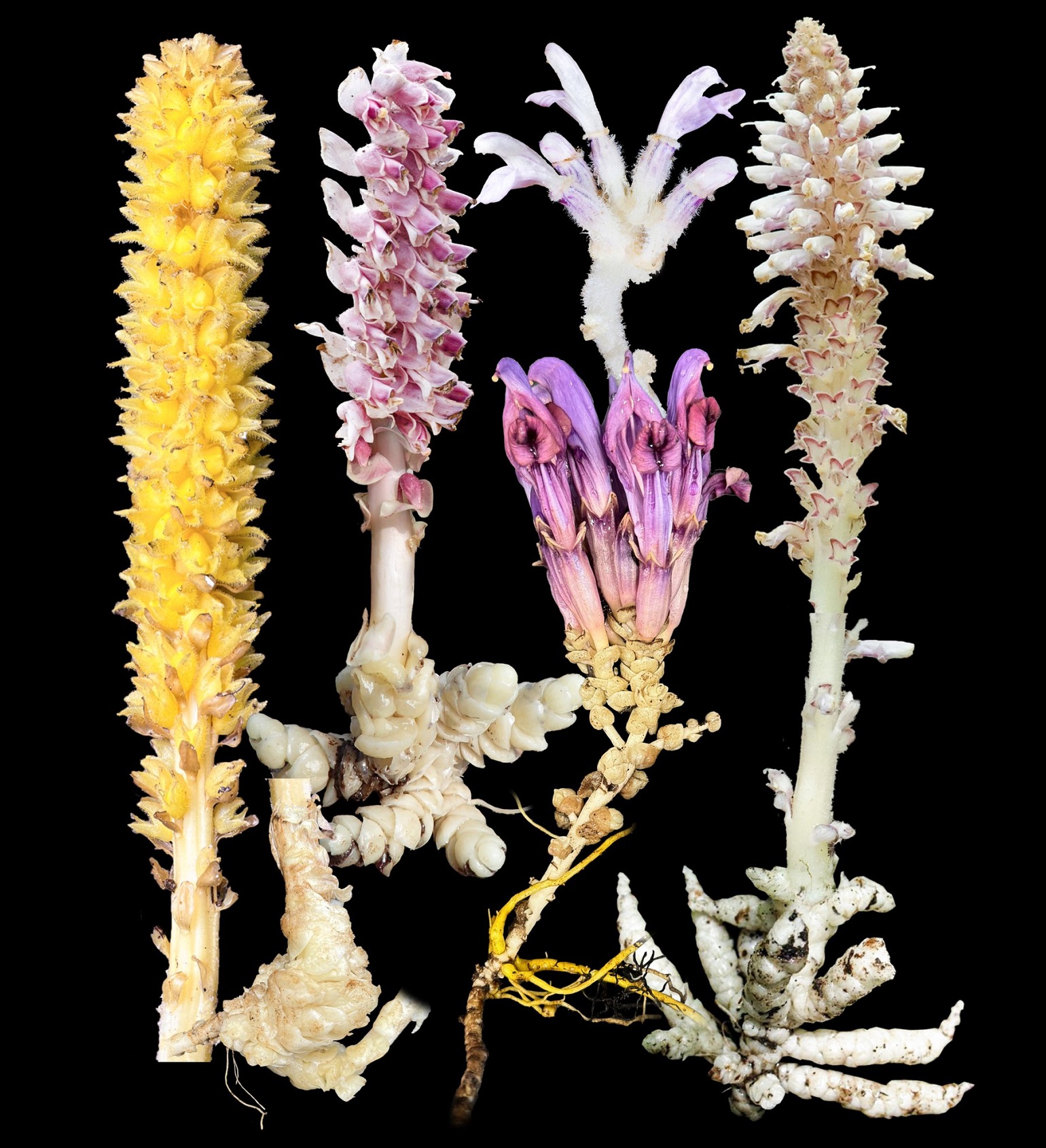
[Botany • 2024] A Taxonomic Monograph of the Eurasian holoparasitic plant Genus Lathraea L. (Orobanchaceae)


 Five species of Lathraea
 Lathraea squamariaLathraea clandestina, Lathraea japonicaLathraea rhodopeaLathraea purpurea

in Hatt, Tsiftsis et Thorogood, 2024. 

Abstract
A taxonomic monograph is presented for Lathraea L. (Orobanchaceae), a genus of holoparasitic plants distributed across Europe and Asia. Plants in this genus are characterised by their underground stems, achlorophyllous scales with internal gland-lined cavities, and, in some species, explosive seed dehiscence. Despite their conspicuousness, no taxonomic treatment of the genus has been written since 1930. Our work draws upon extensive international field data and a comprehensive survey of herbarium specimens. Detailed descriptions are provided for each species, along with full synonymy, distribution maps, and notes on habitat, host specificity, phenology, ecology, ethnobotany and threat risk. We present evidence to consolidate Lathraea into five species, resolving taxonomic confusion. The infrageneric classification is reviewed and a key to species is provided. Species are illustrated with photographs of living and dried material.

Lamiales, Lathraea, Orobanchaceae, Lathraea squamariaLathraea clandestina, parasitic plants, holoparasite, Lathraea japonicaLathraea rhodopeaLathraea purpurea, Eudicots


Sebastian A. Hatt, Spyros Tsiftsis and Chris J. Thorogood. 2024. A Taxonomic Monograph of the Eurasian holoparasitic plant Genus Lathraea L. (Orobanchaceae). Phytotaxa. 672(1); 1-29. DOI: doi.org/10.11646/phytotaxa.672.1.1

Friday, November 29, 2024

[Botany • 2024] Orobanche dagestanica (Orobanchaceae) • A New Species from the Greater Caucasus


Orobanche dagestanica Ó.Sánchez, Piwow., Fateryga, Svirin & Murtaz., 

in Piwowarczyk, Sánchez Pedraja, Fateryga, Svirin et Murtazaliev, 2024.
 
Abstract
A new, probably endemic species, Orobanche dagestanica is described from Dagestan in Russia (the Greater Caucasus). The species grows in alpine shale scree slopes, and is a parasite of the roots of species from the genus Lophiolepis (Asteraceae). Based on morphological and phylogenetic data, the newly-described species belongs to Orobanche subsect. Curvatae, and specifically to O. ser. Krylowianae, however it is distinct from all other taxa in this group. A detailed description, diagnosis, illustrations, a comparison with related species, as well as phylogenetic analysis are provided.

Curvatae, Krylowianae, holoparasites, Dagestan, Lophiolepis, Cirsium, taxonomy, Eudicots


Renata Piwowarczyk, Óscar Sánchez Pedraja, Alexander V. Fateryga, Sergey A. Svirin and Ramazan A. Murtazaliev. 2024. Orobanche dagestanica (Orobanchaceae): A New Species from the Greater Caucasus.  Phytotaxa. 653(1); 67-78. DOI: doi.org/10.11646/phytotaxa.653.1.5


Wednesday, November 27, 2024

[Botany • 2024] Phelipanche cingularum (Orobanchaceae) • A New Species from southern France


Phelipanche cingularum Croze, Carlón, J.-M.Tison, Michaud, J.Molina & Moreno Mor., 

in Croze, Carlón Ruiz, Tison, Michaud, Molina et Moreno Moral. 2024. 
Phélipanche des vires  ||  DOI: doi.org/10.11646/phytotaxa.653.1.1 
photos by T. Croze.

Abstract
A new species of Phelipanche has been discovered in various steep places in southern France at meso- and supra-mediterranean levels. It is always parasitic on Brassicaceae, almost exclusively on Hesperis laciniata, a plant that had never been reported as host for any Orobanchaceae previously. The new species, named Phelipanche cingularum for its rocky ledge (cingula) habitat, is described and illustrated. Diagnostic characters against up to 16 presumably related species are given. We also present the results of molecular analyses well-supporting its independence. The distribution and the unusual ecology of the plant are considered and illustrated, and its conservation status is evaluated.

Cévennes, conservation, Liguro-Provençal Pre-alps, Mediterranean, molecular phylogeny, Provence, taxonomy, Eudicots

Phenological stages.
photos by T. Croze.


Phelipanche cingularum Croze, Carlón, J.-M.Tison, Michaud, J.Molina & Moreno Mor., sp. nov.

Etymology:—the specific epithet is from a feminised late Latin form (genitive of cingula) derived of the classical Latin cingulum (belt), having given place to several words applied in southern France to grassy fringes surrounding limestone cliffs along its base or in ledges. It refers to the peculiar ecology of the plant grows on small flat rocky areas,or « vires » in French.

French name:—Phélipanche des vires. 


Thomas Croze, Luis Carlón Ruiz, Jean-Marc Tison, Henri Michaud, James Molina, Gonzalo Moreno Moral. 2024. Phelipanche cingularum (Orobanchaceae), A New Species from southern France. Phytotaxa. 653(1); 1-19. DOI: doi.org/10.11646/phytotaxa.653.1.1

Wednesday, May 1, 2024

[Botany • 2019] Neobartsia matuy (Orobanchaceae) • A New Species from the Colombian Andes


 Neobartsia matuy  Malagón, Humberto Mend. & Uribe-Convers, 

in Malagon, Mendoza-Cifuentes, Gómez-Parra et Uribe-Convers, 2019.

Abstract
A new species of Neobartsia endemic to the eastern Andes of Colombia is described, illustrated, and compared with related species. This species belongs to section Orthocarpiflorae and morphologically it is characterized by having floral bracts light green with glandular hairs, corolla yellowish green, the galea cucullate, longer than the lip, retrorsely glandular-puberulous, the lip three-lobed, glabrous and the corolla tube decurved. Currently, it is only known from two localities in the Colombian department of Boyacá, where it grows in the páramo ecosystem between 3528 and 3639 meters above sea level on rocky soil with grassy vegetation.

Keywords: Eudicots, Bartsia, Boyacá, Colombia, endemism, Orthocarpiflorae, páramo

 Neobartsia matuy.
A. Habit. B, C. Inflorescence. D. Floral bract, adaxial surface. E. Lateral view of a flower including bract, calyx and corolla. F. Lateral view of the corolla with the tube decurved. G. Lateral view of corolla, style, and ovary.
A–C from S. Gómez et al. 594 (paratype), D–G from H. Mendoza & E. Torres 22013 (Holotype). Photographers: Sofía Gómez (A–C), Humberto Mendoza (D–G).

Neobartsia matuy Malagón, Humberto Mend. & Uribe-Convers, sp. nov. 

Diagnosis:—This species belongs to the sect. Orthocarpiflorae and differs from Neobartsia alba (Molau) Uribe-Convers & Tank (2016: 678), N. elachophylla (Diels) Uribe-Convers & Tank (2016: 679), N. filiformis (Wedd.) Uribe-Convers & Tank (2016: 679), N. laniflora (Benth.) Uribe-Convers & Tank (2016:680), N. laticrenata (Benth.) Uribe-Convers & Tank (2016: 680), N. orthocarpiflora (Benth.) Uribe-Convers & Tank (2016:681), N. santolinifolia (Kunth) Uribe-Convers & Tank (2016: 681), N. sericea (Molau) Uribe-Convers & Tank (2016: 682) and N. trichophylla (Wedd.) Uribe-Convers & Tank (2016: 681) by the following combination of characters: stems green, retrorsely hirsute with colorless eglandular hairs in two rows; leaves linear to lanceolate, retrorsely hirsute on the veins on both sides, hairs eglandular, margins revolute, evenly crenate with 8–9 lobes on each side; floral bracts light green with glandular hairs, lanceolate, cuneate at base; calyx light green, glandular hirsute; flowers 13–13.6 mm long (without pedicel); corolla yellowish green, tube decurved, galea cucullate longer than the lip, retrorsely glandular-puberulous, hairs yellowish green.

Distribution and habit:—Neobartsia matuy is only known from two localities in the Northeastern Andean Cordillera in the department of Boyacá (Colombia), suggesting it is endemic to a few closely distributed páramos (Figure 4). It is possible that this species is also found in the Flora and Fauna Sanctuary of Iguaque, a protected natural national area adjacent to El Valle. It grows in the páramo ecosystem between 3550 and 3639 m above sea level on rocky soil with grassy vegetation.  

 Etymology:— The specific epithet is established to honor Uribe-Convers’ parents, Maria Luisa Convers and Ernesto Uribe, whose support was invaluable during the author’s dissertation on the genus Neobartsia. His parents do not use their given names and are better known by their nicknames “Marily” and “Tuchi”, respectively, and the word “Matuy”—a combination of their nicknames—has been used for years among family and friends to refer to both of them.

 Neobartsia matuy.
 A. Stem and leaves. B. Abaxial view of leaves, detail of revolute margin. C. Adaxial view of leaf apex. D. Lateral view of the leaf base. E. Abaxial view of the leaf base. F. Adaxial view of the leaf base. G. Detail of the pubescence of stem.
 All from H. Mendoza & E. Torres 22013 (Holotype). Photos by Humberto Mendoza. 

 Neobartsia matuy.
 A. Lateral view of the calyx. B–C. Detail of the calyx indumentum. D. Frontal view of the galea and lip. E. Lateral view of the corolla, detailing of the galea indumentum. F. Filament and anther in adaxial view. G. Filament and anther in abaxial view. H. Lateral view of the ovary. I. Cross section of the ovary.
All from H. Mendoza & E. Torres 22013 (Holotype). Photos by Humberto Mendoza.

 Distribution map of Neobartsia matuy


Maria Del Pilar Malagon, Humberto Mendoza-Cifuentes, Sofia Gómez-Parra and Simon Uribe-Convers. 2019. Neobartsia matuy (Orobanchaceae), A New Species from the Colombian Andes.  Phytotaxa. 424(2); 87–96. DOI: 10.11646/phytotaxa.424.2.2
 
Resumen: Una nueva especie de Neobartsia endémica a los Andes orientales de Colombia es descrita, ilustrada y comparada con especies afines. Esta especie pertenece a la sección Orthocarpiflorae y morfológicamente se caracteriza por tener brácteas florales verde claro con pelos glandulares, corola verde amarillenta, galea cuculada y mayor que el labio, glandularpubérula con pelos retrorsos, el labio con tres lóbulos, glabro y el tubo de la corola curvado. Hasta el momento, solo se conoce de dos localidades en el departamento colombiano de Boyacá, donde crece en ecosistemas de páramo entre los 3528 y 3639 metros sobre el nivel del mar, sobre suelos rocoso con vegetación herbácea.


Thursday, November 2, 2023

[Botany • 2023] Pedicularis revealiana (Orobanchaceae) • A New hemiparasitic Species of Pedicularis from North Sikkim


Pedicularis revealiana Arti Garg,

in Garg et Shukla, 2023. 
 
Abstract
The new species Pedicularis revealiana, is described from Katao in Sikkim Himalaya, India. The new species is hemiparasitic and possesses a combination of characters which makes it unique among all Pedicularis species as it has a perennial caespitose habit, stout and woody stems with decumbent branches and congested internodes, evanescent radical leaves and smaller and fewer cauline leaves with linear pinnae, 3–5 flowered and subcapitate or fascicled inflorescence, pedicillate bracts, minute flowers, hairy calyx with crestate-dentate and recurved lobes, stipitate and arcuate galea with truncate apex and papillose surface, gland-dotted labium with very large lateral lobes, unequal filament pairs inserted near top of the corolla tube, stipitate stigma which is bilobed and woolly and monocolpate pollen grains which are large and fusiform in shape with rugulose-punctate surface. With these combination of characters, it is differentiated from the only allied species Pedicularis gracilis.

Keywords: caespitose, Katao, North Sikkim district, novelty, Orobanchaceae, Pedicularis revealiana, rocky soil


Pedicularis revealiana Arti Garg sp. nov. 


Arti Garg and Achuta Nand Shukla. 2023. A New hemiparasitic Species of Pedicularis (Orobanchaceae) from North Sikkim, India. Nordic Journal of Botany. DOI: 10.1111/njb.03966

Sunday, January 15, 2023

[Botany • 2022] Christisonia flavirubens (Orobanchaceae) • A New Species from south Western Ghats, India


Christisonia flavirubens J.Mathew & P.M.Salim, 

in Mathew & Salim, 2022
 
ABSTRACT
Christisonia flavirubens J.Mathew & P.M.Salim (Orobanchaceae), a new holoparasitic plant species from the southern Western Ghats, Kerala, India, is described based on morphological data. The diagnostic morphological characters, distribution and images of the new species are presented. Images and comparative characters of the reddish yellow coloured Christisonia species of the south Western Ghats are also provided for its easy identification.
  
KEYWORDS: holoparasitic plant, India, Kerala, new species, Strobilanthes, taxonomy

Christisonia flavirubens J.Mathew & P.M.Salim:
 A – opened flower, B-C – inflorescence, D-E – uprooted plant with inflorescence, F – dissected flower, G-J – stamen and spur, K – gynoecium, L – ovary cross section
 (photograph by J. Mathew)


Christisonia flavirubens J.Mathew & P.M.Salim 

Diagnosis: Christisonia flavirubens is morphologically similar to C. mira (Fig. 2) especially in the reddish yellow flower colour and host specificity. However this new taxon differs in: anthers of equal length to filaments, 0.6-0.7 mm long, yellow in colour, hairs present at the base of the filaments (vs. anther filaments are 3-4 times longer than anther lobes, 2.5-3 cm long, light purplish in colour, glandular hairs present throughout the filaments in C. mira); both anther locules having fertile pollens (vs. one anther locule has fertile pollen and the other one is sterile in C. mira) and spur originating from the connective and having same length of anthers (vs. spur originating from the sterile locule and having double size of the anthers in C. mira). Distinguishing characters from other reddish yellow coloured species of Christisonia found in the south Western Ghats are listed in Table 1. Pollen viability of both locules of anther the anther is an interesting character among Christisonia. Apart from this, Christisonia subacaulis is the only known Indian species having this peculiarity. However, Csubacaulis can be easily distinguished by the violet colour corolla and didynamous conditions of the stamen.

Etymology: The epithet (‘flavirubens’) is used to indicate the reddish yellow colour of the corolla in this taxon.


Jose Mathew and Pichan M. Salim. 2022. Christisonia flavirubens (Orobanchaceae), A New Species from south Western Ghats, India. Biodiversity: Research and Conservation (Biodiv. Res. Conserv.). 68; 

Friday, October 28, 2022

[Botany • 2022] Harveya kiangombensis (Orobanchaceae) • A New Parasitic Species from Kenya, East Africa


Harveya kiangombensis Ngugi, Kirika & Mwachala, 

Abstract
A new holoparasitic species of Orobanchaceae, Harveya kiangombensis, is here described and illustrated. This species is easily distinguished from the closely related H. liebuschiana by its glandular pubescent pedicels, the position of its flowers that occur singly in the leaf axils, and its acute calyx lobes. An assessment of the conservation status of the new species is provided.

Keywords: Holoparasitic, New Species, Critically Endangered, Eudicots


Harveya kiangombensis Ngugi, Kirika & Mwachala sp. nov.


Grace Ngugi, Paul M. Kirika and Geoffrey Mwachala. 2022. Harveya kiangombensis (Orobanchaceae), A New Parasitic Species from Kenya, East Africa. Phytotaxa. 559(3); 293-297.

Thursday, January 3, 2019

[Botany • 2019] Holoparasitic Orobanchaceae (Cistanche, Diphelypaea, Orobanche, Phelipanche) in Armenia: Distribution, Habitats, Host Range and Taxonomic Problems


Diphelypaea tournefortii 

in Piwowarczyk, Pedraja, Moral, et al., 2019.

Abstract
The species of holoparasitic genera from the family Orobanchaceae have a specific lifestyle associated with the host, greatly reduced vegetative organs, very variable features and quickly lose their color, resulting in difficulties and mistakes in identification. This study represents the first comprehensive monograph of 36 species from the four holoparasitic genera, Cistanche, Diphelypaea, Phelipanche and Orobanche (Orobanchaceae), in Armenia. This country, as a part of the Caucasus, is one of the most important biodiversity centers in the world, a diversity which includes rich and insufficiently understood holoparasitic plants. Our investigations were based on five years of field work in the Caucasus, and complemented by examination of ca. 1200 herbarium sheets with ca. 3000 specimens from 37 herbaria. We present information on distribution, list of localities, habitat, phenology, host range, taxonomic clarification, illustrations and descriptions for problematic ones, images from the field, proposals for new synonymisations, new combination Phelipanche cernua subsp. sinaica (Beck) Piwow., Ó. Sánchez & Moreno Mor., 20 lectotypes, two epitypes, one neotype are designated here, as well as a key and geospatial conservation assessments for all species based on IUCN criteria.

Keywords: Caucasus, western Asia, parasitic plants, taxonomy, typification, new synonyms, new records, conservation assessment, Eudicots


 Renata Piwowarczyk,  Óscar Sánchez Pedraja, Gonzalo Moreno Moral, George Fayvush, Narine Zakaryan, Nune Kartashyan and Alla Aleksanyan. 2019. Holoparasitic Orobanchaceae (Cistanche, Diphelypaea, Orobanche, Phelipanche) in Armenia: Distribution, Habitats, Host Range and Taxonomic Problems. Phytotaxa.  386(1); 1-106.  DOI: 10.11646/phytotaxa.386.1.1