Showing posts with label Dinosaur: Australia. Show all posts

Friday, November 3, 2023

[Paleontology • 2023] A megaraptorid (Theropoda: Megaraptora) Frontal from the upper Strzelecki Group (Lower Cretaceous) of Victoria, Australia


in Kotevski, Duncan, Pentland, Rule, Vickers-Rich, ... et Poropat, 2023.

Highlights: 
• First non-mandibular skull element reported for an Australian non-avian theropod.
• Geologically oldest megaraptorid frontal element worldwide.
• Megaraptorid and non-megaraptorid megaraptorans present in upper Strzelecki Group.

Abstract
Cretaceous (non-avian) theropod dinosaurs from Australia are poorly understood, primarily because almost all specimens described thus far comprise isolated postcranial elements. In Australia, only three non-dental cranial elements pertaining to Theropoda have been reported: the left and right dentaries of Australovenator wintonensis from the Winton Formation (Cenomanian–lowermost Turonian) of Queensland, and an isolated surangular from the Eumeralla Formation (lower Albian) of Victoria. Herein, we report the first evidence of non-mandibular cranial material of a non-avian theropod from Australia: a left frontal and fused parietal fragment from the Lower Cretaceous (lower Aptian) upper Strzelecki Group of Victoria. The specimen shares several synapomorphies with the frontals assigned to Megaraptoridae, including an anteroposteriorly elongate postorbital articulation and a truncated nasal articular surface. Accordingly, we regard this frontal as Megaraptoridae gen. et sp. indet. We performed both parsimony-based and Bayesian-based phylogenetic analyses to support our assignment, and both analyses support a placement within Megaraptoridae. However, this specimen appears to possess plesiomorphic characters relative to other megaraptorid frontals, lacking dorsoventrally high walls of bone that emarginate the nasal and prefrontal articular surfaces. The plesiomorphies of this specimen have implications for the evolution of the megaraptoran skull roof, suggesting the acquisition of specialised adaptations for longirostry over time. This specimen improves the limited record of Cretaceous Australian theropod cranial remains, and provides limited support for the hypothesis that Megaraptoridae might have originated in Australia.
 
Keywords: Gondwana, Australia, Dinosauria, Theropoda, Cretaceous, Megaraptoridae


THEROPODA Marsh, 1881.
TETANURAE Gauthier, 1986.

COELUROSAURIA von Huene, 1914.
MEGARAPTORA Benson et al. 2010.

MEGARAPTORIDAE Novas et al. 2013.

Megaraptoridae gen. et sp. indet.

 Referred material: NMV P229038: An isolated, almost complete left frontal, fused to a fragment of the left parietal (Fig. 3).


Graphical abstract depicting major research findings of this report.
Clockwise from top: Geological scale indicating ages of known megaraptoran frontals; Locality map of the upper Strzelecki Group portraying localities yielding Megaraptora and Megaraptoridae fossils (map data cited in Fig. 1);
Life reconstruction of Victorian megaraptorid with approximate life position of NMV P229038 shown in silhouette and in dorsal view (illustration by Ruairidh J. Duncan);
Map of southern hemisphere with modern geographic borders showing approximate location of constituent Gondwanan continents and fossil locality at ∼110Ma.
Southern hemisphere map derived and adapted from Rich et al. (2002). 
Chronostratigraphic data derived from Cohen et al. (2013; updated).

 
Jake Kotevski, Ruairidh J. Duncan, Adele H. Pentland, James P. Rule, Patricia Vickers-Rich, Thomas H. Rich, Erich M.G. Fitzgerald, Alistair R. Evans and Stephen F. Poropat. 2023. A megaraptorid (Dinosauria: Theropoda) Frontal from the upper Strzelecki Group (Lower Cretaceous) of Victoria, Australia. Cretaceous Research. In Press, 105769. DOI: 10.1016/j.cretres.2023.105769
 

Friday, February 11, 2022

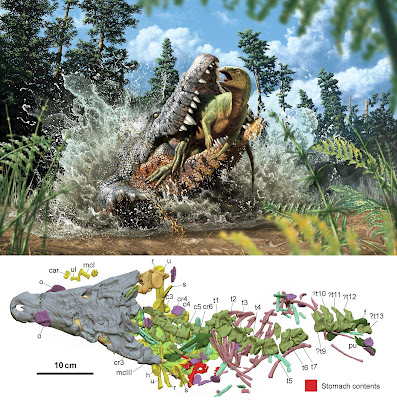
[Paleontology • 2022] Confractosuchus sauroktonos • Abdominal Contents reveal Cretaceous Crocodyliforms ate Dinosaurs


 Confractosuchus sauroktonos 
White, Bell, Campione, Sansalone, Brougham, Bevitt, Molnar, Cook, Wroe & Elliott, 2022

Illustration: Julius Csotonyi  facebook.com/JuliusCsotonyi 

Highlights: 
• Description of a new early-branching eusuchian from Australia.
• New taxon named Confractosuchus sauroktonos gen. et sp. nov.
• Tomography scans revealed its last meal was a juvenile ornithopod dinosaur.
• Morphometric analysis identifies Confractosuchus as a macro-generalist.


Abstract
Crocodylians are among Earth’s most successful hyper-carnivores, with their crocodyliform ancestors persisting since the Triassic. The diets of extinct crocodyliforms are typically inferred from distinctive bite-marks on fossil bone, which indicate that some species fed on contemporaneous dinosaurs. Nevertheless, the most direct dietary evidence (i.e. preserved gut contents) of these interactions in fossil crocodyliforms has been elusive. Here we report on a new crocodyliform, Confractosuchus sauroktonos gen. et sp. nov., from the Cenomanian (92.5–104 Ma) of Australia, with exceptionally preserved abdominal contents comprising parts of a juvenile ornithopod dinosaur. A phylogenetic analysis recovered Confractosuchus as the sister taxon to a clade comprising susisuchids and hylaeochampsids. The ornithopod remains displayed clear evidence of oral processing, carcass reduction (dismemberment) and bone fragmentation, which are diagnostic hallmarks of some modern crocodylian feeding behaviour. Nevertheless, a macro-generalist feeding strategy for Confractosuchus similar to extant crocodylians is supported by a morphometric analysis of the skull and reveals that dietary versatility accompanied the modular assembly of the modern crocodylian bauplan. Of further interest, these ornithopod bones represent the first skeletal remains of the group from the Winton Formation, previously only known from shed teeth and tracks, and may represent a novel taxon.
 
Keywords: Confractosuchus sauroktonos, crocodyliform, crocodylians, morphometrics, Winton Formation, Cretaceous, ornithopod, stomach contents


Cranial and mandibular osteology of  Confractosuchus sauroktonos gen. et sp. nov. (AODF0890).
(a-b) dorsal view of skull; (c-d) left lateral view of skull; (e-f), dorsal view of posterior part of skull with skull table removed following a natural break; (g) synchrotron image of suture margins between the choana and palatines; (h) 3D render of the choana and palatine suture.
Abbreviations: art, articular; cond occ, occipital condyle; cho, choana; den, dentary; eoc, exoccipital; emf, external mandibular fenestra; f, frontal; intemp, infratemporal fenestra; j, jugal; l, lacrimal; max, maxilla; n, nasal; nar, naris; orb, orbit; pal, palatine; par, parietal; pf, prefrontal; pmax, premaxilla; po, postorbital; pter, pterygoid; q, quadrate; qj, quadratojugal; s, scapula; sm, suture margins of cervical ribs; sq, squamosal; stp, superior temporal fossa; sur, surangular; t, tooth. Dotted lines represent suspected suture regions.

 Digital dissection of Confractosuchus sauroktonos gen. et sp. nov. (AODF0890) in (a) dorsal aspect; (c) ventral aspect; (c) left lateral aspect; (d) close-up of pectoral region with ventral osteoderms removed (in ventral aspect); (e) abdominal contents showing ornithopod remains.
Abbreviations: c, coracoid; car, carpal; c(no.), cervical vertebrae (number); cho, choana; cr3, cervical rib 3; d, dentary; f, femur; h, humerus; mcI, metacarpal 1; mc1-1, manual phalanx 1-1; mcI-2, manual phalanx I-2; mcII metacarpal 2; mcIII metacarpal III; mcV metacarpal 5; man, manus; o, osteoderm; p, manual phalanx; pal, palatines; pter, pterygoids; pu, pubis; r, radius; s, scapula; tm, tooth mark; t(no.), thoracic vertebrae (number); u, ulna; ul, ulnare; vo, ventral osteoderm.

Systematic Palaeontology
Crocodyliformes Hay 1930
Mesoeucrocodylia Whetstone & Whybrow 1983

Neosuchia Benton & Clark 1988
Eusuchia Huxley 1875

Confractosuchus gen. nov.
 
Confractosuchus sauroktonos gen. et sp. nov.

 Diagnosis: Neosuchian with the following autapomorphies: two pairs of longitudinal ridges on the rostrum that appear to span the prefrontal and lacrimal bones and terminate mid-rostrum; strongly regionalised vertebral assembly consisting of incipiently procoelous cervicals (c3–5), strongly procoelous thoracics (t1–2), incipiently procoelous (t3, ?t13) and amphicoelous mid-thoracic vertebrae (t4–7, ?9–12) (Fig. 2).

  Etymology: Confractus (‘broken’, Latin), referring to the shattered concretion in which the holotype was preserved, and suchus (derived from the Greek, Soûkhos), referring to the Egyptian crocodile god Sobek; sauros (‘lizard’, Greek), a common word used as a suffix for dinosaur genera, and ktonos (‘killer’ Greek) referring to its abdominal contents.


 Conclusion: 
Here, we have described a new crocodyliform, Confractosuchus sauroktonos gen. et sp. nov., from the Winton Formation of central Queensland Australia. Its last meal, a juvenile ornithopod dinosaur, was discovered in its abdominal cavity. These gut contents oddly represent the first recorded skeletal remains of ornithopods from the Winton Formation and may represent a novel taxon. The abdominal contents provided a unique opportunity to verify predictions of feeding behaviour, ascertained from a morphometric analysis of the skull. The prediction of Confractosuchus as a macro-generalist or, at the very least a generalist feeder via GM was substantiated by the ornithopod it consumed.


Matt A. White, Phil R. Bell, Nicolás E. Campione, Gabriele Sansalone, Tom Brougham, Joseph J. Bevitt, Ralph E. Molnar, Alex G. Cook, Stephen Wroe and David A. Elliott. 2022. Abdominal Contents reveal Cretaceous Crocodyliforms ate Dinosaurs. Gondwana Research. In Press. DOI: 10.1016/j.gr.2022.01.016

Tuesday, June 8, 2021

[Paleontology • 2021] Australotitan cooperensis • A New Giant Sauropod (Saurischia: Titanosauria) from the mid-Cretaceous of Australia


Australotitan cooperensis
Hocknull​, Wilkinson, Lawrence, Konstantinov, Mackenzie & Mackenzie, 2021


Abstract 
A new giant sauropod, Australotitan cooperensis gen. et sp. nov., represents the first record of dinosaurs from the southern-central Winton Formation of the Eromanga Basin, Australia. We estimate the type locality to be 270–300 m from the base of the Winton Formation and compare this to the semi-contemporaneous sauropod taxa, Diamantinasaurus matildae Hocknull et al., 2009, Wintonotitan wattsi Hocknull et al., 2009 and Savannasaurus elliottorum Poropat et al., 2016. The new titanosaurian is the largest dinosaur from Australia as represented by osteological remains and based on limb-size comparisons it reached a size similar to that of the giant titanosaurians from South America. Using 3-D surface scan models we compare features of the appendicular skeleton that differentiate Australotitan cooperensis gen. et sp. nov. as a new taxon. A key limitation to the study of sauropods is the inability to easily and directly compare specimens. Therefore, 3-D cybertypes have become a more standard way to undertake direct comparative assessments. Uncoloured, low resolution, and uncharacterized 3-D surface models can lead to misinterpretations, in particular identification of pre-, syn- and post-depositional distortion. We propose a method for identifying, documenting and illustrating these distortions directly onto the 3-D geometric surface of the models using a colour reference scheme. This new method is repeatable for researchers when observing and documenting specimens including taphonomic alterations and geometric differences. A detailed comparative and preliminary computational phylogenetic assessment supports a shared ancestry for all four Winton Formation taxa, albeit with limited statistical support. Palaeobiogeographical interpretations from these resultant phylogenetic hypotheses remain equivocal due to contrary Asian and South American relationships with the Australian taxa. Temporal and palaeoenvironmental differences between the northern and southern-central sauropod locations are considered to explain the taxonomic and morphological diversity of sauropods from the Winton Formation. Interpretations for this diversity are explored, including an eco-morphocline and/or chronocline across newly developed terrestrial environments as the basin fills.


Systematic Palaeontology

Dinosauria Owen, 1842
Saurischia Seeley, 1887

Sauropodomorpha von Huene, 1932
Sauropoda Marsh, 1878
Eusauropoda Upchurch, 1995
Neosauropoda Bonaparte, 1986
Macronaria Wilson and Sereno, 1998

Titanosauriformes Salgado et al., 1997a
Somphospondyli Wilson and Sereno, 1998
Titanosauria Bonaparte and Coria, 1993

Australotitan gen. nov.

Australotitan cooperensis gen. et sp. nov.

Material. Holotype: EMF102, consists of ten appendicular elements and pieces of corticocancellous internal bone. The appendicular elements include a partial left scapula, partial left and complete right humerus, right ulna, right and left pubes and ischia, and partial right and left femora.

Referred Specimens: EMF164, a fragmented femur, a fragmented ulna, presacral vertebral centrum fragments and rib fragments. EMF105, a complete femur and EMF165, a distal humerus.

Age & Horizon. Cenomanian-? Turonian, Winton Formation.

Type Locality. EML011(a). Referred Specimen Localities, EML010 & EML013.

Etymology. Australo–meaning southern in Greek and in reference to the southern continent of Australia; titan–from the Greek mythological Titan gods and in reference to its gigantic size; cooperensis–being from the Cooper-Eromanga Basin, Cooper Creek system & “Cooper Country”.

Diagnosis: A large titanosaurian sauropod with the following combination of characters that differentiate this new taxon from all others. Proposed autapomorphies indicated by an asterisk. Scapular blade, narrow and straight with sub-parallel dorsal and ventral margins with lateral ridge situated near the ventral margin. Humerus with a rounded ridge that extends from the distal end of the deltopectoral crest to just proximal of a tri-lobate distal epiphysis. Ulna with heavily reduced anterolateral and olecranon processes relative to much enlarged and elongate anteromedial process. Ulna with a distinct radial interosseous ridge within the distal half of the radial fossa*. Anterolateral process of the ulna with a distal accessory projection* proximal to a proximally beveled distal epiphysis*. Pubes and ischia broad and contact each other medially forming a cohesive pelvic floor. Distal ischial blades curve ventrally to produce a dorsal face that is posteriorly directed. Femur with a medially sloped proximolateral margin, diaphysis narrow anteroposteriorly, and distal condyles directed anterolaterally to posteromedially.


Scott A. Hocknull​, Melville Wilkinson, Rochelle A. Lawrence, Vladislav Konstantinov, Stuart Mackenzie and Robyn Mackenzie. 2021. A New Giant Sauropod, Australotitan cooperensis gen. et sp. nov., from the mid-Cretaceous of Australia. PeerJ. 9:e11317. DOI: 10.7717/peerj.11317


Monday, May 18, 2020

[Paleontology • 2020] First Elaphrosaurine Theropod Dinosaur (Ceratosauria: Noasauridae) from Australia — A Cervical Vertebra from the Early Cretaceous of Victoria


Elaphrosaurinae gen. et sp. indet. 
in Poropat, Pentland, Duncan, et al., 2020.

Highlights
• First evidence of an elaphrosaurine theropod dinosaur ever reported from Australia.
• New elaphrosaurine is geologically the second youngest member of its group known worldwide.
• Elaphrosaurine theropods were capable of tolerating Cretaceous near-polar climates.

Abstract
Elaphrosaurinae is an enigmatic clade of gracile ceratosaurian theropod dinosaurs known from the Late Jurassic of Africa (Elaphrosaurus bambergi) and Asia (e.g., Limusaurus inextricabilis), and the early Late Cretaceous of Argentina (Huinculsaurus montesi). Elaphrosaurinae is often placed within Noasauridae as the sister taxon to Noasaurinae, a clade of small-bodied theropods that lived in South America, Africa, Madagascar and India throughout much of the Cretaceous. Herein, we report the first evidence of Elaphrosaurinae from Australia: a nearly complete middle cervical vertebra from the upper Lower Cretaceous (lower Albian) Eumeralla Formation of Cape Otway, Victoria, Australia. The fact that this site would have been situated at ~76°S towards the end of the Early Cretaceous (~110–107 Ma) implies that elaphrosaurines were capable of tolerating near-polar palaeoenvironments, whereas its age indicates that elaphrosaurines persisted in Australia until at least the late Early Cretaceous. The new Australian elaphrosaurine, in tandem with the recently described Huinculsaurus montesi from the Cenomanian–Turonian of Argentina, implies that the spatiotemporal distribution of Elaphrosaurinae has heretofore been greatly underestimated. Historic confusion of elaphrosaurines with coelurosaurs, especially ornithomimosaurs, coupled with our generally poor understanding of noasaurid evolution, might explain the apparent dearth of fossils of this theropod clade worldwide.

Keywords: Elaphrosaurinae, Theropoda, Gondwana, Australia, Cretaceous


 Systematic Palaeontology 

Dinosauria Owen, 1842 
Theropoda Marsh, 1881 
Ceratosauria Marsh, 1884 

Noasauridae Bonaparte and Powell, 1980
Elaphrosaurinae Rauhut and Carrano, 2016 

Elaphrosaurinae gen. et sp. indet.


Stephen F. Poropat, Adele H. Pentland, Ruairidh J. Duncan, Joseph J. Bevitt, Patricia Vickers-Rich and Thomas H. Rich. 2020. First Elaphrosaurine Theropod Dinosaur (Ceratosauria: Noasauridae) from Australia — A Cervical Vertebra from the Early Cretaceous of Victoria. Gondwana Research. In Press. DOI: 10.1016/j.gr.2020.03.009 

Rare long-necked dinosaur that roamed the polar world unearthed in Australia  theguardian.com/science/2020/may/18/rare-long-necked-dinosaur-that-roamed-the-polar-world-unearthed-in-australia

Tuesday, November 12, 2019

[Paleontology • 2019] A Polar Dinosaur Feather Assemblage from Australia


Australian feathered polar dinosaur.

in Kundrát, Rich, Lindgren, et al., 2019. 
 Illustration: Peter Trusler 

Highlights: 
• Fossil feathers from the Koonwarra Fossil Bed in southeastern Australia record the first demonstrable dinosaur (including birds) integumentary structures described from the Mesozoic polar regions.
• This diverse range of non-avian theropod (paravian) and bird feathers more than doubles the number of Mesozoic fossil feather specimens and morphologies recovered from the Gondwanan landmasses to date.
• Possible traces of eumelanosomes imply original dark colouration and patterning. Some of the geologically oldest barbicel-like structures also evince advanced avian-grade flight feather morphologies in the Early Cretaceous.

ABSTRACT
Exceptionally preserved Mesozoic feathered dinosaur fossils (including birds) are famous, but recognized from only very few localities worldwide, and are especially rare in the Southern Hemisphere. Here we report an assemblage of non-avian and avian dinosaur feathers from an Early Cretaceous polar (around 70°S) environment in what is now southeastern Australia. The recovered remains incorporate small (10–30 mm long) basal paravian-like tufted body feathers, open-vaned contour feathers, and asymmetrical bird-like wing feathers that possess high-angled barbs with possible remnants of barbicels — amongst the geologically oldest observed to date. Such morphological diversity augments scant skeletal evidence for a range of insulated non-avian theropods and birds inhabiting extreme southern high-latitude settings during the Mesozoic. Although some of these fossil feathers exhibit what may be residual patterning, most are uniformly toned and preserve rod-shaped microbodies, as well as densely-packed microbody imprints on the barbules that are structurally consistent with eumelanosomes. Geochemical analysis detected no identifiable residual biomolecules, which we suspect were lost via hydrolysis and oxidization during diagenesis and weathering. Nevertheless, an originally dark pigmentation can be reasonably inferred from these melanic traces, which like the coloured feathers of modern birds, might have facilitated crypsis, visual communication and/or thermoregulation in a cold polar habitat.

Keywords: Mesozoic birds, Aves, Paravesmelanosomes, Early Cretaceous


 Martin Kundrát, Thomas H. Rich, Johan Lindgren, Peter Sjövall, Patricia Vickers-Rich, Luis M. Chiappe and Benjamin P. Kear. 2019. A Polar Dinosaur Feather Assemblage from Australia. Gondwana Research. In Press. DOI: 10.1016/j.gr.2019.10.004 

First evidence of feathered polar dinosaurs found in Australia - Uppsala University  mynewsdesk.com/uk/uu/pressreleases/first-evidence-of-feathered-polar-dinosaurs-found-in-australia-2942524 

Monday, March 11, 2019

[Paleontology • 2019] Galleonosaurus dorisae • New Small-bodied Ornithopods (Dinosauria, Neornithischia) from the Early Cretaceous Wonthaggi Formation (Strzelecki Group) of the Australian-Antarctic Rift System, with Revision of Qantassaurus intrepidus


Galleonosaurus dorisae 
Herne, Nair, Evans & Tait, 2019


Abstract
The Flat Rocks locality in the Wonthaggi Formation (Strzelecki Group) of the Gippsland Basin, southeastern Australia, hosts fossils of a late Barremian vertebrate fauna that inhabited the ancient rift between Australia and Antarctica. Known from its dentary, Qantassaurus intrepidus Rich and Vickers-Rich, 1999 has been the only dinosaur named from this locality. However, the plethora of vertebrate fossils collected from Flat Rocks suggests that further dinosaurs await discovery. From this locality, we name a new small-bodied ornithopod, Galleonosaurus dorisae n. gen. n. sp. from craniodental remains. Five ornithopodan genera are now named from Victoria. Galleonosaurus dorisae n. gen. n. sp. is known from five maxillae, from which the first description of jaw growth in an Australian dinosaur is provided. The holotype of Galleonosaurus dorisae n. gen. n. sp. is the most complete dinosaur maxilla known from Victoria. Micro-CT imagery of the holotype reveals the complex internal anatomy of the neurovascular tract and antorbital fossa. We confirm that Q. intrepidus is uniquely characterized by a deep foreshortened dentary. Two dentaries originally referred to Q. intrepidus are reassigned to Q. ?intrepidus and a further maxilla is referred to cf. Atlascopcosaurus loadsi Rich and Rich, 1989. A further ornithopod dentary morphotype is identified, more elongate than those of Q. intrepidus and Q. ?intrepidus and with three more tooth positions. This dentary might pertain to Galleonosaurus dorisae n. gen. n. sp. Phylogenetic analysis recovered Cretaceous Victorian and Argentinian nonstyracosternan ornithopods within the exclusively Gondwanan clade Elasmaria. However, the large-bodied taxon Muttaburrasaurus langdoni Bartholomai and Molnar, 1981 is hypothesised as a basal iguanodontian with closer affinities to dryomorphans than to rhabdodontids.


Figure 4. Specimens of Galleonosaurus dorisae n. gen. n. sp. from the Flat Rocks Sandstone in the upper Barremian, Wonthaggi Formation, Gippsland Basin, southeastern Australia:
(1–2) holotype (NMV P229196), left maxilla in lateral (1) and medial (2) views; (3) NMV P208178, left maxilla in lateral view; (4) NMV P212845, left maxilla in lateral view; (5) NMV P209977, left maxilla in lateral view; (6) NMV P186440, left maxilla in lateral view; (7) NMV 208113, right maxillary tooth in labial view.

Scale bars = 10 mm (1–6); 1 mm (7).

Systematic paleontology

Dinosauria Owen, 1842
Ornithischia Seeley, 1888
Neornithischia Cooper, 1985
Cerapoda Sereno, 1986
Ornithopoda Marsh, 1881

Genus Galleonosaurus new genus

Type species: Galleonosaurus dorisae n. gen. n. sp., by monotypy.


Etymology: From galleon (Latinization of the English for a type of large sailing ship) + saurus (New Latin from the Greek sauros for lizard), in reference to the appearance of the maxilla to the upturned hull of a galleon.

Occurrence: Flat Rocks locality in the Inverloch region of Victoria, southeastern Australia (Fig. 1); Flat Rocks Sandstone and The Caves Sandstone, upper Barremian of the Wonthaggi Formation in the Gippsland Basin.

Remarks: Prior to the recognition of Galleonosaurus n. gen., Atlascopcosaurus loadsi and Leaellynasaura amicagraphica were the only Victorian ornithopods identified from maxillary remains (Rich and Rich, 1989). The maxillae of Atlascopcosaurus loadsi are highly incomplete and the only known maxilla of L. amicagraphica (that of the holotype, NMV P185991) is damaged, and due to its diminutive size, difficult to study. The maxillae of Galleonosaurus n. gen., as well as the complete palatine and fragment of the lacrimal, now provide new information from which the anatomy of the other Victorian ornithopods can be better understood. The holotype of Galleonosaurus dorisae n. gen. n. sp. (NMV P229196) represents the most complete maxilla of a dinosaur currently known from Victoria.

Diagnosis: Small-bodied, noniguanodontian ornithopod characterized by five potential autapomorphies: (1) ascending ramus of maxilla has two slot-like foramina on the anterior margin that communicate with the neurovascular tract; (2) neurovascular tract bifurcates internally to exit at two anteroventral maxillary foramina; (3) lingual margin of maxillary tooth roots in midregion of tooth row form an S-bend at their bases; (4) posterior third of maxilla on some, but not all, specimens deflects posterolaterally at an abrupt kink; and (5) lateral end of palatine lateral ramus forms a hatchet-shaped flange.

Occurrence: Flat Rocks locality in the Inverloch region of Victoria, southeastern Australia (Fig. 1); Flat Rocks Sandstone and The Caves Sandstone, upper Barremian of the Wonthaggi Formation in the Gippsland Basin.

Etymology: dorisae, in recognition of Doris Seegets-Villiers for her geological, palynological, and taphonomic work on the Flat Rocks fossil vertebrate locality.


Figure 1. Maps of Australia, southern Victoria and Gondwana: (1) present-day eastern Australia indicating region of interest; (2) inset from (1) showing upper Barremian–lower Albian ornithopod localities and associated geology; (3) reconstruction of Gondwana during the late Barremian (~ 125 Ma) using GPlates (www.gplates.org). Dashed lines in (2) indicate basin boundaries. Geological information in (2) based on Bryan et al. (1997, 2000). V-shaped symbols in (3) indicate direction and position of plate subduction, based on Wandres and Bradshaw (2005). Australian paleoshoreline in (3) based on Heine et al. (2015). Dashed arrows in (2–3) indicate paleoflow direction. AAR = Australian-Antarctic rift; AF = Africa; AN = Antarctica; AU = Australia; I = India; EF = Eumeralla Formation; ES = epeiric Eromanga Sea (in region of Eromanga Basin); ETRW = Eric the Red West; M = Madagascar; NC = New Caledonia; NZ = New Zealand; SA = South America; VHFT2 = Victorian Hypsilophodontid Femur Type 2; VOPC1 = Victorian ornithopod postcranium 1 (NMV P185992/P185993); VOPC2 = Victorian ornithopod postcranium 2 (NMV P186047); W = Whitsunday Large Siliceous Igneous Province (Bryan et al., 1997); WF = Wonthaggi Formation.

Figure 27. Australian ornithopod occurrences: ETRW = Eric the Red West; VHFT2 = Victorian Hypsilophodontid Femur Type 2; VOD2 = Victorian ornithopod dentary morphotype 2; VOD3 = Victorian ornithopod dentary morphotype 3; VOM4 = Victorian ornithopod maxilla morphotype 4; VOPC1 = Victorian ornithopod postcranium 1 (NMV P185992/P185993); VOPC2 = Victorian ornithopod postcranium 2 (NMV P186047). See Table 5 for associated information on ornithopod occurrences.

Figure 28. Time-calibrated phylogeny of the ornithopods from the IW strict consensus cladogram (Fig. 25.2). Dashed lines indicate unknown times of Pangaean branch/lineage divergences prior to the middle Callovian. Time scale based on Cohen et al. (2013). Thick lines indicate taxon (graduated shaded lines) and clade (solid lines) durations (for sources, see Text S1). Aal = Aalenian; AF = Africa; Alb = Albian; AN = Antarctica; Apt = Aptian; AU = Australia; Baj = Bajocian; Bar = Barremian; Bat = Bathonian; Ber = Berriasian; Cal = Callovian; Cam = Campanian; Cen = Cenomanian; Con = Coniacian; Hau = Hauterivian; Kim = Kimmeridgian; LA = Laurasia; Maa = Maastrichtian; NZ = New Zealand; Oxf = Oxfordian; SA = South America; San = Santonian; Tit = Tithonian; Tur = Turonian; Val = Valanginian.


Conclusions: 
The identification of the new ornithopod, Galleonosaurus dorisae n. gen. n. sp., and three further jaw morphotypes (VOM4, VOD2, and VOD3) from the Flat Rocks locality in the upper Barremian Wonthaggi Formation complements the four previously named ornithopods from Victoria—Atlascopcosaurus loadsi, Diluvicursor pickeringi, Leaellynasaura amicagraphica, and Qantassaurus intrepidus. Although synonymy between some of these taxa is possible, Galleonosaurus dorisae n. gen. n. sp. and the newly identified craniodental morphotypes confirm that a highly diverse small-bodied ornithopod fauna flourished in the periodically disturbed, high-latitude, riverine floodplain environment of the Australian-Antarctic rift valley (see also Rich and Rich, 1989; Rich and Vickers-Rich, 1999, 2000; Rich et al., 2002; Herne et al., 2016, 2018).

The new dentary morphotype from the Flat Rocks Sandstone (VOD3) confirms the presence of an ornithopod with a more elongate dentary than that of Qantassaurus intrepidus, from the same locality, and with more alveoli in specimens of similar size (15 alveoli compared to 10). We speculate that VOD3 is a more likely candidate for the presently unknown dentary of Galleonosaurus dorisae n. gen. n. sp. than the dentary of Q. intrepidus, although this suggestion cannot be presently confirmed. The similarity between the dentary teeth of VOD3 and an isolated dentary tooth (QM F52774) discovered in the Winton Formation, central-western Queensland (Hocknull and Cook, 2008) suggests that the spatiotemporal range of potentially closely related ornithopods in eastern Australia extended from at least the upper Barremian of the Australian-Antarctic rift system to the lower Turonian of the Eromanga Basin (Figs. 1.3, 27).

The phylogenetic analysis (Figs. 25.2, 26) recovered the Victorian ornithopods Diluvicursor pickeringi, Leaellynasaura amicagraphica, and Galleonosaurus dorisae n. gen. n. sp. within Elasmaria (Calvo et al., 2007). In addition to the Victorian taxa, Elasmaria also comprises the Argentinian taxa Anabisetia saldiviaiGasparinisaura cincosaltensisMacrogryphosaurus gondwanicus, and Talenkauen santacrucensis. Increased anatomical understanding of the ornithopods recovered within Elasmaria, and particularly the Victorian ornithopods, will undoubtedly impel renewed phylogenetic assessment. The large-bodied Australian genus Muttaburrasaurus, however, is a nonelasmarian and was recovered within Iguanodontia. The time-calibrated phylogeny derived from the IW strict consensus tree (Fig. 28) suggests that Elasmaria and the stem of Muttaburrasaurus langdoni had their origins in Pangaea prior to the opening of seaways between Gondwana and Laurasia in the middle Callovian.


Matthew C. Herne, Jay P. Nair, Alistair R. Evans and Alan M. Tait. 2019. New Small-bodied Ornithopods (Dinosauria, Neornithischia) from the Early Cretaceous Wonthaggi Formation (Strzelecki Group) of the Australian-Antarctic Rift System, with Revision of Qantassaurus intrepidus Rich and Vickers-Rich, 1999Journal of Paleontology. First View. DOI: 10.1017/jpa.2018.95

New wallaby-sized dinosaur from the ancient Australian-Antarctic rift valley https://phys.org/news/2019-03-wallaby-sized-dinosaur-ancient-australian-antarctic-rift.html via @physorg_com

Friday, January 12, 2018

[Paleontology • 2018] Diluvicursor pickeringi • A New Small-bodied Ornithopod (Dinosauria, Ornithischia) from A Deep, High-energy Early Cretaceous River of the Australian–Antarctic Rift System


Diluvicursor pickeringi
Herne​, Tait, Weisbecker, Hall, Nair, Cleeland & Salisbury, 2018

Artwork by P. Trusler.  DOI: 10.7717/peerj.4113 

Abstract

A new small-bodied ornithopod dinosaurDiluvicursor pickeringi, gen. et sp. nov., is named from the lower Albian of the Eumeralla Formation in southeastern Australia and helps shed new light on the anatomy and diversity of Gondwanan ornithopods. Comprising an almost complete tail and partial lower right hindlimb, the holotype (NMV P221080) was deposited as a carcass or body-part in a log-filled scour near the base of a deep, high-energy river that incised a faunally rich, substantially forested riverine floodplain within the Australian–Antarctic rift graben. The deposit is termed the ‘Eric the Red West Sandstone.’ The holotype, interpreted as an older juvenile ∼1.2 m in total length, appears to have endured antemortem trauma to the pes. A referred, isolated posterior caudal vertebra (NMV P229456) from the holotype locality, suggests D. pickeringi grew to at least 2.3 m in length. D. pickeringi is characterised by 10 potential autapomorphies, among which dorsoventrally low neural arches and transversely broad caudal ribs on the anterior-most caudal vertebrae are a visually defining combination of features. These features suggest D. pickeringi had robust anterior caudal musculature and strong locomotor abilities. Another isolated anterior caudal vertebra (NMV P228342) from the same deposit, suggests that the fossil assemblage hosts at least two ornithopod taxa. D. pickeringi and two stratigraphically younger, indeterminate Eumeralla Formation ornithopods from Dinosaur Cove, NMV P185992/P185993 and NMV P186047, are closely related. However, the tail of D. pickeringi is far shorter than that of NMV P185992/P185993 and its pes more robust than that of NMV P186047. Preliminary cladistic analysis, utilising three existing datasets, failed to resolve D. pickeringi beyond a large polytomy of Ornithopoda. However, qualitative assessment of shared anatomical features suggest that the Eumeralla Formation ornithopods, South American Anabisetia saldiviai and Gasparinisaura cincosaltensis, Afro-Laurasian dryosaurids and possibly Antarctic Morrosaurus antarcticus share a close phylogenetic progenitor. Future phylogenetic analysis with improved data on Australian ornithopods will help to test these suggested affinities.

Systematic Palaeontology
ORNITHISCHIA Seeley, 1888
CERAPODA Sereno, 1986
ORNITHOPODA Marsh, 1881


Figure 6: Partial postcranium, NMV P221080, assigned to the holotype of Diluvicursor pickeringi gen. et sp. nov., as prepared on five blocks of ETRW Sandstone. (A) Specimen viewed from above, normal to the bedding. (B) Schematic.

Abbreviations: as, astragalus; B #, host block number; Ca #, designated caudal vertebra and position; cal, calcaneum; fib, fibula; ha #, haemal arch/process and position; pd #, pedal digit number; tib, tibia. Image of NMV P221080, courtesy S. Poropat and Museums Victoria.

Figure 7: Diluvicursor pickeringi gen. et sp. nov. holotype (NMV P221080), schematic restoration in left lateral view, showing preserved bones (light shading) and incomplete caudal vertebrae (outlined). 

Abbreviations: as, astragalus; Ca #, designated caudal vertebral position; pd #, pedal digit number; tib, tibia.

Diluvicursor gen. nov.  

Etymology: From the Latin ‘diluvi,’ for deluge or flood, in reference to the deep high-energy palaeo-river within which the type material was deposited and the palaeo-floodplain upon which the river extended, combined with the suffix ‘-cursor,’ from the Latin for runner.

Diagnosis: A turkey- to rhea-sized small-bodied ornithopod, differentiated from all other ornithopods by 10 potential autapomorphies: (1) dorsoventral height of the neural arch on the anterior-most caudal vertebrae (indicated at Ca 3), highly reduced and sub-equal to dorsoventral centrum height; (2) proximodistal length of the spinal process on the anterior caudal vertebrae (Ca 3–6), highly reduced and sub-equal to anteroposterior centrum length; (3) prezygapophysis on the anterior-most caudal vertebrae (up to Ca 5), horizontally oriented and located at the neural arch base, lateral to the neural canal; (4) tuberous process dorsally on the spinoprezygapophyseal lamina (sprl) of the anterior-most caudal vertebrae; (5) dorsoventrally narrowest part of the centrum on the posterior caudal vertebrae, distinctly offset posteriorly and embayed by a sulcus; (6) deep haemal groove present on all posterior caudal vertebrae; (7) triangular intervertebral process anteriorly on the centrum of the posterior-most caudal vertebrae incises a V-shaped notch at the posterior end of the adjoining centrum; (8) caudal ribs on the anterior-most caudal vertebrae (indicated at Ca 3) are transversely broad with the distance across the ribs ∼85% of total vertebral height (inclusive of haemal arch); (9) lateral distal tarsal embayed anteriorly by a sulcus for the calcaneum; and (10) pd IV-1 is strongly asymmetrical in dorsoplantar view (the proximal cotyle flares medially and the lateral edge is straight).


Diluvicursor pickeringi sp. nov.   
2009 Ornithopoda; Rich et al., p. 677.
2014 Ornithopoda; Herne, pp. 246–274.

Derivation of name: To acknowledge the significant contribution of David A. Pickering to Australian palaeontology and in memory of his passing during the production of this work.

Distribution: Lower Cretaceous Australia.

Locality: Eric the Red West, ETRW Sandstone, lower Albian, Eumeralla Formation, Otway Group, southern Victoria.

Figure 36: Artist’s interpretation of the early Albian, volcaniclastic, floodplain palaeoenvironment within the Australian-Antarctic rift graben, in the region of Eric the Red West.
Scene depicting two individuals of Diluvicursor pickeringi on the cutbank of a high-energy meandering river, regional floral components and distant rift margin uplands. Floral components potentially included forest trees of Araucariaceae (Agathis and Araucaria), Podocarpaceae and Cupressaceae and lower story/ground cover plants, including pteridophytes (ferns, including equisetaleans), hepatics, lycopods, cycadophytes, bennettitaleans, seed-bearing fern- or cycad-like taeniopterids and early Australian angiosperms.
 Artwork by P. Trusler.

Conclusion
Diluvicursor pickeringi nov. gen. et sp. is a new small-bodied ornithopod from the lower Albian of the Eumeralla Formation in the Otway Basin. The taxon is known from an almost complete tail and lower partial right limb of the holotype (NMV P221080), as well as an isolated posterior caudal vertebra (NMV P229456), discovered at the fossil locality of Eric the Red West (ETRW). The deposit, termed the ETRW Sandstone, is interpreted to have been a broad (∼600 m), deep (∼25 m), high-energy meandering river. Sediments and fossils from the ETRW Sandstone indicate that D. pickeringi inhabited a faunally rich, substantially forested riverine floodplain within the Australian–Antarctic rift complex. A further isolated caudal vertebra from the deposit (NMV P228342), interpreted as that of an indeterminate ornithischian, suggests the locality may have hosted at least two small-bodied ornithischians. D. pickeringi grew to at least 2.3 m in length and is characterised by 10 potential autapomorphies, among which, the combination of dorsoventrally low neural arches and transversely broad caudal ribs on the anterior-most caudal vertebrae present a visually defining combination of features.

Features of the caudal vertebrae and pes suggest that D. pickeringi and the two stratigraphically younger, indeterminate ornithopods from Dinosaur Cove, NMV P185992/P185993 and NMV P186047, are closely related. However, D. pickeringi differs from NMV P185992/P185993 by having a far shorter tail (50 vertebrae compared to >71) and from NMV P186047 by having a comparatively shorter, more robust, pes. The phylogenetic position of D. pickeringi investigated through searches within three recently published datasets was unresolved beyond placement within a polytomous clade of non-iguanodontian ornithopods. Various features of the caudal vertebrae and pes suggest that the Eumeralla Formation ornithopods Diluvicursor, NMV P185992/P185993 and NMV P186047 may be more closely related to the Argentinean ornithopods Anabisetia and Gasparinisaura, the Antarctic ornithopod Morrosaurus and possibly Afro-Laurasian dryosaurids, than all other ornithopods. A common progenitor of these taxa is suggested. However, these suggested affinities are to be tested more rigorously within a revised cladistic dataset of Gondwanan ornithopods.

The discovery of D. pickeringi in the ETRW Sandstone indicates that future prospecting efforts in the Eumeralla Formation at locations where coarse, gritty sediments crop-out at the base of deep palaeoriver channels, could lead to significant new discoveries (see also Rich et al., 2009b). The articulated postcrania of similarly sized, but anatomically differing small-bodied ornithopods from the Eumeralla Formation provide unique fossil material for future comparative investigations on dinosaur biomechanics, and how differing locomotor abilities could relate to differing palaeoecosystems.


Matthew C. Herne​, Alan M. Tait, Vera Weisbecker, Michael Hall, Jay P. Nair, Michael Cleeland and Steven W. Salisbury. 2018. A New Small-bodied Ornithopod (Dinosauria, Ornithischia) from A Deep, High-energy Early Cretaceous River of the Australian–Antarctic Rift System.  PeerJ. 5:e4113.  DOI: 10.7717/peerj.4113