Showing posts with label Reproduction. Show all posts

Saturday, February 28, 2026

[Herpetology • 2026] Dibamus irregularis • A New Species of Blind Skink (Squamata: Dibamidae: Dibamus) from Chu Yang Sin National Park, southern Vietnam, with the first description of a Dibamus clutch


Dibamus irregularis Kliukin, Poyarkov, Bragin, Krone & Nguyen, 

in Kliukin, Bragin, Nguyen, Vu, Le, Gorin, Krone & Poyarkov, 2026
Chu Yang Sin Blind Skink  |  DOI: doi.org/10.11646/zootaxa.5760.5.1  
Thằn lằn giun Chư Yang Sin  ||  Researchgate.net/publication/401227726  

Abstract
A new species of dibamid lizard, Dibamus irregularis sp. nov. is described based on molecular (three mitochondrial genes) and morphological (external and skeletal) characters of twelve specimens collected from the Chu Yang Sin National Park, Dak Lak Province, southern Vietnam. The new species can be distinguished from other congeners by the following combination of characters: medial rostral suture absent or incomplete, nasal sutures incomplete, labial sutures complete or incomplete; two to three postoculars; three to four scales on the posterior edge of infralabial; 22–24 midbody scale rows; 180–211 ventral scales; 39–46 subcaudal scales; and maximum snout-vent length 147 mm. Moreover, two eggs of a new species were collected in the same locality. The only known clutch of Dibamus was described more than 120 years ago based on a single egg of D. alfredi collected from Bukit Besar, Thailand. Herein, we provide the first description of a complete clutch of the genus Dibamus based on two eggs of Dibamus irregularis sp. nov. Our study brings the total number of species in the genus Dibamus to 30; Dibamus irregularis sp. nov. is the 10th species of Dibamus recorded from Vietnam, highlighting the importance of the country as a hot spot of reptilian diversity in Southeast Asia.

Reptilia, Dibamus irregularis sp. nov., Dak Lak Province, conservation, Southeast Asia, systematics, morphology, reproduction

 Dibamus irregularis sp. nov. in life.
(A) holotype ZMMu re-18313, male; (B) Paratype ZMMu re-18315, female.
Photographs by Andrey M. Bragin


Dibamus irregularis sp. nov.
Kliukin, Poyarkov, Bragin, Krone & Nguyen

Etymology. the new species epithet is a latin adjective in nominative singular, meaning “irregular,” andis given in reference to the high intraspecific variability of external morphological features in the new species,especially to the irregularity and asymmetry of the number of postocular scales (Fig. 6). Since Allen greer’s revision(greer 1985) and in all subsequent papers describing new species of Dibamus, the number of postocular scales wasconsidered as a relatively stable diagnostic character underlying diagnoses for new species of dibamids, which in partcould be explained by generally small sample sizes of Dibamus spp. available for examination. however, Dibamus irregularis sp. nov. demonstrates an unexpectedly irregular and asymmetrical number of postocular scales: fivespecimens have two postoculars, four specimens have three postoculars, and three specimens have two postocularson the left side and three on the right side of the head.

Suggested common names: Chu Yang Sin Blind Skink (English); Thằn lằn giun Chư Yang Sin (Vietnamese),Chuyangsinskaya cherveobraznaya yascheritsa (Чуянгсинская червеобразная ящерица, Russian).  


Nikita S. KLIUKIN, Andrey M. BRAGIN, Tan Van NGUYEN, Duy Dinh VU, Son Xuan LE, Vladislav A. GORIN, Isaac W. KRONE, Nikolay A. POYARKOV. 2026. A New Species of Blind Skink (Squamata: Dibamidae: Dibamus) from Chu Yang Sin National Park, southern Vietnam, with the first description of a Dibamus clutch.  Zootaxa. 5760(5); 501-528. DOI: doi.org/10.11646/zootaxa.5760.5.1 [2026-02-26] 

Tuesday, July 15, 2025

[Paleontology • 2025] Neonatal State and Degree of Necessity for Parental Care in Maiasaura based on inferred Neonatal Metabolic Rates


The hatching of hadrosaurid dinosaur Maiasaura peeblesorum  

in Bert, Woodward, Rinder, Amiot, ... et Cubo, 2025. 
Artwork by Delphine Zigoni linkedin.com: Delphine Zigoni 

Abstract 
We infer the neonatal metabolic rate at rest (RMR) and at maximum activity levels (MMR) of the hadrosaurid dinosaur Maiasaura peeblesorum from the Two Medicine Formation of Montana (USA) using Phylogenetic Eigenvector Maps applied to the following osteohistological features: the Relative Primary Osteon Area and the size of the femoral nutrient foramen as proxies. We investigate the locomotor/motor activity of the neonates by comparing the difference between maximum and minimum rates of oxygen consumption—referred to as aerobic scope and denoted as ΔMR, as a proxy of their activity levels. Applied to Maiasaura, this novel methodology allows for a quantitative assessment of its neonatal state and to deduce its dependence on parental care. The inferred neonatal RMR values for Maiasaura are similar to those of present-day fast-growing endotherms. As for the aerobic scope, M. peeblesorum neonates have a ΔMR value similar to those observed in present-day altricial birds that need intensive parental care. This result is consistent with the previously proposed hypothesis of nidicolous M. peeblesorum requiring parental care. Finally, based on age-estimations from M. peeblesorum neonate remains found both in and outside nest sites, we estimate that this species remained in the nest for approximately 40–75 days. Maiasaura provides a useful ecological baseline from which to infer neonatal states in an other hadrosaur of similar adult size—Hypacrosaurus stebingeri, whose differing ecological traits point to a relatively more precocial condition. The diversity of post-hatching reproductive strategy partly explains the adaptation of hadrosaurs to a wide range of paleolatitudes and environments.

Keywords: Relative primary osteon area, Nutrient foramina, Phylogenetic eigenvector maps, Reproductive strategy

 
Hugo Bert, Holly Woodward, Nicolas Rinder, Romain Amiot, John R. Horner, Christophe Lécuyer, Mariana Sena and Jorge Cubo. 2025. Neonatal State and Degree of Necessity for Parental Care in Maiasaura based on inferred Neonatal Metabolic Rates. Scientific Reports. 15: 24827. DOI: doi.org/10.1038/s41598-025-06282-5 [10 July 2025]

Saturday, December 23, 2023

[Herpetology • 2023] Limnonectes phyllofolia • A New Species of terrestrially-nesting Fanged Frog (Anura: Dicroglossidae) from Sulawesi Island, Indonesia


Limnonectes phyllofolia 
 Frederick, Iskandar, Riyanto, Hamidy, Reilly, Stubbs, Bloch, Bach & McGuire, 2023

 
Abstract
Herein, we describe a new species of terrestrially-nesting fanged frog from Sulawesi Island, Indonesia. Though male nest attendance and terrestrial egg deposition is known in one other Sulawesi fanged frog (Limnonectes arathooni), the new species exhibits a derived reproductive mode unique to the Sulawesi assemblage; male frogs guard one or more clutches of eggs festooned to leaves or mossy boulders one to two meters above small slow-moving streams, trickles, or seeps. This island endemic has thus far been collected at three sites on Sulawesi: one in the Central Core of the island, and two on the Southwest Peninsula—south of the Tempe Depression (a major biogeographical boundary). The new Limnonectes has the smallest adult body size among its Sulawesi congeners—with a maximum snout-vent length of about 30 millimeters. Beyond its unique reproductive behavior and body size, the species is further diagnosed on the basis of advertisement call and genetic distance from sympatric fanged frogs. The discovery and description of the new species highlights the remarkable reproductive trait diversity that characterizes the Sulawesi fanged frog assemblage despite that most species in this radiation have yet to be formally described.

 
Limnonectes phyllofolia sp. nov. in life.
(A) A male L. phyllofolia (no voucher) guards an egg clutch on a leaf 0.2 meters above a slow spring-fed stream on Gunung Balease—24 October 2010, 21:05 h. (B) A male L. phyllofolia, MVZ:Herp:295234, guards an egg clutch 0.6 m up on a 2 m tall mossy boulder overhanging a stream in Bantimurung National Park—25 June 2014, 20:30 h. (C) A male L. phyllofolia, MVZ:Herp:295430, guards an egg clutch on a leaf 0.2 m above a puddle in Bantimurung National Park—25 June 2014, 22:25 h.
(D) A male L. phyllofolia, MVZ:Herp:295248, guards an egg clutch on a mossy boulder 1 m above a 1 m wide cascading stream in Bantimurung National Park—25 June 2014, 21:38 h. (E) A male L. phyllofolia (no voucher) guards an egg clutch on a leaf while larvae hatch and drop into the water below.


Limnonectes phyllofolia sp. nov.

Diagnosis: L. phyllofolia sp. nov. can be diagnosed on the basis of the following combination of character states: (1) small body size, (2) reduced webbing, (3) unique advertisement call, (4) a heretofore unique reproductive mode, and (5) by geographic range—being restricted to localities on the Southwest Peninsula and the southeastern quadrant of Sulawesi’s Central Core.

Etymology: We have informally referred to this species as Limnonectes sp. “leaf-nester” in reference to its characteristic reproductive mode. We therefore opted to memorialize this in its formal specific epithet, “phyllofolia”, which is derived from the combination of the greek fýllo—meaning “leaf”, and foliá—meaning “nest”.

  Eggs and newly hatched larvae of Limnonectes phyllofolia sp. nov. 
 (A) A male L. phyllofolia, MVZ:Herp:295236, guards two egg clutches on a sapling 2 m above a 1 m wide stream in Bantimurung National Park. (B) Example of dual egg clutches (guarded by MVZ:Herp:295224) deposited on fern frond 0.6 m above a puddle in Bantimurung National Park.
(C) Example of eggs from clutch guarded by MVZ:Herp:295224—clutch was collected from leaves 0.75 m above a puddle on 24 June 2014, 19:00 h from Bantimurung National Park. (D) Example of eggs from clutch guarded by MVZ:Herp:295236—clutch was collected from leaves of a sapling tree, 2 m above a 1 m wide stream on 25 June 2014 at 21:38 h from Bantimurung National Park. (E) Example of newly hatched tadpoles. The associated clutch was guarded by MVZ:Herp:295246, and collected on a mossy boulder 1.5 m above a 1 m wide stream on 25 June 2014 at 21:38 h from Bantimurung National Park.

 
 Jeffrey H. Frederick, Djoko T. Iskandar, Awal Riyanto, Amir Hamidy, Sean B. Reilly, Alexander L. Stubbs, Luke M. Bloch, Bryan Bach and Jimmy A. McGuire. 2023.  A New Species of terrestrially-nesting Fanged Frog (Anura: Dicroglossidae) from Sulawesi Island, Indonesia. PLoS ONE. 18(12): e0292598. DOI: 10.1371/journal.pone.0292598

Wednesday, November 15, 2023

[Paleontology • 2023] Qianlong shouhu • Exceptional early Jurassic Fossils with Leathery Eggs shed light on Dinosaur Reproductive Biology


 Qianlong shouhu
Han, Yu, Zhang, Zeng, Wang, Cai, Wu, Wen, Cai, Li, Wu, Zhao & Xu, 2023


Abstract
Our understanding of pre-Cretaceous dinosaur reproduction is hindered by a scarcity of evidence within the fossil record. Here we report three adult skeletons and five clutches of embryo-containing eggs of a new sauropodomorph from the Lower Jurassic of southwestern China, displaying several significant reproductive features that are either unknown or unlike other early-diverging sauropodomorphs, such as relatively large eggs with a relatively thick calcareous shell formed by prominent mammillary cones, synchronous hatching, and a transitional prehatching posture between the crocodilians and living birds. Most significantly, these Early Jurassic fossils provide strong evidence for the earliest known leathery eggs. Our comprehensive quantitative analyses demonstrate that the first dinosaur eggs were probably leathery, elliptical and relatively small, but with relatively long eggshell units, and that along the line to living birds, the most significant change in reptilian egg morphology occurred early in theropod evolution rather than near the origin of Aves.

dinosaur, Sauropodomorph, Jurassic, embryo, egg evolution, reproductive behaviour

Skeletal morphology of Qianlong shouhu.
 Skeletal silhouettes of the adult (a) and embryo (b) showing preserved bones (in grey) and standing postures. The skull photograph (c) and line-drawing (d) in right lateral view, maxillary teeth in right lateral view (e), and right pes in posterior view (f) of GZPM VN001 (adult). The skull normal image (g) and transparency image (h) showing cheek teeth in left lateral view

Systematic paleontology
Dinosauria Owen, 1842
Saurischia Seeley, 1887
Sauropodomorpha von Huene, 1932

Qianlong shouhu gen. et sp. nov.

Etymology: The genus name is derived from Mandarin Chinese Qian (an alternative name for Guizhou Province where the fossils were collected) + long (‘dragon’); the species name shouhu means ‘guarding’ in Chinese, referring to the associated preservation of adult skeletal fossils and embryo-containing egg fossils.

Holotype: GZPM VN001 is a partial and semi-articulated skeleton (Fig. 1), though the partial skull and mandible are preserved 30 m western to the postcranial skeleton (Supplementary Fig. S1). It is probably an adult individual given the closed neurocentral sutures of all preserved vertebrae.

Locality and horizon: The locality and horizon are Zhuanpo, Pingba District, Anshun City, Guizhou Province, southwestern China and the Lower Jurassic Zhenzhuchong Member (possibly in Sinemurian), Ziliujing Formation. 

Diagnosis: Qianlong differs from other sauropodomorphs in the following character states (autapomorphies marked by *): a shallow concavity at the base of the premaxilla nasal process; relatively straight teeth with labiolingually asymmetrical crowns and without denticles; jaw articulation lower than dentary dorsal margin; a short retroarticular process; a very small external mandibular fenestra; well-developed nutritive foramina on the maxillary and dentary, the width of Metacarpal I being greater than its length; Metatarsal V with a strongly expanded proximal end that is four times the mediolateral width of the distal end and with a small bulge on the lateral margin * (Fig. 1 and Supplementary Fig. S2).


Fenglu Han, Yilun Yu, Shukang Zhang, Rong Zeng, Xinjin Wang, Huiyang Cai, Tianzhuang Wu, Yingfeng Wen, Sifu Cai, Chun Li, Rui Wu, Qi Zhao and Xing Xu. 2023. Exceptional early Jurassic Fossils with Leathery Eggs shed light on Dinosaur Reproductive Biology. National Science Review, nwad258. DOI: 10.1093/nsr/nwad258


Thursday, December 1, 2022

[Paleontology • 2022] Ramoprismatoolithus okurai • Fossil Eggshells (Testudoolithidae & Prismatoolithidae) from the Early Cretaceous Okurodani Formation, northern central Japan


Ramoprismatoolithus okurai 
Uematsu, Tanaka, Kozu, Isaji & Shimojima, 2022


ABSTRACT
Seven isolated eggshell fragments and six eggshell impressions were collected from the Okurodani Formation (Hauterivian to Barremian) in Shokawa, Takayama City, Gifu Prefecture, Japan. To date, these specimens represent the oldest fossil eggshells in the country. Microscopic observations classified the eggshells into Testudoolithidae indet., Ramoprismatoolithus okurai oogen. et oosp. nov. and indeterminate type. For Testudoolithidae indet., the eggshell microstructure and estimated egg size suggest that they could be laid by any of the cryptodiran turtles reported by skeletal remains from the formation: Trionychoidea, Xinjiangchelyidae and Sinemydidae. Ramoprismatoolithus okurai bears prismatic microstructure and ramifying ridges on the outer surface, the combination of which is unusual for prismatoolithid eggshells. Based on morphological observations and phylogenetic analyses, Ramoprismatoolithus was ascribed to troodontid or closely related non-avian maniraptorans. The remaining specimens consist of eggshell surface impressions without original fragments, for which oospecies and taxonomic affinity are indeterminate. These findings demonstrate that eggshell fragments shed light on small-bodied taxa that are poorly represented by skeletal remains in the region. While the fossil record of small maniraptoran species from the early Early Cretaceous is relatively scarce worldwide, Ramoprismatoolithus adds to this record and extends the confirmed geographic range of this clade. 

KEYWORDS: Eggshells, Testudoolithidae, Prismatoolithidae, Early Cretaceous, Okurodani Formation, Japan

 
Oofamily Prismatoolithidae, Hirsch 1994a emend. Moreno-Azanza et al. 2014

Ramoprismatoolithus oogen. nov.

Etymology.Ramo’ from Latin rāmus meaning branch, referring to the reticulate ridges on the eggshell outer surface.

 
Ramoprismatoolithus okurai oosp. nov.

Diagnosis. Combination of the following characters distinguishes Ramoprismatoolithus from all other ootaxa: low reticulate ridges on the outer surface; eggshell thickness 0.3–0.6 mm including ornamentation; eggshell consists of two distinct layers: the inner mammillary layer and the outer prismatic layer delimited by a gradual boundary; mammillae composed of acicular crystals; the mammillary layer to prismatic layer thickness ratio of 1:4–1:5; columnar extinction patterns under PLM.

Holotype. GPM-Fo-1925, eggshell fragments up to 3 × 4 mm in size mounted on a SEM stub.

Referred specimens. Five isolated eggshell fragments and four outer surface impressions that are the external moulds of the eggshell fragments (<12 × 17 mm; GPM-Fo-1924, 1926, 1927 and 1928).

Locality and horizon. All referred specimens were discovered in black mudstone layers from the upper part of the Hauterivian to Barremian Okurodani Formation at the Kobudani Valley in the Shokawa area, Takayama City, Gifu Prefecture, Japan.

Etymology. The specific name honours the late Masatoshi Okura who pioneered the discovery of fossil eggshells and other vertebrate remains in Shokawa.


Conclusion: 
The current study describes fossil eggshells collected from the Hauterivian to Barremian Okurodani Formation in Shokawa, northwestern Gifu Prefecture, which represents so far the oldest fossil eggshells in Japan. The Shokawa eggshells are ascribed to a turtle and non-avian theropod species, suggesting the faunal composition that is yet to be recognised in skeletal remains from the deposits. Notably, a new oospecies Ramoprismatoolithus with peculiar ornamentation sheds light on the presence of unreported maniraptorans during the early Early Cretaceous. This finding reveals the distribution of small-bodied non-avian theropods in the eastern margin of Asia at that time.


Rina Uematsu, Kohei Tanaka, Shohei Kozu, Shinji Isaji and Shizuo Shimojima. 2022. Fossil Eggshells from the Early Cretaceous Okurodani Formation, northern central Japan.  Historical Biology: An International Journal of Paleobiology. DOI: 10.1080/08912963.2022.2142910  
 phys.org/news/2022-11-dinosaur-egg-species-mystery-cretaceous.html

Wednesday, December 22, 2021

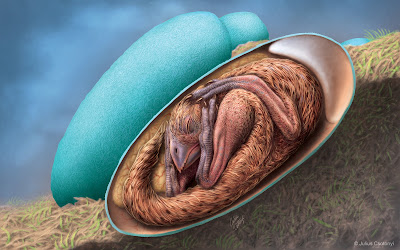
[Paleontology • 2021] An Exquisitely Preserved in-ovo Theropod Dinosaur Embryo sheds Light on Avian-like Prehatching Postures


in Xing, Niu, Ma, ... et Brusatte, 2021.

Artwork by Julius Csotonyi facebook.com/JuliusCsotonyi 

Highlights:
• A Late Cretaceous oviraptorid theropod dinosaur embryo is preserved in-ovo
• Its head lies ventral to the body, and the back curled along the egg's blunt pole
• Its posture is similar to that of a late-stage modern bird embryo
• Avian tucking behavior possibly originated among non-avian theropods

Summary
Despite the discovery of many dinosaur eggs and nests over the past 100 years, articulated in-ovo embryos are remarkably rare. Here we report an exceptionally preserved, articulated oviraptorid embryo inside an elongatoolithid egg, from the Late Cretaceous Hekou Formation of southern China. The head lies ventral to the body, with the feet on either side, and the back curled along the blunt pole of the egg, in a posture previously unrecognized in a non-avian dinosaur, but reminiscent of a late-stage modern bird embryo. Comparison to other late-stage oviraptorid embryos suggests that prehatch oviraptorids developed avian-like postures late in incubation, which in modern birds are related to coordinated embryonic movements associated with tucking — a behavior controlled by the central nervous system, critical for hatching success. We propose that such pre-hatching behavior, previously considered unique to birds, may have originated among non-avian theropods, which can be further investigated with additional discoveries of embryo fossils.


Lida Xing, Kecheng Niu, Waisum Ma, Darla K. Zelenitsky, Tzu-Ruei Yang and Stephen L. Brusatte. 2021. An Exquisitely Preserved in-ovo Theropod Dinosaur Embryo sheds Light on Avian-like Prehatching Postures. iScience.  DOI: 10.1016/j.isci.2021.103516

Friday, April 2, 2021

[Herpetology • 2021] Novel Reproductive Behavior in An Asian Frog: Sex‐reversed Inguinal Amplexus [Leptobrachella laui; Megophryidae]


Leptobrachella laui (Sung, Yang, and Wang, 2014)

in Sung, Lee, Ng, et al., 2021. 

Abstract
Amphibians exhibit diverse reproductive behaviors, including nine documented types of amplexus, the behavior in which male and female frogs position themselves for courtship, oviposition, and fertilization. All known forms of amplexus involve the male on top of or in line horizontally (cloacal apposition) with the female. Here, we report a novel form of amplexus observed in Lau’s leaf litter toad (Leptobrachella laui; Megophryidae) in Hong Kong, China. Termed “sex‐reversed inguinal amplexus,” the female climbs on top of a male and the male transports the female to a concealed breeding site. We were unable to determine whether this was the amplectant position in which frogs engaged during oviposition or solely during courtship and prior to oviposition, but there are a number of possible evolutionary drivers that may have given rise to this behavior, including limiting suitable oviposition sites or strong competition for males among females. Further research will be necessary to understand the evolutionary origins of this novel reproductive behavior.

Keywords: amphibian, amplexus, behavioral ecology, Leptobrachella laui, Megophryidae, oviposition


A pair of Lau’s leaf litter toads (Leptobrachella laui) in sex‐reversed inguinal amplexus, in which a female is on top of a male, in Hong Kong, China in March 2017.
 

Yik‐Hei Sung, Wing‐Ho Lee, Ho‐Nam Ng, Martha L. Crump and Nancy E. Karraker. 2021. Novel Reproductive Behavior in An Asian Frog: Sex‐reversed Inguinal Amplexus. Ecosphere Naturalist. DOI: 10.1002/ecs2.3407
 
Lingnan University scholar discovers novel reproductive behaviour in native frog species

Wednesday, December 30, 2020

[Paleontology • 2021] An Oviraptorid Preserved Atop An Embryo-bearing Egg Clutch sheds light on the Reproductive Biology of Non-avialan Theropod Dinosaurs


 an oviraptorid specimen [LDNHMF2008]
consisting of an adult skeleton preserved atop an embryo-bearing egg clutch. 

Bi, Amiot, Peyre de Fabrègues, ... et Xu, 2020.
 Artwork by Zhao Chuang. english.IVPP.cas.cn

 
Abstract
Recent studies demonstrate that many avialan features evolved incrementally prior to the origin of the group, but the presence of some of these features, such as bird-like brooding behaviours, remains contentious, in non-avialan dinosaurs. Here we report the first non-avialan dinosaur fossil known to preserve an adult skeleton atop an egg clutch that contains embryonic remains. The preserved positional relationship of the adult to the clutch, coupled with the advanced growth stages of the embryos and their high estimated incubation temperatures, provides strong support for the brooding hypothesis. Furthermore, embryos in the clutch are at different developmental stages, suggesting the presence of asynchronous hatching—a derived feature even among crown-group birds—in non-avialan theropods. These findings demonstrate that the evolution of reproductive biology along bird-line archosaurs was a complex rather than a linear and incremental process, and suggest that some aspects of non-avialan theropod reproduction were unique to these dinosaurs.

Keywords: Oviraptorosauria, Cretaceous, Clutch, Brooding, Embryos, Asynchronous hatching


Fig. 1. LDNHMF2008, an oviraptorid specimen consisting of an adult skeleton preserved atop an embryo-bearing egg clutch.
(a) Photograph. (b) Interpretive drawing with bones and gastroliths in white and eggs color-coded by ring (A, red; B, green; C, blue).
(c) Restoration (white indicates bones preserved in the adult skeleton).

Abbreviations: I, digit I; II, digit II; III, digit III; A#, egg in lowermost ring (A); as, astragalus; B#, egg in middle ring (B); C#, egg in uppermost ring (C); cav, caudal vertebra; ch, chevron; cv, cervical vertebra; di, manual digit; dr, dorsal ribs; dv, dorsal vertebra; em, egg known to preserve embryo; fe, femur; fi. fibula; ga, gastralium; gl, gastroliths; h, humerus; il, ilium; is, ischium; mt, metatarsal; O2, egg sampled for oxygen isotope analysis; pb, pubis; pp, pedal phalanges; ra, radius; sl, semilunate carpal; ti, tibia; ul, ulna. Note that C11 and C12 are not paired eggs. The eggs that would have been paired with C11 and C12 are probably not preserved, as is the case for some other eggs and skeletal elements.
 

An attentive oviraptorid theropod dinosaur broods its nest of blue-green eggs while its mate looks on in what is now Jiangxi Province of southern China some 70 million years ago.
 Artwork by Zhao Chuang.


 Shundong Bi, Romain Amiot, Claire Peyre de Fabrègues, Michael Pittman, Matthew C. Lamanna, Yilun Yu, Congyu Yu, Tzuruei Yang, Shukang Zhang, Qi Zhao and Xing Xu. 2020. An Oviraptorid Preserved Atop An Embryo-bearing Egg Clutch sheds light on the Reproductive Biology of Non-avialan Theropod Dinosaurs. Science Bulletin. In Press. DOI: 10.1016/j.scib.2020.12.018

Researchers Announce World’s First Dinosaur Preserved Sitting on Nest of Eggs that Includes Fossilized Babies

Monday, November 26, 2018

[Fungi • 2018] Gymnopus nidus-avis • A New Gymnopus Species with Rhizomorphs and Its Record as Nesting Material by Birds (Tyrannidae) in the Subtropical Cloud Forest from eastern Mexico


Gymnopus nidus-avis César, Bandala & Montoya

in César, Bandala, Montoya  & Ramos, 2018. 

Abstract
A new species of Gymnopus is described on the basis of collections from the subtropical cloud forest of eastern Mexico. Macro- and micromorphological characters, in combination with ITS sequences obtained from fruit body tissues, were used for its taxonomic circumscription. Basidiomata of this species were found growing scattered on fallen twigs of Quercus and also developing abundant long, black, wiry rhizomorphs. The authors discovered that these latter are used as part of nesting material by Mionectes oleaginous (Tyrannidae) inhabiting the subtropical cloud forest studied. A macro- and microscopical description as well as a discussion and illustrations are provided. A new combination in Gymnopus is proposed for Marasmius westii, a synonym of Marasmius brevipes.

Keywords: Marasmioid fungi, Neotropical fungi, nesting biology, Omphalotaceae


Figure 2. Gymnopus nidus-avis: basidiomata (César 36, holotype).
Scale bar: 4 mm 

Gymnopus nidus-avis César, Bandala & Montoya, sp. nov.

Holotype: MEXICO. Veracruz: Municipality of Xalapa, Santuario del Bosque de Niebla, Instituto de Ecología A.C., 1343 m a.s.l., gregarious, on fallen twigs of Quercus, 20 April 2016, Cesar 36 (XAL).

Diagnosis: Pileus pale brown to brown. Lamellae adnexed, distant, very pale brown. Basidiospores ellipsoid to subcylindrical. Basidia 2–4-spored, narrowly clavate. Cheilocystidia 20–39 × 3–8 µm, irregularly cylindrical, with constrictions and small lateral appendages. Pileipellis hyphae with colourless incrustations; terminal elements appendiculate. Pileus and lamellar tissues clampless.
...

Etymology: Referring to the use of rhizomorphs as nesting material by birds.


 Enrique César, Victor M. Bandala, Leticia Montoya and Antero Ramos. 2018. A New Gymnopus Species with Rhizomorphs and Its Record as Nesting Material by Birds (Tyrannidae) in the Subtropical Cloud Forest from eastern Mexico. MycoKeys. 42: 21-34.  DOI: 10.3897/mycokeys.42.28894

Thursday, August 30, 2018

[Botany • 2018] Bauhinia proboscidea (Fabaceae: Cercidoideae) • A New Species from Costa Rica and Panama, with notes on B. beguinotii, B. gorgonae and B. pansamalana


Bauhinia proboscidea P. Juárez, R. Flores & M.A. Blanco

in Juárez, Flores & Blanco, 2018. 

Abstract
Bauhinia proboscidea, a new species from Costa Rica and Panama, is described and illustrated, and compared to the closely related B. pansamalana of southern Mexico, Guatemala and Honduras. It is also compared with B. beguinotii, with which has been confused in herbaria. Bauhinia gorgonae, endemic to Gorgona Island in Colombia and which has been classified as a variety of B. beguinotii, is here considered a separate species. A key to the Neotropical species of Bauhinia with three fertile stamens is provided. Some observations on the morphology and reproductive biology of B. proboscidea are presented. Global-level assessments of the conservation status according to IUCN Red List criteria indicate that B. proboscidea and B. beguinotii (which was previously assessed using some misidentified records) should both be considered as species of Least Concern (LC), B. gorgonae should be considered as Endangered (EN), and B. pansamalana should be considered Not Threatened (NT). Country-level conservation assessments are also provided for all four species. The homology of the “intrastipular spines” of Bauhinia is briefly discussed.

Keywords: Central America, conservation, intrastipular spines, IUCN Red List categories, taxonomy, reproductive biology, Eudicots


FIGURE 2. Bauhinia proboscidea
A. Staminate flower. B. Perfect (hermaphrodite) flower. C. Apex of fertile stamens of staminate flower with incurved filaments and open anthers. D. Detail of perfect flower, showing recurved fertile anthers and pistil with incurved style. E. Detail of staminodes (red and yellow, with white abortive anthers), filaments of fertile stamens (dark red) and pistillode (green) in staminate flower. F. Immature fruits. G. Two-flowered inflorescence, with one perfect flower and one staminate flower; the perfect flower (left) has already shed its petals. H. Detail of stem node showing intrastipular spine with liquid secretion.
F from Flores et al. 3835 (PMA) by R. Flores; all other photos from Juárez 1241 (USJ) by P. Juárez.

FIGURE 1. Bauhinia proboscidea.
A. Fruiting branch. B. Perfect (hermaphrodite) flower; note recurved fertile stamens and incurved style. C. Staminate flower; note apically incurved fertile stamens. D. Apex of staminodes and bases of free portion of filaments of fertile stamens in staminate flower. E. Apex of fertile stamen filaments and anthers of staminate flower. F. Floral diagram of perfect flower. G. Pair of intrastipular spines at a node (leaf scar on opposite side of stem, not visible), with liquid secretion. A based on type specimen (Juaìrez 420, USJ, CR, MO); B–F based on photographs of Juárez 1241 (USJ).
Drawn by P. Juaìrez.   facebook.com/MarioBlanco


Bauhinia proboscidea P. Juárez, R. Flores & M.A. Blanco, sp. nov.

Etymology:— The specific epithet refers to the prominent staminal tube and the projecting pistil (the latter in hermaphroditic flowers), which together resemble a snout or proboscis of an animal. The recurved fertile stamens of hermaphroditic flowers also bear a superficial resemblance to the tusks of elephants Loxodonta spp., order Proboscidea).


Pedro Juárez, Rodolfo Flores and Mario A. Blanco. 2018.  Bauhinia proboscidea (Fabaceae: Cercidoideae), A New Species from Costa Rica and Panama, with notes on B. beguinotiiB. gorgonae and B. pansamalana.  Phytotaxa. 361(1); 25-40. DOI:  10.11646/phytotaxa.361.1.2


Resumen: Se describe e ilustra Bauhinia proboscidea, una nueva especie de Costa Rica y Panamá, y se compara con la cercanamente emparentada B. pansamalana del sur de México, Guatemala y Honduras. También se compara con B. beguinotii, con la cual se ha confundido en los herbarios. Bauhinia gorgonae, endémica de la Isla Gorgona en Colombia, se considera aquí como una especie independiente de B. beguinotii, de la cual se ha clasificado como una variedad. Se brinda una clave para las especies neotropicales de Bauhinia con tres estambres fértiles. Se presentan algunas observaciones sobre la morfología y biología reproductiva de B. proboscidea. Evaluaciones a nivel global del estado de conservación de acuerdo con los criterios de la Lista Roja de UICN, indica que tanto B. proboscidea como B. beguinotii (que había sido previamente evaluada usando algunos registros mal identificados) deben ser consideradas como especies de Preocupación Menor (LC), B. gorgonae debe considerarse como En Peligro (EN), y B. pansamalana debe considerarse como No Amenazada (NT). También se presentan evaluaciones de conservación a nivel de país para las cuatro especies. Se discute brevemente la homología de las “espinas intraestipulares” de Bauhinia.

Saturday, March 31, 2018

[Herpetology • 2018] Reproductive Biology and Maternal Care of Neonates in southern African Python (Python natalensis)


 Neonate southern African pythons (Python natalensis) basking at the entrance to the nest chamber.

in  Alexander. 2018.  DOI: 10.1111/jzo.12554

Abstract
Reproductive strategies such as parental care have been pivotal in evolutionary innovations such as endothermy in birds and mammals. The diversity of reproductive biology across the squamates provides a unique opportunity for elucidating the selective forces responsible for the evolution of various reproductive strategies. Here, I report on the reproductive biology of the southern African python (Python natalensis), based on a 7-year study of free-ranging pythons, revealing a behavioural complexity not usually expected for snakes. Mating occurred in the austral winter, with individual males following females for more than 2 months. As is typical for pythons, females brooded eggs by coiling around the clutch. Females are capital breeders; they lost ~40% body mass during a breeding event and did not breed in consecutive years. There was no evidence of the facultative thermogenesis that has been reported in congeners, suggesting that facultative thermogenesis has arisen independently more than once in Python. Reproductive females thermoregulated more carefully than non-reproductives, maintaining higher, more stable Tbs at all stages of reproduction, especially while brooding. This was achieved by a stereotypic basking regime facilitated by ‘facultative melanism’, with females darkening significantly for the entire breeding event. Mothers remained with neonates at the nest site for approximately 2 weeks after hatching. During this time, mothers alternated between brief bouts of basking on the surface and coiling around the hatched eggs, on which the neonates rested. Neonates formed an aggregation near the burrow entrance to bask during the day, individually returning to the nest intermittently throughout the day. During the night, neonates remained within the mother's coils on the hatched eggs. This study highlights the diversity of reproductive biology within Python and cautions against generalization in this regard. This is the first unambiguous report of maternal care of neonates in an oviparous snake.


Figure 4.  Neonate southern African pythons (Python natalensis) basking at the entrance to the nest chamber.
 Some of the neonates have already undergone their first shed.

G. J. Alexander. 2018. Reproductive Biology and Maternal Care of Neonates in southern African Python (Python natalensis).  Journal of Zoology.  DOI: 10.1111/jzo.12554

New insights into how southern African pythons look after their babies  theconversation.com/new-insights-into-how-southern-african-pythons-look-after-their-babies-91276
'Cold-blooded' pythons make for caring moms  phy.so/440240120 via @physorg_com