Showing posts with label Genome. Show all posts

Monday, March 23, 2026

[Botany • 2026] Gentiana daofuensis (Gentianaceae) • A New Species from Sichuan, China

 
Gentiana daofuensis  Y.M.Yuan & P.C.Fu, 

in Sun, Guo, Zhang, Yi, Xu et Fu, 2026.
道孚小龙胆  ||  DOI: doi.org/10.3897/phytokeys.272.183828

Abstract
Gentiana daofuensis, a new species of the family Gentianaceae, is described and illustrated here. Currently, this species is known only from Daofu County, Sichuan Province, China. Phylogenetic analyses based on chloroplast genome data indicate that it belongs to G. section Chondrophyllae s.l. Morphologically and genetically, it is closely related to G. crassuloides but can be clearly distinguished from the latter by its shorter calyx and pale blue-purple corolla with numerous dark blue short stripes or spots.

Key words: Chloroplast genome, Gentiana, Qinghai-Tibet Plateau, section Chondrophyllae

Morphological characteristics of Gentiana daofuensis sp. nov.
A. Habit; B. Whole plants; C. Stem with flower at anthesis; D. Stem with mature flower bud; E. Leaf pair (front view); F. Leaf pair (reverse view); G. Calyx; H. Flower (front view); I. Fruit (front view); J. Seed; K. Fruit (side view); L. Pistil; M. Dissected flower; N. Flower.
Photographs by Peng-Cheng Fu (B–N) and Yong-Ming Yuan (A).

Gentiana daofuensis Y.M.Yuan & P.C.Fu, sp. nov.

Diagnosis. Gentiana daofuensis is distinguishable from all other similar species of the genus by the combination of the reniform leaves on the upper stem and the pale blue-purple corolla with numerous dark blue short stripes or spots.

Etymology. The specific epithet “daofuensis” is derived from the type locality of the new species, Daofu County, and the Latin suffix -ensis, indicating the place of origin or growth.

Vernacular name. Chinese mandarin: dao fu xiao long dan (道孚小龙胆).


Shan-Shan Sun, Yuan-Meng Guo, Xin-Yue Zhang, Wen-Jie Yi, Shu-Han Xu and Peng-Cheng Fu. 2026. Gentiana daofuensis (Gentianaceae), A New Species from Sichuan, China. PhytoKeys. 272: 1-10.  DOI: doi.org/10.3897/phytokeys.272.183828  [18 Mar. 2026] 

Wednesday, March 18, 2026

[Botany • 2026] Iris cariciformis (Iridaceae) • A New Species from China


Iris cariciformis Z.Z.Zhang & G.X.Zhang, 

in Z.Z. Zhang et G.X. Zhang, 2026. 

Abstract
Iris cariciformis Z.Z.Zhang & G.X.Zhang, sp. nov. from China is described and illustrated. This species grows on cliff faces or open slopes in the central Qinling Mountains. Morphologically, I. cariciformis is similar to I. dabashanensis but can be distinguished by its longer perianth tube and ellipsoidal capsules with a long beak. Furthermore, this study facilitates the valid publication of Iris fujianensis. Phylogenetic analysis based on chloroplast DNA sequences confirms the placement of the former within I. series Chinenses, while the latter is inferred as sister to I. speculatrix. Simultaneously, a new combination, Iris valida (S.S.Chien) Z.Z.Zhang, H.T.Li & T.Y.Zuo, comb. et stat. nov., is proposed.

Key words: Chloroplast genome, Iris, new species, phylogeny
 
Iris cariciformis Z.Z.Zhang & G.X.Zhang, sp. nov.
A. Habitat; B. Plant; C. Sepals, petals and stamens; D. Bracts; E. Pedicel, ovary and pistil; F. Flower; G. Inflorescence (Photos A, B, C. author; C–G Xiaoqiang Shen).

Iris cariciformis Z.Z.Zhang & G.X.Zhang, sp. nov.
 
Diagnosis. Morphologically similar to I. dabashanensis, but differs by the longer perianth tube (1.6–2.5 cm vs 0.2–0.5 cm) and ovoid capsules with a prominent beak (vs globose and beakless).

Etymology: The new species grows in clusters and has slender leaves, resembling plants of the Carex L. that inhabit the same environment, hence the specific epithet “cariciformis” was chosen.


 Zhongzheng Zhang and Gexiang Zhang. 2026. Descriptions of A New Species, Validation of a name, and Elevation of a variety in Iris (Iridaceae) from China. PhytoKeys. 271: 299-312. DOI: doi.org/10.3897/phytokeys.271.176663 [16 Mar 2026]

Wednesday, March 11, 2026

[Diplopoda • 2026] Riukiaria langyaensis • A New Species of the Genus Riukiaria (Polydesmida: Xystodesmidae) from eastern China, with the characterization of its complete mitochondrial genome


Riukiaria langyaensis  Han & Wang, 

in Han, Liu, Wang et Dong, 2026. 

Abstract
This study describes a new millipede species of the genus Riukiaria from China: Riukiaria langyaensis sp. nov., and provides an identification key to all 19 Riukiaria species currently known from China. A systematic review was conducted on the 34 described Riukiaria species, and these species were classified into five categories based on the morphology of the male gonopod. The complete mitochondrial genome of this new species was sequenced and annotated for the first time, representing the first mitogenomic data reported for the genus Riukiaria. The mitogenome of R. langyaensis sp. nov. is 14,954 bp in length, containing 13 protein-coding genes, 22 tRNA genes, 2 rRNA genes, and a control region, with an overall A+T content of 65.8%. All 37 mitochondrial genes are encoded on the Heavy strand. The results help clarify the confused species relationships within Riukiaria and provide fundamental data for phylogenetic studies of Xystodesmidae.

Key words: Complete mitochondrial genome, identification key, millipede, mitogenome, Riukiaria, species description, taxonomy

Riukiaria langyaensis sp. nov. 
A. Live coloration; B. Live specimen under UV light.

Riukiaria langyaensis sp. nov. 
A. Posterior part of body, dorsal view; B. Midbody rings, dorsal view; C. Anterior part of body, dorsal view; D. Telson, ventral view; E. Both gonopods, ventral view; F. Rings 16–19 and telson, dorsal view. Scale bars: 1.0 mm.

Riukiaria langyaensis Han & Wang, sp. nov.
  
Diagnosis. This species closely resembles Riukiaria mundyi Korsós, Nakamura & Tanabe, 2011 in tergal features and body coloration. However, Riukiaria langyaensis sp. nov. differs by having a lighter body color than R. mundyi, with antennae and walking legs exhibiting a wheat-colored hue and the paratergal margins appearing translucent. In terms of gonopod structure, the prefemorite of Riukiaria langyaensis sp. nov. is similar to that of Riukiaria contigua (Wang, 1957), but its acropodite is more inflated and nearly spherical, with an indistinctly forked tip, and the prefemoral processes are completely missing.


 Zewu Han, Xin Liu, Jiajia Wang and Yan Dong. 2026. Description of A New Species of the Genus Riukiaria (Diplopoda, Polydesmida, Xystodesmidae) from eastern China, with the characterization of its complete mitochondrial genome. ZooKeys. 1272: 315-335.  DOI: doi.org/10.3897/zookeys.1272.182977 [10 Mar 2026]

Monday, January 26, 2026

[Invertebrate • 2026] Alloscopus ramanai • A New Collembola Species (Orchesellidae: Heteromurinae) from central Thailand, with complete mitochondrial genome and phylogenetic placement


Alloscopus ramanai  Nilsai, Jantarit & Jaitrong, 

in Nilsai, Jantarit, Jeenthong, Detcharoen et Jaitrong, 2026.

Abstract
Background: Alloscopus is one of the genera within the subfamily Heteromurinae, recently recorded in Thailand and is currently represented by six species from two regions of the country. In the northern part, A. tetracanthus Börner, 1906 and A. thailandensis Mari Mutt, 1985 have been recorded from forested habitats. In the southern part, A. whitteni Jantarit & Sangsiri, 2020, A. namtip Jantarit & Sangsiri, 2020 and A. jantapasoae Jantarit, Nilsai & Manee, 2025 have been reported from a cave habitat, while A. sago Jantarit & Manee, 2025 was recently described from a sago palm forest.

New information: A new species, Alloscopus ramanai sp. nov., is described from central Thailand, based on an integrative taxonomic approach combining morphological and molecular data. The new species closely resembles A. tetracanthus Börner, 1906, sharing several diagnostic characters including a dark red ocular patch and PAO shape and the number of M and S series chaetae on the dorsal head. Additional similarities include the number of spiniform labral papillae, labial basis chaetae, the number of pseudopores on the manubrium, the number of central and lateral macrochaetae on Th.II, the number of central macrochaetae on Th.III and Abd.IV. However, A. ramanai sp. nov. can be clearly distinguished from A. tetracanthus by a unique combination of traits, including the number of lateral macrochaetae on Abd. III and Abd. IV and the number of chaetae on the anterior side of the ventral tube. A detailed diagnosis and illustrations of the new species are provided herein. A key for species of Alloscopus in Thailand is also included. The complete mitochondrial genome of A. ramanai sp. nov. is 14,757 bp in length and comprises 13 concatenated protein-coding genes (PCGs), 22 transfer RNA (tRNA) genes and two ribosomal RNA (rRNA) genes. Phylogenetic analysis, based on mitochondrial genome data, indicates that A. ramanai sp. nov. forms a sister lineage to Alloscopus bannaensis Zhang, 2020. The description of this new species contributes to a more comprehensive understanding of Heteromurinae diversity in Thailand and underscores the need for expanded mitogenomic sampling across Collembola.

Keywords: Entomobryoidea, mitogenome, new species, taxonomy, phylogeny

A Habitus of Alloscopus ramanai sp. nov. (SEM image, upper; wet specimen, lower). Scale bars = 0.5 mm;
B–C The type locality of the new species, a forest plantation of the Natural History Museum of the National Science Museum Thailand (THNHM);
D The localities of Alloscopus recorded in Thailand. 1, A. tetracanthus Börner, 1906 and A. thailandensis Mari Mutt, 1985. 2, A. whitteni Jantarit & Sangsiri, 2020. 3, A. namtip Jantarit & Sangsiri, 2020. 4, A. jantapasoae Jantarit, Nilsai & Manee, 2025. 5, A. sago Jantarit & Manee, 2025.

Alloscopus ramanai Nilsai, Jantarit & Jaitrong, sp. nov.

Diagnosis: Alloscopus ramanai sp. nov. exhibits the morphological similarity to A. tetracanthus Börner 1906, a species reported from Australia, Indonesia, Malaysia, Singapore, Papua New Guinea, India, New Britain, Micronesia and Thailand (Chiang Mai Province). Both species share several morphological characters, including a dark red eye patch with reddish to dark dot pigmentation, a semi-divided PAO, labial basis M1(m)m2rel1l2, four spiniform labral papillae, 4–5 central and 4–5 posterior mac on Th. II, six central mac on Th. III, two central mac on Abd. IV, 0–2 inner unpaired ungual teeth, the presence of teeth on the unguiculus, smooth chaetae on the tibiotarsi, a similar number of chaetae on the manubrium and 4–7 spines on the dens. However, Alloscopus ramanai sp. nov. can be distinguished from A. tetracanthus by the absence of eyes (vs. 1+1), orange dot pigmentation (vs. lack of pigmentation) and the presence of five macrochaetae on the “A” series of the dorsal head chaetotaxy (vs. four). Furthermore, A. ramanai sp. nov. can ...

Etymology: The new species was collected in the vicinity of the Rama 9 Museum, part of the National Science Museum, Thailand, which serves as the locality. The specific epithet ramanai is derived from the name of the Museum and is used as a noun in apposition, honouring the institution.


 Areeruk Nilsai, Sopark Jantarit, Tadsanai Jeenthong, Matsapume Detcharoen and Weeyawat Jaitrong. 2026. Alloscopus ramanai sp. nov. (Orchesellidae, Heteromurinae), A New Collembola Species from central Thailand, with complete mitochondrial genome and phylogenetic placement. Biodiversity Data Journal. 14: e173157. DOI: doi.org/10.3897/BDJ.14.e173157

Saturday, November 22, 2025

[Invertebrate • 2025] Troglobdella guizhouensis • A New Genus and Species of Cave-dwelling Leech (Hirudinea: Salifidae) from China: Taxonomy, Phylogeny, and mitochondrial Genome Characterization


Troglobdella guizhouensis  Liu & Nakano, 

in K. Liu, Q. Li, Wu, Lin, H. Li, Nakano et Z. Liu, 2025.
 贵州隐洞蛭  ||  DOI: doi.org/10.3897/zse.101.168628 
 
Abstract
Accurate identification of leech species is critical for biodiversity conservation and evolutionary studies. However, due to the ambiguity and variability of some key characteristics, Salifidae remains a rather poorly known group of Erpobdelliformes. In this study, a new genus of salifid leech, Troglobdella gen. nov., is established, and a new species, Troglobdella guizhouensis sp. nov., is described based on specimens collected from a cave in Guizhou Province, Southwest China. Phylogenetic analyses based on mitochondrial cytochrome c oxidase subunit I (COI) and nuclear 18S rRNA gene sequences reveal that Troglobdella guizhouensis represents a distinct lineage within a clade that also includes the troglobiotic species Shibabdella wulingensis Tang & Liu, 2025, and the terrestrial Odontobdella gaowangjiensis Yin & Liu, 2025, both of which are known from Hunan Province. This suggests that cave-related morphologies in Chinese salifid leeches may have evolved independently. The complete mitochondrial genome of the new species was assembled into a circular molecule of 15,732 bp, comprising 13 protein-coding genes, 22 tRNAs, and 2 rRNAs. This study contributes new insights into the taxonomy, systematics, and mitochondrial architecture of cave-adapted leeches.

Key Words: mitochondrial genome, phylogeny, Salifidae, taxonomy, Troglobdella guizhouensis, troglobiont

Taxonomy
Family Salifidae Johansson, 1910

Troglobdella guizhouensis 
 B. The entrance of the cave; C. A leech living in the puddle.

 Troglobdella Liu & Nakano, gen. nov.

 Troglobdella guizhouensis Liu & Nakano, sp. nov.

Diagnosis. Troglobdella guizhouensis can be distinguished from the other salifid genera as well as other species by the following combination of characters: body milky white with no pigments; without eyes; oral sucker well developed, distinctly laterally expanded; mid-body somites six-annulate; gonopores separated by four annuli; testisacs multiple; pharynx strepsilaematous; lacking preatrial loop of male paired ducts; paired atrial cornua conical, curved laterad; atrium short, globular; ovisacs descending to anterior of somite XIV, then turned several times in each of posterior parts, forming globular mass.

Etymology. The genus name Troglobdella is derived from the Ancient Greek “troglos” meaning “cave” and “bdella” meaning “leech” referring to the genus’ trait to subterranean habitats. We suggest the Chinese formal name as “yǐn dòng zhì shǔ” (隐洞蛭属). The species name “guizhouensis” is based Guizhou Province in China, where the species was discovered, with the suffix “-ensis” indicating geographical origin. We suggest the Chinese formal name as “guì zhōu yǐn dòng zhì” (贵州隐洞蛭).


Kaiqing Liu, Qing Li, Heqi Wu, Yiquan Lin, Hexiang Li, Takafumi Nakano, Zichao Liu. 2025. A New Genus and Species of Cave-dwelling Leech from China in the family Salifidae: Taxonomy, Phylogeny, and mitochondrial Genome Characterization. Zoosystematics and Evolution. 101(4): 2123-2132. DOI: doi.org/10.3897/zse.101.168628 

Friday, November 14, 2025

[Ichthyology • 2025] Genome-wide Pphylogeny reshapes our Understanding of the Evolution of Deep-sea Dragonfishes, bristlemouths, viperfishes, and allies (Stomiiformes)


Stomiiformes phylogeny

in Chang, Heiple, Hays, Melendez-Vazquez, Lee, Frable, Pogonoski, Martinez, Betancur-R et Arcila, 2025. 

Abstract
Background: 
The evolutionary relationships within Stomiiformes, a diverse order of deep-sea fishes dominating the mesopelagic and bathypelagic zones, remain contentious due to conflicting morphological and molecular evidence. These fishes, comprising 464 species across four traditionally recognized families (Gonostomatidae, Sternoptychidae, Phosichthyidae, and Stomiidae), exhibit remarkable adaptations such as bioluminescence, ultra-black pigmentation, and extreme jaw morphologies. Their global abundance and ecological significance, including contributions to the biological carbon pump, underscores the need to resolve their phylogeny amid escalating threats from climate change and human activities.

Results: 
We conducted the most comprehensive phylogenomic analysis of Stomiiformes to date, integrating 936 nuclear loci from 60 species and an expanded dataset of 135 species with mitochondrial sequences from publicly available repositories such as the Barcode of Life Data Systems (BOLD) database. We used maximum likelihood and coalescent-based approaches to assess family monophyly and relationships, including extensive quality control to address contamination in public databases. Our analyses reveal unstable tree topologies and complex evolutionary histories that challenge traditional classifications, while our quality control analyses identified 29% of BOLD sequences as misidentified or contaminated, emphasizing rigorous curation for deep-sea taxa. Congruent with a recent taxonomic treatment of Stomiiformes, the families Phosichthyidae and Gonostomatidae exhibit polyphyly and paraphyly, respectively, while subfamilies within Stomiidae are extensively non-monophyletic, leading us to recommend their abandonment. We propose the recognition of eight monophyletic families: Vinciguerriidae, Diplophidae, Gonostomatidae, Yarrellidae, Ichthyococcidae, Phosichthyidae, Sternoptychidae, and Stomiidae, supported by robust molecular and morphological evidence.

Conclusions: 
This revised classification reflects the morphological and ecological diversity of Stomiiformes, aligning with their evolutionary diversification in the deep sea. Our phylogenomic framework resolves longstanding systematic uncertainties and highlights the power of genome-wide data in tackling taxonomically challenging clades. These findings provide a foundation for understanding deep-sea fish diversification and assessing the potential ecBMC Ecology and Evolution  Article
Genome-wide phylogeny reshapes our understanding of the evolution of deep-sea dragonfishes, bristlemouths, viperfishes, and allies (Stomiiformes)

Keywords: Mesopelagic Fishes, Taxonomic Classification, Morphological Diversity


Solomon Chang, Zach Heiple, Delson Hays, Fernando Melendez-Vazquez, Casey Lee, Benjamin W. Frable, John Pogonoski, Christopher M. Martinez, Ricardo Betancur-R  and Dahiana Arcila. 2025. Genome-wide Pphylogeny reshapes our Understanding of the Evolution of Deep-sea Dragonfishes, bristlemouths, viperfishes, and allies (Stomiiformes). BMC Ecol Evo. 25, 111. DOI: doi.org/10.1186/s12862-025-02453-0 [21 October 2025] 

Monday, July 1, 2024

[PaleoMammalogy • 2024] Temporal Dynamics of Woolly Mammoth Genome Erosion prior to Extinction


woolly mammoth Mammuthus primigenius wanders the frozen shore of Wrangel Island. 

in Dehasque, Morales, et al., 2024. 
    DOI: 10.1016/j.cell.2024.05.033    
 Artwork by Beth Zaiken

Highlights: 
• Analysis of long-term genomic changes using 21 high-coverage woolly mammoth genomes
• Severe bottleneck of the last surviving population when Wrangel Island was isolated
• The population partially recovered within a few generations and then remained stable
• Inbreeding depression and purging persisted for thousands of years after the recovery

Summary:
  A number of species have recently recovered from near-extinction. Although these species have avoided the immediate extinction threat, their long-term viability remains precarious due to the potential genetic consequences of population declines, which are poorly understood on a timescale beyond a few generations. Woolly mammoths (Mammuthus primigenius) became isolated on Wrangel Island around 10,000 years ago and persisted for over 200 generations before becoming extinct around 4,000 years ago. To study the evolutionary processes leading up to the mammoths’ extinction, we analyzed 21 Siberian woolly mammoth genomes. Our results show that the population recovered quickly from a severe bottleneck and remained demographically stable during the ensuing six millennia. We find that mildly deleterious mutations gradually accumulated, whereas highly deleterious mutations were purged, suggesting ongoing inbreeding depression that lasted for hundreds of generations. The time-lag between demographic and genetic recovery has wide-ranging implications for conservation management of recently bottlenecked populations.

Keywords: Mammuthus primigenius, woolly mammoth, extinction, ancient DNA, paleogenomics, mutation load, inbreeding, bottleneck, climate, Wrangel Island

The last woolly mammoth Mammuthus primigenius wanders the frozen shore of Wrangel Island. 
 Artwork by Beth Zaiken

 
M. Dehasque, H. E. Morales, et al. 2024. Temporal Dynamics of Woolly Mammoth Genome Erosion prior to Extinction. Cell.  DOI: 10.1016/j.cell.2024.05.033    

New genetic study reveals the woolly mammoths' journey towards extinction
 

Friday, September 30, 2022

[Ornithology • 2022] Genome-wide SNPs confirm Plumage Polymorphism and Hybridisation within A Cyornis Flycatcher Species Complex


in Ng, Li, Zhang, Garg, ... et Lei, 2022. 

Abstract
Morphology has been a leading taxonomic guiding light to systematists for the last couple of hundred years. However, the genetic and – more recently – genomic revolution have produced numerous demonstrations of erroneous classifications that were based on labile morphological traits. We used thousands of genome-wide markers to shed light on evolutionary dynamics in a confusing and taxonomically obscure group of Asian Cyornis flycatchers. Using genomic data, we corroborated recent findings based on three mitochrondrial and five nuclear genes that the two taxa hainanus and klossi which were previously treated as separate species (Cyornis hainanus and Cyornis rubeculoides klossi, respectively) are genomically homogeneous and form a single species, C. hainanus. We also uncovered a novel case of interbreeding between C. hainanus and a non-sister species, C. glaucicomans, illustrating these flycatchers' ability to hybridise in marginal situations even after substantial times of divergence. Our study illustrates how genome-wide loci can shed light on complicated taxonomic problems, resulting in a better integration of phenotypic and genotypic data.

Keywords: Cyornis, ddRADseq, introgression, phylogenetics, species complex


(a) Distribution range of Cyornis rubeculoides and C. hainanus. Sampling localities are indicated by coloured circles, and the size of the circles is proportional to sample size. Approximate distributions of subspecies are indicated with dashed lines, but it should be noted that the subspecies distributions are poorly understood, especially the range of dialilaemus. Photographs of C. rubeculoides by Ashutosh Singh are reproduced here with permission from Singh et al. (2019).
(b) Maximum likelihood tree based on 21,283 SNPs, with bootstrap support indicated at major nodes. Colours represent different taxa: red, C. r. rubeculoides; orange, C. r. rogersi; blue, C. hainanus hainanus and C. h. klossi; green, C. glaucicomans; and pink, C. unicolor unicolor (outgroup). Plumage-type assignment for male C. hainanus is indicated by the squares, with typical hainanus in blue squares labelled with a h, typical klossi-type plumage in orange with a k and intermediate plumage types in both orange and blue squares and labelled with a h/k. Females have a brown square without any labels.
 (c) Species tree for all individuals generated with SNAPP


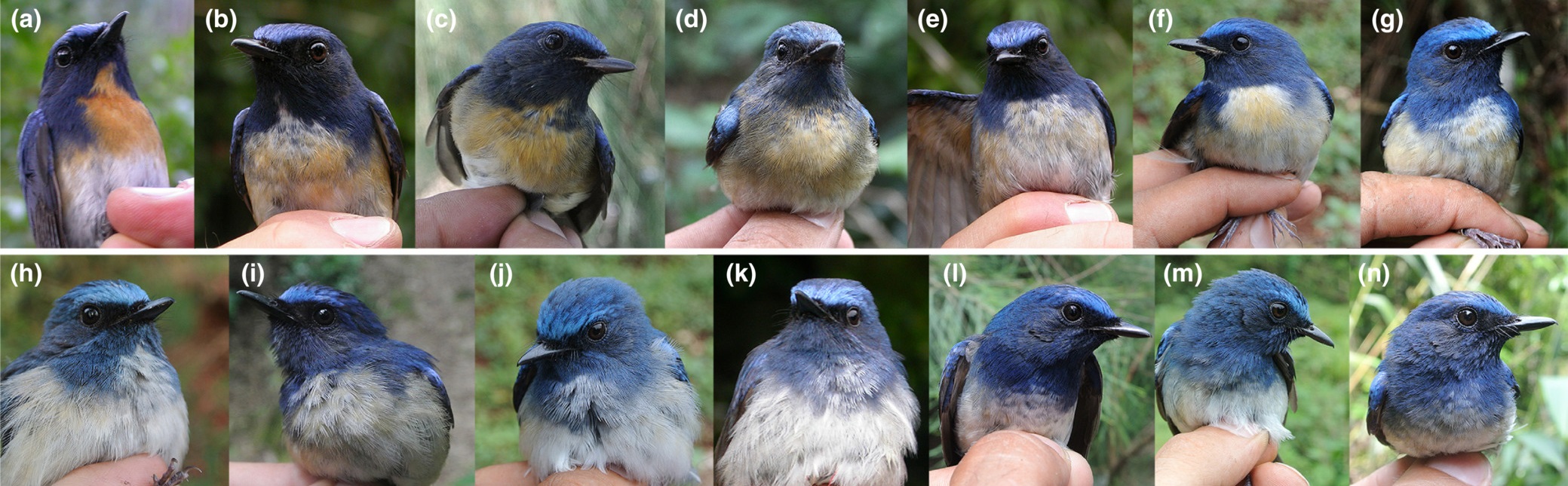
Photos of male Cyornis hainanus showing variability in breast coloration from typical C. h. klossi (a, o, p) to typical C. h. hainanus (l, m, n, s) and birds with intermediate characteristics in between. (a) Dakrong, Quang Tri, Vietnam, 25 March 2004; (b) Dakrong, Quang Tri, Vietnam, 4 April 2004; (c) Xitou, Guangdong, China, 29 September 2014 [IOZ-JM019]; (d) Leizhou, Guangdong, China, 24 October 2014 [IOZ-JM024]; (e) Dakrong, Quang Tri, Vietnam, 4 April 2004; (f) Leizhou, Guangdong, China, 13 November 2013; (g) Sanjia Shan, Guangdong, China, 20 April 2014 [IOZ-JM003]; (h) Weizhou Island, Guangxi, China, 15 April 2013; (i) Longtan, Guangxi, China, 01 June 2015; (j) Leizhou, Guangdong, China, 13 November 2013; (k) Vu Quang National Park, Ha Tinh, Vietnam, 13 March 2005; (l) Xitou, Guangdong, China, 27 September 2014 [JM013]; (m) Yunfu, Guangdong, China, 12 May 2014 [IOZ-JM005]; (n) Heweishan, Guangdong, China, 26 May 2014 [IOZ-JM006]; (o) Tra My, Quang Nam, Vietnam [AMNH833192]; (p) from left to right, Bolovens plateau, Thatèng, Xedong, Laos, 28 November 1931 [MNHN-ZO-MO-1933-72]; Quang Tri, Annam, Vietnam, 22 February 1924 [MNHN-ZO-MO-1924-665]; (q) Trakam, Laos, 29 April 1927 [MNHN-ZO-MO-1929-1100]; Bolovens plateau, Thatèng, Xedong, Laos, 28 November 1931 [MNHN-ZO-MO-1933-73]; Di Linh Plateau, Vietnam, 14 March 1927 [MNHN-ZO-MO-1928-385]; (r) Hainan, China, 9 October 1962 [GIABR-0275]; Ledong, Hainan, China 25 October 1962 [GIABR-0367]; Bawangling, Hainan, China 15 January 1964 [GIABR-2200]; (s) Paksé, Laos, 5 January 1932 [MNHN-ZO-MO-1933-74]; Siem Reap, Cambodia, 27 December 1927 [MNHN-ZO-MO-1929-1092]; Angkor, Siem Reap, Cambodia, December 1927 [MNHN-ZO-MO-1929-1093]; Angkor, Siem Reap, Cambodia, 4 February 1962 [MNHN-ZO-MO-61]. Photos in (a, b, e) by Peter Nilsson at Swedish Museum of Natural History; Photos in (c, d, f, g-j, l-n, p-s) by Jonathan Martinez; Photo in K by Ingrid Cederholm at the Swedish Museum of Natural History; Photo in (o) by Paul Sweet at the American Museum of Natural History. Abbreviations: AMNH – American Museum of Natural History, New York, USA; GIABR – Guangdong Institute of Applied Biological Resources; IOZ – Institute of Zoology, Beijing, China; MNHN – Muséum National d'Histoire Naturelle, Paris, France

Photos of male Cyornis hainanus showing variability in breast coloration from typical C. h. klossi (a, o, p) to typical C. h. hainanus (l, m, n, s) and birds with intermediate characteristics in between.

CONCLUSIONS: 
The classification of Cyornis flycatchers has undergone substantial change over the last two decades, resulting in taxonomic rearrangements, in particular the synonymisation of the genus Rhinomyias with Cyornis (Sangster et al., 2010; Zhang et al., 2016; Zuccon & Ericson, 2010). Our study demonstrates that population-genomic and phylogenomic methodologies can effectively be applied to disentangle the complicated evolutionary history of cryptic species complexes such as the Cyornis flycatchers. Our ddRADseq data set confirms the remarkable case of incongruence between plumage and genomic divergence that has misled previous taxonomists into erroneous classifications (Zhang et al., 2016). Our results also show a novel interbreeding event between two non-sister species.

 
Elize Y. X. Ng, Siqi Li, Dezhi Zhang, Kritika M. Garg, Gang Song, Jonathan Martinez, Le Manh Hung, Vuong Tan Tu, Jérôme Fuchs, Lu Dong, Urban Olsson, Yuan Huang, Per Alström, Frank E. Rheindt and Fumin Lei. 2022. Genome-wide SNPs confirm Plumage Polymorphism and Hybridisation within A Cyornis Flycatcher Species Complex. Zoologica Scripta. DOI: 10.1111/zsc.12568

• Using genome wide markers, our study confirmed that 𝘊𝘺𝘰𝘳𝘯𝘪𝘴 𝘩𝘢𝘪𝘯𝘢𝘯𝘶𝘴 𝘬𝘭𝘰𝘴𝘴𝘪 was the same species as 𝘊. 𝘩. 𝘩𝘢𝘪𝘯𝘢𝘯𝘶𝘴.
• Based on plumage alone, 𝘊. 𝘩. 𝘬𝘭𝘰𝘴𝘴𝘪 was historically placed in the same species as 𝘊. 𝘳𝘶𝘣𝘦𝘤𝘶𝘭𝘰𝘪𝘥𝘦𝘴. 
• Furthermore, in the same study, we also uncovered the first reported instance of hybridization between 𝘊. 𝘩𝘢𝘪𝘯𝘢𝘯𝘶𝘴 and 𝘊 𝘨𝘭𝘢𝘶𝘤𝘪𝘤𝘰𝘮𝘢𝘯𝘴

Tuesday, September 13, 2022

[PaleoOrnithology • 2022] A 14,000-year-old Genome sheds light on the Evolution and Extinction of A Pleistocene Vulture


in Ericson, Irestedt, Zuccon, ... et Qu, 2022. 
Artwork: Julian Hume   facebook.com/JulianHume5

Abstract
The New World Vulture [Coragyps] occidentalis (L. Miller, 1909) is one of many species that were extinct by the end of the Pleistocene. To understand its evolutionary history we sequenced the genome of a 14,000 year old [Coragyps] occidentalis found associated with megaherbivores in the Peruvian Andes. occidentalis has been viewed as the ancestor, or possibly sister, to the extant Black Vulture Coragyps atratus, but genomic data shows occidentalis to be deeply nested within the South American clade of atratus. Coragyps atratus inhabits lowlands, but the fossil record indicates that occidentalis mostly occupied high elevations. Our results suggest that occidentalis evolved from a population of atratus in southwestern South America that colonized the High Andes 300 to 400 kya. The morphological and morphometric differences between occidentalis and atratus may thus be explained by ecological diversification following from the natural selection imposed by this new and extreme, high elevation environment. The sudden evolution of a population with significantly larger body size and different anatomical proportions than atratus thus constitutes an example of punctuated evolution.


a Fossils identified as [Coragyps] occidentalis collected in the cave Casa del Diablo situated at c. 3800 m a.s.l. in the Altiplano of southern Peru (marked with a red star on the map).
 b Localities for fossil Coragyps specimens were identified as either atratus (blue) or occidentalis (red).


Per G. P. Ericson, Martin Irestedt, Dario Zuccon, Petter Larsson, Jean-Luc Tison, Steven D. Emslie, Anders Götherström, Julian P. Hume, Lars Werdelin and Yanhua Qu. 2022. A 14,000-year-old Genome sheds light on the Evolution and Extinction of A Pleistocene Vulture. Communications Biology.  857. DOI: 10.1038/s42003-022-03811-0 

Thursday, February 18, 2021

[Ichthyology • 2021] Genome Sequences reveal Global Dispersal Routes and Suggest Convergent Genetic Adaptations in Seahorse Evolution


Genetic diversity and phylogenetic relationships of Hippocampus.

in Li, Olave, Hou, ... et Lin, 2021. 

Abstract
Seahorses have a circum-global distribution in tropical to temperate coastal waters. Yet, seahorses show many adaptations for a sedentary, cryptic lifestyle: they require specific habitats, such as seagrass, kelp or coral reefs, lack pelvic and caudal fins, and give birth to directly developed offspring without pronounced pelagic larval stage, rendering long-range dispersal by conventional means inefficient. Here we investigate seahorses’ worldwide dispersal and biogeographic patterns based on a de novo genome assembly of Hippocampus erectus as well as 358 re-sequenced genomes from 21 species. Seahorses evolved in the late Oligocene and subsequent circum-global colonization routes are identified and linked to changing dynamics in ocean currents and paleo-temporal seaway openings. Furthermore, the genetic basis of the recurring “bony spines” adaptive phenotype is linked to independent substitutions in a key developmental gene. Analyses thus suggest that rafting via ocean currents compensates for poor dispersal and rapid adaptation facilitates colonizing new habitats.


Fig. 1: Genetic diversity and phylogenetic relationships of 358 seahorse specimens.


Independent evolution in the phylogenetic tree reconstructed for the protein encoded by bmp3. Seahorses illustrations by Geng Qin.
 

Chunyan Li, Melisa Olave, Yali Hou, Geng Qin, Ralf F. Schneider, Zexia Gao, Xiaolong Tu, Xin Wang, Furong Qi, Alexander Nater, Andreas F. Kautt, Shiming Wan, Yanhong Zhang, Yali Liu, Huixian Zhang, Bo Zhang, Hao Zhang, Meng Qu, Shuaishuai Liu, Zeyu Chen, Jia Zhong, He Zhang, Lingfeng Meng, Kai Wang, Jianping Yin, Liangmin Huang, Byrappa Venkatesh, Axel Meyer, Xuemei Lu and Qiang Lin. 2021. Genome Sequences reveal Global Dispersal Routes and Suggest Convergent Genetic Adaptations in Seahorse Evolution. Nature Communications. 12, 1094. DOI: 10.1038/s41467-021-21379-x 

Friday, October 16, 2020

[PaleoMammalogy • 2020] Genomic Adaptations and Evolutionary History of the Extinct Scimitar-Toothed Cat, Homotherium latidens


Couple of Homotherium chasing a horse. 

in Barnett, Westbury, Sandoval-Velasco, ... et Gilbert, 2020. 
Illustration: Velizar Simeonovski facebook.com/VelizarSimeonovski 

Highlights: 
• Nuclear genome and exome analyses of extinct scimitar-toothed cat, Homotherium latidens
Homotherium was a highly divergent lineage from all living cat species (∼22.5 Ma)
• Genetic adaptations to cursorial and diurnal hunting behaviors
• Relatively high levels of genetic diversity in this individual

Summary
Homotherium was a genus of large-bodied scimitar-toothed cats, morphologically distinct from any extant felid species, that went extinct at the end of the Pleistocene. They possessed large, saber-form serrated canine teeth, powerful forelimbs, a sloping back, and an enlarged optic bulb, all of which were key characteristics for predation on Pleistocene megafauna. Previous mitochondrial DNA phylogenies suggested that it was a highly divergent sister lineage to all extant cat species. However, mitochondrial phylogenies can be misled by hybridization, incomplete lineage sorting (ILS), or sex-biased dispersal patterns, which might be especially relevant for Homotherium since widespread mito-nuclear discrepancies have been uncovered in modern cats. To examine the evolutionary history of Homotherium, we generated a ∼7x nuclear genome and a ∼38x exome from H. latidens using shotgun and target-capture sequencing approaches. Phylogenetic analyses reveal Homotherium as highly divergent (∼22.5 Ma) from living cat species, with no detectable signs of gene flow. Comparative genomic analyses found signatures of positive selection in several genes, including those involved in vision, cognitive function, and energy consumption, putatively consistent with diurnal activity, well-developed social behavior, and cursorial hunting. Finally, we uncover relatively high levels of genetic diversity, suggesting that Homotherium may have been more abundant than the limited fossil record suggests. Our findings complement and extend previous inferences from both the fossil record and initial molecular studies, enhancing our understanding of the evolution and ecology of this remarkable lineage.
 
Keywords: Homotherium, paleogenome, genomics, comparative genomes, adaptation, phylogeny, ancient DNA, palaeogenome, diversity, selection


Figure 2: Depiction of 18 of the 31 Genes under Positive Selection with High Values (Free Ratio > 2) in the Homotherium Genome
Hypothetical functions and the adaptive insights that these provide on the species’ behavior, morphology, and functional adaptations are also shown. Additional genes not depicted here are likely involved in cellular processes such as apoptosis, protein synthesis, and protein signaling, as well as immunity/cancer, olfaction, and reproduction. ...


Ross Barnett, Michael V. Westbury, Marcela Sandoval-Velasco, Filipe Garrett Vieira, Sungwon Jeon, Grant Zazula, Michael D. Martin, Simon Y.W. Ho, Niklas Mather, Shyam Gopalakrishnan, Jazmín Ramos-Madrigal, Marc de Manuel, M. Lisandra Zepeda-Mendoza, Agostinho Antunes, Aldo Carmona Baez, Binia De Cahsan, Greger Larson, Stephen J. O’Brien, Eduardo Eizirik, Warren E. Johnson, Klaus-Peter Koepfli, Andreas Wilting, Jörns Fickel, Love Dalén, Eline D. Lorenzen, Tomas Marques-Bonet, Anders J. Hansen, Guojie Zhang, Jong Bhak, Nobuyuki Yamaguchi and M. Thomas P. Gilbert. 2020. Genomic Adaptations and Evolutionary History of the Extinct Scimitar-Toothed Cat, Homotherium latidensCurrent Biology.  DOI: 10.1016/j.cub.2020.09.051

Thursday, June 2, 2016

[Cetacea • 2016] Genome-Culture Coevolution promotes Rapid Divergence of Killer Whale Ecotypes


Figure 1: Map of sampling locations of the five killer whale types included in this study.
Map of sampling locations of the five killer whale types included in this study. Sampling locations and inset photographs illustrating favoured prey species are colour-coded by ecotype: ‘transient’ (blue) and type B1 (purple) are predominantly mammal-eating; ‘resident’ (brown) and type C (orange) are predominantly fish-eating; type B2 (green) is known to feed on penguins. The map is superimposed on a colour grid of sea-surface temperature (SST). The Antarctic ecotypes primarily inhabit waters 8–16 °C colder than the North Pacific ecotypes. The relationship among these types and their estimated divergence times based on mitochondrial genomes are shown in the superimposed chronogram. Boxes 1–4 indicate pairwise comparisons spanning points along the ‘speciation continuum’ used to investigate the build up of genomic differentiation.


Analysing population genomic data from killer whale ecotypes, which we estimate have globally radiated within less than 250,000 years, we show that genetic structuring including the segregation of potentially functional alleles is associated with socially inherited ecological niche. Reconstruction of ancestral demographic history revealed bottlenecks during founder events, likely promoting ecological divergence and genetic drift resulting in a wide range of genome-wide differentiation between pairs of allopatric and sympatric ecotypes. Functional enrichment analyses provided evidence for regional genomic divergence associated with habitat, dietary preferences and post-zygotic reproductive isolation. Our findings are consistent with expansion of small founder groups into novel niches by an initial plastic behavioural response, perpetuated by social learning imposing an altered natural selection regime. The study constitutes an important step towards an understanding of the complex interaction between demographic history, culture, ecological adaptation and evolution at the genomic level.


Andrew D. Foote, Nagarjun Vijay, María C. Ávila-Arcos, Robin W. Baird, John W. Durban, Matteo Fumagalli, Richard A. Gibbs, M. Bradley Hanson, Thorfinn S. Korneliussen, Michael D. Martin, Kelly M. Robertson, Vitor C. Sousa, Filipe G. Vieira, Tomáš Vinař, Paul Wade, Kim C. Worley, Laurent Excoffier, Phillip A. Morin, M. Thomas P. Gilbert and Jochen B.W. Wolf. 2016. Genome-Culture Coevolution promotes Rapid Divergence of Killer Whale Ecotypes. Nature Communications. 7, Article number: 11693.
DOI:  10.1038/ncomms11693

Orcas are first non-humans whose evolution is driven by culture  newscientist.com/article/2091134-orcas-are-first-non-humans-whose-evolution-is-driven-by-culture/

Tuesday, December 9, 2014

[Ichthyology / Genome • 2014] Mudskipper Genomes provide insights into the Terrestrial Adaptation of Amphibious Fishes


Figure 1: Habitats of the four sequenced mudskippers.  Scartelaos histophorus (SH or blue mudskipper), Boleophthalmus pectinirostris (BP or blue-spotted mudskipper), Periophthalmodon schlosseri (PS or giant mudskipper) and Periophthalmus magnuspinnatus (PM or giant-fin mudskipper)


Mudskippers are amphibious fishes that have developed morphological and physiological adaptations to match their unique lifestyles. Here we perform whole-genome sequencing of four representative mudskippers to elucidate the molecular mechanisms underlying these adaptations. We discover an expansion of innate immune system genes in the mudskippers that may provide defence against terrestrial pathogens. Several genes of the ammonia excretion pathway in the gills have experienced positive selection, suggesting their important roles in mudskippers’ tolerance to environmental ammonia. Some vision-related genes are differentially lost or mutated, illustrating genomic changes associated with aerial vision. Transcriptomic analyses of mudskippers exposed to air highlight regulatory pathways that are up- or down-regulated in response to hypoxia. The present study provides a valuable resource for understanding the molecular mechanisms underlying water-to-land transition of vertebrates.

......


Xinxin You, Chao Bian, Qijie Zan, Xun Xu, Xin Liu, Jieming Chen, Jintu Wang, Ying Qiu, Wujiao Li, Xinhui Zhang, Ying Sun, Shixi Chen, Wanshu Hong, Yuxiang Li, Shifeng Cheng, Guangyi Fan, Chengcheng Shi, Jie Liang, Y. Tom Tang, Chengye Yang, Zhiqiang Ruan, Jie Bai, Chao Peng, Qian Mu, Jun Lu, Mingjun Fan, Shuang Yang, Zhiyong Huang, Xuanting Jiang, Xiaodong Fang, Guojie Zhang, Yong Zhang, Gianluca Polgar, Hui Yu, Jia Li, Zhongjian Liu, Guoqiang Zhang, Vydianathan Ravi, Steven L. Coon, Jian Wang, Huanming Yang, Byrappa Venkatesh, Jun Wang & Qiong Shi. 2014. Mudskipper Genomes provide insights into the Terrestrial Adaptation of Amphibious Fishes. Nature Communications 5, Article number: 5594 doi: 10.1038/ncomms6594