Showing posts with label Hylidae. Show all posts

Tuesday, July 21, 2026

[Herpetology • 2026] Isthmohyla nacientes • A New Species of Stream-Breeding Isthmohyla (Anura: Hylidae) from Costa Rica


Isthmohyla nacientes  
Chaves-Acuña, Abarca, Navarro-Picado, Hidalgo-Mora, Ureña-Chaves, Valverde-Castillo, Chaves, Bolaños & Faivovich, 2026
   

Abstract
We describe a new species of the Isthmohyla tica group that occurs along the montane regions of the central Pacific of Costa Rica, between 1,400 and 2,000 masl. Although the new species is the sister taxon of a clade including an unde-scribed species and I. rivularis, it is more similar to I. tica. However, the new species can be distinguished because the flanks have scattered, distinct, round and irregular dark blotches or spots and because the advertisement call is comprised by a single, tonal note, typically emitted singly or in series, at dominant frequencies of 4,048–4,909 Hz, with a duration of 10–50 ms. The new species exhibits a broad acoustic repertoire composed of advertisement, release, and courtship calls, with the latter being emitted underwater. We discuss our findings with respect to adult and larval morphology, reproductive biology, and bioacoustics of the I. tica group.

Isthmohyla nacientes in life.
 (A) Holotype (UCR 24345), dorsal coloration at night. (B) Lateral view of male paratype (UCR 24367). (C) Ventral view of male paratype (UCR 24367), showing orange coloration on the hidden and ventral surfaces of the thighs and shank. (D) Male paratype (UCR 23770) showing bilobate, translucent vocal sac. (E) Lateral view of female paratype (UCR 24368).
Photos: B, C, and E by Gabriel Ureña

Isthmohyla nacientes, new species  
 
Etymology.—The specific epithet “nacientes” refers to the crucial role of headwaters and springs (nacientes in Spanish) in the habitat and life cycle of the new species and its stream-breeding congeners. This name highlights the species’ association with aquatic environments, particularly the springs found in its range, acknowledging the ecological significance of these water sources.


Wagner Chaves-Acuña, Juan Abarca, Jonathan Navarro-Picado, Esteban Hidalgo-Mora, Marilyn Ureña-Chaves, Alejandro Valverde-Castillo, Gerardo Chaves, Federico Bolaños and Julián Faivovich. 2026. A New Species of Stream-Breeding Isthmohyla (Anura: Hylidae) from Costa Rica. Ichthyology & Herpetology. 114(2); 337-356. DOI: doi.org/10.1643/h2024066 (3 July 2026) x.com/IchsAndHerps/status/2076689784525717838
  
We describe a new species of the Isthmohyla tica group that occurs along the montane regions of the central Pacific of Costa Rica, between 1,400 and 2,000 masl. Although the new species is the sister taxon of a clade including an undescribed species and I. rivularis, it is more similar to I. tica. However, the new species can be distinguished because the flanks have scattered, distinct, round and irregular dark blotches or spots and because the advertisement call is comprised by a single, tonal note, typically emitted singly or in series, at dominant frequencies of 4,048–4,909 Hz, with a duration of 10–50 ms. The new species exhibits a broad acoustic repertoire composed of advertisement, release, and courtship calls, with the latter being emitted underwater. We discuss our findings with respect to adult and larval morphology, reproductive biology, and bioacoustics of the I. tica group.

Friday, July 3, 2026

[Herpetology • 2026] Dendropsophus liliae • A New Species of Dendropsophus (Anura: Hylidae) of the D. ruschii group from the Atlantic Forest in Serra da Mantiqueira, Minas Gerais, Brazil


Dendropsophus liliae
Santana, Shepard, Carvalho, Müller, Assis & Feio, 2026 

 
Abstract
The Dendropsophus ruschii species group currently comprises two species with disjunct distributions between the Atlantic Forest and the Amazon. Based on an integrative approach combining morphological, acoustic, and molecular data (mtDNA barcoding), we describe a new species from the Serra da Mantiqueira, Minas Gerais, Brazil. Dendropsophus liliae sp. nov. is diagnosed by its small size, rounded digital discs, presence of a calcar appendage, dark red iris, and a distinct white stripe from the snout to the upper eyelid. This discovery expands the known diversity of the group and represents its most inland record within the Atlantic Forest.

Live specimens of Dendropsophus liliae sp. nov. from Serra do Brigadeiro (type locality).
 (A) Holotype adult male (MZUFV20707), (B) paratype adult male (ZUFMS-AMP7816), (C–F) unvouchered adult males.
Photographs by D.J. Santana (A–B) and C.L. Assis (C–F).
Published under a CC BY 4.0 license.

Dendropsophus liliae sp. nov.  
   
Diagnosis.—We assigned the new species to the genus Dendropsophus and to the D. ruschii species group based on phylogenetic results (see Results below). In addition, the new species morphologically resembles other species of the D. ruschii group, especially D. ruschii, which exhibit white marks on the head and flanks. Dendropsophus liliae sp. nov. can be distinguished from its congeners within the D. ruschii group by the combination of the following features: (1) small size, adult males 16.0–19.5 mm SVL; (2) dominant frequency of the advertisement call from 6030 to 6630 Hz; (3) rounded discs on fingers and toes; (4) presence of sparse small granules on the dorsum; (5) presence of a calcar appendage; (6) eyes dark red; (7) overall dorsal coloration brown; (8) nuptial pad poorly developed; (9) wide head HW/SVL = 0.30–0.34; (10) a well-marked white line running from the posterior edge of the upper eyelid to the tip of the snout.

Etymology.— The specific epithet liliae is a patronym honoring Prof. Lília Maria Fraga Tostes (in memoriam) for her extensive contributions to biology education, her friendship, and her mentorship of DJS during his undergraduate studies. Prof. Lília, affectionately known as “Lilinha,” was a dear friend and a charismatic teacher widely known by the citizens of Muriaé, Minas Gerais (the hometown of DJS). Her kindness and charisma inspired many students to pursue careers in the biological sciences, and several of her former students are now professors who continue to carry her lessons forward.

 
Diego J. Santana, Donald B. Shepard, Priscila S. Carvalho, Márcia M. P. Müller, Clodoaldo L. Assis and Renato N. Feio. 2026. A New Species of Dendropsophus (Anura, Hylidae) of the D. ruschii group from the Atlantic Forest in Serra da Mantiqueira, Minas Gerais, Brazil. PLoS One. 21(6): e0351087. DOI: doi.org/10.1371/journal.pone.0351087 [June 23, 2026]

Friday, April 10, 2026

[Herpetology • 2026] Phyllodytes gravataAnother Piece in the Puzzle: A New Species of Phyllodytes Wagler, 1830 (Anura: Hylidae) from the Atlantic Forest of southern Bahia, northeastern Brazil


 Phyllodytes gravata 
Santos, Rodrigues & Dias, 2026
 

Abstract
We describe Phyllodytes gravata sp. nov., a new species of bromeligenous treefrog from the Atlantic Forest of southern Bahia, Brazil. The new species is characterised by its small body size (males 19.5–22.0 mm snout-vent length; female 23.5 mm), a rounded snout with an apical tubercle, an inconspicuous row of tubercles along the tarsus, with a single prominent tubercle at the tibiotarsal articulation, a dorsolateral brown stripe, and an advertisement call composed of long series of pulsed notes (22–34 notes/call; call duration 5.2–7.3 s; dominant frequency 2.75–3.83 kHz). The species is currently known from only two nearby localities within the Central Corridor of the Atlantic Forest (CCAF), in the municipality of Porto Seguro, district of Trancoso, Bahia, a major tourist destination, where it inhabits bromeliads in sandy-soil ecosystems known as mussunungas. Its apparently microendemic distribution and strict association with bromeliads render it vulnerable to several anthropogenic threats, such as bromeliad harvesting, increasing tourism, urbanisation, and agriculture. This discovery underscores the persistent hidden diversity of the CCAF and reinforces the urgent need to protect its highly special microhabitats.

Keywords: Taxonomy, Amphibia, Bioacoustic, Bromeliad, Conservation


In-life photographs of Phyllodytes gravata sp. nov.
  
A.  Paratype, ♂  (MZUESC 23915). B. Paratype, ♂  (MZUESC 23885).
C.  Paratype, ♂  (MZUESC 23884) Dorsal view. D.  Paratype, ♂  (MZUESC 23884) ventral view.
E. Aechmea lamarchei Mez; F. Mussununga, the natural habitat at the type locality.

A. Map showing thedistribution of Phyllodytes gravata sp. nov. and its sister species, P. amadoi and Phyllodytes sp. 7. in southern Bahia, northeastern Brazil. 
B. Phyllodytes gravata sp. nov., paratype, ♂ (MZUESC 23915). C. Phyllodytes amadoi, ♂ (MZUESC 24030 – photograph by  Tadeu T.  Medeiros). D. Phyllodytes sp. 7, ♂.

Phyllodytes gravata sp. nov.


Laisa Souza dos Santos, Miguel Trefaut  Rodrigues and Iuri Ribeiro Dias. 2026. Another Piece in the Puzzle: A New Species of Phyllodytes Wagler, 1830 (Anura, Hylidae) from the Atlantic Forest of southern Bahia, northeastern Brazil. European Journal of Taxonomy. 1048(1); 62–83. DOI: doi.org/10.5852/ejt.2026.1048.3235 [2026-03-27]

Monday, March 9, 2026

[Herpetology • 2026] Ololygon paracatu • A New Species of the Ololygon catharinae group (Anura: Hylidae: Scinaxini) from the Brazilian Cerrado


Ololygon paracatu 
 Carvalho, Valencia-Zuleta, Araujo-Vieira, Faivovich, Maciel & Brandão,  2026

 
Abstract
We describe a new species of the Ololygon catharinae group from the Cerrado biome, in the state of Minas Gerais, Brazil. Ololygon paracatu sp. nov. is morphologically similar to O. goya and O. skaios, although in phylogenetic analyses, it is recovered as the poorly supported sister taxon of O. pombali. It is distinguished from other species of the O. catharinae group by having a canthus rostralis marked and curved; subovoid snout in dorsal view and protruding in profile; inverted triangle shaped interocular blotch, exceeding the posterior margin of the eyes; inguinal region and hidden areas of thighs with dark brown irregular blotches on a pale yellow background in life; and advertisement call composed of 3–5 pulsed notes and dominant frequency of 2.5–3.5 kHz. Ololygon paracatu sp. nov. inhabits gallery forests associated with streams in the Cerrado biome.

Amphibia, Hylinae, taxonomy, phylogeny, calls, gallery forest
 
 
Ololygon paracatu sp. nov.


Daniele CARVALHO, Alejandro VALENCIA-ZULETA, Katyuscia ARAUJO-VIEIRA, Julián FAIVOVICH, Natan M. MACIEL and Reuber A. BRANDÃO. 2026. A New Species of the Ololygon catharinae group from the Brazilian Cerrado (Anura, Hylidae, Scinaxini). Zootaxa. 5757(6); 522-542. DOI: doi.org/10.11646/zootaxa.5757.6.2 [2026-02-11]

Sunday, November 30, 2025

[Herpetology • 2025] Ololygon paulofreirei • Taxonomic Assessment of Ololygon gr. argyreornata (Anura: Hylidae) from northern Atlantic Forest reveals A New Species from the Pernambuco Endemism Centre, northeastern Brazil


Ololygon paulofreirei
Roberto, Ávila, de Lima & Santos, 2025 
 

Abstract
The Atlantic Forest in Brazil is a highly threatened biome, recognized as a biodiversity hotspot that hosts numerous endangered species with restricted distributions and facing intense human pressures. The Pernambuco Endemism Centre (PEC), located in Northeastern Brazil, represents one of the most concerning regions within the Atlantic Forest, as it comprises small, fragmented patches of pristine forest harboring several endangered species. Additionally, many species may be threatened but remain undocumented due to a lack of taxonomic studies, particularly within cryptic species complexes. In this study, we assessed the taxonomic status of populations assigned to the genus Ololygon from the state of Pernambuco. This genus presents several cryptic species with subtle morphological differences. Based on morphological, molecular, and acoustic data, we conclude that the populations from the state of Pernambuco constitute a previously undescribed species. Furthermore, we update the geographic distribution of the Ololygon gr. argyreornata species group, providing new morphological and acoustic data for O. skuki from the northern coast of Bahia state, and redescribe the advertisement call of O. argyreornata from Linhares, Espírito Santo.

Keywords: cryptic species; integrative taxonomy; Ololygon skuki; Scinaxinae; vocalization


Ololygon paulofreirei


  Igor Joventino Roberto, Robson Waldemar Ávila, Marcelo G. de Lima and Ednilza Maranhão dos Santos. 2025. Taxonomic Assessment of Ololygon gr. argyreornata (Anura, Hylidae) from northern Atlantic Forest reveals A New Species from the Pernambuco Endemism Centre, northeastern Brazil. Amphibia-Reptilia. DOI: doi.org/10.1163/15685381-bja10241 [23 Oct 2025] 
 facebook.com/aldeiadagente/posts/1371425611660473


Friday, June 27, 2025

[Herpetology • 2024] Scinax ushiniauae • A New Species of the Scinax cruentomma group (Anura: Hylidae) from the Ucayali River Basin of Loreto, Peru


Scinax ushiniauae 
Gagliardi-Urrutia, Araujo-Vieira, Padial, Simões, Faivovich & Castroviejo-Fisher, 2024


Abstract
We describe a new species of the Scinax cruentomma species group, with a red streak in the iris and a weakly bilobate vocal sac. It is known from oligotrophic soils in the sedimentary basin of the Ucayali River near Jenaro Herrera (province of Requena, Peru) and Río Blanco (buffer zone of the Matses Indigenous territory and reserve). The new species can be distinguished from the other species of the S. cruentomma group by its small snout-vent length, body and iris color patterns, weakly bilobate vocal sac, myological characters, and the number of notes and pulses of the advertisement call. It is morphologically most similar to S. strussmannae, from which the advertisement call, nostril, canthus rostralis, and loreal region can distinguish it.

Amphibia, Amazon basin, bioacoustics, mating call, sp. nov., varillal, taxonomy, white-sand forests


Scinax ushiniauae  


Giussepe GAGLIARDI-URRUTIA, Katyuscia ARAUJO-VIEIRA, José M. PADIAL, Pedro Ivo SIMÕES, Julián FAIVOVICH and Santiago CASTROVIEJO-FISHER. 2024. A New Species of the Scinax cruentomma group (Anura: Hylidae) from the Ucayali River Basin of Loreto, Peru. Zootaxa. 5406(3); 401-420. DOI: doi.org/10.11646/zootaxa.5406.3.1 [2024-02-07]
 
Descubren nueva especie de rana en nuestra Amazonía
Importante hallazgo lo hicieron especialistas del IIAP, entidad del Ministerio del Ambiente en la cuenca del río Ucayali.

Friday, June 6, 2025

[Herpetology • 2025] Hyla dabieshanensis • A New Species of the Genus Hyla (Anura: Hylidae) from the Dabie Mountains, Anhui, China


Hyla dabieshanensis  Zhang, Zhang & Zhang, 

in C.-W. Zhang, Y. Zhang, Cai, Yu, Pang, Jiang, Ding, Gong et B.-W. Zhang, 2025.

Abstract
Hyla tsinlingensis (Hu et al., 1966), is endemic to China, and is widely distributed in the Qinling and Dabie Mountains. Previous studies have suggested that genetic differentiation and geographical isolation exist between the Qinling Mountains population and Dabie Mountains population of H. tsinlingensis, and that the Dabie Mountains population is a cryptic species. Several Hyla specimens were collected from the Dabie Mountains of western Anhui Province, China during herpetological surveys from 2022‒2024; these specimens belonged to a species previously identified as H. tsinlingensis. Herein, we utilized phylogenetic analyses, morphological comparisons, and advertisement call comparisons, revealing significant differences from those of other known congeners; thus, we describe them as a new species. The discovery of this species implies that there are currently 18 identified species in the genus Hyla, 7 of which are found in China.

Keywords: Dabie Mountains, Hyla dabieshanensis sp. nov., Hyla tsinlingensis, Taxonomy, Morphology

Photographs of holotype AHUWFS001 of Hyla dabieshanensis sp. nov.
 A: Right lateral view; B: Left lateral view; C: Dorsal view; D: Ventral view; E: Dorsal view of hand; F: Ventral view of hand; G: Dorsal view of foot; H: Ventral view of foot.
Scale bars equal to 10 mm. Photos by Cai-wen Zhang and Yong Zhang.


Hyla dabieshanensis sp. nov. Zhang, Zhang, and Zhang


Cai-Wen Zhang, Yong Zhang, Yin-Fan Cai, Lei Yu, Da-Peng Pang, Qing-Yue Jiang, Jun Ding, Da-Jie Gong, Bao-Wei Zhang. 2025. A New Species of the Genus Hyla (Amphibia: Anura: Hylidae) from the Dabie Mountains, Anhui, China. Zoological Research: Diversity and Conservation. 2(1): 42-54. DOI: doi.org/10.24272/j.issn.2097-3772.2024.026 

Monday, February 24, 2025

[Herpetology • 2025] Dendropsophus cannatellai • Systematics of the Dendropsophus leucophyllatus species group (Anura: Hylidae) from the Chocó region of Ecuador, with Description of a new species


Dendropsophus cannatellai 
 Aguirre, Apunte & Ron, 2025


Abstract
The Dendropsophus leucophyllatus group is composed by 19 species distributed from Central America to the Atlantic Forest of Brazil. Only one species is known from the Chocó region, D. ebraccatus, which is also distributed in Central America. Previous studies suggested the existence of two species masked under “D. ebraccatus”. The only other species of Dendropsophus in the Chocó lowlands of Ecuador is D. gryllatus, an elusive species never included in phylogenetic analyses. In the present study, we review the systematics of both species based on morphological, genetic, and bioacoustic data. For phylogenetic analyses, we sequenced four mitochondrial genes (12S, 16S, COI, ND1, including flanking tRNAs) and two nuclear genes (TYR, POMC). Our results indicate that the populations of “D. ebraccatus” from the Chocó of Ecuador represent a new species, not most closely related to D. ebraccatus from Central America, but to D. gryllatus. The new species inhabits tropical rainforest and piedmont evergreen forest of NW Ecuador and SW Colombia. Populations of the new species differ from D. gryllatus by having larger body size and by the presence of an hourglass-shaped dorsal mark. The new species differs from D. ebraccatus from Central America by the absence of a clear band under the eye, by having well defined dorsal spots and by having a distinct advertisement call. Both species appear to be allopatric and, according to our time-tree, diverged from each other during the late Pliocene.

Key Words: Advertisement calls, Chocó rainforest, Colombia, Dendropsophus cannatellai sp. nov., Dendropsophus gryllatus, phylogeny

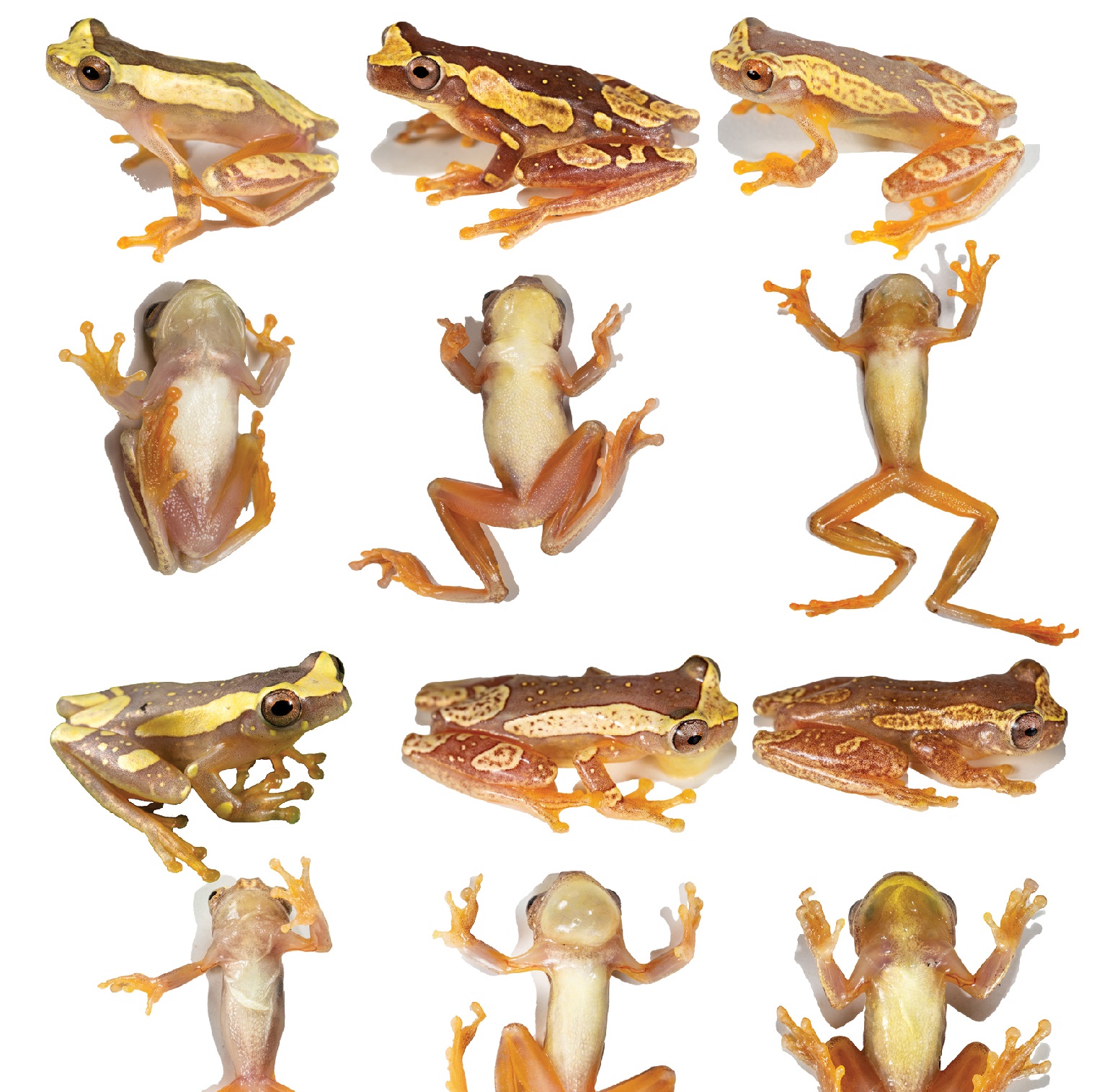
Life coloration of Dendropsophus cannatellai sp. nov.
First and third rows, dorsolateral views; second and fourth, ventral views. From left to right, first and second rows: QCAZ 51877 (SVL = 22.26 mm, male); QCAZ 78809 (SVL = 33.61 mm, female); QCAZ 55558 (SVL = 21.96 mm, male); third and fourth rows: QCAZ 40847 (holotype; SVL = 22.32 mm, male); QCAZ 78812 (SVL = 25.86 mm, male); QCAZ 78813 (SVL = 24.94 mm, male). See type series for locality data. All specimens are shown at the same scale.

 Dendropsophus cannatellai sp. nov.

Common names: English: Cannatella’s treefrog. 
Spanish: Ranita de Cannatella.

Definition: (Figs 8, 9). In this section, we describe coloration in life. We assign the new species to the genus Dendropsophus based on the phylogeny (Fig. 1). The new species is characterized by: (1) mean SVL 23.4 mm in males (range 21–26; n = 115); 30.7 mm in females (range 28–33; n = 14); (2) axillary membrane reaching arm halfway to elbow; (3) reduced webbing on fingers; (4) webbing on feet; (5) palmar tubercle single; (6) pectoral glands present; (7) dorsal background coloration brown with white to bright yellow dorsolateral bands, extending to the eyes and top of head; white or bright yellow well defined sacral mark, fused with dorsolateral bands in some individuals; (8) absence of a light labial stripe in contact with the orbit; (9) dorsal surfaces of the limbs brown, with white to bright yellow ovoid marks, with the forearm typically bearing one to two marks, and the shank one to three; (10) webbing and ventral surfaces vary from orange to yellow; (11) iris dull bronze to coppery bronze, and (12) advertisement call pulsed with a mean dominant frequency = 3274.7 Hz (range 3169.0–3498.7) and mean pulse rate of the primary note = 95 pulses/s (range 87–100).

Etymology: The specific name cannatellai is a noun in the genitive case and is a patronym for David C. Cannatella, who collected type specimens of the new species. Moreover, during his career he has contributed extensively to the study of systematics and evolution of neotropical amphibians. He has been integral part of scientific societies, exemplified by his presidencies of the American Society of Ichthyologists and Herpetologists (2002–2003) and the Society of Systematic Biologists (2004–2005). Currently he is Dean of the Department of Integrative Biology at the University of Texas at Austin, USA.


 P. Doménica Aguirre, Katherine Apunte and Santiago R. Ron. 2025. Systematics of the Dendropsophus leucophyllatus species group (Anura, Hylidae) from the Chocó region of Ecuador, with Description of a new species. Evolutionary Systematics. 9(1): 7-31. DOI: doi.org/10.3897/evolsyst.9.135431 

Wednesday, October 30, 2024

[Herpetology • 2024] Scinax ritaleeae • A New Species of the Scinax granulatus Group (Anura: Hylidae: Hylinae: Scinaxini) from Northeastern Brazil


Scinax ritaleeae
Marinho, Faivovich, Haddad & Araujo-Vieira, 2024


We describe a new species in the Scinax granulatus group from the Atlantic Forest of northeastern Brazil and include the new species in an updated phylogenetic hypothesis for the group. The new species differs from all other species in the S. granulatus group by a combination of characters, such as a weakly bilobate vocal sac, moderately developed pre- and postaxial webbing of Toe IV, and advertisement call features. The newly described taxon is more similar with S. tropicalia, a species that is not closely related; both can be distinguished by the red-colored iris in the new species and differences in pulse rate of the call. The new species was recovered as the sister taxon of a clade including all other species of the S. granulatus group. However, the low support of some internal clades suggests that the knowledge about relationships in this group is still incomplete.
 
Holotype of Scinax ritaleeae, new species (CFBH 47526, SVL 33.8 mm), in life.
(A) Anterolateral view, (B) belly, thighs, and legs in ventral view; flank and groin in ventrolateral view, (C) left thigh in posterior view.


Scinax ritaleeae, new species 

Etymology.— Rita Lee Jones de Carvalho, known as Rita Lee, was a Brazilian rock singer whose lyrics criticized the conservative, far-right, military dictatorship of the Brazilian government, which lasted from 1964 to 1985. She was a feminist activist, an ally of the LGBTQIAPN+ movement, and an environmentalist. Notably, Rita Lee is famous for her musical compositions and for her red-dyed hair, the latter trait considered unusual in her time. The reddish blotches in the iris of the new species are also an uncommon characteristic when compared to its congeners in the S. granulatus group. In this sense, we propose the new species epithet honoring the Queen of Brazilian rock music.


Pedro Marinho; Julián Faivovich; Célio F. B. Haddad and Katyuscia Araujo-Vieira. 2024. A New Species of the Scinax granulatus Group (Hylinae: Scinaxini) from Northeastern Brazil. Ichthyology & Herpetology. 112(3); 398–417. DOI: doi.org/10.1643/h2024012

Monday, October 21, 2024

[Herpetology • 2024] The Second Specimen of the Ghost Leaf-Frog Phrynomedusa fimbriata Miranda-Ribeiro, 1923 (Hylidae: Phyllomedusinae) from the Brazilian Atlantic Forest


Phrynomedusa fimbriata Miranda-Ribeiro, 1923

in Baêta et Pombal, 2024. 

Abstract
Leaf-frogs of the genus Phrynomedusa are rare phyllomedusine species known from a limited number of localities in the Brazilian Atlantic Forest, most of them known only from its small type series. Phrynomedusa fimbriata is known only from the holotype, a female collected in 1898. Despite subsequent efforts, no additional specimens have been collected or registered since this date, which led to the inclusion of P. fimbriata in the list of extinct taxa in the official Brazilian Red List. While examining the specimens deposited in the herpetological collection of the Museu de Zoologia da Universidade de São Paulo, Brazil, we discovered a second specimen of P. fimbriata, an adult male collected in the “Serra do Araraquara,” state of Paraná, Brazil, previously identified as Phrynomedusa appendiculata. Herein, we updated the diagnosis of P. fimbriata to include a description of an adult male and revised the doubtful voucher specimens identified as P. fimbriata and P. appendiculata in the herpetological collections outside of Brazil. In addition, we provide a new locality record of P. appendiculata in the state of São Paulo, Brazil.


Délio Baêta and José P. Pombal Jr. 2024. The Second Specimen of the Ghost Leaf-Frog Phrynomedusa fimbriata Miranda-Ribeiro, 1923 from the Brazilian Atlantic Forest (Hylidae, Phyllomedusinae). Ichthyology & Herpetology. 112(3); 418-428. DOI: doi.org/10.1643/h2023063

Friday, July 5, 2024

[Herpetology • 2024] Hyloscirtus arcanusForty years later: A New Andean Stream Treefrog of the Genus Hyloscirtus (Anura: Hylidae) from Ecuador, with comments on arm hypertrophy in the H. larinopygion group


Hyloscirtus arcanus
Rivera-Correa, Ron, Nunes, Araujo-Vieira, Pinheiro & Grant, 2024

 
Abstract
We present the description of a novel treefrog species inhabiting the Andean streams in southeastern Ecuador that has been erroneously identified as Hyloscirtus lindae for four decades. The new species is closely related to H. tapichalaca and is part of the southern clade of the H. larinopygion group, which comprises five species confined to the southeastern Andes of Ecuador to the northeastern Andes of Peru. It is diagnosed from its close relatives by a unique combination of characteristics, including hypertrophied forelimbs in males, a pronounced, curved, and protruding spine-shaped prepollex, a substantial supracloacal flap, supratympanic fold, digital discs colored in shades of orange-red or bright-red, and the concealed surfaces of limbs displaying a bluish-gray hue and dorsal spicules in males. We briefly explore the implications of this discovery for the evolution of arm morphology in the H. larinopygion group. Our findings underscore the continued importance of periodically reviewing historical specimens, leading to unexpected discoveries; once again confirming the importance of natural history museums and their custodian biological collections.

 Amphibia, Andes, biological collections, biodiversity, morphology, systematics, taxonomy


Mauricio Rivera-Correa, Santiago Ron, Ivan Nunes, Katyuscia Araujo-Vieira, Paulo D. P. Pinheiro and Taran Grant. 2024. Forty years later: A New Andean Stream Treefrog of the Genus Hyloscirtus (Anura: Hylidae) from Ecuador, with comments on arm hypertrophy in the H. larinopygion group.  Zootaxa. 5474(2); 101-126. DOI: 10.11646/zootaxa.5474.2.1
  facebook.com/DoubleHelixRanch/posts/10161470283035170

Thursday, February 1, 2024

[Herpetology • 2024] Scinax juruena • A New snouted Treefrog (Anura: Hylidae: Scinax) from Fluvial Islands of the Juruena River, southern Brazilian Amazonia


Scinax juruena
Ferrão, Hanken, Oda, Campião, Penhacek, Anjos & Rodrigues. 2024


Abstract
Southern Amazonia is one of the less-explored regions by anuran taxonomists. We describe small new species of snouted treefrog, genus Scinax, from this region, from a fluvial archipelago in the Juruena River, state of Mato Grosso, Brazil. The description is based on external morphology of adults and tadpoles, advertisement call and molecular data. The species is phylogenetically related to other snouted treefrogs of the Scinax cruentomma species group and shows the most southeastern distribution in Amazonia among its close relatives. It is distinguished from congeners mainly by its larger adult body size and bilobate vocal sac that reaches the level of the pectoral fold, a reddish-brown horizontal stripe on the iris, dark melanophores or blotches on the vocal sac and the throat of females, and the uniformly brown posterior portion of the thigh. The advertisement call comprises one pulsed note emitted at regular intervals, with a duration of 189–227 ms, 30–35 pulses/note and a dominant frequency of 2,250–2,344 Hz. The type locality is suffering several environmental impacts, including illegal mining, overfishing, unsustainable agriculture, uncontrolled logging and degradation associated with the construction of new hydroelectric dams. Further study of the biology and regional distribution of the new species is required to propose mitigation measures needed for its conservation.

Coloration in life of Scinax juruena sp. nov. from islands in the Juruena River, municipality of Cotriguaçu, state of Mato Grosso, Southern Amazonia, Brazil.
Nocturnal (A–D) and diurnal (E, F) color patterns.

Scinax juruena sp. nov.  
 
Generic placement. The new species is assigned to the snouted treefrog genus Scinax based on the phylogenetic position inferred from mitochondrial and nuclear genes (Fig 2).

Diagnosis: Scinax juruena sp. nov. is distinguished from congeners by the following combination of characters. SVL 24.1–27.6 mm (n = 14) in adult males; snout truncate in dorsal view; vocal sac bilobate and reaching the level of pectoral fold; dorsum covered by dark brown spots and irregularly distributed blotches, but lacking dorsal or dorsolateral dark stripes; absence of longitudinal stripe on thigh; reddish brown horizontal stripe on iris; vocal sac covered by dark melanophores or blotches; green bones. Tadpoles have LKRF 2(2)/3; upper lip unemarginated laterally; MPRF (1)/3/1; P-3 smaller than P-2 and P-1; and a dark brown horizontal bar on iris. Advertisement call is composed of one pulsed note with a call duration of 189–227 ms; a call rate of 68–89 calls/min; 30–35 pulses/note; and a dominant frequency of 2,250–2,344 Hz.

Etymology: The specific epithet juruena refers to the Juruena River, where the pristine type locality of the new species is located.

Phylogenetic relationships among Scinax juruena sp. nov. and closely related species of the S. cruentomma group.


Miquéias Ferrão, James Hanken, Fabrício H. Oda, Karla M. Campião, Marcos Penhacek, Samuel Anjos and Domingo J. Rodrigues. 2024. A New snouted Treefrog (Anura, Hylidae, Scinax) from fluvial Islands of the Juruena River, southern Brazilian Amazonia. PLoS ONE. 19(1): e0292441.  DOI: 10.1371/journal.pone.0292441
 

Wednesday, December 6, 2023

[Herpetology • 2023] Phyllodytes iuna • A New Species of Phyllodytes Wagler, 1930 (Anura: Hylidae) from the Atlantic Forest of southern Bahia, northeastern Brazil


 Phyllodytes iuna
 Santos, Roseno, Solé & Dias, 2023
 
 
Abstract
The genus Phyllodytes, endemic to the Atlantic Forest, stands out for its life cycle being closely associated with bromeliads. Since the 2000s, the number of species in the group has more than doubled and the number is still increasing, a fact proven here with the description of Phyllodytes iuna sp. nov. This species, herein described using morphological and molecular evidence, is endemic to the Atlantic Forest of southern Bahia, in the northern portion of the Atlantic Forest Central Corridor. Phyllodytes iuna differs from both its sister species and most of its congeners by the color pattern on the dorsum and by the presence of a single tubercle in the tibiotarsal region. The genetic distance for a fragment of the 16S gene ranged from 4.4% to 5.0% between Phyllodytes iuna and its sister species (P. brevirostris and P. edelmoi), and from 5.8% to 14.2% with its congeners. The description of a new species of Phyllodytes serves as a reminder that our understanding of the group’s diversity is far from complete. Despite the alarming rates of deforestation, the Atlantic Forest continues to hold significant untapped potential for unexplored biodiversity.

  taxonomy, diversity, Amphibia, Lophyohylini


Phyllodytes iuna


Laisa S. Santos, Rafaella S. Roseno, Mirco Solé  and Iuri Ribeiro Dias. 2023. Another New Species (and It’s not Over yet) of Phyllodytes Wagler, 1930 (Anura, Hylidae) from the Atlantic Forest of southern Bahia, northeastern Brazil.  Zootaxa. 5374(4); 519-532. DOI: 10.11646/zootaxa.5374.4.4

Wednesday, August 2, 2023

[Herpetology • 2023] Treefrog Diversity in the Neotropics: Phylogenetic Relationships of Scinaxini (Anura: Hylidae: Hylinae)

 
Phylogenetic Relationships of Scinaxini

in Araujo-Vieira, Lourenço, Lacerda, Lyra, Blotto, Ron, ... et Faivovich, 2023.
 
Abstract
Scinax is the most species-rich genus of Neotropical treefrogs, with 129 currently recognized species divided between two major clades, the S. catharinae and S. ruber clades. The S. catharinae clade includes 52 species currently placed in the S. perpusillus and S. catharinae groups, whereas the S. ruber clade is composed of 77 species, 13 of which are included in two species groups: the S. rostratus and Suruguayus groups, with all 64 remaining species being unassigned to any group. Although some studies have addressed the phylogenetic relationships of the genus, its relationships remain poorly understood. To test the monophyly of the genus, its major clades, and the currently recognized species groups, and the relationships within and among them, we performed a total evidence phylogenetic analysis including sequences of five mitochondrial (portions of cytochrome b and cytochrome oxidase c subunit I, and 12S rRNA, 16S rRNA, NADH dehydrogenase subunit 1, plus three intervening tRNAs) and six nuclear genes (portions of chemokine receptor type 4, proopiomelanocortin, seven in absentia homolog 1, recombination activating gene 1, rhodopsin exon 1, and tyrosinase), and 159 phenotypic characters. The dataset included 121 of the 129 known species of Scinax and many unnamed species. Most species are represented by multiple specimens, including topotypic material for approximately 52% of the species. As a result of this analysis, we partition Scinax into three genera. We restrict Scinax to most species of the former S. ruber clade and divide its species among 13 species groups: the S. auratus, S. boesemani, S. cruentomma, S. danae, S. elaeochroa, S. eurydice, S. funereus, S. fuscomarginatus, S. fuscovarius, S. granulatus, S. nasicus, S. rostratus, and S. squalirostris groups; only one species (Spachycrus) remains unassigned to any group. To eliminate the paraphyly of Scinax, we redefine Julianus—originally erected for the S. uruguayus group—to include the former S. camposseabrai. We recognize Ololygon for the species of the former S. catharinae clade and divide its species among seven species groups: the O. agilis, O. argyreornata, O. belloni, O. cardosoi, O. catharinae, O. feioi, and O. perpusilla groups. All species groups of the three recognized genera of Scinaxini are discussed, diagnosed, characterized—in many cases using phenotypic synapomorphies—and taxonomic comments are provided for many species. Our study further revealed 57 candidate species, an increase of 44.2% of the recognized species in the tribe, highlighting how far we are from fully understanding the diversity of this clade of Neotropical treefrogs.

KEYWORDS: Amphibia, JulianusOlolygonScinax, taxonomy, total evidence


Katyuscia Araujo-Vieira, Ana Carolina C. Lourenço, João Victor A. Lacerda, Mariana L. Lyra, Boris L. Blotto, Santiago R. Ron, Diego Baldo, Martín O. Pereyra, Ángela M. Suárez-Mayorga, Délio Baêta, Rodrigo Barbosa Ferreira, César L. Barrio-Amorós, Claudio Borteiro, Reuber A. Brandão, Cinthia A. Brasileiro, Maureen A. Donnelly, Marcos J. M. Dubeux, Jörn Köhler, Francisco Kolenc, Felipe Sá Fortes Leite, Natan M. Maciel, Ivan Nunes, Victor G. D. Orrico, Pedro Peloso, Tiago L. Pezzuti, Steffen Reichle, Fernando J. M. Rojas-Runjaic, Helio R. Da Silva, Marcelo J. Sturaro, José A. Langone, Paulo C. A. Garcia, Miguel Trefaut Rodrigues, Darrel R. Frost, Ward C. Wheeler, Taran Grant, José P. Pombal Jr, Célio F. B. Haddad and Julián Faivovich. 2023. Treefrog Diversity in the Neotropics: Phylogenetic Relationships of Scinaxini (Anura: Hylidae: Hylinae). South American J. of Herpetology. 27(sp1); 1-143. DOI: 10.2994/SAJH-D-22-00038.1

Friday, July 7, 2023

[Herpetology • 2023] Osteocephalus vasquezi • A New Species of Spiny-backed Tree Frog, Genus Osteocephalus (Anura Hylidae), from the Yanachaga Chemillén National Park in central Peru


 Osteocephalus vasquezi
Venegas, García-Ayachi, Toral, Malqui & Ron, 2023


Abstract
We describe a new species of Osteocephalus Fitzinger, 1843 using morphological traits of adult frogs and its larvae, as well as molecular evidence. The new species occurs in the premontane forest of the Cordillera del Yanachaga in the Andes of central Peru, at elevations between 1000 and 1150 m a.s.l. It belongs to the Osteocephalus mimeticus species group and is the sister species of O. mimeticus. It is most similar to three species with predominantly dark irises, tuberculate dorsal skin, and brown dorsal coloration: O. festae Peracca, 1904, O. mimeticus Melin, 1941, and O. verruciger Werner, 1901. Of these three species, the most similar is O. mimeticus. However, the new species can be easily distinguished from O. mimeticus by having a cream or creamy-tan venter with a well-defined pattern of brown chocolate blotches and flecks (venter cream, tan, or brown without marks in O. mimeticus). The tadpoles of O. vasquezi sp. nov. are strikingly different from the tadpoles of O. mimeticus by having a larger oral disk with nine lower labial tooth rows (only six in O. mimeticus). Tadpoles of the new species and those of O. festae are unique among Osteocephalus by belonging to the suctorial ecomorphological guild as shown by their large oral disks. Our time tree suggest that the new species diverged from its sister species at the beginning of the Pleistocene, ~2.5 million years ago.

Key Words: Biodiversity, DNA, new species, Osteocephalus mimeticus, phylogeny, tadpole, taxonomy


Dorsolateral and ventral views of Osteocephalus vasquezi sp. nov.
A, B. Dorsolateral and ventral view of holotype CORBIDI 7284, SVL = 51.4 mm;
C, D. Dorsolateral and ventral view of adult male, CORBIDI 7285, SVL = 40.8 mm;
E, F. Dorsolateral and ventral view of adult female CORBIDI 7280, SVL = 65.9 mm;
 G. Dorsolateral view of a recently metamorphosed CORBIDI 7304, SVL = 13 mm; H. Dorsolateral view of tadpole in stage 42.
Photographs by P.J. Venegas.

 Osteocephalus vasquezi sp. nov.

Definition: Osteocephalus vasquezi sp. nov. can be distinguished from its congeners by the following combination of characters: (1) size sexually dimorphic; maximum SVL in males 52.9 mm (n = 14), in females 75.5 mm (n = 2); (2) skin on dorsum of breeding males bearing conical tubercles with keratinized tips, not present in non-breeding males, smooth in females; (3) skin on flanks weakly areolate in the anterior two-thirds and smooth posteriorly; (4) hand webbing formula varies from II2–—3–III2½—2+IV to I basal II2––—3+III3—2½IV; foot webbing formula varies from I1–—1II1–—1–III0—1–IV1–—1–V to I1—2–II1—2–III2–—2–IV2––—1V; (5) in life, dorsum varies from brown to dark brown or orange-brown, with or without dark brown irregular marks; (6) throat brown or tan with a distinctive pattern of white irregular blotches or vermiculations, as well as tan to brown blotches on a whitish cream to creamy tan background; chest and belly cream or creamy tan with chocolate blotches or flecks; (7) cream suborbital mark indistinct, clear labial stripe distinct or faint; (8) color of dorsolateral region of flanks similar to dorsal coloration; ventrolateral region whitish cream or brownish cream with brown scattered blotches and/or vermiculations; (9) dermal roofing bones of the skull not exposed; (10) in life, bones green; (11) in life, iris dark brown with golden vermiculations or flecks; (12) vocal sacs paired, small, located laterally, behind jaw articulation; (13) in life, juveniles with red iris, dorsal surface of body and limbs dark brown (almost black) with marks or coppery with dark brown marks, without conspicuous pale elbows, knees, and heels; (14) larvae with LTRF of 3/9.

Etymology: The specific name is a patronym for Pedro Vásquez Ruesta, a Peruvian forest engineer, who is a pioneer in the wildlife management in Peru. Since 1978 he has worked for the development of wildlife management and protected natural areas as a professor at the Faculty of Forestry at Universidad Nacional Agraria La Molina, Lima, Peru, teaching to generations of forest engineers about wildlife management and conservation. During his academic life, Pedro Vásquez Ruesta made many contributions to the field of conservation of natural resources, advising theses and published scientific articles especially about the management of caimans and deer.

 
Pablo J. Venegas, Luis A. García-Ayachi, Eduardo Toral, José Malqui and Santiago R. Ron. 2023. A New Species of Spiny-backed Tree Frog, Genus Osteocephalus (Anura, Hylidae), from the Yanachaga Chemillén National Park in central Peru. Evolutionary Systematics. 7(2): 237-251. DOI: 10.3897/evolsyst.7.102360