Showing posts with label eponym. Show all posts

Thursday, June 20, 2024

[Botany • 2024] Capurodendron ambanizanense, C. vulcanicola, ... • A Phylogenomic Reconstruction of the Endangered Malagasy Tree Genus Capurodendron (Sapotaceae) with Nine New Species and an Identification Key


[A-C] Capurodendron christeae Boluda & L. Gaut., 
[E-G] Capurodendron sommerae Boluda, Naciri & L. Gaut., 
Capurodendron vulcanicola Boluda & L. Gaut.,  

in Boluda, Naciri et Gautier, 2024.
Photographs by C. G. Boluda; P. Ranirison; S. D. Ramandimbimanana. 
Drawings: G. Loza

Abstract
Capurodendron is the second largest endemic genus of vascular plants in Madagascar. It comprises mainly trees that are frequently logged for their valued wood. This, together with deforestation, led to 76% of the known species being Endangered or Critically Endangered. However, a confident species identification is often not possible with the current available literature and many morphotypes do not fit any described taxa, which has impeded the implementation of conservation measures. We performed a phylogenomic revision studying c. 900 collections morphologically, and sequencing 638 nuclear genetic markers of 180 representative specimens up to 90 years old, including all the described species and some undescribed morphotypes. Our results show that Capurodendron may contain up to 21 undescribed species in addition to the 35 already known. Nine of these are confirmed as valid species supported by genetic, morphological, and ecological data, and we describe them here (Capurodendron ainae, C. ambanizanense, C. antilahimenae, C. christeae, C. nataliae, C. ratovosonii, C. razakamalalae, C. sommerae, and C. vulcanicola). For the remaining 12 candidate new species, three are genetically analysed but require more sampling, and nine are only supported by morphological and ecological data so far, and therefore require genetic analyses to confirm their validity. For practical purposes and to assist with conservation assessments we provide an identification key, based mainly on vegetative characters, that also include the undescribed species.

conservation assessments, endangered species, gene capture, Madagascar, precious timbers, target capture

Capurodendron ainae (A--B, Gautier et al. 7035; C, Randriarisoa 75). A, Mature bark; B, leaves; C, pre- and post-anthesis flowers.
Capurodendron ambanizanense (Gautier et al. 5520): D, slashed trunk.
  Capurodendron nataliae (Randrianaivo & Boluda 3175): E, slashed trunk; F, branch with leaves highlighting the plagiotropic arrangement; G, adaxial side of leaves; and H, abaxial side of leaves.
Photographs C. G. Boluda (A--B, E--H); A. Randriarisoa (C); L. Gautier (D).

Capurodendron christeae (A--C, Gautier7051; D; Ranirison & Nusbaumer 1029 [both collections from the same individual]). A, Slashed trunk; B, adaxial side of the leaves; C, abaxial side of a leaf; D, flower.
Capurodendron sommerae
 (Ramandimbimanana & Randimbiarison 260): E, slashed trunk; F, branch with fruits; and G, fruit, post-anthesis calyx, and leaves.
Photographs C. G. Boluda (A--C); P. Ranirison (D); S. D. Ramandimbimanana (E--G). 
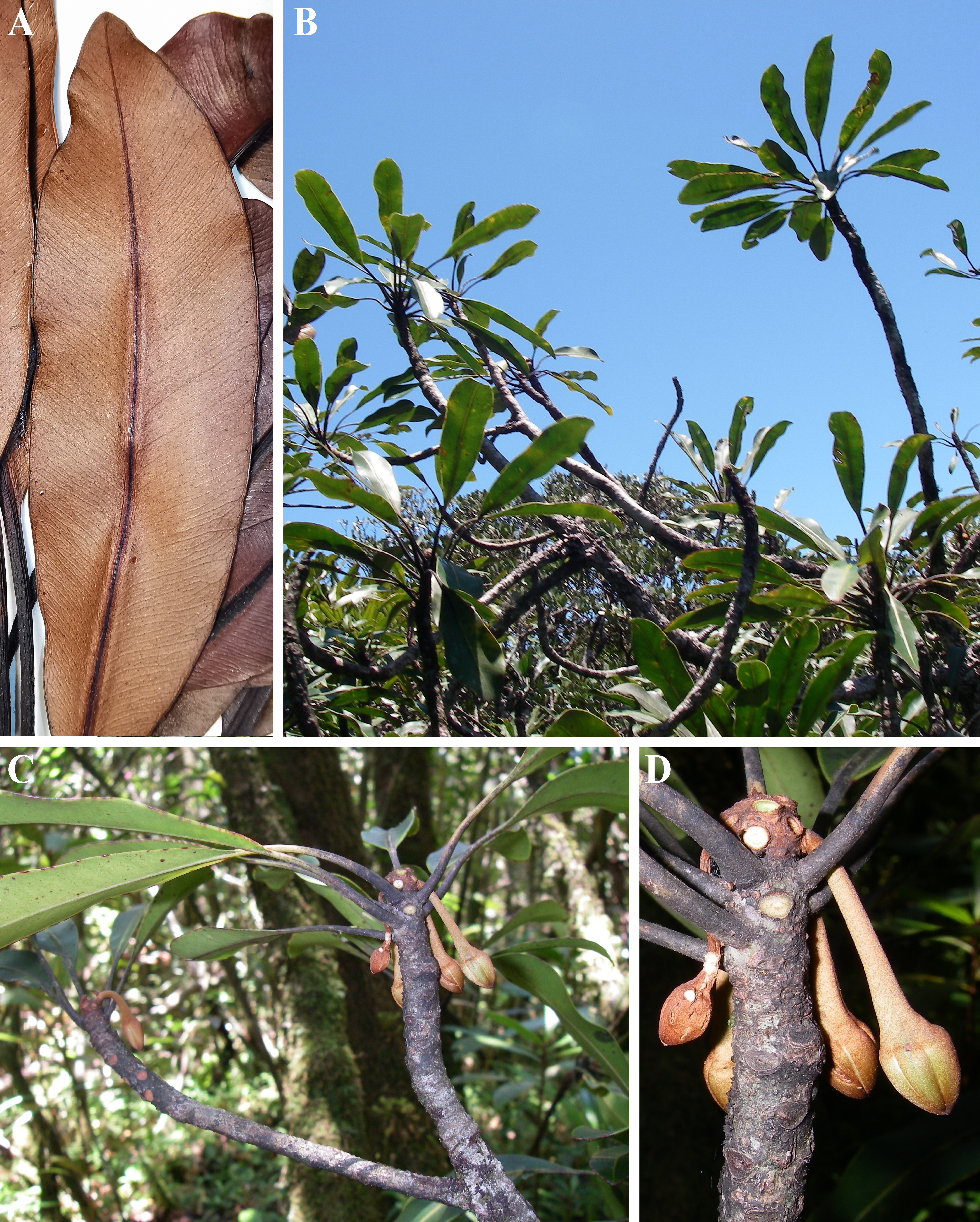
Capurodendron vulcanicola Boluda & L. Gaut. (Ramandimbimanana 388). A, Branch with fruit; and B, fruit.
 

Carlos G. Boluda, Yamama Naciri and Laurent Gautier. 2024. A Phylogenomic Reconstruction of the Endangered Malagasy Tree Genus Capurodendron (Sapotaceae) with Nine New Species and an Identification Key. Botanical Journal of the Linnean Society. 205(2); 85–115, DOI: 10.1093/botlinnean/boad073

Wednesday, January 24, 2024

[Botany • 2023] Linderniella porembskii (Linderniaceae) • A New Species from central Malagasy Granitic Inselbergs


Linderniella porembskii Andriamiar. & Rabarim., 

in Andriamiarisoa, Rabarimanarivo et Porembski, 2023.

Abstract
rupicolous, resurrection, inselberg specialist plant is newly described and illustrated. Linderniella porembskii Andriamiar. & Rabarim. (Linderniaceae) is restricted to central Malagasy granitic inselbergs in the Amoron'i Mania Region. It differs from the other Malagasy species of the genus by its habit with dense and richly branched stems, decumbent to erect, and by being glabrous to glabrescent and having obovoid-acuminate capsule. A detailed description of the species is provided, accompanied by illustrations and an identification key to the Malagasy species of the genus. The new species is assessed as “Endangered” using to IUCN Red List Categories.

KEYWORDS: LINDERNIACEAE, Linderniella, Madagascar, inselberg, new species, Resurrection plant

Linderniella porembskii Andriamiar. & Rabarim.
 A. Habit; B. Distal leaf; C. Basal leaf; D. Sepal; E. Corolla (open); F. Staminode; G. Stamens; H. Pistil; I–K. Fruits; L. Seed.
[Rabarimanarivo et al. 741, TAN]
 [Drawings: R.L. Andriamiarisoa]


Linderniella porembskii Andriamiar. & Rabarim., sp. nov. 

Linderniella porembskii Andriamiar. & Rabarim. can be distinguished from the most similar L. horombensis (Eb. Fisch.) Eb. Fisch. et al. by its habit with dense and richly branched stems, decumbent to erect (vs. stems usually single, erect from a basal rosette), plants glabrous to glabrescent (vs. pubescent), and its capsules obovate-acuminate (vs. acuminate-attenuate).


Roger Lala Andriamiarisoa, Marina N. Rabarimanarivo and Stefan Porembski. 2023. A New Species of Linderniella (Linderniaceae) from central Malagasy Granitic Inselbergs. Candollea. 78(1); 11-15. DOI: 10.15553/c2023v781a2

 
Andriamiarisoa, R.L., M.N. Rabarimanarivo & S. Porembski (2023). Une nouvelle espèce de Linderniella (Linderniaceae) des inselbergs granitiques du centre de Madagascar. Candollea 78: 11–15.  
Une plante rupicole, reviviscente, spécialistes des inselbergs est nouvellement décrite et illustrée. Linderniella porembskii Andriamiar. & Rabarim. (Linderniaceae) est restreinte aux inselbergs granitiques du centre de Madagascar, dans la Région d'Amoron'i Mania. Elle se distingue des autres espèces malgaches du genre par son port herbacé avec des tiges richement ramifiées et touffues, décombantes et dressées, des plantes glabres à glabrescentes et sa capsule obovoïde-acuminée. Une description détaillée de l'espèce est fournie, accompagnée d'illustrations et d'une clé d'identification des espèces malgaches du genre. La nouvelle espèce est considérée comme “En danger” selon les Catégories de la Liste rouge de l'UICN.

Thursday, January 18, 2024

[Botany • 2023] Bemangidia frankliniae (Sapotaceae) • A Taxonomic Revision of the Madagascar-endemic Genus Bemangidia, with Description of A Second Species


Bemangidia frankliniae Boluda & L.Gaut., 

in Boluda, Randriarisoa, Naciri et Gautier, 2023.

Abstract
Bemangidia L.Gaut. (Sapotaceae) is a genus endemic to a restricted area in the southeastern lowland moist evergreen forests of Madagascar. It was published in 2013 to accommodate an undescribed species, Bemangidia lowryi L.Gaut., which showed a combination of characters unique in the family Sapotaceae. At the time of description, three atypical collections from the same locality but growing on a ridge, slightly higher in altitude, were already known. Although matching well with the Bemangidia genus, they were phenotypically different from B. lowryi and were therefore not included in the species description. In the present study, we evaluate whether these specimens correspond to a new species, using a combination of morphological and genetic data based on 638 nuclear genes. The results show that Bemangidia contains two lineages, each one corresponding to a different morphology, with a genetic branch length similar to those observed among species pairs in other genera of Sapotaceae. We conclude that the genetic and  morphological differences are sufficient to consider the two lineages as two distinct species. Consequently, the genus is here revised and a second species described.

Keywords: Bemangidia, critically endangered, Madagascar, new species, Sapotaceae

Bemangidia frankliniae Boluda & L.Gaut.
A, Detail of the abaxial surface of a dried leaf; B, tree upper branches; C, detail of a flowering branch; D, flower buds.
Photographs: A (the type specimen, Razakamalala et al. 3976), Carlos G. Boluda; B–D (Gautier 5790), L. Gautier.

Bemangidia frankliniae Boluda & L.Gaut., sp. nov.

Differs from the only other known species in the genus, Bemangidia lowryi, by its smaller stipules (1–3.5 mm vs c.8 mm), its smaller leaf lamina (4.3–14 × 1.4–3.5 cm vs 18–22 × 6–6.5 cm), the apex usually acute (vs mostly rounded), the midrib raised on the adaxial surface (vs nearly flat to depressed), depressed or rarely slightly raised on the abaxial surface (vs strongly raised), its faintly raised to flat lateral veins (vs raised and forming a conspicuous striate surface), the less numerous lateral veins (70–145 vs 175–330) forming an angle of 45°–60° with the midrib (vs 70°–90°), and its smaller sepals (12 mm vs > 20 mm)

Etymology. The specific epithet honours the Franklinia Foundation, a non-governmental organisation dedicated to the conservation of trees, which founded the project ‘Understanding Malagasy Sapotaceae, a critical step towards conservation of a threatened group of prime importance trees’, in the framework of which this species is described.


C.G. Boluda, A. Randriarisoa, Y. Naciri and L. Gautier. 2023. A Taxonomic Revision of the Madagascar-endemic Genus Bemangidia (Sapotaceae), with Description of A Second Species. EDINBURGH JOURNAL OF BOTANY. 80, 1996. DOI: 10.24823/ejb.2023.1996

Saturday, December 31, 2016

In Memoriam: King Bhumibol Adulyadej, 1927-2016 | พระบาทสมเด็จพระมหาภูมิพลอดุลยเดชมหาราช ฯ บรมนาถบพิตร (๒๔๗๐ - ๒๕๕๙)


Bhumibol Adulyadej (Thai: ภูมิพลอดุลยเดช; pronounced [pʰuːmípʰon ʔàdunjádèːt], 5 December 1927 – 13 October 2016), conferred with the title King Bhumibol the Great in 1987, was the ninth monarch of Thailand from the Chakri Dynasty as Rama IX. Having reigned since 9 June 1946, he was, at the time of his death, the world's longest-serving head of state and the longest-reigning monarch in Thai history, serving for 70 years, 126 days.  


• หมึกสายราชา Amphioctopus rex (Nateewathana & Norman, 1999)

• 'ปูเจ้าพ่อหลวง' Indochinamon bhumibol (Naiyanetr, 2001)

เพื่อเป็นการเฉลิมพระเกียรติพระบาทสมเด็จพระเจ้าอยู่หัว เนื่องในวโรกาสมหามงคลเฉลิมพระชนมพรรษา 6 รอบ จุฬาลงกรณ์มหาวิทยาลัยได้ค้นพบปูชนิดใหม่ของโลก เป็นปูน้ำจืดตัวใหญ่ที่สุดในประเทศไทย ณ บริเวณภูหลวง อำเภอวังสะพุง จังหวัดเลย โดย ศาสตราจารย์ ไพบูลย์ นัยเนตร ภาควิชาชีววิทยา คณะวิทยาศาสตร์ จุฬาลงกรณ์มหาวิทยาลัย ได้ทำหนังสือกราบบังคมทูลขอพระราชทานพระบรมราชานุญาตอัญเชิญพระปรมาภิไธย พระบาทสมเด็จพระเจ้าอยู่หัวเป็นนามปูน้ำจืดชนิดใหม่ของโลก โดยเรียกชื่อวิทยาศาสตร์ของปูที่พบใหม่ว่า Potamon bhumibol ชื่อไทยว่า ปูเจ้าพ่อหลวง มีชื่อสามัญว่า Giant Mountain Crab และได้รับพระบรมราชานุญาต เมื่อวันที่ 5 มกราคม 2543 โดยจะทำการพิมพ์เผยแพร่ปูที่พบใหม่นี้ในวารสารต่างประเทศชื่อ Crustacena, International Journal of Crustacean Research 
ลักษณะเด่นของปูเจ้าพ่อหลวงมี 3 สี คือ สีน้ำตาลเข้ม สีม่วง และสีส้ม โดยกระดองจะเป็นสีน้ำตาลเข้ม ขาเดิน 4 คู่ และขาก้ามทั้งสองข้างเป็นสีน้ำตาลเข้ม ยกเว้นด้านในของก้ามหนีบอันล่างเป็นสีม่วง และปลายก้ามหนีบทั้งสองข้างเป็นสีส้ม เป็นปูน้ำจืดตัวใหญ่ที่สุดในประเทศไทย


• 'เต่าทรงพระเจริญ'  Basilochelys macrobios  Tong, Claude, Naksri, et al, 2009


• เทียนพระบารมี Impatiens charisma Suksathan & Keerat. (2009)

• มะลิเฉลิมนรินทร์ Jasminum bhumibolianum Chalermglin (2013)

• ภูมิพลินทร์ Paraboea bhumiboliana Triboun & Chuchan (2012)


• Nateewathana, A. and Norman, M.D. 1999. Phuket Mar. Biol. Center Special Publ. 19(2); 445-462. http://www.fao.org/3/a-i3489e.pdf
• Naiyanetr, P. 2001. Potamon bhumibhol n. sp., a new giant freshwater crab from Thailand (Decapoda, Brachyura, Potamidae). Crustaceana 74(3); 309-316.
• Haiyan Tong, Julien Claude, Wilailuck Naksri, Varavudh Suteethorn, Eric Buffetaut, Sasidhorn Khansubha, Kamonrak Wongko and Phisit Yuangdetkla. 2009.  Basilochelys macrobios n. gen. and n. sp., A Large Cryptodiran Turtle from the Phu Kradung Formation (latest Jurassic-earliest Cretaceous) of the Khorat Plateau, NE Thailand. In: Buffetaut, E.; Cuny, G.; Le Loeuff, J. & Suteethorn, V. (eds.). Late Palaeozoic and Mesozoic Ecosystems in SE Asia. Geological Society, London, Special Publications. 315: 229-243. DOI:  10.1144/SP315.12

• Suksathan, P. and P. Triboun. 2009. Ten new species of Impatiens (Balsaminaceae) from Thailand. Gardens’ Bulletin Singapore. 61 (1): 159-184.
• Pramote Triboun and David J. Middleton. 2012. Twenty new species of Paraboea (Gesneriaceae) from Thailand. Gardens’ Bulletin Singapore. 64(2): 333–370.

• Chalermglin, P. and Kiew, R. 2013. A new species of Jasminum (Oleaceae) from Thailand. Blumea - Biodiversity, Evolution and Biogeography of Plants. 58 (3); 80-81. DOI: 10.3767/000651913X673216


พันธุ์สัตว์และพรรณพืช อันเนื่องด้วยพระปรมาภิไธย
พระบาทสมเด็จพระเจ้าอยู่หัวภูมิพลอดุลยเดช


 ชื่อวิทยาศาสตร์สิ่งมีชีวิต ตั้งขึ้นเพื่อถวายเป็นเกียรติพระบรมวงศานุวงศ์


Tuesday, December 27, 2016

[Ichthyology • 2016] Tosanoides obama • A New Basslet (Perciformes, Percoidei, Serranidae) from Deep Coral Reefs in the Northwestern Hawaiian Islands


Tosanoides obama 
Pyle, Greene & Kosaki, 2016  


Abstract

The new species Tosanoides obama is described from two specimens collected at a depth of 90–92 m off Kure Atoll and Pearl and Hermes Atoll, Northwestern Hawaiian Islands. It differs from the other two species of this genus in life color and in certain morphological characters, such as number of pored lateral-line scales, pectoral-fin rays, snout length, anterior three dorsal-fin spine lengths, dorsal-fin profile, and other characters. There are also substantial genetic differences from the other two species of Tosanoides (d ≈ 0.10 in mtDNA cytochrome oxidase I). The species is presently known only from the Northwestern Hawaiian Islands within the Papahānaumokuākea Marine National Monument.

Keywords:  Mesophotic Coral Ecosystem, Closed-Circuit Rebreather, Endemic, Papahānaumokuākea Marine National Monument, President Obama


Figure 1. Holotype of Tosanoides obama (BPBM 41315), collected at a depth of 90 m off Kure Atoll, Northwestern Hawaiian Islands. Photo by R. L. Pyle. 

Diagnosis:  A species of Tosanoides (sensu Katayama & Masuda, 1980) distinguished by the following combination of characters: fourth or fifth dorsal spine the longest, dorsal-fin soft rays 17; anal-fin soft rays 8; pored lateral-line scales 33 or 34; head 2.9–3.0 in SL; body depth 2.8–2.9 in SL; color in life pink or yellowish pink on head and body, slightly darker dorsally fading ventrally; snout and region immediately dorsal to eye bright yellow, with a thin bright yellow band extending dorsally on either side of nape; a thin bright yellow horizontal stripe extending horizontally from posterior middle edge of eye posteriorly across most of operculum, continuing as a series of irregular oblong spots on midline of body from just posterior to gill opening to a point approximately one-fourth to one-half of pectoral fin; a second thin bright yellow stripe extending posteriorly from lower jaw across maxilla just ventral to eye and continuing horizontally across operculum and base of pectoral fin; dorsal fin pink or yellowish pink with darker pink regions on membranes, and a bright magenta margin extending from tip of first dorsal fin posteriorly on anterior half of soft dorsal fin; males with a large circular ocellate spot covering posterior one-third of soft dorsal fin, bluish magenta on perimeter and dark red with faint yellow stripes centrally; anal and pelvic fins magenta or yellow; caudal fin translucent yellow, more pale and translucent medially and distally, with bright magenta margins extending along margins of both lobes.

Figure 4. Holotype of Tosanoides obama (upper left) alongside presumed female (lower right, not collected) immediately prior to collection of the holotype, at a depth of 90 m off Kure Atoll, Northwestern Hawaiian Islands. Both fish retreated into the same hole moments after this image was captured. Cropped frame from video by R. L. Pyle. 


Etymology:  We name this species obama (a noun in apposition) in honor of Barack H. Obama, 44th President of the United States, in recognition of his efforts to protect and preserve the natural environment, particularly through his decision to expand the Papahānaumokuākea Marine National Monument several weeks after the discovery of this new species.

Discussion
Tosanoides obama is another example of several new fish species that have been discovered on deep coral reefs over the past several decades, mostly involving the use of modern mixed-gas closed-circuit rebreather diving technology (Pyle 1996, 2000). In recent years there has been increased attention focused on mesophotic coral ecosystems (MCEs), coral-reef habitat at depths of approximately 30–150 m in tropical regions worldwide (Hinderstein et al. 2010, Baker et al. 2016). Many more new species of fishes and other reef-associated marine organisms are likely to be discovered as a result of continued exploratory work in this poorly documented environment.

The fish subfamily Anthiinae (Anthiadides Poey, 1861, type genus Anthias Bloch, 1792, stem Anthi-), is a homonym of the beetle subfamily Anthiinae (Anthies Bonelli, 1813, type genus Anthia Weber, 1801, stem Anthi-). According to Article 55.3 of the International Code of Zoological Nomenclature (ICZN 1999), homonymous family-group names in current use based on similar (but not identical) genus-group names must be referred to the Commission for a ruling to remove homonymy. A case is currently in preparation to formally resolve this homonymy through application to the ICZN. Until an Opinion is issued, we follow van der Laan et al. (2014, 2016) and Carvalho-Filho (2016) in using the spelling “Anthiadinae” to represent the subfamily for this new species, instead of the more commonly used (but homonymous) spelling “Anthiinae”.


Richard L. Pyle, Brian D. Greene and Randall K. Kosaki. 2016. Tosanoides obama, A New Basslet (Perciformes, Percoidei, Serranidae) from Deep Coral Reefs in the Northwestern Hawaiian Islands. ZooKeys 641: 165-181. DOI:  10.3897/zookeys.641.11500

[Ichthyology • 2011] Apogonichthyoides erdmanni • A New Cardinalfish of the Genus Apogonichthyoides (Perciformes, Apogonidae) from Raja Ampat Islands, Western Papua, Indonesia, with A Key to Species


Apogonichthyoides erdmanni  Fraser & Allen, 2011

FIGURE 1. Holotype of Apogonichthyoides erdmanni, 39.2 mm SL, 51.1 mm TL. A. Fresh, pinned from below, left side, by Mark V. Erdmann. B. Post mortem, right side, by Mark V. Erdmann, lined feature in second dorsal and anal an artifact of wet fins on surface. C. Right side, in 70% ethyl alcohol by Thomas H. Fraser.

Apogonichthyoides uninotatus. D. Live, Coron I., Calamianes Is., Philippines, by G.R. Allen. E. Postmortem buccal male, USNM 395671, 41 mm SL, Apo Reef, Mindoro Occidental , Philippines, by J.T. Williams.

Abstract

Another deep-water cardinal fish of the genus Apogonichthyoides is described from Fiabacet Island, Western Papua, Indonesia. Collected at 73 m, Apogonichthyoides erdmanni has very distinctive markings on the head and body. It is brown with a dark spot on the body below the anterior lateral line, two slightly darker body bars and darker markings on the head, all similar features to those of the Philippine species Apogonichthyoides uninotatus. The new species has vivid, horizontal dark cheek and post-ocular marks, a small oval spot between the eye and tip of upper preopercular arm, yellowish anal, second dorsal and caudal fins, a narrow basicaudal bar less than 1/3 the length of the caudal peduncle, a vertical bar under the posterior half of the second dorsal-fin base reaching the base of the anal fin, small dark spots on the lower half of the body onto the lower portion of the caudal peduncle and a body spot smaller than the pupil of the eye. Apogonichthyoides uninotatus has a faint diagonal cheek mark, a faint horizontal post-ocular mark, a faint dash between the eye and the tip of the upper preopercular arm, brownish anal, second dorsal and caudal fins, a broad basicaudal bar more than 2/3 the length of the caudal peduncle, a broad body bar as a chevron including all of the second dorsal-fin base reaching the base of the anal fin, no small dark spots on the lower half of body and a body spot larger than the pupil of the eye. A key to twenty-two species of Apogonichthyoides is provided.

Keywords: Apogonichthyoides erdmanni; species key; Apogonidae; cardinalfish


Etymology. Named for Mark Erdmann of Conservation International, Indonesia Marine Program, who collected and photographed the type specimen. Mark has worked closely with the second author for the past six years and is responsible for numerous new discoveries, resulting from his deep scuba collections around the East Indian region. 

Habitat. The specimen was collected at 73m at the base of a sheer drop off exposed to moderate to strong cur-rents. The specimen was sheltering under a large block of dead coral rubble that rested on a moderate, silty sandslope.


Thomas H. Fraser and Gerald R. Allen. 2011. A New Cardinalfish of the Genus Apogonichthyoides (Perciformes, Apogonidae) from Raja Ampat Islands, with A Key to Species. Zootaxa. 3095; 63-68. http://www.mapress.com/j/zt/article/view/12166

Monday, December 26, 2016

[Botany • 2016] Areca jokowi • A New Species of Betel Nut Palm (Arecaceae) from Western New Guinea


Areca jokowi Heatubun

Pinang Jokowi  |  DOI:  10.11646/phytotaxa.288.2.8 

Abstract
A new species of betel nut palm, Areca jokowi, is described and illustrated here. This is the third species of Areca to have been described recently from New Guinea that is closely related to the widespread, economically important species A. catechu, the cultivated betel nut palm. A discussion of its morphological characters, distribution, ecology, habitat, uses and conservation status is provided, as well as a new identification key for western New Guinean Areca.

Key words: Arecaceae, Palmae, palms, New Guinea, taxonomy


Taxonomic Treatment 

Areca jokowi Heatubun, sp. nov. 

Type:— CULTIVATED. Indonesia, West Papua Province. Kaimana Regency, Yamor District, Yamor Lake, Gariau (Urubika) village, 106 m elev., 06 June 2015, Heatubun et al. 1252 (holotype MAN!, isotype BO!, K!) 

FIGURE 2. Areca jokowi Heatubun.
A. Slender habit with irregular crown shape. B. Leaf and inflorescence held by Christian Anggua for scale. C. Inflorescence-a strongly divaricate panicle with crowded rachillae. D. Pistillate flowers, striking in their white colour. E. Close up of pistillate flower at anthesis showing stigma. F. Young fruit in section. 


A–E photos were taken from the holotype specimen (Heatubun et al. 1252), F from voucher collected by Ekspedisi NKRI Koridor Papua Barat 2016. Photos: A, F (Lt. Ardiansyah), B–E (Charlie D. Heatubun). 

Diagnosis:— This new species is similar to Areca catechu L., Areca mandacanii Heatubun and Areca unipa Heatubun in habit and inflorescence structure, but differs by the inflorescence branched to four orders, the rachillae crowded, borne very close together and not expanding widely, sinuous especially in the distal two thirds, the floral clusters uniseriate in arrangement (although distichous near the tip of the rachilla), complete floral triads (comprising two staminate and one pistillate flower) always solitary at the base of rachillae, but absent from many rachillae, the remaining floral clusters consisting of dyads of staminate flowers, or solitary staminate flowers near the rachilla tip, and the pistillate flowers with striking white calyx at anthesis. Solitary, slender palm to 15 m. Stem 7–8 cm diam.; internodes 30–34 cm. Leaves 9 in 

Distribution:— Known only from two individuals palms cultivated in Gariau (Urubika) village, on the SW shore of Yamor Lake in Yamor District, Kaimana Regency, West Papua Province, Indonesia. These palm were grown from the seeds brought from hill forest at Kepala Air Kali Ima (headwaters of Ima river) in Gunung Daweri (Mt. Daweri), near Kewo village on the border of Nabire Regency of Papua Province.

 Habitat:— Based on information gathered from the person who brought the seeds and planted this betel nut palm, the species grows in hill forest at an elevation of about 300 m altitude on soils derived from sandstones.

 Local names:— Siaku’ (Yamor dialect, Kamoro language).

 Uses:— The fruits are chewed as a betel nut substitute. However, the palm has potential as an ornamental.

Etymology:— The specific epithet refers to the acronym the President of Republic Indonesia, His Excellency Joko Widodo-Jokowi. This new species is dedicated to Mr. Joko Widodo for his exemplary leadership, his simplicity, and more importantly for his concern for the development of Tanah Papua (the Indonesian Provinces of Papua and West Papua). The common name “Pinang Jokowi” is suggested here.


  Charlie D. Heatubun. 2016. Areca jokowi: A New Species of Betel Nut Palm (Arecaceae) from Western New Guinea.  Phytotaxa. 288(2); 175-180. DOI:  10.11646/phytotaxa.288.2.8

Wednesday, December 21, 2016

[Botany • 2015] Syzygium humbertii & S. mortonianum spp. nov. (Myrtaceae) from Madagascar


Abstract

Two new species, Syzygium humbertii Byng and S. mortonianum Byng, are described from Madagascar. When compared with other Madagascan Syzygium, S. humbertii Byng is characterised by sessile to subsessile leaves, orbicular to oval blades with usually cordate bases and rounded apices, and an obconic hypanthium. Syzygium mortonianum Byng is characterised by relatively long leaves that are typically wrinkled when dried, widely spaced venation, long petioles, and particularly dense capitate inflorescences with many flowers. Both new species are threatened with extinction and known from few contemporary collections.


James W. Byng. 2015. Syzygium humbertii and S. mortonianum spp. nov. (Myrtaceae) from Madagascar.    Nordic Journal of Botany.  34(3); 355–359. DOI:  10.1111/njb.00843/full

Tuesday, December 20, 2016

[Botany • 2017] Musa paramjitiana (Musaceae) from Andaman and Nicobar Islands, India


Musa paramjitiana  L. J. Singh


 A new species of wild banana, Musa paramjitiana L. J. Singh, from the Andaman Islands, India is described and illustrated, and its conservation status is assessed. A key to the species of Musa L. from Andaman and Nicobar Islands is also provided.


Etymology:  Th e species is named in honour of Dr Paramjit Singh, Director, Botanical Survey of India, Kolkata, for his significant contributions to the taxonomy of flowering plants. 


Lal Ji Singh. 2016. Musa paramjitiana sp. nov. (Musaceae) from Andaman and Nicobar Islands, India. Nordic Journal of Botany.  Early View. DOI: 10.1111/njb.01343 

Saturday, December 17, 2016

[Botany • 2014] Impatiens paramjitiana • A New Species of Balsaminaceae from Arunachal Pradesh, India


Impatiens paramjitiana  
Gogoi & Borah 


Abstract
A new species Impatiens paramjitiana is described and illustrated from Siang valley of Arunachal Pradesh, India. This species is similar to I. apsotis Hook. f. in general floral shapes but differs having spirally arranged leaves, shallowly serrate leaf margins, deep purple flowers, lateral sepals purple, capsule turgid at the middle.


Impatiens paramjitiana Gogoi & Borah, sp. nov. 
 Similar to Iapsotis Hook. f. (1911: 2972) in general floral shapes but differs having spirally arranged leaves, shallowly serrate leaf margins, deep purple flowers, lateral sepals purple, capsule turgid at the middle. 


 Rajib Gogoi and Souravjyoti Borah. 2014. Impatiens paramjitiana, A New Species of Balsaminaceae from Arunachal Pradesh, India.  
Phytotaxa. 175(3); 171-175. DOI:  10.11646/phytotaxa.175.3.8


Friday, December 16, 2016

[Botany • 2016] Dudleya hendrixii • A New, Rare Species (Crassulaceae) from Colonet Mesa, Baja California


Dudleya hendrixii 
S. McCabe & Dodero 


Abstract
Dudleya hendrixii S. McCabe & Dodero is a succulent endemic, restricted to a small area of Colonet Mesa (Baja California, Mexico). It is similar to the more widespread D. blochmaniae (Eastw.) Moran subsp. blochmaniae, which has been placed in subg. Hasseanthus (Rose) Moran, and to D. attenuata (S. Watson) Moran subsp. orcuttii (Rose) Moran, which has been placed in subg. Stylophyllum (Britton & Rose) Moran. Both of these other species have much wider ranges. Dudleya hendrixii differs from D. blochmaniae subsp. blochmaniae in having fewer, terete, more upright, and waxier leaves. Unlike D. attenuata subsp. orcuttii, D. hendrixii is summer deciduous, acaulescent, and has much shorter inflorescences.

Keywords: Colonet, Crassulaceae, Dudleya, Jimi Hendrix, new species, rare


Stephen Ward McCabe, Mark W. Dodero and Michael G. Simpson. 2016. Dudleya hendrixii A New, Rare Species From Colonet Mesa, Baja California.
 Madroño63(4); 359-365.  DOI:  10.3120/0024-9637-63.4.359


Resumen: Dudleya hendrixii S. McCabe & Dodero es suculenta. Dudleya hendrixii es endémico a una pequeña porción de la mesa Colonet. Es similar a la D. blochmaniae (Eastw.) Moran subsp. blochmaniae, que se ha colocado en el subgenera Hasseanthus (Rose) Moran, y D. attenuata (S. Watson) Moran subsp. orcuttii (Rose) Moran, que se ha colocado en el subgenera Stylophyllum (Britton & Rose) Moran, las cuales tienen rangos más extensivos. Se distingue Dudleya hendrixii de D. blochmaniae subsp. blochmaniae por la presencia de menos hojas, que son más verticales, cilíndricos, más vertical, y las hojas más cerosas. A diferencia de D. attenuata subsp. orcuttii, D. hendrixii es de hoja caducifolio verano, casi sin tallo, y tiene inflorescencias mucho más cortos.


Jimi Hendrix Lends New Plant Species His Name | NewsCenter | SDSU http://newscenter.sdsu.edu/sdsu_newscenter/news_story.aspx?sid=76502
Rare Baja liveforever plant named after late rock great Jimi Hendrix | The Japan Times http://www.japantimes.co.jp/culture/2016/12/16/entertainment-news/rare-baja-liveforever-plant-named-late-rock-great-jimi-hendrix/

Tuesday, December 13, 2016

[Ichthyology • 2016] Myloplus lucienae • A New Large Myloplus Gill 1896 (Characiformes: Serrasalmidae) from rio Negro basin, Brazilian Amazon


Myloplus lucienae 
Andrade, Ota, Bastos & Jégu, 2016
    

Abstract

Myloplus lucienae, new species, is described from the blackwater tributaries of the rio Negro basin. It is one of the few Myloplus species typically found in rapid areas of the Guiana Shield. It is diagnosed from congeners by the combination of an elongated body, small prepelvic spines that reach anteriorly just to the middle of the abdomen between verticals through pectoral- and pelvic-fin origin, and large scales on flanks resulting in smaller scale counts.

Keywords: Pisces, Neotropical fishes, Myleus, taxonomy, Alfred Russell Wallace, Ostariophysi


Etymology. Myloplus lucienae is named in honor of Luciene Maria Kassar Borges in recognition of her pioneer attempt to organize the knowledgement on the herbivorous Serrasalmidae from the rio Negro basin.


Andrade, Marcelo C., Rafaela P. Ota, Douglas A. Bastos and M. Jégu. 2016. A New Large Myloplus Gill 1896 from rio Negro basin, Brazilian Amazon (Characiformes: Serrasalmidae). Zootaxa. 4205(6); 571–580.    DOI:  10.11646/zootaxa.4205.6.5