Showing posts with label Guinea Conakry. Show all posts

Tuesday, August 27, 2024

[Arachnida • 2024] Selenogyrus foordi • A New Species and the first record of the subfamily Selenogyrinae Smith, 1990 (Araneae: Theraphosidae) from Guinea


Selenogyrus foordi 
Sherwood, Henrard & Spiegel, 2024. 

 
Abstract
A new spider species, Selenogyrus foordi sp. nov. (♂♀), is described from Mount Nimba, Guinea. Consequently, we provide the first in vivo photographs of a selenogyrine in the scientific literature and the first record of Selenogyrinae Smith, 1990 from Guinea. We also record S. aureus Pocock, 1897, described from Sierra Leone, from Massif du Ziama Biosphere Reserve, Guinea, representing the second known species for this country.  

Key words: distribution, morphology, spider, tarantula, taxonomy

Selenogyrus foordi sp. nov. holotype male (BE_RMCA_ARA.Ara.246088), habitus in situ at type locality   
A general view B same, on different background C frontal view, specimen in defensive posture.  

Selenogyrus foordi sp. nov. paratype female (BE_RMCA_ARA.Ara.222490)
A habitus, dorsal view B habitus, ventral view C chelicera, prolateral view (inset: close-up of stridulatory lyra) D spermathecae, dorsal view E habitus in vivo. Scale bars: 10 mm (A–B); 0.5 mm (D); 0.1 mm (C).
 

Theraphosidae Thorell, 1869
Selenogyrinae Smith, 1990

Selenogyrus Pocock, 1897

 Selenogyrus foordi sp. nov.

Diagnosis: Males of Selenogyrus foordi sp. nov. can be distinguished from S. aureus by the thinner apical taper of the embolus (embolus wider at apex in S. aureus) and the presence of darkened femora and white markings on the distal third tibiae in vivo (femora with golden tinge and lacking white markings on the distal third of the tibiae in S. aureus). Females of S. foordi sp. nov. can be distinguished from S. africanus, S. austini, and S. caeruleus by the medially flared receptacles of the spermathecae (not medially flared in S. africanus, S. austini, and S. caeruleus).

Etymology: The specific epithet is an eponym honouring our colleague the late Stefan Foord (1971–2023), in recognition of his significant contributions to African arachnology, and in remembrance of his kind and collaborative spirit.

 
Danniella Sherwood, Arnaud Henrard and Didier Van Den Spiegel. 2024. Selenogyrus foordi, A New Species and the first record of the subfamily Selenogyrinae Smith, 1990 from Guinea (Araneae, Theraphosidae). African Invertebrates. 64(3): 291-302. DOI: doi.org/10.3897/afrinvertebr.64.113946

Tuesday, April 30, 2024

[Botany • 2024] Casearia septandra (Salicaceae) • A New tree Species from the Mountains of Guinea, West Africa


Casearia septandra Breteler & Baldé, 

in Breteler et Baldé, 2024. 

Summary
In the synopsis of Casearia Jacq. in West and Central Africa (Breteler 2008), only a single, poor collection (Adam 3972), identified as C. prismatocarpa Mast., was recorded from the mountains of Guinea. More recently, some other flowering and fruiting specimens of Casearia have been collected from the same region as Adam’s specimen and together they represent a new species. It is illustrated and named herein as Casearia septandra, its distribution is mapped and conservation status assessed as Endangered, according to the IUCN criteria. A key to the four Casearia species of the Upper Guinea region of West Africa is presented.

Key Words: endangered, endemic, montane rainforest, taxonomy, woody plant

Casearia septandra. A leafy branchlet; B fruits; C dehisced fruit.
A – B from Baldé 1001; C from C. A. Couch et al. 550.
photos: A – B © A. Baldé; C © X. van der Burgt

Casearia septandra Breteler & Baldé sp. nov.


F. J. Breteler and A. Baldé. 2024. Casearia septandra (Salicaceae), A New tree Species from the Mountains of Guinea, West Africa. Kew Bulletin. DOI: 10.1007/s12225-024-10166-8

Wednesday, April 17, 2024

[Botany • 2022] Benna alternifolia (Melastomataceae: Sonerileae) • A New herbaceous Genus and Species from Guinea, West Africa


Benna alternifolia  Burgt & Ver.-Lib.,

in van der Burgt, Haba, Magassouba et Veranso-Libalah, 2022. 

Abstract
Benna is a new monospecific genus in the Melastomataceae, from the Benna Plateau in Forécariah Prefecture in Guinea, West Africa. Molecular sequence data show the genus Benna is nested within the tribe Sonerileae but clearly unrelated to the other African Sonerileae genera. The genus is weakly supported as sister to the South American Sonerileae genus Phainantha. Similarities and differences with African and American Sonerileae genera are listed. The new species Benna alternifolia is a perennial evergreen herb, half-spherical in shape, up to 1.2 m in diameter. A plant may have up to 60 alternate leaves, with petioles up to 45 cm long and blades up to 31 × 28 cm. The flowers are actinomorphic, with 4 sepals and 4 pink petals, 8 dimorphic stamens, and an inferior 4-locular ovary. The fruit is a capsule. The seeds are obovoid or nearly so, with a smooth testa. Benna alternifolia occurs in deep shade in canyons, on vertical or overhanging sandstone rocks out of reach of falling rain drops, and only where water is seeping all year round, including during the 6-month dry season. About 680 plants were found. Benna alternifolia is assessed to the IUCN category Near Threatened.

KEYWORDS: Africa, alternate leaves, Benna, Guinea, Melastomataceae, near threatened, new genus, Sonerileae  

Benna alternifolia – A: the largest population was found in a deep canyon, of which the upper part is visible at the centre of the photograph, on a 1040 m-high hill on the Benna Plateau; B: plants in their habitat, on vertical rock in deep shade, under overhanging rocks, out of reach of falling rain drops, but within reach of permanently seeping water; C: group of four plants; D: single plant.
 – Origin: A, C from Burgt & al. 2274 (type gathering); B from Burgt & al. 2323; D from Burgt & Haba 2333. – All photographs by Xander van der Burgt.

Benna alternifolia – A: leaf upper surface; B: leaf lower surface; C: inflorescence with flower buds; D: roots. – Origin: A, D from Burgt & Haba 2333; B, C from Burgt & al. 2274 (type gathering).
– All photographs by Xander van der Burgt.

Taxonomy
Benna Burgt & Ver.-Lib., gen. nov.
Type: Benna alternifolia Burgt & Ver.-Lib.

Diagnosis — The genus Benna differs from all other African Melastomataceae genera by the following combination of characters: Herbs. Leaves alternate, venation acrodromous, margin dentate. Inflorescence cymose, paniculate, axillary, branching alternate. Flowers actinomorphic, epigynous, 4-merous, 8 dimorphic stamens. Fruit a capsule, apically dehiscent, containing many seeds. Seeds obovoid or nearly so, glossy, testa smooth. The genus Benna is placed in the tribe Sonerileae. A morphological comparison between Benna and the seven currently accepted African Sonerileae genera is presented in Table 1. A morphological comparison between Benna and the six currently accepted American Sonerileae genera is presented in Table 2.

Benna alternifolia Burgt & Ver.-Lib., sp. nov.

Benna alternifolia – A: branch showing alternate leaf arrangement, with two inflorescences and seven leaves: five mature leaves of which three removed, a young leaf, and a very young leaf; B: flower bud; C: petal inner surface; D: flower bud in longitudinal section with petals partly removed; E: large stamen back and front, small stamen back and front; F: ovary of flower bud in transverse section; G: ovary of flower bud seen from above; H: old infructescence with fruits partly decomposed; J: fruit; K: seeds.
– Origin: A from Burgt & al. 2274 (type gathering) and Burgt & al. 2323; B–G from Burgt & al. 2274; H–K from Burgt & Haba 2333.
 – Drawing by Xander van der Burgt.


Habitat and ecology — Benna alternifolia occurs on vertical sandstone rock, in deep shade in canyons 10–100 m deep (Fig. 3), and on vertical sandstone rock in deep shade of trees, at 300–800 m altitude. Plants occur only under overhanging rocks (Fig 3B), out of reach of falling rain drops, and only on vertical rock where water is seeping all year round, within reach of the several-meter-long roots. In this habitat, the perennial, evergreen, herbaceous plants, which do not have a rootstock, can continue to grow during the six-month dry season.

Benna alternifolia is often found together with Cincinnobotrys felicis (A. Chev.) Jacq.-Fél. (Melastomataceae), Impatiens bennae (Balsaminaceae) and Mesanthemum bennae (Eriocaulaceae). On the same vertical rocks, but higher up and in sunny, seasonally dry habitat, two plant species endemic to Guinea occur abundantly: Cailliella praerupticola (Melastomataceae) and Pitcairnia feliciana (Bromeliaceae), the only member of the family that is native outside America.


Etymology — The genus is named for the Benna Plateau or Benna Gadyah in the Susu language. The Benna Plateau holds the only known locations for the species. The specific epithet refers to the alternate leaf arrangement.

Vernacular name — In the Susu language, the name of Benna alternifolia is Labalaba Khamè or Labalaba Hamey, which means “male soft leaf”. The name Labalaba is given to Piper umbellatum L. (Burkill 1997, vol 4: p. 441), a herb with leaves similar in size and appearance. On the Benna Plateau, Piper umbellatum is named Labalaba Guinè, which means “female soft leaf”.
 
 
Xander M. van der Burgt, Pepe M. Haba, Sékou Magassouba and Marie Claire Veranso-Libalah. 2022. Benna alternifolia (Melastomataceae: Sonerileae), A New herbaceous Genus and Species from Guinea, West Africa. Willdenowia. 52(1); 25-37. DOI: 10.3372/wi.52.52102


Wednesday, January 26, 2022

[Herpetology • 2022] Conraua kamancamarai • A New Slippery Frog (Anura: Conrauidae: Conraua Nieden, 1908) from the Fouta Djallon Highlands, west-central Guine


Conraua kamancamarai
Neira-Salamea, Doumbia, Hillers, Sandberger-Loua, Kouamé, Brede, Schäfer, Blackburn, Barej & Rödel, 2022

‘Kaman Camara’s Slippery Frog’ | ‘la grenouille glissante de Kaman Camara’ 
|| ‘Tôti bhowroundi de Kaman Camara’ 

Abstract
We describe a new species of the genus Conraua from the Fouta Djallon Highlands in Guinea. The species is recognised as distinct from nominotypical C. alleni, based on morphological evidence and is supported by a recent species delimitation analysis, based on DNA sequence data. The new species is distinguished from its congeners by the unique combination of the following characters: medium body size, robust limbs, only one instead of two palmar tubercles, the first finger webbed to below the first subarticular tubercle, presence of a lateral line system, indistinct tympanum, two subarticular tubercles on fingers III and IV, venter in adults white with dark brown spots or dark brown with grey or whitish spots. The new species differs from all congeners by more than 6% in the DNA sequence of mitochondrial ribosomal 16S. We discuss isolation in Pliocene and Pleistocene forest refugia as a potential driver of speciation in the C. alleni complex. We also emphasise the importance of conserving the remaining forest fragments in the Fouta Djallon Region for the preservation of both its unique biodiversity and its valuable water sources for local people.

Key Words: Anura, conservation, forest refugia, Upper Guinea forest zone, West Africa


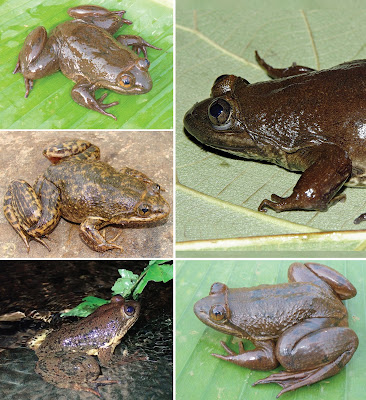
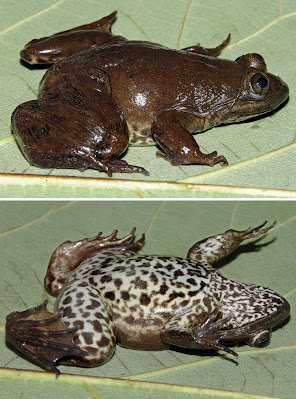
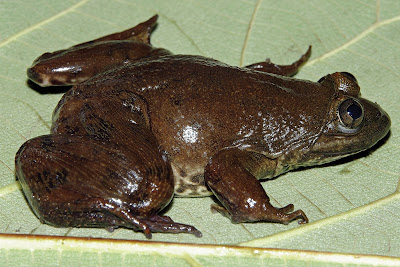
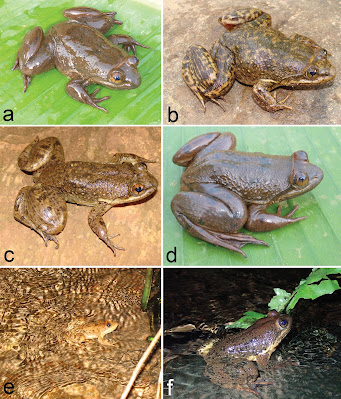
Conraua kamancamarai sp. nov., female holotype (ZMB 78432) in life.


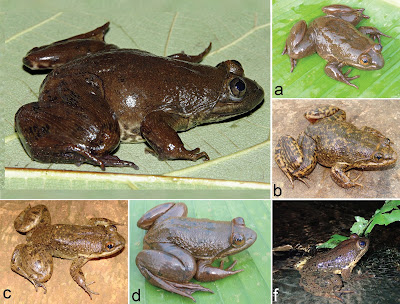
Colouration of life Conraua kamancamarai sp. nov. from the Fouta Djallon and surrounding region, Guinea, illustrating variation in colour pattern and skin texture.
a. From Dubreka, River Bindinbandan (10°22'21.9"N, 13°9'16.8"W, 199 m a.s.l.); b. From Dalaba, Chute de Ditinn; c. From Hörè Binti; d. From Dubreka, River Bindinbandan (10°22'21.9"N, 13°9'16.8"W, 199 m a.s.l.); e. From Dalaba, Chute de Ditinn; f. From Télimélé, locality Kourakoto, river Didounpouriguè (10°55'30.4"N, 13°47'39.4"W, 238 m a.s.l.); frogs in lower row in typical calling position, sitting in shallow water; specimens either not collected or not assignable to a voucher specimen, whereas the frogs from Hörè Binti and Chute de Ditinn can be assigned to Conraua kamancamarai sp. nov. without doubt; the other frogs may represent an undescribed Conraua.


Conraua kamancamarai sp. nov.
  
Diagnosis: The new species resembles other members of the genus Conraua Nieden, 1908. Conraua kamancamarai sp. nov. is an aquatic frog with the following traits: smooth dorsal skin, covered with scattered small, rounded warts on back and longitudinal ridges on dorsal part of hind legs; venter skin smooth; three odontoid projections on lower jaw, one at symphysis and one to each side on dentary; vocal sacs absent; fully webbed feet, i.e. to end of last phalanx of toe. Conraua kamancamarai sp. nov. is closely related to a clade including C. alleni sensu stricto, C. derooi and C. sagyimase (see Blackburn et al. 2020). Genetic distances between the new species and all other Conraua species were higher than 6% in the examined part of the 16S gene.

Etymology: This species is dedicated to Kaman Camara, our long-term field assistant and friend, who started working with MOR in 2002 on a survey to the Simandou Range that was organised by Conservation International (Rödel and Bangoura 2004). From 2007 until his recent death, Kaman was a member of our Guinean team, investigating the amphibians of the Nimba Mountains and other Guinean areas. Kaman had outstanding skills in detecting and catching frogs, and, more importantly, an unswerving positive attitude. A day could be completely exhausting and frustrating, but with a simple joke from Kaman all was good again! Kaman was born and lived in a remote village at the western foothills of the Simandou Range. He never received any formal education. Still, he repeatedly rejected other better paying job offers from mining companies, preferring instead to work with his frog team whenever it was possible. Kaman died in June 2020 after a short severe disease. These frogs shall be a permanent memory to an outstanding person! 
We suggest ‘Kaman Camara’s Slippery Frog’ as the English common name, ‘la grenouille glissante de Kaman Camara’ in French and in the local language Poular: ‘Tôti bhowroundi de Kaman Camara’.

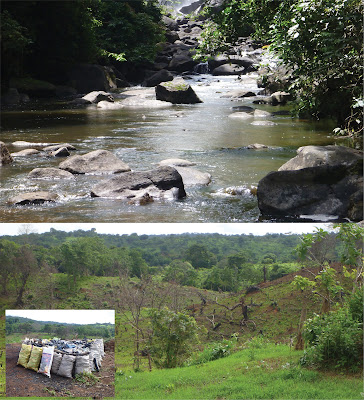
 The type locality of Conraua kamancamarai sp. nov. near Konkouré Fetto, Fouta Djallon, Guinea (10°20'28.21"N, 12°10'16.82"W, 650 m a.s.l.). The frogs live in clear, fast flowing streams, with riverine forest. The surroundings are heavily degraded by agriculture, cattle grazing and charcoal production (inset figure).


The Fouta Djallon, Guinea and habitats of Conraua kamancamarai sp. nov. Hörè Binti landscape (upper photo) and typical river habitats.  


 Karla Neira-Salamea, Joseph Doumbia, Annika Hillers, Laura Sandberger-Loua, N’Goran G. Kouamé, Christian Brede, Marvin Schäfer, David C. Blackburn, Michael F. Barej and Mark-Oliver Rödel. 2022. A New Slippery Frog (Amphibia, Conrauidae, Conraua Nieden, 1908) from the Fouta Djallon Highlands, west-central Guinea. Zoosystematics and Evolution. 98(1): 23-42. DOI: 10.3897/zse.98.76692

Resumé: Nous décrivons une nouvelle espèce du genre Conraua des hauts plateaux du Fouta Djallon en Guinée. L'espèce est reconnue comme distincte du C. alleni nominotypique, sur la base de preuves morphologiques et est soutenue par une analyse récente de délimitation des espèces, basée sur des données de séquence d'ADN. La nouvelle espèce se distingue de ses congénères par la combinaison unique des caractères suivants: taille moyenne du corps, membres robustes, un seul tubercule palmaire au lieu de deux, premier doigt palmaire jusqu'en dessous du premier tubercule subarticulaire, présence d'un système de lignes latérales, tympan indistinct, deux tubercules subarticulaires sur les doigts III et IV, ventre blanc avec des taches brun foncé ou brun foncé avec des taches gris ou blanchâtre chez les adultes. La nouvelle espèce diffère de ses congénères avec plus de 6% de sa séquence d'ADN du ribosome mitochondrial 16S. Nous discutons de l'isolement dans les refuges forestiers du Pliocène et du Pléistocène comme facteur potentiel de spéciation dans le complexe C. alleni. Nous soulignons également l'importance de conserver les fragments de forêt restants dans la région du Fouta Djallon pour préserver à la fois sa biodiversité unique et ses sources d'eau précieuses pour les populations locales.


Friday, December 31, 2021

[Mammalogy • 2021] Shrews (Eulipotyphla: Soricidae) from A Biodiversity Hotspot, Mount Nimba (West Africa), with A Field Identification Key to Species


in Denys, Jacquet, Kadjo, ... et Monadjem, 2021. 

In this study, we collected 226 shrew specimens originating from 16 localities on the Guinean and Liberian sides of Mount Nimba. We surveyed all major vegetation zones from 400 to 1600 m above sea level (asl), including forest and savannah habitats. We recorded 11 species, whose identifications were confirmed by genetic analyses and classical morphometrics. Furthermore, we provide cytogenetic data for five of these species. The shrew community at Mount Nimba is composed of a mix of both savannah- and forest-dependent species, which is related to the peculiar position of Mount Nimba situated at the transition between lowland rainforest to the south and Guinean woodlands to the north. We recorded 11 species of shrews in syntopy in lowland rainforest, seven in edaphic savannah and mountain forest, and five in high-altitude savannah at 1600 m asl. Based on morphometric analyses, we show that these syntopic species separate along a size axis, allowing species to occupy different ecological niches, which we speculate allows them to access different food resources. We also highlight that Crocidura theresae Heim de Balsac, 1968 from Mount Nimba has a different karyotype from that described in Côte d’Ivoire. Finally, we develop a novel identification key for shrews from Mount Nimba using external characters and standard body measurements, allowing it to be used in the field on live specimens. In total 12 shrew species are now known from Mount Nimba, which highlights its exceptional position as a tropical African biodiversity hotspot.

KEYWORDS: Soricidae, CrociduraSuncus, community, cytogenetics, barcoding, morphometrics, morphology, Africa, Guinea, Liberia, biosphere reserve


Examples of habitats where pitfall traps were placed on the Guinean and Liberian Nimba:
A, gallery forest and swamp, camp 4 (Liberia); B, pitfall, altitude savannah with Loudetia kagerensis, Mare d’hivernage site (1642m) (Guinea);
C, pitfall, Selingbala (Guinea): mesophyllous secondary forest; D, pitfall, Gbie (Guinea): gallery forest with Parinari excelsa Sabine,1824, Carapa procera DC., 1824 and Pseudospondias microcarpa (A. Rich.) Engl., 1883, Maranthochloa purpurea (Ridl.) Milne-Redh.

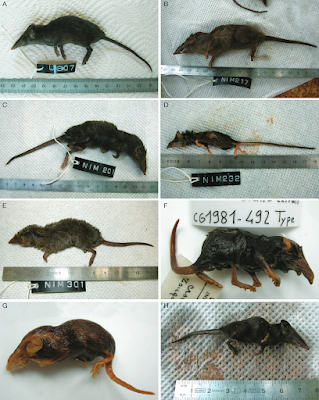
Nimba shrews skins with field numbers:
A, MNHN-ZM-2014-900 (LB07) C. buettikoferi Jentink, 1888 Camp 4;
B, MNHN-ZM-2012-1079 (NIM217) C. grandiceps Hutterer, 1983 Gouan;
C, MNHN-ZM-2012-1158 (NIM201) C. olivieri (Lesson, 1827) Gbié;
D, MNHN-ZM-2012-1111 (NIM232) C. muricauda (Miller, 1900) Gouan;
E, MNHN-ZM-2012-1180 (NIM 301) C. theresae Heim de Balsac, 1968 Gouan;
F, MNHN-ZM-MO-1981-492 C. nimbae Heim de Balsac, 1956 Holotype Zouguepo;
G, MNHN-ZM-MO-1981-483 C. eburnea Heim de Balsac, 1958 Mt Tonkui;
H, MNHN-ZM-2012-1123 (NIM 219) C. obscurior Heim de Balsac, 1958 Gouan. 

 
Christiane Denys, François Jacquet, Blaise Kadjo, Alain Didier Missoup, Vladimir Aniskine, Joelle Goüy de Bellocq, Barré Soropogui, Mory Douno, Morlaye Sylla, Violaine Nicolas, Aude Lalis and Ara Monadjem. 2021. Shrews (Mammalia, Eulipotyphla) from A Biodiversity Hotspot, Mount Nimba (West Africa), with A Field Identification Key to Species.   ZOOSYSTEMA. 43(30); 729-757. 


Tuesday, November 9, 2021

[Botany • 2021] Ctenium bennae (Poaceae: Chloridoideae) • A New Rheophytic Species from Guinea-Conakry


Ctenium bennae Xanthos

in Xanthos, Konomou, Haba & van der Burgt, 2021. 

Summary
Ctenium bennae Xanthos is described and illustrated as the only rheophytic species in the genus. The new species is known from a single waterfall on the Benna Plateau, at the border between Forecariah and Kindia Prefectures in Guinea Conakry. Ctenium bennae is here assessed as Near Threatened according to the categories and criteria of IUCN.

Key Words: Africa, rheophyte, taxonomy


Ctenium bennae Xanthos. 
 A habit; B spikelet with glumes removed; C lower glume; D upper Glume; E third lemma; F third palea; G caryopsis.
 From Konomou 657. Drawn by Hazel Wilks.


Ctenium bennae Xanthos.
A the species was only found in the waterfall seen in the distance, 5 Nov. 2019; B unmounted herbarium specimen of Konomou 657; C habitat, sandstone rocks in the rapids of a permanent stream, 2 Nov. 2019; D close up of the species growing in the rocks, 2 Nov. 2019.
Photos: A, C, D Xander M. van der Burgt, B Martin Xanthos.
 
Ctenium bennae Xanthos sp. nov. 

Type: Guinea Conakry, border between Forécariah and Kindia Prefectures, slopes of Benna Plateau above Gombokori Village, ...

RECOGNITION. Ctenium bennae has the most reduced spikelet structure among the African species of Ctenium, with the first two florets reduced completely to awns (i.e. lemma body absent) and the fourth floret absent. Only the third floret is fully developed. Affinities occur with C. sesquiflorum but this has the first and fourth floret absent and the presence of a second rudimentary lemma. Specimens of C. newtonii var. newtonii at K have been recorded with no fourth floret but even these specimens have rudimentary first and second lemmas, and the inflorescence has 1 spike; not 3 – 7 as in C. bennae. The species is the only rheophytic representative in the genus. A comparison of C. bennae with morphologically similar species from West Africa is given in Table 1.


HABITAT. Ctenium bennae is a rheophytic species collected on rocks in the rapids of a permanent stream that flows over sandstone bedrock in gallery forest.


ETYMOLOGY. The epithet is named after the type locality of the species, Benna Plateau.

CONSERVATION STATUS. Ctenium bennae is known only from one site, the type locality, Benna Plateau. There are currently no discernible threats to this site, however a single threatening event could eliminate this species globally. The Area of Occupancy (AOO) is 4 km2, which was calculated using GeoCat (Bachman et al. 2011) using 2 × 2 km2 grid cells. Assessed against the guidelines for IUCN, this species does not quite meet the threshold for threatened taxa and is here assessed as Near Threatened (NT).


Martin Xanthos, Gbamon Konomou, Pepe M. Haba and Xander M. van der Burgt. 2021. Ctenium bennae (Poaceae; Chloridoideae), A New Rheophytic Species from Guinea-Conakry. Kew Bulletin.  DOI: 10.1007/s12225-021-09989-6