Showing posts with label Cyclophoridae. Show all posts

Wednesday, October 29, 2025

[Mollusca • 2025] Theobaldius? konkanensis • A New Species of cyclophorid land snail (Gastropoda: Caenogastropoda: Cyclophoridae) from the coastal regions of Maharashtra, India


Theobaldiuskonkanensis 
Bhosale, Thackeray, Yadav, Khandekar, White & Raheem, 2025

 
ABSTRACT
We describe a new species of cyclophorid land snail, Theobaldiuskonkanensis n. sp., from the coastal and lower elevational region of the northern Western Ghats in Maharashtra, India. Theobaldius? konkanensis n. sp. can be differentiated from other species of Theobaldius Nevill, 1878 by the combination of a conoidally depressed shell with a more elevated spire, a deep notch on the apertural margin overhung by a prominent raised fold, and an operculum with the edges of the whorls conspicuously raised and bearing short spines. We provide a detailed description of the new species, focusing on the shell, operculum, jaw and radula, and the external morphology of the living animal; we map its distribution using recently collected data, and compare it with other species of Theobalidus and other cyclophoroidean genera.

KEYWORDS: Konkan, northern Western Ghats, operculum, taxonomy, Theobaldius?


Theobaldiuskonkanensis n. sp.

 
Amrut Bhosale, Tejas Thackeray, Omkar Yadav, Akshay Khandekar, Tom S. White and Dinarzarde C. Raheem. 2025. A New Species of cyclophorid land snail (Caenogastropoda: Cyclophoridae) from the coastal regions of Maharashtra, India. Molluscan Research. 45(2); 157-169. DOI: doi.org/10.1080/13235818.2025.2462864 [11 Mar 2025] 

Friday, October 17, 2025

[Mollusca • 2025] Lagocheilus hayaomiyazakii • First Record of the Genus Lagocheilus W.T. Blanford, 1864 (Caenogastropoda: Cyclophoridae) from the northern Western Ghats, India, with the Description of A New Species


Lagocheilus hayaomiyazakii
Bhosale, Thackeray, Raheem, Pawar & Khandekar, 2025

Tilari hairy snail ||  Journal of Conchology. 45(4);

Abstract
 We describe a new species of Lagocheilus from Ratoba Point, Tilari Nagar, Kolhapur District, in the northern Western Ghats of Maharashtra, India. Lagocheilus hayaomiyazakii n. sp. can be distinguished from its South Indian and Sri Lankan congeners by a unique combination of shell characters: a conoidal shell with a raised spire, a broad base, and narrow umbilicus; a wide aperture with a clearly expanded lip and a distinct angle where the lip joins the parietal wall; shell sculpture of prominent, widely spaced spiral lirae; and, in juvenile and young adults, a thick peri­ostracum with numerous periostracal hairs. We also describe the living animal, operculum, radula and jaw. This is the first record of the genus Lagocheilus from the northern Western Ghats, extending its known distribution range by 540 km north into the Indian Peninsula.

Key words. Hairy land snail, Japonia, Lagocheilus hayaomiyazakii n. sp., taxonomy, Western Ghats

Shell of South Indian and Sri Lankan Lagocheilus species.
 A–C, L. malleatus from the Beddome collection (NHMUK 1875. 03.06.22/1). D–F, L. shiplayi lectotype (NHMUK 20110216/1). G–I, L. shiplayi from the Barnacle collection (NHMUK 20110217/1). J–L, L. binoyae syntype (NHMUK 1958.1.14.26).
M–O, L. occultus syntype (NHMUK 1958.1.14.29). P–R, L. vescus syntype (NHMUK 1958.1.14.13). S–U, Lagocheilus hayaomiyazakii n. sp., holotype (NRC-AA-9576).
A–R © The Trustees of the Natural History Museum, London.

Lagocheilus hayaomiyazakii n. sp.
E, male, paratype NRC-AA-9601. F, female, paratype NRC-AA-9600.


Lagocheilus hayaomiyazakii n. sp. 

 Diagnosis. The new species can be diagnosed from its South Indian and Sri Lanka congeners by the following combination of shell characters: a conoidal shell with a raised spire, broad base and narrow umbilicus; a wide aperture with a clearly expanded lip and a distinct angle where the lip joins the parietal wall; shell sculpture of prominent widely spaced spiral lirae; and numerous hairs on the periostracum of juvenile and young adult shells.

Etymology. The specific epithet is a Latinised patronym honouring Hayao Miyazaki (b. 1941), a renowned Japanese animator, filmmaker, and co-founder of Studio Ghibli; the new species is named after him in recognition of his contribution to animation films. The suggested English common name is Tilari hairy snail.


Amrut Bhosale, Tejas Thackeray, Dinarzarde C. Raheem, Swapnil Pawar and Akshay Khandekar. 2025. First Record of the Genus Lagocheilus W.T. Blanford, 1864 (Caenogastropoda: Cyclophoridae) from the northern Western Ghats, India, with the description of L. hayaomiyazakii n. sp. Journal of Conchology. 45(4); DOI. 10.61733/jconch/4557 [14 October 2025]


Friday, December 8, 2023

[Paleontology • 2023] Ferussina petofiana (Gastropoda: Caenogastropoda: Cyclophoridae) • the Oldest representative of its subfamily from the Late Cretaceous of Romania


Ferussina petofiana Páll-Gergely, 
  
in Páll-Gergely, Magyar, Csiki-Sava et Botfalvai, 2023. 
Artwork by Márton Zsoldos  facebook.com: Zsoldos Paleo Art
  
Abstract
The terrestrial gastropod Ferussina petofiana Páll-Gergely sp. n. is described from uppermost Cretaceous (Maastrichtian) deposits from the Haţeg Basin, Romania. It represents the first properly diagnosed and described snail taxon from these deposits, despite numerous earlier reports of gastropod occurrences. This new species is characterized by a depressed, mostly smooth shell, three spiral carinae on the ventral side (inside the umbilicus), and an upward-turning aperture. The last feature characterizes two European fossil snail genera, the cyclophoroidean Ferussina, and the stylommatophoran Strophostomella. The new species is classified in the former group due to its nearly circular aperture, and the presence of conspicuous spiral carinae. In contrast, the aperture of most stylommatophoran genera (including Strophostomella) is semilunar, and if raised sculptural elements are present, they are mostly radially oriented. The identification of this new taxon in the uppermost Cretaceous of Romania represents an important range extension for the genus Ferussina, and adds it to the brief list of European clades that appear to have survived the mass extinction event at the Cretaceous-Paleogene boundary.
 
Keywords: Maastrichtian, Strophostomella, Anostomopsidae, Paleogene, K-Pg boundary

Holotype and only specimen of Ferussina petofiana Páll-Gergely, sp. n.:
 A–D, F = vari-ous views of the shell; E = aperture; G: protoconch and first teleoconch whorls; H = Arrows on Fig. E indicate the positions of the spiral carinae

Artistic reconstruction of Ferussina petofiana Páll-Gergely, sp. n.
 (artwork by Márton Zsoldos)


Barna Páll-Gergely, János Magyar, Zoltán Csiki-Sava and Gábor Botfalvai. 2023. Ferussina petofiana sp. n. (Gastropoda, Caenogastropoda, Cyclophoridae), the Oldest representative of its subfamily from the Late Cretaceous of Romania. Acta Zoologica Academiae Scientiarum Hungaricae. 69(4) 337-352. DOI: 10.17109/AZH.69.4.337.2023  


Friday, January 27, 2023

[Mollusca • 2023] Systematic Revision of the Snorkel Snail Genus Rhiostoma Benson, 1860 (Gastropoda: Caenogastropoda: Cyclophoridae) with Descriptions of New Species


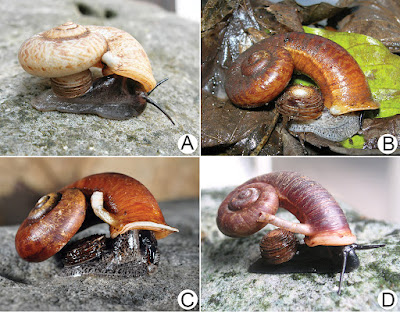
Live snails of the species group I 
Rhiostoma haughtoni specimen CUMZ 10048/2 from Dhammathat Cave, Myanmar 
B–D Rhiostoma samuiense B specimen CUMZ 3989 from Samui Island, Surat Thani C specimen CUMZ 3996 from Perlis, Malaysia (topotype of Rhiostoma chupingense) D specimen CUMZ 4713 of “proboscis” morphotype from Surat Thani 
E, F copulation pair of Rhiostoma samuiense specimen CUMZ 4713 from Surat Thani shows unsuccessfully transferred spermatophore (female on the right in E and on the left in F)

Live snails of the species group II 
A Rhiostoma housei specimen CUMZ 3987 from Ao Manow, Prachuap Khiri Khan 
Rhiostoma hainesi from Khao Soi Dao, Chanthaburi B without breathing device  
Rhiostoma jalorensis specimen CUMZ 3994 from Wat Tham Sue, Krabi. 

in Tongkerd, Tumpeesuwan, Inkhavilay, Prasankok, ... et Sutcharit, 2023.
All figures are not to scale.

Abstract
The snorkel snail genus Rhiostoma Benson, 1860 is comprised of terrestrial cyclophorid snails with wide-ranging species diversity and radiation in Southeast Asia. The typical characters of the genus are a depressed shell, a detached and descending portion of the last whorl with a distinctive peristomal breathing device attached, and a calcareous cup-shaped operculum. Herein, we have revised the systematics of extant species based on shell morphology combined with COI barcoding. From these thirty recognised species, twelve are described as new to science: R. ? amarapuraense sp. nov., R. anceyi sp. nov., R. breviocollar sp. nov., R. ebenozostera sp. nov., R. cheliopegma sp. nov., R. furfurosum sp. nov., R. gnomus, sp. nov., R. lannaense sp. nov., R. laoense sp. nov., R. platymorpha sp. nov., R. rhothonotaphrosa sp. nov., and R. tigrina sp. nov. All conchological characters are provided via illustrations of type specimens and living snails, and descriptions of the shells and radulae. Phylogenetic analysis based on partial COI gene sequences strongly supports the designated morphospecies and a monophyletic Rhiostoma, confirming that all pterocyclinid snails with a calcareous, cup-shaped operculum belong to the same clade. A high intra-specific divergence was observed in R. jalorensis and R. housei populations from locations in close proximity, suggesting a lower dispersal and higher level of isolation. The low inter-specific divergence found in R. hainesi, R. samuiense, R. asiphon, and R. rhothonotaphrosa sp. nov. supports their recent diversification and local adaptation, and is congruent with their marked morphological differences. Finally, nine formerly Rhiostoma-placed species were reclassified into either the genus Cyclotus or the genus Opisthoporus.

Keywords: DNA barcoding, endemic, Indochina, limestones, operculum, Prosobranchia, taxonomy
 
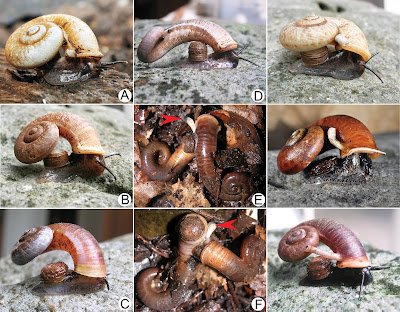
Live snails of the species group I 
Rhiostoma haughtoni specimen CUMZ 10048/2 from Dhammathat Cave, Myanmar B–D Rhiostoma samuiense B specimen CUMZ 3989 from Samui Island, Surat Thani C specimen CUMZ 3996 from Perlis, Malaysia (topotype of Rhiostoma chupingense) D specimen CUMZ 4713 of “proboscis” morphotype from Surat Thani E, F copulation pair of Rhiostoma samuiense specimen CUMZ 4713 from Surat Thani shows unsuccessfully transferred spermatophore (female on the right in E and on the left in F), and the red arrows indicate a spermatophore illustrated in Fig. 7D.
All figures are not to scale.

Live snails of the species group II
A Rhiostoma housei specimen CUMZ 3987 from Ao Manow, Prachuap Khiri Khan B, C Rhiostoma hainesi from Khao Soi Dao, Chanthaburi B without breathing device and C with long breathing device D Rhiostoma jalorensis specimen CUMZ 3994 from Wat Tham Sue, Krabi. All figures are not to scale.
Photographs: P. Tongkerd (B, C).
 

Piyoros Tongkerd, Sakboworn Tumpeesuwan, Khamla Inkhavilay, Pongpun Prasankok, Ekgachai Jeratthitikul, Somsak Panha and Chirasak Sutcharit. 2023. Systematic Revision of the Snorkel Snail Genus Rhiostoma Benson, 1860 (Gastropoda, Caenogastropoda, Cyclophoridae) with Descriptions of New Species. ZooKeys. 1142: 1-144. DOI: 10.3897/zookeys.1142.90097