Showing posts with label Author: Couvreur. Show all posts

Friday, September 5, 2025

[Botany • 2025] Uvariopsis niangadoumae (Annonaceae)Passion and Combat on a Floral Stage: A New Species from Monts de Cristal, Gabon, with Notes on its Unique Pollination Ecology


Uvariopsis niangadoumae  Couvreur & Dagallier,

in Couvreur, Niangadouma, Nguimbit, Paradis, Dagallier, Baudoin-Huit, Collin, Haran et Droissart, 2025. 

Abstract
Background and aims – Gabon is a major centre of biodiversity. We describe a new species from the tropical plant family Annonaceae: Uvariopsis niangadoumae sp. nov., known from a single population in the Monts de Cristal National Park.

Material and methods – Field work was conducted to collect plant specimens and observe floral visitors. Pollen samples were collected and prepared for microscopic analysis. The phylogenetic tree of Uvariopsis was reconstructed using a maximum likelihood method and based on hundreds of nuclear markers. Pollination biology was studied using a DIY camera trap (PICT) placed near a female flower to record floral visitors and their behaviour for one full day. Several flower visitors were collected and identified using DNA barcoding.

Key results – Uvariopsis niangadoumae is a tree reaching five metres tall, characterized by strong-scented leaves, few-flowered cauliflorous foul-smelling flowers, and large pollen grains shed in tetrads. The species is endemic to a small area within the Monts de Cristal National Park. Phylogenetic analysis places U. niangadoumae within the “large-leaved clade” species complex with now five taxa. Pollination is diurnal, and the primary pollinator is a rove beetle (Staphylinidae), which uses the female flowers as a mating site, with males fighting for control of the flower. The rove beetles might be attracted by a chemical cue, the foul scent of the flowers, and visual cues, with the inner part of the petals resembling mushrooms.

Conclusion – These results emphasize once again the importance of the Monts de Cristal National Park for biodiversity and highlight conservation concerns for the newly described species. The new species is monitored regularly, especially for fruiting individuals, to support ex situ propagation. The Kinguélé Aval project maintains a conservation nursery with 56 species, including 20 individuals of this new species.

Keywords: camera trap, hydrological dam, IUCN conservation, plant-insect interactions, saprocantharophily, Staphylinidae

Uvariopsis niangadoumae, detail of male and female flowers. 
A. Detail of inner side of female (left) and male (right) flowers, one petal removed. B. Detail of female flower, one petal removed. C. Detail of inner side of one female petal. D. Old female flower. E. Detail of sepals on male flower. F. Young male flower, not at anthesis yet. 
From Couvreur 1803. Photos by Thomas L.P. Couvreur. Scale bars: A–D = 0.5 cm.

Uvariopsis niangadoumae, natural habit and vegetative characters.
A. Habitat along a small stream. B. General view. C. Young leaves, light green, dropping. D. Detail of adaxial side of leaf base. E. Detail of abaxial side of leaf base.
From Couvreur 1803. Photos by Thomas L.P. Couvreur.

Uvariopsis niangadoumae, detail of fruits and flower visitors.
A. One monocarp. B. Longitudinal section of a single monocarp showing the seeds. C. Male flower with small Diptera visitors. D. Female flower with one large Staphylinidae beetle. F. Upper side of male flower covered with Crematogaster sp. ants. F. Male flower with large Staphylinidae beetle emerging covered in pollen.
 From Couvreur 1803. Photos by Thomas L.P. Couvreur. Scale bars: A, B = 1 cm.

 Uvariopsis niangadoumae Couvreur & Dagallier, sp. nov.
 
Diagnosis: Uvariopsis niangadoumae resembles U. korupensis in the shape and dimensions of its leaves and the overall size of the flowers. It differs by having strong scented leaves versus no clear scent in U. korupensis. Furthermore, U. niangadoumae bears no more than two, few-flowered inflorescences on small protrusions at the base of the trunk, whereas in U. korupensis the base of the trunk is densely covered with inflorescences. Flowers of U. niangadoumae have free petals with a length:width ratio between 1.3 and 1.7 vs fused at base and a l:w ratio between 2.2 and 7 in U. korupensis. Uvariopsis niangadoumae also has fewer carpels than U. korupensis (20–25 vs 25–120).

Etymology: This species is dedicated to the Gabonese botanist Raoul Niangadouma who participated in the (long and arduous) botanical inventories that led to the official recognition of the Monts de Cristal National Park. Raoul Niangadouma is also one of the collectors of the type specimen of this species.


 Thomas L.P. Couvreur, Raoul Niangadouma, Igor Nguimbit, Anne-Hélène Paradis, Léo-Paul M.J. Dagallier, Lola Baudoin-Huit, Myriam Collin, Julien M. Haran and Vincent Droissart. 2025. Passion and Combat on a Floral Stage: A New Species of Uvariopsis (Annonaceae) from Monts de Cristal, Gabon, with Notes on its Unique Pollination Ecology. Plant Ecology and Evolution. 158(2): 294-308. DOI: doi.org/10.5091/plecevo.152843

Tuesday, September 26, 2023

[Botany • 2023] Phylogenomic Inference of the African Tribe Monodoreae (Annonaceae) and Taxonomic Revision of Dennettia, Uvariodendron and Uvariopsis


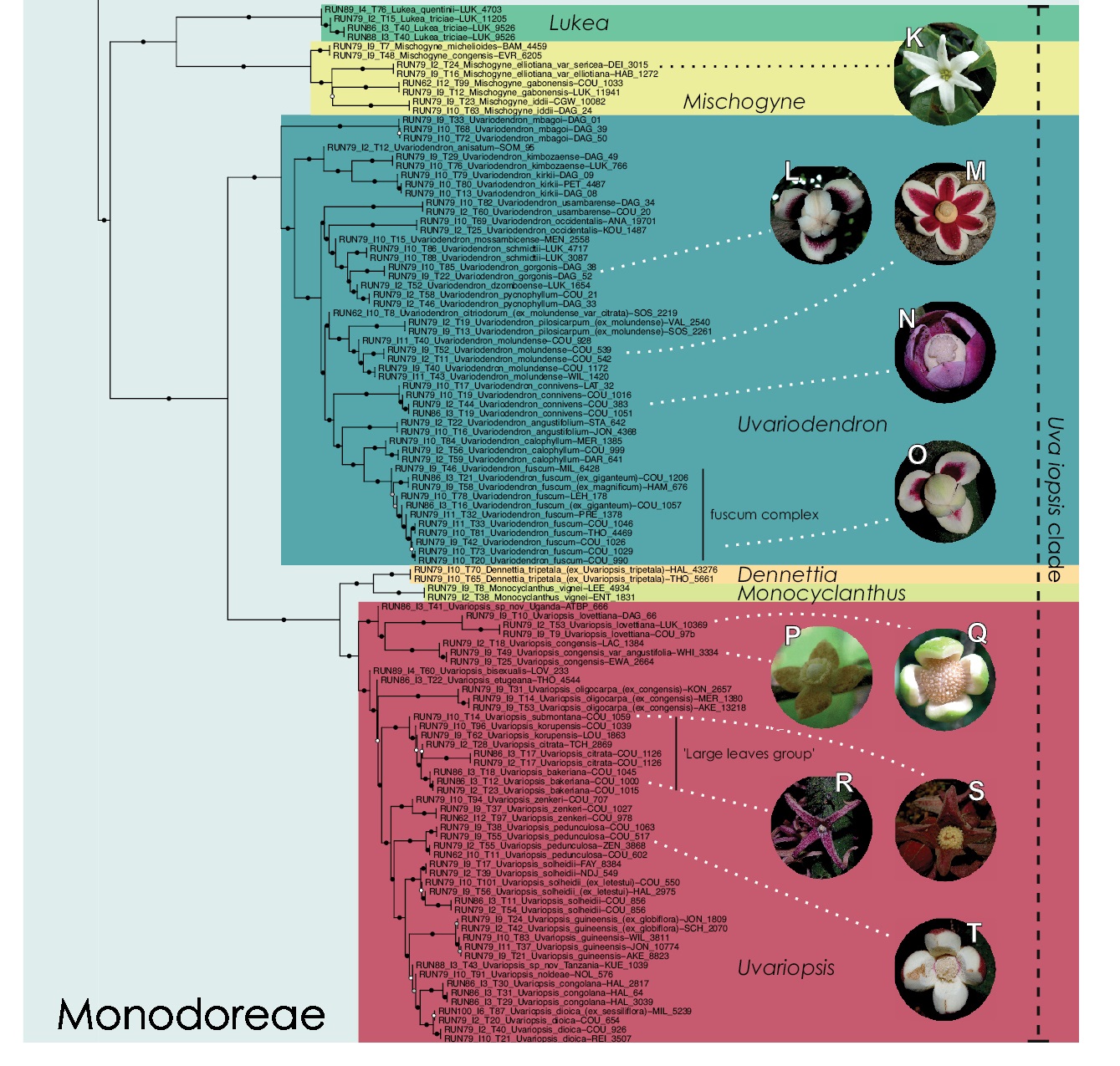
flowers of K Mischogyne elliotana (no specimen associated) L Uvariodendron gorgonis (Dagallier 38) M Ud. molundense (Bidault 2222) N Ud. connivens (Couvreur 1016) O Ud. var. fuscum (Couvreur 990)
Uvariopsis congensis (Lachenaud 1384) Q Uplovettiana (Couvreur 97b) R Upbakeriana (Couvreur 1000) S Upsubmontana (Couvreur 627) T Uppedunculosa (Couvreur 878).

in Dagallier, Mbago, Couderc, Gaudeul, ... et Couvreur, 2023.

 Photos by Thomas Couvreur, Léo-Paul Dagallier, Carel Jongkind, Ehoarn Bidault & Olivier Lachenaud.

Abstract
Monodoreae (Annonaceae) is a tribe composed of 11 genera and 90 species restricted to the tropical African rain forests. All the genera are taxonomically well circumscribed except the species rich genera Uvariodendron and Uvariopsis which lack a recent taxonomic revision. Here, we used a robust phylogenomic approach, including all the 90 currently accepted species, with several specimens per species, and based on more than 300 Annonaceae-specific nuclear genes, to infer the phylogenetic tree of the Monodoreae and test the limits between the genera and species. We recover all the genera as monophyletic, except the genus Uvariopsis for which the species Uvariopsis tripetala falls outside this clade. We thus reinstate the monotypic genus Dennettia for its single species Dennettia tripetala. We also erect a new tribe, Ophrypetaleae trib. nov., to accommodate the genera Ophrypetalum and Sanrafaelia, as we recover them excluded from the Monodoreae tribe with good support. Below the genus level, the genera Isolona, Monodora, Uvariastrum, Uvariodendron and Uvariopsis show weakly supported nodes and phylogenetic conflicts, suggesting that population level processes of evolution might occur in these clades. Our results also support, at the molecular level, the description of several new species of Uvariodendron and Uvariopsis, as well as several new synonymies. Finally, we present a taxonomic revision of the genera DennettiaUvariodendron and Uvariopsis, which contain one, 18 and 17 species respectively. We provide a key to the 11 genera of the Monodoraeae and describe four new species to scienceUvariodendron kimbozaense Dagallier & Couvreur, sp. nov.Uvariodendron mossambicense Robson ex Dagallier & Couvreur, sp. nov.Uvariodendron pilosicarpum Dagallier & Couvreur, sp. nov. and Uvariopsis oligocarpa Dagallier & Couvreur, sp. nov., and provide provisional descriptions of three putatively new species. We also present lectotypifications and nomenclatural changes implying synonymies and new combinations (Uvariodendron citriodorum (Le Thomas) Dagallier & Couvreur, comb. et stat. nov., Uvariodendron fuscum var. magnificum (Verdc.) Dagallier & Couvreur, comb. et stat. nov., Uvariopsis congensis var. angustifolia Dagallier & Couvreur, var. nov., Uvariopsis guineensis var. globiflora (Keay) Dagallier & Couvreur, comb. et stat. nov., and Uvariopsis solheidii var. letestui (Pellegr.) Dagallier & Couvreur, comb. et stat. nov.).

Key words: conservation, evolution, new species, phylogeny, tropical rain forests


Ophrypetaleae tribe.
Ophrypetalum odoratum Diels  A trunk B young branch with leaves, upper side C flower and flower buds D flower, from below.
Sanrafaelia ruffonammari Verdc E trunk F young branch with leaves and flower buds G flower buds H flower, top view I flower, side view J fruit.
A, B Dagallier 54 C Couvreur 56 D Couvreur 82 E–J Dagallier 31. Photos A,,B, E–J Léo-Paul Dagallier C, ,D Thomas Couvreur.

Phylogenetic trees of the Monodoreae inferred with ASTRAL, based on 334 nuclear genes trees.
The branch support is given as local posterior probability (LPP) in three shades of greys. For the details on the specimens see Suppl. material 3.
Insets: flowers of A Ophrypetalum odoratum (Couvreur 82) B Sanrafaelia ruffonammari (Dagallier 31) C Asteranthe asterias (Dagallier 10) D Hexalobus crispiflorus (no specimen associated) E Uvariastrum zenkeri (no specimen associated) F Isolona hexaloba (no specimen associated) G I. cauliflora (Dagallier 44) H Monodora grandidieri (Dagallier 26) I M. myristica (living specimen at NY conservatory) J M. tenuifolia (Couvreur 1019)
Mischogyne elliotana (no specimen associated) L Uvariodendron gorgonis (Dagallier 38) M Ud. molundense (Bidault 2222) N Ud. connivens (Couvreur 1016) O Ud. var. fuscum (Couvreur 990) P Uvariopsis congensis (Lachenaud 1384) Q Uplovettiana (Couvreur 97b) R Upbakeriana (Couvreur 1000) S Upsubmontana (Couvreur 627) T Uppedunculosa (Couvreur 878).
 Photos CC BY-NC 4.0 A, D–F, J, N, O, Q–T Thomas Couvreur B, C, G–I, L Léo-Paul Dagallier K Carel Jongkind M Ehoarn Bidault P Olivier Lachenaud.

Uvariodendron fuscum (Benth.) R.E.Fr. var. fuscum
A leaf, lower side B apex of young branch with detail of petiole and leaf base, upper side, inset: detail of sparse pubescence on young branch C trunk with flower bud (top) and flower (bottom) D open flower E young fruit with unripe monocarps, one old petal remaining F flower semi-bottom view, showing bracts and sepals G detail of flower after anthesis, note the falling stamens and pollinator insects, inset: detail of Coleoptera full of pollen grains.
A, E, G Couvreur 1046 B, C Couvreur 1029 D, F Couvreur 990. Photos Thomas Couvreur.

Uvariodendron kimbozaense Dagallier & Couvreur
A habit B trunk with borne inflorescences C young inflorescence with flower buds D flower with one outer petal and the 3 inner petals torn or gnawed E young branch with leaves, lower side F young branch with leaves, upper side G detail of flower receptacle with stamens and stigmas, note the gleaming exudate on the stigmas and the hairs stuck on them H base of leaf, upper side, note the slightly raised midrib.
 A–H Dagallier 49 (type). Photos Léo-Paul Dagallier.

 
Léo-Paul M. J. Dagallier, Frank M. Mbago, Marie Couderc, Myriam Gaudeul, Aurélie Grall, Caroline Loup, Jan J. Wieringa, Bonaventure Sonké and Thomas L. P. Couvreur. 2023. Phylogenomic Inference of the African Tribe Monodoreae (Annonaceae) and Taxonomic Revision of DennettiaUvariodendron and UvariopsisPhytoKeys. 233: 1-200. DOI: 10.3897/phytokeys.233.103096

Résumé: La tribu des Monodoreae (Annonaceae) est composée de 11 genres et 90 espèces des forêts tropicales humides d’Afrique. Tout les genres sont taxonomiquement bien résolus, à part les genres Uvariodendron et Uvariopsis qui manquent d’une révision taxonomique récente. Ici, nous avons utilisé une approche phylogénomique robuste pour estimer l’arbre phylogénétique des Monodoreae, et tester les limites de genres et d’espèces. Pour cela, nous avons inclut les 90 espèces acceptées, et avons séquencé plus de 300 gènes. Tous les genres sont retrouvés monophylétiques, à part le genre Uvariopsis pour lequel l’espèce Uvariopsis tripetala se retrouve exclue. Nous rétablissons donc le genre monotypique Dennettia et son unique espèce Dennettia tripetala. Nous érigeons une nouvelle tribu, les Ophrypetaleae trib. nov.pour accueillir les genres Ophrypetalum et Sanrafaelia, car nous les retrouvons exclus de la tribu des Monodoreae avec un bon support. Au niveau infra-générique, les genres Isolona, Monodora, Uvariastrum, Uvariodendron et Uvariopsis montrent de faibles supports de noeuds et des conflits phylogénétiques, ce qui suggère que des processus d’évolution se déroulent au niveau des populations. Nos résultats soutiennent également, sur un plan moléculaire, la description de plusieurs nouvelles espèces d’Uvariodendron et d’Uvariopsis, de même que plusieurs synonymies. Enfin, nous présentons une révision taxonomique des genres Dennettia, Uvariodendron et Uvariopsis, qui contiennent respectivement un, 18 et 17 espèces. Nous fournissons une clé des 11 genres de Monodoreae, et décrivons quatre nouvelles espèces pour la science: Uvariodendron kimbozaense Dagallier & Couvreur, sp. nov.Uvariodendron mossambicense Robson ex Dagallier & Couvreur, sp. nov.Uvariodendron pilosicarpum Dagallier & Couvreur, sp. nov. et Uvariopsis oligocarpa Dagallier & Couvreur, sp. nov., et fournissons une description provisoire de trois autres potentielles. Nous effectuons des lectotypifications et des changements nomenclaturaux tels que des synonymies et des nouvelles combinaisons (Uvariodendron citriodorum (Le Thomas) Dagallier & Couvreur, comb. et stat. nov., Uvariodendron fuscum var. magnificum (Verdc.) Dagallier & Couvreur, comb. et stat. nov., Uvariopsis congensis var. angustifolia Dagallier & Couvreur, var. nov., Uvariopsis guineensis var. globiflora (Keay) Dagallier & Couvreur, comb. stat. nov., et Uvariopsis solheidii var. letestui (Pellegr.) Dagallier & Couvreur, comb. stat. nov.).

Tuesday, December 18, 2018

[Botany • 2019] Pre‐Pleistocene Origin of Phylogeographical Breaks in African Rain Forest Trees: New Insights from Greenwayodendron (Annonaceae) Phylogenomics


Greenwayodendron sp.

in Migliore, Kaymak, Mariac, Couvreur, et al., 2019.

Abstract
Aim: 
Palaeoecological records indicate that Pleistocene glaciations affected the African rain forest, probably causing its fragmentation, which could explain phylogeographical breaks documented in many tree species. This refuge hypothesis was further tested through species distribution models, hindcasting persistence during the Last Glacial Maximum. However, previous studies failed to estimate with sufficient precision the divergence time between phylogeographical entities to confirm their Pleistocene origin. Developing genomic tools on a representative tree of mature rain forests, we test if parapatric genetic clusters documented in widespread tree species can be interpreted as the legacy of past population fragmentation during the last glacial period(s).

Location: Tropical Africa, Guineo‐Congolian forests.

Taxon: Greenwayodendron (Annonaceae).

Methods:
To further test the Pleistocene refuge hypothesis by molecular dating, we sequenced the plastome of 145 individuals of the shade‐tolerant rain forest tree Greenwayodendron suaveolens and congeneric species, and genotyped the same samples using nuclear microsatellites to identify genetic clusters.

Results: 
Five plastid phylogroups of G. suaveolens occur in parapatry throughout Central Africa, following a spatial pattern generally congruent with genetic clusters. Four of them diverged 3.5–4.5 Ma, whereas the fifth one, located in the Cameroon volcanic line (CVL), diverged 8.3 Ma, in the range of divergence times between Greenwayodendron species, highlighting the key role of the CVL in hosting ancient lineages. Within phylogroups, most nodes were dated from 0.9 to 3.2 Myr and a correlation between haplotype divergence and spatial distance was still perceptible, indicating a slow population dynamic.

Main conclusions: 
The phylogeographical structures of Central African trees probably established during the Pliocene or early Pleistocene, and while they might have been reinforced during subsequent glacial–interglacial cycles, interglacial phases did not lead to genetic homogenization. Therefore, interpreting phylogeographical patterns of African trees must account for a much deeper past than previously assumed, and cannot be limited to the last glacial period.

Keywords: African rain forests, evolutionary history, Greenwayodendron, High‐throughput sequencing, molecular dating, nuclear microsatellites, phylogeography, plastome captures, Pleistocene glaciations


CONCLUSIONS
The well‐resolved plastome phylogeny of Greenwayodendron species challenges the accepted view of Central African forest historical dynamics by showing that phylogeographical patterns of mature forest trees can have a very ancient origin, pre‐dating the Pleistocene. Our results call for a reassessment of the reference time‐scale traditionally used to interpret phylogeographical patterns in African rain forest trees, earlier than the last glacial cycle. The long generation time of shade‐tolerant tree species, their limited dispersal capacity and their incapacity to colonize open habitats probably explain their slow spatial dynamics, which in turn induces genetic signatures of very ancient historical or biogeographical events.


Jérémy Migliore, Esra Kaymak, Cédric Mariac, Thomas L. P. Couvreur, Brandet‐Junior Lissambou, Rosalía Piñeiro and Olivier J. Hardy. 2019. Pre‐Pleistocene Origin of Phylogeographical Breaks in African Rain Forest Trees: New Insights from Greenwayodendron (Annonaceae) Phylogenomics. Journal of Biogeography.  DOI: 10.1111/jbi.13476  

Wednesday, February 11, 2015

[Botany • 2014] Revision of the African genus Uvariastrum (Annonaceae)


Figure 2. Species of Uvariastrum.
a Uvariastrum insculptum, Ivory Coast (photo O. Lachenaud, no specimen) b Uvariastrum pierreanum, fruit, Gabon (photo: TLP Couvreur, (Sosef 2034)) c U. pierreanum, Cameroon (photo: TLP Couvreur; Couvreur 454)

d Uvariastrum zenkeri; cauliflorous flowers; Cameroon (photo: XM van der Burgt (van der Burgt 590)) e U. zenkeri, flower bud; Cameroon (photo Sonneck, no specimen) f U. zenkeri, mature flower; Cameroon (photo Sonneck, no specimen) g U. zenkeri, detail of receptacle; Cameroon (photo Sonneck, no specimen).

Abstract
The genus Uvariastrum (Annonaceae) is restricted to continental Africa and is characterized by sepals with folded margins, few carpels and numerous stamens. The genus is mainly found in the tropical lowland rain forests of Africa, with one species growing in a drier woodland habitat. The species name Uvariastrum pynaertii De Wild is reduced into synonymy with Uvariastrum zenkeri Engl. & Diels. Uvaraistrum neglectum Paiva and Uvariastrum modestum Dielsare transferred to the genus Uvaria leading to two new combinations: Uvaria modesta (Diels) Couvreur, comb. nov. and Uvaria paivana Couvreur, nom. nov. Five species are currently recognized in Uvariastrum. The present revision, the first of the genus for over 100 years, provides an overview of previously published information and discussions on morphology, taxonomy and palynology. Preliminary conservation status assessments are provided for each species, as well as diagnostic keys for fruiting and flowering material as well as detailed species descriptions. Furthermore, all species are illustrated by line drawings and all species are mapped.

Keywords: Taxonomy, IUCN conservation, Monodoreae, Uvaria


Thomas L.P. Couvreur. 2014. Revision of the African genus Uvariastrum (Annonaceae).
PhytoKeys. 33: 1-40. doi: 10.3897/phytokeys.33.5907

[Botany • 2009] Mwasumbia alba • Molecular and Morphological Characterization of A New Monotypic Genus of Annonaceae from Tanzania


Mwasumbia alba Couvreur & D.M.Johnson
Photos: TLP Couvreur | Annonaceae.myspecies.info 

Abstract
The coastal lowland rain forests of eastern Africa are well known for their high levels of plant endemism. A new genus of Annonaceae, Mwasumbia, is described from Tanzania, underscoring this high biodiversity and represented by a single species, Mwasumbia alba. The new genus presents several morphological characters suggesting a close relationship to two other African genera, Greenwayodendron and Polyceratocarpus. Maximum parsimony and Bayesian molecular phylogenetic analyses based on two plastid markers, rbcL and the trnLtrnF region, strongly support the close relationship of these three genera to one another as well as to two other African genera, Annickia and Piptostigma. Together these five genera form a moderately supported clade within the so-called short-branch clade of Annonaceae. A detailed morphological and palynological comparison between Mwasumbia and the four other genera shows that this new genus exhibits a combination of features unique within this group: intermediate tertiary leaf venation, exclusively bisexual flowers, slightly imbricate sepals, valvate petals, outer and inner petals equal in length, numerous stamens, four carpels, few and uniseriate ovules, few and sessile monocarps, and verrucate sulculate pollen grains. Phylogenetic analyses also suggest the genus Piptostigma, as currently circumscribed, to be paraphyletic. An IUCN conservation status of VU D2 is proposed, reflecting the narrow distribution of the single species.

Keywords: Annonaceae, biodiversity hotspot, coastal forest, East Africa, Kimboza Forest Reserve, pollen, Tanzania, taxonomy, Uluguru Mountains


T.L.P Couvreur, R. W. J. M. Van der Ham, Y.M. Mbele, F. M. Mbago and D. M. Johnson. 2009. Molecular and Morphological Characterization of A New Monotypic Genus of Annonaceae, Mwasumbia, from Tanzania. Systematic Botany. 34:266-276. DOI: 10.1600/036364409788606398