Showing posts with label Dominican Republic. Show all posts

Wednesday, March 4, 2026

[PaleoEntomology • 2026] Hypoponera electrocacica • The Ant Genus Hypoponera (Hymenoptera: Formicidae) in Dominican Amber


Hypoponera electrocacica 
Fiorentino, Bouju, Sosa, Navarro & Barden, 2026
 
 
Abstract
Hypoponera Santschi, 1938 is a genus of ponerine ants, well known for its simplified morphology, lacking any clear autopomorphy, and its cosmopolitan distribution. Here, we describe the first Hypoponera in Dominican amber. The discovery of Hypoponera electrocacica new species confirms the long-expected presence of the genus in the Caribbean Miocene. The modern diversity of Hypoponera in the Greater Antilles now stands at five species and two putative subspecies.

Systematic paleontology
Order Hymenoptera Linnaeus, Reference Linnaeus1758

Family Formicidae Latreille, Reference Latreille1802
Subfamily Ponerinae Lepeletier de Saint-Fargeau, Reference Lepeletier de Saint-Fargeau1835

Genus Hypoponera Santschi, Reference Santschi1938

Type species: Ponera abeillei André, 1881, 
now Hypoponera abeillei (André, Reference André1881).

 Photomicrographs and illustration of Hypoponera electrocacica n. sp., holotype specimen, MNHNSD FOS 18.126.
(1) Head in front face view. (2) Illustration of forewing venation. (3) Body in dorsal view. (4) Body in lateral view.
Scale bars = 0.5 mm.

Hypoponera electrocacica new species

Etymology: The specific epithet electrocacica (from the Latin electrum, meaning ‘amber,’ and the feminine form of the Taino word cacique, meaning ‘chief’) is a feminine singular adjective in the nominative case. It refers to the alate ant or queen trapped in amber.


Gianpiero Fiorentino, Valentine Bouju, Diyael Sosa, Santo Navarro  and Phillip Barden. 2026. The Ant Genus Hypoponera (Hymenoptera: Formicidae) in Dominican Amber. Journal of Paleontology. First View. DOI: doi.org/10.1017/jpa.2025.10213 [05 February 2026]

Saturday, December 20, 2025

[PaleoEntomology • 2025] Aulacigaster alabaster, A. breviradia, ... • Aulacigaster Macquart (Diptera: Schizophora: Aulacigastridae) in Amber


Aulacigaster alabaster 
Grimaldi, 2025 

Abstract
Four new species of the nearly worldwide genus Aulacigaster are described based on specimens preserved in Late Miocene amber (15–17 million years old) from the Dominican Republic: Aulacigaster alabaster n. sp., A. breviradia n. sp., A. mathisi n. sp., and A. rungae n. sp. Details of the male terminalia of A. neoleucopeza are provided as a comparison to three of the fossil species. Commentary is provided on morphological characters pertaining to aulacigastrid relationships. All the fossil Aulacigaster belong to the A. leucopeza group, which today predominates in the Holarctic Region, Africa and Asia, with only a few of the 42 Neotropical species in the genus belonging to the group. No leucopeza-group species are known from the Caribbean, so the fossils probably represent significant extinction in the region.

KEYWORDS: acalyptrates, biogeography, fossil resin, Hispaniola, Neogene


David A. Grimaldi. 2025. Aulacigaster Macquart in Amber (Diptera: Schizophora: Aulacigastridae). Proceedings of the Entomological Society of Washington. 127(3):458-473. DOI: doi.org/10.4289/0013-8797.127.3.458 [28 November 2025]

Thursday, April 17, 2025

[PaleoEntomology • 2025] Basiceros enana • A Fossil-informed pattern of Body Size increase and local extinction in Basiceros dirt ants (Hymenoptera: Formicidae)


 Basiceros enana
Fiorentino, Probst, Richter, Economo & Barden, 2025
 

Abstract
Basiceros dirt ants are morphologically distinct and widely distributed members of Neotropical communities. These ants possess features that aid in leaf litter camouflage and are larger than other closely related lineages with similar cryptic adaptations. Here, we report the first fossil of this genus group, Basiceros enana sp. nov., from Miocene-aged Dominican amber, which reveals a pattern of body size evolution and disjunct biogeography. The fossil evidences the local extinction of Basiceros in the Caribbean, even as living Basiceros are known from Honduras to Southern Brazil. Using combined morphological and molecular datasets of all closely related lineages, we recover the evolutionary trajectory for body size within the group, demonstrating that body size was initially small in these ants and followed by a rapid expansion of body size in the common ancestor of all living species. Results reflect the capacity for early morphological evolution to influence perceived patterns of body size increase through a mosaic of ancestral legacy and continuous enlargement.

Keywords: fossil, local extinction, ancestral state reconstruction, Caribbean evolution, body size 

Artistic rendition of Basiceros enana preserved in Dominican amber from CT-scan data. Specialized hairs used for picking up dirt can be seen highlighted in yellow covering the ants' legs and head.
Credit: Gianpiero Fiorentino (NJIT)

Basiceros enana sp. nov. 


Gianpiero Fiorentino, Rodolfo Probst, Adrian Richter, Evan P. Economo and Phillip Barden. 2025. A Fossil-informed pattern of Body Size increase and local extinction in Basiceros dirt ants (Hymenoptera: Formicidae). Proc. R. Soc. B. 292; 20242171. DOI: doi.org/10.1098/rspb.2024.2171 [16 April 2025]

Friday, April 19, 2024

[Botany • 2023] Gesneria clasei (Gesneriaceae) • A New lithophilous Species from the Sierra de Bahoruco, Dominican Republic

 
 Gesneria clasei  J.L.Clark, 

in Clark, 2023. 

Abstract
A new lithophytic species of Gesneria was discovered during a recent research expedition to the Dominican Republic. Gesneria clasei J.L.Clark is a locally endemic species known from a single population in the Sierra de Bahoruco in the southwestern province of Barahona in the Dominican Republic. Images and a discussion are provided to differentiate Gesneria clasei from congeners that share tubular red corollas. Based on IUCN guidelines, a preliminary conservation status of Critically Endangered (CR) is assigned to G. clasei.
 
Keywords: Biodiversity, Gesneria, lithophyte, Sierra de Bahoruco, taxonomy

Gesneria clasei.
A. Lateral view of mature flower. B. Ventral view of mature flower. C. Shoot with foliage and calyx. D. Lateral view of immature fruit. E. Habit (lithophyte). F. Teodoro Clase adjacent to the monument of Erik L. Ekman in the central park in San José de Ocoa (Dominican Republic).
 [A–E field images from J.L. Clark & T. Clase 17372].

Gesneria clasei J.L.Clark, sp. nov.

Diagnosis.—Differs from all other Gesneria taxa by the presence of uniformly red tubular corollas, ribbed floral tubes, narrow calyx lobes that are nearly as long as the corolla tube, and a lithophytic subshrub habit.

Etymology.—The specific epithet clasei honors Teodoro Clase (Fig. 1F), a Dominican botanist from the Jardín Botánico Nacional “Dr. Rafael M. Moscoso” (JBSD) in Santo Domingo, Dominican Republic. Clase’s heroic efforts have facilitated and promoted plant biodiversity studies in the Dominican Republic, including the discovery of the species here. Clase is also an active plant collector, currently one of the most extensive for Hispaniola (more than 14,000 field collections throughout Haiti and the Dominican Republic).


John L. Clark. 2023. Gesneria clasei (Gesneriaceae), A New lithophilous Species from the Sierra de Bahoruco, Dominican Republic. Brittonia. DOI: 10.1007/s12228-023-09766-8

Tuesday, November 14, 2023

[Botany • 2023] Gesneria tuberifera (Gesneriaceae) • A New lithophytic Species from the Sierra de Bahoruco, Barahona Peninsula of southern Hispaniola (Dominican Republic)


Gesneria tuberifera J.L.Clark & T.Clase, 

in Clark et Clase, 2023. 

Abstract
narrowly endemic new species of Gesneria is described from the Sierra de Bahoruco in the Dominican Republic’s Barahona Peninsula of southern Hispaniola. Gesneria tuberifera J.L.Clark & T.Clase, sp. nov. differs from all other congeners by the presence of a tuber and tubular red corollas with yellow lobes. Images and a discussion are provided to summarize the presence of tubers in other Gesneriaceae and differentiate Gesneria tuberifera from congeners that share a lithophytic habit. Based on IUCN guidelines, a preliminary conservation status of Endangered (EN) is assessed for G. tuberifera.

Key words: Biodiversity, Gesneriinae, Sierra de Bahoruco, systematics, taxonomy, tuber

Gesneria tuberifera J.L.Clark & T.Clase
 A lateral view of mature flower B lithophytic habit C tuber with foliage D abaxial leaf surface E mature fruit
 (A, B J.L. Clark 17279 C J.L. Clark 17284 E J.L. Clark 17312). 
Photos by John L. Clark.

 Gesneria tuberifera J.L.Clark & T.Clase, sp. nov.
 
Diagnosis: Differs from all other Gesneria by the presence of a tuber. Additional characters that differentiate G. tuberifera from congeners is a rosette of leaves, elongate red tubular corollas with yellow lobes, and a lithophytic habit.

Etymology: The specific epithet means growing a tuber and is derived from the presence of a swollen stem base (Fig. 1C), a vegetative character consistent throughout the two populations observed during a 2023 field expedition to the Dominican Republic.  


John L. Clark and Teodoro Clase. 2023. Gesneria tuberifera (Gesneriaceae), A New lithophytic Species from the Sierra de Bahoruco, Barahona Peninsula of southern Hispaniola (Dominican Republic). PhytoKeys. 235: 43-52. DOI: 10.3897/phytokeys.235.110476

Resumen: Se describe una nueva especie de Gesneria endémica de la Sierra de Bahoruco en la península de Barahona en la República Dominicana, en el sur de La Española. Gesneria tuberifera J.L.Clark & T.Clase, sp. nov. se diferencia de todos los demás congéneres por la presencia de un tubérculo y corolas rojas tubulares con lóbulos amarillos. Se proporcionan imágenes y una discusión para resumir la presencia de tubérculos en otras Gesneriaceae y diferenciar a Gesneria tuberifera de otros congéneres que comparten un hábito litófito. Con base en las pautas de la UICN, se evalúa un estado de conservación preliminar de En Peligro (EN) para G. tuberifera.

Saturday, February 11, 2023

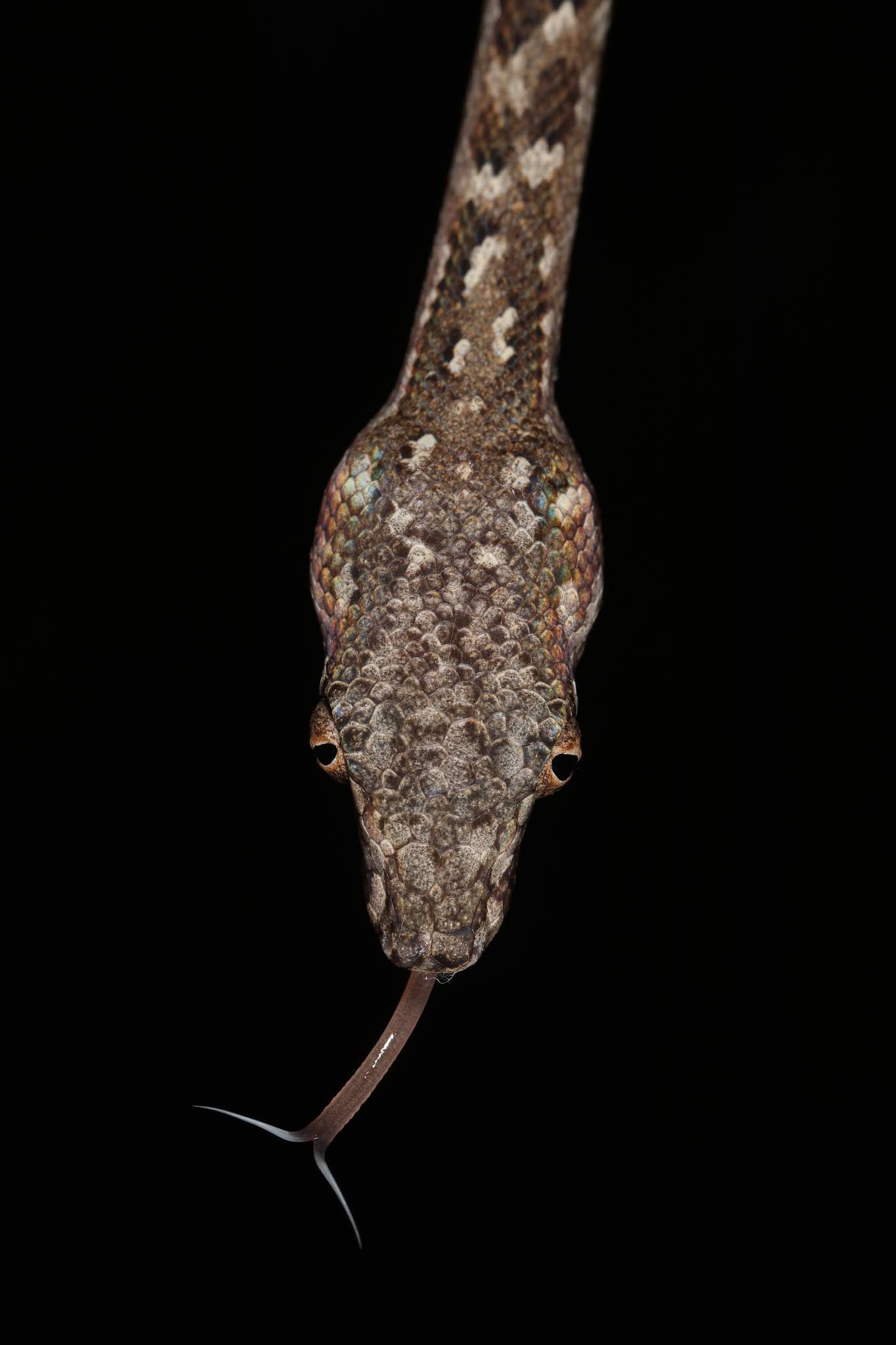
[Herpetology • 2023] Tropidophis leonae • A Remarkable New Snake of the Genus Tropidophis (Serpentes: Tropidophiidae) from southern Hispaniola


Tropidophis leonae 
 Landestoy. 2023


Abstract
A new species of Tropidophis is described from the dry forest of the Barahona Peninsula, southwestern Dominican Republic, on the Caribbean island of Hispaniola. There, the new species is parapatric with T. haetianus, the only previously known Tropidophis on Hispaniola, but exhibits striking differences in scalation (much higher number of ventral scales), in other structural morphological traits (head and body proportions), and in dorsal and ventral coloration and pattern (e.g., fewer spot rows, and a patternless head and venter, etc.). The locality of this new species lies within an area where other vertebrate species have been recently discovered, underscoring the growing appreciation of the Barahona Peninsula as a diversity hotspot. Yet, this region also remains poorly studied and it is also highly imperiled due to ongoing anthropogenic change, justifying more conservation efforts.

Keywords: Caribbean Islands; dwarf boas; Barahona Entrapment.

Lateral view of the head of A) Tropidophis leonae sp. nov. (MNHNSD 23.3951) showing the nearly uniformly colored head, and B) that of T. haetianus (MNHNSD 23.3967) with a distinctive dark cap, and a dark mask or facial horizontal stripe across the eye.


 Ventral views of A) Tropidophis leonae sp. nov. (MNHNSD 23.3951), and B) T. haetianus (MNHNSD 23.3967). Note the lack of pattern in A, whereas large discrete dark spots are present in B.

 Dorsal and lateral partial views of Tropidophis leonae sp. nov. (A, B, respectively) and T. haetianus (C, D) in life, showing coloration and pattern. Numbers in B and D point out the number of spot rows on one side only.

Tropidophis leonae sp. nov.
Jaragua Golden Trope

Diagnosis. A medium-sized (SVL 362–389 mm) species of Tropidophis of slender habitus (body somewhat laterally compressed), a distinctive neck and long snout, small eyes, high ventral scale count, a pale dorsal coloration of yellow-tan to light tan-brown with a dorsal pattern of only four brown spot rows, the middorsal blotches at times in contact or fused, and the lateral spot row much smaller and fainter; a pale yellow venter, and lacking a ventral and head pattern. 
...

Etymology. The epithet honors Dominican biologist and friend Yolanda (a.k.a “Yoli”) M. León, a tireless advocate of conservation efforts in the Dominican Republic and whose support also contributed to this work. 

  Dorsal view of the full body of Tropidophis leonae sp. nov.
 A) Holotype; B) typical substrate at the habitat floor in the type locality. The matching pattern provides good camouflage.

Tropidophis leonae sp. nov. (holotype) submerged in a water hole in the limestone floor. Note the arrows pointing at some toad (Peltophryne armata) metamorphs and tadpoles. The snake was observed feeding on the tadpoles and also striking at the toadlets.
Habitat at the type locality of Tropidophis leonae sp. nov. The blue arrow in the photo at the right points out the water hole where the holotype was found (in Fig. 2).
 

Miguel A. Landestoy T. 2023. A Remarkable New Snake of the Genus Tropidophis (Squamata: Tropidophiidae) from southern Hispaniola [Una notable nueva serpiente del género Tropidophis (Squamata: Tropidophiidae) del sur de la Hispaniola]. Novitates Caribaea. (21), 1–17. DOI: 10.33800/nc.vi21.323 

Tuesday, January 31, 2023

[Herpetology • 2022] Guarocuyus jaraguanus • A New Genus and Species of Caribbean Forest Lizard (Diploglossidae: Celestinae) from southern Hispaniola


Guarocuyus jaraguanus
Landestoy, Schools & Hedges, 2022

  
Abstract
A new genus and species of Caribbean forest lizard of the subfamily Celestinae Schools & Hedges are described. This new taxon is known only from two small adjacent keys in the Laguna de Oviedo of the Parque Nacional Jaragua in the Barahona Peninsula, Dominican Republic, at the southernmost region of the Caribbean island of Hispaniola. The genus Guarocuyus gen. nov. is genetically more closely related to the clade containing Celestus Gray, Comptus Schools & Hedges, and Panolopus Cope; nevertheless, we compare it to all celestine genera. Morphologically, it differs from other celestines by having an interdigital web on three toes and by having the widest ear opening. Additionally, the species Guarocuyus jaraguanus sp. nov. has some ecological attributes that when combined, appear to be unique, including nocturnal habits, a semiprehensile tail, and a facultatively arboreal lifestyle. We note sexual dimorphism in the new species and in two other celestines, Caribicus darlingtoni (Cochran) and the poorly known Celestus macrotus Thomas & Hedges, and report a range extension of the latter species into the Dominican Republic. We also discuss several scale topography conditions considered of taxonomic value for the group.

Keywords: Reptilia, Neoanguimorpha, Anguidae, Celestus, Hispaniola, Barahona Peninsula


Guarocuyus jaraguanus sp. nov. 


Miguel A. Landestoy T., Molly Schools and S. Blair Hedges. 2022. A New Genus and Species of Caribbean Forest Lizard (Diploglossidae; Celestinae) from southern Hispaniola. Zootaxa. 5219(3); 201-226. DOI: 10.11646/zootaxa.5219.3.1  

Sunday, June 12, 2022

[Botany • 2021] Leptocereus velozianus (Cactaceae) • Phylogenetics of Leptocereus on Hispaniola: Clarifying Species Limits in the L. weingartianus complex and A New Species from the Sierra de Bahoruco


 Leptocereus velozianus Clase, Y.Encarn., Peguero & Majure, 

in Majure, Encarnación, Clase, Peguero, Ho & Barrios, 2021. 
Photos taken by L.C. Majure.

Abstract
The Antillean genus Leptocereus represents an in-situ radiation among the Greater and Lesser Antilles of 19 currently recognized species. Extensive fieldwork carried out in the Dominican Republic over recent years has revealed that the species limits of Leptocereus of Hispaniola are more complex than previously thought. There are four currently recognized species that occur on the island, L. demissus, L. paniculatus, L. undulosus and L. weingartianus. We evaluate species limits in this group based on DNA sequence data and phylogenetic analysis, morphological characters and a survey of herbarium specimens from across Hispaniola. Based on our analyses, it is clear that at least five species occur on the island of Hispaniola, with the new species from Sierra de Bahoruco, L. velozianus, described here. We provide an identification key, distribution maps and photographic plates for all species on Hispaniola based on our own fieldwork and the study of herbarium specimens. The description of yet another species of Leptocereus on Hispaniola reiterates the importance of the poorly studied, but yet biodiverse, seasonally dry tropical forest in the Antilles.

Keywords: Biodiversity, Greater Antilles, plastome phylogeny, Seasonally Dry Tropical Forest

Leptocereus velozianus Clase, Y.Encarn., Peguero & Majure. 
A–C stems showing crenate margins D, E cross sections showing 4-5 ribbed stems, also showing large crystals in the parenchyma F day old flower showing rounded external tepal apices and spiny pericarpel, and G immature fruit showing spiny pericarpel and remnant floral tube.
 A from Majure 7842, and B–F from Majure 7843.

Leptocereus velozianus Clase, Y.Encarn., Peguero & Majure. 
A small tree habit of L. velozianus alongside T. Clase for scale B, C arching branches and spine color D trunk and bark E growing stem showing white spines as they mature F spiny, immature fruit G colliculate-pitted seed, and H stems with immature fruit, showing crenate rib margins.
A, D, F, G from Majure 7851 B, C, H from Majure 7843, and E from Majure 7842. 
Photos taken by L.C. Majure.

 Leptocereus velozianus Clase, Y.Encarn., Peguero & Majure, sp. nov.
 
Diagnosis: Differing from both L. weingartianus and L. demissus by the white young spines (vs. yellowish spines) and larger stem diameter (up to 3.7 cm in diameter in L. velozianus). Differing from L. demissus by the erect, primary trunk rather than the sprawling growth form, and oblong hypanthium in L. velozianus rather than obconic hypanthium as in L. demissus.

 Etymology: The specific epithet, “velozianus” is given honoring the Dominican botanist Alberto Veloz, who is the Head and Curator of the Herbarium JBSD of the “Dr. Rafael M. Moscoso” National Botanical Garden of Dominican Republic. For 27 years, Veloz has dedicated his life to the study of the Hispaniolan flora and has conducted extensive fieldwork across the island, with many collections from the Sierra de Bahoruco, where this new species was found. Together with other botanists he has collected over 10,000 specimens and has published several papers on the flora in national and international journals. His publications have included different approaches, such as floristics, taxonomy, ecology and conservation. Veloz has also contributed to the formation of young botanists by involving students as part of the staff in the herbarium JBSD and through fieldwork.


 Lucas C. Majure, Yuley Encarnación, Teodoro Clase, Brígido Peguero, Kelly Ho and Duniel Barrios. 2021. Phylogenetics of Leptocereus (Cactaceae) on Hispaniola: Clarifying Species Limits in the L. weingartianus complex and A New Species from the Sierra de Bahoruco. PhytoKeys. 172: 17-37. DOI: 10.3897/phytokeys.172.59497

Saturday, March 19, 2022

[Botany • 2021] Castela senticosa (Sapindales: Simaroubaceae) • A New Species from the Caribbean Clade Endemic to Seasonally Dry Tropical Forest on Hispaniola


Castela senticosa  

in Majure, Pham & Clase, 2021. 

Abstract 
Recent fieldwork in the Sierra Martín García in southwestern Dominican Republic has yielded a new species of the American clade Castela (Simaroubaceae), Castela senticosa sp. nov., from seasonally dry tropical forest. This species has been collected from two separate localities, including Môle St. Nicolas in northwestern Haiti in 1929, but until now fertile material with both flowers and fruit was unknown. We provide a photographic plate and illustration, place it phylogenetically using plastome data, and compare it morphologically with close relatives. This increases the number of known species of Castela on Hispaniola from one to two, both of which are endemic but from different clades, and yields another species for the Greater Antilles, a known biodiversity hotspot and clear center of diversification for this group of arid-adapted, thorny shrubs. This work emphasizes that seasonally dry, tropical forests, although often understudied, house as yet undiscovered biodiversity and deserve far more comprehensive studies.

Keywords: Biodiversity hotspot; Greater Antilles; plastome phylogeny


 Castela senticosa sp. nov.
 

Lucas C. Majure, Kasey Pham and Teodoro Clase. 2021. Castela senticosa (Simaroubaceae: Sapindales), A New Species from the Caribbean Clade Endemic to Seasonally Dry Tropical Forest on Hispaniola. Systematic Botany. 46(4); 1033-1041. DOI: 10.1600/036364421X16370109698560

Researchers discover new species in critically imperiled ecosystem

Wednesday, October 6, 2021

[Paleontology • 2021] Paradoryphoribius chronocaribbeus • A Tardigrade in Dominican Amber


Paradoryphoribius chronocaribbeus 
Mapalo, Robin, Boudinot, Ortega-Hernández & Barden, 2021

Illustration: Holly Sullivan. 
 
Abstract
Tardigrades are a diverse group of charismatic microscopic invertebrates that are best known for their ability to survive extreme conditions. Despite their long evolutionary history and global distribution in both aquatic and terrestrial environments, the tardigrade fossil record is exceedingly sparse. Molecular clocks estimate that tardigrades diverged from other panarthropod lineages before the Cambrian, but only two definitive crown-group representatives have been described to date, both from Cretaceous fossil deposits in North America. Here, we report a third fossil tardigrade from Miocene age Dominican amber. Paradoryphoribius chronocaribbeus gen. et sp. nov. is the first unambiguous fossil representative of the diverse superfamily Isohypsibioidea, as well as the first tardigrade fossil described from the Cenozoic. We propose that the patchy tardigrade fossil record can be explained by the preferential preservation of these microinvertebrates as amber inclusions, coupled with the scarcity of fossiliferous amber deposits before the Cretaceous.

Keywords: Paradoryphoribius, Miocene, invertebrate palaeontology, Eutardigrada


 Phylogenetic and temporal summary of the tardigrade fossil record.
 (a) Simplified tardigrade phylogeny following topology from recent molecular analyses; node ages correspond with mean molecular divergence estimates of Regier et al. [2004]. The position of the undescribed ‘Orsten’ tardigrade as sister to all extant tardigrades reflects the putative stem-group hypotheses recently summarized by Guidetti & Bertolani [2018].
(b) Eutardigrade fossil record. (1) Paradoryphoribius chronocaribbeus gen. et sp. nov. from Miocene age Dominican amber. (2) Beorn leggi from Campanian age Grassy Lake Canadian amber. Horizontal dotted line indicates uncertainty in the ordinal-level placement. (3) Milnesium swolenskyi from Turonian age Raritan amber from New Jersey. (4) ‘Orsten’ tardigrade from the middle Cambrian Kuonamka Formation in Siberia.  

Artistic reconstruction of Paradoryphoribius chronocaribbeus gen. et sp. nov.
Illustration: Holly Sullivan. 


Systematic palaeontology

Phylum Tardigrada Doyère, 1840 
Class Eutardigrada Richters, 1926 

Order Parachela Schuster, Nelson, Grigarick and Christenberry, 1980 
Superfamily Isohypsibioidea Sands, McInnes, Marley, Goodal-Copestake, Convey and Linse, 2008 

Genus Paradoryphoribius gen. nov. 
(Three letter acronym: Pdo.).

Etymology: owing to the close resemblance (para-) to the extant genus Doryphoribius [Gąsiorek, et al. 2019].

Diagnosis: tardigrade with Isohypsibius-type claws (i.e. the basal section and secondary branch form a right angle) with the claw pairs slightly different in shape and size. Accessory points present but not clearly visible. Cuticular bar present between claws of the fourth pair of legs. Pseudolunules absent. Bucco-pharyngeal apparatus consists of a rigid buccal tube with a ventral lamina (ventral apophysis) for the apophyses of the stylet muscle insertion (AISM). No dorsal AISM observed. Pharyngeal apophyses and one thin macroplacoid present, but microplacoids appear absent. Cuticle smooth. Cuticular gibbosities (i.e. cuticular protuberances) may be present.

Differential diagnosis: by the presence of Isohypsibius-type claws and ventral lamina, the new genus is morphologically similar to Doryphoribius but differs in the presence of a single thin macroplacoid instead of separated granular-shaped macroplacoids present in Doryphoribius.


  Paradoryphoribius chronocaribbeus sp. nov.

Etymology: from the Greek ‘chrono’ (khronos)—meaning time—in reference to the age of the fossil taxon and ‘caribbeus’ reflecting the region of the type locality.

Type locality: Dominican Republic mined from La Cumbre; amber from this region dates to the Miocene, with an approximate age of 16 Ma.

 
Marc A. Mapalo, Ninon Robin, Brendon E. Boudinot, Javier Ortega-Hernández and Phillip Barden. 2021. A Tardigrade in Dominican Amber.  Proc. R. Soc. B. 20211760. DOI: 10.1098/rspb.2021.1760

“Once-in-a generation” tardigrade fossil discovery reveals new species in 16-million-year-old amber
Researchers announce just the third-ever tardigrade fossil on record, offering a glimpse into the history of the cryptic micro-animal that has survived five mass extinction events over its 500 million years on Earth.


Thursday, September 16, 2021

[Herpetology • 2021] Chilabothrus ampelophis • A Small New Arboreal Species of west Indian Boa (Serpentes: Boidae) from southern Hispaniola


Chilabothrus ampelophis 
Landestoy, Reynolds & Henderson, 2021

 DOI: 10.3099/MCZ67.1 

Abstract
Thirteen species of West Indian boas (Chilabothrus) are distributed across the islands of the Greater Antilles and Lucayan Archipelago. Hispaniola is unique among this group of islands in having more than two species of Chilabothrus—three are currently recognized. Here we describe a fourth species from Hispaniola, a newly discovered distinctive species of small boa from the dry forest of the Barahona Peninsula, southwestern Dominican Republic, near the border with Haiti. This new species resembles in body size and in other aspects its closest relative Chilabothrus fordii (Günther 1861), with which it appears to be allopatric. The new species, which we describe as Chilabothrus ampelophis sp. nov., differs from C. fordii in body, head, and snout shape; in scalation; in both coloration and color pattern; and in phylogenetic uniqueness. Some relevant meristic characters from C. ampelophis sp. nov. fall between C. fordii and C. gracilis (Fischer, 1888), accentuating the morphological and likely ecological differences from its sister species C. fordii. The discovery of this new species is especially important as it appears to be among the smallest boid (Boidae) species, has an arboreal specialization, and is found in a very restricted and highly threatened habitat.


Figure 5. Head shape and scutellation in dorsal view of
A, Chilabothrus fordii (MNHNSD 23.3904).
B-F, type series of Chilabothrus ampelophis sp. nov.: MNHNSD 23.3900, KUH 352337, MNHNSD 23.3902, MNHNSD 23.3901, MCZ R-197400, respectively.
Head-scale formula is indicated by light shading (intersupraocular or frontal scales) and numbers (3-1-2; F = frontal); dark shading highlights supraocular scales. Scale bars = 5 mm.

Figure 2. Chilabothrus ampelophis sp. nov.
Clockwise from top: KUH 352337 (5 December 2020), MNHSD 23.3901 (19 November 2020), MNHSD 23.3901 (19 November 2020).


Figure 6. Head and snout profiles of left, Chilabothrus ampelophis sp. nov. (MCZ R-197400) and right, C. fordii (MNHNSD 23.3906).
Note the flat head and protruding eyes and supraoculars above the level of frontal region in C. ampelophis; this region is convex with a gradually tapering snout in C. fordii.

Figure 7. Dorsal patterns of A, Chilabothrus ampelophis sp. nov. (MNHNSD 23.3901) and B, C. fordii (MNHNSD 23.3906).
Note the differences in coloration and shape of the primary elements: basically and predominantly a zigzag in C. ampelophis and ovate to subcircular blotches in C. fordii. Sizes are not to scale.


Chilabothrus ampelophis sp. nov.
Hispaniolan Vineboa

Etymology. The epithet is from ancient greek ampelos, meaning vine, in allusion to the slender body and head shape, which is rather unusual for the genus, and for the relative abundance of vines in the dry rocky habitat at the type locality. The suffix -ophis refers to a snake, hence the epithet is translated as ‘‘vinesnake.’’ 

Figure 8. Habitat of Chilabothrus ampelophis sp. nov. in the southwestern corner of the Dominican Republic.
A, aerial drone photo from March 2021 showing general habitat consisting of forested rolling hills from 200-to 400-m elevation where all specimens of C. ampelophis sp. nov. were found.
B and C, photos showing habitat characteristics of the type locality for C. ampelophis sp. nov.
D, agricultural encroachment along the foothills of the type locality.


Thursday, April 2, 2020

[Botany • 2020] Helicteres pegueroi (Malvaceae: Helicteroideae) • A New Species from the Dry Forests of the Dominican Republic


Helicteres pegueroi Mart.Gord. & Clase

in Martínez-Gordillo, Clase & Fragoso-Martínez, 2020.

Abstract 
A new species of Helicteres from the Dominican Republic is described and illustrated; increasing the number of species occurring in the Caribbean to five. The new species, Helicteres pegueroi, can be distinguished from H. jamaicensis and H. semitriloba by its habit and calyx and corolla colour, i.e. it is a shrub with red calyces and corollas; its pseudoactinomorphic flower due to a slight curvature at the base of the androgynophore; and its densely woolly, globose fruit. An artificial, dichotomous key is provided to distinguish the new species from the other species of the Caribbean region and Mexico. 

Keywords: Barahona, Helicteroideae, Hispaniola, Malvales, Sierra Martín García

FIGURE 1. Helicteres pegueroi. A: Branch with flowers. B: Dissected calyx with one lobe slightly different from the rest. C: Clawed petals. D: Androgynophore. E: Lanate fruit. F: Triangular seeds. G: Stipitated stellate trichomes from the stem and, H: lower surface of the leaf with trichomes lacking stipe. All drawn from Clase et al. 9925 (JBSD), by Ramiro Cruz Durán.

Helicteres pegueroi Mart.Gord. & Clase sp. nov.

 Frutex calycibus et corollis rubris, calyx nectario parietali completo et undulatus, corolla exserta, inflorescentia cincinnus biflorus, flores pedicellis nectariis patelliformibus, androgynophoro parce curvato ad basim, fructibus globosis dense lanatis.


Etymology:—The name of the new species honors the Dominican botanist Brigido Peguero, who is the head of the Botany department at the National botanical garden of Dominican Republic (Jardín Botánico Nacional “Dr. Rafael Ma. Moscoso”), and part of the editorial board of the journal Moscosoa. Professor Peguero has dedicated his academic life to the study of the Hispaniolan flora from different perspectives, such as: economic botany, ecology and taxonomy. Together with other botanists he has collected over 15, 000 specimens in the Dominican Republic, Haiti and Puerto Rico. 

Distribution, habitat and phenology:— The new species is found in the Sierra Martín García, in the province of Barahona, from where it seems to be endemic. It is only known from dry forests at 600 m of elevation, sharing habitat with the following species: Bursera simaruba (L.) Sargent (1890: 260), Exostema caribaeum (Jacq.) Roemer & Schultes (1819: 19) and Guaiacum sanctum Linnaeus (1753: 382). Flowers from August to November. 


 Martha Martínez-Gordillo, Teodoro Clase and Itzi Fragoso-Martínez. 2020. Helicteres pegueroi (Malvaceae: Helicteroideae): A New Species from the Dry Forests of the Dominican Republic. Phytotaxa. 438(1); 1–5. DOI: 10.11646/phytotaxa.438.1.1

Resumen: Una nueva especie del género Helicteres de República Dominicana es descrita e ilustrada; aumentando el número de especies distribuidas en el Caribe a cinco. La nueva especie, H. pegueroi, se distingue de H. jamaicensis y H. semitriloba por ser un arbusto con flores de cáliz y corola rojos; la flor es pseudoactinomórfica, debido a una ligera curvatura en la base del androginóforo y, la presencia de fruto densamente lanoso, globoso. Se proporciona una clave dicotómica para distinguir al nuevo taxón de las otras especies de la región del Caribe y México.