Showing posts with label Dryopteridaceae. Show all posts

Thursday, May 8, 2025

[Botany • 2022] Elaphoglossum matogrossense (Dryopteridaceae) • A New and Threatened Species from Chapada dos Guimarães, Mato Grosso, Brazil


Elaphoglossum matogrossense F.B.Matos & A.Vasco, 

in Matos et Vasco, 2022. 

Summary
Elaphoglossum matogrossense, a new species from central-western Brazil, is here described and illustrated. It belongs to Elaphoglossum section Lepidoglossa, which is often characterised by conspicuously scaly leaves and non-subulate scales with acicular, one-celled, non-glandular teeth. The new species was first collected c. 35 years ago. It is characterised by short-creeping stems, orangish to brown stem scales, moderately to densely scaly leaves, short petioles, and narrowly elliptic to oblanceolate laminae with round apices and gradually decurrent bases. Elaphoglossum matogrossense is known only from the Chapada dos Guimarães National Park and is here considered critically endangered. We provide a description, taxonomic and ecological comments, conservation status assessment, geographic distribution, phenology, and illustrations for this new species. 

Key Words: Cerrado, endangered, fern, Lepidoglossa, new species, pteridophyte, taxonomy
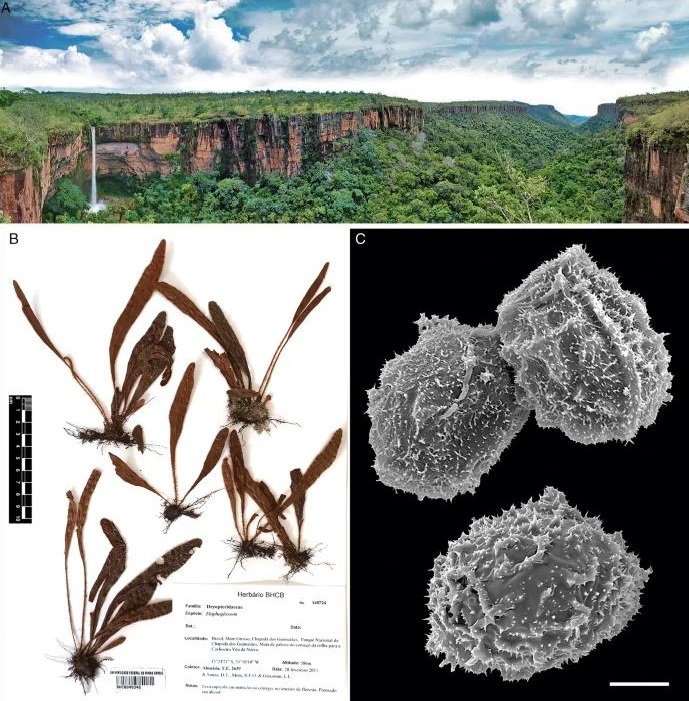
Elaphoglossum matogrossense.
A type locality, Véu de Noiva (Bridal Veil) Waterfall (at left), Chapada dos Guimarães National Park, Municipio de Cuiabá, Mato Grosso, Brazil (photo: robert dona);
B holotype (Almeida et al. 2639, BHCB); C spores (Salino 387, UPCB), scale bar = 10 μm.

Elaphoglossum matogrossense F.B.Matos & A.Vasco sp. nov.

Etymology. The specific epithet matogrossense refers to the Brazilian state of Mato Grosso, from where the new species was discovered.

 
Fernando B. Matos and Alejandra Vasco. 2022. Elaphoglossum matogrossense (Dryopteridaceae), A New and Threatened Species from Chapada dos Guimarães, Mato Grosso, Brazil. Kew Bulletin. 77; 721–728. DOI: doi.org/10.1007/s12225-022-10043-2 [29 July 2022]

Saturday, December 14, 2024

[Botany • 2024] Whittieria hengduanensis (Ophioglossaceae) • A New fern Species from Southwest China demonstrates a unique intercontinental disjunct pattern in plants between the Himalaya and the Americas

 
Whittieria hengduanensis Z.L.Liang & Li Bing Zhang, 

in Liang et Zhang. 2024. 

Abstract
A new fern species, Whittieria hengduanensis (Ophioglossaceae), from Sichuan, Xizang, and Yunnan, Southwest China (eastern Himalaya), is described and illustrated. This species is similar to W. engelmannii in the Americas in having a cylindrical rhizome and complex-reticulate venation. In addition, both species grow in open habitat on basic soil. However, the two species are distinguishable in root number per rhizome and the number of the larger areolae per trophophore. Our molecular study also supports that they are sister to each other but divergent at the molecular level. The discovery of W. hengduanensis shows that the genus is intercontinentally disjunct between the Himalaya and the Americas, a unique pattern not having been documented in the literature.

Key words: Adder’s tongues, fern biogeography, intercontinental disjunctions

Whittieria hengduanensis
A, B habitat C lower portion of plant showing stem and roots D individuals in different sizes E trophophores and sporophore stalks F sporophore G veins showing complex-reticulate venation.

Whittieria hengduanensis 
A, B habit C trophophore and base of sporophore D sporophore spike E veins showing complex-reticulate venation.

 Whittieria hengduanensis Z.L.Liang & Li Bing Zhang, sp. nov.

Diagnosis: Whittieria hengduanensis is similar to W. engelmannii but the former has up to 25 (–50) roots per rhizome and 10–20 large areolae per trophophore, whereas the latter has fewer than 15 roots per rhizome and 0–8 areolae per trophophore.

Etymology: The species epithet henduanensis is based on the distribution of this species in the Hengduan Mountain.


Zhen-Long Liang, Li-Bing Zhang. 2024. Discovery of Whittieria hengduanensis sp. nov. (Ophioglossaceae) from Southwest China demonstrates a unique intercontinental disjunct pattern in plants between the Himalaya and the Americas. PhytoKeys 249: 27-36. DOI: doi.org/10.3897/phytokeys.249.135379 

Friday, June 28, 2024

[Botany • 2024] Cyrtomium adenotrichum (Dryopteridaceae) • A New Species from Guangxi, China


Cyrtomium adenotrichum Y. Nong & R.H. Jiang, 

in Nong, Lei, Zhao, Wei, Xu, Feng, Qu et Jiang, 2024. 
腺毛贯众  ||  DOI: 10.3897/phytokeys.243.127579

Abstract
Cyrtomium adenotrichum Y. Nong & R.H. Jiang (Dryopteridaceae), a new species from Guangxi, China, is described and illustrated. This new species is similar to C. nephrolepioides (Christ) Copel., C. obliquum Ching & K. H. Shing ex K. H. Shing, C. sinningense Ching & K. H. Shing ex K. H. Shing and C. calcis Liang Zhang, N.T.Lu & Li Bing Zhang in having erect rhizomes, dense, leathery lamina and rounded sori, but it can be easily distinguishable by its stipe sparsely glandular, base obvious oblique, basiscopic base truncate, acroscopic base auriculate or ovate.

Key words: Gully, limestone, Nandan, new species, taxonomy


Line drawing of Cyrtomium adenotrichum Y. Nong & R.H. Jiang
 A plant B scale C indusium (Drawn by Xin–Cheng Qu).

Habitat of Cyrtomium adenotrichum Y. Nong & R.H. Jiang on cliffs at a gully
(Photographed by You Nong).

Cyrtomium adenotrichum Y. Nong & R.H. Jiang
A, B plant C, D lamina (adaxially and abaxially view) E, F sori and indusia G, H terminal pinna (adaxially and abaxially view) I lateral pinnae (abaxially view, showing: margins entire and often slightly reflexed) J stipe (sparsely glandular) K curled leaves L, M, N scales O curled leaves (sparsely glandular)
(Photographed and edited by You Nong).

 Cyrtomium adenotrichum Y.Nong & R.H.Jiang, sp. nov.
 
Chinese name: xiàn máo guàn zhòng (腺毛贯众)

Diagnosis: Cyrtomium adenotrichum is similar to C. nephrolepioides, C. obliquum, C. sinningense and C. calcis, but differs in its stipe sparsely glandular (vs. glabrous). In addition, it can be distinguished from C. sinningense by its scale margins fimbriate (vs. dentate), lateral pinnae 5–10 pairs (vs. 1–4 pairs), indusia margins dentate (vs. subentire); it can also be distinguished from C. nephrolepioides by its lateral pinnae 5–10 pairs (vs. 10–26 pairs), base obvious oblique (vs. cordate or sometimes obliquely cordate). It differs from C. obliquum by its scale margins fimbriate (vs. dentate), lateral pinnae 5–10 pairs (vs. 12–21 pairs), indusia margins dentate (vs. entire). It can be distinguished from C. calcis by its base obvious oblique (vs. cordate to hastate), lateral pinnae thin leathery (vs. thick leathery). Comparative morphological differences among all five species are presented in Table 1.

Etymology: The specific epithet refers to the stipe sparsely glandular of the new species.


 You Nong, Li-Qun Lei, Zi-Yi Zhao, Gui-Yuan Wei, Chuan-Gui Xu, Bin Feng, Xin-Cheng Qu and Ri-Hong Jiang. 2024. Cyrtomium adenotrichum (Dryopteridaceae), A New Species from Guangxi, China. PhytoKeys. 243: 199-207. DOI: 10.3897/phytokeys.243.127579

Wednesday, April 17, 2024

[Botany • 2022] Dryopteris gaoligongensis • A Revision of Dryopteris sect. Diclisodon (Dryopteridaceae) based on Morphological and Molecular Evidence with Description of A New Species


 Dryopteris gaoligongensis Z.Y. Zuo, Jin Mei Lu & D.Z. Li, 

in Zuo, Zhao, Du, Xiong, Lu et Li, 2022.
 高黎贡山鳞毛蕨   ||  DOI: 10.1016/j.pld.2021.09.005
 
Highlights: 
• We reconstruct the first phylogeny of Dryopteris sect. Diclisodon using combined plastid regions and nuclear gene AK1.
• A revision of Dryopteris sect. Diclisodon in China is proposed based on morphological and phylogenetic evidence.
• Phylogenetic studies confirm the distinctiveness of Dryopteris gaoligongensis, D. renchangiana, and D. sinonepalensis.
• Our study show that the morphological characteristics of the rhizome should be taken into more account in Dryopteris.

Abstract
Dryopteris sect. Diclisodon is a small section of ferns with about 12 species mainly distributed in East Asia. Here, we carried out morphological and phylogenetic analyses of this section. A new species from southwest China, D. gaoligongensis, is described and illustrated. Dryopteris gaoligongensis resembles D. indonesiana and D. sparsa, but differs by having a creeping rhizome and large 4-pinnate fronds. We also show that D. glabrior Ching & Z.Y. Liu is a distinct species; however, because it is a later homonym of D. glabrior Copel., it should be renamed D. renchangiana. We conclude that a species previously known as D. nitidula, also an illegitimate homonym, should be recognized with a new name, D. sinonepalensis. We resolve the phylogenetic position of D. yoroii as sister to other sampled species of D. sect. Diclisodon. Our phylogenetic analyses confirm the distinctiveness of D. gaoligongensis, D. renchangiana, and D. sinonepalensis. A key to species of D. sect. Diclisodon in China is provided.
 
Keywords: Dryopteris gaoligongensis, Dryopteris renchangiana, Dryopteris sect. Nephrocystis, Dryopteris sinonepalensis, Molecular phylogeny, Nomenclatural novelties

 Dryopteris gaoligongensis Z.Y. Zuo, Jin Mei Lu & D.Z. Li.
A. Habitat and well-developed fronds. B. 4-pinnate lower pinnae. C. The bipinnate-pinnatifid fronds in a young plant. D. Rhizome. E. Sori on ultimate pinnules. F. Scales.

 Dryopteris gaoligongensis Z.Y. Zuo, Jin Mei Lu & D.Z. Li, sp. nov. 
 高黎贡山鳞毛蕨 
【gāo lí gòng shān lín máo jué】

Diagnosis: Dryopteris gaoligongensis is different from other species in D. sect. Diclisodon by being a large plant with a creeping rhizome. It is similar to some species of D. sect. Marginatae (e.g., D. subimpressa Loyal.) in leaf shape. However, it can be identified as a member of D. sect. Diclisodon by typical asymmetrical bases of pinnales, basiscopic pinnule of basal pair of pinnae elongated as pinnatifid.

Etymology: The specific epithet “gaoligongensis” refers to its type locality, the Gaoligong Mountains, on the border of Yunnan of China and Myanmar.


 Zheng-Yu Zuo, Ting Zhao, Xin-Yu Du, Yun Xiong, Jin-Mei Lu and De-Zhu Li. 2022. A Revision of Dryopteris sect. Diclisodon (Dryopteridaceae) based on Morphological and Molecular Evidence with Description of A New Species. Plant Diversity. 44(2); 181-190. DOI: 10.1016/j.pld.2021.09.005

Tuesday, April 16, 2024

[Botany • 2024] Dryopteris jinpingensis (Dryopteridaceae) • A Critically Endangered Diploid New Species from Yunnan, China


Dryopteris jinpingensis  Z.Y.Zuo, Jin Mei Lu & D.Z.Li, 

in Zuo, Lu, C.-Fu. Li et D.-Z. Li, 2024. 
  金平鳞毛蕨  ||  DOI: 10.3897/phytokeys.239.118655

Abstract
Dryopteris jinpingensis, a new species of diploid, sexually reproductive ferns of Dryopteridaceae from Yunnan, southwestern China, is described and illustrated. Morphologically, D. jinpingensis is similar to D. gaoligongensis but unique in elongated lanceolate laminae, sessile or subsessile pinna stalks, and overlapping membranous scales adnate to stipe base. Phylogenetic analyses based on both plastome and the nuclear AK1 gene sequences showed that D. jinpingensis is sister to D. gaoligongensis. A detailed taxonomic description with line drawings is provided, and its conservation status is evaluated to be critically endangered.

Key words: Dryopteris sect. Diclisodon, molecular phylogeny, new species, sexual diploid

 Dryopteris jinpingensis (Z.Y. Zuo 5378)
A habitat B plant C proximal part of the lamina D sori on ultimate pinnules E glandular hairs on the abaxial surface of pinnules F young plant G rhizome H portion of stipe base, showing adnate scale I scales of stipe.

 Dryopteris jinpingensis Z.Y.Zuo, Jin Mei Lu & D.Z.Li, sp. nov.
  金平鳞毛蕨 
(jīn píng lín máo jué)
 
Diagnosis: Dryopteris jinpingensis is similar to D. gaoligongensis with stout and creeping rhizome, 3- to 4-pinnate large frond, and largest and longest basal basiscopic pinnule. However, D. jinpingensis differs from it in the elongated lanceolate lamina, sessile or subsessile pinna stalks (less than 1 cm), and overlapping membranous and thin scales adnate to stipe base.

Etymology: The specific epithet “jinpingensis” refers to its type locality, Jinping County, in the border between south Yunnan of China and Vietnam.

 
 Zheng-Yu Zuo, Jin-Mei Lu, Cun-Fu Li, De-Zhu Li. 2024. Dryopteris jinpingensis, A Critically Endangered Diploid New Species of Dryopteridaceae from Yunnan, China.  PhytoKeys. 239: 195-204. DOI: 10.3897/phytokeys.239.118655

Monday, April 18, 2022

[Botany • 2019] Bolbitis lianhuachihensis (Dryopteridaceae) • A New Species from Taiwan


Bolbitis lianhuachihensis Y.S.Chao, Y.F.Huang, & H.Y.Liu,

in Chao, Huang, Dong, Huang & Liu, 2019. 

Abstract
A new species 
of Bolbitis, B. lianhuachihensis sp. nov., was found in central Taiwan. It most resembles B. virens var. compacta and B. hainanensis. A phylogenetic tree of Taiwanese and other Asian species of Bolbitis species supports the recognition of the new species. Morphologically, the combination of anastomosing venation and fewer sterile pinnae are critical characters to discriminate B. lianhuachihensis from other Taiwanese Bolbitis species. Bolbitis lianhuachihensis can be further distinguished from B. virens var. compacta and B. hainanensis by having lanceolate sterile pinnae and absent or fewer free veinlets in small areoles of sterile pinnae. The morphological descriptions, illustration, ecology and distribution of the new species are presented. A key to all Taiwanese Bolbitis is also provided.

Keywords: Ferns, Taiwan, taxonomy, venation

Bolbitis lianhuachihensis
A habit; note taller fertile fronds (photographed by Y.-S. Chao)
B acrostichoid sori (photographed by P.-F. Lu)
C venation of sterile frond (photographed by Y.-F. Huang).


Bolbitis lianhuachihensis
Y.S.Chao, Y.F.Huang, & H.Y.Liu, sp. nov.
 
Bolbitis virens var. compacta auct. non Hennipman: Knapp, 
Ferns Fern Allies Taiwan: 440. 2011.
  
Bolbitis lianhuachihensis
morphologically resembles B. virens var. compacta and B. hainanensis, from which it is distinguished in having lanceolate sterile pinnae and no free veinlets in areoles of sterile fronds.

Etymology: The specific epithet ‘lianhuachihensis’ refers to the type locality [Lienhuachih, Nantou County].

Common name (assigned here): Lian Hua Chih Shih Jyue (蓮華池實蕨; Chinese name).


 Yi-Shan Chao, Yu-Fang Huang, Shi-Yong Dong, Yao-Moan Huang and Ho-Yih Liu. 2019. Bolbitis lianhuachihensis (Dryopteridaceae), A New Species from Taiwan.  PhytoKeys. 131: 69-81. DOI: 10.3897/phytokeys.131.36548

Tuesday, December 29, 2020

[Botany • 2020] Polystichum asia-minoris (Dryopteridaceae) • A New Fern from Kastamonu, Turkey


Polystichum asia-minoris Tunçkol & Li-Bing Zhang

in Tunçkol, Yaşayacak, ... et Zhang, 2020.

Abstract

A new fern of Polystichum (Dryopteridaceae), Polystichum asia-minoris, is described and illustrated from Horma Canyon in the borders of Küre Mountains National Park in Kastamonu Province located in the north of Turkey. Polystichum asia-minoris is distinguishable from the morphologically similar P. obliquum by having pinnae abaxially densely covered with broad-type microscales. It is not certain to which lineage the new species closely allied. The new species has extremely narrow distribution and is classified as Critically Endangered (CR) following IUCN Red List Criteria.

Keywords: IUCN Red List, Polystichum obliquum, Pteridophytes


Bilge Tunçkol, Hasan Yaşayacak, Zhen-Long Liang, Necmi Aksoy and Li-Bing Zhang. 2020. Polystichum asiae-minoris (Dryopteridaceae), A New Fern from Kastamonu, Turkey. Phytotaxa. 447(4); 293-300. DOI: 10.11646/phytotaxa.447.4.8

Tuesday, August 21, 2018

[Botany • 2018] Eight New Species of Polystichum (subg. Haplopolystichum; Dryopteridaceae) from Limestone Caves in Guangdong and Yunnan, China, with Reference to Species Diversity in the Karst Terrains at High Elevations in Subtropical Areas


Polystichum deltatum

in Han, Liu & Zhang, 2018. 

Abstract
Eight new fern species of Polystichum subg. Haplopolystichum (Dryopteridaceae) are described and illustrated from Guangdong and Yunnan provinces, southern and southwestern China, respectively. These eight species include P. deltatum, P. gejiuense, P. malipoense, P. oblongipinnarum, P. pingbianense, P. rectum, and P. superum from Yunnan, and P. hanmengqii from Guangdong. Four of the eight species are described from high elevations (around 2000 m) demonstrating that the limestone areas at high elevations in subtropical areas are species-rich and deserve special conservation attention. All eight species are so far known only from single caves; they are all classified as Critically Endangered (CR) following IUCN Red List criteria.

Keywords: Pteridophytes, Guangdong, high elevations, limestone caves, Polystichum subg. Haplopolystichum, Yunnan


Meng-Qi Han, Yan Liu and Li-Bing Zhang. 2018. Eight New Species of Polystichum (subg. Haplopolystichum; Dryopteridaceae) from Limestone Caves in Guangdong and Yunnan, China, with Reference to Species Diversity in the Karst Terrains at High Elevations in Subtropical Areas. Phytotaxa. 365(2); 145–168. DOI:  10.11646/phytotaxa.365.2.3