Showing posts with label Sapotaceae. Show all posts

Friday, April 10, 2026

[Botany • 2026] Sarcaulus paujilensis (Sapotaceae: Chyrsophylloideae) • Morphological and Genetic Evidence for the Sarcaulus brasiliensis complex reveals A New Species from the Rainforests of the Middle Magdalena Valley, Colombia


Sarcaulus paujilensis M.A.Jaram. & T. D.Penn.,

in Jaramillo, Pennington, Aymard-Corredor et Majin-Ladino, 2026. 

Abstract
Sarcaulus is a small genus of neotropical trees in the Sapotaceae. Most specimens in herbaria are identified as S. brasiliensis, a species recognized from Costa Rica to Bolivia. Morphological characteristics and molecular sequence data help us to identify a new species of Sarcaulus with hermaphrodite flowers from the Middle Magdalena Valley, Colombia. A complete description, an illustration, a Lancaster plate, information about habitat, phenology, conservation status, and the species name etymology are presented. In addition, a key for identifying Sarcaulus species is provided. Sarcaulus paujilensis is remarkable for its bisexual flowers, in an otherwise predominantly unisexual (plant dioecious) genus. This new finding increases the number of species of the genus in the Neotropical flora to six. More fieldwork and molecular phylogenetics are needed to establish many new taxa.
 
Key words: Chocó Region, Ericales, Flora Neotropical, Flora of Colombia
 
Sarcaulus paujilensis.
A. Flowering branch; B. Seed; C. Fruiting branch; D. Immature fruit; E. Mature fruit; F, G. Transversal section of fresh fruit.
Photos by A. Lizette Sierra, Paula Lara, and Luisa Suarez; B–G. Andrés F. Majín-Ladino.

Sarcaulus paujilensis M.A.Jaram. & T. D.Penn., sp. nov.

Diagnosis. Sarcaulus paujilensis resembles S. oblatus, however, this new species can be differentiated from the latter by having leaves oblanceolate to oblong (vs. elliptic to narrowly oblong-elliptic), petiole 1.7–2.5 cm long (vs. 8–15 mm long), flowers paired (vs. fascicles 5-many-flowered), bisexual (vs unisexual), sepals 5–6 mm (vs. 2.5–3 mm), staminodes ca. 2 mm long (vs. 0.5–1 mm), ovary 1–4-locular, shortly sericeous (vs. 4­5-locular, minutely adpressed puberulent), fruits ca. 50 × 25–30 mm, ovoid (vs. 22–25 × 30–32 mm, oblate), and seeds 25–28 mm long (vs. seeds 17–18 mm long).


M. Alejandra Jaramillo, Terence D. Pennington, Gerardo A. Aymard-Corredor and Andrés F. Majin-Ladino. 2026. Morphological and Genetic Evidence for the Sarcaulus brasiliensis complex (Sapotaceae, Chyrsophylloideae) reveals A New Species from the Rainforests of the Middle Magdalena Valley, Colombia. PhytoKeys. 273: 37-54. DOI: doi.org/10.3897/phytokeys.273.175192  [09 Apr 2026]

Thursday, June 20, 2024

[Botany • 2024] Capurodendron ambanizanense, C. vulcanicola, ... • A Phylogenomic Reconstruction of the Endangered Malagasy Tree Genus Capurodendron (Sapotaceae) with Nine New Species and an Identification Key


[A-C] Capurodendron christeae Boluda & L. Gaut., 
[E-G] Capurodendron sommerae Boluda, Naciri & L. Gaut., 
Capurodendron vulcanicola Boluda & L. Gaut.,  

in Boluda, Naciri et Gautier, 2024.
Photographs by C. G. Boluda; P. Ranirison; S. D. Ramandimbimanana. 
Drawings: G. Loza

Abstract
Capurodendron is the second largest endemic genus of vascular plants in Madagascar. It comprises mainly trees that are frequently logged for their valued wood. This, together with deforestation, led to 76% of the known species being Endangered or Critically Endangered. However, a confident species identification is often not possible with the current available literature and many morphotypes do not fit any described taxa, which has impeded the implementation of conservation measures. We performed a phylogenomic revision studying c. 900 collections morphologically, and sequencing 638 nuclear genetic markers of 180 representative specimens up to 90 years old, including all the described species and some undescribed morphotypes. Our results show that Capurodendron may contain up to 21 undescribed species in addition to the 35 already known. Nine of these are confirmed as valid species supported by genetic, morphological, and ecological data, and we describe them here (Capurodendron ainae, C. ambanizanense, C. antilahimenae, C. christeae, C. nataliae, C. ratovosonii, C. razakamalalae, C. sommerae, and C. vulcanicola). For the remaining 12 candidate new species, three are genetically analysed but require more sampling, and nine are only supported by morphological and ecological data so far, and therefore require genetic analyses to confirm their validity. For practical purposes and to assist with conservation assessments we provide an identification key, based mainly on vegetative characters, that also include the undescribed species.

conservation assessments, endangered species, gene capture, Madagascar, precious timbers, target capture

Capurodendron ainae (A--B, Gautier et al. 7035; C, Randriarisoa 75). A, Mature bark; B, leaves; C, pre- and post-anthesis flowers.
Capurodendron ambanizanense (Gautier et al. 5520): D, slashed trunk.
  Capurodendron nataliae (Randrianaivo & Boluda 3175): E, slashed trunk; F, branch with leaves highlighting the plagiotropic arrangement; G, adaxial side of leaves; and H, abaxial side of leaves.
Photographs C. G. Boluda (A--B, E--H); A. Randriarisoa (C); L. Gautier (D).

Capurodendron christeae (A--C, Gautier7051; D; Ranirison & Nusbaumer 1029 [both collections from the same individual]). A, Slashed trunk; B, adaxial side of the leaves; C, abaxial side of a leaf; D, flower.
Capurodendron sommerae
 (Ramandimbimanana & Randimbiarison 260): E, slashed trunk; F, branch with fruits; and G, fruit, post-anthesis calyx, and leaves.
Photographs C. G. Boluda (A--C); P. Ranirison (D); S. D. Ramandimbimanana (E--G). 
Capurodendron vulcanicola Boluda & L. Gaut. (Ramandimbimanana 388). A, Branch with fruit; and B, fruit.
 

Carlos G. Boluda, Yamama Naciri and Laurent Gautier. 2024. A Phylogenomic Reconstruction of the Endangered Malagasy Tree Genus Capurodendron (Sapotaceae) with Nine New Species and an Identification Key. Botanical Journal of the Linnean Society. 205(2); 85–115, DOI: 10.1093/botlinnean/boad073

Thursday, January 18, 2024

[Botany • 2023] Bemangidia frankliniae (Sapotaceae) • A Taxonomic Revision of the Madagascar-endemic Genus Bemangidia, with Description of A Second Species


Bemangidia frankliniae Boluda & L.Gaut., 

in Boluda, Randriarisoa, Naciri et Gautier, 2023.

Abstract
Bemangidia L.Gaut. (Sapotaceae) is a genus endemic to a restricted area in the southeastern lowland moist evergreen forests of Madagascar. It was published in 2013 to accommodate an undescribed species, Bemangidia lowryi L.Gaut., which showed a combination of characters unique in the family Sapotaceae. At the time of description, three atypical collections from the same locality but growing on a ridge, slightly higher in altitude, were already known. Although matching well with the Bemangidia genus, they were phenotypically different from B. lowryi and were therefore not included in the species description. In the present study, we evaluate whether these specimens correspond to a new species, using a combination of morphological and genetic data based on 638 nuclear genes. The results show that Bemangidia contains two lineages, each one corresponding to a different morphology, with a genetic branch length similar to those observed among species pairs in other genera of Sapotaceae. We conclude that the genetic and  morphological differences are sufficient to consider the two lineages as two distinct species. Consequently, the genus is here revised and a second species described.

Keywords: Bemangidia, critically endangered, Madagascar, new species, Sapotaceae

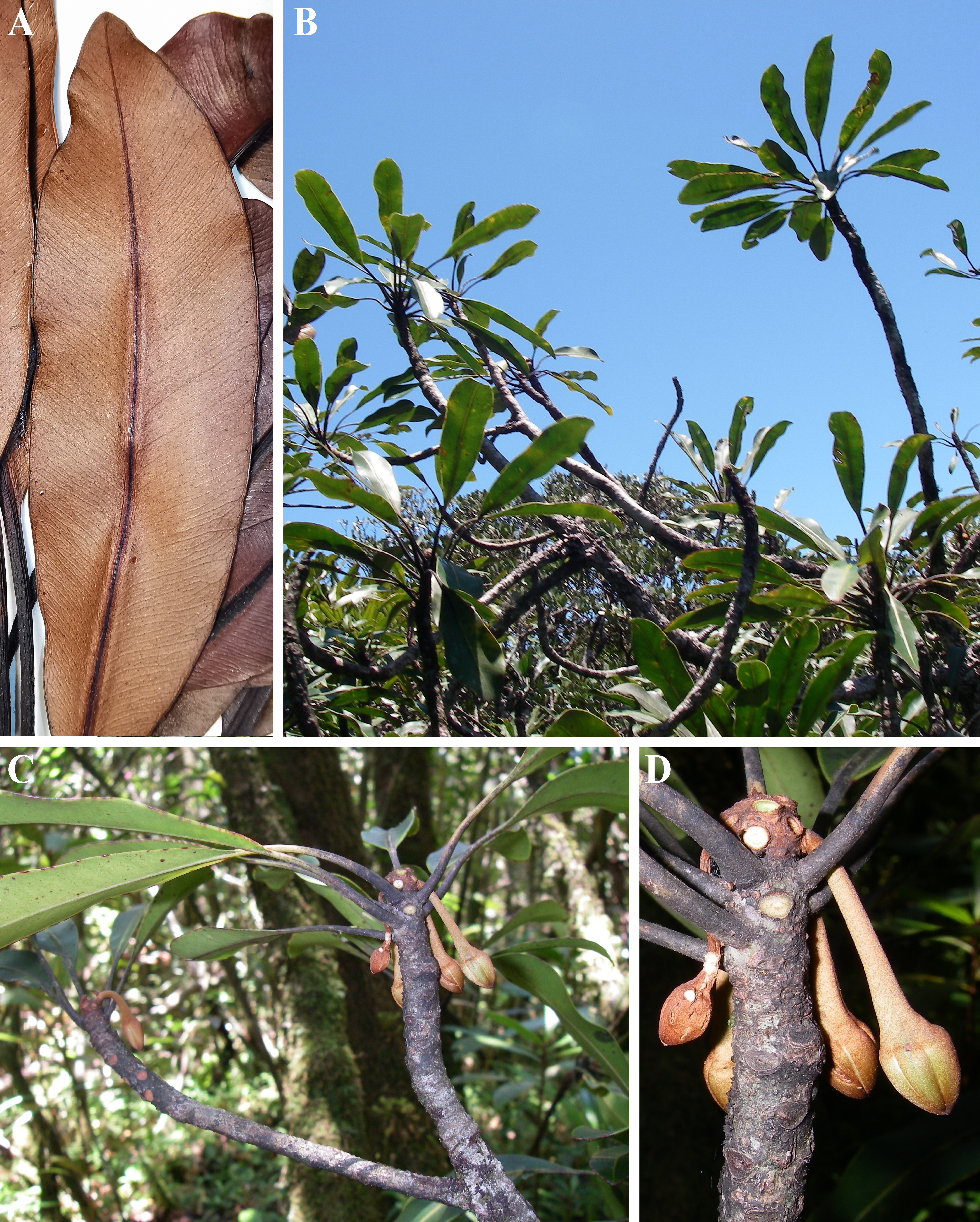
Bemangidia frankliniae Boluda & L.Gaut.
A, Detail of the abaxial surface of a dried leaf; B, tree upper branches; C, detail of a flowering branch; D, flower buds.
Photographs: A (the type specimen, Razakamalala et al. 3976), Carlos G. Boluda; B–D (Gautier 5790), L. Gautier.

Bemangidia frankliniae Boluda & L.Gaut., sp. nov.

Differs from the only other known species in the genus, Bemangidia lowryi, by its smaller stipules (1–3.5 mm vs c.8 mm), its smaller leaf lamina (4.3–14 × 1.4–3.5 cm vs 18–22 × 6–6.5 cm), the apex usually acute (vs mostly rounded), the midrib raised on the adaxial surface (vs nearly flat to depressed), depressed or rarely slightly raised on the abaxial surface (vs strongly raised), its faintly raised to flat lateral veins (vs raised and forming a conspicuous striate surface), the less numerous lateral veins (70–145 vs 175–330) forming an angle of 45°–60° with the midrib (vs 70°–90°), and its smaller sepals (12 mm vs > 20 mm)

Etymology. The specific epithet honours the Franklinia Foundation, a non-governmental organisation dedicated to the conservation of trees, which founded the project ‘Understanding Malagasy Sapotaceae, a critical step towards conservation of a threatened group of prime importance trees’, in the framework of which this species is described.


C.G. Boluda, A. Randriarisoa, Y. Naciri and L. Gautier. 2023. A Taxonomic Revision of the Madagascar-endemic Genus Bemangidia (Sapotaceae), with Description of A Second Species. EDINBURGH JOURNAL OF BOTANY. 80, 1996. DOI: 10.24823/ejb.2023.1996

Wednesday, February 22, 2023

[Botany • 2022] Madhuca kanchanaburiensis (Sapotaceae) • A New Species from Thailand


  Madhuca kanchanaburiensis Chantar., Kunasit & Kladwong, 

in Chantaranothai, Kunasit & Kladwong, 2022.
มะซางกาญจน์  ||  DOI: 10.11646/phytotaxa.574.2.6

Abstract
A new species of Madhuca from Thailand, M. kanchanaburiensis is described and illustrated. The species appears most similar to M. malaccensis and M. punctata, but differs in having conspicuous secondary veins toward the leaf margin, woolly filaments and longer corolla. The vernacular name and conservational status of this endemic species are also provided.

Keywords: endemic, Sapotoideae, Kanchanaburi, Eudicots


มะซางกาญจน์ 
Madhuca kanchanaburiensis Chantar., Kunasit & Kladwong


Pranom Chantaranothai, Pongsakorn Kunasit and Pornchai Kladwong. 2022. Madhuca kanchanaburiensis (Sapotaceae), A New Species from Thailand. Phytotaxa. 574(2); 173-178. DOI: 10.11646/phytotaxa.574.2.6

นักวิจัยคณะวิทยาศาสตร์ มข. ค้นพบพืชชนิดใหม่ของโลก

Monday, August 8, 2022

[Botany • 2021] Madhuca balakrishnanii (Sapotaceae) • A New Species from Kerala, India


Madhuca balakrishnanii E.S.S.Kumar, Shailajakumari & Shareef, 

in Kumar, Shailajakumari & Shareef, 2022.

Abstract
Madhuca balakrishnanii (Sapotaceae), a new species from Kerala is here described with photographs. It is most closely similar to M. diplostemon and M. insignis but differs in having long stipules, sparsely hairy pedicels, abaxially hairy inner sepals, shorter corolla tubes with oblong lobes, fairly long densely hairy staminal filaments, shorter styles and ovoid fruits. The IUCN conservation status, ecology, distribution and phenology along with a key for the identification of Madhuca species in the Western Ghats is provided.
 
Keywords: Endemic, Western Ghats, Kerala, Indian flora, Novelty, Eudicots

Madhuca balakrishnanii E.S.S.Kumar, Shailajakumari & Shareef. 
A. Habit, B. Stipule, C. Leaves, D. Twig with flowers and fruits, E. Single flower, F. Calyces and style, G. Outer sepal, H & I. Inner sepal-outer and inner view, J. Petal, K. View of stamens and petals, L. Single stamen, M. Ovary, N & O. T.S.of ovary showing ovules, P. Seeds, Q. Fruiting twig.
(Photographs by E.s. santhosh Kumar)

Madhuca balakrishnanii E.S.S.Kumar, Shailajakumari & Shareef, sp.nov.

Diagnosis:— Madhuca balakrishnanii is easily distinguished from the two allied species, M. diplostemon and M. insignis by its hairy young shoots, fairly long stipules, sparsely hairy pedicels, inner sepals rufous hairy abaxially, shorter corolla tube, fairly long densely hairy staminal filaments, shorter style and ovoid fruit (Table 1). 

Etymology:— The new species is named after Late Mr. Balakrishna Pillai (Madathinal Thekkathil, Muzhangodi, Karunagappally, Kollam, Kerala) who preserved this tree species in his premises as ‘star tree’ for several years. 


Ettickal Sukumaran Santhosh Kumar, Sreedharan Shailajakumari and Sainudeen Muhammed Shareef. 2022. Madhuca balakrishnanii (Sapotaceae), A New Species from Kerala, India.  Phytotaxa510(1); 78–82. DOI: 10.11646/phytotaxa.510.1.8 

Wednesday, March 30, 2022

[Botany • 2022] Capurodendron andrafiamenae, C. sakarivorum, etc. (Sapotaceae) • A 638-gene Phylogeny supports the Recognition of Twice as many Species in the Malagasy Endemic Genus Capurodendron


[A] Capurodendron naciriae,
C. andrafiamenae
[H-J] C. sakarivorum
 L.Gaut & Boluda, 

in Boluda, Christe, Naciri & Gautier, 2022. 

Abstract
The Malagasy genus Capurodendron currently accommodates 26 described species and is the largest genus of the family Sapotaceae in Madagascar. These species are frequently logged because of their valued hardwood, which potentially puts them at risk of extinction. Species-level identifications are often problematic, and this hinders both an accurate assessment of their conservation status and the development of effective protection measures. We sorted all the material (ca. 860 collections) available in the herbaria with significant collections for Madagascar into 47 putative species based on morphology. On 41 of these, for which we were able to retrieve suitable DNA, we conducted a phylogenetic reconstruction based on molecular sequences of 638 loci from 108 Capurodendron specimens, performing a target capture approach combined with next-generation sequencing. Maximum likelihood (RAxML), pseudocoalescence (ASTRAL), and coalescence (STACEY) analyses showed that Capurodendron comprises two deeply divergent lineages. One, which includes a single species, is here newly described as C. subg. Reflexisepala based on its distinctive morphology. The second lineage contains all remaining species, which seem to have resulted from a rapid radiation event. The phylogenetic tree provides good support for most of the species hypothesized based on morphology, with the exception of two species-groups that we have named the Arid Complex and the Eastern Complex. As many as 20 species-level lineages genetically distinct from any of the currently recognized species were identified, 17 of which were morphologically well-characterized, representing strong candidates for new species. This would suggest that Capurodendron is the most species-rich endemic genus of plants in Madagascar. While 14 of these 20 clades are still under study, we here describe six species new to scienceCapurodendron andrafiamenae (provisionally assessed as CR), C. aubrevillei (VU), C. birkinshawii (CR), C. naciriae (EN), C. randrianaivoi (CR), and C. sakarivorum (EN). Capurodendron oblongifolium comb. nov. (EN), previously regarded as a variety of C. perrieri, represents a distinct lineage that is here recognized at the species level. The newly described species are illustrated by line drawings and photographs from the field, and a preliminary threat assessment is provided. We discuss the evolutionary history of Capurodendron and also explore the question of node age estimates and their methodological limitations.

Keywords: Capurodendron, Madagascar, NGS, new species, node age estimation, phylogenomics, Sapotaceae, target capture
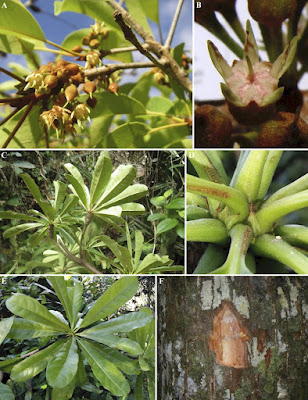

Capurodendron andrafiamenae:
A, Flower fascicles (Gautier 5395); B, Flower detail (Burivalova 138). C. aubrevillei: C, Twig showing Aubréville's branching pattern and thickened apices (Gautier 5544); D, Detail of the stipules among the petioles (Randriarisoa 125); E, Young leaves (Randriarisoa 125); F, Bark with a slash showing some latex and the external wood color (Gautier 6024).
— Photos: A, C & F by Laurent Gautier; B by Zuzana Burivalova; D & E by Carlos G. Boluda.

Capurodendron andrafiamenae.
A, Flowering branch; B, Leaf (upper surface); C, Leaf (lower surface); D, Flower; E, Flower in longitudinal section; F, Outer side of a detached corolla spread and opened, with a lobe folded down showing a stamen; G, Inner side of a detached corolla spread and opened; H, Fruit; I, Lateral view of a seed; J, Ventral view of a seed. — Drawing: Gabriela Loza.


Capurodendron Aubrév. in Adansonia, sér. 2, 2: 92. 1962.

Capurodendron subg. Reflexisepala Boluda & L.Gaut., subg. nov. 

– Type: Capurodendron madagascariense (Lecomte) Aubrév.
 (≡ Sideroxylon madagascariense Lecomte).


Capurodendron Aubrév. subg. Capurodendron

Capurodendron andrafiamenae L.Gaut & Boluda, sp. nov. 

Diagnosis: Capurodendron andrafiamenae differs from the vegetatively most similar species C. greveanum by the young shoots and petioles covered by rusty trichomes (vs. green and glabrous in Cgreveanum), the longer pedicels (7–11 vs. 5 mm), the longer sepals (4.5 vs. 3.5 mm), the longer corolla lobes (5.4 vs. 3 mm), and the glabrous (vs. pubescent) ovary.

Etymology: The specific epithet refers to the Andrafiamena forest, where the new species was found, now part of the Andrafiamena-Andavakoera protected area, managed by the NGO Fanamby.

Distribution, ecology and phenology: Capurodendron andrafiamenae is only known from the type locality in the north of Madagascar, in dense humid semi-deciduous forest on sandstone from 360 to 540 m asl (Fig. 7). The two collections have flowers and were collected in November and December, the earlier one also bearing fruit from the previous season's flowering.


Capurodendron aubrevillei L.Gaut & Boluda, sp. nov. 

Diagnosis: Capurodendron aubrevillei differs from other Capurodendron species with marked Aubréville growth pattern and brachyblasts by its oblanceolate, almost glabrous and flat leaves (vs. pubescent and more or less bullate or with markedly raised secondaries on the lower surface in C. antongiliense, C. birkinshawii, C. schatzii, and C. nodosum).

Etymology: This species is dedicated to André Aubréville, professor at the Muséum National d'Histoire Naturelle in Paris, a famous and sagacious taxonomist of Sapotaceae, and author of the corresponding volume of the Flore de Madagascar et des Comores (Aubréville, 1974). The Aubréville growth pattern, dominant in the Sapotaceae family and particularly evident in this species, was also named in his honor (Hallé & al., 1978).

Distribution, ecology and phenology: Capurodendron aubrevillei is found in lowland moist evergreen forests, from the Masoala Peninsula southwards to Foulpointe, from ca. 80 to 400 m elevation (Fig. 7). This very distinctive species has been collected from November to February so far, but never in fertile condition.


Capurodendron birkinshawii L.Gaut & Boluda, sp. nov. 

Diagnosis: Capurodendron birkinshawii resembles C. nodosum by the arrangement of its leaves at the apex of short brachyblasts, but differs by its glabrous ovary, the villous stamen filaments, larger stipules, its broadly rounded to subcordate leaf base (vs. obtuse), its bullate leaf lamina, and the higher number of secondary veins (12–14 vs. 8–12).

Etymology: This species honors Chris Birkinshaw, of the Missouri Botanical Garden's Madagascar Program, who collected the type specimen, in recognition of his dedication to the conservation of the Malagasy flora and the training of national botanists.


Capurodendron naciriae: A, Flower; B, Leaf; C, Fruit (Gautier 6036).
C. oblongifolium: D, Branch with fruits (Randrianaivo 3349); E, Corolla being expulsed by the calyx contraction (Frank Rakotonasolo, not collected).
C. randrianaivoi: F, Underside of a leaf with remains of a flower (Randriarisoa 25); G, Twig with mature and growing leaves (Randriarisoa 50).
C. sakarivorum: H, Flowering branch (Nusbaumer 1510); I, Flower clusters (Ranirison 1095), J, Immature fruits (Nusbaumer 1902).
— Photos: A–C by Laurent Gautier; D by Richard Randrianaivo; E by Frank Rakotonasolo; F & G by Aina Randriarisoa; H–J by Louis Nusbaumer.

Capurodendron naciriae L.Gaut & Boluda, sp. nov. 

Diagnosis: Capurodendron naciriae resembles C. ludiifolium in its vegetative characters, especially the size and venation pattern of its leaves. It differs however by its smaller fruits (15–18 × 9–11 vs. 28–38 × 15–21 mm) that are ovoid (vs. elliptic), its larger calyx lobes, at least at fruiting stage, and its distinctly petiolate leaves (vs. subsessile).

Etymology: This species is dedicated to our colleague and friend Yamama Naciri of the Conservatoire et Jardin botaniques de la Ville de Genève, who was part of the collecting team and is deeply involved in our present efforts to resolve Malagasy Sapotaceae taxonomy and systematics by providing invaluable knowledge in population genetics and molecular phylogeny.

Distribution, ecology and phenology: Capurodendron naciriae is only known from northern Madagascar from: the littoral dry forest on sand at Analabe, near Lac Sahaka; the dry deciduous forest of Bobankora and Bekaraoka, 20 km inland; and forest remnants a few kilometers northwest of Vohémar (Fig. 7). Flowers were observed from October to January, and fruit in November.


Capurodendron randrianaivoi L.Gaut & Boluda, sp. nov. 

Diagnosis: Capurodendron randrianaivoi is vegetatively similar to C. sakarivorum, but differs by its leaf blade length/petiole length ratio of 7–14 (vs. 2–5), its secondary and tertiary veins that have the same green color as the lamina in living specimens (vs. pale green), its usually lower number of secondaries (5–11 vs. 9–13), its staminodes that are glabrous in the central part of their outer side (vs. pubescent), and its beaked fruit with ridges (vs. non-beaked and without ridges).

Etymology: It is a pleasure to dedicate this species to our colleague and friend Richard Randrianaivo, of the Missouri Botanical Garden's Madagascar Program, who was the first to collect the species in flower, in recognition of his extensive knowledge of Sapotaceae, and in appreciation of the many fine moments we shared while collecting Sapotaceae in the field.

Distribution, ecology and phenology: Capurodendron randrianaivoi is only known from the extreme north of Madagascar, in dry deciduous forest, including in littoral sites (Fig. 7). It flowers from December to February, and the only specimen in fruit was collected in December.


Capurodendron sakarivorum L.Gaut & Boluda, sp. nov.

Diagnosis: Capurodendron sakarivorum is vegetatively similar to C. ankaranense Aubrév., especially in leaf blade shape, dimension and venation, but differs by its stipules, which are lacking or scale-like, inconspicuous and pubescent (vs. linear, 2 mm long, and glabrescent), its shorter petiole (ratio leaf blade length/petiole length of 4.2–8 vs. 2–5), its villous sepals and pedicels (vs. glabrous or with rare scattered trichomes), and its staminodes with the outer side densely villous (vs. glabrous toward the middle).

Etymology: This species is named after the Malagasy word “sakarivo”, which means “blood brother” to honor Patrick Ranirison and Louis Nusbaumer, two former Ph.D. students at Antananarivo and Geneva Universities, respectively, who have both collected this new species. They worked hand in hand for three consecutive seasons in the forest fragments around the municipality of Daraina. They contributed greatly to our knowledge of the flora and vegetation of this area, and to the official recognition of the entire region as the Loky Manambato protected area. At the end of their field work together, they decided to sacralize their friendship through the traditional ceremony of becoming blood brothers.

Distribution, ecology and phenology: Capurodendron sakarivorum is only known from northern Madagascar, in the deciduous forests of the Loky-Manambato protected area (previously Daraina), on laterite or sands (Fig. 7). Flowering recorded from January to February, fruiting starting in January.


Capurodendron oblongifolium (Lecomte) L.Gaut. & Boluda, comb. & stat. nov.


Carlos G. Boluda, Camille Christe, Yamama Naciri and Laurent Gautier. 2022. A 638-gene Phylogeny supports the Recognition of Twice as many Species in the Malagasy Endemic Genus Capurodendron (Sapotaceae). TAXON. DOI: 10.1002/tax.12676

Thursday, October 17, 2019

[Botany • 2019] Synsepalum chimanimani (Sapotaceae) • A New Species from the Chimanimani Mountains of Mozambique and Zimbabwe, with Notes on the Botanical Importance of This Area


Synsepalum chimanimani S.Rokni & I.Darbysh.

in Rokni, Wursten & Darbyshire, 2019.

Abstract
Synsepalum chimanimani S.Rokni & I.Darbysh., sp. nov., a small tree endemic to the forests of the southern foothills of the Chimanimani Mountains of Mozambique and Zimbabwe, is described and illustrated. The differences in morphology and distribution between the new species and the related S. kaessneri and S. muelleri, with which it has been confused, are clarified. The new species is globally Endangered due to ongoing habitat loss within its restricted range. The botanical importance and conservation of the Chimanimani foothills is also discussed, and they are highlighted as a candidate Important Plant Area.

Keywords: conservation, herbarium, Important Plant Area, Makurupini, taxonomy


Figure 1. Synsepalum chimanimani (A-K) and Synsepalum kaessneri (L)
A habit B stem apex with apical buds/young leaves and petioles showing indumentum C medifixed hairs on stem D abaxial leaf surface showing sparse medifixed hairs on midrib E leaf showing (faint) secondary veins F flower cluster showing bud, open flower and partially opened flower G flower, side view (hydrated) H corolla after removal of two petals and stamens (hydrated) I stamen and staminodes in situ on petal, inner face bases of neighbouring petals shown J side view of stamen and petal (staminodes omitted) K immature fruit (from photograph) 
L leaf (abaxial) of Synsepalum kaessneri

A, D-K drawn from B.T. Wursten BW897 (BR0000020700003) B, C from Timberlake et al. 6197 (K001291035) L drawn from Magogo & Glover 280 (K). Scale bars: 1mm (Single bar); 2 mm and 5 mm (graduated single bar); 1 cm (double bar); 5 cm (graduated double bar). 
Drawn by Andrew Brown, November 2018.

Figure 2. Synsepalum chimanimani 
A habit and leaves B, C flowering stems D flowers E immature fruit
(Photographs by Bart Wursten).

Synsepalum chimanimani S.Rokni & I.Darbysh., sp. nov.

Diagnosis: This species differs from Synsepalum kaessneri (Engl.) T.D.Penn. in the generally smaller (7.9–12.6 x 1.7–3.4 cm versus 9.8–16.7 x 2.8–5.2 cm) narrowly elliptic leaves with a long and narrow acuminate tip versus oblanceolate leaves with a short and broad acuminate tip (see illustration, Fig. 1E, L); flowers sessile or almost so with pedicels less than 1 mm long (extending to 2 mm long in fruit) versus flowers stalked with pedicels 1–3 mm long (extending to 3–5 mm in fruit); shorter corolla tube (0.75–0.8 mm long versus 1.2 mm long) and shorter (1.45–1.5 mm versus 1.8–1.9 mm), broadly ovate versus ovate corolla lobes; anthers with elliptic thecae with a minute, inconspicuous point at the apex of the connective versus arrow-head shaped anthers with oblong thecae with a conspicuous apiculate apex to the connective. Table 1 shows the distinguishing characters between the two species.

Etymology: The specific epithet is taken from the Chimanimani mountains to which the species is confined.


 Saba Rokni, Bart Wursten and Iain Darbyshire. 2019. Synsepalum chimanimani (Sapotaceae), A New Species from the Chimanimani Mountains of Mozambique and Zimbabwe, with Notes on the Botanical Importance of This Area. PhytoKeys. 133: 115-132. DOI: 10.3897/phytokeys.133.38694