Showing posts with label Author: L. Cavin. Show all posts

Friday, November 8, 2024

[PaleoIchthyology • 2024] Graulia branchiodonta • The most detailed anatomical reconstruction of a Mesozoic coelacanth


Graulia branchiodonta
Manuelli, Mondéjar Fernández, Dollman, Jakata & Cavin, 2024


Abstract
Although the split of coelacanths from other sarcopterygians is ancient, around 420 million years ago, the taxic diversity and the morphological disparity of the clade have remained relatively low, with a few exceptions. This supposedly slow evolutionary pace has earned the extant coelacanth Latimeria the nickname “living fossil”. This status generated much interest in both extinct and extant coelacanths leading to the production of numerous anatomical studies. However, detailed descriptions of extinct taxa are made difficult due to the quality of the fossil material which generally prevents fine comparisons with the extant Latimeria. Here we describe a new genus and species of coelacanth, Graulia branchiodonta gen. et sp. nov. from the Middle Triassic of Eastern France, based on microtomographical imaging using synchrotron radiation. Through exquisite 3D preservation of the specimens, we reconstructed the skeletal anatomy of this new species at an unprecedented level of detail for an extinct coelacanth, and barely achieved for the extant Latimeria. In particular, we identified a well-developed trilobed ossified lung whose function is still uncertain. The skeletal anatomy of G. branchiodonta displays the general Bauplan of Mesozoic coelacanths and a phylogenetic analysis resolved it as a basal Mawsoniidae, shedding light on the early diversification of one of the two major lineages of Mesozoic coelacanths. However, despite its exquisite preservation, G. branchiodonta carries a weak phylogenetic signal, highlighting that the sudden radiation of coelacanths in the Early and Middle Triassic makes it currently difficult to detect synapomorphies and resolve phylogenetic interrelationships among coelacanths in the aftermath of the great Permo-Triassic biodiversity crisis.

Graulia branchiodonta gen. et sp. nov.
Photographs of the specimens in laterodorsal view.
(A) MHNG GEPI V5787, holotype. (B) MHNG GEPI V5788.

Systematic paleontology
Class OSTEICHTHYES Huxley, 1880
Subclass SARCOPTERYGII Romer, 1955
Infraclass ACTINISTIA Cope, 1891

Order COELACANTHIFORMES Huxley, 1861
Suborder LATIMERIOIDEI Schultze, 1993

Family MAWSONIIDAE Schultze, 1993

Graulia branchiodonta gen. et sp. nov. 

Holotype: MHNG GEPI V5787, complete specimen

Diagnosis: Mawsoniid coelacanth characterized by the following association of characters: anteromedial process of the posterior parietal present; one pair of lateral extrascapulars; few pores at the sutural contact with bones enclosing the supraorbital sensory canal.; the presence of anterior branches of the supratemporal commissure; a preoperculum with an anterior blade-like portion; a simple anterior end of the lachrymojugal; the infraorbital sensory canal running at the anterior margin of the postorbital; long teeth on the ceratobranchial tooth plates; denticles on the rays of the first dorsal fin and on the first rays of the dorsal lobe of the caudal fin; tri-lobed unpaired lung; scales ornamented with pointed small tubercles. Only known species, same diagnosis as for the genus.

Locality: Sarraltroff, 57400 Moselle, Grand Est, France.

Etymology: The genus name Graulia refers to the Graoully, Graouli or Graully, a mythical dragon from the folklore of Lorraine, the region of France where the specimens were found. The species name branchiodonta, from the greek βράγχια gills” and ὀδούς, ὀδόντος tooth” refers to the large teeth found on the ceratobranchials.

Graulia branchiodonta gen. et sp. nov., interpretative body reconstructions and detailed skull drawings in lateral view.
(A) body profile. (B) lateral view of skull and pectoral girdle. (C) lateral view of skull and pectoral girdle with neurocranium highlighted. (D) lateral view of skull and pectoral girdle with palate and hyobranchial skeleton highlighted.

 
Luigi Manuelli, Jorge Mondéjar Fernández, Kathleen Dollman, Kudakwashe Jakata and Lionel Cavin. 2024.   The most detailed anatomical reconstruction of a Mesozoic coelacanth. PLoS ONE. 19(11): e0312026. DOI: doi.org/10.1371/journal.pone.0312026 

Tuesday, August 6, 2024

[PaleoIchthyology • 2024] Ferganoceratodus edwardsi • A New Lungfish (Sarcopterygii: Dipnoi) from the Upper Triassic of the Mid-Zambezi Basin, Zimbabwe


Ferganoceratodus edwardsi
Challands, Cavin, Zondo, Munyikwa, Choiniere & Barrett, 2024

Geographic and stratigraphic distributions of Ferganoceratodus spp. and Ptychoceratodus serratus.


ABSTRACT
The lungfish, the extant sister group of the tetrapods, have an evolutionary history illustrated by a fossil record extending for ∼420 million years. The post-Paleozoic fossil record of the clade is almost exclusively restricted to sediments deposited in freshwater paleoenvironments and is characterized by an abundance of highly mineralized tooth plates, whereas cranial and postcranial remains are scarce. Here, we report a sample of isolated tooth plates found in the Upper Triassic Pebbly Arkose Formation of the Mid-Zambezi Basin, Zimbabwe. It consists of pterygoid and prearticular tooth plates from adult individuals, plus some dental plates referred to juvenile individuals, which we refer to a new species of Ferganoceratodus. This discovery provides an opportunity to review briefly the tooth plates of the ‘ptychoceratodontid morphotype’ reported from around the world. We discuss how various occurrences previously referred to Ptychoceratodus may be more appropriately referred, with caution, to Ferganoceratodus. We also describe the histology of the tooth plates of the new species and note similarities with other Mesozoic taxa. The scarcity of histological data for Mesozoic lungfish tooth plates compounds the problem of assigning isolated tooth plates to genus and species level. Ferganoceratodus and closely related taxa arose in the Early Triassic in southern Gondwana and diversified worldwide in the Late Triassic. The genus then became more common in Laurasia during the Jurassic and Early Cretaceous and declined thereafter with relict Late Cretaceous occurrences in Madagascar and South America.

 Ferganoceratodus edwardsi. A-E, upper tooth plates; F-J, lower tooth plates. A-B, NHMZ 2432(9), holotype in labial and occlusal views. Arrowhead indicates the surface for a potential symphyseal contact; C, NHMZ 2432(6); D, NHMZ 2432(13); E, NHMZ 2432(5); F, NHMZ 2432(1), juvenile; G, NHMZ 2432(2), juvenile; H, NHMZ 2432(12); I, NMHZ 2432(11); J, NHMZ 2432(14); K, NHMZ 2432(4), juvenile. Scale bars equal 10 mm.


Subclass SARCOPTERYGII Romer, Citation1955
Order DIPNOI Müller, Citation1845
Suborder CERATODONTOIDEI Nikolski, Citation1954 sensu Kemp et al., Citation2017

Family incertae sedis

Genus FERGANOCERATODUS Nessov and Kaznyshkin, Citation1985

FERGANOCERATODUS EDWARDSI sp. nov.

Etymology—Named in honor of Mr. Steve Edwards, discoverer of ‘The Dentists’ and other Late Triassic field sites in Matusadona National Park, who collected the specimens described herein.


Geographic and stratigraphic distributions of Ferganoceratodus spp. and Ptychoceratodus serratus.

 
Tom J. Challands, Lionel Cavin, Michel Zondo, Darlington Munyikwa, Jonah N. Choiniere and Paul M. Barrett. 2024. A New Lungfish from the Upper Triassic of the Mid-Zambezi Basin, Zimbabwe. Journal of Vertebrate Paleontology.  e2365391. DOI: doi.org/10.1080/02724634.2024.2365391  

Friday, December 22, 2023

[PaleoIchthyology • 2023] Rhamphoichthys taxidiotis • The First articulated Skeletons of enigmatic Late Cretaceous Billfish-like Actinopterygians (Tselfatiiformes: Plethodidae)


 Rhamphoichthys taxidiotis
El Hossny, Cavin, Kaplan, Schwermann, Samankassou & Friedman. 2023
 
Artwork by Sky Jung.
 
Abstract
Only few candidates of Mesozoic fishes with a similar body plan and ecological niche to the modern billfishes are suggested as their analogues. Several specimens were recovered from Cenomanian deposits in Germany and Lebanon and display a billfish-like fusiform body with elongated premaxillae. They are found close to the plethodids and show a unique combination of characters (rostrum pointed and extremely elongated, double articular head of the quadrate, anteroposteriorly elongated abdominal centra indicating a slender body and different types of scales on the body) allowing their inclusion in a new genus. Two ‘Protosphyraena’ species are also assigned to this new genus. This fish can be considered as an ecological analogue to the extant xiphioids sharing their feeding habits. This fish was abundant and roamed, as an apex predator, the Central Tethys and the Boreal realms during the Cenomanian.

Keywords: ecological analogue, Cenomanian, billfishes, Protosphyraena, Plethodidae, Rhamphoichthys taxidiotis
 

 Cranial anatomy of  Rhamphoichthys taxidiotis gen. et sp. nov., holotype WMNM P 48342.
(a) Photograph of the skull in left lateral view. (b) Interpretive line drawing of (a).
Ang-rart, angulo-retroarticular; Ao, antorbital; Art, articular; Asp, autosphenotic; Br.r, branchiostegal rays; Ce.a, anterior ceratohyal; Cl, cleithrum; Cor, coracoid; Den, dentary; d.f, dilatator fossa; Dsp, dermosphenotic; Ecp, ectopterygoid; Enp, endopterygoid; Fr, frontal; Hm, hyomandibular; Io, infraorbitals; Mes, mesethmoid; Mpt, metapterygoid; Mx, maxillary; Na, nasal; Op, operculum; Ors, orbitosphenoid; Pa, parietal; Par, parasphenoid; Pmx, premaxillary; Pop, preoperculum; Psp, pterosphenoid; Qu, quadrate; Sc.r, sclerotic ring; Sca, scapula; So, supraorbital; Soc, supraoccipital; Sop, suboperclum; Stt, supratemporal; V, vertebrae.


Tselfatiiformes Nelson, 1994 
Plethodidae Loomis, 1900  

Genus: Rhamphoichthys gen. nov.
 
Diagnosis. Elongate plethotid that differs from all others by the combination of the following characters: fusiform body with a slender rostrum making up half the length of the skull; presence of sclerotic ring; a broad and double-headed articular head of quadrate; hyomandibula hourglass shaped; seven broad branchiostegal rays; vertebral column with at least 100 vertebrae (55 abdominal + 40 caudal); abdominal vertebral centra elongate anteroposteriorly; dorsal fin rays very long with some rays exceeding depth of the body; hypural plate large made of fusion of hypurals 1–4 and an autogenous dorsal hypural 5; scales of different types: weakly mineralized ovoid scales, more robustly mineralized rhombic scales, bilaterally symmetrical scales with midline ridge and notch and at least one scale with a serrated posterior margin.

Etymology. From the Greek: rámfos (rhamphos) meaning beak with the suffix ichthys for fish.


Rhamphoichthys taxidiotis sp. nov.
 
Holotype. WMNM P 48342, articulated skull and highly disrupted postcranium.

Horizon. Lowermost horizon of upper Cenomanian of the Hesseltal Formation, Halle, Westphalia, Germany.

Etymology. From the Greek taxidiotis, meaning traveller. The combination makes it ‘the traveller fish with a beak’, reflecting the long rostrum and wide geographical distribution of this presumably pelagic taxon.


 Reconstruction of Rhamphoichthys taxidiotis gen. et sp. nov.
Artwork by Sky Jung.


Tamara El Hossny, Lionel Cavin, Ulrich Kaplan, Achim H. Schwermann, Elias Samankassou and Matt Friedman. 2023. The First articulated Skeletons of enigmatic Late Cretaceous Billfish-like Actinopterygians. R. Soc. Open Sci.10; 231296 DOI:10.1098/rsos.231296

Thursday, October 26, 2023

[PaleoIchthyology • 2022] Libys callolepis • The First Jurassic Coelacanth from Switzerland


 Libys callolepis 
Ferrante, Menkveld-Gfeller & Cavin, 2022
 

Abstract
Coelacanths form a clade of sarcopterygian fish represented today by a single genus, Latimeria. The fossil record of the group, which dates back to the Early Devonian, is sparse. In Switzerland, only Triassic sites in the east and southeast of the country have yielded fossils of coelacanths. Here, we describe and study the very first coelacanth of the Jurassic period (Toarcian stage) from Switzerland. The unique specimen, represented by a sub-complete individual, possesses morphological characteristics allowing assignment to the genus Libys (e.g., sensory canals opening through a large groove crossed by pillars), a marine coelacanth previously known only in the Late Jurassic of Germany. Morphological characters are different enough from the type species, Libys polypterus, to erect a new species of Libys named Libys callolepis sp. nov. The presence of Libys callolepis sp. nov. in Lower Jurassic beds extends the stratigraphic range of the genus Libys by about 34 million years, but without increasing considerably its geographic distribution. Belonging to the modern family Latimeriidae, the occurrence of Libys callolepis sp. nov. heralds a long period, up to the present day, of coelacanth genera with very long stratigraphic range and reduced morphological disparity, which have earned them the nickname of ‘living fossils’.

Keywords: Sarcopterygii, Actinistia, Libys, New species, Mesozoic, Toarcian, Morphology

Skeleton of Libys callolepis sp. nov. on the part (holotype, NMBE 5034073).
 A Photos with osteological details: 1, denticles on the proximal fin rays of the caudal fin. 2, Postparietal shield with the otic sensory canal opening as a deep groove crossed by pillars (white arrowhead). 3, Posterior parietal and the supraorbitals with their pillars (white arrowhead). 4, Consolidated snout with the anterior opening for the rostral organ (white arrowhead). 5, Teeth on the prearticular. B Semi-interpretative line drawing of the specimen

Libys callolepis sp. nov.

Diagnosis: Libys species with the postparietal shield about half the length of the parietonasal shield (the parietonasal is then proportionally shorter than in the type species). The teeth covering the prearticular are very small, and rounded and smooth. Between 41–47 neural arches. Fin rays are slender than in the type species and then not expanded. The scales are strongly ornamented with irregularly sized and elongated round-to-ovoid ridges disposed along a longitudinal axis.

Etymology: From the ancient Greek καλόςkalós, (‘beautiful’, ‘nice’) and λεπίςlepís, (‘scale’) in reference to the nicely ornamented scales of the species, which differentiates it from the type species.

Holotype and only known specimen: NMBE 5034072 and 5034073, a sub-complete specimen preserved in right lateral view as part and counterpart. Most of the bones, including the scales on the body, are preserved in anatomical position and only the bones of the cheek and the jaw are missing. The specimen is kept in the collections of the Natural History Museum Bern (Canton of Bern, Switzerland).

Horizon and type locality: Toarcian (Lower Jurassic), Creux de l’Ours section, locality of Les Pueys near the Teysachaux summit (Canton of Fribourg, Switzerland).


Skeleton of  Libys callolepis sp. nov. on the counterpart (holotype, NMBE 5034072).
A Photos with osteological details: 1, articular head of the scapulocoracoid. 2, Scales on the flank immediately beneath the first anterior dorsal fin. 3, Scales of the lateral line showing the ornamental pattern with the larger central tubercles (white arrowheads point, showed only on one scale). 4, Scales on the ventral flank from the pelvic to the anal fin. 5, Axial mesomere (white arrowhead) surrounded by some fin rays of the anal fin. 6, Axial mesomeres (white arrowhead) partially covered by sediment in the pelvic fin. B Semi-interpretative line drawing of the specimen


Christophe Ferrante, Ursula Menkveld-Gfeller and Lionel Cavin. 2022. The First Jurassic Coelacanth from Switzerland. Swiss Journal of Palaeontology. 141: 15. DOI: 10.1186/s13358-022-00257-z

Sunday, July 9, 2023

[PaleoIchthyology • 2023] Ypsiloichthys sibelleae • A New Enigmatic Teleost Fish from the Mid-Cretaceous of Lebanon


 Ypsiloichthys sibelleae 
El Hossny & Cavin, 2023

Artwork by Alain Bénéteau.

Abstract
Teleosts form the largest clade among the extant actinopterygians, some extinct forms of which are still poorly positioned in the phylogeny. The Tselfatiiformes and Araripichthyidae are such examples. A newly discovered genus and species from the Cenomanian of Haqel, Lebanon, is described, and its systematic affinities are discussed. It shares several characteristics (deep and compressed body with elongated and high dorsal and anal fins, edentulous maxilla, and sinusoidal vertebral column) with both the Tselfatiiformes and Araripichthys, making it difficult to place within the teleosts. It shares with Abisaadichthys, among the tselfatiiforms’ family Protobramidae, an autogenous retroarticular, and with Araripichthys premaxillae with a long ascending process, well-developed maxillary articular condyle and two supramaxillae. Moreover, it shows some unique characteristics (a thin maxilla with two large supramaxillae, fused articular and angular bones, mandibular sensory canal opening on the external side of the anguloarticular, first dorsal pterygiophore having the same enlarged semi-circular plate as the first anal pterygiophore) justifying its generic status. Comments on some of the protobramids are presented, and the necessity for phylogenetic analysis to place the Tselfatiiformes, Araripichthys and Ypsiloichthys within the teleosts is outlined.

Keywords: Teleostei; Tselfatiiformes; Araripichthys; Lebanon; mid-Cretaceous; Ypsiloichthys sibelleae

 Ypsiloichthys sibelleae gen. et sp. nov., holotype MHNG GEPI V5786,
 (A) original specimen; (B) interpretive line drawing of (A).
 Scale bar: 2 cm.

Systematic Paleontology
Teleostei Müller, 1845 
Incertae sedis

Ypsiloichthys gen. nov.

Ypsiloichthys sibelleae gen. et sp. nov.

Holotype. MHNG GEPI V5786 (Figure 1, Figure 2 and Figure 3) is a single and almost complete specimen preserved in a lateral view, lacking some skull roof and caudal elements.

Diagnosis. moderate-sized deep bodied teleost fish characterized by: high dorsal and anal fins; forked caudal fin; cycloid scales covering the entire body and the bases of the dorsal, anal and caudal fins; supraorbitals absent; edentulous jaws; well-developed ascending process of premaxilla; thin maxilla with a well-developed articular condyle; two large supramaxillae, the posterior one with a process extending along the dorsal margin of the anterior one; entry of the mandibular sensory canal on the external side of angular; fused articular and angular; retroarticular excluded from joint facet of the quadrate; hyomandibula with long opercular process; subopercle with a triradiate ridge pattern on its posteroventral corner; pectoral girdle and fins inserted low on the flank; presence of pelvic girdle and fins in connection with the pectoral girdle in thoracic position; wing-like anterior extensions of the few first haemal spines; large semi-circular first dorsal and anal pterygiophores; neural and haemal arches articulated with the centra; presence of supraneurals and epineurals; two ural centra; two uroneurals; five hypurals; ‘Z’ or step-like segmented caudal fin rays.

 Reconstruction of  Ypsiloichthys sibelleae gen. et sp. nov.
 Artwork by Alain Bénéteau.

Locality and Horizon. The material studied here consists of a single specimen (Figure 1) preserved in the right lateral view, originating from the limestones of Haqel, Lebanon, which belong to the lowermost horizon of the upper Cenomanian of the Sannine Formation.
 
Etymology. The generic name is derived from the Greek “ypsilos” for deep and “ichthys” for fish, with respect to its high and deep dorsal and anal fins. The species epithet “sibelleae” is named after Sibelle Maksoud, who is currently working on a detailed study of the site from where this fish originates.

 
Tamara El Hossny and Lionel Cavin. 2023. A New Enigmatic Teleost Fish from the Mid-Cretaceous of Lebanon. Diversity. 15(7); 839. DOI: 10.3390/d15070839  


Friday, November 12, 2021

[PaleoIchthyology • 2021] Mawsonia sp. • The First late Cretaceous Mawsoniid Coelacanth (Sarcopterygii: Actinistia) from North America: Evidence of A Lineage of Extinct ‘Living Fossils’


Reconstruction of Mawsonia sp. roaming in the brackish or fresh water costal environment of Texas during the Cenomanian.

in Cavin, Toriño, Van Vranken, ... et Winkler, 2021. 
Original artwork by Zubin Erik Dutta.

Abstract

Today, the only living genus of coelacanth, Latimeria is represented by two species along the eastern coast of Africa and in Indonesia. This sarcopterygian fish is nicknamed a "living fossil", in particular because of its slow evolution. The large geographical distribution of Latimeria may be a reason for the great resilience to extinction of this lineage, but the lack of fossil records for this genus prevents us from testing this hypothesis. Here we describe isolated bones (right angular, incomplete basisphenoid, fragments of parasphenoid and pterygoid) found in the Cenomanian Woodbine Formation in northeast Texas that are referred to the mawsoniid coelacanth Mawsonia sp. In order to assess the impact of this discovery on the alleged characteristic of "living fossils" in general and of coelacanths in particular: 1) we compared the average time duration of genera of ray-finned fish and coelacanth in the fossil record; 2) we compared the biogeographic signal from Mawsonia with the signal from the rest of the vertebrate assemblage of the Woodbine formation; and 3) we compared these life traits with those of Latimeria. The stratigraphical range of Mawsonia is at least 50 million years. Since Mawsonia was a fresh, brackish water fish with probably a low ability to cross large sea barriers and because most of the continental components of the Woodbine Fm vertebrate assemblage exhibit Laurasian affinities, it is proposed that the Mawsonia’s occurrence in North America is more likely the result of a vicariant event linked to the break-up of Pangea rather than the result of a dispersal from Gondwana. The link between a wide geographic distribution and the resilience to extinction demonstrated here for Mawsonia is a clue that a similar situation existed for Latimeria, which allowed this genus to live for tens of millions of years.


Systematic paleontology
Actinistia Cope, 1871.
Latimerioidei Schultze, 1993.
Mawsoniidae Schultze, 1993.

Genus Mawsonia Woodward in Mawson and Woodward, 1907

Mawsonia sp.


‘Mid’-Cretaceous paleogeographical map of western Laurasia and western Gondwana showing biogeographical affinities of vertebrates from the woodbine formation (red circle).
Brown areas indicates continental vertebrates and the blue areas indicate brackish and marine vertebrates. Orange dots indicate approximate locations of records of Mawsonia.

Comparison of the geographical distributions of the two extant Latimeria species and their supposedly common ancestor 30 to 40 million years ago (left) with those of Mawsonia in the mid-cretaceous, about 100 million years ago and in the Late Jurassic–basal Cretaceous, about 145 million years ago (right).


Lionel Cavin, Pablo Toriño, Nathan Van Vranken, Bradley Carter, Michael J. Polcyn, Dale Winkler. 2021. The First late Cretaceous Mawsoniid Coelacanth (Sarcopterygii: Actinistia) from North America: Evidence of A Lineage of Extinct ‘Living Fossils’ PLoS ONE. 16(11): e0259292. DOI: 10.1371/journal.pone.0259292 


Friday, October 16, 2020

[PaleoIchthyology • 2020] Ferganoceratodus annekempae | เฟอร์กาโนเซราโตดัส แอนน์เคมเป • A New Lungfish (Sarcopterygii: Dipnoi) from the Jurassic of Thailand


Ferganoceratodus annekempae
Cavin, Deesri & Chanthasit, 2020

เฟอร์กาโนเซราโตดัส แอนน์เคมเป   || DOI: 10.1080/02724634.2020.1791895  
Reconstruction by Sakka Weerataweemat 

Ferganoceratodus annekempae sp. nov., holotype (all elements belong to a single individual), Upper Jurassic of Phu Noi, Tambon Din Chi, Kam Muang district, Kalasin province, northeastern Thailand.


SYSTEMATIC PALEONTOLOGY 
Subclass SARCOPTERYGII Romer, 1955 
Order DIPNOI Müller, 1845 
NEODIPNOI Agnolin, 2010 sensu Kemp, Cavin, and Guinot, 2017 
Suborder CERATODONTOIDEI Nikolski, 1954 sensu Kemp, Cavin, and Guinot, 2017 

Genus FERGANOCERATODUS Kaznyshkin and Nessov, 1985 (in Nessov and Kaznyshkin, 1985) 

Type Species— Ferganoceratodus jurassicus Kaznyshkin and Nessov, 1985. 

Referred Species— Ferganoceratodus szechuanensis (Young, 1942); Fmartini Cavin, Suteethorn, Buffetaut, and Tong, 2007. 

FERGANOCERATODUS ANNEKEMPAE, sp. nov.

Etymology— Species dedicated to Anne Kemp for her contribution to the study of lungfishes, past and present, and for her engagement in the protection of the Australian lungfish.

Locality and Horizon— Phu Noi, Tambon Din Chi, Kam Muang district, Kalasin province, northeastern Thailand. Lower part of the Upper Phu Kradung Formation, Upper Jurassic.


Lionel Cavin, Uthumporn Deesri and Phornphen Chanthasit. 2020. A New Lungfish from the Jurassic of Thailand. Journal of Vertebrate Paleontology. e1791895. DOI: 10.1080/02724634.2020.1791895  

นักวิจัย ค้นพบปลาปอดชนิดใหม่ของโลก จากแหล่งซากดึกดำบรรพ์ภูน้อย จ.กาฬสินธุ์ kalasinnews.com/news1/8-news/3220


Monday, October 29, 2012

[PaleoIchthyology • 2006] อีสานอิกธิส พาลัสทริส | Isanichthys palustris • A new Semionotiform (Actinopterygii, Neopterygii) from Upper Jurassic - Lower Cretaceous Deposits of northeastern Thailand, with Comments on the Relationships of Semionotiforms


อีสานอิกธิส พาลัสทริส 
Isanichthys palustris Cavin & Suteethorn 2006

Abstract
  A new semionotiform fish, Isanichthys palustris gen. et sp. nov., is described from the Late Jurassic – Early Cretaceous Phu Kradung Formation, north-east Thailand. I. palustris is known from a single, nearly complete specimen found alongside abundant Lepidotes specimens at the Phu Nam Jun locality. I. palustris shows a mixture of semionotid-like characters, such as the pattern of cheek ossifications, and lepisosteid-like characters, such as the body shape and a dorsal fin opposed by an anal fin. I. palustris possesses only some of the characters currently used to define the Semionotidae. Cladistic analyses including various semionotid and gar taxa, together with Amia calva and Leptolepis coryphaenoides, suggest that the Semionotiformes (Lepisosteidae and ‘Semionotidae’) form a monophyletic clade, but the ‘Semionotidae’ taxa form an unresolved polytomy. The relationships between Semionotiformes, Halecomorphi and Teleostei are unresolved. When restricted to the best-known taxa, however, the analysis shows the monophyly of the Semionotidae sensu stricto (Semionotus + Lepidotes) and a sister-group relationship between halecomorphs and teleosts. These last two results are regarded as the preferred hypothesis for further studies. I. palustris is the only known example of a predaceous, probably piscivorous, ‘semionotid’. It illustrates the great diversity and ecological adaptation of the semionotiforms during the Late Jurassic – Early Cretaceous. We question the phylogenetic relationships of ‘ancient fishes’ founded on molecular-based trees because we suspect that the use of very few Recent taxa as representatives of previously diverse lineages is an inevitable, but important, bias in the construction of such trees.

Keywords: Actinopterygii; Semionotiformes; Lepisosteidae; new taxon; Thailand; Mesozoic; phylogeny


Cavin, L. & Suteethorn, V. 2006. A new Semionotiform (Actinopterygii, Neopterygii) from Upper Jurassic - Lower Cretaceous Deposits of North-East Thailand, with Comments on the Relationships of Semionotiforms. Palaeontology. 49, 339–353 : http://dx.doi.org/10.1111/j.1475-4983.2006.00539.x

[PaleoIchthyology • 2007] สยามเอเมีย นาคา | Siamamia naga • The first sinamiid fish (Holostei, Halecomorpha) from Southeast Asia (Early Cretaceous of Thailand)


ยามเอเมีย นาคา | Siamamia naga 
Cavin, Suteethorn, Buffetaut, Claude, Cuny, Le Loeuff & Tong 2007

 Siamamia naga, gen. et sp. nov, is described on the basis of three partly articulated skulls and a collection of isolated ossifications from a continental Early Cretaceous Formation of northeastern Thailand. The new taxon is a sinamiid halecomorph as demonstrated by the median parietal and other cranial characters. Sinamiidae is hitherto known by two genera occurring in Early Cretaceous freshwater deposits in China. Although a complete revision of all species within the family is necessary, the Thai material shows characters justifying a new genus. It is the first sinamiid found outside eastern Asia (South and North Chinese blocks, plus small Central Asian terranes), thus validating the close paleogeographical affinities between mainland Asia and SE Asia in the Early Cretaceous. A preliminary phylogenetic assessment of the new taxon with the data matrix of Grande and Bemis (1998) with the addition of data for Siamamia and Tomognathus provides a strict consensus tree similar to the phylogenetic hypothesis of Halecomorphi proposed by these authors, except the basal-most amiids which show a lower resolution in our hypothesis. The Sinamiidae appear as a monophyletic clade, but the four taxa included in the analysis form a polytomy

Etymology — Siam, geographic (former name of Thailand), referring to locality, + Amia (Greek); Naga, mythological creature living in the Kong River (Maekong).


Lionel Cavin, Varavudh Suteethorn, Eric Buffetaut, Julien Claude, Gilles Cuny, Jean Le Loeuff & Haiyan Tong. 2007. The first sinamiid fish (Holostei, Halecomorpha) from Southeast Asia (Early Cretaceous of Thailand). Journal of Vertebrate Paleontology. 27(4) 

[PaleoIchthyology • 2007] เฟอร์กาโนเซอราโตดัส มาร์ตินี | Ferganoceratodus martini • A new Thai Mesozoic lungfish (Sarcopterygii, Dipnoi) with an insight into post-Palaeozoic dipnoan evolution


We describe a new species of lungfish, Ferganoceratodus martini sp. nov., based on a single specimen discovered in the Late Jurassic – Early Cretaceous of the Phu Nam Jun locality, north-eastern Thailand. The material comprises an almost complete skull roof with associated upper and lower jaws, as well as some postcranial remains. F. martini shows characters unexpected and/or unknown in other Mesozoic lungfishes, such as pieces of a ‘hard snout’. The microstructure of the ‘hard snout’ provides support to the Bemis and Northcutt interpretation of the cosmine tissue of Palaeozoic lungfishes as homologous to the complex cutaneous vasculature of the living Neoceratodus. Because the homologies of the ossifications of the skull roof among lungfishes and among piscian sarcopterygians are unsatisfactorily understood, we use a topological nomenclature in the description of the specimen and in the discussion of post-Devonian dipnoan skull roof characters. We define a few characters for the cladistic analysis only, but these are regarded as less theory-laden. We propose a hypothesis of phylogenetic relationships for most of the post-Devonian forms known by skull remains. The main feature is the ancient dichotomy between the Neoceratodus lineage and most of the other Mesozoic forms, including the Lepidosirenids. The palaeobiogeographical pattern shows a series of vicariant events between Laurasia and Gondwana in the Late Triassic – Early Jurassic, followed by a vicariant event between Africa and South America.  

 Keywords: histology – new taxon – palaeoecology – palaeogeography – phylogeny – tooth plate.


Reconstitution of fossil lungfish Ferganoceratodus martini discovered in the Early Cretaceous (140 million years) in Thailand. © Lionel Cavin MHN / MHS

A, B: fossil lungfish Ferganoceratodus martini discovered in the Early Cretaceous (140 million years) in Thailand. C, D: Position of fossil inside the head of the animal. This fish has large enameled plates instead of teeth (visible between the eyes) he used to grind their food. E: reconstitution of lungfish. © Lionel Cavin MHN / MHS

Lionel Cavin, a paleontologist at the Natural History Museum of the City of Geneva (Switzerland) and Anne Kemp, a biologist at the Australian Rivers Institute, Brisbane (Australia), have recently shown that the lungfish, these curious primitive fish that have the both lungs and gills are much older and valuable than was previously thought.

Thailand discovering a fossil from the Lower Cretaceous (140 million years) belonging to this lineage of fish fossils and reviewing the Triassic (250 million years) from museum collections, the two researchers have shown that some lungfish belong to a branch very old, very special and long tree of evolution, as well as the famous coelacanth fish considered true living fossils.

Lungfish were widespread in the freshwaters of the world at the beginning of secondary. Helvetic-Australian study shows that it is in these times that distant line of lungfish is individualized and managed to survive until today in the form of a single species living in Australia.

This discovery provides novel arguments in favor of the protection of lungfish. According to Lionel Cavin and Anne Kemp, "we must now consider the fish as a living fossil part of our global heritage of biodiversity." It now appears particularly urgent to protect Neoceratodus forsteri, the endemic Australian species of about 120 cm long is weakened because it does (on) lives only in four small watersheds in the region of Brisbane (Queensland ). To preserve the unique Australian lungfish, it is essential to better manage the development and operation of waterways around Brisbane, a high growth area and among the most densely populated areas of Australia.

This study shows that paleontology, science based on the study of extinct for millions of years, can lead to very current issues related to the future of biodiversity.


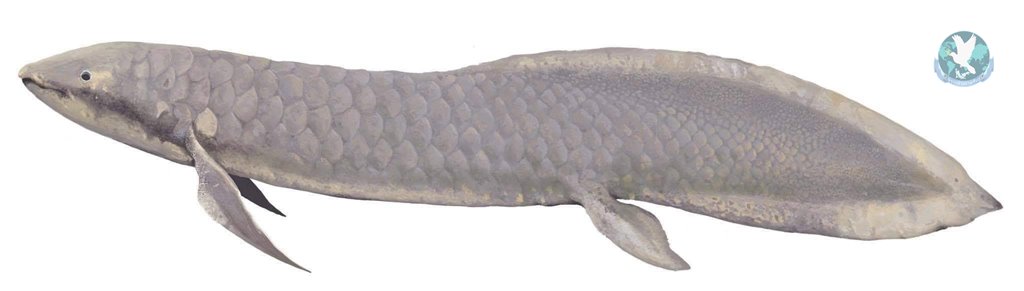
The Australian lungfish Neoceratodus forsteri in the process of breathing air. Lungfish have both gills and lungs, which allows them to breathe in water as in the air. © Anne Kemp

2007. A new Thai Mesozoic lungfish (Sarcopterygii, Dipnoi) with an insight into post-Palaeozoic dipnoan evolution. Zoological Journal of the Linnean Society. 149: 141–177. [[Fulltext]]


Progress in Jurassic studies in Thailand in 2006 and early 2007