Showing posts with label patronym Thai. Show all posts

Thursday, March 26, 2026

[Phycology • 2026] Lobophora lewmanomontiae, L. ogawae, ... • A Survey along the East Coast of Thailand reveals High Diversity in the Genus Lobophora (Dictyotales: Phaeophyceae): with the Description of Four New Species


Lobophora lewmanomontiae A. M. Klomjit, J. Praiboon & N. Muangmai sp. nov.
 Lobophora ogawae A. M. Klomjit, C. W. Vieira & N. Muangmai sp. nov. 
Lobophora thiemmedhii A. M. Klomjit, C. W. Vieira & N. Muangmai sp. nov. 
Lobophora velasquezii A. M. Klomjit, S. G. A. Draisma & N. Muangmai sp. nov. 

in Klomjit, Draisma, Praiboon, Jurejan, Sutti, Sun, Vieira et Muangmai, 2026. 

 ABSTRACT
Lobophora (Dictyotales, Phaeophyceae) is an ecologically important seaweed genus in tropical and subtropical marine ecosystems. This alga exhibits cryptic diversity and morphological plasticity, which require taxonomic delineations that primarily depend on DNA analyses, complemented by morphological and ecological data. Species diversity and distribution within Southeast Asia remain understudied compared to well-documented regions such as the Caribbean and the western Pacific. This study provides a comprehensive assessment of the genus Lobophora along the east coast of Thailand, integrating DNA-based surveys with morphological analyses. Extensive sampling across the Gulf of Thailand revealed 14 well-supported monophyletic clades of Lobophora. Among these, we described four new species (L. lewmanomontiae sp. nov., L. ogawae sp. nov., L. thiemmedhii sp. nov., and L. velasquezii sp. nov.) and reported three new national records (L. abscondita, L. henae, and L. quangtriensis), thereby bringing the Thai total to 21 species. When combined with previous records, 30 species have now been recorded from Southeast Asia, with 12 of which are endemic to the region. This study also emphasizes the importance of extensive sampling across broader areas, which enhances our understanding of biogeographic distributions and their implications for coastal ecosystem management.

Key words: DNA barcoding; Gulf of Thailand; macroalgae; Phaeophyceae; phylogeny; species diversity; taxonomy

In situ photographs of four new Lobophora species from east coast of Thailand.
(A) Lobophora lewmanomontiae sp. nov. (THNHM-P-2021-0314). (B) Lobophora ogawae sp. nov. (THNHM-P-2021-0310).
(C) Lobophora thiemmedhii sp. nov. (THNHM-P-2022-02470). (D) Lobophora velasquezii sp. nov. (THNHM-P-2022-0237).
Scale bars represent: A, 3 cm; B, 1 cm; C & D, 2 cm.

Lobophora lewmanomontiae A. M. Klomjit, J. Praiboon & N. Muangmai sp. nov. 

Lobophora ogawae A. M. Klomjit, C. W. Vieira & N. Muangmai sp. nov.

Lobophora thiemmedhii A. M. Klomjit, C. W. Vieira & N. Muangmai sp. nov.

Lobophora velasquezii A. M. Klomjit, S. G. A. Draisma & N. Muangmai sp. nov.

Ex situ photographs, transversal (Top) and longitudinal (Bottom) section on holotype specimens.
(A–C) Lobophora lewmanomontiae sp. nov.
(D–F) Lobophora ogawae sp. nov.
(G–I) Lobophora thiemmedhii sp. nov.
(J–L) Lobophora velasquezii sp. nov.
Scale bars represent: A, 2 cm; D & J, 0.5 cm; G, 1 cm.


Distribution pattern of Lobophora species along the east coast of Thailand. The black lines on the map represent the geographic borders of Thai province. The marine territories of the provinces where Lobophora species were identified, are highlighted in colors other than blue. The black dots indicated specific locations where Lobophora samples were collected. The numbers in parentheses next to the species names indicate the number of samples identified in each province. The table on the right lists the Lobophora species found in each province, with circles indicating species presence. Provinces ranked left to right by geographic location starting from east to west and then north to south.


Anirut Klomjit, Stefano G. A. Draisma, Jantana Praiboon, Narapat Jurejan, Suttikarn Sutti, Zhongmin Sun, Christophe Vieira and Narongrit Muangmai. 2026. A Survey along the East Coast of Thailand reveals High Diversity in the Genus Lobophora (Dictyotales, Phaeophyceae): with the Description of Four New Species. Algae. 41(1); 77-94. DOI: doi.org/10.4490/algae.2026.41.2.2 [March 15, 2026] 

Wednesday, January 21, 2026

[PaleoMammalogy • 2023] Pachypanthera piriyai • A new large pantherine and a sabre-toothed cat (Carnivora: Felidae) from the late Miocene hominoid-bearing Khorat sand pits, Nakhon Ratchasima Province, northeastern Thailand


Pachypanthera piriyai   
de Bonis, Chaimanee, Grohé, Chavasseau, Mazurier, Suraprasit & Jaeger, 2023
  
 
Abstract
We describe two large predators from the hominoid-bearing Khorat sand pits, Nakhon Ratchasima Province, northeastern Thailand: a new genus of pantherine, Pachypanthera n. gen., represented by partial mandible and maxilla and an indeterminate sabre-toothed cat, represented by a fragment of upper canine. The morphological characters of Pachypanthera piriyai n. gen. n. sp., notably the large and powerful canine, the great robustness of the mandibular body, the very deep fossa for the m. masseter, the zigzag HSB enamel pattern, indicate bone-cracking capacities. The genus is unique among Felidae as it has one of the most powerful and robust mandibles ever found. Moreover, it may be the oldest known pantherine, as other Asian pantherines are dated back to the early Pliocene. The taxa we report here are the only carnivorans known from the late Miocene of Thailand. Although the material is rather scarce, it brings new insights to the evolutionary history of Neogene mammals of Southeast Asia, in a geographic place which is partly “terra incognita.”

Keywords: Asia, Felidae, New taxon, Bone cracking, Late Miocene, Sabre-toothed cat, Pantherine


Order Carnivora Bowdich, 1821
Sub-order Feliformia Kretzoi, 1945

Family Felidae Batsch, 1788
Sub-family Felinae Batsch, 1788

Pachypanthera n. gen.

Etymology: from the greek “Pachy” = thick.
 
Digital reconstruction of the mandible of Pachypanthera piriyai n. gen. n. sp. (a) in comparison with the mandible of Panthera leo (UPPal CAR-5-001) (b) in occlusal view. Scale bar = 20 mm

Right maxilla of Pachypanthera piriyai n. gen. n. sp. (CUF-KR-2).
a Occlusal view; b medial view; c lateral view (scale bar = 20 mm)

Pachypanthera piriyai n. gen. n. sp., left hemi-mandible CUF-KR-1.
a Occlusal view (stereopair); b inferior view; c lateral view; d medial view (scale bar = 20 mm)

Pachypanthera piriyai n. sp

Origin of the name: in honor of Piriya Vachajitpan, who played a critical part in recovering the fossils.

Holotype (CUF-KR-1): left hemi-mandible with the alveoli for i1–i3, canine alveolus, remains of roots of p3, p4 and partially broken off m1 crown.
 
Locality: Khorat sand pit, Nakhon Ratchasima Province, northeastern Thailand

Age: late Miocene, 9 to 6 Ma.
 
 
L. de Bonis, Y. Chaimanee, C. Grohé, O. Chavasseau, A. Mazurier, K. Suraprasit and J.J. Jaeger. 2023. A new large pantherine and a sabre-toothed cat (Mammalia, Carnivora, Felidae) from the late Miocene hominoid-bearing Khorat sand pits, Nakhon Ratchasima Province, northeastern Thailand. The Science of Nature. 110, 42. DOI: 10.1007/s00114-023-01867-4


Monday, September 29, 2025

[Arachnida • 2020] Atmetochilus songsangchoteiRecords and Redescription of a mygalomorph spider genus ignored for over 100 years with A New Species: the Genus Atmetochilus Simon, 1887 (Araneae: Nemesiidae) in Thailand


Atmetochilus songsangchotei Kunsete & Warrit,

in Kunsete, Sivayyapram, Traiyasut, Thanoosing, Khamwan et Warrit, 2020.

Abstract
The wishbone spider of genus Atmetochilus Simon, 1887 (Nemesiidae: Bemmerinae) containing six species and is known from Asia. We describe a new Thai species, Atmetochilus songsangchotei sp. nov. Since the holotype of the type species of AtmetochilusA. fossor, is presumed lost, we describe fresh specimens (ARA-2018-132) and designate one as as neotype; similarly, because a holotype (only syntypes) of Atmetochilus atriceps in NHMUK was not designated, we chose the most intact specimen of the syntypes (NHMUK 1895.9.21.16) and designate it as lectotype. From a photo of the type specimen of Atmetochilus bifidus (sternum) from ZSI, we transfer Atmetochilus bifidus back to Damarchus.

Keywords: Burma, Damarchus, Neotype, Tenasserim, Wishbone spider, Araneae


 Atmetochilus songsangchotei sp. nov. female paratype (ARA-2017-117) 
 A. fossor female neotype (ARA-2018-132). 
 A. atriceps female lectotype (NHMUK 1895.9.21.16)

 
Chawakorn KUNSETE, Varat SIVAYYAPRAM, Prapun TRAIYASUT, Chawatat THANOOSING, Kitiwat KHAMWAN and Natapot WARRIT. 2020. Records and Redescription of a mygalomorph spider genus ignored for over 100 years with A New Species: the Genus Atmetochilus Simon, 1887 (Araneae, Nemesiidae) in Thailand. Zootaxa. 4819(3); 521–543. DOI: doi.org/10.11646/zootaxa.4819.3.5 


Saturday, July 12, 2025

[Funga • 2025] Lentinus saisamorniae (Polyporales: Polyporaceae) • A New edible macrofungus from northern Thailand


Lentinus saisamorniae  Kumla & N. Suwannar.,

in Kumla, Kaewnunta et Suwannarach, 2025. 
เห็ดขอนขาวสายสมร  ||  DOI: doi.org/10.11646/phytotaxa.705.2.2 
 
Abstract
A new edible Lentinus species, described herein as L. saisamorniae, was collected from local markets and natural habitats in northern Thailand between 2019 and 2021. This species is characterized by its small to medium-sized basidiomata, white to yellowish-white pileus, broadly ellipsoid to elongate-shaped basidiospores, dimitic hyphal system, and hyphal pegs. Nonetheless, its longer basidia and smaller basidiospores make it distinguishable from L. cladopus. A molecular phylogenetic analysis of the combined internal transcribed spacer (ITS) large subunit (nrLSU) of nuclear ribosomal DNA, and RNA polymerase II large subunit (rpb1) sequences supported the monophyly of L. saisamorniae as a distinct lineage within the genus Lentinus. Therefore, this new species was introduced based on both morphological characteristics and molecular phylogeny. A full description, illustrations, color photographs, and a phylogenetic tree to show the placement of L. saisamorniae are provided. Comparisons between the new species and morphologically similar and related species are discussed.

Edible fungus, lentinoid fungus, phylogeny, saprotrophic fungus, taxonomy, tropical area, Fungi


Jaturong KUMLA, Atsadawat KAEWNUNTA and Nakarin SUWANNARACH. 2025. Lentinus saisamorniae (Polyporaceae, Polyporales), A New edible macrofungus from northern Thailand. Phytotaxa. 705(2); 149-161. DOI: doi.org/10.11646/phytotaxa.705.2.2 [2025-06-13]


Sunday, May 4, 2025

[Botany • 2025] Bulbophyllum thaithongiae (Orchidaceae: Epidendroideae) • A New Species of Bulbophyllum sect. Racemosae from Thailand


Bulbophyllum thaithongiae  

in Taosiri et Seelanan, 2025.
สิงโตรวงข้าวไทยทอง  ||  DOI: doi.org/10.11646/phytotaxa.698.3.4 

Abstract
During an exploration for the diversity of orchids in Thong Pha Phum National Park, Kanchanaburi Province, a new species of Bulbophyllum in section Racemosae was discovered. It is described here as Bulbophyllum thaithongiae. This new species can be characterized by having sub-densely arranged inflorescences, short floral bracts which never completely hide the flowers and long papillae up to 0.53 mm on the labellum which are clearly visible by naked eye. A detailed description and illustrations are provided together with notes on taxonomy and conservation status.

Bulbophyllum section Racemosae, Thong Pha Phum, Kanchanaburi Province, Monocots


Bulbophyllum thaithongiae sp. nov.
 สิงโตรวงข้าวไทยทอง


Neeranud TAOSIRI and Tosak SEELANAN. 2025. Bulbophyllum thaithongiae (Orchidaceae), A New Species from Thailand. Phytotaxa. 698(3); 178-186. DOI: doi.org/10.11646/phytotaxa.698.3.4 [2025-04-30]
facebook.com/thongpong.saardjai.5/posts/1447059513331292

Monday, April 14, 2025

[Botany • 2025] Somnuekia flaviflora (Malvaceae: Brownlowioideae) • A New Genus and Species from Thailand


 Somnuekia Duangjai, Chalermw., Sinbumr. & Suddee, gen. nov.
Somnuekia flaviflora Duangjai, Chalermw., Sinbumr. & Suddee,
  
in Chalermwong, Duangjai, Sinbumroong, Thananthaisong, Daonurai, Kaewmuan, Poopath, Bhuchaisri, Tangjaipitak, Chantarasuwan, Ngernsaengsaruay, Rueangruea et Suddee, 2025.
ปอศรีสมนึก  ||  DOI: doi.org/10.3897/phytokeys.254.141219

Abstract
Somnuekia is described as a new genus of Malvaceae, currently known only from a few locations in the upper part of Tenasserim in northern and peninsular Thailand. Morphological and molecular phylogenetic analyses, based on plastid DNA sequence regions, support the recognition of this new genus within the Brownlowioideae (Malvaceae). Its distinct phylogenetic position, along with a distinct set of morphological and palynological characteristics, strongly support the recognition of Somnuekia as a new genus. A formal description of Somnuekia flaviflora is provided along with illustrations, photographs, a distribution map and conservation notes. Furthermore, this new genus is compared to other Asian genera within the subfamily.

Key words: Endemic, monotypic, phylogenetic, taxonomy

Somnuekia flaviflora
A habit, fruiting branch and leaf-like bracts B, C leaves B leaf showing adaxial surface C leaf showing abaxial surface and venation D mature flower bud E–K opened flower and its components E opened flower F sepals showing pilose adaxial surface G petals H staminode I stamens: anterior view (left), posterior view (middle) and lateral view (right) J dissected flower with sepals and petals removed, stamens: anterior view (left), posterior view (middle) and lateral view (right) K pistil L mature capsules M mature capsules at splitting stage N carpel in lateral view, split longitudinally to show seed arrangement O mature seeds.
A–C, L–O from Chalermwong et al. 20220317-01 (type) D–K from Sinbumroong & Chalermwong 20190128-01. 
Drawings by W. Bhuchaisri. 
Scale bars: 5 cm (A–C); 1 cm (D, E); 5 mm (F); 1 cm (G); 5 mm (H); 1 mm (I); 5 mm (J); 5 mm (K); 2 cm (L–N); 2 mm (O).

Somnuekia flaviflora
 A flowers and flower bud B–D flowers at different stages of anthesis B early blooming flower with indehiscent anther C blooming flower with dehiscent anther D late blooming flower with dehiscent anther E immature capsules with immature seeds, showing reddish-pink stellate scale covering F mature capsule with mature seeds, showing dark brown stellate scale covering.
Flowers shown in A–C were taken from branches placed in a plastic bag overnight.

Somnuekia flaviflora
A habit B trunk and bark C lower-branch shoot and leaves C1 apical shoot of the lower-branch shoot, showing filiform stipules and trichome covering D terminal bud of upper branch shoot showing scale covering E leaf-like bracts in infructescence F mature flower buds and blooming flower G infructescence with immature and mature capsules H immature capsules with prominent ridges I lateral view of carpel, split longitudinally to show seed arrangement and mature seeds.

Subfam. Brownlowioideae Burret

 Somnuekia Duangjai, Chalermw., Sinbumr. & Suddee, gen. nov.
 
Somnuekia flaviflora Duangjai, Chalermw., Sinbumr. & Suddee

Diagnosis. Somnuekia Duangjai, Chalermw., Sinbumr. & Suddee resembles Pityranthe Thwaites morphologically, but differs from the latter by its unique pollen, having more numerous ovules in each loculus and fruit characters. The detailed distinguishing characters of this new genus and other genera are listed in Table 2.
....


 Porntawat Chalermwong, Sutee Duangjai, Aroon Sinbumroong, Theerawat Thananthaisong, Kunanon Daonurai, Anusara Kaewmuan, Manop Poopath, Wanwisa Bhuchaisri, Kusol Tangjaipitak, Bhanumas Chantarasuwan, Chatchai Ngernsaengsaruay, Sukid Rueangruea and Somran Suddee. 2025. Somnuekia flaviflora (Malvaceae, Brownlowioideae), A New Genus and Species from Thailand. PhytoKeys 254: 221-243. DOI: doi.org/10.3897/phytokeys.254.141219

Friday, June 28, 2024

[Entomology • 2024] Aspila pibooni • A peculiar New Species of Aspila (Lepidoptera: Tortricidae: Olethreutinae: Grapholitini) from Thailand


Aspila pibooni
Pinkaew, 2024

 
Abstract
Aspila pibooni sp. nov. is described and illustrated from Thailand. The species is provisionally assigned to Aspila on the basis of morphological features of the male and female genitalia. Superficially, the new species resembles three Afrotropical species of Cydia (Grapholitini), all of which lack the distinctive coremata and a pair of short projections from the eight sternite that characterize the Grapholita group of genera to which Aspila belongs.

Lepidoptera, Cydia, Grapholita coremata, new species, Thailand.


 Nantasak Pinkaew. 2024. Aspila pibooni (Lepidoptera: Tortricidae: Olethreutinae: Grapholitini), A peculiar New Species from Thailand.  Zootaxa. 5397(3); 427-434. DOI: 10.11646/zootaxa.5397.3.7

Tuesday, April 30, 2024

[Botany • 2024] Kaempferia noctiflora var. thepthepae (Zingiberaceae) • A New Taxon from Thailand


 Kaempferia noctiflora var. thepthepae Noppornch. & Somnoo,

in Nopporncharoenkul, Jenjittikul, Somnoo, Meewasana et Tanming, 2024.

Taxonomic study of Kaempferia subgen. Protanthium (Zingiberaceae) is difficult due to a high degree of intraspecific morphological variation in several species and the implied morphological overlap among the currently recognized species. Herein, we clarify the taxonomic circumscription of K. noctiflora, a rare species endemic to Chiang Mai Province (N Thailand), by describing Kaempferia noctiflora var. thepthepae Noppornch. & Somnoo, var. nova. It differs from K. noctiflora var. noctiflora especially by the labellum colouration and flowering time. The diagnostic characters of this novel variety are discussed and compared with those of morphologically similar taxa. Images of the plants, habit and dissected flowers, and information on the phenology, distribution and ecology are provided. Kaempferia noctiflora var. noctiflora and var. thepthepae are considered Vulnerable and Endangered, respectively.


Nattapon Nopporncharoenkul, Thaya Jenjittikul, Thunchanok Somnoo, Jiraporn Meewasana, Wattana Tanming. 2024. Kaempferia noctiflora var. thepthepae (Zingiberaceae), A New Taxon from Thailand.  Ann. Bot. Fennici. 61: 79–92. DOI: 10.5735/085.061.0112

 “เปราะนพรัตน์” (K. noctiflora var. thepthepae Noppornch. & Somnoo) พืชเฉพาะถิ่นของไทยพันธุ์ใหม่ของโลก อยู่ในวงศ์ขิงข่า สกุลเปราะหอม สกุลย่อยดอกดิน (Protanthium) มีสถานะทางอนุกรมวิธานเป็น พันธุ์ (variety) ของเปราะชนิด “เปราะราตรี, เปราะใบม่วง” (Kaempferia noctiflora Noppornch. & Jenjitt.) พบเฉพาะ อ.ดอยสะเก็ด และ อ.สันกำแพง จ.เชียงใหม่ เท่านั้น ผลงานการค้นพบได้ถูกตีพิมพ์ลงวารสาร Annales Botanici Fennici ฉบับที่ 61 เมื่อวันที่ 7 มี.ค. 2567

เปราะราตรี จัดจำแนกย่อยเป็น 2 พันธุ์ (variety) ตามช่วงเวลาการบานและสีของกลีบปากที่แตกต่างกัน
เปราะราตรี - Kaempferia noctiflora var. noctiflora 
เปราะนพรัตน์ - K. noctiflora  var. thepthepae Noppornch. & Somnoo. 

รายงานการค้นพบโดย ทีมนักวิจัยจากองค์การพิพิธภัณฑ์วิทยาศาสตร์แห่งชาติ - NSM นำโดย ดร.ณัฐพล นพพรเจริญกุล นักวิชาการกองวิชาการพฤกษศาสตร์ สำนักวิชาการพิพิธภัณฑ์ธรรมชาติวิทยา NSM และ ผศ.ดร.ทยา เจนจิตติกุล ภาควิชาพฤกษศาสตร์ คณะวิทยาศาสตร์ มหาวิทยาลัยมหิดล น.ส.ธัญชนก สมหนู นักศึกษาระดับปริญญาโท ภาควิชาชีววิทยา คณะวิทยาศาสตร์ มหาวิทยาลัยขอนแก่น น.ส.จิราภรณ์ มีวาสนา นักวิชาการป่าไม้ชำนาญการพิเศษ สำนักบริหารพื้นที่อนุรักษ์ที่ 16 กรมอุทยานแห่งชาติ สัตว์ป่าและพันธุ์พืช และดร.วัฒนา ตันมิ่ง สวนพฤกษศาสตร์สมเด็จพระนางเจ้าสิริกิติ์ 

 www.nsm.or.th/nsm/th/node/54772

Saturday, October 28, 2023

[Botany • 2023] Curcuma suraponii (Curcuma subg. Curcuma, Zingiberaceae) • A New Species from Tak Province, Northern Thailand


 Curcuma suraponii 
 Boonma. 2023.

 
Abstract
A new species, Curcuma suraponii Boonma sp. nov. has been collected in Tak Province, Northern Thailand during an exploration of Zingiberaceae diversity. This species belongs to the family Zingiberaceae and the genus Curcuma subgen. Curcuma. The plant materials were collected from their natural habitats and measurements were recorded from both living and preserved specimens. This species bears resemblance to Curcuma rubrobracteata Škorničk., Sabu & Prasanth, but differs in certain morphological characteristics and does not match any existing species. Therefore, the author described it as a new species to science under the name Curcuma suraponii Boonma. The description includes detailed information on its morphological characteristics, supported by illustrations, and provides the vernacular name, ecology, phenology, traditional utilization, conservation status, distribution map, and a comparative table to highlight its differences with allied species. Additionally, a revised key of 29 species within the Curcuma subgen. Curcuma in Thailand is also presented.

Keywords: Curcuma, new species, taxonomy, Thailand, Zingiberaceae


Thawatphong Boonma. 2023. Curcuma suraponii sp. nov. (Zingiberaceae), A  New Species of Curcuma Subgen. Curcuma from Thailand. BIODIVERSITAS24(9);  4885-4895. 


Wednesday, August 30, 2023

[Botany • 2023] Ehretia pranomiana (Boraginales: Ehretiaceae) • A New scrambler from Thailand


Ehretia pranomiana  Rueangs. & Suddee,

in Rueangsawang, Thananthaisong, Kaewmuan, Daonurai et Suddee, 2023.
"ก้อมอาจารย์น้อย"  DOI: 10.1111/njb.04010
 
Abstract
Ehretia pranomiana sp. nov. is illustrated and described from northern and south-western Thailand. The new species is similar to E. macrophylla and E. acuminata by having elliptic leaves with a serrate margin, but can be distinguished by being a scrambling shrub with densely hispid leaf blades, corymbose inflorescence with 4–10 flowers, corolla with erect lobes and calyx longer than fruit at maturity. An updated identification key to the species of Ehretia known from Thailand is provided.

Keywords: conservation, endemic, morphology, taxonomy


Ehretia pranomiana Rueangs. & Suddee
  "ก้อมอาจารย์น้อย" 


Kanokorn Rueangsawang,  Theerawat Thananthaisong,  Anusara Kaewmuan,  Kunanon Daonurai and  Somran Suddee. 2023. Ehretia pranomiana sp. nov. (Boraginales: Ehretiaceae), A New scrambler from Thailand. Nordic Journal of Botany. e04010. DOI: 10.1111/njb.04010
  facebook.com/DNP1362/posts/625491413097229
  thairath.co.th/news/society/2719251

Thursday, August 10, 2023

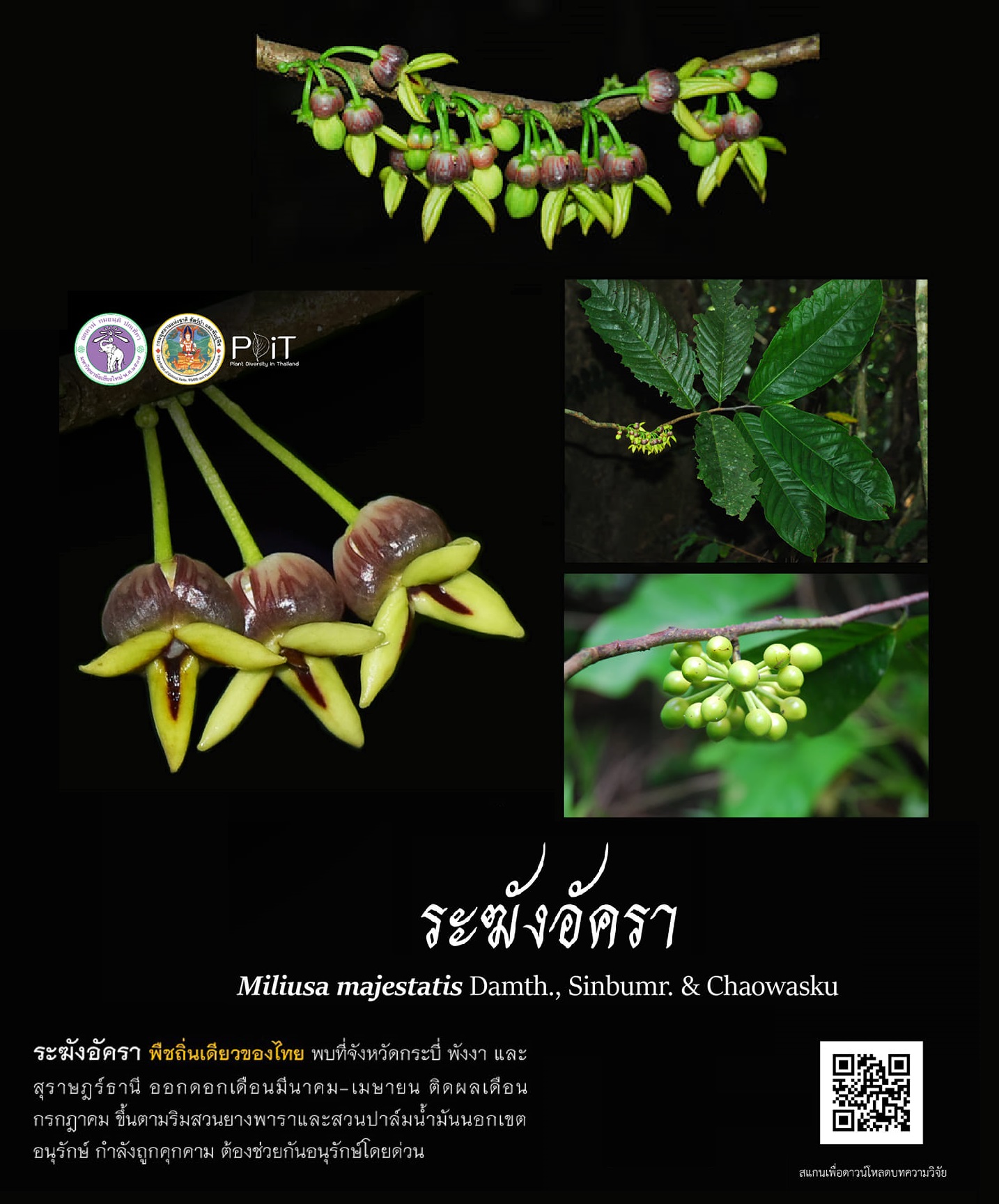
[Botany • 2023] Miliusa majestatis (Annonaceae) • A New Species from southern Thailand as evidenced by Molecular Phylogeny and Morphology


Miliusa majestatis Damth., Sinbumr. & Chaowasku, 

in Damthongdee, Sinbumroong, Rungrueng, Aongyong, Wiya, Saengpho et Chaowasku, 2023. 
ระฆังอัครา  ||  facebook.com/PlantDiversityinThailand

Miliusa majestatis Damth., Sinbumr. & Chaowasku (Annonaceae), a new species from southern Thailand, is described and illustrated. Based on molecular phylogenetic analysis using up to seven plastid DNA regions (matK, ndhF, rbcL and ycf1 exons; trnL intron; psbA-trnH and trnL-trnF intergenic spacers) and including, among others, 35 accessions (representing 34 species) of Miliusa, the new species belongs to one of the four unnamed major clades in the genus. Within that clade and in the genus in general, M. majestatis is unique in having constricted inner petals and small basal openings between adjacent inner petals. Its conservation status is provisionally assessed as Data Deficient (DD).


Miliusa majestatis Damth., Sinbumr. & Chaowasku 


Anissara Damthongdee, Aroon Sinbumroong, Apichat Rungrueng, Kithisak Aongyong, Chattida Wiya, Chanwut Saengpho, and Tanawat Chaowasku. 2023. Miliusa majestatis (Annonaceae), A New Species from southern Thailand as evidenced by Molecular Phylogeny and Morphology. Annales Botanici Fennici. 60(1); 151–160. 
  

นักวิจัย มช. และกรมอุทยานฯ ค้นพบ "ระฆังอัครา" กระดังงาดอกสวยชนิดใหม่ของโลกจากภาคใต้ 

 คณะผู้วิจัย นำโดยผู้ช่วยศาสตราจารย์ ดร.ธนวัฒน์ เชาวสกู สังกัดภาควิชาชีววิทยา คณะวิทยาศาสตร์ มหาวิทยาลัยเชียงใหม่ นางสาวอานิสรา ดำทองดี นักศึกษาระดับปริญญาเอก สาขาวิชาความหลากหลายทางชีวภาพและชีววิทยาชาติพันธุ์ พร้อมทั้งนายอรุณ สินบำรุง นักวิชาการป่าไม้ชำนาญการ สังกัดกรมอุทยานแห่งชาติ สัตว์ป่าและพันธุ์พืช และนักวิจัยอีกหลายท่าน ได้ร่วมกันดำเนินโครงการวิจัยเรื่อง “อนุกรมวิธานและวิวัฒนาการชาติพันธุ์ของพรรณไม้วงศ์กระดังงา (Annocaceae) ในประเทศไทยที่หายากและยังไม่เป็นที่รู้จัก เพื่อการอนุรักษ์และการใช้ประโยชน์อย่างยั่งยืน”  จากการวิจัยดังกล่าวได้พบพืชชนิดใหม่ของโลกในวงศ์กระดังงาจากจังหวัดกระบี่ พังงา และสุราษฎร์ธานี มีชื่อวิทยาศาสตร์ว่า Miliusa majestatis Damth., Sinbumr. & Chaowasku ชื่อไทย "ระฆังอัครา" ได้รับการตีพิมพ์ในวารสารวิชาการระดับนานาชาติ Annales Botanici Fennici ปีที่ 60 หน้าที่ 151-160 เมื่อวันที่ 7 สิงหาคม พ.ศ. 2566 

ทั้งนี้ คำระบุชนิด “majestatis” ได้ตั้งขึ้นเพื่อเฉลิมพระเกียรติสมเด็จพระนางเจ้าสิริกิติ์ พระบรมราชินีนาถ พระบรมราชชนนีพันปีหลวง “พระมารดาแห่งการคุ้มครองความหลากหลายทางชีวภาพ” ในโอกาสที่ทรงเจริญพระชนมพรรษาครบ ๙๐ พรรษา