Showing posts with label Bivalvia. Show all posts

Wednesday, October 15, 2025

[Mollusca • 2025] Pseudodon septuaginta • Integrative Taxonomy Reveals A New Species of Freshwater Mussel (Bivalvia: Unionidae: Pseudodontini), from the Mekong River Basin in Northeastern Thailand


Pseudodon septuaginta
Jeratthitikul, Phuhong, Sucharit et Prasankok, 2025.

Tropical Natural History. Suppl. 8
หอยกาบสามเหลี่ยมลำน้ำมูล  ||  facebook.com/EkgachaiJeratthitikul

Abstract
This study investigated the taxonomy and phylogenetic relationships of the freshwater mussel genus Pseudodon Gould, 1844, with a specific focus on Indochinese populations, using a comprehensive molecular dataset and morphometric analyses. Our findings confirm the valid status of seven among the nine currently recognized extant Pseudodon species, and include the discovery of a new cryptic species, Pseudodon septuaginta sp. nov., from the Mekong River Basin in northeastern Thailand. The new species is characterized by a compressed, sub-trigonal shell outline, the presence of a posterior wing, weakly developed pseudocardinal teeth, and obsolete lateral teeth. Phylogenetic analysis revealed this new species as the sister taxon to the adjacent allopatric P. vagulus, which is distributed in Mekong River tributaries in the upper Khorat Plateau, exhibiting a 6.71% uncorrected COI p-distance. Despite some morphological overlap, these two species are distinguishable by pseudocardinal tooth structure and overall shell shape. Furthermore, phylogenetic analyses support a potential Bornean origin for Pseudodon, followed by dispersal into Myanmar and Indochina, with paleo-drainage isolation driving diversification within the Indochinese lineages.

 Keywords: biogeography, evolutionary history, Indochina, new species, Unionidae

Shells of Pseudodon species showing the inner side of the right valve, the outer side of the left valve, and the dorsal view of both valves.
A–D. Pseudodon vagulus. A.Holotype NHMUK 1874.12.11.3 of Unio vagulus Fischer, 1891 from “Siam” [=Thailand]. B.Holotype SMF 188817/1 of P. cambodjensis tenerrimus Brandt, 1974, from Songkhram River, Nakhon Phanom,Thailand, with label. C. Sequenced specimen MUMNH-UNI2209 from Thuai River, Nakhon Phanom,Thailand. D. Sequenced specimen MUMNH-UNI0902 from Songkhram River, Nakhon Phanom, Thailand.
E, F. Pseudodon septuaginta sp. nov. E. Holotype MUMNH-UNI3423 from Dom Yai River, Ubon Ratchathani, Thailand and F. paratype MUMNH-UNI2557 from the type locality. Photographs: Kevin Webb, NHMUK
Photographic Unit (A); C. Sucharit (B–F); label photo, S. Hof (B). 


Pseudodon septuaginta sp. nov.

Etymology.– The specific epithet “septuaginta” is derived from the Latin word meaning “seventy”, and chosen to celebrate the occasion of the seventieth birthday of H.R.H. Princess Maha Chakri Sirindhorn of Thailand, who has long been interested in and promoted the study of taxonomy and diversity in Thailand. 


Ekgachai Jeratthitikul, Nawaporn Phuhong, Chirasak Sucharit and Pongpun Prasankok. 2025. Integrative Taxonomy Reveals A New Species of Freshwater Mussel, Pseudodon septuaginta sp. nov. (Unionidae: Pseudodontini), from the Mekong River Basin in Northeastern Thailand. Tropical Natural History. Supplement 8; 160-181 [2025-10-14]

 Pseudodon septuaginta Jeratthitikul et al., 2025 
 หอยกาบสามเหลี่ยมลำน้ำมูล 
หอยกาบขนาดกลาง เปลือกไม่หนามาก ป่องทางด้านข้างเล็กน้อย รูปทรงโดยรวมเป็นรูปสามเหลี่ยม หรือค่อนข้างมนเกือบเป็นรูปไข่ ขอบล่างของเปลือกโค้ง ขอบเปลือกส่วนปลายด้านท้ายทำมุมยื่นออกเล็กน้อย อัมโบมีขนาดเล็ก ยกขึ้นเล็กน้อย ด้านหน้าของเปลือกต่ำกว่าอัมโบ ด้านหลังโค้งเล็กน้อย ค่อย ๆ ยกสูงขึ้นไปทางด้านท้ายของเปลือก เห็นเป็นปีกชัดเจน เปลือกด้านนอกมีสีน้ำตาลเข้ม พื้นผิวด้าน เห็นรอยรอบวงการเติบโตชัดเจน ด้านในเปลือกมันวาว ฟันซูโดคาร์ดินัลมีขนาดเล็ก อยู่บนเปลือกทั้งสองฝา ฝาละซี่ ไม่มีฟันแลเทอรัล หอยกาบชนิดนี้เป็นหอยกาบถิ่นเดียว พบบริเวณลุ่มแม่น้ำมูล โดยเฉพาะในลำโดมใหญ่ 
ชื่อชนิด ‘septuaginta’ มีความหมายว่า ‘เจ็ดสิบ’ สื่อถึง ปีมหามงคลเฉลิมพระชนมพรรษา 70 พรรษา

Thursday, August 28, 2025

[Mollusca • 2025] Gibbosula sinensis • A New Species on the verge of Extinction of the World’s most Threatened Freshwater Mussel Family Margaritiferidae Henderson, 1929 (Bivalvia: Unionida) from China


Gibbosula sinensis Z.-G. Chen, Y.-T. Dai, H. Chen & X.-P. Wu,

in Z.-G. Chen, Dai, H. Chen, Hu, Jiang, Guo, Ouyang, Zhao et Wu, 2025. 

Abstract
A new species of freshwater mussel, Gibbosula sinensis Z.-G. Chen, Y.-T. Dai, H. Chen & X.-P. Wu, sp. nov., is described from the lower Lancangjiang River Basin in Yunnan, China based on comparative morphology and molecular phylogeny. The new species can be distinguished from congeners by the oblong, slender, very curved, relatively thin, fragile, and rather smooth shell, the front end of the shell higher than the posterior end, and the special habitat selection. The new species is on the verge of extinction and urgently requires attention and protection.

Key Words: Biodiversity, molluscs, phylogeny, taxonomy

Systematics

Family Margaritiferidae Henderson, 1929

Subfamily Gibbosulinae Bogan, Bolotov, Froufe & Lopes-Lima, 2018

Genus Gibbosula Simpson, 1900
Type species. Mya crassa Wood, 1815, by original designation.
 
Gibbosula sinensis sp. nov.
A. Holotype, NCUMB B2507001; B–E. Partial paratypes, NCUMB B2507002–05;
F. Paratype, NCUMB B2507012, shows the soft anatomy; G. Shows mantle attachment scars.

 Gibbosula sinensis Z.-G. Chen, Y.-T. Dai, H. Chen & X.-P. Wu, sp. nov.


Zhong-Guang Chen, Yu-Ting Dai, Hui Chen, Hong-Fei Hu, Jiao Jiang, Liang Guo, Shan Ouyang, Xing-Xing Zhao and Xiao-Ping Wu. 2025. Gibbosula sinensis, A New Species on the verge of Extinction of the World’s most Threatened Freshwater Mussel Family Margaritiferidae Henderson, 1929 from China (Bivalvia, Palaeoheterodonta, Unionida). Zoosystematics and Evolution. 101(4): 1613-1620. DOI: doi.org/10.3897/zse.101.166584

Tuesday, February 11, 2025

[Mollusca • 2025] Delectopecten thermus • Integrative Morphological, Mitogenomic and Phylogenetic Analyses reveal New Vent-dwelling Scallop Species (Bivalvia: Pectinidae: Camptonectinae)


Delectopecten thermus Lin, 

in Lin, Peng, Chen, Xu et Qiu, 2025.

Abstract
Delectopecten is a small genus of the family Pectinidae (Bivalvia: Pectinida) that remains poorly studied in terms of both morphology and phylogeny. Here, we describe the first member of this genus from deep-sea hydrothermal vent ecosystems, D. thermus sp. nov., based on morphological investigations and molecular analyses of a specimen collected from the Higashi–Ensei vent field (962-m depth) in the northern Okinawa Trough. Morphologically, this new species resembles D. vancouverensis and D. gelatinosus in shell size, shape, auricle size and sculpture. However, D. thermus sp. nov. can be distinguished from its congeneric species (including 9 extant and 12 fossil species) by its unequal auricles (the anterior one being larger than the posterior), inwardly recurved anterior auricle of the left valve and a large byssal notch angle of ~90°. Comparisons of genetic sequences from three mitochondrial and three nuclear gene fragments supported the placement of the new species in the genus Delectopecten. Further phylogenetic analyses using these gene markers support that Delectopecten is monophyletic and positioned as an early diverging clade of the family Pectinidae. Additionally, the mitogenome of D. thermus sp. nov. was assembled and annotated, a first for its genus – revealing significant divergences in gene order compared to other pectinids. The 16S rRNA amplicon analysis of the gill tissue indicated that this vent-dwelling scallop does not exhibit symbiosis with chemosynthetic bacteria. A key to all known species of Delectopecten is provided to aid the identification of species in this understudied genus.

Keywords: bivalvia, deep sea, Delectopecten, heterotrophy, Higashi–Ensei, hydrothermal vent, identification key, new species, Okinawa Trough, Pectinidae, systematics, taxonomy, trophic mode.

Delectopecten thermus sp. nov., holotype (NSMT-Mo 79569).
(a, b) External and internal views of the left valve. The ‘6’-like structure on the outer surface is the calcareous tube of an annelid worm.
(c, d) External and internal views of the right valve. 

Order: PECTINIDA Gray, 1854

Family: PECTINIDAE Rafinesque, 1815
Subfamily: CAMPTONECTINAE Habe, 1977

Delectopecten Stewart, 1930
Type species: Delectopecten vancouverensis Whiteaves, 1893 

Delectopecten thermus Lin, sp. nov.

Etymology: The species epithet ‘thermus’ means ‘thermal’ in Latin, refer-ring to its hot vent habitat.


Yi-Tao Lin, Ying-Bei Peng, Chong Chen, Ting Xu and Jian-Wen Qiu. 2025. Integrative Morphological, Mitogenomic and Phylogenetic Analyses reveal New Vent-dwelling Scallop Species. Invertebrate Systematics. 39, IS24091. DOI: doi.org/10.1071/IS24091


Friday, January 31, 2025

[Mollusca • 2022] Songkhlanaia gen. nov.; Songkhlanaia tamodienica, Sundadontina plugpomenica, Trapezoideus thachiadensis, ... • Diversity and Phylogenetics of Freshwater Mussels (Unionidae) from Southern Thailand with the Description of One New Genus and Five New Species-Group Taxa


 Songkhlanaia gen. nov.; Stamodienica gen. et sp. nov.; 
Sundadontina plugpomenica sp. nov.;
 Monodontina vondembuschiana tapienica ssp. nov.; Mv. thasaenica ssp. nov.
; and 
Trapezoideus thachiadensis sp. nov.
 

in Konopleva, Lheknim, Sriwoon, Kondakov, Tomilova, Gofarov, Vikhrev et Bolotov, 2022. 

Abstract 
Southern Thailand represents a region of unique freshwater biodiversity with many endemic taxa, including a number of freshwater mussel species (Bivalvia: Unionidae). In this study, we recognize 13 taxa in the tribes Contradentini, Rectidentini, Pseudodontini (subfamily Gonideinae), and Indochinellini (subfamily Parreysiinae) that inhabit different localities in the Songkhla Lake, Tapi River, and Tha Taphao River basins. Based on the results of morphological and phylogenetic analyses, we discovered among these mussels six taxa new to science, including one genus, three species, and two subspecies. New taxonomic names are introduced here as follows: Songkhlanaia gen. nov.; S. tamodienica gen. & sp. nov.; Sundadontina plugpomenica sp. nov.; Monodontina vondembuschiana tapienica ssp. nov.; Mvondembuschiana thasaenica ssp. nov. (Pseudodontini); and Trapezoideus thachiadensis sp. nov. (Contradentini). These new taxa confirm the high conservation priority of the Southern Thai freshwater mussel fauna.

Keywords: freshwater mussel fauna; new taxa; phylogenetics; Southern Thailand; Unionidae


 Songkhlanaia gen. nov.; S. tamodienica gen. & sp. nov.; 
Sundadontina plugpomenica sp. nov.; 
Monodontina vondembuschiana tapienica ssp. nov.; Mvondembuschiana thasaenica ssp. nov.; 
 Trapezoideus thachiadensis sp. nov.  


Ekaterina S. Konopleva, Vachira Lheknim, Rujinard Sriwoon, Alexander V. Kondakov, Alena A. Tomilova, Mikhail Y. Gofarov, Ilya V. Vikhrev and Ivan N. Bolotov. 2022. Diversity and Phylogenetics of Freshwater Mussels (Unionidae) from Southern Thailand with the Description of One New Genus and Five New Species-Group Taxa. Diversity. 2023, 15(1), 10. DOI: 10.3390/d15010010   

Wednesday, November 20, 2024

[Crustacea • 2023] Polkamenes gen. nov. & Tympanicheles gen. nov. • Polka-dotted Treasures: Revising A Clade of Ascidian- and Bivalve-associated Shrimps (Caridea: Palaemonidae)


Polkamenes pycnodontae (Bruce, 1978),
  Tympanicheles ornatus (Holthuis, 1952),

 B) Anchistus australis
D) A. demani,  
F, H) A. miersi,

in de Gier et Fransen. 2023.  
photographs by C.H.J.M Fransen

Abstract
Most marine shrimp species of the family Palaemonidae are characterized by symbiotic associations with hosts that belong to a wide range of invertebrate phyla. One clade of related endosymbiotic species has evolved to live inside the branchial chambers of ascidians and the mantle cavities of bivalve molluscs. The phylogeny of this clade (comprising 15 bivalve-associated species in the genera Anchistus, Neoanchistus, and Paranchistus, and three species of ascidian-associated species in the genus Dasella) is the topic of the present study, which is based on both morphological and molecular data. A concatenated phylogeny reconstruction was built by using the markers coi and 16S. With the help of a total evidence approach (with a scored morphological datamatrix), species could be added for which no molecular data were available. An ancestral character state analysis was performed to detect host switches. In contrast to another endosymbiotic clade, the ancestral host state was found to be slightly in favour of bivalves. The phylogenetic relevance of morphological features is discussed with a focus on a tympanal organ located in the major chelipeds of some bivalve-associated shrimp species. This little-known anatomical structure is illustrated by sem and µCT scans. Its possible function is discussed. In the phylogeny reconstructions, both Anchistus and Paranchistus were found to be polyphyletic. They were reclassified to obtain a more natural classification: Anchistus custoides and Anchistus custos were transferred to the resurrected genus Ensiger. Paranchistus liui, P. nobilii, P. pycnodontae, and P. spondylis were transferred to Polkamenes gen. nov. Anchistus pectinis and P. ornatus were transferred to Tympanicheles gen. nov. Per genus, a key to the species is provided.
 
Keywords: commensal shrimp, host switching, symbiosis, taxonomic revision, total evidence

A) Anchistus australis Bruce, 1977, RMNH.CRUS.D.58048, stn ber.28, in Tridacna squamosa Lamarck, 1819; B) A. australis, RMNH.CRUS.D.53540, stn ter.12, in T. squamosa;
C) Anchistus demani Kemp, 1922, RMNH.CRUS.D.42792, stn sey.792, in Tridacna maxima (Röding, 1798); D) A. demani, RMNH.CRUS.D.58049, stn thu.07, in T. maxima;
E) Anchistus gravieri Kemp, 1922, RMNH.CRUS.D.58052, stn FR15, in Hippopus hippopus (L., 1758);
F) Anchistus miersi (De Man, 1888), RMNH.CRUS.D.42970, stn sey.720, in T. squamosa: G) A. miersi, RMNH.CRUS.D.46473, sw Sulawesi, in T. squamosa; H) A. miersi, RMNH.CRUS.D.53568, stn ter.19, in T. squamosa
photographs by C.H.J.M Fransen

Polkamenes pycnodontae (Bruce, 1978) RMNH.CRUS.D.48261, from Hyotissa hyotis (L., 1758)

 Genus Polkamenes gen. nov.

Etymology. Polkamenes’: named after the characteristic blue-, red-, and orange-dotted pattern seen on the species’ carapace, abdomen, and appendages ‘Polka dots’ (English, in combination with the common palaemonid suffix ‘-menes’; see e.g., Ancylomenes Okuno & Bruce, 2010, Laomenes Clark, 1919, Periclimenes). Gender: masculine.

recognize four species: Polkamenes liui (Li, Bruce & Manning, 2004); Polkamenes nobilii (Holthuis, 1952); Polkamenes pycnodontae (Bruce, 1978); and Polkamenes spondylis (Suzuki, 1971).

Distribution. Shiraiso, Manazura-Machi, Kanagawa Prefecture, Japan, (cf. Suzuki, 1971, Hayashi, 2005, 2006); South China Sea (Li et al., 2004).


  Tympanicheles ornatus (Holthuis, 1952), RMNH.CRUS.D.42794, from Atrina vexillum (Born, 1778) 

Genus Tympanicheles gen. nov.

Etymology. ‘Tympanicheles’: named after the ‘drum-like’ veil on the species’ major chela. Built from ‘Tympani-’, a suffix for drum in Latin (‘Tympanum’), and ‘-cheles’ for claws in Latin. Gender: masculine.
 
  recognize two species: Tympanicheles ornatus (Holthuis, 1952), and Tympanicheles pectinis (Kemp, 1925).
 

 Werner de Gier and Charles H.J.M. Fransen. 2023. Polka-dotted Treasures: Revising A Clade of Ascidian- and Bivalve-associated Shrimps (Caridea: Palaemonidae). Contributions to Zoology. 92(3); 179-282. DOI: doi.org/10.1163/18759866-bja10042

Thursday, October 24, 2024

[Mollusca • 2023] Parabrachidontes amnicus • A New lineage of Fresh- and Brackish-water Mussels (Bivalvia: Mytilidae) from Southeast Asia


Parabrachidontes amnicus 
K. S. Tan, S. H. M. Tan, Sanpanich, Duangdee & Ambarwati, 2023


Abstract
Three species of mussels collected from fresh- and low salinity (10 psu or lower) brackish-water environments in southern Thailand, Singapore, northern Borneo and south Sulawesi formed a new, well-supported and distinct mytilid clade based on molecular phylogeny. All are small (< 30 mm) species with either radially ribbed or smooth shells. Internally, the upper edges of the ascending lamellae of the outer and inner demibranchs are, respectively, fused to the mantle lobes and visceral mass. A new genus Parabrachidontes is proposed to accommodate the three species. Of the species in the new genus, one is described as new (Parabrachidontes amnicus sp. n.), and the other two poorly known species (P. leucostictus and P. cochinensis) are re-described. The Parabrachidontes clade is closely related to Mytella, Perna and Arcuatula. Together, they formed a well-supported clade, most members of which have ctenidial edges attached to the mantle and/or visceral mass. These genera are clearly distinct phylogenetically from two other mytilid clades containing brackish- and fresh-water species with ctenidia free of the mantle: one comprising the genera Limnoperna and Sinomytilus (together constituting the Limnoperninae), and the other Xenostrobus and Vignadula (forming the Xenostrobinae). We therefore suggest the existence of at least three lineages of mytilids living in rivers and estuaries of East Asia and Australasia.

Keywords: Mytiloidea, Pteriomorphia, systematics, taxonomy

Parabrachidontes amnicus sp. n., Khlong Pak Bara, Satun Province, Thailand.
a, b. Holotype, PMBC 30680, SL = 15.2 mm, BET 1 (see Figure 1);
c, d. Paratype, ZRC.MOL 24083, SL = 14.8 mm, BET 2 (see Figure 1);
e, f. Paratype, PMBC 30681, SL = 15.6 mm, BET 3 (see also Table S1).

Parabrachidontes amnicus sp. n.


Koh Siang Tan, Samuel H. M. Tan, Kitithorn Sanpanich, Teerapong Duangdee, Reni Ambarwati. 2023. A New lineage of Fresh- and Brackish-water Mussels (Bivalvia, Mytilidae) from Southeast Asia. Zoologica Scripta. 52(3); 298-313. DOI: doi.org/10.1111/zsc.12585

Sunday, October 6, 2024

[Mollusca • 2024] Lannanaia gen. nov. & Isannaia gen. nov. • Two New Genera and Three New Species of exceptionally rare and endemic Freshwater Mussels (Bivalvia: Unionidae) from the Mekong Basin


Lannanaia kokensis 
Isannaia fortunata and I. occultata

Jeratthitikul, Sutcharit & Prasankok, 2024

Abstract
Two new genera and three new species of freshwater mussels in the tribe Pseudodontini (Bivalvia, Unionidae) are described from the Mekong Basin in Thailand based on an integrative taxonomic study involving morphology and multi-locus phylogenetic analyses (mitochondrial COI and 16S, and nuclear 28S genes). The monotypic genus, Lannanaia kokensis gen. et sp. nov., presents unique features of being rather compressed, sub-trigonal in outline with short and high shell, and with a distinct posterior wing. Another new genus, Isannaia gen. nov., is characterized by having a thin and moderately inflated shell, with rhomboidal to ovate outline. It includes two lineages that are genetically separated by 3.54% uncorrected COI p-distance, and are herein described as I. fortunata sp. nov. and I. occultata sp. nov. Phylogenetic analyses further revealed that these two new genera were nested within a clade of subtribe Pseudodontina, and with pairwise uncorrected COI p-distance to other genera ranging from 11.42 to 15.66%. Based on the present data, Lannanaia gen. nov. is known only from the Kok River in the north of Thailand, whereas the two species of Isannaia gen. nov. are restricted to tributaries of the Mekong River in the northeast of Thailand. The discovery of rare and probably endemic freshwater mussels in the Mekong Basin thus again highlights the importance of this region among freshwater biodiversity hotspots of the world.

Key Words: Freshwater mussels, Indochina, Mekong Basin, multi-locus phylogeny, new taxa, Thailand


 Ekgachai Jeratthitikul, Chirasak Sutcharit, Pongpun Prasankok. 2024. Two New Genera and Three New Species of exceptionally rare and endemic Freshwater Mussels (Bivalvia, Unionidae) from the Mekong Basin. Zoosystematics and Evolution. 100(4): 1333-1345. DOI: doi.org/10.3897/zse.100.130929

Monday, September 23, 2024

[Mollusca • 2024] Cenonovaculina siamensis • Molecular phylogeny reveals Cenonovaculina gen. nov. (Adapedonta: Pharidae), A New freshwater razor clam Genus from Indochina


Cenonovaculina gen. nov. 
Cenonovaculina siamensis (Morlet, 1889), from Bang Pakong River, Prachin Buri, Thailand

in Jeratthitikul & Sutcharit, 2024. 
หอยเสียบน้ำจืดสยาม  ||  DOI: 10.1071/IS24024 
photos: Kongkit Macharoenboon

Abstract  
The razor clam genus Novaculina is a secondary marine-derived freshwater taxa within the otherwise exclusively marine family Pharidae. Novaculina currently comprises four valid species that are distributed allopatrically across several drainages in Asia. We employed an integrated approach, combining morphology and molecular phylogenetic analyses to elucidate the taxonomic placement of members within this genus. The multi-locus phylogenetic trees based on cytochrome c oxidase subunit I (COI), 16S rRNA and 28S rRNA gene sequences demonstrate that Novaculina is polyphyletic. Specimens identified as N. siamensis form a distinct clade that is not sister group to other currently recognised congeners. Furthermore, morphological examination reveals distinct characteristics in ‘N. siamensis’, namely a fused, fringed siphon, in contrast to the separated, smooth siphons observed in other species. Based on these findings, we propose the establishment of a new genus, Cenonovaculina gen. nov., to accommodate ‘N. siamensis’. The new genus is distinguished from other genera in having a short shell, deep pallial sinus, elongate, oval to bean-shaped anterior adductor scar and long fused siphons surrounded by conical tentacles.

Keywords: freshwater razor clams, Indochina, marine-derived freshwater taxa, multi-locus phylogeny, new taxa, Pharidae, siphon anatomy, Thailand.


Ekgachai Jeratthitikul and Chirasak Sutcharit. 2024. Molecular phylogeny reveals Cenonovaculina gen. nov. (Adapedonta: Pharidae), A New freshwater razor clam Genus from Indochina. Invertebrate Systematics 38, IS24024. DOI: 10.1071/IS24024

The taxonomic status of the freshwater razor clam Novaculina siamensis Morlet, 1889 is determined using molecular and morphological analyses. Phylogenetic analyses placed the species separately from other currently recognised Novaculina species. Additionally, N. siamensis also possesses distinct morphological characteristics including fused, fringed siphons instead of separated, smooth siphons, as found in the type species of Novaculina s.s. Therefore Cenonovaculina gen. nov. is proposed to accommodate ‘N. siamensis’. 

Sunday, August 18, 2024

[Mollusca • 2024] Brachiomya ducentiunus • Bivalves of Superfamily Galeommatoidea (Bivalvia) from western South Africa, with Observations on Commensal Relationships and Habitats


Brachiomya ducentiunus 
Valentich-Scott, Griffiths, Landschoff, R. Li & J. Li, 2024. 


Abstract
The Galeommatoidea are a diverse but little-studied group of small bivalves, well known for the symbiotic relationships many species have with a range of invertebrate taxa. Four species collected from the Western Cape region of South Africa were examined and illustrated, providing new details on their habitat preferences, and depicting the mantle structure of live specimens for the first time. Brachiomya ducentiunus sp. nov., is described herein, and an additional record of Montacuta substriata (Montagu, 1808) is reported from South Africa. Brachiomya ducentiunus and Montacuta substriata have obligate symbiotic relationships with different burrowing echinoids, while Kellia becki (WH Turton, 1932) and Melliteryx mactroides (Hanley, 1857) are free-living. DNA data and phylogenetic analyses are provided for three of the species.

Key words: Biodiversity, commensalism, heart urchin, South Atlantic Ocean, Spatagobrissus mirabilis, Spatangus capensis, symbiosis, taxonomy


Brachiomya ducentiunus new species, living animals
A, B crawling on hard substrate C overview of specimens crawling on the aboral surface of urchin Spatagobrissus mirabilis D crawling on urchin spine with mantle and foot extended E, F extended mantle between urchin spines.

Brachiomya ducentiunus sp. nov.

Discovery: Initially discovered via free-diving in 2016 at the type locality, collected by Jannes Landschoff and Craig Foster.

Etymology: The name ducentiunus is from Latin, meaning “201.” The species was discovered while preparing and working on the ‘1001 Seaforest Species’ project, a research and storytelling program aimed at increasing awareness of regional kelp bed ecosystems colloquially referred to as ‘the Great African Seaforest’ (see www.seachangeproject.com). The number 201 was chosen as a unique identifier for the 1001 program, with the goal to link each hundredths species to a species described as new to science.

Comparisons: The Pacific and Asian Brachiomya stigmatica, which is the only other known species in the genus, is more evenly rounded anteriorly, has a strong rust-colored stripe medially, lacks radial striae, and has more developed teeth.


Paul Valentich-Scott, Charles Griffiths, Jannes Landschoff, Ruiqi Li, Jingchun Li. 2024. 
Bivalves of Superfamily Galeommatoidea (Mollusca, Bivalvia) from western South Africa, with Observations on Commensal Relationships and Habitats. ZooKeys. 1207: 301-323. DOI: doi.org/10.3897/zookeys.1207.124517


Thursday, July 4, 2024

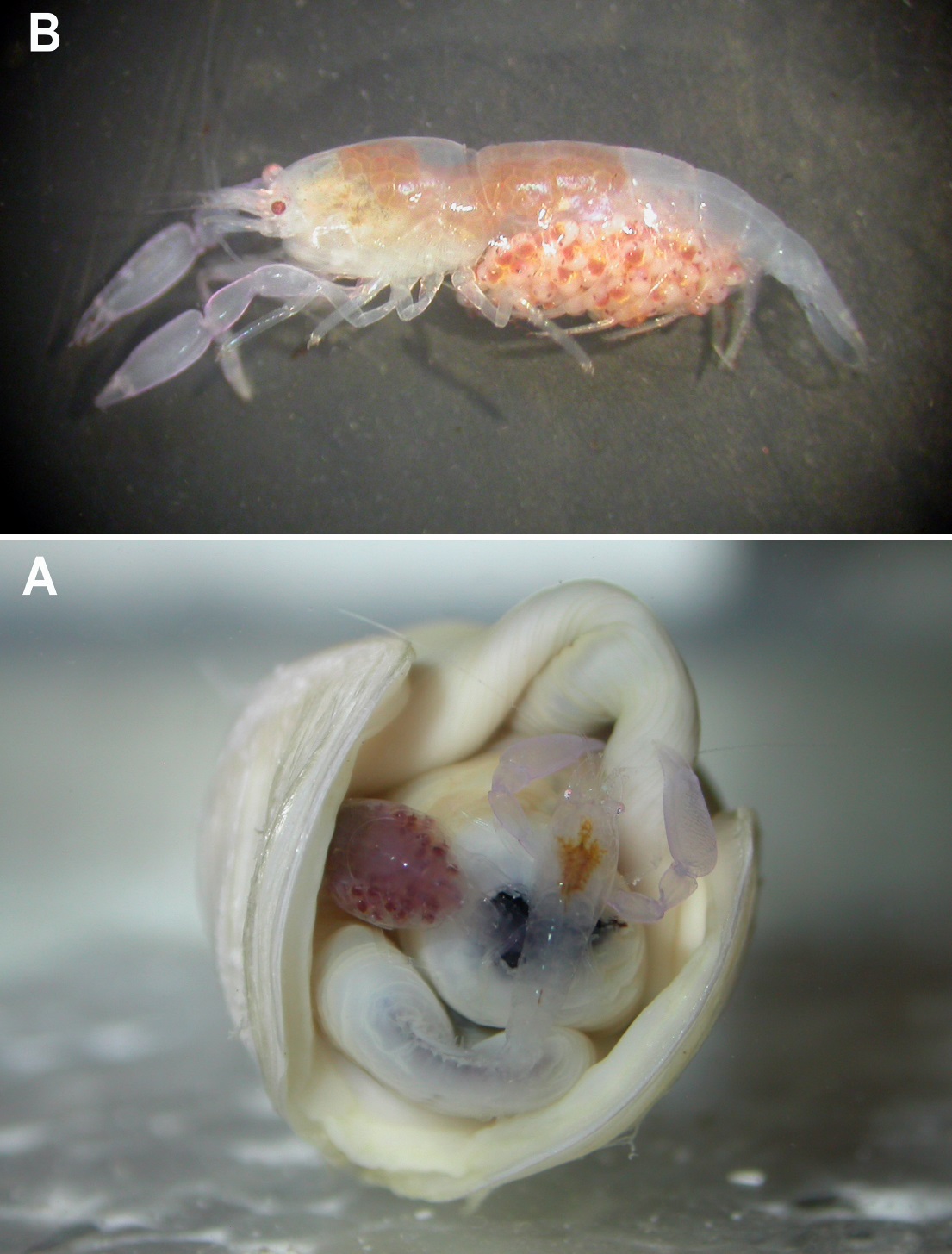
[Crustacea • 2024] Platypontonia ngae • A New symbiotic Shrimp (Decapoda: Palaemonidae) living inside a boring gastrochaenid bivalve mollusk from the Philippines


Platypontonia ngae  Fransen, 2024
ovigerous female holotype & male-female pair in gastrochaenid bivalve

 
Abstract
A new symbiotic palaemonid shrimp Platypontonia ngae sp. nov., is described based on a male-female pair found inside the mantle cavity of a gastrochaenid bivalve mollusk collected on a coral slope on the island Panglao, Philippines. The new species constitutes the third member of the genus Platypontonia Bruce, 1968. The new species is described, figured and compared with its congeners.

Crustacea, Malacostraca, Caridea, Symbiosis, Mollusca, Gastrochaenidae, Philippines


Platypontonia ngae sp. nov.:
A, male-female pair in gastrochaenid bivalve; B, ovigerous female holotype, RMNH.CRUS.D.58061.
Photographs by Stefano Schiaparelli.


Charles H.J.M. Fransen. 2024. Platypontonia ngae sp. nov., A New symbiotic Shrimp (Decapoda: Palaemonidae) living inside a boring gastrochaenid bivalve mollusk from the Philippines.  Zootaxa. 5476(1); 89-98. DOI: 10.11646/zootaxa.5476.1.11

Monday, June 10, 2024

[Mollusca • 2017] Leoparreysia gen. nov. & Trapezidens gen. nov., Radiatula mouhoti, Trapezoideus panhai, ... • New Taxa of Freshwater Mussels (Unionidae) from A Species-rich but overlooked Evolutionary Hotspot in Southeast Asia


Shells of the endemic Parreysiinae taxa from the Sittaung River basin, Myanmar.
 (a) Leoparreysia canefrii Vikhrev, Bolotov et Kondakov gen. et sp. nov., Sittaung River near Taungoo, 
(b) Radiatula mouhoti Vikhrev, Bolotov et Konopleva sp. nov., Sittaung River near Taungoo, 
(c) Lamellidens brandti Bolotov, Konopleva et Vikhrev sp. nov., Pathi River, 
(d) Trapezidens obesa feae Kondakov, Konopleva et Vikhrev gen. et ssp. nov., Myit Kyi Pauk Stream,  
Scale bar = 2 cm.

in Bolotov, Vikhrev, Kondakov, Konopleva, Gofarov, Aksenova et Tumpeesuwan, 2017. 
 (Photos: Ekaterina S. Konopleva).


Abstract
Southeast Asia harbors a unique and diverse freshwater fauna of Mesozoic origin, which is under severe threat of extinction because of rapid economic development and urbanization. The largest freshwater basins of the region are certainly the primary evolutionary hotspots and they attract the most attention as key biodiversity areas for conservation. In contrast, medium-sized rivers are considered low-importance areas with secondary biodiversity, whose faunas originated via founder events from larger basins during the Pleistocene, although such a scenario has never been tested by using a phylogenetic approach. In this investigation, we used freshwater mussels (Unionidae) as a model to estimate the levels of endemism within the Sittaung, a little-known remote basin in Myanmar, compared with the surrounding larger rivers (Irrawaddy, Salween and Mekong). We discovered that the Sittaung represents an exceptional evolutionary hotspot with numerous endemic taxa of freshwater mussels. On the basis of our extensive dataset, we describe two new tribes, two genera, seven species and a subspecies of Unionidae. Our results highlight that medium-sized basins may represent separate evolutionary hotspots that harbor a number of endemic lineages. These basins should therefore be a focus of special conservation efforts alongside the largest Southeast Asian rivers.

Leoparreysiini Vikhrev, Bolotov et Kondakov tribe nov. 
Pilsbryoconchini Bolotov, Vikhrev et Tumpeesuwan tribe nov.


Shells of the endemic Parreysiinae taxa from the Sittaung River basin. (a) Leoparreysia canefrii Vikhrev, Bolotov et Kondakov gen. et sp. nov., Sittaung River near Taungoo, Myanmar (holotype RMBH biv254_4). (b) Radiatula mouhoti Vikhrev, Bolotov et Konopleva sp. nov., Sittaung River near Taungoo, Myanmar (holotype RMBH biv256). (c) Lamellidens brandti Bolotov, Konopleva et Vikhrev sp. nov., Pathi River, Myanmar (holotype RMBH biv243_14). (d) Trapezidens obesa feae Kondakov, Konopleva et Vikhrev gen. et ssp. nov., Myit Kyi Pauk Stream, Myanmar (holotype RMBH biv250_4).
Scale bar = 2 cm. (Photos: Ekaterina S. Konopleva).


Shells of the endemic Pseudodontinae and Rectidentinae taxa from the Sittaung River basin.
 Pseudodontinae (a,b), including (a) Pseudodon bogani Bolotov, Kondakov et Konopleva sp. nov., Kanni River, Myanmar (holotype RMBH biv241_5), and (b) P. manueli Konopleva, Kondakov et Vikhrev sp. nov., Pyowne Stream, Myanmar (holotype RMBH biv246_3).
Rectidentinae (c,d), including (c) Trapezoideus nesemanni Konopleva, Vikhrev et Bolotov sp. nov., Tauk Ue Kupt River, Myanmar (holotype RMBH biv255_2), and (d) T. panhai Konopleva, Bolotov et Kondakov sp. nov., Kyan Hone River (holotype RMBH biv138_4).
Scale bar = 2 cm. (Photos: Ekaterina S. Konopleva).

Haplotype-level phylogeny and distribution of Indo-Chinese Unionidae.
(a) Multi-locus fossil-calibrated phylogeny based on the BEAST 1.8.4 model and obtained for the complete data set of mitochondrial and nuclear sequences (five partitions: three codons of ...
(b) Map of distribution areas. Red circles indicate our collecting localities ...
 

Ivan N. Bolotov, Ilya V. Vikhrev, Alexander V. Kondakov, Ekaterina S. Konopleva, Mikhail Yu. Gofarov, Olga V. Aksenova and Sakboworn Tumpeesuwan. 2017. New Taxa of Freshwater Mussels (Unionidae) from A Species-rich but overlooked Evolutionary Hotspot in Southeast Asia. Scientific Reports. 7, Article number: 11573. DOI: 10.1038/s41598-017-11957-9

Tuesday, May 28, 2024

[Mollusca • 2024] Assamnaia gen. nov. & Pseudoscabies gen. nov. • Discovery of an Endemism Hotspot of Freshwater Mussels (Bivalvia: Unionidae) in Assam, with A Description of Two New Genera


 Pseudoscabies Bolotov, Sonowal, Kardong, Pasupuleti & Subba Rao gen. nov.,

in Bolotov, Sonowal, Kardong, Pasupuleti, Rao, Unnikrishnan, Gofarov, Kondakov, Konopleva, Lyubas & Vikhrev, 2024

 Abstract
The Indian subcontinent houses a unique fauna of freshwater mussels. Tectonic and biogeographic reconstructions indicate that this fauna represents a derivative of Mesozoic Gondwanan biota and that it arrived in Asia on the Indian Plate, using this tectonic block as a ‘biotic ferry’. Though a preliminary integrative revision of the Indian Unionidae was published recently, the level of endemism and taxonomic richness of regional assemblages are unsatisfactorily known. Here, we revise the taxonomy of freshwater mussels from the Brahmaputra River basin based on a large DNA-sequence and morphological dataset that was sampled in Assam, north-eastern India. We managed to collect and sequence topotypes for nearly all nominal species described from the region, except for Lamellidens friersoni and Parreysia smaragdites. Our phylogenetic and morphology-based research reveals that the regional Unionidae assemblage contains nine species, belonging to a single subfamily, the Parreysiinae. Seven species and three genera (BalwantiaPseudoscabies Bolotov, Sonowal, Kardong, Pasupuleti and Subba Rao gen. nov., and Assamnaia Bolotov, Sonowal, Kardong, Pasupuleti and Subba Rao gen. nov.) appear to be endemic to the region, indicating that the Brahmaputra River may represent an endemism hotspot of global significance. Our findings highlight that this region should be considered a high-priority area for freshwater conservation management.

biogeography, Bivalvia, Brahmaputra River, conchological variability, conservation, India, phylogenetics, rare species, taxonomy, Unionidae


Ivan N. Bolotov, Jyotish Sonowal, Devid Kardong, Rajeev Pasupuleti, Nalluri V. Subba Rao, Suresh Kumar Unnikrishnan, Mikhail Y. Gofarov, Alexander V. Kondakov, Ekaterina S. Konopleva, Artem A. Lyubas and Ilya V. Vikhrev. 2024. Discovery of an Endemism Hotspot of Freshwater Mussels (Bivalvia: Unionidae) in Assam, with A Description of Two New Genera. Zoological Journal of the Linnean Society. zlae052. DOI: 10.1093/zoolinnean/zlae052
Researchgate.net/publication/380667703_freshwater_Unionidae_in_Assam