Showing posts with label Dinosaur: South America. Show all posts

Sunday, October 8, 2023

[Paleontology • 2023] Farlowichnus rapidus • A Speedy and Small Theropod in the Early Cretaceous Botucatu Paleodesert (Paraná Basin), Brazil


Farlowichnus rapidus 
 Leonardi, Fernandes, Carvalho, Schutzer & Silva, 2023


Abstract
The Botucatu Formation (Paraná Basin, Brazil and the southern neighboring countries) comprises one of the richest tetrapod ichnological deposits of the Lower Cretaceous in South America. The ichnofossils are found in reddish sandstones lithofacies -interpreted to be dune and interdune deposits. The sandstones of Botucatu Formation originally covered a surface estimated in at least 1,300,000 km2, the largest known fossil desert in the Earth’s history. The distribution area of the Botucatu paleodesert presents one of the world’s largest megatracksites. The tetrapod ichnofauna from the Botucatu Formation comprises minor bipedal dinosaur tracks (almost all attributable to theropods, with one exception, a doubt ornithopod trackway) along with many thousands of footprints of early mammals, and a single trackway of a lacertiform reptile. Among the bipedal dinosaur footprints, the most common and typical are considered theropod tracks, with long strides and high step angle and always with an acuminate termination. These trackways are straight and very narrow, with long strides and step angles showing high values. The footprints have a relatively large and very wide III digit and small, short, pointed, bladelike outer digits. The most special characteristic is that the II digit is longer and more important than the IV digit. Because of this morphology, the general outline of the footprint often reminds that of a waterdrop and, although it is structurally tridactyl, it usually looks like functionally monodactylous. These tracks are herein assigned to small theropods adapted to desert life with a prevalently cursorial gait, probably ancestors of clades such as noasaurs and velocisaurs. Due its unique morphological aspects it is defined a new ichnogenus and ichnospecies.


 Farlowichnus rapidus new ichnogen., new ichnosp.
 

 Giuseppe Leonardi, Marcelo Adorna Fernandes, Ismar de Souza Carvalho, Julia Beatrice Schutzer and Rafael Costa da Silva. 2023. Farlowichnus rapidus new ichnogen., new ichnosp.: A Speedy and Small Theropod in the Early Cretaceous Botucatu Paleodesert (Paraná Basin), Brazil. Cretaceous Research. 105720. DOI: 10.1016/j.cretres.2023.105720

Wednesday, June 21, 2023

[Paleontology • 2018] Macrocollum itaquii • An Exceptionally Preserved Association of Complete Dinosaur Skeletons Reveals the Oldest Long-necked Sauropodomorphs (Sauropodomorpha: Unaysauridae)


Macrocollum itaquii  
 Müller, Langer & Dias-da-Silva, 2018


Abstract
The rise of sauropodomorphs is still poorly understood due to the scarcity of well-preserved fossils in early Norian rocks. Here, we present an association of complete and exceptionally well-preserved dinosaur skeletons that helps fill that gap. They represent a new species, which is recovered as a member of a clade solely composed of Gondwanan Triassic taxa. The new species allows the definition of a set of anatomical changes that shaped sauropodomorph evolution along a period from 233 to 225 Ma, as recorded in the well dated Late Triassic beds of Brazil. In that time span, apart from achieving a more herbivorous diet, sauropodomorph dinosaurs increased their size in a ratio of 230% and their typical long neck was also established, becoming proportionally twice longer than those of basal taxa. Indeed, the new dinosaur is the oldest-known sauropodomorph with such an elongated neck, suggesting that the ability to feed on high vegetation was a key trait achieved along the early Norian. Finally, the clustered preservation mode of the skeletons represents the oldest evidence of gregarious behaviour among sauropodomorphs.


Systematic palaeontology

Dinosauria Owen, 1842
Saurischia Seeley, 1887
Sauropodomorpha Huene, 1932

Unaysauridae clade nov.

 Type genus: Unaysaurus tolentinoi Leal et al., 2004.

  Definition: Most inclusive clade including Unaysaurus tolentinoi Leal et al., 2004, but not Plateosaurus engelhardti von Meyer, 1837 nor Saltasaurus loricatus Bonaparte & Powel, 1980.

  Diagnosis: Unaysauridae differs from all other sauropodomorphs by a substantial cranial expansion of the medial condyle of the astragalus. In addition, a promaxillary fenestra is also unique for the group of sauropodomorphs, although cranial elements are still unknown for Jaklapallisaurus asymmetrica.

Macrocollum itaquii gen. et sp. nov.

  Etymology: The generic name combines the Greek word μακρο (= long) and the Latin word ‘collum’ (= neck), referring to the elongated neck of the new taxon. The specific epithet honours Mr José Jerundino Machado Itaqui, one of the main actors behind the creation of CAPPA/UFSM.
 
 Locality and horizon: The specimens were collected at the Wachholz site (29°36′46.42″ S; 53°15′54.06″ W), Agudo, Rio Grande do Sul, Brazil; upper portion of the Candelária Sequence, Paraná Basin. Stratigraphically correlated beds from a nearby site were dated as early Norian (ca 225.42 ± 0.37), Late Triassic.

 Diagnosis: Macrocollum itaquii differs from all other known sauropodomorphs based on a unique combination of characters: antorbital fossa perforated by a promaxillary fenestra; medial margin of the supratemporal fossa with a simple smooth curve at the frontal/parietal suture; proximal articular surface of metacarpal I transversely narrow; acetabulum not fully open; ischiadic longitudinal groove not reaching the caudal half of the ischium; absence of trochanteric shelf on the femur; medial condyle of distal femoral articulation subrectangular in distal view; proximal end of metatarsal II with a straight medial margin (see electronic supplementary material, figure S2 for further details).


Rodrigo Temp Müller, Max Cardoso Langer and Sérgio Dias-da-Silva. 2018. An Exceptionally Preserved Association of Complete Dinosaur Skeletons Reveals the Oldest Long-necked Sauropodomorphs.  Biology Letters. 14(11); 20180633.  DOI: 10.1098/rsbl.2018.0633


Mom's Phone Call Helps Uncover Oldest Long-Necked Dinosaur on Record shar.es/aa2quM via @LiveScience
Three ancient skeletons, ancestors of giant dinosaurs, unearthed in Brazil  phys.org/news/2018-11-ancient-skeletons-ancestors-giant-dinosaurs.html via @physorg_com
Pesquisadores do Cappa, da UFSM e da USP descobrem mais antigo dinossauro de pescoço longo ufsm.br/2018/11/20/descoberto-no-brasil-o-mais-antigo-dinossauro-de-pescoco-longo/
Three ancient skeletons, ancestors of giant dinosaurs, unearthed in Brazil  phys.org/news/2018-11-ancient-skeletons-ancestors-giant-dinosaurs.html via @physorg_com

Thursday, May 11, 2023

[Paleontology • 2023] A Reappraisal of the Cranial and Mandibular Osteology of the spinosaurid Irritator challengeri (Dinosauria: Theropoda)


Irritator challengeri  Martill, Cruickshank, Frey, Small & Clarke, 1996

in Schade, Rauhut, Foth, Moleman et Evers, 2023. 

ABSTRACT
Although originally described almost three decades ago, the holotype of Irritator challengeri from the Lower Cretaceous Romualdo Formation of Brazil still represents the most complete spinosaurid skull known to science. Here, we present a detailed description of the skull of Irritator based on digital reconstructions from medical and micro computed tomography (µCT) data. Segmentation reveals the near-complete palatal complex and braincase, an unusual morphology of the retroarticular process, a large, ventrally inclined surangular shelf and the tooth replacement pattern. The digitally reconstructed skull anatomy indicates a robust dentition, a field of binocular vision in front of the skull with an inclined snout orientation, a relatively weak but fast bite, as well as laterally spreading and rotating lower jaw rami during jaw opening. We modified an existing phylogenetic matrix of Tetanurae to account for new observations on the morphology of Irritator and analysed this using parsimony and Bayesian methods. Results support Spinosauridae as members of Megalosauroidea and recover a monophyletic Carnosauria (Megalosauroidea + Allosauroidea). Parsimony analysis recovers Monolophosaurus nested within Megalosauroidea as sister taxon to spinosaurids, but this is not supported by the Bayesian analysis. Bayesian time-calibration and evolutionary rate analysis indicate that spinosaurid evolution happened fast, despite a long ghost lineage of at least 35 million years. High evolutionary rates over a prolonged time can explain the highly derived skull morphology of spinosaurids. This study provides an in-depth look into the evolution of spinosaurid skull anatomy and refines our understanding of these specialized Mesozoic predators.

Keywords: Dinosaur; Theropod; Spinosaurid; Cretaceous; Mesozoic; Brazil


Theropoda Marsh, 1881
Tetanurae Gauthier, 1986
Megalosauroidea Fitzinger, 1843; sensu Carrano et al. (2012)

Spinosauridae Stromer, 1915
Spinosaurinae (Stromer, 1915); sensu Sereno et al. (1998)

Irritator challengeri Martill, Cruickshank, Frey, Small and Clarke, 1996

Holotype. SMNS 58022, largely complete skull, missing most of the premaxillae, anterior ends of the maxillae, and anteriormost parts of both mandibles.

Locality and horizon. Near Buxexé, close to Santana do Cariri, Ceará State, northeastern Brazil (see Sues et al., 2002: 535). Lower part of the Romualdo Formation (Santana Formation of some authors; see discussion in Arai and Assine, 2020) of the Santana Group, late Aptian (Arai and Assine, 2020).


Marco Schade, Oliver W. M. Rauhut, Christian Foth, Olof Moleman, and Serjoscha W. Evers. 2023. A Reappraisal of the Cranial and Mandibular Osteology of the spinosaurid Irritator challengeri (Dinosauria: Theropoda). Palaeontologia Electronica. 26(2): a17.DOI: 10.26879/1242
 
palaeo-electronica.org/content/2023/3821-the-osteology-of-irritator


Monday, March 6, 2023

[Paleontology • 2023] Chucarosaurus diripienda • A New Giant Titanosaur (Sauropoda: Titanosauria: Colossosauria) from the Upper Cretaceous of Northwestern Patagonia, Argentina


Chucarosaurus diripienda 
 Agnolin, Gonzalez Riga, Aranciaga Rolando, Rozadilla, Motta, Chimento & Novas, 2023


Abstract
Chucarosaurus diripienda gen. et sp. nov. is a new and large titanosaurian sauropod from the Neuquén Basin, Rio Negro Province, Patagonia. The specimen was discovered in the Upper Cretaceous strata of the Huincul Formation (middle Cenomanian–lower Turonian). It includes appendicular and relatively slender elements, with a femoral total length of about 1.9 m long. This taxon shows a unique combination of characters indicating that appendicular bones such as the femur, ischium and tibia, show a remarkable morphological variety, greater than previously described, and are morphologically informative as source of phylogenetic data. A cladistic phylogenetic analysis placed Chucarosaurus well nested within the Colossosauria clade.

 Keywords: Chucarosaurus, Sauropods, Colossosauria, Neuquén Basin, Cenomanian–Turonian, Patagonia, Argentina


Dinosauria Owen 1842
Saurischia Seeley 1887
Sauropoda Marsh, 1878

Titanosauria Bonaparte and Coria, 1993
Colossosauria Gonzalez Riga, Lamanna, Otero, Ortiz David, Kellner, and Ibiricu, 2019 

Chucarosaurus diripienda gen. et sp. nov. 

 Etymology. Chucaro, from the native language Quechua, also used for the gauchos (people who live in the countryside of Argentina), Mapundungum, meaning hard and indomitable animalsaurus, from the Latin, reptile; diripienda, from the Latin, meaning scrambled.


Federico L. Agnolin, Bernardo J. Gonzalez Riga, Alexis M. Aranciaga Rolando, Sebastián Rozadilla, Matías J. Motta, Nicolás R. Chimento and Fernando E. Novas. 2023. A New Giant Titanosaur (Dinosauria, Sauropoda) from the Upper Cretaceous of Northwestern Patagonia, Argentina. Cretaceous Research. 146, 105487. DOI: 10.1016/j.cretres.2023.105487  

Tuesday, January 10, 2023

[Paleontology • 2023] New Records of Theropoda from a Late Cretaceous (Campanian-Maastrichtian) Locality in the Magallanes-Austral Basin, Patagonia, and Insights into end Cretaceous Theropod Diversity


in Davis, Soto-Acuña, Fernández, Amudeo-Plaza, ... et Clarke, 2023. 

Abstract
The end Cretaceous mass extinction was marked by a dramatic change in biodiversity, and the extinction of all non-avian dinosaurs. To understand the diversity of dinosaur clades prior to this event, as well as recovery by avian dinosaurs (birds), we need a better understanding of the global fossil record. However, the fossil record from southern localities, particularly southernmost (>60°S) South America, has only recently begun to be described. Discoveries from Patagonia are important to accurately assess global trends in dinosaur diversity, particularly during the latest Cretaceous before the Cretaceous/Paleogene (K/Pg) mass extinction event. Here we describe new theropod dinosaur specimens, representing both associated material and isolated elements, from Upper Cretaceous (Campanian-Maastrichtian) deposits of the Río de las Chinas Valley, Magallanes-Austral Basin, Chile. These discoveries include the southern-most known occurrences of several theropod clades outside of Antarctica, including megaraptorids, unenlagiines, enantiornithines and ornithurines. Notably, these remains provide much needed time-constrained records of smaller theropods, including birds, which are less often recovered from Upper Cretaceous deposits. While fragmentary, these fossils are the first records of theropods from Chilean Patagonia, and provide insight into the distribution of avian and non-avian theropods in southern high latitude ecosystems prior to the K/Pg mass extinction event. Sampling from this region is still sparse, and more fossils from age-controlled sections are needed to accurately assess global extinction dynamics through the end Cretaceous.


Sarah N. Davis, Sergio Soto-Acuña, Roy A. Fernández, Jared Amudeo-Plaza, Marcelo A. Leppe, David Rubilar-Rogers, Alexander O. Vargas and Julia A. Clarke. 2023. New Records of Theropoda from a Late Cretaceous (Campanian-Maastrichtian) Locality in the Magallanes-Austral Basin, Patagonia, and Insights into end Cretaceous Theropod Diversity. Journal of South American Earth Sciences. 122, 104163. DOI: 10.1016/j.jsames.2022.104163


Friday, December 2, 2022

[Paleontology • 2022] Patagopelta cristata • A New Small-bodied Ankylosaurian Dinosaur (Ornithischia: Nodosauridae) from the Upper Cretaceous of North Patagonia (Río Negro Province, Argentina)


Patagopelta cristata 
 Riguetti, Pereda-Suberbiola, Ponce, Salgado, Apesteguía, Rozadilla Arbour, 2022
 
 facebook.com: Sebastián Apesteguía 
illustration by Gabriel Dìaz Yantèn
 
Abstract
The most representative ankylosaurian remains from Argentina have been found in sediments of the Allen Formation (Campanian–Maastrichtian) in Salitral Moreno, Río Negro Province. Several authors have discussed the identity and history of these remains. In this study, we review all published material along with some new remains in order to summarize all the knowledge about these ankylosaurs. Previously published material includes a tooth, dorsal and anterior caudal vertebrae, a femur and several osteoderms. The new remains include synsacral and caudal elements, a partial femur and osteoderms. The anatomy of the tooth, the synsacrum, the mid-caudal vertebra, the femur and the osteoderms, and the histology of the post-cervical osteoderms, support a nodosaurid identification, as proposed in previous descriptions of the Salitral Moreno material. Patagopelta cristata gen. et sp. nov. is a new nodosaurid ankylosaur characterized by the presence of unique cervical half-ring and femoral anatomies, including high-crested lateral osteoderms in the half rings and a strongly developed muscular crest in the anterior surface of the femur. The ∼2 m body length estimated for Patagopelta is very small for an ankylosaur, comparable with the dwarf nodosaurid Struthiosaurus. We recovered Patagopelta within Nodosaurinae, related to nodosaurids from the ‘mid’-Cretaceous of North America, contrasting the previous topologies that related this material with Panoplosaurini (Late Cretaceous North American nodosaurids). These results support a palaeobiogeographical context in which the nodosaurids from Salitral Moreno, Argentina, are part of the allochthonous fauna that migrated into South America during the late Campanian as part of the First American Biotic Interchange.
 
Keywords: Patagopelta, Nodosauridae Late Cretaceous, Salitral Moreno, Patagonia, Gondwana


 Patagopelta cristata gen. et sp. nov.

 
Facundo Riguetti, Xabier Pereda-Suberbiola, Denis Ponce, Leonardo Salgado, Sebastián Apesteguía, Sebastián Rozadilla... 2022. A New Small-bodied Ankylosaurian Dinosaur from the Upper Cretaceous of North Patagonia (Río Negro Province, Argentina). Journal of Systematic Palaeontology. 20(1): 2137441. DOI: 10.1080/14772019.2022.2137441 

Saturday, September 24, 2022

[Paleontology • 2022] Perijasaurus lapaz • A Sauropod from the Lower Jurassic La Quinta formation (Dept. Cesar, Colombia) and the initial Diversification of Eusauropods at low Latitudes


Perijasaurus lapaz 
 Rincón, Raad Pájaro, Jiménez Velandia, Ezcurra & Wilson Mantilla, 2022


ABSTRACT
The northern-most occurrence of Sauropoda in South America was collected in the 1940s from Early–Middle Jurassic-aged continental sediments on the western flank of the Serranía del Perijá in Colombia. Relocation of the site and re-preparation of the specimen, a well-preserved dorsal vertebra, provide important information about the initial diversification of sauropods at low latitudes. The specimen possesses autapomorphies and a unique combination of character states (e.g., divided centropostzygapophyseal lamina, strongly dorsally arched postzygapophyseal facets) that diagnose it as the new genus and species Perijasaurus lapaz. A medium-sized early eusauropod, Perijasaurus inhabited tropical lowland forested areas around the Toarcian–Aalenian boundary. Our phylogenetic analysis recovers Perijasaurus near the base of Eusauropoda, in an unresolved position near Cetiosaurus, Patagosaurus and kin (Bagualia, Spinophorosaurus, Nebulasaurus), and more deeply nested eusauropods. The phylogenetic position of Perijasaurus bolsters the idea that eusauropods achieved a broad geographic distribution during the Early–Middle Jurassic, before the deeper fragmentation of Pangea and after the Toarcian faunal turnover documented at high southern latitudes. Perijasaurus and other basally diverging sauropods display an intermediate level of bone weight reduction in the axial column that represents an antecedent to the more highly developed pneumatic system characterizing Neosauropoda.

Original reconstruction of the dorsal vertebra of Perijasaurus lapaz gen. et sp. nov.  (UCMP 37689) in left lateral view, A, posterior view, B, and in transverse section at tickmark, C. Note that the two pieces of the vertebra, which have no snap fit, have been partially reconstructed after reversing the upper neural arch component. Modified from Langston and Durham (1955:fig. 1).

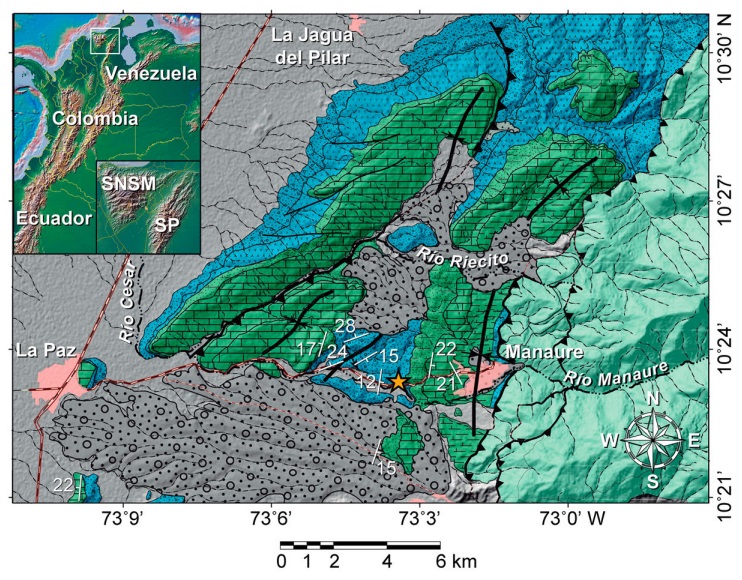
Regional and local geological and stratigraphic context for Perijasaurus lapaz gen. et sp. nov. (UCMP 37689). The inset maps in the upper left show the locations of the Serranía del Perijá (SP) and the Sierra Nevada de Santa Marta (SNSM), two geological structures in tropical South America that incorporate Lower to Middle Jurassic synrift continental sequences (Tschanz et al., 1974; Schubert, 1986; Ryan et al., 2009; Bayona et al., 2010; Nova et al., 2012). The larger geological map of the western Serranía del Perijá shows the location of the holotype of Perijasaurus lapaz. Note its location north of the La Paz–Manaure road and east of a prominent thrust fault, referenced in the original description of the specimen (Langston and Durham, 1955).

Perijasaurus lapaz gen. et sp. nov. (UCMP 37689). Virtual sections through the three-dimensional model of the dorsal vertebra.
 A–C, sections through the upper neural arch; D–H, sections through the centrum and lower neural arch.
A, transverse section through the neural spine and diapophysis; B, horizontal section through the neural spine; C, oblique section through the diapophysis; D, horizontal section through the centrum; E, mid-sagittal section through the centrum and neural arch; and F–H, transverse sections through the centrum and lower neural arch. Anterior faces down in B, to the right in C, and to the left in D and E.


SYSTEMATIC PALEONTOLOGY

SAUROPODOMORPHA von Huene, 1932 (Fabbri et al., 2020)
SAUROPODA Marsh, 1878 (Yates, 2006)

EUSAUROPODA Upchurch, 1995

PERIJASAURUS LAPAZ, gen. et sp. nov.

Holotype— UCMP 37689, an anterior to middle dorsal vertebra, possibly corresponding to the fifth element in the series (see below, “Serial Position”).

Etymology— The genus name derives from the Serranía del Perijá, which is a part of the cordillera shared by Colombia and Venezuela (like the La Quinta Formation). The species name refers both to the nearby town of La Paz and the 2016 Acuerdos de Paz (peace agreement) that allowed us to conduct fieldwork in this region. 
Pronunciation: pear-EE-hah-SOW-roos la-PAHZ.


Aldo F. Rincón, Daniel A. Raad Pájaro, Harold F. Jiménez Velandia, Martín D. Ezcurra and Jeffrey A. Wilson Mantilla. 2022. A Sauropod from the Lower Jurassic La Quinta formation (Dept. Cesar, Colombia) and the initial Diversification of Eusauropods at low Latitudes. Journal of Vertebrate Paleontology. e2077112. DOI: 10.1080/02724634.2021.2077112 
 

RESUMEN: La ocurrencia más septentrional de Sauropoda en América del Sur se recolectó en la década del 1940 en sedimentos continentales del Jurásico Inferior a Medio, en el flanco occidental de la Serranía del Perijá en Colombia. La relocalización del sitio y una nueva preparación del espécimen, correspondiente a una vértebra dorsal bien conservada, brindan información importante acerca de la diversificación inicial de los saurópodos en paleolatitudes bajas. El espécimen tiene autapomorfías y una combinación única de caracteres morfológicos (por ejemplo, lámina centropostzigoapofiseal dividida, facetas postzigoapofiseales fuertemente arqueadas dorsalmente) que lo diagnostican como un nuevo género y especie, Perijasaurus lapaz. Perijasaurus es un eusaurópodo de tamaño mediano, que habitó en áreas boscosas en tierras bajas tropicales alrededor del límite Toarciano-Aaleniano. Nuestro análisis filogenético muestra a Perijasaurus cerca de la base de Eusauropoda, en una posición ambigua cercana a Cetiosaurus, Patagosaurus y sus parientes (Bagualia, Spinophorosaurus, Nebulasaurus), y eusaurópodos anidados más profundamente. La posición filogenética de Perijasaurus refuerza la idea de que los eusaurópodos alcanzaron una amplia distribución geográfica durante el Jurásico Temprano-Medio, antes de la fragmentación completa de Pangea y posterior al recambio faunístico del Toarciano documentado en las altas latitudes del sur. Perijasaurus y otros miembros basales de saurópodos muestran un nivel intermedio de reducción de la masa ósea en la columna vertebral que representa un precursor del sistema neumático más desarrollado que caracteriza a Neosauropoda.

Friday, September 16, 2022

[Paleontology • 2022] Ibirania parva • A New nanoid titanosaur (Dinosauria: Sauropoda) from the Upper Cretaceous of Brazil


 Ibirania parva
Navarro, Ghilardi, Aureliano, Díaz, Bandeira, Cattaruzzi, Iori, Martine, Carvalho, Anelli, Fernandes & Zaher, 2022


Abstract
Titanosaurian sauropods are known to exhibit remarkable body size disparity, with some taxa famed for nearing the zenith of terrestrial vertebrate body size. Here, we describe a new titanosaurian – Ibirania parva gen. et sp. nov. – from the Upper Cretaceous (Santonian–Campanian) São José do Rio Preto Formation of Bauru Basin,  n which represents one of the smallest sauropods known to date. The new taxon is diagnosed by seven autapomorphies and had an estimated body length of 5.7 m. Histological and μCT scan analyses showed that this new taxon is represented by skeletally mature individuals, which had attained somatic maturity prior to death. Phylogenetic analyses recovered the new taxon deeply nested within Saltasaurinae, a  clade previously known by small-sized forms. Ibirania parva gen. et sp. nov. brings new information indicating that the body size reduction in some titanosaurians could be driven by recurrent ecophysiographical settings, present in South America prior to the diversity peak attained by the group during the Campanian–Maastrichtian.

Keywords: Bauru Basin, Growth Patterns, Histology, Nanism, Saltasauridae, São José do Rio Preto Formation


 Bruno A. Navarro, Aline M. Ghilardi, Tito Aureliano, Verónica Díez Díaz, Kamila L. N. Bandeira, André G. S. Cattaruzzi, Fabiano V. Iori, Ariel M. Martine, Alberto B. Carvalho, Luiz E. Anelli, Marcelo A. Fernandes and Hussam Zaher. 2022. A New nanoid titanosaur (Dinosauria: Sauropoda) from the Upper Cretaceous of Brazil.  Ameghiniana. 59(5); 317-354. DOI: 10.5710/AMGH.25.08.2022.3477


Saturday, July 9, 2022

[Paleontology • 2022] Meraxes gigas • New Giant Carnivorous Dinosaur (Theropoda: Carcharodontosauridae) reveals Convergent Evolutionary Trends in Theropod Arm Reduction


Meraxes gigas

Canale, Apesteguía, Gallina, Mitchell, Smith, Cullen, Shinya, Haluza, Gianechini & Makovicky, 2022

Highlights: 
Meraxes, a new, giant predatory dinosaur from Patagonia had short arms like T. rex
Meraxes is the most complete carcharodontosaurid yet from the Southern Hemisphere
• It documents peak diversity of carcharodontosaurids just before they went extinct
Meraxes documents convergent evolution of short arms among megapredatory theropods.

Summary
Giant carnivorous dinosaurs such as Tyrannosaurus rex and abelisaurids are characterized by highly reduced forelimbs that stand in contrast to their huge dimensions, massive skulls, and obligate bipedalism. Another group that follows this pattern, yet is still poorly known, is the Carcharodontosauridae: dominant predators that inhabited most continents during the Early Cretaceous and reached their largest sizes in Aptian-Cenomanian times. Despite many discoveries over the last three decades, aspects of their anatomy, especially with regard to the skull, forearm, and feet, remain poorly known. Here we report a new carcharodontosaurid, Meraxes gigas, gen. et sp. nov., based on a specimen recovered from the Upper Cretaceous Huincul Formation of northern Patagonia, Argentina. Phylogenetic analysis places Meraxes among derived Carcharodontosauridae, in a clade with other massive South American species. Meraxes preserves novel anatomical information for derived carcharodontosaurids, including an almost complete forelimb that provides evidence for convergent allometric trends in forelimb reduction among three lineages of large-bodied, megapredatory non-avian theropods, including a remarkable degree of parallelism between the latest-diverging tyrannosaurids and carcharodontosaurids. This trend, coupled with a likely lower bound on forelimb reduction, hypothesized to be about 0.4 forelimb/femur length, combined to produce this short-armed pattern in theropods. The almost complete cranium of Meraxes permits new estimates of skull length in Giganotosaurus, which is among the longest for theropods. Meraxes also provides further evidence that carchardontosaurids reached peak diversity shortly before their extinction with high rates of trait evolution in facial ornamentation possibly linked to a social signaling role.

Keywords: Dinosauria, Theropoda, Carcharodontosauridae, anatomy, evolution, Patagonia, Cretaceous


 Meraxes gigas, gen. et sp. nov.


Juan I. Canale, Sebastián Apesteguía, Pablo A. Gallina, Jonathan Mitchell, Nathan D. Smith, Thomas M. Cullen, Akiko Shinya, Alejandro Haluza, Federico A. Gianechini and Peter J. Makovicky. 2022. New Giant Carnivorous Dinosaur reveals Convergent Evolutionary Trends in Theropod Arm Reduction. Current Biology. DOI: 10.1016/j.cub.2022.05.057