Showing posts with label Eleutherodactylidae. Show all posts

Monday, June 24, 2024

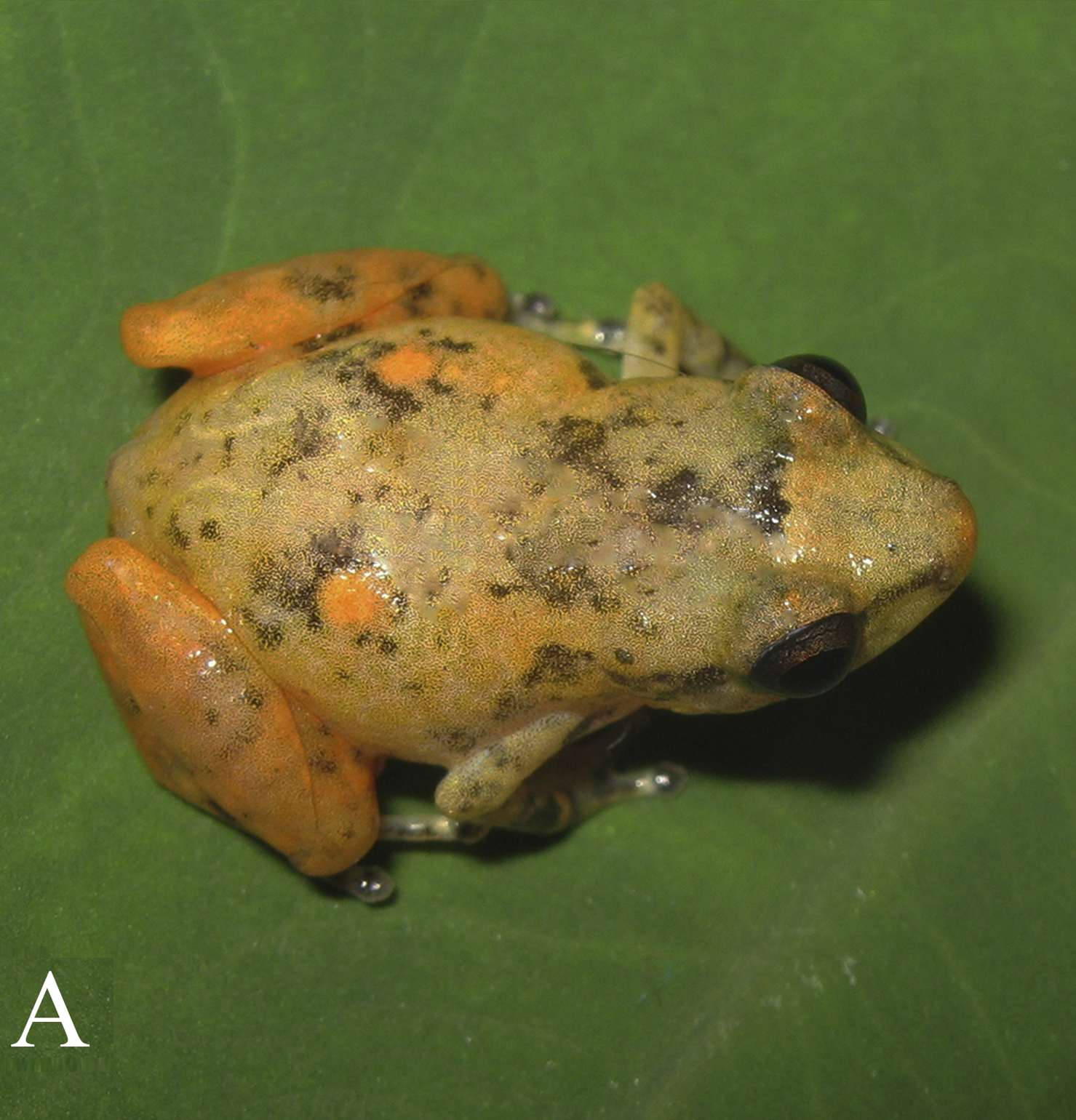
[Herpetology • 2024] Eleutherodactylus coelum • A New Species of Direct-developing Frog of the Genus Eleutherodactylus (Anura: Eleutherodactylidae) from Tamaulipas, Mexico


Eleutherodactylus (Syrrhophuscoelum
Hernández-Austria, García-Castillo & Parra-Olea, 2024

 
Abstract
The number of species of the subgenus Syrrhophus, genus Eleutherodactylus has increased rapidly in the last eight years, due to recent taxonomic studies. This subgenus of direct-developing frogs is well represented in Mexico, which harbors more than 90% of the species richness reported for the subgenus. In this study, we describe one new speciesEleutherodactylus (Syrrhophuscoelum sp. nov. from the El Cielo Biosphere Reserve in Tamaulipas, Mexico, based on morphological and molecular data. The new species, which was previously assigned to E. cystignathoides, differs from its congeners mainly by its small size and by having the tips of Finger III and IV expanded to twice the width of the narrowest part of these fingers. Phylogenetic analyses recovered a well-supported relationship of the new species as the sister group to an undescribed taxon from San Luis Potosí. This analysis also indicates there are more lineages wating for description.

Amphibia, Terraranas, eastern Mexico, taxonomy, diversity, phylogenetics, conservation


Eleutherodactylus (Syrrhophuscoelum


Raquel Hernández-Austria, Mirna G. García-Castillo and Gabriela Parra-Olea. 2024. A New Species of Direct-developing Frog of the Genus Eleutherodactylus (Anura: Eleutherodactylidae) from Tamaulipas, Mexico.  Zootaxa. 5471(4); 433-450. DOI: 10.11646/zootaxa.5471.4.3
facebook.com/RaquelHAustria/posts/pfbid0msrcjLJhMfW3U4GLsAAHoPgtj8Mjr5zdt9H1azQ2eQm6kYx3RHbuehLeMcLDv1Ucl

Saturday, April 29, 2023

[Herpetology • 2023] Eleutherodactylus franzi • A Novel Species of Piping Frog Eleutherodactylus (Anura: Eleutherodactylidae) from southern Mexico


Eleutherodactylus franzi
Grünwald, Montaño-Ruvalcaba, Jones, Ahumada-Carrillo, Grünwald, Zheng, Strickland & Reyes-Velasco, 2023


Abstract
We describe a new species of Eleutherodactylus (subgenus Syrrhophus) from Guerrero, Mexico, based on morphological and molecular data, as well as advertisement call analysis. Eleutherodactylus franzi sp. nov. has unique features including widely expanded fingertips, indistinct, but visible lumbo-inguinal glands, an immaculate white venter and dark reticulations on a cream dorsal background colouration. The new species belongs to the Eleutherodactylus nitidus species group. Eleutherodactylus franzi sp. nov. is micro-endemic, restricted to a small range in karstic hillsides on the southern extreme of the Mexican Transverse Ranges. We discuss conservation needs of this species, which we provisionally classify as Critically Endangered.

Key Words: amphibians, Anura, conservation, Guerrero, Mexican Transverse Ranges, taxonomy

Holotype of Eleutherodactylus franzi, sp. nov., INIRENA 2900 (CIG 01725), El Cucharillo, Municipio de Ixcateopan de Cuauhtémoc, Guerrero, Mexico
in life (A–C) and in preservative (D, E).
 
 Eleutherodactylus franzi sp. nov .

Diagnosis: Based on our phylogenetic analysis, this is a member of the genus Eleutherodactylus, subgenus Syrrhophus, as defined by Hedges et al. (2008). In the Eleutherodactylus (Syrrhophus) nitidus species series and the Eleutherodactylus (Syrrhophus) nitidus species group as defined by Grünwald et al. (2018), based on the condition of the tympanic annuli, ventral epidermis and visceral peritoneum. A small frog, but relatively large Syrrhophus, adult males measure 25.6–29.5 mm SVL; vocal slits are present in males, readily visible under partially translucent ventral epidermis; digital tips are widely expanded, 1.8–2.6 times the width of the narrowest part of the finger on the third and fourth fingers; fingers moderately long, finger lengths are I-II-IV-III with third finger length ranging from 15–18% of SVL; compact lumbo-inguinal gland above the inguinal region present, raised, indistinct, but visible in live specimen; ventral epidermis is partially translucent and visceral peritoneum is clear, not white, thus abdominal vein is not clearly visible against a white background on the venter of live specimens and viscera is partially visible through translucent dark grey ventral epidermis; limbs moderate, TL/SVL ratio is 0.40–0.50, FeL/SVL ratio is 0.31–0.38 and TotFL/ SVL ratio is 0.50–0.60; snout relatively short, END/ SVL ratio is 0.08–0.11; tympanum small, indistinct and round, tympanic annuli not visible in live specimen; TW/ED ratio is 0.40–0.60. The dorsal and lateral skin is slightly shagreened, whereas the ventral skin is smooth. Dorsal colouration cream or tan, with darker brown reticulations on dorsal and lateral portions of head and back; loreal and region dark brown, from snout to behind tympanum, with some pale spots and speckling present on labial region same colour as pale dorsal colouration; pale interorbital bar variable, may be present or absent, when present same colour as pale dorsal colouration of head and body; distinct irregular-edged dark brown transverse bands present on legs; upper arms same colouration and pattern as forearms; no pale mid-dorsal stripe; upper flanks same colour as dorsum, lower flanks whitish with some grey marbling; venter pale lavender with some sparse white spotting and pale grey on throat. No inguinal flash colours present on thighs and groin. The mating call of adult males is a short low-pitched pipe (see below; Fig. 4).

Etymology: This species is named after Héctor Franz-Chávez, Mexican herpetologist and avid field collector who collected the type material and who helped collect an extensive sampling of the Eleutherodactylus specimens to be used in our succession of studies.
 
Some of the paratypes of Eleutherodactylus franzi, sp. nov., in life.
A–C. INIRENA 2902 (CIG 01717) El Cucharillo, Municipio de Ixcateopan de Cuauhtémoc, Guerrero, Mexico;
D–F. INIRENA 2910 (CIG 01726) El Cucharillo, Municipio de Ixcateopan de Cuauhtémoc, Guerrero, Mexico;
G–I. INIRENA 2895 (CIG 01727), 3 km E of Ixcateopan de Cuauhtémoc, Municipio de Ixcateopan de Cuauhtémoc, Guerrero, Mexico;
J–L. INIRENA 2896 (CIG 01728), 3 km E of Ixcateopan de Cuauhtémoc, Municipio de Ixcateopan de Cuauhtémoc, Guerrero, Mexico;
M–O. INIRENA 2898 (CIG 01731), between El Cucharillo and Chichila, Municipio de Taxco de Alarcón, Guerrero, Mexico.


 Christoph I. Grünwald, Carlos Montaño-Ruvalcaba, Jason M. Jones, Iván Ahumada-Carrillo, André J. Grünwald, Jiacheng Zheng, Jason L. Strickland and Jacobo Reyes-Velasco. 2023. A Novel Species of Piping Frog Eleutherodactylus (Anura, Eleutherodactylidae) from southern Mexico. Herpetozoa. 36: 95-111. DOI: 10.3897/herpetozoa.36.e104707

Resumen: Describimos una especie nueva de Eleutherodactylus (subgénero Syrrhophus) de Guerrero, México basado en datos morfológicos y moleculares, así como análisis de llamadas de apareamiento. Eleutherodactylus franzi sp. nov. tiene características únicas, incluyendo puntas de los dedos ampliamente expandidas, glándulas lumbo-inguinales indistintas pero visibles, un vientre blanco inmaculado y una coloración dorsal de reticulaciones oscuras sobre un fondo crema. La especie nueva pertenece al grupo de especies de Eleutherodactylus nitidus. Eleutherodactylu. franzi sp. nov. es micro-endémica, restringida a un pequeño rango en laderas kársticas en el extremo sur del Eje Neovolcánico. Presentamos mapas de distribución y gráficos de llamadas de apareamiento de los machos de la nueva especie y sus parientes más cercanos, así como recomendaciones de conservación.
Palabras clave: anfibios, Anura, conservación, Eje Neovólcanico, Guerrero, taxonomía

Monday, March 27, 2023

[Herpetology • 2023] Eleutherodactylus humboldti & E. jamesdixoni • Two New Species of Eleutherodactylus (Anura: Eleutherodactylidae) from western and central Mexico


Eleutherodactylus humboldti 
Devitt​, Tseng, Taylor-Adair, Koganti, Timugura & Cannatella, 2023


Abstract
Background: 
The subgenus Syrrhophus (genus Eleutherodactylus) contains >40 species of small, direct-developing frogs that occur at low to moderate elevations from Texas through Mexico and into Guatemala and Belize, with two species in western Cuba. Morphological conservatism and phenotypic convergence have made species delimitation challenging and resulted in a complicated taxonomic history. Since 2015, molecular systematic work has uncovered eleven new species from western Mexico and one from eastern Mexico, but current taxonomy still underestimates species level diversity and there is confusion surrounding the validity and boundary of several species.

Methods: 
We used phylogenetic analysis of 16S ribosomal RNA (rRNA) sequences, multivariate statistical analysis of morphological data, and bioacoustic analysis of male advertisement calls to discover two additional unnamed species of Eleutherodactylus from Central and Western Mexico. We describe those species here.

Results: 
Eleutherodactylus (Syrrhophus) humboldti sp. nov. is described from the Quaternary Valle de Bravo volcanic field of the Eje Neovolcánico in Central Mexico. This species is sister to E. maurus and is 3% divergent in 16S. Eleutherodactylus (Syrrhophus) jamesdixoni sp. nov. is described from the Sierra Madre Occidental of western Mexico. This species is sister to E. nitidus and is 3% divergent. We provide color photographs, advertisement call recordings, and molecular diagnoses of these new species and their sister species to aid future workers.

Eleutherodactylus humboldti, sp. nov. in life
(A) MZFZ 4505 (holotype); (B) MZFZ 4504 (paratype); (C and D) MZFZ 4506 (paratype);

Eleutherodactylus (Syrrhophus) humboldti, new species 
Suggested English name: Humboldt’s Peeping Frog
Suggested Spanish name: Rana fisgona de Humboldt

Diagnosis and comparisons: 
Molecular synapomorphies for this species are (character: state change): 147: A => G, 204: C => T, 241: C => T, 243: A => T, 256: T => C, 279: C => A, 281: C => T, 292: G => A, 295: A => G and 358: G => C. Character numbers refer to the position in the alignment (Data S1).
Among species of the western clade of Syrrhophus, E. humboldti is most similar in appearance to E. maurus (Fig. 8); however, our sample sizes for each species are too small to make robust inter- or intrapopulation comparisons. These two taxa are very similar in having a triangular head with a sharp canthus rostralis with a black stripe on the lateral aspect. The stripe fades inferiorly into a grayish brown. This stripe seems to extend across the eye in the sense that the middle and lower part of the iris is black, whereas the upper part of the iris is gold. The stripe extends posterior to the eye across the tympanum (which is slightly paler in color) to the axilla. In the postorbital region, the stripe borders the sharp supratympanic fold.
....

Etymology: We name this species in honor of German scientist Alexander von Humboldt, whose year-long exploration of south-central Mexico at the turn of the 19th century resulted in the first scientific account of the New World and whose writings continue to influence biogeographers, ecologists and evolutionary biologists seeking to understand the origin and maintenance of biodiversity in mountain regions (Rahbek et al., 2019b, 2019a).


Holotype of Eleutherodactylus jamesdixoni, sp. nov. (IBH 34852) in life. 

Eleutherodactylus (Syrrhophus) jamesdixoni, new species
Suggested English name: Dixon’s Peeping Frog
Suggested Spanish name: Rana fisgona de Dixon

Diagnosis and comparisons: 
Molecular synapomorphies for this species are (character: state change) 204: C => T, 291: C => A, and 360: C => A. Character numbers refer to the position in the alignment (Data S1).

Among species of the western clade of Syrrhophus, E. jamesdixoni (Fig. 10) is most similar in appearance to E. nitidus (Fig. 11). We restrict our comparison to topotypic samples of E. nitidus. The two species are very similar in having a roughly triangular head with a gently angled canthus rostralis. The lateral aspect of the canthus is darker than the dorsal surface of the snout. In E. jamesdixoni a dark greenish black stripe is present, but in E. nitidus this stripe varies from very dark to barely differentiated from the color of the snout (Fig. 11). The stripe fades inferiorly in E. nitidus, but in E. jamesdixoni it is more distinct. This stripe seems to extend across the eye in that the middle and lower part of the iris is dark, whereas the upper part of the iris appears as densely packed gold flecks (this golden region is larger than in E. maurus and E. humboldti). In both, the stripe extends posterior to the eye across the tympanum (which is slightly copper-colored) to the axilla but is much less distinct than in E. maurus and E. humboldti. In the postorbital region the stripe becomes indistinct. The supratympanic fold is rounded but weakly developed.

Etymology: We name this species in honor of the late James R. Dixon, Professor Emeritus and Curator Emeritus of amphibians and reptiles at the Biodiversity Research and Teaching Collections at Texas A&M University. Dr. Dixon provided the first and most thorough statistical analysis to date of geographic variation among populations of the former genus Tomodactylus from western Mexico (Dixon, 1957).

Conclusions: 
Here, we have delimited two new species of Syrrhophus using morphology, calls, and DNA-based diagnoses. These frogs are among the most ubiquitous and abundant of Mexican amphibians, yet remain among the least known. Exceptional microendemism typifies this group, with several species known only from the type locality. Their ubiquity, diversity, high endemism, and unusual reproductive mode (direct development) offer potential for addressing fundamental and emerging questions in ecology, evolution, and behavior. This potential has not yet been realized however, due to an inaccurate taxonomy that underestimates species-level diversity. Additional species await description; the need for this research is great, and the timing is urgent. Mexico is home to two Biodiversity Hotspots—the Madrean Pine Oak Woodlands and tropical lowlands of Mesoamerica—but high rates of deforestation and a general lack of conservation areas pose increasing threats to species survival there. Some 60% of Mexican amphibians are threatened with or have already been lost to extinction, including nine species of Syrrhophus that are classified as Endangered or Critically Endangered by the International Union for the Conservation of Nature (IUCN, 2021). Discovering and describing unrecognized species-level diversity and identifying areas of endemism will directly impact conservation prioritization in Mexico.


Thomas J. Devitt​, Karen Tseng, Marlena Taylor-Adair, Sannidhi Koganti, Alice Timugura and David C. Cannatella. 2023. Two New Species of Eleutherodactylus from western and central Mexico (Eleutherodactylus jamesdixoni sp. nov., Eleutherodactylus humboldti sp. nov.) PeerJ. 11:e14985. DOI:  10.7717/peerj.14985

Tuesday, February 8, 2022

[Herpetology • 2022] Diasporus lynchi • A New Golden Species of Diasporus (Anura: Eleutherodactylidae) from southwestern Colombia, with Evaluation of the Phylogenetic Significance of Morphological Characters in Diasporus


Diasporus lynchi
 Ospina Sarria​, Velásquez Trujillo, Castaño Saavedra, Castillo & Bolívar-García, 2022

 Anchicaya’s Golden Frog | Rana Dorada de Anchicayá  ||  FrogDOI: 10.7717/peerj.12765
Photos: J.J. Ospina-Sarria.

Abstract 
A new species of Diasporus is described from the lowlands of southwestern Colombia. The new species exhibits a yellowish coloration in life, a character that it shares with other three species in the genus—Diasporus citrinobapheus, D. gularis, and D. tigrillo. The new species differs from all other congeners in having two chrome orange spots (=glandlike protrusions) on sacral region, smooth ventral skin, basal webbing between the toes, and distal papillae at tips of disc covers on fingers II–IV and toes II–IV. Further, the new species differs from all congeners by an uncorrected p-distance of > 5.56% of the 16S rRNA gene fragment examined. In addition to the new species described herein, we demonstrated that the possession of a yellowish coloration in life optimizes unambiguously as a synapomorphy of a clade within Diasporus, which may be recognized as the Diasporus diastema species group. We also discussed the phylogenetic significance of two morphological characters previously considered of systematic value in Diasporus, the occurrence of oval palmar tubercles (undivided) and longitudinal folds (of the vocal sacs) on the throat. On this basis, we demonstrated that these characters appear to be symplesiomorphies rather than synapomorphies of Diasporus. Regarding pointed disc covers (ungual flap) present in some species of Diasporus, we show that this character conflates various characters, involving variation in pad shape, dorsal outline of the disc (ungual flap), and dependence between discs of different digits. Finally, considering that phenotypic data are a valuable source of evidence in testing phylogenetic hypotheses of terraranan frogs, we encourage future research to incorporate phenotypic evidence into phylogenetic studies involved in the genus Diasporus.


Living specimens of the Diasporus species known from Colombia.
Diasporus lynchi (A–B; holotype, CPZ-UV 7298 (field no. JJS 065), adult male, snout–vent length [SVL] 19.1 mm; photo: J.J Ospina-Sarria);
Diasporus gularis (C; not collected, Pianguita, Valle del Cauca; J.J Ospina-Sarria);
Diasporus quidditus (D; holotype, ICN 45173, adult male; photo: J.D. Lynch);
Diasporus anthrax (E; MHUAA 09775, San Vicente de Chucuri, Santander; photo: H. Martinez);
Diasporus tinker (F; holotype, ICN 45174, adult male; photo: J.D. Lynch).

Dorsal and ventral views of Diasporus lynchi (holotype, CPZ-UV 7298 (field no. JJS 065) in life.
Photos: J.J. Ospina-Sarria.

Diasporus lynchi sp. nov. 
Proposed standard Spanish name. Rana Dorada de Anchicayá
Proposed standard English name. Anchicaya’s Golden Frog

Diagnosis.—Diasporus lynchi is diagnosed by the following combination of characters: (1) skin on dorsum and venter smooth; discoidal fold absent; dorsolateral folds absent; (2) tympanic membrane absent; tympanum annulus visible through skin round, its length 33–40% of eye length in two males; supratympanic fold poorly defined; (3) snout subacuminate in dorsal view, truncate in profile; canthus rostralis angular, weakly concave; loreal region slightly concave; (4) upper eyelid bearing two or three small tubercles; narrower than IOD (54.1–60% IOD); cranial crest absent; (5) choanae small, ovoid; partially concealed by palatal shelf of maxillary arch; dentigerous processes of vomers prominent and positioned posterior to level of choanae, triangular in outline, separated medially by a distance equal to the width of the visible dentigerous process, each dentigerous process of vomers bearing four to six teeth; (6) males having vocal slits and large subgular vocal sac (forming longitudinal folds, Figs. 3B, 3D); nuptial pads absent; testes white; (7) finger I shorter than finger II; discs slightly wider than digits, disc on finger I smaller than that of finger II and this in turn smaller than discs on fingers III and IV; disc cover on finger I unornamented; papillae on digits II, III, and IV; triangular pads on fingers; (8) fingers with lateral fringes; palmar tubercle oval (undivided; Fig. 4A); thenar tubercle oval, equal in size to palmar tubercle; supernumerary tubercles low, restricted to the proximal segments of fingers III and IV; subarticular tubercles low, with rounded base and larger than supernumerary tubercles; (9) ulnar tubercles absent; (10) heel and tarsus lacking tubercles and folds; (11) oval inner metatarsal tubercle, its length four times its width; low, conical outer metatarsal tubercle one-fourth size of inner metatarsal tubercle; supernumerary plantar tubercles absent; subarticular present; (12) toes bearing lateral fringes; webbing basal, I 2−- 2+ II 2−- 3+ III 3−- 4+IV 4−- 21/2 V (Fig. 4B); toe III shorter than toe V; toe III reaching midway between penultimate and distal subarticular tubercle of toe IV; toe V extending to distal edge of distal subarticular tubercle of toe IV; discs of toes III–V larger than disc of toe II and this in turn larger than discs on toe I; discs covers on toe I and V unornamented; discs with minute papillae at tips of toes II, III, and IV; triangular pads on toes; (13) in life, dorsal ground color yellow with dark markings, anterior and posterior surfaces of thighs chrome orange. Two chrome orange spots (=glandlike protrusions) on sacral region (Fig. 3A). Canthal, interorbital, and postocular stripes are poorly defined. Limbs with darks marking and disc covers blackish gray (Fig. 2A). Ventral surfaces of body almost transparent with scattered iridophores, ventral surfaces of hind limbs chrome orange, and vocal sac yellow with diminutive black spots (Fig. 3B). The iris is golden-bronze with a reddish-brown horizontal streak; (14) SVL in three adult males 19.1, 19.5, and 19.7 mm.

Distribution and ecology.—The holotype was found vocalizing in leaf litter along a forested stream in a primary forest at night. The calls sound like a “whistle”. The paratypes were also found along stream in primary but thinned forest. Both paratypes were found at distances no greater than 2 m from the stream. Thus, the species seems to be associated with streams in primary forests. As in other species of Diasporus (e.g., D. gularis and D. tinker), D. lynchi vocalizes from concealed sites (e.g., dried leaf); therefore, a considerable effort is required to detect each individual. The species occurs at low elevations in the humid tropical regime (54–300 m elevation) in localities in the vicinity to the Estación Agroforestal Bajo Calima, Departamento de Valle del Cauca, Colombia (Fig. 5), which is the locality type of Diasporus quidditus and D. tinker.

Etymology.—The specific name is an noun in the genitive case and is a patronym for John D. Lynch, who first found the species during his explorations of the Bajo Calima, and in recognition of his many contributions to understanding the taxonomy and systematics of the world’s most diverse family-group of amphibians (superfamily Brachycephaloidea = Terraranae).

Conclusions: 
With the description of Diasporus lynchi, 17 species compose the genus Diasporus. Phylogenetic analyses based on molecular evidence indicate that D. lynchi is the sister species of a clade containing D. gularis, D. aff. diastema EPL, D. aff. diastema MM, D. tigrillo, D. diastema, and D. citrinobapheus. Furthermore, we found that the possession of a yellowish coloration in life optimizes unambiguously as a morphological synapomorphy for this clade. Although species of genus Diasporus are characterized by having oval palmar tubercles (undivided) and longitudinal folds (of the vocal sacs) on the throat, none of them optimizes unambiguously as synapomorphies of this genus. Another morphological character that has been suggested to characterize the species of Diasporus is the pointed disc covers (ungual flap), however, there is evidence revealing that multiple characters have been conflated under this character.

Frogs of the genus Diasporus, together with the genus Pristimantis, are among the terraranan genera with the greatest taxonomy uncertainty for many of their taxa. This is because, as mentioned earlier, no attempt at morphological revision has been conducted recently. In the specific case of Diasporus, this situation has led to a lack of confidence in the taxonomic identification of numerous DNA sequences deposited in GenBank (e.g., Diasporus diastema, D. hylaeformis, D. quidditus, D. tinker). To address this situation, it is necessary a taxonomic revision incorporating morphological evidence. Besides, and considering that many species of Diasporus are sympatric and syntopic, we recommend being cautious when assigning species identification based on specimens collected near or at the type locality. For example, the Estación Agroforestal Bajo Calima in the Departamento de Valle del Cauca, Colombia is the type locality of Diasporus quidditus and D. tinker, but D. gularis and D. lynchi can also be found. That is, at the Estación Agroforestal Bajo Calima is possible to find four of the five species of the genus Diasporus known from Colombia, except for D. anthrax that is distributed in the Valle of the Magdalena River (Frost, 2021).

Finally, as has been pointed out in the literature, phenotypic data are a valuable source of evidence in testing phylogenetic hypotheses of terraranan frogs. Therefore, we hope our results encourage further research using phenotypic characters into phylogenetic and taxonomic studies involving the genus Diasporus.

 
Jhon Jairo Ospina Sarria​, David Andrés Velásquez Trujillo, Christian Oswaldo Castaño Saavedra, Luis Fernando Castillo and Wilmar Bolívar-García. 2022. A New Golden Species of Diasporus (Anura: Eleutherodactylidae) from southwestern Colombia, with Evaluation of the Phylogenetic Significance of Morphological Characters in Diasporus.  PeerJ. 10:e12765. DOI: 10.7717/peerj.12765


Thursday, September 2, 2021

[Herpetology • 2021] Adelophryne nordestina • A New Species of the Genus Adelophryne (Anura: Eleutherodactylidae: Phyzelaphryninae) from the Atlantic Forest of Northeastern Brazil


Adelophryne nordestina 
Lourenço-De-Moraes, Lisboa, Drummond, Moura, Moura, Lyra, Guarnieri, Mott, Hoogmoed & Santana, 2021

 
Abstract
Species in the Adelophryne genus consist of diminutive, agile, and secretive frogs that inhabit forest leaf litter and have direct development. Species richness within Adelophryne was previously underestimated, and several new species have recently been described. Here, we describe a new species of Adelophryne from the Atlantic Forest in the Brazilian states of Alagoas, Pernambuco, and Paraíba. The new species is characterized by its small body size, small and distinct tympanum, toes with subarticular tubercles, fingers mucronate, three phalanges in the Finger IV, and an advertisement call composed of one single pulsed note with a high dominant frequency. The new species is phylogenetically related to other Adelophryne species of the Northern Atlantic Forest Clade and is endemic to the “Pernambuco Endemism Center” in the Atlantic Forest biodiversity hotspot.
  
Keywords: Alagoas, Amphibia, biodiversity, hotspot, miniature, Paraíba, Pernambuco


Paratypes of Adelophryne nordestina sp. nov. in life
 (MUFAL 11767, SVL = 11.5 mm; MUFAL 10851, SVL = 12.5 mm;
MUFAL 11770, SVL = 10.5 mm; MUFAL 11769, SVL = 11.5 mm;
ZUFMS-AMP13680, SVL = 12.2 mm).
Specimens showing dorsal coloration (A-E) and showing ventral coloration (F-J).


Ricardo Lourenço-De-Moraes, Barnagleison Silva Lisboa, Leandro De Oliveira Drummond, Carina Carneiro De Melo Moura, Geraldo Jorge Barbosa De Moura, Mariana Lúcio Lyra, Miriam Camargo Guarnieri, Tamí Mott, Marinus Steven Hoogmoed and Diego José Santana. 2021. A New Species of the Genus Adelophryne (Anura: Eleutherodactylidae: Phyzelaphryninae) from the Atlantic Forest of Northeastern Brazil. Herpetologica. 77(2); 164-175. DOI:  10.1655/Herpetologica-D-20-00022.1

Sunday, November 22, 2020

[Herpetology • 2020] Adelophryne amapaensis • A New Amazonian Species of the Diminutive Frog Genus Adelophryne (Anura: Brachycephaloidea: Eleutherodactylidae) from the State of Amapá, Northern Brazil


Adelophryne amapaensis
Taucce, Costa-Campos, Haddad & de Carvalho, 2020


Abstract
During recent field expeditions to an Amazonian region in eastern Guiana Shield (Serra do Navio, state of Amapá, northern Brazil), we collected and recorded calls of a species of Adelophryne, a diminutive leaf-litter-dwelling, direct-developing frog genus. After a careful integrative taxonomic evaluation using morphological, molecular, and bioacoustic data, we concluded that the series of specimens collected represent a new taxon, which we describe herein. The new species of Adelophryne is distinguished from all ten congeners by the following combination of character states: (1) male SVL = 12.5 mm; female SVL = 13.0–14.4 mm; (2) tympanic membrane present; (3) tympanic annulus present, incomplete; (4) vomerine teeth absent; (5) finger terminal discs absent; (6) tips of Fingers I–IV mucronate; (7) finger pads present (formula 1–1–2–1); (8) three phalanges in Finger IV; (9) dorsum smooth; (10) cloacal flap absent; (11) multi-note advertisement call composed of non-pulsed notes; (12) the call dominant frequency (4,802–5,706 Hz) coincides with the fundamental harmonic. Our study describes the eleventh species of Adelophryne, and, despite the increase in taxonomic knowledge within the past few years, there are still some species in the genus lacking a formal taxonomic description.


 the holotype of Adelophryne amapaensis (CFBH 43257; SVL = 12.5 mm) in life.

Adelophryne amapaensis, new species

Etymology.—The species is named after the Brazilian state of Amapá, from which all known specimens come. The specific epithet is used here as a noun in apposition.

 
Fig. 6. Type locality of Adelophryne amapaensis (black square): Parque Natural Municipal do Canca˜o, municipality of Serra do Navio, state of Amapá, Brazil. Elevation 100 m above sea level.


Pedro P. G. Taucce, Carlos E. Costa-Campos, Célio F. B. Haddad and Thiago R. de Carvalho. 2020. A New Amazonian Species of the Diminutive Frog Genus Adelophryne (Anura: Brachycephaloidea: Eleutherodactylidae) from the State of Amapá, Northern Brazil. Copeia. 108(4); 746-757. DOI: 10.1643/CH-19-254    


Wednesday, July 3, 2019

[Herpetology • 2019] Diasporus amirae • A New Species of Dink Frog, Genus Diasporus (Anura: Eleutherodactylidae), from the Caribbean foothills of the Cordillera de Talamanca, Costa Rica


Diasporus amirae
Arias, Chaves, Salazar, Salazar-Zúñiga & García-Rodríguez, 2019


Abstract
A new dink frog (Eleutherodactylidae: Diasporus) is described from the Tropical Wet Forest, in the northeastern foothills of Cordillera de Talamanca in Costa Rica at an elevation of ca. 1000 m. Analysis of DNA sequences of the 16S rRNA (16S) and cytochrome oxidase 1 (COI) mitochondrial genes revealed a distinct lineage within the genus Diasporus. Additional morphological, morphometric, and acoustic analyses support the differences of this lineage, which we recognize as a new species. This new taxon is distinguished from other members of the genus Diasporus inhabiting Isthmian Central America by its unique coloration: dorsum brown to brown-grayish and venter gray-bluish with pale blotches. The new species is distinguished from other members of the genus Diasporus by very significant genetic distances (higher than 5.6 % in 16S and 16.7 % in COI). The new taxon is most closely related to D. vocator from the south pacific of Costa Rica and to an unnamed taxon from western Panama.

Keywords: Amphibia, Brachycephaloidea, Isthmian Central America, Panama, Taxonomy, Terrarana


Diasporus amirae


Erick Arias, Gerardo Chaves, Stanley Salazar, José Andrés Salazar-Zúñiga and Adrián García-Rodríguez. 2019. A New Species of Dink Frog, Genus Diasporus (Anura: Eleutherodactylidae), from the Caribbean foothills of the Cordillera de Talamanca, Costa Rica. Zootaxa. 4609(2); 269–288.  DOI: 10.11646/zootaxa.4609.2.4 

En Costa Rica, están presentes otras cinco especies del género 'Diasporus'   ucr.ac.cr/noticias/2019/06/20/talamanca-le-revela-al-mundo-una-nueva-especie-de-rana.html

Tuesday, December 18, 2018

[Herpetology • 2018] Phyzelaphryne nimio • A New Species of Phyzelaphryne Heyer, 1977 (Anura: Eleutherodactylidae) from the Japurá River Basin, northwestern Brazilian Amazonia, with A Discussion of the Diversity and Distribution of the Genus


Phyzelaphryne nimio 
Simões, Costa, Rojas-Runjaic, Gagliardi-Urrutia, Sturaro, Peloso & Castroviejo-Fisher, 2018


Abstract
We describe and name the second species of Phyzelaphryne (Brachycephaloidea, Eleutherodactylidae), from northwestern Brazilian Amazonia. Phyzelaphryne nimio sp. nov. is distinguished from its only congener, Phyzelaphryne miriamae, by its smaller body size and the anatomy of the carpal and metacarpal regions, with relatively larger (sometimes fused) supernumerary carpal and metacarpal tubercles. Molecular phylogenetic analyses based on fragments of the mitochondrial genes 16S rRNA and COI suggest that the currently known distribution of the species is restricted to its type locality and other areas within Estação Ecológica Juami-Japurá, state of Amazonas, Brazil. Based on molecular, morphological and bioacoustic evidence, we assigned other specimens recently collected in Parque Nacional do Jaú, state of Amazonas, Brazil, to P. miriamae, extending the species’ known geographic distribution north of the Amazon River.

Keywords: Amphibia, Amazonia, Brazil, conservation units, DNA barcoding, morphology, Phyzelaphryninae, Terrarana


Cephalic amplexus of Phyzelaphryne nimio sp. nov. male paratype MCP 13702 (SVL = 11.9 mm) and female paratype MCP 13688 (SVL = 14.0 mm).

twitter.com/RojasRunjaic


Pedro Ivo Simões, João Carlos Lopes Costa, Fernando J.M. Rojas-Runjaic, Giussepe Gagliardi-Urrutia, Marcelo José Sturaro, Pedro L.V. Peloso and Santiago Castroviejo-Fisher. 2018. A New Species of Phyzelaphryne Heyer, 1977 (Anura: Eleutherodactylidae) from the Japurá River Basin, with A Discussion of the Diversity and Distribution of the Genus.  Zootaxa. 4532(2); 203–230. DOI:  10.11646/zootaxa.4532.2.2


Saturday, September 22, 2018

[Herpetology • 2018] Adelophryne michelin • Diversity of Miniaturized Frogs of the Genus Adelophryne (Anura: Eleutherodactylidae: Phyzelaphryninae): A New Species from the Atlantic Forest of northeast Brazil.


Adelophryne michelin  
Lourenço-de-Moraes, Dias, Mira-Mendes, Oliveira, Barth, Ruas, Vences, Solé & Bastos, 2018


Abstract
The number of species of frogs in the South American genus Adelophryne has increased in recent years, and it has become apparent that this group contains a substantial amount of undescribed diversity. Currently the genus contains nine described species and five candidate species. Here we describe the tenth species of the genus Adelophryne from the municipality of Igrapiúna, southern Bahia state, Brazil. The new species is characterized by its small body size, indistinct tympanum, and two phalanges in the finger IV. The species of the genus are distributed in three groups, Northern Amazonia Clade, Northern Atlantic Forest Clade and Southern Atlantic Forest Clade. The new species is phylogenetically related to species of the Northern Atlantic Forest Clade of Adelophryne and restricted to forested habitat, as typical for other Adelophryne. The species is restricted to the pristine forests in the type locality, and we consider its conservation status as Near Threatened. New morphological and molecular data of other Adelophryne species are presented, extending the distribution of Adelophryne sp. 2, Adelophryne sp. 4, Adelophryne mucronata and Adelophryne glandulata. However, a more comprehensive revision of the diversity and phylogenetic position of most Adelophryne species is needed, and the evolutionary relationships of A. meridionalis and A. pachydactyla remain unknown.


Adelophryne michelin sp. nov.
Adelophryne sp. (Mira-Mendes et al. [2018])

Etymology: The name “michelin” honors the Reserva Ecológica Michelin that has been supporting our researches for more than 10 years in the municipality of Igrapiúna, Bahia. The name is used as an invariable noun in apposition to the generic name.

Common name: Michelin Flea Frog or rãzinha-pulga-da-Michelin (in Portuguese).

Diagnosis: The new species is included in the subfamily Phyzelaphryninae because of the molecular evidence and by the presence of apically pointed digits; its leaf litter habitat; its terminal digits either barely or not expanded, and the SVL not exceeding 23 mm in SVL. In addition to the results of molecular analysis, the generic assignment of Adelophryne michelin sp. nov. is based on the possession of a head narrower than body, cranial crests absent, small size, with subdigital pad and mucronate tip on the fingers and toes, toes III and IV with discs and mucronate tips, and terminal phalanges of toes and fingers T-shaped.

The new species can be distinguished from species in the genus Phyzelaphryne by the absence of subarticular tubercles on fingers, for presenting indistinct tympanum, and reduction of the phalanges in the Finger IV. Phyzelaphryne has subarticular tubercles, distinct tympanum and no reduction of the phalanges.

The new taxon is diagnosed by the following combination of character states: (1) snout–vent length smaller than 11.5 mm (males 7.6–9.1 mm, N = 7; females 10.0–11.4 mm, N = 12); (2) tympanum indistinct without visible membrane; (3) tympanic annulus absent; (4) dentigerous processes of vomers present; (5) fingers without terminal discs, with mucronate tips, terminal phalanges T-shaped; (6) toes with terminal discs or circumferential grooves and mucronate tips; (7) terminal phalanges of toes T-shaped and sharply reduced; (8) Finger I shorter than Finger II; (9) Finger IV with two phalanges; (10) Toe III longer than Toe V; (11) subarticular tubercles absent on the fingers and toes (subdigital pads present); (12) belly skin smooth; (13) dorsum skin smooth; (14) anal flap absent.


Fig 4. Adult individuals of Adelophryne michelin sp. nov. in life (A) female paratype MBML 10498 and (B) paratype but not identified. Individual (A) showing an unusual bluish coloration and (B) showing common coloration.

Fig 5. Phylogenetic relationship of genus Adelophryne through 16S mitochondrial rRNA fragment gene (798 bp). Bayesian Posterior Probabilities and Maximum Likehood Bootstrap values are indicated above and below the branches. Asterisk = ≥ 0.99 and values below 0.50 are not shown (see methods for analysis details).
Abbreviations are: NAFC = Northern Atlantic Forest Clade; NAMC = Northern Amazonia Clade and SAFC = Southern Atlantic Forest Clade representing the clades proposed by Fouquet et al. [9]. The paratype of Adelophryne glandulata (MZUESC 12180) has number MH304347 in the tree. Photos not to scale.


Geographic distribution: Adelophryne michelin sp. nov. is known only from the type locality, at the Reserva Ecológica Michelin (REM), municipality of Igrapiúna, Bahia—Brazil (Fig 6).

Natural history, ecology and status conservation: Adelophryne michelin sp. nov. occurs in the leaf litter of primary forest. Two large ovarian eggs (2.0 mm) were found in one female of Adelophryne michelin sp. nov. (ZUFG 10697). We dissected five specimens of Adelophryne michelin sp. nov. one specimens there was nothing (ZUFG 10696) and four specimens revealed ants in their stomachs (ZUFG 10695 and 10697, MZUESC 17506, MBML10498). Beetles were found in stomachs of A. glandulata and ants were also found in A. glandulata [8] in A. gutturosa [5] and in A. mucronata [6]. We recorded a new population of A. mucronata and A. sp. 2 (sensu Fouquet et al. [9]), both species living sympatrically and syntopically with A. michelin sp. nov. in the REM.

Adelophryne michelin sp. nov has only been recorded at the type locality, in the Atlantic Forest biome of southeast Bahia, being restricted to well preserved forests. Based on the forest remnants size of landscape its area of occupancy is <500 km². As such, this new species can be included under criterion B2a of IUCN Red List [28]. Because we do not have data on habitat decline [11] or population data, we felt unable to fit the species into a threat category given that at least two of three conditions of criterion "B" need to be fulfilled for including a species into a threat category. Thus, we suggest that Adelophryne michelin sp. nov. should be listed as Near Threatened (NT) under the criterion B2a.


 Ricardo Lourenço-de-Moraes, Iuri R. Dias, Caio V. Mira-Mendes, Renan M. de Oliveira, Adriane Barth, Danilo S. Ruas, Miguel Vences, Mirco Solé and Rogério P. Bastos. 2018. Diversity of Miniaturized Frogs of the Genus Adelophryne (Anura: Eleutherodactylidae): A New Species from the Atlantic Forest of northeast Brazil.   PLoS ONE. 13(9): e0201781.  DOI:  10.1371/journal.pone.0201781