Showing posts with label Journal of Ornithology. Show all posts

Friday, March 17, 2023

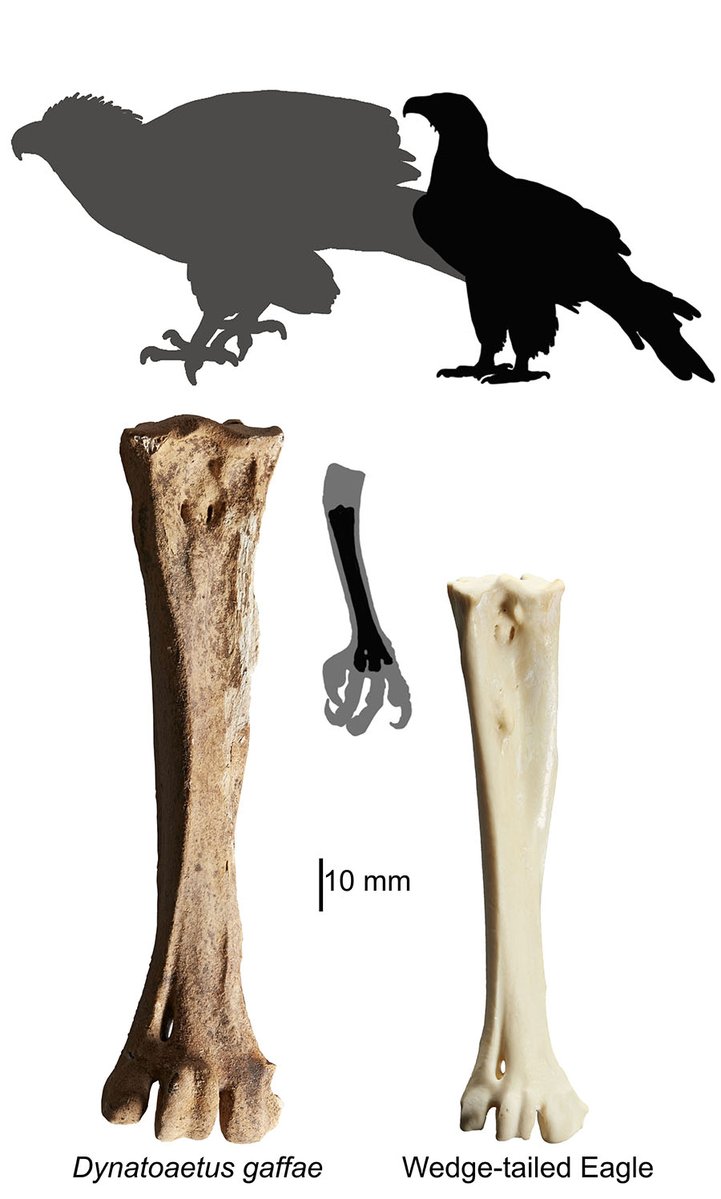
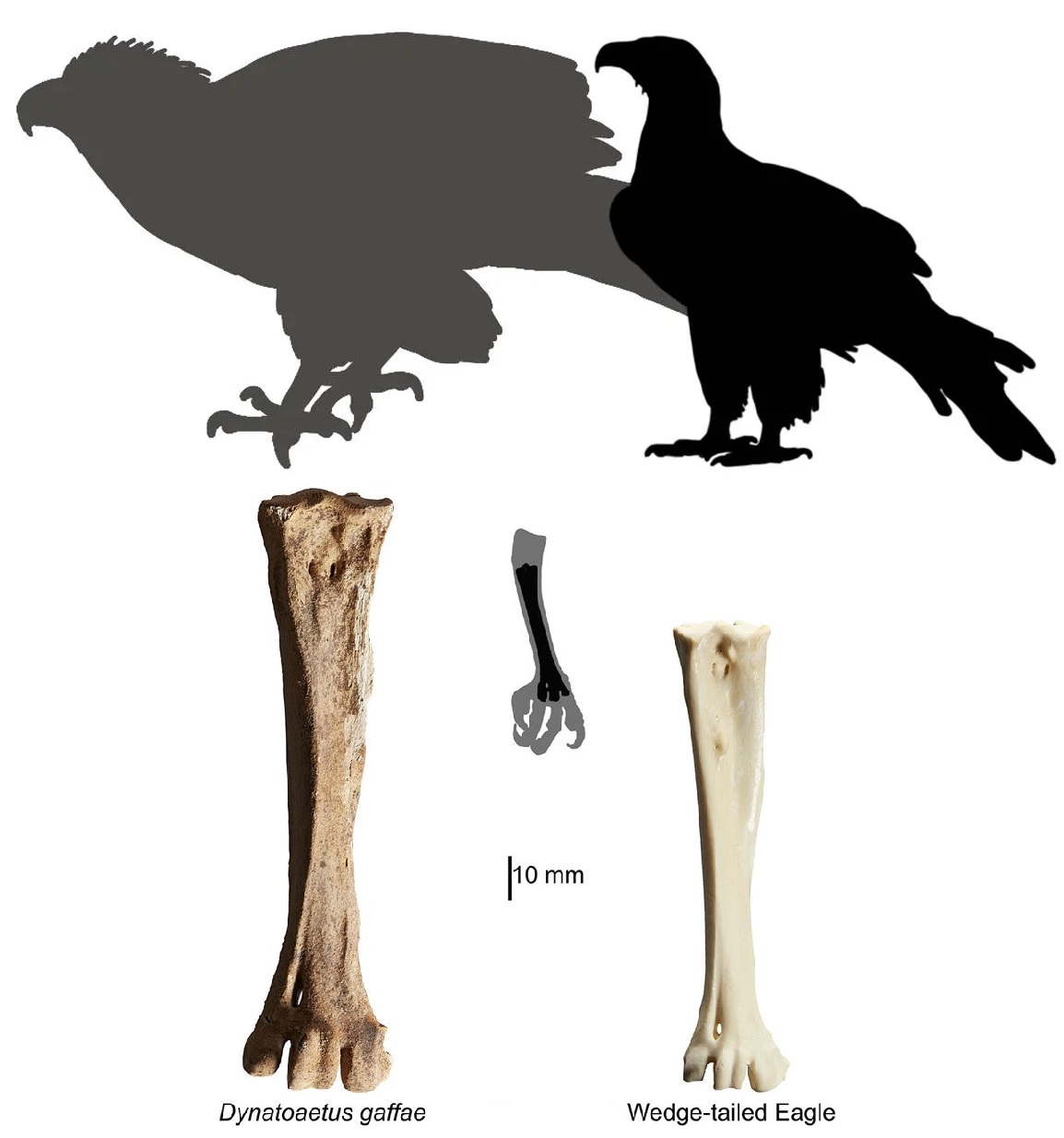
[PaleoOrnithology • 2023] Dynatoaetus gaffae • A Giant Raptor (Aves: Accipitridae) from the Pleistocene of southern Australia


Dynatoaetus gaffae
Mather, Lee, Camens & Worthy, 2023


Abstract
The giant accipitrid Dynatoaetus gaffae gen. et sp. nov. is described from existing and newly collected material. Initial fossil remains were collected from Mairs Cave (Flinders Ranges, South Australia) in 1956 and 1969, and comprised a sternum, distal humerus and two ungual phalanges. A further 28 bones from this individual—including the neurocranium, vertebrae, furculum, and additional wing and leg bones, most of which were incomplete—were discovered at the site in 2021. This allowed identification of additional fossils from the same species in collections from Cooper Creek (Lake Eyre Basin, SA), Victoria Fossil Cave (Naracoorte, SA) and Wellington Caves (Wellington, NSW). Dynatoaetus has variable similarity across elements to those of living species in the Perninae, Gypaetinae, Circaetinae and Aegypiinae. Parsimony and Bayesian phylogenetic analyses of combined morphological and DNA data resolved it as the immediate sister-group to the Aegypiinae within the Circaetinae + Aegypiinae clade. The robust and eagle-like morphology of the lower hindlimbs suggest that the species was a predator, rather than a scavenger, and thus functionally similar to large circaetines such as the Philippine Eagle Pithecophaga jefferyi. Furthermore, this new species is the largest known bird of prey from Australia, much larger than the modern Wedge-Tailed Eagle Aquila audax. It is outsized in Australasia only by female Hieraaetus moorei (the extinct Haast’s Eagle from New Zealand). It is inferred to have been Australia’s top terrestrial avian predator during the Pleistocene, ranging from arid inland Australia to the more temperate coast, and likely became extinct around the time of the megafaunal mass extinction which peaked around 50 Ka. Its extinction in the late Pleistocene, along with the recently described scavenging vulture Cryptogyps lacertosus, marked a distinct decline in the diversity and function of Australia’s raptor guild.

Keywords: Aegypiinae, Accipitriformes, Circaetinae, Taxonomy, Extinction, Pleistocene predatory birds


Visual representation of the parts of the skeleton known from Dynatoaetus gaffae (coloured grey). Image based on Meyer (1897), plate 121


Systematic palaeontology
Accipitriformes Vieillot 1816
Accipitridae Vigors 1824

Dynatoaetus gen. nov.
 
Diagnosis: A large accipitrid distinguishable from other genera by the following combination of characters: a neurocranium that is (1) relatively short and wide compared to Aquila audax; (2) has the line linking the tip of the processus zygomaticus to the ventral tip of the processus paroccipitalis aligned about 45 degrees to the plane of basioccipital-parasphenoidal plane and ventrally encloses a tympanic recess that is longer than high; (3) the condylus occipitalis is relatively large; (4) the mamillar tuberosities (tubercula basilaria) are robust, and prominent caudally; (5) the foramen magnum is near-perpendicular to the basioccipital plane (~ 10 degrees off perpendicular); (6) has prominent tubercula for the insertion for m. pseudotemporalis superficialis on the facies orbitalis. A sternum with (7) distinct and prominently projecting processus labrum internum; (8) a spina externa that is narrower than the apex carinae; (9) a crista medialis carinae that does not extend to the base of the spina externa. A humerus with (10) a weakly ventrally projecting epicondylus ventralis; (11) the distance between the interior margin of the tuberculum supracondylare ventrale and the proximal tip of the condylus dorsalis is equal to that between the tip of the condylus dorsalis and the dorsal margin; and (12) a deep insertion pit for the distal head of the m. pronator profundus. An ulna with (13) a tuberculum carpale that has little prominence cranioventrally. A tarsometatarsus that (14) is robust; (15) has a trochlea metatarsi II that is broad and more distally elongate than trochlea metatarsi III; (16) has the trochleae metatarsorum II and IV with robust plantar flanges and with (17) the plantar openings of the foramen vasculare proximale medialis positioned on the lateral side of the crista medialis hypotarsi; and (18) has the medial side of the shaft deeply excavated caudally by the fossa parahypotarsalis medialis such that the medial margin is very thin.

Etymology: The genus name is a combination of the ancient Greek words δῠνᾰτός (dynatós), meaning strong, mighty, or powerful, and ᾱ̓ετός (āetós) meaning eagle.

 
Dynatoaetus gaffae gen. et sp. nov.

Etymology: The name ‘gaffae’ honours Priscilla Gaff, who first discussed the fossil material of this species in her 2002 thesis revising Australian accipitrids.


Ellen K. Mather, Michael S. Y. Lee, Aaron B. Camens and Trevor H. Worthy. 2023. A Giant Raptor (Aves: Accipitridae) from the Pleistocene of southern Australia. Journal of Ornithology.  DOI: 10.1007/s10336-023-02055-x
  

Tuesday, February 2, 2021

[PaleoOrnithology • 2021] Crosnoornis nargizia • A New Passeriform (Aves: Passeriformes) from the early Oligocene of Poland sheds light on the Beginnings of Suboscines

 
 Crosnoornis nargizia 
Bochenski, Tomek, Bujoczek & Salwa, 2021

 
Abstract
The paper describes a complete specimen of a passerine bird from the early Oligocene of Poland, preserved as imprints of bones and feathers on two slabs. Crosnoornis nargizia gen. et sp. nov. is just the fifth passerine species described from the Paleogene worldwide and the fourth complete. The features preserved in the distal elements of the wing exclude Acanthisittidae and Oscines and indicate that this bird can be included in Suboscines, making it the second complete representative of this group in the Paleogene. A strong, straight beak indicates that this bird could feed on a variety of foods, including hard seeds, fruit and invertebrates, and, therefore, occupied a different foraging niche than the Oligocene passerines described so far. The wing proportions, a very short tail and relatively long legs indicate that this bird spent most of its time in the forest, close to the ground in dense shrubs or dense tree crowns.

Keywords: Fossil birds, Passeriformes, Suboscines, New species, Rupelian, Paleogene


 Crosnoornis nargizia gen. et sp. nov., holotype, specimen MSFK RR 01/2013a + b from Rudawka Rymanowska, exposure 01, Poland, early Oligocene (left) and interpretative drawings (right) with only the main skeletal elements indicated.
a slab A; b slab B. Left (L) and right (R) elements are indicated.
 Abbreviations: cmc carpometacarpus, cor coracoid, d1-d4 digit 1–4, fem femur, hum humerus, pal phalanx digiti alulae, pdm phalanx distalis digiti majoris, pmi phalanx digiti minoris, ppm phalanx proximalis digiti majoris, qu quadratum, rad radius, scap scapula, tbt tibiotarsus, tmt tarsometatarsus, tr tracheal rings, vr vertebrae


Aves Linnaeus 1758
Passeriformes Linnaeus 1758
Suboscines (sensu Ericson et al. 2003)

Family indeterminate

Genus Crosnoornis gen.nov.
Type species Crosnoornis nargizia sp. nov.

Etymology: The genus name Crosno is the Latin equivalent of the Polish Krosno, a town located nearby the type locality, Rudawka Rymanowska, added to the Ancient Greek ὄρνις (ornis) meaning “bird”.


Crosnoornis nargizia gen. et sp. nov.

Etymology: The species is named after Nargiz Salwa, the wife of the finder and co-author of this paper, Grzegorz Salwa.

Holotype: MSFK RR 01/2013a + b (Figs. 1, 2, S1–S7), complete articulated skeleton preserved on two slabs, deposited at the Institute of Systematics and Evolution of Animals, PAS, Kraków, Poland.

 
Zbigniew M. Bochenski, Teresa Tomek, Małgorzata Bujoczek and Grzegorz Salwa. 2021. A New Passeriform (Aves: Passeriformes) from the early Oligocene of Poland sheds light on the Beginnings of Suboscines. Journal of Ornithology.  DOI: 10.1007/s10336-021-01858-0


Zusammenfassung: Ein neuer Sperlingsvogel (Aves: Passeriformes) aus dem frühen Oligozän Polens erhellt die Ursprünge der Suboscines
Diese Arbeit beschreibt ein vollständiges Exemplar eines Sperlingsvogels aus dem frühen Oligozän Polens, welches als Abdruck von Knochen und Federn auf zwei Steinplatten erhalten ist. Crosnoornis nargizia gen. et sp. nov. ist weltweit erst die fünfte für das Paläogen beschriebene Sperlingsvogelart und erst die vierte vollständig erhaltene. Die im distalen Flügelteil erhaltenen Merkmale schließen die Acanthisittidae und die Oscines aus und sind Indizien dafür, dass dieser Vogel zu den Suboscines gerechnet werden kann, was ihn zum zweiten vollständig erhaltenen Vertreter dieser Gruppe aus dem Paläogen macht. Ein kräftiger gerader Schnabel deutet darauf hin, dass dieser Vogel ein breitgefächertes Nahrungsspektrum nutzen konnte, darunter harte Samen, Früchte und Wirbellose, und daher eine andere Nahrungsnische besetzte als die bislang beschriebenen Sperlingsvögel des Oligozäns. Die Proportionen des Flügels, ein sehr kurzes Steuer und relativ lange Beine sind Anzeichen dafür, dass dieser Vogel die meiste Zeit im Wald verbrachte, entweder in dichtem Gebüsch in Bodennähe oder in dichten Baumkronen.

Saturday, October 5, 2019

[Ornithology • 2019] Myzomela prawiradilagae • A New Myzomela Honeyeater (Meliphagidae) from the Highlands of Alor Island, Indonesia


Myzomela prawiradilagae 
Irham, Ashari, Suparno, Trainor, Verbelen, Wu & Rheindt, 2019


Abstract
We here describe a new species of Myzomela honeyeater from the Lesser Sunda island of Alor (southeast Indonesia). The new species is phylogenetically most closely related to Myzomela kuehni from the adjacent island of Wetar and most closely resembles that species in plumage. However, it differs in important morphological, bioacoustic and ecological characteristics. The discovery of a new bird species on Alor is of great biogeographic importance and elevates this island to the status of an Endemic Bird Area. The new Alor Myzomela is restricted to montane eucalypt woodland mostly above 900 m elevation and is currently known from few sites across the island. Based on its occurrence records and human population trends in the highlands of Alor Island, we recommend classification under the IUCN threat status endangered.

Keywords: Myzomela, Honeyeater, Alor, Wetar, Plumage, Bioacoustics, Ecological characteristics, Novel species 

 Two individuals of the new Alor Myzomela Myzomela prawiradilagae perched in Eucalyptus urophylla tree at 1250 m near Manmas-Subo in April 2014.
 (photo: Philippe Verbelen). 

Myzomela prawiradilagae
English name: Alor Myzomela. 
Indonesian name: Myzomela Alor.

Etymology: The new Alor Myzomela is named after Dr. Dewi Malia Prawiradilaga. One of the frst leading female Indonesian ornithologists, “Ibu Dewi” is the head of the bird division at the Museum Zoologicum Bogoriense, Research Center for Biology, Indonesian Institute of Science. She has made substantial contributions to the development of research on the ecology and conservation of Indonesian birds.


Mohammad Irham, Hidayat Ashari, Suparno, Colin R. Trainor, Philippe Verbelen, Meng Yue Wu and Frank E. Rheindt. 2019. A New Myzomela Honeyeater (Meliphagidae) from the Highlands of Alor Island, Indonesia. Journal of Ornithology. DOI: 10.1007/s10336-019-01722-2


Wednesday, September 4, 2013

[Ornithology • 2013] Mohouidae: a new Family of Songbird from New Zealand | Phylogenetic Relationships of the Genus Mohoua, endemic hosts of New Zealand’s obligate brood parasitic Long-tailed Cuckoo Eudynamys taitensis


three songbirds from New Zealand – the Whitehead Mohoua albicilla, shown in this image, the Yellowhead Mohoua ochrocephala and the Brown Creeper Mohoua novaseelandiae– belong to a new bird family.
Image: Andrew Hardacre / CC BY 2.0.

Abstract
 The three species of New Zealand’s endemic Mohoua genus are sole hosts of the obligate brood parasitic Long-tailed Cuckoo (Eudynamys taitensis), making their intrageneric phylogenetic relationships particularly important for coevolutionary studies. Also, recent molecular phylogenetic analyses have not identified the family-level placement of this genus. To resolve both intrageneric and family relationships, we generated new nuclear and mitochondrial sequence data and conducted phylogenetic analyses using Bayesian inference among representatives of endemic New Zealand passerines and Australasian ‘core Corvoidea’ lineages. The results establish strong intrageneric relationships of all three Mohoua species, confirm the monophyly of the genus, and suggest its placement in a re-erected monotypic family: Mohouidae.


Zachary Aidala, Nicola Chong, Michael G. Anderson, Luis Ortiz-Catedral, Ian G. Jamieson, James V. Briskie, Phillip Cassey, Brian J. Gill, Mark E. Hauber. 2013. Phylogenetic Relationships of the Genus Mohoua, endemic hosts of New Zealand’s obligate brood parasitic Long-tailed Cuckoo (Eudynamys taitensis). Journal of Ornithology. doi: dx.doi.org/10.1007/s10336-013-0978-8


Ornithologists Describe New Songbird Family – the Mohouidae – from New Zealand

The make this discovery, the team analyzed DNA of three bird species: the Whitehead (Mohoua albicilla), the Yellowhead (Mohoua ochrocephala) and the Brown Creeper (Mohoua novaseelandiae).

“It’s an achievement that has international significance as the taxonomy of birds, especially Australasian songbirds, is the subject of intense research. By conducting DNA sequencing of three bird species — two of them for the first time — the testing confirmed what had been suspected since the 1950s,” explained Dr Luis Ortiz-Catedral and Dr Michael Anderson, both from Massey University in Auckland, New Zealand, who reported the results in the Journal of Ornithology.

The discovery brings the number of New Zealand endemic songbird families to five and increases the number of endemic vertebrate families from 13 to 14 (11 bird, 1 frog, 1 bat, 1 tuatara).

.....................


Thursday, July 4, 2013

[Ornithology • 2013] Rediscovery of a Long-Lost Lark reveals the Conspecificity of Endangered Heteromirafra populations in the Horn of Africa | Archer's Lark Heteromirafra archeri rediscovered after 90 years


Heteromirafra archeri | Archer's Lark
 Jijiga Ethiopia by David Hoddinott 

Abstract
The African lark genus Heteromirafra is thought to consist of three threatened species inhabiting mid-altitude grasslands, one in South Africa and two in the Horn of Africa. One of the latter, Archer’s Lark H. archeri of Somaliland, has not been seen with certainty since 1922. We surveyed its type locality as well as a nearby area of grassland east of Jijiga in adjacent north-eastern Ethiopia, where sightings of Heteromirafra larks have recently been made. First, we used a combination of morphological and molecular evidence to show that these recent sightings refer to the same taxon as Archer’s Lark. Second, we used a combination of morphological, molecular and vocal evidence to show that these populations are conspecific with the Liben (Sidamo) Lark H. sidamoensis of southern Ethiopia, but that the Horn of Africa populations are highly distinct from Rudd’s Lark H. ruddi of South Africa. Third, we suggest that the extent and quality of their habitat in north-eastern Ethiopia is small and poor, and that the type locality of Archer’s Lark in Somaliland has been completely transformed. Taken together, these results imply that there is a single species of Heteromirafra in the Horn of Africa (for which the scientific name H. archeri has priority, and which we suggest retains the English name Liben Lark), consisting of two tiny populations separated by 590 km of apparently unsuitable habitats. Environmental niche models suggest that there are no environmentally similar locations elsewhere within the region. Despite the discovery of a second population, the Liben Lark remains a highly threatened species in urgent need of conservation intervention to avert the extinction of both of its populations.


Claire N. Spottiswoode, Urban Olsson, Michael S. L. Mills, Callan Cohen, Julian E. Francis, Negussie Toye, David Hoddinott, Abiy Dagne, Chris Wood, Paul F. Donald. 2013. Rediscovery of a Long-Lost Lark reveals the Conspecificity of Endangered Heteromirafra populations in the Horn of Africa. Journal of Ornithology. 154 (3): 813-825. doi: 10.1007/s10336-013-0948-1