Showing posts with label Tunicata. Show all posts

Tuesday, July 8, 2025

[Invertebrate • 2025] Eusynstyela sesokoensis • A New Species of Eusynstyela (Ascidiacea: Stolidobranchia) from Okinawa, Japan with Molecular Insight into Its Phylogenetic Position


Eusynstyela sesokoensis 
Hasegawa, 2025


Abstract
The colonial styelid genus Eusynstyela Michaelsen, 1904 comprises 12 species. Seven colonies of Eusynstyela were collected via SCUBA diving from three coastal sites in Okinawa, Japan, between 2018 and 2023. Morphological observations in this study identified these specimens as a new species, described here as Eusynstyela sesokoensis sp. nov. This species can be distinguished from its congeners by the following characteristics: i) ten oral tentacles, ii) twelve stomach plications, iii) absence of a stomach caecum, iv) no lobes on the anal rim, and v) two testes per gonad. Intraspecific variations were observed in zooid coloration and the number of longitudinal vessels on the pharyngeal folds. The molecular phylogenetic analysis based on a partial sequence of 18S rRNA and the mitochondrial cytochrome c oxidase subunit I genes indicates a possible sister relationship between the new species and E. latericius (Sluiter, 1904).
 
Keywords: ascidian, Chordata, Sesoko Island, subtropical, Styelidae, systematics, taxonomy, Tunicata

Eusynstyela sesokoensis sp. nov.
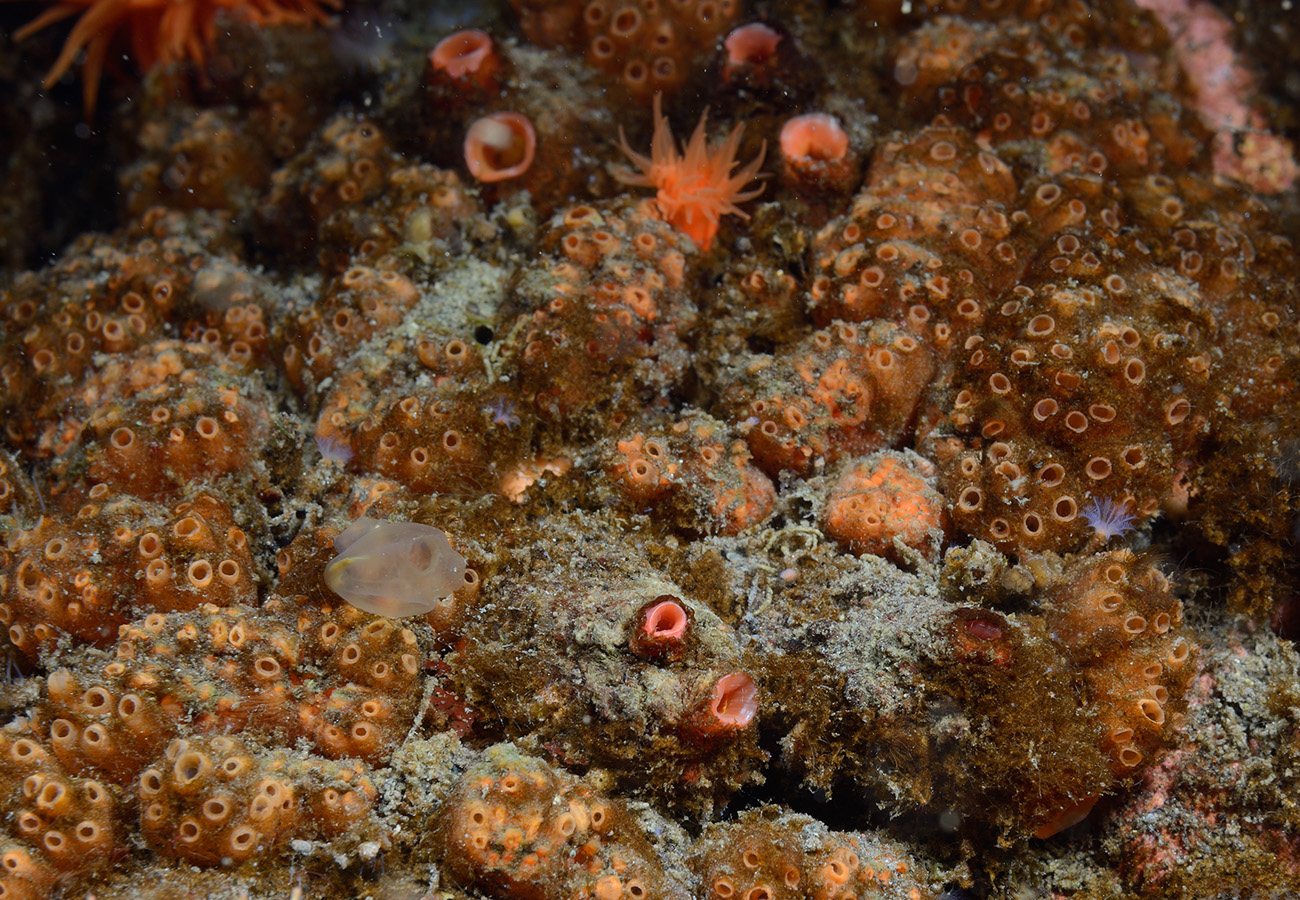
A, In situ live colony of the holotype, NCHSU 962, photographed by N. Hasegawa; B, in situ live colony of one of the paratypes, NCHSU 966, photographed by Y. Kushida;
C, zooid, viewed from the ventral side; D, peripharyngeal area in the dorsal side; E, gonad, viewed from atrial cavity.
 
Eusynstyela sesokoensis sp. nov. 


Naohiro Hasegawa. 2025. Description of A New Species of Eusynstyela (Ascidiacea: Stolidobranchia) from Okinawa, Japan with Molecular Insight into Its Phylogenetic Position. Species Diversity. 30(1); 99-106. DOI: doi.org/10.12782/specdiv.30.99
https://x.com/Species_Divers/status/1925746069654110374

Sunday, May 26, 2024

[Invertebrate • 2024] Clavelina ossipandae • A strange-looking New Species of Colonial Ascidians in the Genus Clavelina (Tunicata: Ascidiacea) off the coast of Kumejima Island, Japan


Clavelina ossipandae 
Hasegawa & Kajihara, 2024
 
 
Abstract   
An unidentified colonial ascidian called gaikotsu-panda-hoya in Japanese, literally meaning ‘skeleton panda ascidian,’ has been attracting SCUBA divers’ attention for the past few years since its strange appearance was introduced on the Internet by a diving shop in Kumejima Island, Japan. To confirm the taxonomic status of this species, fresh samples were collected from a diving point off the coast of Kumejima Island. Our morphological examination revealed that they represent a new species, herein described as Clavelina ossipandae sp. nov., which can be distinguished from 44 congeners in the genus Clavelina Savigny, 1816 by the combination of the following seven characteristics: i) colony consisting of completely free zooids, ii) zooids up to 20 mm in length, iii) in the living state, zooids transparent, with laterally elongated white patch between oral and atrial siphons, as well as four black markings, one between siphons, one mid-dorsally, and the other two situated laterally in a pair on the anterior part of the body, iv) transverse vessels white, v) endostyle black, vi) 10–14 stigmatal rows, and vii) two longitudinal muscular bands running from the abdomen to the endostyle on each side. Partial sequences (810 bp) of the cytochrome c oxidase subunit I gene from the holotype and one of the paratypes differed at 10 sites from each other (1.26% K2P distance) but were the same when translated into amino acids. A phylogenetic tree supported that this species is included in the genus Clavelina.

Keywords: Aplousobranchia, Chordata, Clavelinidae, East China Sea, Enterogona, Okinawa Islands, subtropical, taxonomy


Clavelina ossipandae sp. nov., holotype, ICHUM 5837.
 A, In situ live colony with four zooids; B, a schematic depiction of the colony showing colony organization and zooid insertion; C, D, a single zooid detached from the colony, drawn from the right side (C) and the left side (D).

Clavelina ossipandae sp. nov.  
 
Diagnosis. Clavelina with colony consisting of zooids extending from basal mass; zooids completely free, mean 15mm long; in life, a white, laterally elongated white patch present between oral and atrial siphons; small black point present on anterior body wall between oral and atrial siphons; an elongated black band situated laterally to the small black point on each side, slightly curved along edge of the white patch; transverse vessels white; endostyle black; short mid-dorsal black line situated posterior to atrial siphon, spanning for about four transverse vessels; 10–14 stigmatal rows in pharynx; on each side of thorax, 10 or 11 very thin longitudinal muscle bands, of which two running to endostyle, 5–6 to branchial siphon, and 2–4 to dorsal side.

Etymology. The new specific name, ossipandae, is a noun in the genitive case, a composite derived from os (‘bone’ in Latin) and ‘Panda,’ the latter is meant to be the giant pandaAiluropoda melanoleuca David, 1869, and herein treated as a noun that is latinized. The species is so named because the white anterior portion of the zooid with the characteristic black markings resembles to the face of the giant panda and the white transverse vessels evoke the ribs of a skeleton.


Naohiro Hasegawa and Hiroshi Kajihara. 2024. Graveyards of Giant Pandas at the Bottom of the Sea? A strange-looking New Species of Colonial Ascidians in the Genus Clavelina (Tunicata: Ascidiacea). Species Diversity.  29(1); 53-64. DOI: 10.12782/specdiv.29.53

Sunday, July 9, 2023

[Paleontology • 2023] Megasiphon thylakos • A mid-Cambrian Tunicate and the Deep Origin of the Ascidiacean Body Plan


Megasiphon thylakos
Nanglu, Lerosey-Aubril, Weaver & Ortega-Hernández, 2023

 Artwork by Franz Anthony.

Abstract
Tunicates are an evolutionarily significant subphylum of marine chordates, with their phylogenetic position as the sister-group to Vertebrata making them key to unraveling our own deep time origin. Tunicates greatly vary with regards to morphology, ecology, and life cycle, but little is known about the early evolution of the group, e.g. whether their last common ancestor lived freely in the water column or attached to the seafloor. Additionally, tunicates have a poor fossil record, which includes only one taxon with preserved soft-tissues. Here we describe Megasiphon thylakos gen. et sp. nov., a 500-million-year-old tunicate from the Marjum Formation of Utah, which features a barrel-shaped body with two long siphons and prominent longitudinal muscles. The ascidiacean-like body of this new species suggests two alternative hypotheses for early tunicate evolution. The most likely scenario posits M. thylakos belongs to stem-group Tunicata, suggesting that a biphasic life cycle, with a planktonic larva and a sessile epibenthic adult, is ancestral for this entire subphylum. Alternatively, a position within the crown-group indicates that the divergence between appendicularians and all other tunicates occurred 50 million years earlier than currently estimated based on molecular clocks. Ultimately, M. thylakos demonstrates that fundamental components of the modern tunicate body plan were already established shortly after the Cambrian Explosion.

The tunicate Megasiphon thylakos from the mid-Cambrian (Drumian) Marjum Formation of Utah and comparisons with modern benthic tunicates.
 a Holotype (UMNH.IP.6079) and only known specimen of Megasiphon thylakos, showing overall morphology including paired siphons and barrel-shaped body drawing immediate comparisons with modern benthic tunicates (c–e). b Counterpart to a.
c Ciona intestinalis (Phlebobranchia). d Ascidiella sp. (Phlebobranchia) e Molgula manhattensis (Stolidobranchia).


a Simplified phylogeny of extant Tunicata [DeBiasse et al., 2020. ]. Depending on the phylogenetic position of Megasiphon thylakos, a solitary, sessile, epibenthic organism with a biphasic life cycle that underwent larval metamorphosis is ancestral for either total-group Tunicata, or for non-appendicularian tunicates.
b M. thylakos reconstructed as a stem-group tunicate would support a sessile mode of life in the adult forms as ancestral to Tunicata, as well as indirect development through a free-swimming larval form.
c Simplified time scale of tunicate evolution. M. thylakos recovered as a crown-group tunicate would indicate that the ascidiacean body plan evolved during the mid-Cambrian (Megasiphon silhouette at the node in the diagram), approximately 50 million years earlier than the Late Ordovician dichotomy (double helix at the node in the diagram) estimated through molecular clocks8.  

Systematic paleontology
Chordata (Linnaeus 1758)
Tunicata (Lamarck 1816)

Megasiphon thylakos gen. et sp. nov

Diagnosis: Barrel-shaped main body extends apically into two similarly sized, long siphons (Fig. 2a, b). Main body with millimetric circular transverse muscle bands. Siphons project at roughly a 25° angle relative to longitudinal axis of main body, and are associated with longitudinal muscle bands extending from the upper region of the main body.

Etymology: From Greek Mega (large) and siphon (siphon), referring to the prominent siphons. Species name from Greek thylakos (sacpouch), refers to the sac-like body.

 Artistic reconstruction of Megasiphon thylakos.
 Artwork by Franz Anthony.


Karma Nanglu, Rudy Lerosey-Aubril, James C. Weaver and Javier Ortega-Hernández. 2023. A mid-Cambrian Tunicate and the Deep Origin of the Ascidiacean Body Plan. Nature Communications. 14, 3832. DOI: 10.1038/s41467-023-39012-4 

Tuesday, October 17, 2017

[Tunicata • 2017] Shallow-water Ascidians from Matua Island (central Kuril Islands, NW Pacific), part 2


Synoicum polyzoinum
Sanamyan & Sanamyan, 2017


Abstract

The paper reports several ascidians, previously not known from central group of Kurile Islands, including two new species, Synoicum polyzoinum n. sp. and Aplidium matua n. sp. In order to systematize our knowledge on numerous members of these genera, reported from NW Pacific, we provide an overview of all Synoicum and Aplidium species, known from Far Eastern Seas of Russia, including comments on the species erroneously identified in the past.

Keywords: Tunicata, Ascidiacea, Aplidium, Synoicum, Kuril Islands, Matua Island, NW Pacific


Karen Sanamyan and Nadya Sanamyan. 2017. Shallow-water Ascidians from Matua Island (central Kuril Islands, NW Pacific), part 2. Zootaxa. 4337(1);  121–131.  DOI: 10.11646/zootaxa.4337.1.6


Wednesday, May 31, 2017

[Tunicata • 2017] Rhopalaea bilobata • A New Species of Sea Squirt (Ascidiacea: Diazonidae) from the Andaman Islands, India


 Rhopalaea bilobata 
Mondal, Raghunathan & Mondal, 2017 

Abstracts
 Rhopalaea bilobata, a new species of the class Ascidiacea, under the family Diazonidae has been described from the Andaman Islands of Andaman & Nicobar, India. The species was found in sandy bottoms, reef areas and artificial structures at a depth range of 10–40 m. This species has bilobed anal border, six lobed branchial and atrial siphons, transparent thorax with pigmented spots at the anus, between the two siphons and at the anterior end of endostyle, and ramified basal test. The species is closely related to R. idonetaRmacrothorax and R. tenuis in several sets of anatomical and morphological features.

Keywords: Anal border, Andaman & Nicobar Islands, Ascidians, Rhopalaea, Tunicata.


Etymology: The species bears distinctive triangular bilobed anal border.

Distribution: India: Havelock Island, Trilby Island and Pongibalu of Andaman Islands.
  
Jhimli Mondal, C. Raghunathan and Tamal Mondal. 2017. A New Species of Sea Squirt, Rhopalaea bilobata (Ascidiacea: Diazonidae) from the Andaman Islands, India. Journal of Threatened Taxa.  9(5); 10187–10193.  DOI: 10.11609/jott.2620.9.5.10187-10193


Saturday, December 3, 2016

[Ichthyology • 2016] Lubricogobius tunicatus • A New Species of Goby (Pisces: Gobiidae) from Papua New Guinea and the First Record of L. ornatus from the East Indies


Tunicate Goby | Lubricogobius tunicatus 
Allen & Erdmann, 2016


Abstract

A new species of goby, Lubricogobius tunicatus, is described from Milne Bay Province, eastern Papua New Guinea, on the basis of 10 adult specimens, 9.1–11.5 mm SL. Diagnostic features include 9 (rarely 10) segmented dorsal-fin rays, 6–7 segmented anal-fin rays, the presence of both anterior and posterior nostrils, the greatest body depth 3.1–3.7 in SL, overall coloration typically pale yellow to whitish (rarely brown), and an exceptionally small maximum size of about 11.5 mm SL. Lubricogobius tunicatus is most similar in appearance to L. nanus Allen, 2015, another diminutive species from Papua New Guinea that differs in having 10–11 dorsal-fin rays and 8–9 anal-fin rays. The new species is apparently invariably associated with a species of tunicate (Polycarpa sp.) on silty-sand bottoms in depths of about 20–28 m. In addition, L. ornatus Fourmanoir, 1966, originally described from Vietnam and also recorded from the Ryukyu Islands in Japan, northern Australia, and New Caledonia, is reported for the first time from the East Indies, based on two specimens collected at Lembeh Strait, North Sulawesi, Indonesia.
.
Key words: ichthyology, taxonomy, systematics, coral-reef fishes, Indo-Pacific Ocean

Figure 3. Lubricogobius tunicatus, approximately 9–11 mm SL, underwater photographs taken at the type locality, Normanby Island, Milne Bay Province, Papua New Guinea (G.R. Allen & M.V. Erdmann). 


Etymology. The new species is named tunicatus (Latinized adjective from tunicate) referring to its commensal host. The specific epithet is a masculine singular adjective in the genitive case.


Gerald R. Allen and Mark V. Erdmann. 2016. Lubricogobius tunicatus, A New Species of Goby (Pisces: Gobiidae) from Papua New Guinea and the First Record of L. ornatus from the East Indies. Journal of the Ocean Science Foundation. 24; 24–34.