Showing posts with label Chilopoda - Centipede. Show all posts

Saturday, June 27, 2026

[Chilopoda • 2026] Hainanthereua albilineataIntegrative Morphological and Molecular Evidence reveals A New Genus of scutigerid centipede (Scutigeromorpha: Scutigeridae) from Hainan, China, with implications for its evolution and biogeography


Hainanthereua albilineata   
Li, Edgecombe & Jiang, 2026
 

Abstract
Hainanthereua albilineata gen. nov. et sp. nov. is described and illustrated based on specimens from Hainan Province, China. Morphological examination showed that these specimens belong to Thereuoneminae and share certain similarities with Thereuopodina Verhoeff, 1905. Phylogenetic reconstruction based on five genes (nuclear 18S and 28S rRNA, mitochondrial 12S and 16S rRNA, and cytochrome c oxidase subunit I) indicated that the specimens form a distinct and well-supported clade that is sister group to Thereuonema Verhoeff, 1904, so a new genus is accordingly established. Combining the evolutionary history and biogeographic framework of Thereuoneminae, this study revealed the evolutionary significance of Hainanthereua gen. nov. in the context of the Peninsular Indian Plate as a biotic ferry implicated in the origin of East and Southeast Asian lineages. Morphological similarities between Hainanthereua and Thereuopodina are symplesiomorphies of a clade that includes these two genera, Thereuonema and Thereuopoda Verhoeff, 1904.

Key words: Chilopoda, morphology, new species, phylogeny, taxonomic key, Thereuoneminae

Hainanthereua albilineata sp. nov., holotype.
A Habitus, dorsal view, body length 23 mm; B head, dorsal view; C T1, dorsal view; D T2, dorsal view.
Abbreviations: lmd, longitudinal median depression; ap, anterior projection of the (cephalic) transverse suture; To, Tömösváry’s organ; t, (cephalic) transverse suture; ce, compound eye.

 Hainanthereua gen. nov.

Hainanthereua albilineata gen. nov. et sp. nov. 

Habitat of Hainanthereua albilineata sp. nov. (from type locality: Mingfenggu Valley, Jianfengling, Ledong Li Autonomous County, Hainan Province, China).
A Panoramic view of type locality; B woodland on the mountain of type locality shown in A; C interior habitat of the woodland shown in B, the species was collected in relatively dry leaf litter or under stones; D individual of the species found under a stone; E live habitus of the species.
 A–D provided by Mr. Quanyu Ji, E provided by Mr. Jiazhou Lu.


Qing Li, Gregory D. Edgecombe and Chao Jiang. 2026. Integrative Morphological and Molecular Evidence reveals A New Genus of scutigerid centipede from Hainan, China, with implications for its evolution and biogeography (Scutigeromorpha: Scutigeridae). Arthropod Systematics & Phylogeny. 84: 447-464. DOI: doi.org/10.3897/asp.84.e186815
 

Tuesday, January 13, 2026

[Chilopoda • 2023] Plutogeophilus jurupariquibaba Assessing Troglomorphic and Phylogenetically Informative Traits in Troglobionts: A New Cave-dwelling Centipede (Geophilidae) illuminates the Evolution of A Soil-dwelling Lineage


 Plutogeophilus jurupariquibaba
Bonato & Ferreira, 2023


Abstract
Cave-dwelling species are of special interest in evolutionary biology, because (i) many share particular traits associated with the cave habitat (troglomorphic traits), and (ii) some represent relict lineages that may conserve ancestral traits or possibly transitional traits, which may provide insights into the evolution of other highly derived species. However, these different kinds of characters are hard to assess thoroughly in troglobionts belonging to little known terrestrial arthropod groups. We describe a new species of centipedes from the Areias System caves, Brazil, namely, Plutogeophilus jurupariquibaba gen.n. sp.n., which adds to the few putative troglobionts known among Chilopoda Geophilomorpha. We analyzed a suite of characters in the light of a phylogenetic analysis and by direct comparison with epigean relatives, controlling for interindividual variation and its confounding sources. We found that: (i) troglomorphic traits of P. jurupariquibaba may include large body, elongate antennae, elongate legs and claws, and possibly also elongate setae and large coxal pores; (ii) the cave-dwelling Plutogeophilus is the sister lineage of the soil-dwelling Macronicophilus, whose morphology is highly derived and whose phylogenetic position remained unclear; (iii) compared with other extant geophilids, symplesiomorphic traits and apparently intermediate traits found in Plutogeophilus provide insights on the origin of the morphology of Macronicophilus, suggesting a stepwise modification of labrum, forcipular apparatus and ultimate legs, and the derivation of the unique rounded and spiny tip of the second maxillae from a pointed claw.

Keywords: Neotropics, Chilopoda, MacronicophilusPlutogeophilus jurupariquibaba, Transitional morphology, Troglomorphy

 Plutogeophilus jurupariquibaba gen.n. sp.n.:
a anterior part of body, dorsal view; b–c head and forcipular segment, dorsal and ventral views, respectively; d–e posterior part of body, dorsal and ventral views, respectively.
 Photos: ♂, ISLA 11879, holotype. Scale bars: 0.4 µm

Living specimen of Plutogeophilus jurupariquibaba gen.n. sp.n. in the Areias de Cima cave, 7.IV.2012 (photo by Robson Zampaulo)
 
Plutogeophilus gen.n. 
Etymology: from the ancient Greek “Ploutōn,” who was the ruler of the underworld in classical mythology.

 Plutogeophilus jurupariquibaba sp.n.

Etymology: from the Tupi-Guarani “jurupariquibaba,” which literally means “devil’s comb” and is used by Brazilian Indians to refer to centipedes.


Lucio Bonato and Rodrigo Lopes Ferreira. 2023. Assessing Troglomorphic and Phylogenetically Informative Traits in Troglobionts: A New Cave-dwelling Centipede illuminates the Evolution of A Soil-dwelling Lineage (Chilopoda: Geophilidae). Organisms Diversity & Evolution. DOI: doi.org/10.1007/s13127-023-00618-7 
 

Monday, November 3, 2025

[Chilopoda • 2025] Strigamia asiatica, S. laterisetosa, S. obliquidentata, ... • Taxonomy of the Strigamia Centipedes (Geophilomorpha: Geophilidae) from the East Asian Mainland


H. Strigamia longiglanda sp. nov., holotype; I. S. dianguiensis sp. nov., holotype; J. S. obliquidentata sp. nov., holotype;
L. S. ziyunensis sp. nov., holotype; M. S. asiatica sp. nov., holotype.
G.  S. laterisetosa sp. nov., holotype; N, O. live specimens of S. laterisetosa (Zhoushan, Zhejiang Province, China; photo by Chao Jiang).
Jiang & Yu, 

in Yu, You et Jiang, 2025. 

Abstract
In this study, 15 centipede species of the genus Strigamia Gray, 1843 were recorded from the East Asian mainland, including 7 newly discovered speciesS. asiatica Jiang & Yu, sp. nov., S. dianguiensis Jiang & Yu, sp. nov., S. laterisetosa Jiang & Yu, sp. nov., S. longiglanda Jiang & Yu, sp. nov., S. obliquidentata Jiang & Yu, sp. nov., S. xizangensis Jiang & Yu, sp. nov. and S. ziyunensis Jiang & Yu, sp. nov. Strigamia monoporus (Takakuwa, 1938) was proposed as a nomen dubium because it was likely derived from immature specimens and lacked sufficient diagnostic information. A key to Strigamia species from the East Asian mainland is provided.

Key Words: Chilopoda, distribution, morphology, new species, taxonomic key

Forcipular segments of Strigamia spp. (A–M).
A. S. svenhedini (Verhoeff, 1933) (spm. CMMI 20220903086); B. S. japonica (Verhoeff, 1935) (spm. CMMI 20231128001D); C. S. tenuiungulata (Takakuwa, 1938) (spm. CMMI 20230414002D); D. S. bicolor Shinohara, 1981 (spm. CMMI 20210227106);
E. S. platydentata Shinohara, 1981 (spm. CMMI 20210702003D); F. S. korsosi Bonato, Bortolin, Drago, Orlando, Dányi, 2017 (spm. CMMI 20191031044);
G.  S. laterisetosa sp. nov., holotype; H. S. longiglanda sp. nov., holotype; I. S. dianguiensis sp. nov., holotype; J. S. obliquidentata sp. nov., holotype; K. S. xizangensis sp. nov., paratype; L. S. ziyunensis sp. nov., holotype; M. S. asiatica sp. nov., holotype.
N, O. live specimens of S. laterisetosa (Zhoushan, Zhejiang Province, China; photo by Chao Jiang).
Scale bars: 250 μm (A–M).


 Yifei Yu, Chunxue You and Chao Jiang. 2025. Taxonomy of the Strigamia centipedes from the East Asian Mainland (Geophilomorpha, Geophilidae). Zoosystematics and Evolution. 101(4): 2065-2101. DOI: doi.org/10.3897/zse.101.160146 

Sunday, June 16, 2024

[Chilopoda • 2024] Edgethereua chilensis & E. goloboffi • A New Genus of scutigerid centipede (Myriapoda) from southern South America with the Description of Two New Species and an updated molecular phylogeny of the myriapod Order Scutigeromorpha


Edgethereua chilensis, sp. nov., dorsal view and phylogenetic tree 

 Porta & Giribet, 2024

Abstract
Scutigeromorph centipedes are conspicuous, yet often ignored myriapods for which little work has been conducted in southern South America. After examining recent and museum collections from Chile and Argentina, two new species of generic uncertainty were identified. A new genus of scutigerid centipede, Edgethreua, is therefore described with two new speciesE. chilensis from Central Chile (type species of the genus) and E. goloboffi from Argentinian Patagonia. The new genus is characterised by the presence of scattered setiform bristles with short paired spines and the absence of simple spinulae and spines on all stomatotergites, the presence of a single spine-bristle in the prefemur of the second maxilla, a patch of cuticular ridges and pores surrounding the sensilla of the proximal labral portion of the epipharynx, the morphology of the sensilla of the distal patch of the hypopharynx and the morphology of the female gonopods. A phylogenetic analysis of the new species using two nuclear ribosomal RNA genes (18S and 28S rRNA), two mitochondrial ribosomal RNA genes (12S and 16S rRNA) and the mitochondrial protein-encoding gene cytochrome c oxidase subunit I show that the new genus does not cluster with any other described genus of scutigeromorph represented in molecular phylogenies. The data indicate that the new genus is probably sister group to a clade including the genera Lassophora, Ballonema and the subfamily Thereuoneminae, although one analysis suggests a position as sister group to Scutigerinae.

Keywords: molecular systematics, morphology, myriapods, phylogenetic relationships, Scutigeridae, southern South America, taxonomy, Thereuoneminae.


Edgethereua chilensis, sp. nov., dorsal view and phylogenetic tree from untrimmed concatenated marker alignment.
(Image credits: picture, A. Porta; tree, G. Giribet.)


Andrés O. Porta and Gonzalo Giribet. 2024. A New Genus of scutigerid centipede from southern South America with the Description of Two New Species and an updated molecular phylogeny of the myriapod Order Scutigeromorpha (Myriapoda: Chilopoda). Invertebrate Systematics. 38, IS24006. DOI: 10.1071/IS24006

House centipedes are conspicuous yet often ignored myriapods for which little work has been conducted in southern South America. After examining recent and museum collections from Chile and Argentina, a new genus of scutigerid centipede, Edgethreua, is described with two new species from Central Chile and Argentinian Patagonia. A phylogenetic analysis of the new species using five molecular markers shows that the new genus does not cluster with any other described genus of scutigeromorph represented in molecular phylogenies. This new genus is likely sister group to a clade including the genera Lassophora, Ballonema and the subfamily Thereuoneminae, although another analysis suggests a position as sister group to Scutigerinae. 

Wednesday, June 12, 2024

[Paleontology • 2023] Theatops groehni • An Eocene Fossil plutoniumid Centipede: A New Species of Theatops (Chilopoda: Scolopendromorpha: Plutoniumidae) from Baltic Amber


 Theatops groehni 
Edgecombe, Strange, Popovici, West & Vahtera, 2023
 
 
Abstract
Four specimens of the same species of scolopendromorph centipede from Eocene Baltic amber provide the first fossil occurrence of the family Plutoniumidae, a clade represented by seven extant species. The fossil material, documented by light microscopy and computed microtomography, is assigned to the genus Theatops Newport, Citation1844, which currently has a disjunct distribution in temperate North America, the Mediterranean region, and central China. The Eocene species is diagnostically distinct from extant congeners and is formally described as Theatops groehni sp. nov. Phylogenetic analysis of combined morphological and molecular data for three loci finds T. groehni to be nested within crown-group Plutoniumidae. The discovery of T. groehni constrains the minimal divergence date for crown-group Plutoniumidae and is consistent with hypotheses regarding the extent and nature of tropical to warm temperate European forests during the Eocene. The fossil reinforces the hypothesis that the distribution of Plutoniumidae, once more geographically widespread, has been pruned by extinction.
 
Keywords: Scolopendromorpha, Plutoniumidae, Theatops, Baltic Amber, Eocene


 Theatops groehni sp. nov.


Gregory D. Edgecombe, Susan E. Strange, George Popovici, Taylor West and Varpu Vahtera. 2023. An Eocene Fossil plutoniumid Centipede: A New Species of Theatops from Baltic Amber (Chilopoda: Scolopendromorpha). Journal of Systematic Palaeontology. 21(1): 2228796. DOI: 10.1080/14772019.2023.2228796

Friday, April 19, 2024

[Chilopoda • 2024] Scolopocryptops longisetosus • Taxonomic Re-appraisal of Scolopocryptops quadristriatus (Verhoeff, 1934) (Chilopoda: Scolopendromorpha: Scolopocryptopidae) and A Description of A New Species from Japan and Taiwan


Scolopocryptops longisetosus 
Jonishi & Nakano, 2024


Abstract
Centipedes of the genus Scolopocryptops Newport, 1844 are blind species mostly described from the New World and East Asia. In this study, a Japanese species, S. quadristriatus (Verhoeff, 1934), which is characterised by four longitudinal keels on the tergites, is re-described, based on the likely holotype preserved in the Zoologische Staatssammlung München and specimens newly collected from near the type locality. In addition, S. longisetosus sp. nov., a new species that bears tergal keels like S. quadristriatus, is described from the Ryukyu Islands in Japan and Taiwan. Although the presence of four keels on tergites is unique to these two species, phylogenetic analyses using nuclear and mitochondrial markers showed that S. longisetosus sp. nov. is not sister to S. quadristriatus. The obtained phylogeny indicates that the tergal longitudinal keels evolved in parallel within Scolopocryptops or that the presence of keels represents a plesiomorphic character of the clade containing these species.

Key Words: molecular phylogeny, nomenclature, plesiomorphic character, Ryukyu Islands, tergal keels

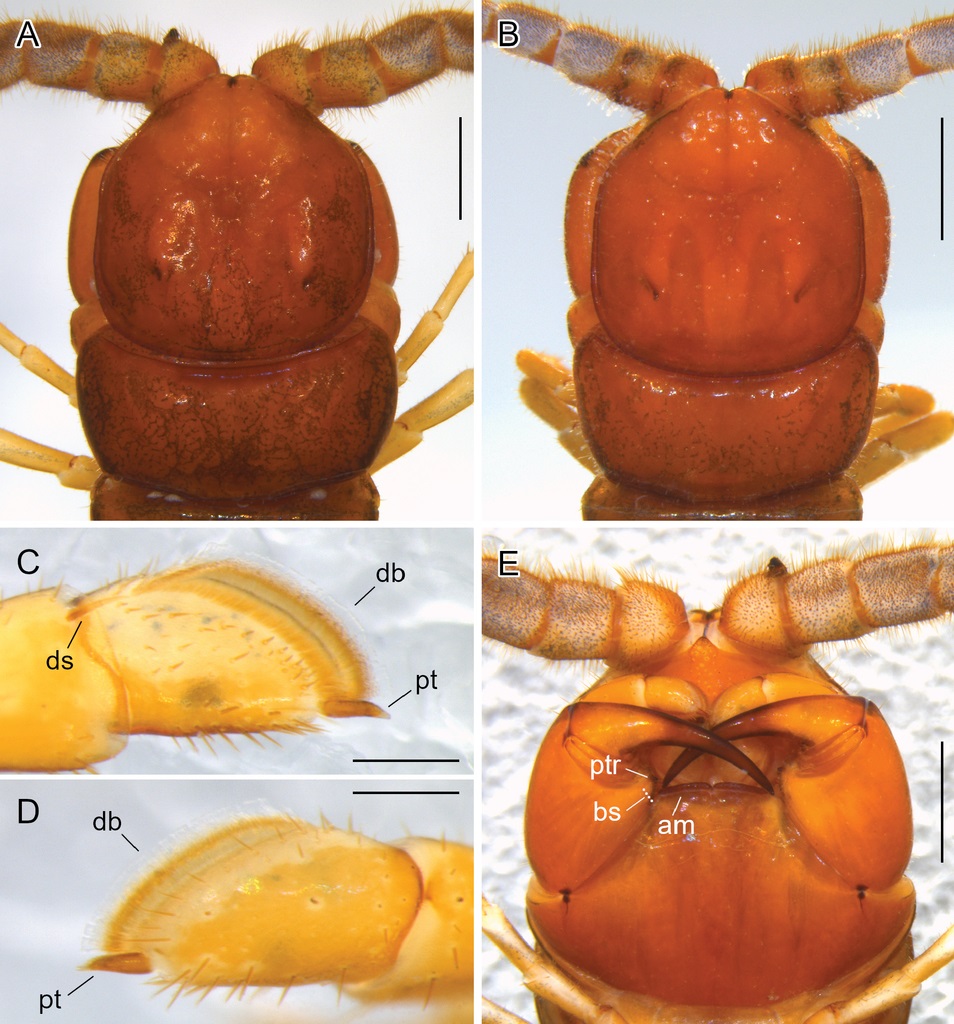
Scolopocryptops longisetosus sp. nov., holotype, ♂ (KUZ Z5107: A, C–E) and non-type specimen from Yonaguni Island, ♂ (KUZ Z5124: B).
A, B. Cephalic plate and tergite 1, dorsal view; C. Distal part of article 2, article 3 and pretarsus of left second maxilla, medial view; D. Article 3 and pretarsus of left second maxilla, lateral view; E. Head, ventral view. Abbreviations: am — anterior margin of forcipular coxosternite; bs — basal suture on forcipular trochanteroprefemoral process; db — dorsal brush on article 3 of second maxilla; ds — dorsal spur on article 2 of second maxilla; pt — pretarsus of second maxilla; ptr — process of forcipular trochanteroprefemur. Scale bars: 1 mm (A, B, E); 0.2 mm (C, D).

Scolopocryptops longisetosus sp. nov., paratype, ♂ (KUZ Z5119: B), non-type specimen from Yonaguni Island, ♂ (KUZ Z5124: C) and habitat near the type locality. 
 A. Habitat (laurel tree forest) on Okinawa Island; B, C. Live specimen, dorsal view. Scale bars: 10 mm.

 Scolopocryptops longisetosus sp. nov.
 Suggested Japanese name: Kuromadara-akamukade

Diagnosis: Antenna with sparse hairs and setae of various lengths dorsally on two basal articles, subsequent articles densely covered with long setae and minute setae. Cephalic plate with complete lateral marginal sulci. Tergites lacking paramedian sutures, tergites 5–20 with four longitudinal keels and median depression bordered by paramedian keels.
 
Etymology: The specific name is derived from the Latin compound adjective, “longus” (long) and “setosus” (hairy), referring to the long antennal setae of this new species.


 Taro Jonishi and Takafumi Nakano. 2024. Taxonomic Re-appraisal of Scolopocryptops quadristriatus (Verhoeff, 1934) and A Description of A New Species from Japan and Taiwan (Chilopoda, Scolopendromorpha, Scolopocryptopidae). Zoosystematics and Evolution. 100(2): 405-423. DOI: 10.3897/zse.100.119297


Tuesday, August 17, 2021

[Chilopoda / Ecology • 2021] Arthropod Predation of Vertebrates Structures Trophic Dynamics in Island Ecosystems


Phillip Island centipede (Cormocephalus coynei; foreground (and upper)) with an adult black-winged petrel (Pterodroma nigripennis; background).   Some foreshortening effect exists in this image, with the largest Phillip Island centipede measured at 23.5 cm (this study) and the combined head and body length of an adult black-winged petrel estimated at 28–30 cm (Marchant and Higgins 1990). Image by L. Halpin, 2018.

in Halpin, Terrington, Jones, ... et Clarke, 2021. 

Abstract
On isolated islands, large arthropods can play an important functional role in ecosystem dynamics. On the Norfolk Islands group, South Pacific, we monitored the diet and foraging activity of an endemic chilopod, the Phillip Island centipede (Cormocephalus coynei), and used a stable isotope mixing model to estimate dietary proportions. Phillip Island centipede diet is represented by vertebrate animals (48%) and invertebrates (52%), with 30.5% consisting of squamates, including the Lord Howe Island skink (Oligosoma lichenigera) and Günther’s island gecko (Christinus guentheri); 7.9% consisting of black-winged petrel (Pterodroma nigripennis) nestlings; and 9.6% consisting of marine fishes scavenged from regurgitated seabird meals. Centipede predation was the principal source of petrel nestling mortality, with annual rates of predation varying between 11.1% and 19.6% of nestlings. This means that 2,109–3,724 black-winged petrel nestlings may be predated by centipedes annually. Petrels produce a single offspring per year; therefore, predation of nestlings by centipedes represents total breeding failure for a pair in a given year. Our work demonstrates that arthropods can play a leading role in influencing vertebrate reproductive output and modifying trophic structures and nutrient flow in island ecosystems.

The Phillip Island centipede (Cormocephalus coynei) has a diet consisting of an unusually large proportion of vertebrate animals, including seabird chicks.
photo: Daniel Terrington

Black-winged petrel chick just prior to being weighed on Phillip Island.
photo: Trudy Chatwin
 
Figure 1.  Phillip Island centipede (Cormocephalus coynei; foreground) with an adult black-winged petrel (Pterodroma nigripennis; background). Some foreshortening effect exists in this image, with the largest Phillip Island centipede measured at 23.5 cm (this study) and the combined head and body length of an adult black-winged petrel estimated at 28–30 cm (Marchant and Higgins 1990).
Image by L. Halpin, 2018.

Figure 5.  Schematic diagram of the general Phillip Island food web with the thickness of dietary linkages to centipedes weighted according to proportional contributions of centipede prey taxa to centipede tissue isotopic values.


Luke R. Halpin, Daniel I. Terrington, Holly P. Jones, Rowan Mott, Wei Wen Wong, David C. Dow, Nicholas Carlile, and Rohan H. Clarke. 2021. Arthropod Predation of Vertebrates Structures Trophic Dynamics in Island Ecosystems. The American Naturalist.  DOI: 10.1086/715702

La depredación de artrópodos sobre vertebrados estructura las dinámicas tróficas de ecosistemas insulares
En islas remotas, los artrópodos de gran tamaño pueden jugar un papel funcional importante en la dinámica del ecosistema. En las Islas Norfolk, en el Pacífico sur, monitoreamos la dieta y comportamiento de forrajeo de un quilópodo endémico, el ciempiés de Phillip Island (Cormocephalus coynei), y usamos isótopos estables para estimar la composición de su dieta. La dieta del ciempiés de Phillip Island está representada por animales vertebrados (48%), e invertebrados (52%): con un 30.5%, las especies del orden Squamata como el eslizón de Lord Howe Island (Oligosoma lichenigera) o el gecko de Günther’s Island (Christinus guentheri); un 7.9% pollos de petrel alinegro (Pterodroma nigripennis); y un 9.6% peces obtenidos de los regurgitados de las aves marinas. La depredación por parte de los ciempiés fue la principal causa de mortalidad de los pollos de aves marinas, con tasas de depredación entre el 11.1% y el 19.6%. Considerando el límite superior del tamaño poblacional estimado para el petrel alinegro, los ciempiés podrían estar depredando 2.109–3.724 pollos por año en este ecosistema. Como los petreles producen un solo huevo por año, la depredación del pollo representa el fracaso reproductivo total para una pareja en ese año. Nuestra investigación demuestra que los artrópodos pueden desempeñar un papel central en los ecosistemas insulares, al influir en el éxito reproductivo de vertebrados y modificar las estructuras tróficas y el flujo de nutrientes.

Giant bird-eating centipedes exist—and they're surprisingly important for their ecosystem

Saturday, April 17, 2021

[Chilopoda • 2021] Scolopendra alcyona • A New Amphibious Species of the Genus Scolopendra Linnaeus, 1758 (Scolopendromorpha, Scolopendridae) from the Ryukyu Archipelago and Taiwan


Scolopendra alcyona Tsukamoto & Shimano 

in Tsukamoto, Hiruta, Eguchi, Liao & Shimano, 2021. 
Halcyon Giant Centipede | 琉神大百足 || U-Ryukyu.ac.jp
 
Abstract
In Japan and Taiwan, five valid species of the genus Scolopendra Linnaeus, 1758 have been described: S. morsitans Linnaeus, 1758, S. subspinipes Leach, 1816, S. mutilans Koch, 1878, S. japonica Koch, 1878, and S. multidens Newport, 1844. Recently, an undetermined species was found in the Ryukyu Archipelago and Taiwan. Using molecular phylogenetic analyses with mitochondrial COI and 16S rRNA and nuclear 28S rRNA and 18S rRNA genes as well as conventional morphological examination, we successfully discriminated this sixth species as an independent lineage from S. subspinipes, S. mutilans, and other named congeners from East and Southeast Asia. Therefore, the species was described as Scolopendra alcyona Tsukamoto & Shimano, sp. nov. Several situational evidences suggest that this species prefers streamside environments and exhibits amphibious behavior.

Keywords: Myriapoda, Chilopoda, molecular phylogeny, morphology, semi-aquatic


Scolopendra alcyona Tsukamoto & Shimano, sp. nov., found underwater at the upper reach of ... River, Kume-jima Island (by H. Sato; specimen not collected).


Scolopendra alcyona Tsukamoto & Shimano, sp. nov.

[New Japanese name: Ryûjin-ômukade (琉神大百足); 
new English name: Halcyon Giant Centipede]

Etymology. This epithet “alcyona” derived from the name of a Greek mythological figure, “Alcyone”. In one version of the story, Alcyone was turned into a common kingfisher (halcyon bird) by Zeus ( Gresseth 1964). This epithet is a metaphor for halcyon bird-like jade green legs seen in the Okinawa-jima Island population, and its amphibious behavior.

 Habitat of Scolopendra alcyona Tsukamoto & Shimano, sp. nov. in Kume-jima Island


Sho Tsukamoto, Shimpei F. Hiruta, Katsuyuki Eguchi, Jhih-Rong Liao and Satoshi Shimano. 2021. A New Amphibious Species of the Genus Scolopendra Linnaeus, 1758 (Scolopendromorpha, Scolopendridae) from the Ryukyu Archipelago and Taiwan. Zootaxa. 4952(3); 465–494. DOI: 10.11646/zootaxa.4952.3.3

国内で143年ぶりのオオムカデの新種発見!渓流に潜む、翡翠色に輝く国内最大のオオムカデ〜日本初、世界で3例目の半水棲ムカデ、沖縄の4地域と台湾から発見され、沖縄の故事にちなみリュウジンオオムカデ(琉神大百足)と命名〜


Wednesday, September 30, 2020

[Chilopoda • 2020] An Overview of the Extant Genera and Subgenera of the Order Scolopendromorpha (Chilopoda): A New Identification Key and Updated Diagnoses


Scolopendropsis duplicata Chagas-Jr, Edgecombe & Minelli, 2008

in Schileyko, Vahtera & Edgecombe, 2020. 
 
Abstract
The extant genera and subgenera of the order Scolopendromorpha are critically reviewed and provided with updated diagnoses and a new identification key; the most recent revisions of scolopendromorph genera are concisely summarised. Rhoda Meinert, 1886 and Cryptops (Chromatanops) Verhoeff, 1906 are suggested to be a junior synonyms of Scolopendropsis Brandt, 1841 and Cryptops (Cryptops) Leach, 1814, respectively. The subgeneric status is formally fixed for Cryptops (Paracryptops) Pocock, 1891 and Cormocephalus (Campylostigmus) Ribaut, 1923; the taxonomic status of the former genus Kanparka Waldock & Edgecombe, 2012 is discussed. As a result of synonymies, the number of scolopendromorph genera and subgenera is currently 37. The formal status of the former tribes Scolopendrini Leach, 1814, Asanadini Verhoeff, 1907 and Arrhabdotini Attems, 1930 is briefly discussed; the presence of the sexual dimorphism among the taxa of generic level is overviewed.

Keywords: Myriapoda, genera and subgenera, identification key, updated diagnoses, new statuses, new synonymy, Scolopendromorpha, taxonomic notes

 
general view dorsally; Scolopendropsis duplicata Chagas-Jr, Edgecombe & Minelli, 2008
 (photo by Dr. Amazonas Chagas-Jr.)

Order Scolopendromorpha

Family Scolopocryptopidae Pocock, 1896

Subfamily Scolopocryptopinae Pocock, 1896
Scolopocryptops Newport, 1844

Subfamily Kethopinae Shelley, 2002
Kethops Chamberlin, 1912
Thalkethops Crabill, 1960

Subfamily Newportiinae Pocock, 1896 
Newportia Gervais, 1847
Newportia (Newportia) Gervais, 1847 stat. nov.
Newportia (Newportides) Chamberlin, 1921
Newportia (Tidops) Chamberlin, 1915

The former subfamily Ectonocryptopinae Shelley & Mercurio, 2005
Newportia (Ectonocryptops) Crabill, 1977
Newportia (Ectonocryptoides) Shelley & Mercurio, 2005

Family Cryptopidae Kohlrausch, 1881

Cryptops (Cryptops) Leach, 1814
Cryptops (Chromatanops) Verhoeff, 1906
Cryptops (Trigonocryptops) Verhoeff, 1906
Cryptops (Haplocryptops) Verhoeff, 1934
Cryptops (Paracryptops) Pocock, 1891 stat. nov.

Family Mimopidae Lewis, 2006
Mimops Kraepelin, 1903

Family Plutoniumidae Bollman, 1893
Plutonium Cavanna, 1881
Theatops Newport, 1844

Family Scolopendridae Leach, 1814
Subfamily Scolopendrinae Leach, 1814

The former tribe Scolopendrini Leach, 1814
Scolopendra L., 1758
The former genus Kanparka Waldock & Edgecombe, 2012 (= Scolopendra)
Arthrorhabdus Pocock, 1891
Tonkinodentus Schileyko, 1992
Cormocephalus (Cormocephalus) Newport, 1844
Cormocephalus (Campylostigmus) Ribaut, 1923 stat. nov.
Hemiscolopendra Kraepelin, 1903
Akymnopellis Shelley, 2008
Psiloscolopendra Kraepelin, 1903
Notiasemus L.E. Koch, 1985
Scolopendropsis Brandt, 1841

The former tribe Asanadini Verhoeff, 1907
Asanada Meinert, 1886
Asanadopsis Würmli

Subfamily Otostigminae Kraepelin, 1903
Tribe Otostigmini Kraepelin, 1903
Otostigmus (Otostigmus) Porat, 1876
Otostigmus (Parotostigmus) Pocock, 1896
Otostigmus (Dactylotergitius) Verhoeff, 1937
Digitipes Attems, 1930
Alipes Imhoff, 1854
Ethmostigmus Pocock, 1898
Rhysida H.C. Wood, 1862
Alluropus Silvestri, 1911
The former tribe Arrhabdotini Attems, 1930
Edentistoma Tömösváry, 1882
Tribe Sterropristini Verhoeff, 1937
Sterropristes Attems, 1934


Arkady A. Schileyko, Varpu Vahtera and Gregory D. Edgecombe. 2020. An Overview of the Extant Genera and Subgenera of the Order Scolopendromorpha (Chilopoda): A New Identification Key and Updated Diagnoses. Zootaxa. 4825(1) ; 1-64. DOI: 10.11646/zootaxa.4825.1.1

Sunday, November 17, 2019

[Chilopoda • 2019] Revision of the Neotropical Species of Aphilodontinae (Geophilomorpha, Geophilidae), with Eight New Species and A First Phylogenetic Analysis of the Subfamily


Mairata itatiaiensis 
Calvanese, Brescovit & Bonato, 2019


Abstract 
Aphilodontinae are a well distinct but poorly known group of soil centipedes (Chilopoda: Geophilomorpha: Geophilidae) inhabiting two disjunct areas in South America and South Africa respectively. A comprehensive revision of the Neotropical species is presented based on the examination of >150 specimens, the phylogenetic analysis of the entire subfamily based on 47 morphological characters, and the description of eight new species from Southeastern Brazil. The Aphilodontinae were confirmed a monophyletic clade within Geophilidae and closely related to Geoperingueyia, with which they share synapomorphic characters in the labrum, second maxillae and forcipules. Particular groups of clypeal setae, inconspicuous lateral parts of labrum and coalescent forcipular throchanteroprefemur and femur were recovered as synapomorphies of the Aphilodontinae. Four monophyletic genera are recognized within the subfamily Aphilodontinae Silvestri, 1909 (1908) (= Brasilophilidae Verhoeff, 1908; = Mecistaucheninae Verhoeff, 1925 n. syn.), three exclusively Neotropical and one exclusively South African. The Neotropical genera are: Aphilodon Silvestri, 1898 (= Mecistauchenus Brölemann, 1907 n. syn.; = Brasilophilus Verhoeff, 1908 n. syn.), with ten species (including A. caboclos n. sp., A. indespectus n. sp., A. meganae n. sp., A. pereirai n. sp. and A. silvestrii n. sp.), characterized by a small terminal spine on the ultimate legs, in both males and females; Mecophilus Silvestri, 1909, with two species (including M. tupiniquim n. sp.), characterized by elongated forcipular segment and first leg-bearing segment; Mairata n. gen., with two species (M. butantan n. sp. and M. itatiaiensis n. sp.), characterized by the partial reduction of the distal article of the second maxillary telopodite and a particular shape of ultimate legs, in both males and females. The South African genus, Philacroterium Attems, 1926, comprises eleven known species (including P. weberi (Silvestri, 1909) n. comb., P. caffrarium (Verhoeff, 1937) n. comb., P. porosum (Verhoeff, 1937) n. comb., P. brevipes (Verhoeff, 1938) n. comb., P. bidentatum (Lawrence, 1955) n. comb., P. longipes (Lawrence, 1955) n. comb., P. macronyx (Lawrence, 1955) n. comb., P. maritimum (Lawrence, 1963) n. comb., P. pauciporum (Lawrence, 1963) n. comb. and P. transvaalicum (Lawrence, 1963) n. comb.) and is characterized by vestigial lateral parts of the labrum and the complete suppression of the distal article of the telopodites of the second maxillae. Identification keys are provided for the Aphilodontinae genera and for the species of Aphilodon, Mecophilus and Mairata n. gen. The known occurrence of Aphilodon in Brazil is extended from the states of São Paulo and Mato Grosso to the states of Minas Gerais and Rio de Janeiro, that of Mecophilus from the state of Paraná to the state of São Paulo.

Keywords: Myriapoda, centipedes, taxonomy, morphology, phylogeny, biodiversity


Victor C. Calvanese, Antonio D. Brescovit and Lucio Bonato. 2019. Revision of the Neotropical Species of Aphilodontinae (Geophilomorpha, Geophilidae), with Eight New Species and A First Phylogenetic Analysis of the Subfamily. Zootaxa. 4698(1); 1–72. DOI: 10.11646/zootaxa.4698.1.1


Thursday, March 14, 2019

[Chilopoda • 2019] Arrup akiyoshiensis • A New Species of the Genus Arrup (Geophilomorpha, Mecistocephalidae) from A Limestone Cave in Akiyoshi-dai, Western Japan


Arrup akiyoshiensis Tsukamoto & Shimano

in Tsukamoto, Shimano, Murakami, et al., 2019. 

Abstract
Arrup akiyoshiensis Tsukamoto & Shimano, sp. n. is described from a limestone cave, Kagekiyo-ana, in Akiyoshi-dai, one of the largest karst regions in Japan, Yamaguchi prefecture. It is distinguishable from 14 valid named congeners by some unique characteristics including entire areolation on the cephalic pleurite, elongation of distal part of female gonopod, and a tubercle on forcipular segment II. In addition, the 18S rRNA gene sequences of A. akiyoshiensis Tsukamoto & Shimano, sp. n. and A. ishiianus, one of the most morphologically similar species, differed by four bp out of 1821 bp. The fact that only troglobionts and troglophilic species are found in the collection site suggests that this new species might be a cave-dweller.

Keywords: Arrupinae, Chilopoda, Kagekiyo-ana, limestone, taxonomy, 18S rRNA gene


Figure 7. Arrup akiyoshiensis sp. n.,
 A–C paratype (TS-20180418-01) D holotype (TS-20180330-01) A whole body, dorsal B head and forcipular segment, dorsal C head and forcipular segment, ventral D head and left antenna, ventral. Scale bar: 1 mm (B–D).

Taxonomy

Family Mecistocephalidae Bollmann, 1893
Genus Arrup Chamberlin, 1912

Arrup akiyoshiensis Tsukamoto & Shimano, sp. n.
Japanese name: Kagekiyo-tsumejimukade

Diagnosis: Arrup akiyoshiensis sp. n. can be distinguished from the all named congeners by a combination of the following morphological characteristics: frontal line curved; seven pectinate lamellae in mandible; comma-shaped distal lobe of coxal projection in first maxillae; a tiny tubercle on outer-distal corner of each article of the telopodite; distal article of the telopodite of the second maxillae without claw; the well-developed tooth of forcipular article I; the triangular basal tooth in tarsungulum; the poison calyx overreaching forcipular article I; 31–35 pores on lateral and ventral sides on coxopleura.
....

Etymology: The species name is derived from the name of Akiyoshi-dai Karst region, which includes the type locality.

Distribution: Known from only the type locality.

Type locality: Kagekiyo-ana, Mitou Town (Mitou-cho), Mine City (Mine-shi), Yamaguchi Prefecture, Japan.

Remarks: Arrup akiyoshiensis sp. n. is morphologically similar to several other congeners, especially A. holstii (Pocock, 1895) and A. ishiianus Uliana, Bonato & Minelli, 2007 (Fig. 10), but can be easily distinguished from them by a combination of the characteristics shown in Table 7.


 Sho Tsukamoto, Satoshi Shimano, Takashi Murakami, Shimpei F. Hiruta, Takeshi Yamasaki and Katsuyuki Eguchi. 2019. A New Species of the Genus Arrup from A Limestone Cave in Akiyoshi-dai, Western Japan (Chilopoda, Geophilomorpha, Mecistocephalidae). ZooKeys. 830: 33-51. DOI: 10.3897/zookeys.830.33060

Monday, December 17, 2018

[Chilopoda • 2018] Taeniolinum neusicus • The First Taeniolinum (Geophilomorpha: Ballophilidae) from the Andes Mountains and Colombia


Taeniolinum neusicus
Tulande-M, Prado & Triana, 2018


Abstract
Taeniolinum neusicus sp. n. is described based on 148 specimens collected at the eastern Colombian Andes. Detailed data on environmental and biological preferences are included in the description. The validity of characters such as the number of labral teeth and the clypeal setae to separate Taeniolinum species is also evaluated.

Keywords: Myriapoda, Ballophilidae, Centipede, Soil fauna, Tropical Montane forest


Order Geophilomorpha 
Suborder Adesmata 

Family Ballophilidae 
Genus Taeniolinum Pocock, 1893

FIGURE 4. Specimen of Taeniolinum neusicus sp. n. found inside a dipteran pupa, probably while brooding.
(Photo: Esteban Tulande-M).

Taeniolinum neusicus sp. n.

Etymology: The specific epithet is a latinized adjective, in masculine form, derived from the name of the type locality, Parque Forestal Embalse del Neusa

Type locality: Colombia: Eastern Andes Mountains: Cundinamarca: Parque Forestal Embalse del Neusa and .... 

Habitat and ecological considerations. This is the first record of the genus Taeniolinum in Colombia and the Andes Mountains, the specimens were collected at two tropical high montane forest patchs (Figure 3) within an altitudinal range of 2700 to 3200 meters above sea level, which is a new distribution range for Taeniolinum, as well as the maximum altitude at which it the genus has been recorded.  
....


 Esteban Tulande-M., César Camilo Prado and Hernán Darío Triana. 2018. The First Taeniolinum from the Andes Mountains and Colombia (Chilopoda: Geophilomorpha).   Zootaxa. 4532(1); 113–124.  DOI: 10.11646/zootaxa.4532.1.7