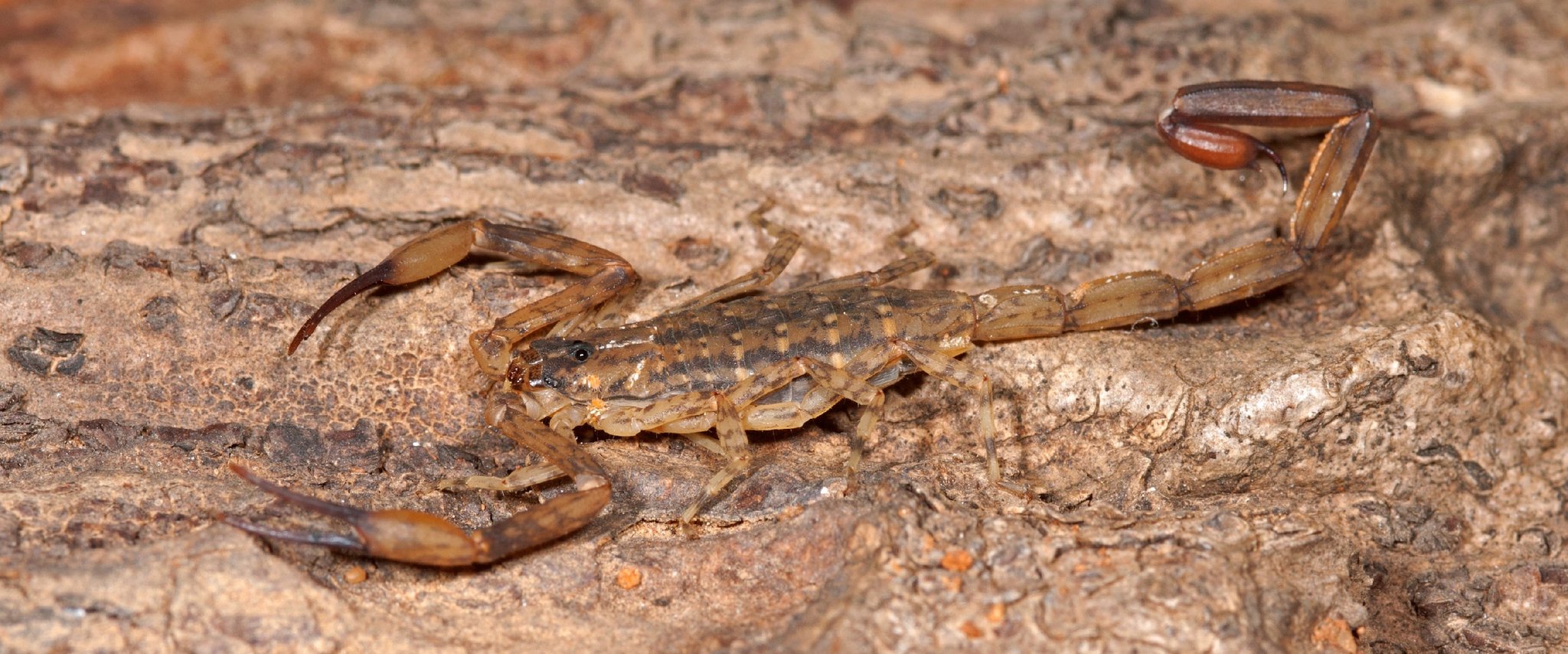
Showing posts with label Buthidae. Show all posts

Saturday, April 25, 2026

[Arachnida • 2026] Androctonus tinzaouatinensis • A New scorpion Species (Scorpiones: Buthidae) from In Guezzam Province, Algeria


Androctonus tinzaouatinensis 
Yağmur, Benali, Derradj & Bikada, 2026


 ABSTRACT
A new scorpion species, Androctonus tinzaouatinensis sp. n. is described and illustrated from the hyperarid Saharan regions of the Tin Zaouatine District, In Guezzam Province and Timiaouine District, Bordj Badji Mokhtar Province, southern Algeria. This new species represents the first record of the genus Androctonus from the Timiaouine and Tin Zaouatine areas. It is compared with congeners from Algeria and Niger, notably A. ajjer Ythier, Sadine, Alioua & Lourenço, A. amoreuxi (Audouin), and A. eburneus (Pallary).
 
KEYWORDS: Morphology, taxonomy, Tin Zaouatine, Sahara, endemic


Androctonus tinzaouatinensis sp. n. 


Ersen Aydın Yağmur, Noureddine Benali, Lotfi Derradj and Manna Bikada. 2026. Androctonus tinzaouatinensis A New scorpion Species from In Guezzam Province, Algeria (Scorpiones: Buthidae). Journal of Natural History. 60(17-20); 1033-1047. DOI: doi.org/10.1080/00222933.2026.2642870 [21 Apr 2026]


Tuesday, January 28, 2025

[Arachnida • 2024] Tityus achilles • Biomechanics of Venom Delivery in South America’s First Toxungen-spraying Scorpion


Tityus (Tityusachilles Laborieux, 2024 

 
Abstract
Venom is a metabolically expensive secretion used sparingly in a variety of ecological contexts, most notably predation and defence. Accordingly, few animals employ their toxins from a distance, and venom-squirting behaviour is only known from select taxa. In scorpions, species belonging to two genera are known to spray venom when threatened, and previous work in Parabuthus transvaalicus shows that venom delivery depends on perceived levels of threat. Here, I describe Tityus (Tityusachilles sp. nov., a new species of buthid scorpion from Cundinamarca, Colombia. Remarkably, this species is capable of venom spraying, a first for both the genus and the South American continent. Using frame-by-frame video analysis and ballistic equations, I show that T. (Tityusachilles sp. nov. employs not one, but two types of airborne defences with dramatic differences in reach and venom expenditure. Further, the new species uses an unusually large reserve of prevenom-like secretion for spraying, as opposed to the costly venom used by other spraying scorpions. In light of these key specializations, I propose that toxungen spraying convergently evolved in response to different selection pressures, laying the groundwork for future investigation.

behaviour, Colombia, evolutionary biology, new species, taxonomy, toxin, toxungen, venom spitting


 Léo Laborieux. 2024. Biomechanics of Venom Delivery in South America’s First Toxungen-spraying Scorpion. Zoological Journal of the Linnean Society. 202(4) zlae161. DOI: doi.org/10.1093/zoolinnean/zlae161  

Wednesday, June 26, 2024

[Arachnida • 2024] Hottentotta hatamtiorum • Integrative Systematics of the widespread Middle Eastern buthid Scorpion, Hottentotta saulcyi (Simon, 1880) (Scorpiones: Buthidae), reveals A New Species in Iran


Hottentotta hatamtiorum 
Amiri, Prendini, Hussen, Aliabadian, Siahsarvie & Mirshamsi, 2024


Abstract
Morphological and genetic variation among populations of the widespread buthid scorpion, Hottentotta saulcyi (Simon, 1880), occurring in western and southwestern Iran was explored using morphometric variables, one nuclear marker (28S rDNA) and three mitochondrial markers (12S rDNA, 16S rDNA, and Cytochrome c Oxidase Subunit I). Genetic and morphometric statistical analyses revealed extensive cryptic diversity. Phylogenetic analysis with Bayesian Inference and Maximum Likelihood uncovered two divergent clades, one of which is described as a new species, Hottentotta hatamtiorum sp. nov., from Ilam and Khuzestan Provinces, southwestern Iran. The description of the new species raises the total count of Hottentotta Birula, 1908 species to 61, twelve of which are endemic or subendemic to the Iranian Plateau.

Key words: Cryptic diversity, morphology, morphometrics, taxonomy


Hottentotta hatamtiorum sp. nov., habitus, dorsal aspect (A, C), ventral aspect (B, D).
 A, B Holotype ♂ (ZMFUM 1977). C, D Paratype ♀ (ZMFUM 1981).
Scale bars = 10 mm.

Hottentotta hatamtiorum sp. nov.
 
Diagnosis: Hottentotta hatamtiorum sp. nov. may be distinguished from H. saulcyi by the wider metasomal segment I (MtIL/WHsau 1.01 ± 0.06; MtIL/WHhat 1.17 ± 0.11) and telson (TWHsau 3.99 ± 0.62; TWHhat 4.25 ± 0.70); from H. akbarii by the infuscate anterior part of the carapace, metasomal segment V, and telson; from H. lorestanus by the uniformly yellowish-brown base color; and from H. khoozestanus by the shorter fingers of the pedipalp chela (ChL/ML 2.35; MFL/ML 1.36) and the infuscate ventral and ventrolateral surfaces of metasomal segment V and telson.

Etymology: The specific epithet refers to Hatamti, an ancient civilization centered in the far west and southwest of modern-day Iran (3200–539 BC), in the lowlands of present-day Khuzestan and Ilam provinces and a small part of southern Iraq.


Masoumeh Amiri, Lorenzo Prendini, Fenik Sherzad Hussen, Mansour Aliabadian, Roohollah Siahsarvie and Omid Mirshamsi. 2024. Integrative Systematics of the widespread Middle Eastern buthid Scorpion, Hottentotta saulcyi (Simon, 1880), reveals A New Species in Iran. Arthropod Systematics & Phylogeny. 82: 323-341. DOI: 10.3897/asp.82.e98662

Friday, May 31, 2024

[Arachnida • 2024] Microtityus adrikiOn one of the smallest Amazonian scorpions: A New Species of Microtityus Kjellesvig-Waering, 1966 (Scorpiones: Buthidae) from Brazil, with amended Diagnosis and potential Distribution Analysis for the Genus


 Microtityus (Microtityusadriki 
Moreno-González, Bertani & Carvalho, 2024


A new scorpion species, Microtityus adriki n. sp., is described based on adult specimens collected in Cantá, state of Roraima (RR), northern Brazil. Microtityus adriki n. sp. is the second species of Microtityus Kjellesvig-Waering, 1966 known from Brazil and is one of the smallest scorpion species (12.39-19.47 mm) in the Amazonian region. In this study, we propose an amended generic diagnosis and a specific diagnosis, describe the male hemispermatophore of Microtityus, give the sequence of COI barcode, and present a potential distribution analysis for the genus. The morphology of the male hemispermatophore of Microtityus differs from that of other Neotropical buthid genera, except for the number of lobes (three lobes), which is a character state shared with several genera. The potential distribution model generated by MaxEnt suggests high environmental suitability for the genus in the Antilles and northern South America, with scattered high suitability in several regions of Central America. However, the model did not indicate high suitability in areas where Brazilian species occur (i.e., Microtityus adriki n. sp. and Microtityus vanzolinii Lourenço & Eickstedt, 1983), and this could be explained by a sampling bias. Therefore, future studies, including extensive sampling, are required to better understand the biogeographic processes behind the distribution of this genus.

KEYWORDS: scorpion, biogeography, MaxEnt, microbuthids, niche, Roraima, new species


 Microtityus (Microtityusadriki n. sp.:
 A, B, ♂ paratype (MZSP 76548): dorsal (A); ventral (B);
C, D, ♀ holotype (MZSP 76547): dorsal (C); ventral (D).
Scale bars: 5 mm.

 Microtityus (Microtityusadriki n. sp., live habitus:
A, B, females, on leaf litter.
photos: Rogério Bertani.


Jairo A. MORENO-GONZÁLEZ, Rogério BERTANI and Leonardo S. CARVALHO. 2024. On one of the smallest Amazonian scorpions: A New Species of Microtityus Kjellesvig-Waering, 1966 (Scorpiones, Buthidae) from Brazil, with amended Diagnosis and potential Distribution Analysis for the Genus. ZOOSYSTEMA. 46(10); 245-268.  

Wednesday, May 8, 2024

[Arachnida • 2020] Isometrus kovariki • A New Species of Isometrus (Scorpiones: Buthidae) from southern India


Isometrus kovariki
Sulakhe, Dandekar, Mukherjee, Pandey, Ketkar, Padhye & Bastawade, 2020


A new species of Isometrus (Buthidae) is described from India using integrated taxonomic approach. Isometrus kovariki sp. n. is closely related to I. thurstoni, and differs in morphological features and raw genetic divergence of more than 9%.

Isometrus kovariki sp. n., male holotype, in vivo habitus.

Isometrus kovariki sp. n.  


Shauri Sulakhe, Nikhil Dandekar, Shomen Mukherjee, Malay Pandey, Makarand Ketkar, Anand Padhye and Deshabhushan Bastawade. 2020. A New Species of Isometrus (Scorpiones: Buthidae) from southern India. Euscorpius - Occasional Publications in Scorpiology. No. 310.   Researchgate.net/publication/341489428_A_new_species_of_Isometrus_from_southern_India

Tuesday, April 30, 2024

[Arachnida • 2023] Leiurus nigellus • A New remarkable Species of Leiurus Ehrenberg, 1828 (Scorpiones: Buthidae) from Saudi Arabia


Leiurus nigellus Abu Afifeh, Aloufi & Al-Saraireh, 

in Afifeh, Aloufi, Al-Saraireh, Badry, Al-Qahtni et Amr, 2023.

 Abstract
A new remarkable buthid scorpionLeiurus nigellus sp. nov., was discovered in Al Ula Governorate, north of Al Madinah Al Monawwarah Province, Saudi Arabia. The new species is described, fully illustrated, and compared with other species of the genus Leiurus reported from the Arabian Peninsula. Notes on its habitats are provided.

 Habitus of Leiurus nigellus sp. nov., male paratype and female holotype.
A. male in dorsal view. B. male in ventral view.
C. female in dorsal view. D. female in ventral view.
Scale bar = 20 mm.

Leiurus nigellus sp. nov. Abu Afifeh, Aloufi & Al-Saraireh

Leiurus nigellus sp. nov., female paratype from Al Buriakah, Al Ula governorate, Saudi Arabia.
 

Bassam Abu Afifeh, Abdulhadi Aloufi, Mohammad Al-Saraireh, Ahmed Badry, Abdulmani H. Al-Qahtni and Zuhair S. Amr. 2023. A New remarkable Species of Leiurus Ehrenberg, 1828 from Saudi Arabia (Scorpiones: Buthidae). Ecologica Montenegrina. 6991-106. DOI: 10.37828/em.2023.69.9

Friday, January 26, 2024

[Arachnida • 2024] Isometrus adviteeya, I. anamalaiensis, I. lithophilis, etc. • A Baffling Case of Morphological, Molecular and Ecological Discordance in Isometrus Ehrenberg, 1828 (Scorpiones: Buthidae) with the Description of Five New Species from southern India


Isometrus adviteeyaI. anamalaiensisI. palani
I. thenmala & I. lithophilis 
 Deshpande, Gowande, Dandekar, Joshi, Bastawade & Sulakhe, 2024


Abstract
The Western and Eastern Ghats of the Peninsular India are known for their high biological diversity, which is shaped due to various geological barriers and environmental parameters. Scorpion diversity in Peninsular India remains poorly known thereby warranting a need to undertake rigorous arachnological surveys. In our continued effort to discover scorpion lineages hitherto unknown to science, we describe five new species of the genus Isometrus Ehrenberg, 1828 which were obtained from southern India, and discuss morphological, molecular and ecological discordance within this genus. The validity of Reddyanus atherii Amir and Kamaluddin, 2008, Isometrus liaqatii Amir and Kamaluddin, 2008 and Isometrus formosus Pocock, 1894 is also commented upon, with implications to propose taxonomic changes within the genus.


Isometrus adviteeya sp. nov.

Etymology: The species is morphologically unique compared to the congeners. The specific epithet is derived from the Sanskrit word ‘adviteeya’, meaning incomparable.


Isometrus anamalaiensis sp. nov.

Etymology: The specific epithet is named after the Annamalai hill complex which is popularly known for the Indian Elephant, within which the type locality is situated. The name is derived from the Tamil words ‘Yanai’ (= elephant) and ‘Malai’ (= mountain).


Isometrus palani sp. nov.
 
Etymology: The specific epithet is a noun in apposition indicating the type locality of the species.


 Isometrus thenmala sp. nov.
 
Etymology: The specific epithet is a noun in apposition indicating the Thenmala Reserve Forest which is located near the type locality.


 Isometrus lithophilis sp. nov.
 
Etymology: The specific epithet is an adjective derived from two Greek words ‘lithos’(= rock), and ‘philia’ (= fondness) indicating the close affinity of the species towards rocks.


Shubhankar Deshpande, Gaurang Gowande, Nikhil Dandekar, Mihir Joshi, Deshabhushan Bastawade and Shauri Sulakhe. 2024. A Baffling Case of Morphological, Molecular and Ecological Discordance in Isometrus Ehrenberg, 1828 (Scorpiones: Buthidae) with the Description of Five New Species from southern India. Zoologischer Anzeiger. 308; 71-98. DOI: 10.1016/j.jcz.2023.11.001
 facebook.com/100063496543843/posts/869400721853138


Sunday, September 17, 2023

[Arachnida • 2023] Leiurus hadb • A New Species and A Key to the Genus Leiurus Ehrenberg, 1828 (Scorpiones: Buthidae) from Saudi Arabia


Leiurus hadb Al-Qahtni, Al-Salem, Alqahtani & Badry,

in Al-Qahtni, Al-Salem, Mesfer, Al Balawi, Allahyani, Alqahtani et Badry, 2023. 

Abstract
A new species, Leiurus hadb Al-Qahtni, Al-Salem, Alqahtani & Badry, sp. nov., is described and illustrated from the Majami al-Hadb Protected Area in the Riyadh Province of Saudi Arabia. The new species is compared with species of Leiurus distributed in Saudi Arabia, especially L. arabicus Lowe, Yağmur & Kovařík, 2014. The integrated results indicate that the population found in Majami al-Hadb represents a distinct species, which is described herein. Moreover, the molecular analysis is conducted on the mitochondrial gene 16S rRNA to compare L. hadb sp. nov. with samples of L. arabicus and L. haenggii from Saudi Arabia. The analysis revealed a genetic divergence ranging from 6.0 to 12%. The combination of molecular evidence and morphological characteristics provides adequate support for recognizing the Majami al-Hadb population as a distinct species. Additionally, an identification key for the genus Leiurus found in Saudi Arabia is also provided.

Key words: Description, identification key, Majami al-Hadb Protected Area, molecular phylogeny scorpion, taxonomy

Family Buthidae C.L. Koch, 1837

Genus Leiurus Ehrenberg, 1828
 
Leiurus hadb sp. nov., from Wadi Rawdat al-hadb, Riyadh region Saudi Arabia.

Habitus of Leiurus hadb sp. nov., male holotype and female paratype
A male in dorsal view B male in ventral view
C female in dorsal view D female in ventral view.
Scale bar: 10 mm.

 Leiurus hadb Al-Qahtni, Al-Salem, Alqahtani & Badry, sp. nov.

Diagnosis: Medium to large Leiurus, 66.5–113.00 mm in length, carapace L 6.7–10.6 mm; base color is yellow or yellow-orange, carapace and tergites with extensive dark pigmentation; ventromedian carinae of metasomas II and III with some vestigial blackish spots over ventral carinae; metasoma IV fuscous except anteriorly; metasoma V heavily blackish; carapace with area between anterior median carinae bearing scattered fine to medium granules, area between posterior median carinae with deep median furrow of carapace moderately flanked by lateral granules by arcs; medial intercarinal surfaces of tergites II and III smooth or lightly shagreened; posterior margin of coxa III smooth or with sparse fine granules; metasoma moderately slender, metasoma II L/W 1.66–1.86, metasoma III L/W 1.81–2.07, metasoma IV L/W 2.02–2.36; ventromedian carinae of metasoma II and III with 23–33 denticles (16/16 carinae); metasoma V with enlarged subtriangular or lobate denticles on ventrolateral carinae; pedipalps slender, patella L/W ♂ 3.62, ♀ 3.08–3.74; leg III patella L/D ♂ 4.10, ♀ 4.16–5.55; pectin teeth ♂ 36–37, ♀ 29–32; pectines long, narrow, pectine L/carapace L ♂ 1.40, ♀ 1.03–1.33, mid-pectine sensillar margin L/metasoma I W ♂ 0.22, ♀ 0.107–0.163; pectin basal piece smooth in females, smooth or slightly shagreened in males; leg III basitarsus with 8–10 retrosuperior setae; pedipalp chela fixed finger with trichobothrium db distal to est; sternite VII with area between median carinae smooth or with sparse fine granulation anteriorly, more heavily in males; sternite carination: males, sternite III with median carinae weak to obsolete, sternites IV and V with weak, finely granulated lateral carinae, obsolete median carinae; females, sternite III with median carinae weak or obsolete, sternites IV and V with lateral carinae moderate, median carinae weak or obsolete.

Etymology: The specific name is placed in apposition to the generic name and refers to Majami al-Hadb protected Area, National Center for Wildlife, where the new species was found.


Abdulmani H. Al-Qahtni, Abdullah M. Al-Salem, Fahad Mesfer, Manal S. Al Balawi, Wasayf S. Allahyani, Abdulaziz R. Alqahtani and Ahmed Badry. 2023. A New Species and A Key to the Genus Leiurus Ehrenberg, 1828 (Scorpiones, Buthidae) from Saudi Arabia. ZooKeys. 1178: 293-312. DOI: 10.3897/zookeys.1178.109083