Showing posts with label DR Congo. Show all posts

Thursday, July 16, 2026

[Mammalogy • 2026] Colobus congoensisLikweli: A remarkable New Species of Colobus Monkey from the Lomami National Park, Democratic Republic of Congo


Colobus congoensis  
  J. Hart, Amboko, Arenson, Horton, Coates, Kapale, Koko, T. Hart, Gilbert, Sargis et Detwiler, 2026 
 
 
Abstract
We describe and name a new species of African monkey, Colobus congoensis sp. nov. (Primates, Cercopithecidae), from the interfluve region of the Lomami and Congo (Lualaba) Rivers in east-central Democratic Republic of Congo (DRC). Colobus congoensis is a rare and cryptic monkey, poorly known even by local communities bordering its range, some of whom use the vernacular name Likweli for the species. Between 2018 and 2022, 114 field observations were made over an estimated range of 1,700 km2. Colobus congoensis is largely restricted to high, closed canopy forest on deep clay pediments and islands of terra firme forest, where it co-occurs with two other colobine species (Piliocolobus parmentieri and Colobus angolensis). Colobus congoensis was most frequently observed in small groups (mean = 6.2 individuals), often in mixed-species associations. Mitochondrial and morphological data confirm the attribution of C. congoensis to the genus Colobus and reveal that it is the sister to Colobus satanas, from which it is geographically separated by more than 1,200 km. Comparative analysis of C. congoensis vocalizations also reveals structural similarities with C. satanas to the exclusion of other Colobus species. Among other features, C. congoensis is distinguished from C. satanas and other Colobus species by its small size, a striking orange cream patch surrounding the mouth, philtrum, and portions of the inferior nasal alae on an otherwise black face, and a white perianal patch that is covered with fine white hairs in males and is glabrous in females. We propose a preliminary IUCN Red List classification of Endangered (EN) for C. congoensis based on its small range area and population size, coupled with the projected impact of increased hunting pressure and habitat conversion. Protection of Lomami National Park, within which most of the C. congoensis range occurs, and engagement of local communities in not hunting the species are the most important actions needed to ensure the conservation of C. congoensis.


An illustration of Colobus congoensis, whose common name is the local vernacular name, “likweli.”
Illustration: Kimio Honda

Systematics 
Family Cercopithecidae Gray, 1821
Subfamily Colobinae Blyth, 1863

Subtribe Colobina Blyth, 1863

Genus Colobus Illiger, 1811

Colobus congoensis and C. satanas in life.
(A & B) Colobus congoensis, Lomami National Park, Democratic Republic of Congo.
(C & D) C. satanas, Lope National Park, Gabon.
Photo credits:(A) Daniel Rosengren, (B) Bravo Bofenda, (C) Martin Royele/Royele Safaris, (D) Barna Takats. Photos used with permission.

Colobus congoensis J. Hart, Amboko, Arenson, Horton, Coates, Kapale, Koko, T. Hart, Gilbert, Sargis, and Detwiler, sp. nov.  
 
Etymology: The nominal congoensis refers to the species range limited to the Democratic Republic of Congo. Likweli, the vernacular name given to the species by communities bordering its range, is the recommended common name.

Diagnosis and Description: A small, long-tailed Colobus monkey that exhibits little sexual dimorphism in overall pelage coloration. The pelage of the limbs and torso is black. Hair length is longest on the upper shoulders and back (Color 89 in [54]), producing a sheen in some lighting and a cape-like pelt in some individuals. Body hairs are relatively short (~9–12.5 cm long in the male; ~ 6–8 cm long in females at mid-dorsum). The tail is largely black. Older individuals may show gray hairs (Glaucous Colors 79–80 in [54]) along the caudal dorsum and the tail, as seen in YPM MAM 17308, which also exhibits heavily worn dentition in the associated cranium, indicating an advanced age for this individual (Text A and Fig B in S4 File). The single male examined had a small, black terminal tail tuft in the fresh specimen, not seen on the two females. The head in both sexes is framed by long black hairs (~4–6 cm) on the forehead and sides of the face. The dark glabrous face is marked in both males and females by ...


John A. Hart, Junior D. Amboko, Julia L. Arenson, Emma R. Horton, Kathryn F. Coates, Jean-Pierre I. Kapale, Mardoché B. Koko, Terese B. Hart, Christopher C. Gilbert, Eric J. Sargis and Kate M. Detwiler. 2026. Likweli: A remarkable New Species of Colobus Monkey from the Lomami National Park, Democratic Republic of Congo. PLoS One. 21(7): e0349857. DOI: doi.org/10.1371/journal.pone.0349857 [July 15, 2026]


Thursday, July 9, 2026

[Botany • 2026] Buchnera hirsutorepens • A New Species of prostrate Orobanchaceae from Zambia and DR Congo, along with a revised description of Buchnera prorepens


Buchnera hirsutorepens  J.K.Gibson & I.Darbysh., 
 Buchnera prorepens Engl. & Gilg, 

in Gibson, Sichamba et Darbyshire, 2026.  

Summary
A new species of Buchnera L. is described, Buchnera hirsutorepens, from south-eastern Democratic Republic of the Congo, and central and eastern Zambia. Buchnera hirsutorepens is split from Buchnera prorepens Engl. & Gilg, which is also redescribed here, its range now encompassing Angola and Western Zambia. These two species are unique in the genus Buchnera in their prostrate habit and axillary flowers. They can be separated from each other by differences in indumentum of the inflorescence and leaves, bract shape, pedicel length and relative length of the corolla tube to the calyx. A distribution map of georeferenced specimen localities of the two species is provided, along with information on their habitat and ecology, and an evaluation of their conservation status based on IUCN guidelines and criteria.

Key Words: Africa, Red List assessment, Savanna, taxonomy, vicariance 

Buchnera hirsutorepens.
A habit (as on sheet); B stem indumentum; C leaf, adaxial surface, with indication of indumentum; D leaf indumentum; E flower, with bract and bracteole; F trichome, from corolla tube entrance; G petal margin; H calyx tube; J ovary, style and stigma; K corolla tube.
 A – D from D. B. Fanshawe F.1963 (holotype K), E – K from E. Robinson 2580 (K). 
drawn by Andrew Brown.

A Buchnera prorepens, Dec. 2023 in the Western Province, Zambia.
Buchnera hirsutorepens, Feb. 2022 in Shiwa-Ngandu District, Zambia.
photos: Nicholas Wightman.

Buchnera hirsutorepens J.K.Gibson & I.Darbysh. sp. nov. 

 
John K. Gibson, Mpande Sichamba and Iain Darbyshire. 2026. Buchnera hirsutorepens, A New Species of prostrate Orobanchaceae from Zambia and the Democratic Republic of the Congo, along with a revised description of Buchnera prorepens Kew Bulletin. DOI: doi.org/10.1007/s12225-025-10349-x [13 May 2026]

Saturday, September 6, 2025

[Ichthyology • 2025] Nothobranchius iridescens, N. marmoreus, ‘Lacustricola’ gemma, ... • Review of Cyprinodontiform Fishes in the Upper Congo Drainage with Descriptions of New Species of Seasonal Nothobranchius (Nothobranchiidae) and ‘LacustricolaLampeye (Procatopodidae) in South-Eastern DR Congo


Nothobranchius iridescens, N. katemomandai, N. marmoreus, 
N. dubieensis, Lacustricola’ gemma 
Nagy, 2025 
  

ABSTRACT
 The cyprinodontiform fish fauna of the Bangweulu–Mweru and Upper Lualaba freshwater ecoregions, situated in the uppermost Congo River drainage, has been reviewed. This study introduces four newly described species of seasonal Nothobranchius killifish and a novel species of lampeye belonging to the genus ‘Lacustricola’. Nothobranchius iridescens, new species, from the Kafila system in the Lufira drainage, is characterized in male colouration by anal fin with irregular red-brown spots and stripes, creating two irregular submedial and medial bands and with broad yellow subdistal band; and a caudal fin with a slender light blue subdistal band, densely marked with irregular red spots, and narrow dark brown distinct distal margin. Nothobranchius katemomandai, new species, from the Kay system in the upper Lualaba drainage, is characterized in male colouration by an anal fin with narrow brown submedial band, followed by a slender yellow band, a slender red-brown band and a slender dark brown distal band; and a caudal fin with brown spots proximally and medially, and with slender white to light blue subdistal band and a narrow dark grey distal band. Nothobranchius marmoreus, new species, from the Lufukwe system in the Lake Mweru basin, is characterized in male colouration by a body with irregular red-brown patches and stripes, forming a marble-like mottled pattern; and anal and caudal fins with slender yellow to amber subdistal band and broad dark brown distal band. Nothobranchius dubieensis, new species, from the Lubule system in the Luvua drainage, is characterized in male colouration by an anal fin with narrow dark brown submedial band, narrow yellow and orange medial bands, narrow white subdistal band, and slender dark brown distal band; and a caudal fin with irregular red-brown spots and stripes proximally and medially, followed by an irregular narrow red-brown subdistal band and slender white distal band, and with interrupted red-brown fin tips. Lacustricolagemma, new species, from the Kay system in the upper Lualaba drainage, is characterized by a pattern of iridescent, diamond-shaped, light blue spots in scale centres below mid-longitudinal series on posteroventral portion of flank; median fins yellow to hyaline, with dark grey stripes perpendicular to fin rays; dorsal fin with light blue distinct margin; anal fin with dark grey margin. Analysis of mitochondrial COI gene sequences revealed that the five new species represent phylogenetically distinct lineages. These findings not only underscore their genetic uniqueness but also confirm their placement within the Nothobranchius brieni species group and the genus ‘Lacustricola’. Species of the genus Nothobranchius complete their seasonal life cycle in ephemeral natural habitats within freshwater wetlands, while ‘Lacustricola’ species migrate to breed in flooded areas of shallow, typically seasonal wetland habitats at the onset of the rainy season. These wetlands are highly vulnerable to a variety of human-induced stressors and threats, including agricultural cultivation, water extraction, urban expansion resulting in land-use pressure, and increased pollution, particularly from industrial activities such as mining. Therefore, it is essential to protect the integrity of these unique aquatic habitats throughout all the seasons of the year to maintain healthy wetland ecosystems and safeguard the distinctive seasonal freshwater biodiversity they support.

Keywords: Bangweulu–Mweru freshwater ecoregion; Barcoding; Conservation; Killifish; Upper Lualaba freshwater ecoregion


 Nothobranchius iridescens, New Species

Etymology. The specific epithet iridescens is a Latin participial adjective deriving from the ancient Greek word iris (ἶρις), rainbow, referring to the colourful appearance of the males, containing different colours of the rainbow, such as yellow and red in the fins, reflective blue on the body slightly shifting hue depending on the angle of light.


 Nothobranchius katemomandai, New Species

Etymology. The specific epithet is given in honour of friend Bauchet Katemo Manda, professor at the University of Lubumbashi, the discoverer of this species, for his dedication to the research of the ichthyofauna of the Democratic Republic of Congo. The exciting adventures and numerous challenges faced during joint research expeditions will always remain vivid memories.


 Nothobranchius marmoreus, New Species

Etymology. The specific epithet marmoreus is a Latin adjective deriving from the ancient Greek word marmaros (μάρμαρος) in the meaning of resembling marble, marblelike, and in reference to the irregularly mottled marbled colour pattern on the body of the males.


Nothobranchius dubieensis, New Species

Etymology. The specific name is given in reference to Dubie township in south-eastern DR Congo, near which place this species is found, and the type locality is situated. An adjective derived from the geographical name.


Lacustricola’ gemma, New Species

Etymology. The specific epithet gemma is derived from the ancient Greek word γέμω, originally meaning “precious stone” or “gem”. It refers to the pattern of the body scales, which are adorned with numerous iridescent, diamond-shaped markings, evoking the appearance of tiny gems. The name also alludes to the relatively small adult size of the species. It is treated as a noun in the nominative singular, standing in apposition to the generic name.

 
Béla Nagy. 2025. Review of Cyprinodontiform Fishes in the Upper Congo Drainage with Descriptions of Four New Species of Seasonal Nothobranchius (Nothobranchiidae) and a New Species of ‘Lacustricola’ Lampeye (Procatopodidae) in South-Eastern DR Congo. Ecol. Divers. 2(2), 10006. DOI: doi.org/10.70322/ecoldivers.2025.10006 
https://x.com/BaukaManda/status/1940645555790925893


Sunday, August 17, 2025

[Ichthyology • 2025] Phylogenomics of African Labeo (Cypriniformes: Cyprinidae) emphasizing central African species


Live photographs of representative specimens of African Labeo species from the Congo and Lower Guinea ichthyofaunal provinces.
 a) Labeo nasus, b) Labeo falcipinnis, c) Labeo greenii, d) Labeo parvus,
e) Labeo weeksii, f) Labeo mbimbii, g) Labeo sp. 18, f) Labeo lukulae

Photos d, e, and g were taken in a photarium (photo tank) and the remaining photos were taken in plain air.
in Liyandja, Smith, Alter, Sidlauskas et Stiassny, 2025. 

Highlights: 
• A large-scale phylogenomic analysis of the genus Labeo using 2,697 UCEs is presented.
• The monophyly of African Labeo is supported, three main clades, & nine species groups are recovered.
• Interspecific relationships are well resolved & numerous previously unrecognized taxa identified.
• A time-calibrated tree & historical biogeography of the African Labeo are presented.
• Morphological synapomorphies are presented & discussed.

Abstract
Labeo constitutes the largest genus within the cyprinid tribe Labeonini with over 110 recognized species in Africa and Asia. The clade comprises a major component of the herbivore/detritivore guild with considerable socio-economic importance to artisanal and commercial fisheries. A pan-African distribution and wide variety of habitat occupancy make the group a model to investigate diversification patterns, eco-phenotypic variation, and biogeographical events underpinning their radiation at a continental scale. However, previous attempts to elucidate Labeo systematics using either molecular or morphological data have failed to produce congruent and robust results, and much taxonomic and nomenclatural confusion remains. Here we present the first phylogenomic analysis of the genus using 2,187 ultraconserved elements from 85 taxa, including 56 recognized species, 27 cryptic (candidate) species, and outgroups from the Asian Labeonini. Both concatenated and coalescence-based phylogenetic analyses strongly support monophyly of African Labeo and recover three major clades comprising at least nine species groups. Two main clades are pan-African, while the third is restricted to four ichthyofaunal provinces. With the single exception of the L. umbratus group, none of the previously proposed morphological groupings are resolved as monophyletic, suggesting rampant morphological convergence across the radiation. In this study, interspecific relationships are well resolved and time calibration results corroborate the key role of the Miocene in the radiation of African freshwater fishes. We identify numerous previously unrecognized taxa, and our study provides a much-needed framework for the taxonomic revision of Labeo, a task critical for the development of sound management of these important food fishes.
 
Keywords: African carps, Interspecific relationships, Ultraconserved elements (UCEs), Diversity, Classification (systematics)


Live photographs of representative specimens of African Labeo species from the Congo and Lower Guinea ichthyofaunal provinces.
 a) Labeo nasus, b) Labeo falcipinnis, c) Labeo greenii, d) Labeo parvus,
e) Labeo weeksii, f) Labeo mbimbii, g) Labeo sp. 18, f) Labeo lukulae.
Photos d, e, and g were taken in a photarium (photo tank) and the remaining photos were taken in plain air.


Tobit L.D. Liyandja, Brian T. Smith, S. Elizabeth Alter, Brian L. Sidlauskas and Melanie L.J. Stiassny. 2025. Phylogenomics of African Labeo (Cypriniformes: Cyprinidae) emphasizing central African species. Molecular Phylogenetics and Evolution. 108427. In Press. DOI: doi.org/10.1016/j.ympev.2025.108427 [5 August 2025]
 

Thursday, November 28, 2024

[Ichthyology • 2024] Parauchenoglanis dolichorhinus, P. megalasma, P. poikilos, ... • Nine in One: Integrative Taxonomic Evidence of Hidden Species Diversity in the widespread Zambezi Grunter, Parauchenoglanis ngamensis (Siluriformes: Auchenoglanididae), from southern and south-central Africa


Parauchenoglanis spp. 
Sithole, Vreven, Bragança, Musschoot & Chakona, 2024 


Abstract
The Zambezi grunter, Parauchenoglanis ngamensis, is currently distributed across four (sub)basins in southern and south-central Africa, namely the Okavango, upper Zambezi, Kwanza, and Kasai. The present study used a combination of molecular (barcoding), colour pattern, and other morphological data to explore the possible existence of hidden species diversity within this species. Based on the available samples, analyses of molecular data uncovered seven well-supported (.96–1.00 Bayesian posterior probabilities) candidate species, with 1.6%−8.5% genetic divergence between them. These, in addition to two more candidate species without genetic data, exhibited a combination of consistent colour pattern and other morphological differences that supported their distinction. The present study redescribes P. ngamensis, which is confined to the Okavango and upper Zambezi (sub)basins, and describes eight new species: two from the Kwanza Basin and six from the Kasai sub-basin. The fact that some of the species occur allopatrically, whereas others are sympatric and even syntopic indicates the complex palaeogeographical history of these basins. In addition, the high species diversity discovered in the Kasai sub-basin seems to be related to its highly peculiar hydrography. Accurate delimitation of species boundaries and mapping of their distribution is crucial for conservation assessments and guiding their protection.

allopatric speciation, barcoding, catfish, colour pattern, conservation


A. Parauchenoglanis patersoni

This species is named in honour of Dr. Angus Paterson, who was the Managing Director of the NRF-South African Institute for Aquatic Biodiversity (NRF-SAIAB) the time this paper was accepted. The name acknowledges Dr. Paterson’s dedication to developing taxonomic expertise and advancing ichthyological research in the poorly explored regions of southern Africa.

B. Parauchenoglanis ernstswartzi

This species is named in honour of Dr. Ernst Swartz, recognising his significant contributions to ichthyology, including the collection of specimens used in this study. Dr. Swartz’s pioneering exploration of the Kwanza and Kasai basins was instrumental in the discovery of several new species.


C. Parauchenoglanis dolichorhinus

The name ‘dolichorhinus’ is derived from the Greek words “dolichos” meaning “long,” and “rhinus” meaning “snout”. This name refers to the notably long snout of this species compared to others in the P. ngamensis group.

D. Parauchenoglanis poikilos

The name of this species is derived from the Greek adjective “poikilos,” which means “spotted”. The numerous distinctive spots along its body are a key characteristic of its identification.

E. Parauchenoglanis megalasma

The name of this species is derived from the Greek words “mega” meaning “large,” and “melasma” meaning “black spot”. It refers to the prominent, large black blotches along its lateral line.


G. Parauchenoglanis lueleensis

The suffix “-ensis” means “lives in” and refers to the Luele River in the Kasai sub-basin, where this species is found.

H. Parauchenoglanis luendaensis

Named after the Luenda River in the Kasai sub-basin, this species also carries the suffix “-ensis,” indicating the region it inhabits.

I. Parauchenoglanis chiumbeensis

This species is named after the Chiumbe River, which is also located in the Kasai sub-basin. The name acknowledges the region as the habitat of this newly identified species.


Yonela Sithole, Emmanuel J W M N Vreven, Pedro H N Bragança, Tobias Musschoot, Albert Chakona. 2024. Nine in One: Integrative Taxonomic Evidence of Hidden Species Diversity in the widespread Zambezi Grunter, Parauchenoglanis ngamensis (Siluriformes: Auchenoglanididae), from southern and south-central Africa. Zoological Journal of the Linnean Society. 202(3); zlae121. DOI: doi.org/10.1093/zoolinnean/zlae121 saiab.AC.za

Unveiling New Species: How Eight New Catfish Species Were Named


Sunday, October 20, 2024

[Ichthyology • 2024] Enteromius cerinus & E. ruforum • Hidden Species Diversity in the Enteromius Cope, 1867 (Teleostei: Cyprinidae) from the Aruwimi Basin (Middle Congo) in the Okapi Wildlife Reserve (DR Congo)


Enteromius cerinus  &  E. ruforum
 Ilodiri, Huyghe, da Costa, Baba, Mizani & Vreven, 2024

 
Abstract
Two new African minnow species, Enteromius cerinus sp. nov. and Enteromius ruforum sp. nov., are described for science from the Angadiko River, a left-bank sub-affluent of first order of the Nepoko River, draining the north-eastern part of the Okapi Wildlife Reserve (OWR). Both new species belong to the group of Enteromius for which the last unbranched dorsal-fin ray is flexible and underrated. Within this morphological group, both are most similar to Enteromius kamolondoensis, especially in life colour pattern characteristics. However, Enteromius cerinus sp. nov. differs from E. kamolondoensis by its low number of circumpeduncular scales, 10–11 (vs. 12), low maximum body depth, 22.8%–25.7% standard length (Ls) (vs. 26.1%–30.0%), and long anterior and posterior barbel lengths, 32.6%–35.3% head length (LH) (vs. 23.6%–27.2%) and 41.6%–43.9% LH (vs. 30.3%–34.9%), respectively. Further, E. ruforum sp. nov. is also easily distinguished from E. kamolondoensis by its high maximum body depth, 30.6%–33.3% Ls (vs. 26.1%–30.0%), and small, isometric, eye diameter, 26.2%–28.0% LH (vs. 29.1%–31.9%). A barcoding study (mtDNA, cytochrome oxidase subunit I [COI]) revealed that specimens of both new species form lineages well differentiated from those of other available species. As such, (i) E. cerinus sp. nov. diverges from E. kamolondoensis by a K2P genetic distance (GD) of 10.3% and (ii) E. ruforum sp. nov. by a K2P GD of 11.2%. To the present day, the fish fauna of the left-bank sub-affluents of the Nepoko River, in general, remains poorly known or undocumented. Unfortunately, at the same time, multiple anthropogenic impacts are affecting this fauna, such as (i) the destruction of habitats along the river banks for agriculture and fishing and (ii) the use of illegal fishing practices, such as fishing with plant-based ichthyotoxins during ecopage, which is combined with dam building. As a result of the demographic growth, this ecopage results in overfishing and thus is threatening both new species in particular, but all other co-occurring fish species as well. Both new species, E. cerinus sp. nov. and E. ruforum sp. nov., should thus be considered Vulnerable (VU) according to IUCN criterion D2. It is therefore hoped that their discovery highlights the urgent need for a better protection and further in situ exploration of the reserve's freshwater (fish) biodiversity, in general, and that of those small sub-affluents, in particular.


Wilson Mayo Ilodiri, Charlotte E. T. Huyghe, Luis M. da Costa, Taylor Mambo Baba, Célestin Danadu Mizani and Emmanuel J. W. M. N. Vreven. 2024. Hidden Species Diversity in the Enteromius Cope, 1867 (Teleostei: Cyprinidae) from the Aruwimi Basin (Middle Congo) in the Okapi Wildlife Reserve (Democratic Republic of the Congo). Journal of Fish Biology. DOI: doi.org/10.1111/jfb.15883

Saturday, August 3, 2024

[Ichthyology • 2024] Parauchenoglanis stiassnyae (Siluriformes: Auchenoglanididae) • A New Species of Giraffe Catfish from Mfimi-Lukenie Basin, central Africa, Democratic Republic of Congo

 
  Parauchenoglanis stiassnyae
Modimo, Bernt, Monsembula Iyaba, Mbimbi & Liyandja, 2024


Abstract
A new, distinctively short-bodied giraffe catfish of Parauchenoglanis is described from the Ndzaa River, a small left-bank tributary of the Mfimi-Lukenie basin in the Central basin of the Congo River in the Democratic Republic of the Congo. The new species can be distinguished from all congeners by having 29 or fewer (vs. 33 or more) total vertebrae. It can further be distinguished from all congeners, except Parauchenoglanis zebratus Sithole et al., 2023 and Parauchenoglanis ngamensis (Boulenger 1911), by having 13 or 14 (vs. 16 or more) pre-anal vertebrae. The species is endemic to the Mfimi River basin, where it has been collected mainly in blackwater tributaries.

Keywords: Congo basin, CT scan, DNA barcoding, morpholog,y Ndzaa River, Parauchenoglanis


  Parauchenoglanis stiassnyae sp. nov. 
Photographs of preserved (a) holotype (AMNH 278139 in lateral view) and (b–d) paratype (AMNH 278165, 68.1 mm standard length [SL], respectively, in dorsal, lateral, and ventral views).
Scale bar: 1 cm.


Parauchenoglanis stiassnyae, sp. nov.

Diagnosis: P. stiassnyae is distinguished from all congeners by having 28–29 vertebrae (vs. 33 or more). P. stiassnyae is also distinguished from all congeners by the possession of 13–14 pre-anal vertebrae (vs. 15 or more) except for Parauchenoglanis zebratus (14–17) and Parauchenoglanis ngamensis (13, holotype). The new species can further be distinguished from P. cf. punctatus_L3, P. balayi, P. longiceps, P. pantherinus, P. punctatus, and P. ubangensis by a narrower supraoccipital process–nuchal plate interdistance (1.4%–2.9% vs. >3% HL); from P. cf. punctatus_L3, P. guttatus, P. longiceps, P. pantherinus, and P. punctatus by a wider orbital HW (64.7%–76.2% vs. 54.9%–63.9% HL); from P. guttatus, P. longiceps, and P. ubangensis by a wider mouth (37.8%–50.8% vs. 25.9%–35.7% HL); from P. guttatus, P. punctatus, P. ubangensis, and P. zebratus by a wider premaxillary toothplate (12.9%–18.6% vs. 6.6%–12.5% HL); from P. guttatus, P. longiceps, P. pantherinus, and P. zebratus by a wider head (HW: 70.1%–81.1% vs. 58.9%–69.3% HL); from P. balayi and P. pantherinus by a shorter dorsal-fin spine (10.8%–16% vs. 16.1%–18.8% SL); from P. guttatus and P. pantherinus by a smaller orbital diameter (9.5%–14.2% vs. 14.4%–16.9% HL) and a wider interpectoral distance (16.7%–21.4% vs. 15.3%–16.6% SL); from P. balayi, P. ngamensis (holotype), and P. ubangensis by a shorter adipose-fin–caudal-fin interdistance (2.7%–5.2% vs. 6.2%–10.5% SL); and from P. balayi by a longer head (HL: 31.3%–35% vs. 28.1%–30.6% SL) and a narrower interorbital (IOD: 19.5%–27.1% vs. 27.3%–28% HL).

 Biology and ecology: Most specimens of P. stiassnyae were collected in forested habitats over mud and plant debris in tributaries of the Mfimi River. The rivers where specimens of P. stiassnyae have been collected are characterized by a humic, moderately acidic (pH 4.1–5.3), and dark-brown water with low conductivity (10–50 μS/cm) and low concentrations of dissolved solids (TDS: 10–30 mg/L). These observations, combined with the species body colouration, suggest that P. stiassnyae is adapted to forested habitats, muddy, humic, and dark-brown waters of the Mfimi River tributaries.

 Etymology: P. stiassnyae is named after Melanie L. J. Stiassny (MLJS) of the AMHN. MLJS is the initiator of the AMNH Congo Project that resulted in significant documentation and an improved systematic, biological, and evolutionary understanding of the Congo River basin ichthyofauna with an extensive collection deposited at the AMNH, the University of Kinshasa, and the University of Marien Ngouabi. Additionally, MLJS trained and continues to train numerous Congolese ichthyologists, including the authors of the present paper. We dedicate this species to her outstanding work and commitment to biodiscovery and conservation in the Congo River basin.

 
Myriam Y. Modimo, Maxwell J. Bernt, Raoul J. C. Monsembula Iyaba, José J. M. M. Mbimbi and Tobit L. D. Liyandja. 2024. Parauchenoglanis stiassnyae (Siluriformes: Auchenoglanididae): A New Species of Giraffe Catfish from Mfimi-Lukenie Basin, central Africa, Democratic Republic of Congo. Journal of Fish Biology. DOI: doi.org/10.1111/jfb.15885

Thursday, January 18, 2024

[Arachnida • 2024] Thiratoscirtus iyomii, T. kalisia & T. khonvoum • Three New Species of Thiratoscirtus (Araneae: Salticidae: Thiratoscirtinae) from Central African Rainforest


Thiratoscirtus iyomii
Pett, Iyomi & Mbende, 2024

 
Abstract
Three new species of Thiratoscirtus are described from Salonga National Park, D.R. Congo: Thiratoscirtus iyomii (♂♀), T. kalisia (♀) and T. khonvoum (♀). All species were caught on the forest floor during a rapid biodiversity inventory and represent the second report of spider collections from the largest protected tropical rainforest reserve in Africa.

Araneae, Salonga National Park, D.R. Congo, jumping spiders, leaf litter


Brogan L. Pett, Dieu Merci Mpongo Iyomi and Menard Mbende. 2024. Discovery of Three New Species of Thiratoscirtus (Araneae: Salticidae: Thiratoscirtinae) from Central African Rainforest.   Zootaxa. 5399(2); 155-162. DOI: 10.11646/zootaxa.5399.2.4

Monday, November 27, 2023

[Ichthyology • 2023] Brachyalestes jackiae • Phylogenomics and Morphology of the African Fish Genus Brycinus with Revalidation of Brachyalestes (Characiformes: Alestidae) and Description of A New Species from the Congo Basin


Brachyalestes jackiae 
 Stiassny, Keane, Mbimbi & Melo, 2023


A time-calibrated phylogeny, based on nuclear ultraconserved elements and including representatives of all major alestid lineages, strongly supports two distantly related clades within the currently accepted concept of Brycinus. The first, which includes the type species of the genus, B. macrolepidotus (herein Brycinus), and a second, composed of taxa previously referred to as the B. nurse group (herein Brachyalestes), are both resolved as monophyletic. These results provide strong evidence for the restriction of the genus Brycinus to nine species, and for the revalidation of the genus Brachyalestes to accommodate 20 valid species. Within Brachyalestes, a new species from the Lulua River basin, initially misidentified as Brycinus kingsleyae, is described and resolved as sister to the widespread, central Congolese lowland species, Brachyalestes bimaculatus. Within Brachyalestes, a subclade mostly restricted to the Central Congo basin is estimated to have undergone diversification within the last 10 million years, suggesting that Late Neogene riverine reorganization likely influenced their allopatric speciation. The split of the new species, endemic to high elevation tributaries of the Lulua River, from its lowland sister species, Brachyalestes bimaculatus, suggests a Late Miocene/Early Pliocene colonization into the upland river ecosystems of the Katanga plateau in the southwestern Democratic Republic of Congo.


Brachyalestes jackiae 


Melanie L. J. Stiassny; Cooper Keane; José J. M. M. Mbimbi and Bruno F. Melo. 2023. Phylogenomics and Morphology of the African Fish Genus Brycinus with Revalidation of Brachyalestes and Description of A New Species from the Congo Basin (Teleostei: Alestidae). Ichthyology & Herpetology. 111(4); 597–611. DOI: 10.1643/i2023033 

Wednesday, October 25, 2023

[Ichthyology • 2023] Labeo mbimbii & L. manasseeae • Two New Labeo (Cypriniformes: Cyprinidae: Labeoninae) Endemic to the Lulua River in the Democratic Republic of Congo (Kasai Ecoregion); a Hotspot of Fish Diversity in the Congo Basin


 Labeo mbimbii L. manasseeae
 Liyandja & Stiassny, 2023


Abstract 
Labeo mbimbii, n. sp., and Labeo manasseeae, n. sp., two small-bodied Labeo species, are described from the lower and middle reaches of the Lulua River (Kasai ecoregion, Congo basin) in the Democratic Republic of Congo. The two new species are members of the L. forskalii species group and are genetically distinct from all other species of that clade. Morphologically they can be distinguished from central African L. forskalii group congeners except L. dhonti, L. lukulae, L. luluae, L. parvus, L. quadribarbis, and L. simpsoni in the possession of 29 or fewer (vs. 30 or more) vertebrae and from those congeners by a wider interpectoral, among other features.

The two new species are endemic to the Lulua River and, although overlapping in geographical range and most meristic and morphometric measures, are readily differentiated by differing numbers of fully developed supraneural bones, predorsal vertebrae, snout morphology, and additional osteological features. The description of these two species brings the total of Labeo species endemic to the Lulua basin to three. The third endemic species, L. luluae, was previously known only from the juvenile holotype, but numerous additional specimens have now been identified. The cooccurrence of 14 Labeo species in the Lulua River, three of which are endemic, highlights this system as a hotspot of Labeo diversity in the Congo basin and across the continent.

Keywords: Labeo mbimbiiLabeo manasseeaeLabeo, Classification, Cyprinida, Congo (Democratic Republic), Congo, Classification, Fishes

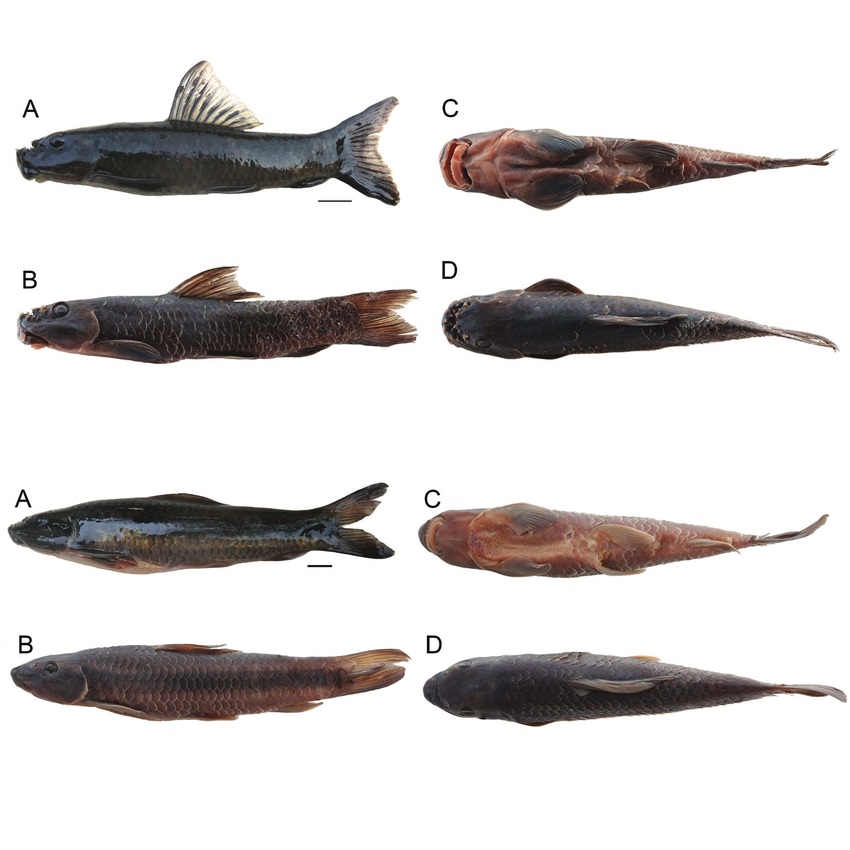
 Labeo mbimbii, n. sp. Holotype (AMNH 277862, AMCC 249232): 
A. lateral view, immediately postmortem; B. in preservation, lateral view; C. ventral view; and D. dorsal view. Scale bar = 1 cm.
 Labeo manasseeae, n. sp. Holotype (AMNH 269110, AMCC 249240):
A. immediately postmortem; B. in preservation, lateral view; C. ventral view; and D. dorsal view. Scale bar = 1 cm

Labeo mbimbii, n. sp.
Labeo manasseeae, n. sp.


Tobit L.D. Liyandja and Melanie L.J. Stiassny. 2023. Description of Two New Labeo (Labeoninae; Cyprinidae) Endemic to the Lulua River in the Democratic Republic of Congo (Kasai Ecoregion); a Hotspot of Fish Diversity in the Congo Basin. American Museum Novitates. (3999); 1-22. DOI: 10.1206/3999.1 URI: hdl.handle.net/2246/7321  

Wednesday, September 27, 2023

[Herpetology • 2023] Lygodactylus kibera, L. mirabundus, L. leopardinus, etc. • Integrative Revision of the Lygodactylus gutturalis (Bocage, 1873) (Squamata: Gekkonidae) Complex unveils extensive Cryptic Diversity and Traces its Evolutionary History


 (A–D) Lygodactylus leopardinus sp. nov. in life and habitat from type locality at Équateur Province, DRC.
(F–I) L. gamblei sp. nov. in life and photo of habitat from type locality at Tanganyika Province, DRC. 

 Lobón-Rovira, Bauer, Pinto, Trape, Conradie, Kusamba, Júlio, Cael, Stanley, Hughes, Behangana, Masudi, Pauwels & Greenbaum, 2023


Abstract
Lygodactylus is the most speciose gekkonid group in Africa, with several additional, candidate species already identified from previous studies. However, in mainland Africa, several groups remain only partially resolved, and there are several taxonomic inconsistencies. Lygodactylus gutturalis was described from Guinea-Bissau in the 1870s and since then, the species has been recorded from West to East Africa, and it is widely distributed through different biomes and ecoregions. However, this taxon has never been studied in detail. In this work, we use an integrative approach, including molecular phylogenetic analysis, morphometrics, skull osteology, and biogeography to provide the first systematic revision of the L. gutturalis species complex. The L. gutturalis complex is a subgroup within the L. picturatus group and includes nine well-differentiated species. We elevate Lygodactylus gutturalis dysmicus to full species status, recognize Lygodactylus depressus as the sister species to L. gutturalis, describe five new species (Lygodactylus kibera sp. nov., Lygodactylus karamoja sp. nov., Lygodactylus mirabundus sp. nov., Lygodactylus leopardinus sp. nov., and Lygodactylus gamblei sp. nov.), and propose an additional candidate species that requires further research. Also, in order to shed light on some taxonomic inconsistencies between the L. gutturalis and Lygodactylus angularis groups, we revisit the L. angularis group, within which we elevate Lygodactylus angularis heeneni and Lygodactylus angularis paurospilus to full species status. The L. gutturalis subgroup diversified during the Late Miocene (between 5–15 Mya), probably as a consequence of multiple vicariant events driven by the expansion of the African savannahs and the establishment of climatic refugia.

Keywords: Africa, biogeography, climatic refugia, CT-scan, Gekkonidae, Miocene, phylogeny, systematics

Geographical distribution of the Lygodactylus gutturalis complex in Africa, on a hybrid map of the major vegetation divisions (Sayre et al. 2013) and 1 arc-second elevation map across tropical Africa (NASA 2000). Different colours depict records of different species within the L. gutturalis subgroup; see inset for explanations of symbols. White circles denote records of L. cf. gutturalis that cannot be assigned to any of the nominate taxa. Black stars represent the type localities of each nominate taxon within the L. picturatus subgroup (1– L. picturatus, 1S– L. picturatus sudanensis, 1U– L. picturatus ukerewensis, 2– L. inexpectatus, 3– L. keniensis, 4– L. kimhowelli, 5– L. manni, 6– L. mombasicus, 7– L. scorteccii, 8– L. tsavoensis, 9– L. wojnowskii, 10– L. williamsi).

Specimens of L. gutturalis in life from (A–C) Guinea Bissau
Photographs by J.F.T. (A–C and F).

LYGODACTYLUS GUTTURALIS S.S. (Bocage, 1873)

LYGODACTYLUS DYSMICUS Perret, 1963

LYGODACTYLUS DEPRESSUS Schmidt, 1919

Specimens of Lygodactylus kibera sp. nov. in life or freshly euthanized from (A) Mpishi (holotype: UTEP 22566), near Kibira National Park, Bubanza Province, Burundi, (B) N'Komo River (UTEP 22586), South Kivu Province, DRC, and (C) Bujumbura city, Bujumbura Mairie Province (UTEP 22576), Burundi. Photo of habitat at (D) Mpishi, Bubanza Province, Burundi.
Photographs by E.G. (A–C) and C.K. (D).

LYGODACTYLUS KIBERA SP. NOV.

Etymology: The name ‘kibera’ derives from the word ‘kibira’ or ‘kibera’ in Kinubi—a Sudanese Arabic-based creole language spoken in some regions of Burundi, Kenya, and Uganda—that means ‘forest’, the main habitat type associated with the species.


Specimens of Lygodactylus karamoja sp. nov. in life from (A–B) Agoro Town (holotype: UTEP 22590), Imatong Foothills and (D–E) Nakapiripirit (UTEP 22594), Mount Kadam, Northern Region, Uganda. Photo of habitat at (C) Imatong Foothills, and (F) Mount Kadam, Northern Region, Uganda.
Photographs by D.F.H.

LYGODACTYLUS KARAMOJA SP. NOV.

Etymology: The name ‘karamoja’ is a noun in apposition and refers to the Karamoja region in north-eastern Uganda where many individuals of this species have been found. The species is named in honour of this arid region, which is occupied by the Karamojong people who are mostly nomadic pastoralists related to the Maasai in Kenya.


LYGODACTYLUS MIRABUNDUS SP. NOV.

Etymology: The name ‘mirabundus’ is a Latin adjective that means ‘astonishing or surprising’. The species is only known from a unique location in a transition zone between dry savannah and the Congolian Rainforest.

A–B, Holotype (UTEP 22577) and (C–D) paratype (UTEP 22596) of Lygodactylus leopardinus sp. nov. in life and photo of habitat from (E) type locality at Balolombo Village, Busira River, Équateur Province, DRC.
F–G, Holotype (UTEP 22587) and (H–I) paratype (UTEP 22584) of L. gamblei sp. nov. in life and photo of habitat from (J) type locality at Manono, Tanganyika Province, DRC. Photographs by E.G.

LYGODACTYLUS LEOPARDINUS SP. NOV.

Etymology: The name ‘leopardinus’ is an adjective referring to the leopard-like dorsal pattern present in males of this species.


LYGODACTYLUS GAMBLEI SP. NOV.

Etymology: We name this new species after the American evolutionary biologist and herpetologist Tony Gamble of Marquette University, in recognition of his substantial contributions to the evolutionary biology of geckos. The name is a patronym formed in the genitive case.


Conclusion: 
We provide a complete integrative approach for the L. gutturalis subgroup, which revealed cryptic diversity that we rectified with the description of five new taxa, the revalidation of another, and the tentative proposal of one additional candidate species, all previously considered to be conspecific. We also revisited the L. angularis group to revalidate two additional taxa. As a consequence of this work, we elevate the number of recognized Lygodactylus species from 82 to 90. Moreover, the morphological variation found within L. angularis suggests a more extensive cryptic diversification within this group that requires further investigation. Additional work in some regions of Africa, including Ethiopia, Somalia, Kenya, and Tanzania may lead to the description of additional species. Diversification events during the Late Miocene (between 5–15 Mya) are likely linked to the expansion of African savannahs and the establishment of climatic forest refugia. This suggests that the L. gutturalis group is the result of a non-adaptative radiation, a consequence of multiple vicariance events during the Miocene that fragmented and prevented genetic connectivity between morphologically and ecologically similar taxa.


Javier Lobón-Rovira, Aaron M Bauer, Pedro Vaz Pinto, Jean-Francois Trape, Werner Conradie, Chifundera Kusamba, Timóteo Júlio, Garin Cael, Edward L Stanley, Daniel F Hughes, Mathias Behangana, Franck M Masudi, Olivier S G Pauwels and Eli Greenbaum. 2023. Integrative Revision of the Lygodactylus gutturalis (Bocage, 1873) Complex unveils extensive Cryptic Diversity and Traces its Evolutionary History. Zoological Journal of the Linnean Society. zlad123. DOI: 10.1093/zoolinnean/zlad123