Showing posts with label Author: Tea. Show all posts

Saturday, September 16, 2023

[Ichthyology • 2023] Paracheilinus amanda • Review of Australian Species of Paracheilinus Fourmanoir (Teleostei: Labridae), with Description of A New Species from the Great Barrier Reef and Coral Sea


 (A1-A2) Paracheilinus amanda, new species;
(B) P. carpenteri, (C) P. flavianalis,
(D) P. mccoskeri, (E) P. rubricaudalis
in Tea & Walsh. 2023.
Photographs by H. H. Tan (A1); T. Yamazumi (A2); T. Cameron (B); V. Chalias (C); T. Kawamoto (D); and N. DeLoach (E).

Abstract
Australian species of the cirrhilabrin labrid genus Paracheilinus are reviewed. Four species of Paracheilinus are reported from Australian waters: P. amanda, new species, from Flora, Holmes, and Osprey Reefs, Coral Sea, off northeast Queensland, and Harrier Reef, Great Barrier Reef; P. filamentosus from Lizard Island, Great Barrier Reef; P. flavianalis from Evans and Flinders Shoals, Timor Sea, off northeast Darwin, Northern Territory, and Ashmore, Scott, Seringapatam, and Hibernia Reefs in the north-western shelf of Western Australia; and P. nursalim from Flinders Shoal, Timor Sea, off northern Darwin, Northern Territory. Paracheilinus amanda, new species, has previously been confused for P. rubricaudalis from Melanesia, but molecular analysis of mitochondrial COI recovers both species as reciprocally monophyletic lineages, differing from each other by 1–1.2% in genetic distance. They further differ in aspects of live coloration of terminal phase (TP) males. Both species are allopatric and do not overlap in distribution. The new species is described on the basis of six specimens: the holotype and two paratypes from Harrier Reef, Great Barrier Reef, one paratype from Flora Reef, Coral Sea, and from two paratypes collected off Hula in southern Papua New Guinea, along the north-western margin of the Coral Sea. The discovery of P. nursalim in Australia represents a new and significant range extension from previous locality records of West Papua and Ambon Bay. Paracheilinus is rediagnosed, and keys, diagnoses, photographs, and Australian distribution records are presented for all species herein. 


Paracheilinus amanda, new species, aquarium specimen from Harrier Reef, the Great Barrier Reef. Specimen not retained. Photograph by K. Endoh.

A selection of Paracheilinus in life.
 (A1) Paracheilinus amanda, new species, ZRC 64175, male paratype, 47.6 mm SL, off Hula, southern Papua New Guinea, Coral Sea; (A2) P. amanda, new species, underwater photograph from Osprey Reef, Coral Sea;
(B) P. carpenteri, underwater photograph from Mabini, Batangas, Philippines. Note the darkened posterior dorsal- and caudal-fin bases and the presence of a second stripe behind the pectoral fin; (C) P. flavianalis, underwater photograph from Bali, Indonesia;
(D) P. mccoskeri, underwater photograph from Khao Lak, Thailand; (E) P. rubricaudalis, underwater photograph from Mborokua, Solomon Islands. Note the reduced markings on caudal fin.
Photographs by H. H. Tan (A1); T. Yamazumi (A2); T. Cameron (B); V. Chalias (C); T. Kawamoto (D); and N. DeLoach (E).


Paracheilinus filamentosus, images of live and preserved specimens.
(A) Male in resting colors, underwater photograph from Guadalcanal, Solomon Islands; (B) flashing male in nuptial colors, underwater photograph from Nggatokae, western Solomon Islands; (C) flashing male in nuptial colors, underwater photograph from the Solomon Islands; (D) AMS I.17479-001, 51.7 mm SL, male paratype, Tassafaronga Point, Guadalcanal, Solomon Islands. Note purple spines and rays in preservation; (E) harem comprising one TP male (middle) and several females and immature males, underwater photograph from Lovukol, central Solomon Islands.
Photographs by M. Rosenstein (A–C, E) and Y. K. Tea (D).

Select individuals of Paracheilinus flavianalis demonstrating variability in the number of dorsal-fin filaments, coloration of anal fin, and spot band pattern on the anal fin.
(A) Underwater photograph from Triton Bay, Indonesia; (B) underwater photograph from Wakatobi, Sulawesi, Indonesia; (C–D) underwater photographs from Bali, Indonesia.
Photographs by R. Smith (A); J. Castellano (B); W. Osborn (C); and R. H. Kuiter (D).


Yi-Kai Tea and Fenton Walsh. 2023. Review of Australian Species of Paracheilinus Fourmanoir (Teleostei: Labridae), with Description of A New Species from the Great Barrier Reef and Coral Sea. Ichthyology & Herpetology. 111(3); 397-415. DOI: 10.1643/i2023019 


Wednesday, March 9, 2022

[Ichthyology • 2022] Cirrhilabrus finifenmaa • A New Species of Fairy Wrasse (Teleostei: Labridae) from the Maldives, with Comments on the Taxonomic Identity of C. rubrisquamis and C. wakanda


Cirrhilabrus finifenmaa
Tea, Najeeb,  Rowlett & Rocha, 2022


Abstract
Cirrhilabrus rubrisquamis is redescribed on the basis of the juvenile holotype and compared to known species of Cirrhilabrus. Examination of material from the Maldives identified as C. rubrisquamis reveal differences from the holotype collected from the Chagos Archipelago. Consequently, the Maldivian specimens are herein described as Cirrhilabrus finifenmaa sp. nov., on the basis of the holotype and twelve paratypes. The new species differs from all congeners in having: males with anterior third to half of body bright magenta, peach to orange-pink posteriorly; lateral line with 22–26 pored scales (16–18 in the dorso-anterior series, 6–8 in the posterior peduncular series); tenth to eleventh dorsal-fin spine longest (14.0–15.5% SL); scales on the opercle, chest, isthmus, and anterior third of the body with a dark purple-red central region (purple in alcohol), the markings joining appearing crosshatched; dorsal, caudal, anal, and pelvic-fin rays purple in alcohol. Meristic details and coloration patterns of C. rubrisquamis are very similar to C. wakanda from Tanzania, Africa, although synonymy of both species cannot be determined without additional material from Chagos. This potential synonymy is briefly discussed; however, until such material becomes available, the taxonomic statuses of C. wakanda and C. rubrisquamis are here provisionally regarded as valid.

Keywords: Coral reefs, deep reefs, Indian Ocean, mesophotic, reef fish


Cirrhilabrus finifenmaa sp. nov., underwater photograph from Rasdhoo Atoll, Maldives.
 Photograph by Luiz A. Rocha.


Cirrhilabrus finifenmaa, sp. nov., not to scale
 A male holotype, BPBM 33094, 69.2 mm SL, Vilingili Island, North Malé Atoll, Maldives B1, B2 male paratype, AMS I.50058-001, 69.1 mm SL, Hulhumalé Island, North Malé Atoll, Maldives, in life and in preservation respectively
C young male paratype, BPBM 41385 (formerly BPBM 33094), 57.6 mm SL, same data as holotype D1, D2 young male paratype, AMS I.50058-001, 59.7 mm SL, Hulhumalé Island, North Malé Atoll, Maldives, in life and in preservation respectively
E juvenile paratype, BPBM 41385 (formerly BPBM 33094), 35.8 mm SL, same data as holotype F1, F2 female paratype, AMS I.50058-001, 54.0 mm SL, Hulhumalé Island, North Malé Atoll, Maldives, in life and in preservation respectively
G male paratype in life, ZRC 62259, 76.7 mm SL, aquarium specimen from Maldives H male in nuptial colors, aquarium specimen from Maldives, specimen not retained.
 Photographs by the late J.E. Randall (A, C, E), AN (B1–B2, D1–D2, F1–F2), and  Yi-Kai Tea (G, H).

 Cirrhilabrus finifenmaa sp. nov.

Diagnosis: A species of Cirrhilabrus distinguished from congeners based on the following combination of characters: males with anterior third to half of body bright magenta, peach to orange-pink posteriorly; lateral line with 22–26 pored scales (16–18 in the dorso-anterior series, 6–8 in the posterior peduncular series); tenth to eleventh dorsal-fin spine longest (14.0–15.5% SL); scales on the opercle, chest, isthmus, and anterior third of the body with a dark purple-red central region, the markings joining to form a crosshatched appearance (purple in alcohol); dorsal, caudal, anal, and pelvic-fin rays purple in alcohol.

Etymology: The epithet is from the Dhivehi "finifenmaa", meaning rose, alluding to the live coloration of this species. The pink rose fiyatoshi finifenmaa (Rosa spp.) is also the national flower of the Maldives. To be treated as a noun in apposition. The common name is given after the facial patterns of the species.

Habitat and distribution: Cirrhilabrus finifenmaa is presently known from Maldives and Sri Lanka, at depths ranging from 40–70 m (Fig. 4). The species belongs to the C. jordani species complex, a group of deep-water fairy wrasses found mostly in mesophotic coral ecosystems. It is likely that this species occurs in greater depths. Like other species of Cirrhilabrus, C. finifenmaa frequents rubble bottoms scattered with loose coral cover.


Underwater photographs of Cirrhilabrus from the Western Indian Ocean
 A harem of putative Cirrhilabrus rubrisquamis. Male depicted in circular inset, females by white arrowheads B putative female C. rubrisquamis C putative terminal male C. rubrisquamis; Photographs taken from video footage provided by K Howell, N Foster, and C Diaz from the University of Plymouth Research Expedition to Egmont Atoll and Sandes Seamount in the Chagos Archipelago, 60–70 m
 D female C. wakanda, underwater photograph from Zanzibar, Tanzania, Africa, 75 m E male C. wakanda, underwater photograph from Zanzibar, Tanzania, Africa, 75 m F terminal male C. wakanda, underwater photograph from Moyette, off the coast of Mozambique, 100 m. Note fuchsia dorsal fin in all individuals and pale yellowish saddle in males.
 Photographs by Luiz A. Rocha (D, E) and P Plantard (F).


 Yi-Kai Tea, Ahmed Najeeb, Joseph Rowlett and Luiz A. Rocha. 2022. Cirrhilabrus finifenmaa (Teleostei, Labridae), A New Species of Fairy Wrasse from the Maldives, with Comments on the Taxonomic Identity of C. rubrisquamis and C. wakanda. ZooKeys 1088: 65-80. DOI: 10.3897/zookeys.1088.78139

Stunning new-to-science fairy wrasse is first-ever fish described by a Maldivian scientist
Named after the country’s national flower, the species is added to the tree of life as part of Academy’s global Hope for Reefs initiative

Tuesday, November 9, 2021

[Ichthyology • 2021] Cirrhilabrus apterygia • Redescription of Conniella apterygia Allen and Its Reassignment in the Genus Cirrhilabrus Temminck & Schlegel (Teleostei: Labridae), with Comments on Cirrhilabrin Pelvic Morphology


Cirrhilabrus apterygia (Allen, 1983)

in Tea, Allen, ... et Frable, 2021. 
 
Abstract
Conniella apterygia is redescribed from re-examination of the holotype, two paratypes, and six additional specimens. The genus is closely allied to Cirrhilabrus, sharing similarities in general morphological and meristic details, but is separated from Cirrhilabrus and most other labrid fishes in lacking pelvic fins and a pelvic girdle. Recent molecular phylogenetic studies have provided strong evidence for the deep nesting of Conniella within Cirrhilabrus, contradicting its generic validity and suggesting that the loss of pelvic elements is autapomorphic. Consequently, the species is redescribed and assigned to the genus Cirrhilabrus, as Cirrhilabrus apterygia new combination. The pelvic morphologies of related cirrhilabrin labrids are discussed, and a new synapomorphy is identified for Paracheilinus.

Key words: coral-reef fishes; taxonomy; ichthyology; apomorphy; fairy wrasse; morphology


Cirrhilabrus apterygia, underwater photograph from Rowley Shoals, Western Australia.
 (A–C) Males and females in loose groups; (D) juvenile, approximately 35 mm total length.
 Note mixed aggregations of Pseudanthias engelhardi and Chrysiptera caeruleolineata in (A). Note individual showing ventral stripes from isthmus to anal-fin origin in (B).
 Photographs by R.H. Kuiter (A, B, D) and G.R. Allen (C).

Cirrhilabrus apterygia (Allen, 1983), new combination 
Connie’s Wrasse
Other names: Mutant Wrasse; Rowley Shoals Wrasse

Diagnosis. A species of Cirrhilabrus distinguished from all other congeners based on the following combination of colouration and morphological characters: absence of pelvic fins and pelvic girdle; lateral line with 21–26 pored scales (16–17 in the dorsoanterior series, 5–9 in the posterior peduncular series); caudal fin rhomboidal to lanceolate in males; both sexes with eight to ten stripes, purple in life and in preservation; preopercle purple in preservation.

Etymology. Allen (1983) named the species apterygia, meaning “without fins,” in reference to the distinctive  lack of pelvic fins and associated elements. To be treated as a noun in apposition. We retain the use of Connie’s Wrasse as the preferred common name, after Connie Lagos Allen, wife of the second author, for whom the junior synonym Conniella was named. The species is also commonly referred to as the mutant wrasse, alluding to its atypical pelvic morphology, as well as the eponymous Rowley Shoals Wrasse, after its type locality.


A selection of cirrhilabrin labrids with horizontal striped patterns.
 (A) Cirrhilabrus apterygia, underwater photograph from Rowley Shoals; (B) Cirrhilabrus earlei, underwater photograph from Koror, Palau;
(C) Cirrhilabrus marjorie, underwater photograph from Vanua Levu, Fiji; (D) Pseudocheilinus octotaenia, underwater photograph from Levuka, Fiji.
Photographs by R.H. Kuiter (A); K. Nishiyama (B); and M. Rosenstein (C–D).


 Yi-Kai Tea, Gerald R. Allen, Christopher H. R. Goatley, Anthony C. Gill and Benjamin W. Frable. 2021. Redescription of Conniella apterygia Allen and Its Reassignment in the Genus Cirrhilabrus Temminck and Schlegel (Teleostei: Labridae), with Comments on Cirrhilabrin Pelvic Morphology. Zootaxa. 5061(3);493-509. DOI: 10.11646/zootaxa.5061.3.5


Wednesday, August 18, 2021

[Ichthyology • 2021] Cirrhilabrus aquamarinus & C. chaliasi • Redescription of Cirrhilabrus solorensis Bleeker, with Description of Two New Species of Fairy Wrasses (Teleostei: Labridae: Cirrhilabrus)


Cirrhilabrus aquamarinus
Tea, Allen & Dailami, 2021

 
Abstract
The labrid fish Cirrhilabrus solorensis was first described in 1853 by Bleeker, based on specimens collected from the Indonesian island of Solor, off the eastern tip of Flores in the Lesser Sunda Islands. Although sufficient at the time, Bleeker's description of the species was brief, resulting in subsequent taxonomic confusion concerning the true identity of this taxon. Presently, the name has been applied to several fishes with notable differences in coloration, particularly in the terminal males. On the basis of additional non-type material and photographic examination of Bleeker's holotype, we redescribe Cirrhilabrus solorensis and resolve the long-standing contention regarding its taxonomic identity. In doing so, we describe two species as newCirrhilabrus aquamarinus, new species, on the basis of the holotype and eight paratypes from Sulawesi and the surrounding islands of Banggai and Wakatobi, Indonesia, and Cirrhilabrus chaliasi, new species, described on the basis of the holotype and nine paratypes from Bali, Indonesia. These three species are closely related and, together with C. aurantidorsalis, C. cyanopleura, C. luteovittatus, C. randalli, and C. ryukyuensis, form a complex of species that differ from congeners in having the following combination of characters: caudal fin in males weakly rhomboidal; median fins hyaline with sinuous filigree in both sexes; body with scales edged in inky blue to indigo, their margins often patterned in an argyle motif; and osseus elements that preserve blue to blue-green in alcohol. We briefly discuss the phylogenetic relationships of species in this complex based on results of a companion study detailed elsewhere.


Cirrhilabrus solorensis, freshly euthanized and wild individuals showing coloration in life.
 (A) BPBM 30166, 71 mm SL, male, Gili Ayer, Lombok, Indonesia; 
(B) BPBM 32146, 75 mm SL, male, Maumere Bay, Flores, Indonesia; (
C) BPBM, 18612, 56 mm SL, male, Ambon Bay, Indonesia;
(D) a large harem of C. solorensis comprising both sexes, underwater photograph from Flores, Indonesia. Note extensive hard coral cover; 
(E) Cirrhilabrus solorensis, male, underwater photograph from Flores, Indonesia. 
Photographs by J. E. Randall (A–C) and R. Whitton (D, E).


Cirrhilabrus solorensis Bleeker, 1853 
Solor Fairy Wrasse

Etymology.—Named after the type location of the species, Lawajong, Solor Island, Indonesia.

A selection of freshly euthanized and preserved species of Cirrhilabrus.
Cirrhilabrus solorensis(A–B) NTM S.17835-002, 93.0 mm SL, male, Franklin Shoal Timor Sea; 
(C) RMNH.PISC.6547 (holotype), 87.5 mm SL, male, Solor Island, Indonesia;

Cirrhilabrus aquamarinus, new species, (D) AMS I.49509-001, 55.0 mm SL, male, Kendari, Sulawesi;
(E) MZB 26051 (formerly WAM P.34500-001), 77.4 mm SL, male, Lintea Selatan Channel, Wakatobi Group, Banda Sea, Indonesia;
(F) WAM P.34500-001, 73.8 mm SL, male, Lintea Selatan Channel, Wakatobi Group, Banda Sea, Indonesia;

Cirrhilabrus chaliasi, new species, (G–H) MZB 26052 (holotype), 60.1 mm SL, male, Bali, Indonesia; 
(I) WAM P.35201-001, 65.1 mm SL, male, Bali, Indonesia. 

Photographs by M. Hammer (A–B), E. Dondorp (C), Y. K. Tea (D), G. R. Allen (E–F), H. H. Tan (G), and Y. K. Tea (H–I).
 
A selection of species of Cirrhilabrus in life.
(A) Cirrhilabrus solorensis, male, underwater photograph from Rinca, Indonesia;
(B) Cirrhilabrus solorensis, male, underwater photograph from Pura, Indonesia;
(C) Cirrhilabrus solorensis, underwater photograph from Nusa Tenggara, Indonesia. Note Pseudanthias tuka and live hard coral cover;
 (D) Cirrhilabrus aquamarinus, new species, transitioning male, underwater photograph from Wakatobi, Sulawesi, Indonesia;
(E) Cirrhilabrus aquamarinus, new species, terminal male, aquarium specimen from Kendari, Sulawesi, Indonesia;
(F) Cirrhilabrus aquamarinus, new species, males and females, underwater photograph from Kendari, Sulawesi;
(G) Cirrhilabrus chaliasi, new species, young male, underwater photograph from Bali, Indonesia; 
(H–I) Cirrhilabrus chaliasi, new species, terminal males and females, underwater photograph from Bali, Indonesia. 

Photographs by F. Libert (A–B), S. Penisson (C), G. R. Allen (D), K. Kohen (E), V. Chalias (F), J. Heard (G), H. Chan (H), and V. Chalias (I).

Distribution records for species of the Cirrhilabrus cyanopleura complex.
Dashed line represents the Coral Triangle. Shaded regions (open circles) represent general distributional ranges. Closed circles represent locality records.
Photographs of C. ryukyuensis by S. Harazaki; C. aff. ryukyuensis by G. R. Allen; all others by Y. K. Tea.


Cirrhilabrus aquamarinus, new species
Chin-strap Fairy Wrasse

Habitat and distribution.— Cirrhilabrus aquamarinus occurs primarily in eastern Sulawesi and the surrounding islands of Banggai and Wakatobi. Rare individuals have also been reported from Banda Neira. The species frequents shallow exposed rubble at depths between 5–20 m (Fig. 5F). 

Etymology.— The specific epithet is given after the brilliant teal to aquamarine males, an unusual color shared with no other species of Cirrhilabrus. The common name alludes to the chin-strapped appearance formed by the intensely pigmented opercular scales of the males.


Cirrhilabrus chaliasi, new species
Ruby-headed Fairy Wrasse 

Habitat and distribution.— Cirrhilabrus chaliasi is known from Bali, Sumbawa, Lombok, Flores, Komodo, and Rinca. It is also reported from Wakatobi, Sulawesi, where it overlaps with C. aquamarinus, though this appears to be a rare distribution record. It frequents the same habitat as other species in its complex, consisting of rubble zones with sporadic coral cover at depths between 8–20 m. 

Etymology.—The specific epithet is given in honour of Vincent Chalias, a skilled underwater photographer, field biologist, and proponent of coral and fish aquaculture in Bali. He greatly assisted in the description of the new species through his excellent underwater photographs and detailed field observations. 


Yi-Kai Tea, Gerald R. Allen and Muhammad Dailami. 2021. Redescription of Cirrhilabrus solorensis Bleeker, with Description of Two New Species of Fairy Wrasses (Teleostei: Labridae: Cirrhilabrus). Ichthyology & Herpetology. 109(3); 669-684. DOI: 10.1643/i2021022


Monday, July 6, 2020

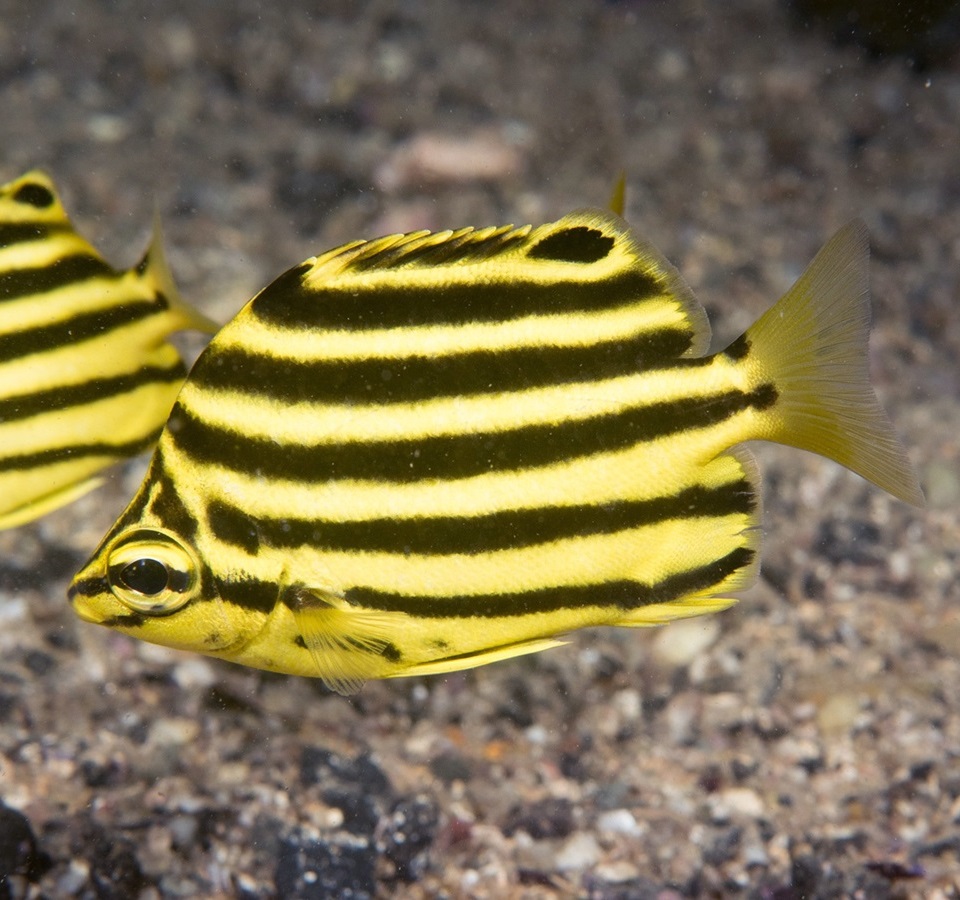
[Ichthyology • 2020] Systematic Reappraisal of the Anti-equatorial Fish Genus Microcanthus Swainson (Teleostei: Microcanthidae), with Redescription and Resurrection of Microcanthus joyceae Whitley


Microcanthus joyceae Whitley, 1931

in Tea & Gill, 2020

Abstract
The taxonomy and classification of the microcanthid fish genus Microcanthus Swainson has been a subject of contention dating back to the 19th century. Its allopatric, disjunct anti-equatorial distribution across the Indo-West Pacific has resulted in the recognition of several nominal taxa, though these have been widely regarded as synonyms of Microcanthus strigatus (Cuvier). Following the results published in a companion study elsewhere by the authors, the taxonomy of Microcanthus and the validity of these nominal synonyms are herewith revised. Microcanthus strigatus is redescribed on the basis of 66 specimens from East Asia, Hawaii and Western Australia, and M. joyceae is resurrected and redescribed on the basis of 25 specimens from eastern Australia and the southwest Pacific. Microcanthus differs from other microcanthid genera in having the following combination of characters: dorsal-fin rays XI,15–17 (usually XI,16); anal-fin rays III,13–15 (usually III,14); pectoral-fin rays 15–17 (usually 16); scales ctenoid with ctenial bases present; lateral-line scales partially or heavily obscured by adjacent scales; and body pale in preservation with five horizontal dark stripes reaching the posterior edges of dorsal and anal fins, and base of caudal fin. The review is accompanied by a key to the genera of Microcanthidae.

Keywords: Pisces, taxonomy, ichthyology, cryptic species, anti-tropical, stripey


FIGURE 2. Genera of Microcanthidae. Tilodon and Neatypus are monotypic.
A) Tilodon sexfasciatusin situ photograph from Blairgowrie, Victoria, Australia; B) Neatypus obliquusin situ photograph from Bunbury, Western Australia;
C) Microcanthus joyceaein situ photograph from Magic Point, Maroubra, New South Wales, Australia; and D) Atypichthys strigatusin situ photograph from Henry Head, Botany Bay, New South Wales, Australia.
Photographs by S. Schulz (A), C. Mark (B), and E. Schlogl (C & D).

Microcanthus Swainson

Etymology. The generic epithet Microcanthus is a combination of the Greek “mikros” for small, and “akantha” for thorn, alluding to the minute crenulations on the preopercle (Swainson 1839). 


Microcanthus strigatus (Cuvier in Cuvier & Valenciennes 1831)

Etymology. The specific epithet strigatus is the Latin for strigate, in having transverse bands or streaks of colour. 


FIGURE 9. Microcanthus joyceae, in situ photograph from Shelly Beach, Manly, New South Wales, Australia. Note the anal-fin stripe without a downward inflection, and the lack of spots on the lower abdomen. Photograph by E. Schlogl.

Microcanthus joyceae Whitley (1931) 

Etymology. The species is named after Joyce K. Allan, who provided Whitley with illustrations of this species for his original description. To be treated as a noun in the genitive case. While Whitley did not provide a common name in his description, he alluded to its vernacular name, the “Stripey,” commonly used by locals in New South Wales, Australia. Since the use of this name is pervasive throughout the region, we choose to retain it in part as the common name, proposing the usage of “East-Australian Stripey” instead to distinguish M. joyceae from M. strigatus.


  Yi-Kai Tea and Anthony C. Gill. 2020. Systematic Reappraisal of the Anti-equatorial Fish Genus Microcanthus Swainson (Teleostei: Microcanthidae), with Redescription and Resurrection of Microcanthus joyceae Whitley. Zootaxa. 4802(1); 41–60. DOI: 10.11646/zootaxa.4802.1.3

Saturday, February 29, 2020

[Ichthyology • 2020] Cirrhilabrus briangreenei • A New Species of Fairy Wrasse (Teleostei: Labridae: Cirrhilabrus) from Mesophotic Coral Ecosystems of the Verde Island Passage, Philippines


Cirrhilabrus briangreenei
 Tea, Pyle & Rocha, 2020


Abstract
The new species, Cirrhilabrus briangreenei, is described on the basis of the holotype and six paratypes collected from mesophotic coral ecosystems of the Verde Island Passage, Philippines, between depths of 82 and 110 m. The new species is most closely related to Cirrhilabrus pylei, but it differs primarily in the presence of: more pored scales on the posterior lateral line (7–9 vs. 5–6); a lower number of circumpeduncular scales (14 vs. 16); a lower number of gill rakers (16–17 vs. 18–20); and differences in coloration details of the dorsal and caudal fins. Both species differ from all other congeners in sharing the following combination of characters: pelvic fins very long (56.5–70.0% SL), often extending past anal-fin terminus in males; caudal fin scintillating and iridescent in males; dorsal fin with sinuous scribbling in both sexes; anterior dorsal fin with a metallic blue spot on first one to two interspinous membrane spaces; snout with three parallel stripes from maxilla to anterior edge of orbit; and rest of head with a network of short broken pinstripes in both sexes. These characters are also distributed in part amongst other species of Cirrhilabrus, in particular, C. katoi, C. lineatus, C. rhomboidalis, and C. rubrimarginatus, and their putative relationships are discussed on the basis of meristic, morphometric, and molecular sequence data. We briefly comment on the variability of morphological characters within Cirrhilabrus and their implications towards phylogenetic classification, with remarks on methods for data collection for species of Cirrhilabrus.

Cirrhilabrus briangreenei, new species, aquarium photographs of specimens from Verde Island, Philippines

Cirrhilabrus briangreenei, new species, and Cirrhilabrus pylei in life.
(A, B) Cirrhilabrus briangreenei, new species, aquarium photographs of specimens from Verde Island, Philippines;
(C, D) Cirrhilabrus pylei, aquarium photographs of specimens from Vanuatu. Note the series of parallel stripes on the snout. Specimens not retained.
Photographs by S. K. Tea (A), E. Fleishauer (B), F. Walsh (C), and K. Kohen (D).

A selection of species of Cirrhilabrus in life.
(A) Cirrhilabrus briangreenei, new species, aquarium specimen in nuptial display from Verde Island, Philippines; (B) Cirrhilabrus katoi, aquarium specimen at rest from Cagayan, northern Philippines; (C) Cirrhilabrus pylei, aquarium specimen in nuptial display from Vanuatu; (D) Cirrhilabrus rubrimarginatus, aquarium specimen in nuptial display from Fiji; (E) Cirrhilabrus rhomboidalis, aquarium specimen at rest from the Marshall Islands; (F) Cirrhilabrus lineatus, aquarium specimen at rest from the Coral Sea, Australia. Specimens not retained. Note the similarities in snout and head patterns in these species, and the dorsal- and anal-fin markings for C. rubrimarginatus, C. rhomboidalis, and C. lineatus.
Photographs by H. Tanaka (A), Ameblo, Japan (C), and Y. K. Tea (B, D, E, F).

Freshly euthanized paratypes of Cirrhilabrus briangreenei, new species. 
(A) BPBM 41374 (formerly CAS 238392), 65.7 mm SL, male; (B) CAS 238392, 59.8 mm SL, female; (C) AMS I. 49028-001 (formerly CAS 238389), 58.2 mm SL, male; (D) CAS 238389, 49.6 mm SL, female. Specimens from 95 m, Maricaban Island, Philippines.
Photographs by L. A. Rocha.

Cirrhilabrus briangreenei, new species 
Latigo Fairy Wrasse

Etymology.— We name this species Cirrhilabrus briangreenei in honor of Brian D. Greene, who in addition to collecting the type specimens, has contributed extensively towards the study and exploration of coral-reef diversity (particularly on MCEs) through deep technical diving. To be treated as a noun in apposition. The common name ‘‘latigo’’ is Tagalog for ‘‘whip,’’ given in reference to the long, slender pelvic fins.


Yi-Kai Tea, Richard L. Pyle and Luiz A. Rocha. 2020. A New Species of Fairy Wrasse (Teleostei: Labridae: Cirrhilabrus) from Mesophotic Coral Ecosystems of the Verde Island Passage, Philippines. Copeia. 108(1); 91-102.  DOI: 10.1643/CI-19-297

Friday, July 12, 2019

[Ichthyology • 2019] Cirrhilabrus wakanda • A New Species of Fairy Wrasse (Teleostei, Labridae) from Mesophotic Ecosystems of Zanzibar, Tanzania, Africa


Cirrhilabrus wakanda 
 Tea, Pinheiro, Shepherd & Rocha, 2019


Abstract
Cirrhilabrus wakanda sp. nov. is described on the basis of the holotype and four paratypes collected between 50 and 80m depth over low-complexity reef and rubble bottoms at the east coast of Zanzibar, Tanzania, Africa. The new species belongs to a group of fairy wrasses from the western Indian Ocean, sharing a combination of characters that include: short pelvic fins (not or barely reaching anal-fin origin); relatively unmarked dorsal and anal fins; males with a strongly lanceolate caudal fin (except in C. rubrisquamis); both sexes with a pair of prominent facial stripes above and below the orbit; and both sexes with prominent purple scales and osseus elements that persist, and stain purple, respectively, even in preservation. This group of fairy wrasse is part of a larger complex that includes related species from the western Pacific Ocean. In addition to meristic and morphometric comparisons, we also compare mitochondrial DNA sequence data to the aforementioned, putatively related species.

Keywords: Coral reefs, deep reefs, Indian Ocean, rebreather diving, reef fish

Figure 1. Cirrhilabrus wakanda sp. nov., freshly euthanized male holotype (CAS 246395), 70.3 mm SL, male, collected at a depth of 75 m, east coast of Zanzibar, Africa (above). Note the pair of facial stripes above and below orbit. Photograph by H.T. Pinheiro and B. Shepherd. 

Figure 2. Paratypes of Cirrhilabrus wakanda sp. nov., not to scale
A1 CAS 246397, 61.3 mm SL, male, freshly euthanized A2 CAS 246397, male in preservation B1 CAS 246398, 57.38 mm SL, female, freshly euthanized B2 CAS 246398, female in preservation C1 CAS 246399, 54.32 mm SL, female, freshly euthanized C2 CAS 246399, female in preservation.
 Photographs by H.T. Pinheiro and B. Shepherd (A1, B1, C1), and J. Fong (A2, B2, C2).

Cirrhilabrus wakanda sp. nov.
 Vibranium fairy wrasse  

Diagnosis: Cirrhilabrus wakanda shares similar meristic characters to other members of this genus. However, it is readily distinguished from all other Cirrhilabrus in having the following combination of colouration and morphological characters: caudal fin strongly lanceolate in males; both sexes with a series of purple scales (in life and in preservation) arranged in a chain-link pattern across dorsal two-thirds of body.

Figure 4. Cirrhilabrus wakanda sp. nov., in situ photographs at 75 m depth, in the east coast of Zanzibar, Tanzania, Africa. Specimens not retained. Note intensity of yellow on the heads of males (A), transitioning males (B), and females (C). Photographs by L.A. Rocha. 


Etymology: The specific epithet refers to the fictional East African nation of Wakanda, home of the superhero Black Panther, as is the case for the new species, which has remained hidden from the world for a long time. To be treated as a noun in apposition. The common name refers to the fictional metal vibranium, a rare substance found on Wakanda that is woven into Black Panther’s suit. The purple chain-link scale pattern of the new species is reminiscent of this detail.

Distribution and habitat: Cirrhilabrus wakanda is presently known only from the east coast of Zanzibar, Tanzania. The species inhabits deep shelves consisting of small patch reefs dominated by rhodolith and sponge beds, at depths between 50 and 80 m.

Figure 5. A selection of Cirrhilabrus species from the western Indian Ocean group of the Cirrhilabrus jordani complex
Cirrhilabrus wakanda sp. nov., in situ photograph from the east coast of Zanzibar, Africa B Cirrhilabrus blatteus, in situ photograph from the Red Sea, off the coast of Eilat; C: Cirrhilabrus sanguineus, aquarium photograph of a specimen from Mauritius D Cirrhilabrus rubrisquamis, aquarium photograph of a specimen from the Maldives.
Photographs by L.A. Rocha (A); E. Brokovich (B), and Y.K. Tea (C, D).


 Yi-Kai Tea, Hudson T. Pinheiro, Bart Shepherd and Luiz A. Rocha. 2019. Cirrhilabrus wakanda, A New Species of Fairy Wrasse from Mesophotic Ecosystems of Zanzibar, Tanzania, Africa (Teleostei, Labridae).  ZooKeys. 863: 85-96. DOI: 10.3897/zookeys.863.35580