Showing posts with label Temnospondyli. Show all posts

Wednesday, March 5, 2025

[Paleontology • 2025] The Ecology and Geography of Temnospondyl Recovery after the Permian–Triassic Mass Extinction


 Temnospondyls of the Triassic.

in Mehmood, Singh, Elsler et Benton, 2025. 
artwork by Mark P. Witton  

Abstract
One of the mysteries of the Permian–Triassic mass extinction was the subsequent success of temnospondyls. Temnospondyls were key early tetrapods in the Carboniferous and Permian and hardly seem to be ideal pioneers in a tough post-extinction world. Did they survive because of some unusual adaptations or by occupying some limited part of the world? We explore temnospondyl success in the Triassic by comparing their functional ecomorphology and palaeogeographic distributions. We find that Early Triassic temnospondyls exhibited all skull sizes and shapes, reflecting a wide diversity of feeding modes: abundant parabolic-snouted forms, and less common longirostrine (long-snouted) and insectivorous (short-skulled) forms. In fact, morphospace occupation by temnospondyls increased dramatically from Late Permian to Early Triassic, and then decreased in the Middle Triassic, but without emphasis on one feeding mode or another. Nor is there any evidence for unusual patterns of evolution: Temnospondyli and subclade Trematosauria follow an Ornstein–Uhlenbeck evolutionary model, suggesting evolution towards a common skull shape. Metoposauroidea, Brachyopoidea and basal Stereospondyli evolved by the stasis model. Further, these Early Triassic temnospondyls did not occupy a limited part of the world; they show temperate distributions, but with some specimens in equatorial regions, contradicting the idea of a permanently impermeable tropical dead zone.

Keywords: geometric morphometrics, ecological function, temnspondyli, Triassic, Permian–Triassic mass extinction

 Temnospondyls of the Triassic.
(a) simplified phylogeny of the temnospondyl clades investigated here, with two paraphyletic assemblages, ’basal temnos’ and basal ’stereos’. Amphibamiformes are a clade within Dissorophoidea, comprising Micropholidae and Lissamphibia. Branches stemming from coloured nodes depict subclades of this node.
(b) three functional groupings based on skull morphology: large parabolic skulls characteristic of generalists such as extant crocodilians; generalist insectivore with short and wide skulls as in modern frogs; and longirostrine, adapted for fast, weak bites usually in fish eating, as in modern gharials.
Abbreviations: Stereo., Sterospondyli; Temno., Temnospondyli.
Silhouette images from Phylopic (https://www.phylopic.org: Dmitry Bogdanov (Metoposaurus, Lydekkerina, Batrachosuchus, Pelorocephalus, Trematosaurus) all CC0 3.0; Steven Traver (Dendrobates) CC0 1.0). Nix Draws Stuff/Nix illustration (Eryops) CC0 4.0. Silhouette images from Wikimedia Commons (https://commons.wikimedia.org: Smokeybjb (Eolydekkerina magna, Deltasaurus kimberleyensis); Nobu Tamura (Gerrothorax BW and Wetlugasaurus BW) all CC0 3.0). Vector graphics: Mike Prince (Gharial) CC0 2.0; Momotarou, 2012 (Andrias japonicus) CC0 3.0; CDC (African Dwarf Frog) Public Domain. Skull Graphics vectorized by AM; Aphaneramma [Fortuny, et al. 2018]; Cyclotosaurus [Schoch & Milner, 2014] and Triadobatrachus [Ascarrunz, et al. 2016].


  Mastodonsaurus vs. Jaxtasuchus

artwork by Mark P. Witton  


Aamir Mehmood, Suresh A. Singh, Armin Elsler and Michael J. Benton. 2025. The Ecology and Geography of Temnospondyl Recovery after the Permian–Triassic Mass Extinction. R. Soc. Open Sci. 12: 241200. DOI: doi.org/10.1098/rsos.241200 [05 March 2025]

Amphibians bounce-back from Earth’s greatest mass extinction

Ancient frog relatives survived the aftermath of the largest mass extinction of species by feeding on freshwater prey that evaded terrestrial predators, University of Bristol academics have found.
In the study, published today in the journal Royal Society Open Science, their findings suggest the amphibians’ success lay in their generalist feeding ecology, enabling them to feed on a wide variety of prey despite the array of environmental changes happening all around them through the Triassic.
...

Thursday, January 25, 2024

[Paleontology • 2024] Kwatisuchus rosai • Interrelationships Among early Triassic Faunas of Western Gondwana and Laurasia as illuminated by A New South American benthosuchid temnospondyl (Temnospondyli: Stereospondyli: Benthosuchidae)


 Kwatisuchus rosai
 Pinheiro, Eltink, Paes-Neto, Machado, Simões & Pierce, 2024

artwork: Márcio L. Castro

Abstract
The End-Permian Mass Extinction marked a critical turning point in Earth's history, and the biological recovery that followed the crisis led to the emergence of several modern vertebrate and invertebrate taxa. Even considering the importance of the Early Triassic biotic recovery for the evolution of modern faunas and floras, our knowledge of this event is still hindered by the sparse sampling of crucial geological formations. This leaves our understanding of Early Triassic ecosystems fundamentally biased toward productive and historically well-explored geological units. Recent surveys in poorly known Gondwanan localities, such as those within the Sanga do Cabral Formation in southern Brazil, have unveiled insights into Early Triassic terrestrial ecosystems, shedding light on a diverse and previously unknown tetrapod fauna. Here, we report the discovery of a new temnospondyl genus and species in the Lower Triassic Sanga do Cabral Formation. The new taxon can be confidently assigned to the Benthosuchidae, a stereospondyl clade with a distribution previously restricted to the East European Platform. Phylogenetic analysis confirms the relationship of the new genus to the trematosaurian lineage, being closely related to the genus Benthosuchus. Our results raise questions about the biogeographical history of stereospondyls after the End-Permian Mass Extinction and suggest a potential connection between Russian and South American Early Triassic faunas. Further investigations are needed to thoroughly explore the potential dispersal routes that may explain this seemingly unusual biogeographical pattern.

Keywords: biogeography, Lower Triassic, Sanga do Cabral Formation, Stereospondyli


 Kwatisuchus rosai


Felipe L. Pinheiro, Estevan Eltink, Voltaire D. Paes-Neto, Arielli F. Machado, Tiago R. Simões and Stephanie E. Pierce. 2024. Interrelationships Among early Triassic Faunas of Western Gondwana and Laurasia as illuminated by A New South American benthosuchid temnospondyl. The Anatomical Record. DOI: 10.1002/ar.25384

Descoberta: Anfíbio gigante mais antigo que dinossauros é encontrado no Rio Grande do Sul
Novo animal mostra semelhança entre faunas do Brasil e Rússia


Tuesday, January 16, 2024

[Paleontology • 2024] Stenokranio boldi • A New eryopid temnospondyl (Temnospondyli: Eryopidae) from the Carboniferous–Permian Boundary of Germany


Stenokranio boldi
 Werneburg, Witzmann, Rinehart, Fischer & Voigt, 2024


Abstract
A new eryopid temnospondyl, Stenokranio boldi n. gen. n. sp. is described based on well-preserved cranial and postcranial material from fluvio-lacustrine deposits of the Permo-Carboniferous (Gzhelian/Asselian) Remigiusberg Formation at the Remigiusberg quarry near Kusel, Saar–Nahe Basin, southwest Germany. The new taxon is characterized by three autapomorphies within the Eryopidae: (1) the relatively narrow posterior skull table, therefore nearly parallel lateral margins of the skull; (2) the short postparietals and tabulars; and (3) the wide ectopterygoid. Phylogenetic analysis reveals a monophyletic Eryopidae with the basal taxa Osteophorus, Glaukerpeton, and Onchiodon labyrinthicus forming a polytomy. Actinodon may be either a basal eryopid or a stereospondylomorph, and the genus Onchiodon is not monophyletic. Stenokranio n. gen. is found as a more derived eryopid forming the sister taxon to Eryops. Stenokranio n. gen. was among the largest predators of the Saar–Nahe Basin. Its semiaquatic lifestyle enabled Stenokranio n. gen. to browse riverbanks and lake shorelines for prey, but most likely it fed on aquatic vertebrates. Stenokranio n. gen. was part of a faunal assemblage of aquatic, semiaquatic, and fully terrestrial vertebrates, such as sarcopterygian and actinopterygian fishes, xenacanthid sharks, a dvinosaurian temnospondyl, different “lepospondyls”, diadectomorphs, and synapsids. This is in general accordance with the vertebrate community from the Permo-Carboniferous of North America and from the early Permian localities of Manebach (Thuringian Forest Basin) and Niederhäslich (Döhlen Basin). It is notable that the occurrence of Stenokranio n. gen. and other eryopids in these localities excluded the presence of other large temnospondyls such as Sclerocephalus. However, a previously described isolated eryopid mandible from the Remigiusberg locality differs from that of Stenokranio n. gen. in several characters, implying that probably two different eryopid taxa lived at the same locality.
 
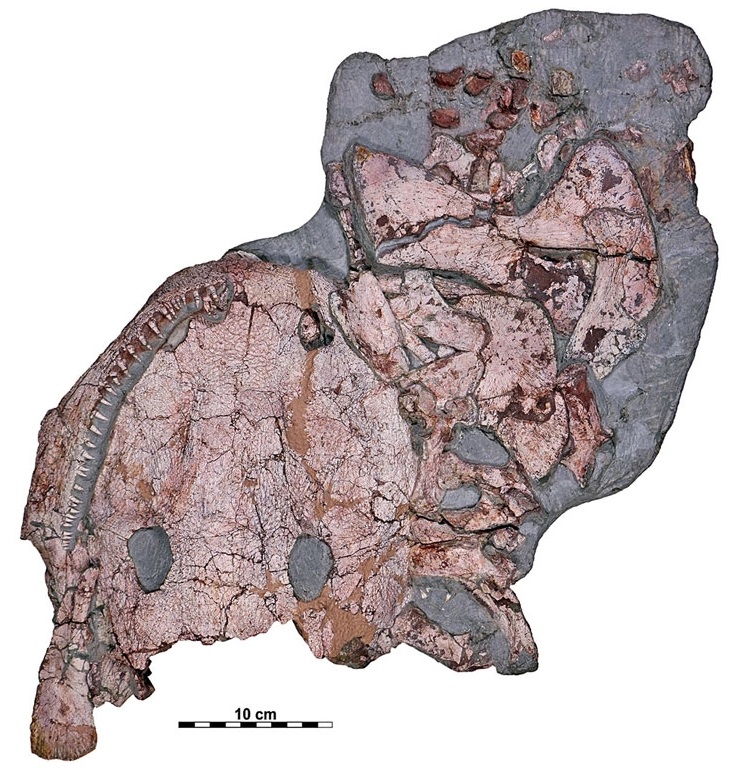
Stenokranio boldi n. gen. n. sp., skull with mandibles and anterior postcranial skeleton, paratype NHMMZ/LS PW 2019/5022.
Dorsal skull roof with left mandible, shoulder girdle, and anterior axial skeleton

Systematic paleontology

Tetrapoda Jaekel, 1909
Amphibia Linneaus, 1758
Temnospondyli von Zittel, 1888
Eryopidae Cope, 1882

Stenokranio new genus
 
Etymology: Greek στενός (stenos) for narrow, κρανίο (kranio) for skull.

Stenokranio boldi new species

Etymology: The species name honors the late Rudolf Bold from Rammelsbach near Kusel who found the holotype and only known specimen of the Remigiusberg sphenacodontid Cryptovenator hirschbergeri Fröbisch et al., 2011, in 2002.


Ralf Werneburg, Florian Witzmann, Larry Rinehart, Jan Fischer and Sebastian Voigt. 2024. A New eryopid temnospondyl from the Carboniferous–Permian Boundary of Germany. Journal of Paleontology. FirstView. pp. 1 - 31. DOI: 10.1017/jpa.2023.58


Friday, August 4, 2023

[Paleontology • 2023] Arenaerpeton supinatus • A New chigutisaurid (Temnospondyli: Brachyopoidea) with Soft Tissue Preservation from the Triassic Sydney Basin, New South Wales, Australia


Arenaerpeton supinatus
Hart, Gee, Smith & McCurry, 2023

Reconstruction by José Vitor Silva.

ABSTRACT
Compared with other Mesozoic tetrapod groups, chigutisaurid fossils from Australia are rare, with only three named taxa described from the continent. From Queensland, Keratobrachyops australis is known from the Triassic, and Siderops kehli from the Jurassic. Koolasuchus cleelandi, from the Cretaceous of Victoria, represents the youngest-known temnospondyl globally. Here we describe the first chigutisaurid from New South Wales, from the Early–Middle Triassic Terrigal Formation. The specimen (AM F125866) comprises an articulated, near-complete skeleton, presented in ventral aspect, as well as outlines of soft tissue. The new taxon preserves features that indicate an affinity with Chigutisauridae, confirming previous hypotheses on the presence of large-bodied chigutisaurids in the Triassic of Australia. The new Terrigal chigutisaurid is only the second chigutisaurid known from the Lower Triassic and fourth from Australia overall. The distribution of brachycephalic temnospondyls throughout the Mesozoic suggests specific adaptations led to the long-term survival of chigutisaurids, especially across the end-Triassic extinction event.


SYSTEMATIC PALEONTOLOGY
TEMNOSPONDYLI von Zittel, Citation1887–1890
STEREOSPONDYLI von Zittel, Citation1887–1890

BRACHYOPOIDEA Lydekker, Citation1885 (sensu Warren & Marsicano, Citation2000)
CHIGUTISAURIDAE Rusconi, Citation1951

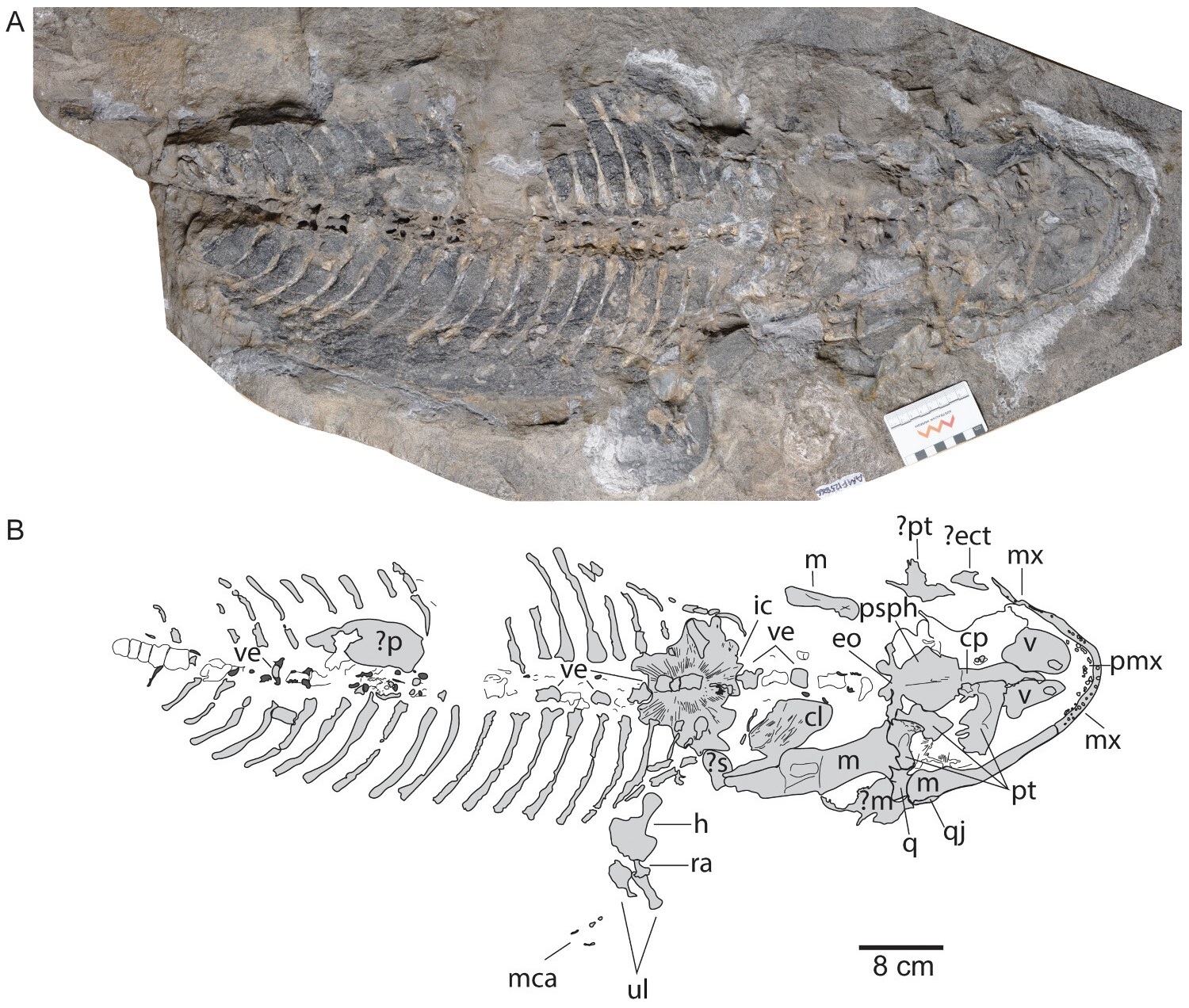
 Arenaerpeton supinatus, AM F125866, articulated skeleton.
A, full fossil in ventral view; B, schematic interpretation.
Abbreviations: cl, clavicle; cp, cultriform process of the parasphenoid; ect, ectopterygoid; eo, exoccipital; h, humerus; ic, interclavicle; m, mandible; mca, metacarpal; mx, maxilla; p, pelvis; pmx, premaxilla; psph, parasphenoid; pt, pterygoid; q, quadrate; qj, quadratojugal ra, radius; s, scapula; ul, ulna; v, vomer, ve, vertebrae. 
Light gray elements represent exposed bone. Darker sections represent cavities in the matrix. Unfilled outlines indicate unexposed bones within the matrix. Photograph by Thomas Peachey.

ARENAERPETON SUPINATUS, gen. et sp. nov.

Holotype—AM F125866 (Fig. 2), an articulated skeleton containing cranial and postcranial elements, exposed in ventral aspect.

Locality and Horizon— The holotype derives from Kincumber Quarry, on the Central Coast of New South Wales, approximately 90 km north of Sydney, Australia (Fig. 1A). The fossil is preserved in sandstone from within the Terrigal Formation of the Lower–Middle Triassic Sydney Basin (Spathian–Anisian) (Fig. 1B, C).

Diagnosis—Arenaerpeton supinatus possesses a brachycephalic skull, as seen in all other brachyopoids and some dvinosaurs but can be excluded from Dvinosauria due to the presence of a flat cultriform process of the parasphenoid which does not expand anteriorly (Warren & Marsicano, Citation2000). Arenaerpeton supinatus is included within Chigutisauridae as it exhibits a large number of small marginal teeth on the premaxilla and maxilla (as opposed to the large and sparse teeth seen in Brachyopidae); and a postquadratojugal projection (Warren & Marsicano, Citation1998). Arenaerpeton supinatus is identified as a new chigutisaurid due to the following unique combination of characters: (1) pterygoid and exoccipital suture (shared with Compsocerops—may also be present in other chigutisaurids); (2) corpus of pterygoid and parasphenoid unornamented (shared with all chigutisaurids except Keratobrachyops); (3) parasphenoid cultriform process narrow and flat (shared with Pelorocephalus and Compsocerops); (4) vomerine depression anterior to the cultriform process (shared with Keratobrachyops and Siderops); (5) parasphenoid corpus almost as wide as long (shared with all chigutisaurids except Compsocerops); (6) ventral surface of the cultriform process of the parasphenoid lacking a keel (shared with Siderops, Compsocerops, and Kuttycephalus); (7) mandible post-glenoid area slender and elongate (shared with Keratobrachyops and Pelorocephalus); (8) adjacent intercentra contact (shared with Siderops and Pelorocephalus); (9) ossified ceratobranchials absent in adult (shared with Kuttycephalus and Compsocerops).

Etymology—The genus name is a combination of the Latin ‘arena,’ meaning ‘sand,’ in reference to the sandstone matrix in which the fossil is preserved, and ‘erpeton’ meaning ‘thing that creeps,’ commonly used for fossil amphibians and reptiles. The species name is the Latin ‘supinatus,’ meaning ‘on its back,’ in reference to the holotype specimen being preserved in ventral aspect.

 Head width and temporal span of chigutisaurids throughout the Mesozoic. Skull silhouette based on Pelorocephalus mendozensis. Silhouettes of Australia, India, and South America used under Creative Commons Zero 1.0 Public Domain License from Openclipart.org.

 Reconstruction of  Arenaerpeton supinatus, preying on Cleithrolepis granulata.
Reconstruction by José Vitor Silva.


CONCLUSIONS
Chigutisaurids are a key component in South American Triassic ecosystems (Dias-da-Silva et al., 2012; Marsicano, 2005) but are surpassed in species diversity by other temnospondyl clades in Australia (where brachyopids, mastodonsaurids, and rhytidosteids are more common). Here we describe Arenaerpeton supinatus (Fig. 8), the fourth chigutisaurid taxon from Australia and the first from the Sydney Basin. It is also only the second chigutisaurid from the Early Triassic and adds weight to the observations of Gee and Sidor (2021) on the asymmetric distributions of brachyopoids throughout the Mesozoic. Chigutisauridae is strictly a Gondwanan clade which has no records in the Middle Triassic, although constituent taxa have a temporal span from the Early Triassic through to the Early Cretaceous (Dias-da-Silva et al., 2012; Marsicano, 1999; Warren & Marsicano, 2000). However, brachyopids are known throughout the Middle Triassic (Gee & Sidor, 2021; Warren & Marsicano, 2000) in Gondwana. Chigutisaurids and brachyopids only co-occur in two localities, both in Australia: Arenaerpeton supinatus with Platycepsion wilkinsoni (from the Terrigal Formation, NSW); and Keratobrachyops australis with Xenobrachyops allos (from the Arcadia Formation, QLD). Apart from these two occurrences, brachyopids, chigutisaurids (and plagiosaurids, also a brachycephalic clade) show marked differentiation in their distribution. This may indicate that an ecological (perhaps an ability to estivate or tolerate unfavorable climatic conditions) or morphological trait (such as overall large body size, or skull shape) drove this segregation, and possibly also assisted chigutisaurids in their survival through to the Cretaceous.
 

Lachlan J. Hart, Bryan M. Gee, Patrick M. Smith and Matthew R. McCurry. 2023. A New chigutisaurid (Brachyopoidea, Temnospondyli) with Soft Tissue Preservation from the Triassic Sydney Basin, New South Wales, Australia. Journal of Vertebrate Paleontology.  e2232829. DOI: 10.1080/02724634.2023.2232829   twitter.com/Dinoh555/status/1687236171707887616

Saturday, July 1, 2023

[Paleontology • 2023] Rhigerpeton isbelli • A New lapillopsid from Antarctica and A Reappraisal of the Phylogenetic Relationships of early Diverging stereospondyls (Temnospondyli: Stereospondyli: Lapillopsidae)


Rhigerpeton isbelli
Gee, Beightol & Sidor, 2023


ABSTRACT
Stereospondyls underwent a global radiation in the Early Triassic, including an abundance of small-bodied taxa, which are otherwise rare throughout the Mesozoic. Lapillopsidae is one such clade and is presently known only from Australia and India. This clade’s phylogenetic position, initially interpreted as micropholid dissorophoids and later as early diverging stereospondyls, remains uncertain. Although the latter interpretation is now widely accepted, lapillopsids’ specific relationship to other Early Triassic clades remains unresolved; in particular, recent work suggested that Lapillopsidae nests within Lydekkerinidae. Here we describe Rhigerpeton isbelli, gen. et sp. nov., based on a partial skull from the lower Fremouw Formation of Antarctica that is diagnosed by a combination of features shared with at least some lapillopsids, such as a longitudinal ridge on the dorsal surface of the tabular, and features not found in lapillopsids but shared with some lydekkerinids, such as the retention of pterygoid denticles and a parachoanal tooth row (as in Lydekkerina, for example). A series of phylogenetic analyses confirm the lapillopsid affinities of R. isbelli but provide conflicting results regarding the polyphyly and/or paraphyly of Lydekkerinidae with respect to lapillopsids. The position of Lapillopsidae within Temnospondyli is highly sensitive to taxon sampling of other predominantly Early Triassic temnospondyls. The occurrence of a lapillopsid in Antarctica brings the documented temnospondyl diversity more in line with historically well-sampled portions of southern Pangea, but robust biogeographic comparisons remain hindered by the inability to resolve many historic Antarctic temnospondyl records to the finer taxonomic scales needed for robust biostratigraphy.


Rhigerpeton isbelli, gen. et sp. nov.
 
 
Bryan M. Gee, Charles V. Beightol and Christian A. Sidor. 2023. A New lapillopsid from Antarctica and A Reappraisal of the Phylogenetic Relationships of early Diverging stereospondyls. Journal of Vertebrate Paleontology. e2216260. DOI: 10.1080/02724634.2023.2216260

Wednesday, June 1, 2022

[Paleontology • 2022] Chemnitzion richteri • A New Basal Zatracheid Temnospondyl from the early Permian Chemnitz Fossil Lagerstätte, central-east Germany


Chemnitzion richteri 
Werneburg, Witzmann, Schneider & Rößler, 2022

Artwork by Frederik Spindler.

Abstract
A new zatracheid temnospondyl adds to the fossil-rich T0 assemblage of the Chemnitz Fossil Lagerstätte (Chemnitz Basin, Sakmarian–Artinskian transition). The skeleton was found in basal air-fall tuffs of the Zeisigwald Tuff (Leukersdorf Formation) and consists of the almost complete skull roof in dorsal view, parts of the occiput, fore and hind limbs, numerous presacral vertebrae and ribs, parts of the pelvic girdle and ventral scales. The new taxon Chemnitzion richteri gen. nov. et sp. nov. is proposed due to the following autapomorphic characters: (1) postorbital skull very short, about five times shorter than the preorbital skull; (2) elongate and robust hindlimbs, with femur length reaching almost half of the skull length. A phylogenetic analysis finds the new taxon at the base of a monophyletic Zatracheidae, forming a trichotomy with Acanthostomatops vorax and the more derived zatracheids [Zatrachys serratus + (Dasyceps bucklandi + D. microphthalmus)]. The animal was part of a diverse trophic web of plants, animals and microorganisms. Various vertebrates, arthropods and gastropods constituted a vital community that lived in a dense, seasonally influenced forest habitat dominated by tree-sized ferns, calamitaleans, medullosans and cordaitaleans. The temnospondyl’s death and taphonomic background is closely related to the ash-cloud deposition following a phreatoplinian eruption. The following massive pyroclastic flow finally entombed the moist forest and intensively heated all enclosed organic remnants.

Keywords: Terrestriality, Chemnitzion richteri gen. nov. et sp. nov., Zatracheidae, Skull roof sculpture, Powerful hind limb, Cisuralian, Volcanic taphonomy


Chemnitzion richteri gen. nov. et sp. nov., dorsal skull roof, skull length of 62 mm;
a, b skull with bones showing heat-derived cracks and blisters, and with rounded organic remains of the orbital sacs and of the intermaxillary gland sac, TA 0949b.

Reconstruction of the new zatracheid temnospondyl Chemnitzion richteri gen. nov. et sp. nov. in the last moments of its life, from the Permian Fossil Lagerstätte of Chemnitz, central-east Germany.
Artwork by Frederik Spindler.

Systematic palaeontology

Order Temnospondyli von Zittel, 1888
Family Zatracheidae Cope, 1882

Genus Chemnitzion gen. nov.

Etymology. The genus name aims to dignify the find locality, the city of Chemnitz—European Capital of Culture 2025.

Chemnitzion richteri gen. nov. et sp. nov. 

Etymology In honour of Mr Fred Richter, dedicated fossil collector for many decades and chairman of the friend’s circle board of the Museum für Naturkunde Chemnitz.

Locality and horizon. Chemnitz-Hilbersdorf excavation, Frankenberger Straße, central-east Germany; basal ash-tuff unit S5 of the Zeisigwald Tuff, Leukersdorf Formation, lower Rotliegend (Sakmarian–Artinskian transition, Cisuralian), Chemnitz Basin.
 

Ralf Werneburg, Florian Witzmann, Joerg W. Schneider and Ronny Rößler. 2022. A New Basal Zatracheid Temnospondyl from the early Permian Chemnitz Fossil Lagerstätte, central-east Germany. PalZ. DOI: 10.1007/s12542-022-00624-8

Monday, March 7, 2022

[Paleontology • 2021] Description of the Metoposaurid Anaschisma browni (Temnospondyli: Metoposauridae) from the New Oxford Formation of Pennsylvania


Anaschisma browni Branson, 1905

in Gee & Jasinski, 2021. 
Illustration: Sergey Krasovskiy

Abstract
Metoposaurids are a widespread and ubiquitous constituent of Late Triassic non-marine paleoenvironments. In North America, this group is practically the only large-bodied temnospondyl clade, and is particularly well documented from the American southwest and south-central regions (Arizona, New Mexico, Texas). However, metoposaurids are poorly documented from eastern North America, with fragmentary, doubtfully diagnostic historical material such as “Dictyocephalus elegans” Leidy, 1856 and “Eupelor durus” Cope, 1866. The Zions View (early Norian?) locality in Pennsylvania preserves more-complete material, which previous workers noted as belonging to “Buettneria perfecta” Case, 1922 (=Anaschisma browni Branson, 1905). However, the material has never been described in a fashion that characterizes the anatomy or that justifies the taxonomic assignment, yet it would represent the most complete material in eastern North America and a substantial expansion of this taxon's geographic range. Here we redescribe the Zions View metoposaurid material in detail, differentiating it from Calamops paludosus Sinclair, 1917, the only other Late Triassic temnospondyl from the eastern seaboard, and demonstrating confident affinities with A. browni. Our study is the first to properly justify the taxonomic referral, underscoring the broader importance of proper documentation of voucher specimens, especially for potential geographic outliers. Anaschisma browni is thus the most widely dispersed metoposaurid. Its easternmost documentation underscores the importance of the undersampled and understudied metoposaurid record on the eastern seaboard for understanding the development of a metoposaurid zone of exclusivity in North America and demonstrates the need for further exploration to refine conceptualizations of Late Triassic tetrapod evolution.


Anaschisma browni Branson, 1905


 Bryan M. Gee and Steven E. Jasinski. 2021. Description of the Metoposaurid Anaschisma browni from the New Oxford Formation of Pennsylvania. Journal of Paleontology. 95(5); 1061-1078.  DOI: 10.1017/jpa.2021.30

Thursday, July 6, 2017

[Paleontology • 2017] Aphaneramma gavialimimus • A New Extreme Longirostrine Temnospondyl from the Triassic of Madagascar: Phylogenetic and Palaeobiogeographical Implications for Trematosaurids


Aphaneramma gavialimimus Fortuny, Gastou, Escuillié, Ranivoharimanana & Steyer, 2017

 DOI: 10.1080/14772019.2017.1335805   Life reconstruction by Marc Boulay | @JournalSystPal 

Aphaneramma gavialimimus
Fortuny, Gastou, Escuillié, Ranivoharimanana & Steyer, 2017


Abstract
Trematosaurids form a very large and remarkable clade of Triassic tetrapods (Temnospondyli: Stereospondyli) with a worldwide geographical distribution. Compared with specimens from Europe, Australia or North America, they remain relatively scarce in African rocks, where they are mainly known in the Early Triassic of Madagascar and South Africa. Longirostrine trematosaurids were only known from Madagascar, represented by the genus Wantzosaurus. However, we describe herein a new species of the longirostrine trematosaurid AphanerammaAphaneramma gavialimimus sp. nov., from the Olenekian (Lower Triassic) of Madagascar. This genus was previously known from the Early Triassic of Europe and Asia. Based on a new nearly complete skull, the new species is characterized by a premaxilla-nasal suture anteriorly directed, not contacting the nostrils; choanae completely included within the palatines; the ventral opening of the orbits in the anterior part of the interpterygoid vacuities; a very elongated nasal covering more than 50% of the prenarial length; and an anteriorly widened cultriform process. Aphaneramma gavialimimus sp. nov., with a skull length of about 40 cm, may be one of the largest known trematosaurids. Its inclusion in a new phylogenetic analysis confirms its close affinities with the North American genus Cosgriffius, and clarifies the relationships of trematosaurids in general and lonchorhynchines in particular. The new species also increases the palaeobiodiversity of marine trematosaurs in Gondwana and allows discussing their apparently rapid cosmopolitanism just after the great Permian–Triassic mass extinction.

Keywords: Lonchorhynchinae, Olenekian, palaeobiogeography, Permian–Triassic mass extinction

Figure 1. Aphaneramma gavialimimus sp. nov., Lower Triassic of Madagascar in dorsal view. A, photograph of the holotype UAAmb007; B, photograph of the plastotype MNHN-6703; C, interpretative drawing. 

Systematic palaeontology

Temnospondyli Zittel, 1888
Stereospondyli Zittel, 1888
Trematosauria Romer, 1947 sensu Yates & Warren, 2000
Trematosauroidea Säve-Söderbergh, 1935 sensu Schoch, 2013

Family Trematosauridae Watson, 1919
Subfamily Lonchorhynchinae Säve-Söderbergh, 1935 sensu Steyer, 2002

Aphaneramma Smith Woodward, 1904
Type species. Aphaneramma rostratum Smith Woodward, 1904
(D ‘Lonchorhynchus obergi’ Wiman, 1910) from the early Olenekian of the Sticky Keep of Spitsbergen, Vikinghøgda Formation, Svalbard Archipelago, Norway.


Definition. All taxa sharing a more recent common ancestor with Aphaneramma rostratum than with Cosgriffius campi.

Aphaneramma gavialimimus sp. nov. 

 Etymology. Imitates a gharial (Gavialis gangeticus), due to the general shape similarity with this hyper-longirostral taxon.

Aphaneramma gavialimimus sp. nov., Lower Triassic of Madagascar.

 Life reconstruction by Marc Boulay  (MarcBoulay.fr). 


Josep Fortuny, Stéphanie Gastou, François Escuillié, Lovasoa Ranivoharimanana and J.-Sébastien Steyer. 2017. A New Extreme Longirostrine Temnospondyl from the Triassic of Madagascar: Phylogenetic and Palaeobiogeographical Implications for Trematosaurids. Journal of Systematic Palaeontology.   DOI: 10.1080/14772019.2017.1335805  


Tuesday, June 20, 2017

[Paleontology • 2017] Chinlestegophis jenkinsi • Stem Caecilian from the Triassic of Colorado Sheds Light On the Origins of Lissamphibia


Chinlestegophis jenkinsi
Pardo, Small & Huttenlocker, 2017 


 Significance: 
Research into modern amphibian origins is increasingly focusing on the limbless caecilians, a poorly studied group whose pre-Cenozoic fossils are limited to two species. We describe tiny fossils from the Triassic of Colorado with a mixture of traits found in caecilians and extinct Permian–Triassic temnospondyls: Stereospondyli. Computed 3D tomography shows how skull bones organized around internal structures, and we suggest how these may have become fused or simplified in caecilians. The fossils’ association with burrows highlights ecological diversity of Triassic amphibians as well as when and how burrowing evolved in the stereospondyl ancestors of caecilians. Our narrative for research on amphibian origins highlights the importance of stereospondyls, the most numerous and anatomically diverse amphibian group of the Triassic.

Abstract
The origin of the limbless caecilians remains a lasting question in vertebrate evolution. Molecular phylogenies and morphology support that caecilians are the sister taxon of batrachians (frogs and salamanders), from which they diverged no later than the early Permian. Although recent efforts have discovered new, early members of the batrachian lineage, the record of pre-Cretaceous caecilians is limited to a single species, Eocaecilia micropodia. The position of Eocaecilia within tetrapod phylogeny is controversial, as it already acquired the specialized morphology that characterizes modern caecilians by the Jurassic. Here, we report on a small amphibian from the Upper Triassic of Colorado, United States, with a mélange of caecilian synapomorphies and general lissamphibian plesiomorphies. We evaluated its relationships by designing an inclusive phylogenetic analysis that broadly incorporates definitive members of the modern lissamphibian orders and a diversity of extinct temnospondyl amphibians, including stereospondyls. Our results place the taxon confidently within lissamphibians but demonstrate that the diversity of Permian and Triassic stereospondyls also falls within this group. This hypothesis of caecilian origins closes a substantial morphologic and temporal gap and explains the appeal of morphology-based polyphyly hypotheses for the origins of Lissamphibia while reconciling molecular support for the group’s monophyly. Stem caecilian morphology reveals a previously unrecognized stepwise acquisition of typical caecilian cranial apomorphies during the Triassic. A major implication is that many Paleozoic total group lissamphibians (i.e., higher temnospondyls, including the stereospondyl subclade) fall within crown Lissamphibia, which must have originated before 315 million years ago.

Keywords: burrow, Gymnophiona, temnospondyl, tetrapod, Triassic

Chinlestegophis jenkinsi, a tiny subterranean carnivore, is an ancient relative of frogs and salamanders.
(Illustration/Jorge Gonzalez)

Systematic Paleontology. 

Tetrapoda Haworth, 1825
 Temnospondyli Zittel, 1888
Stereospondyli Zittel, 1887

 Chinlestegophis jenkinsi gen. et sp. nov. 

Etymology. Jenkins’s amphibian-serpent from the Chinle.
Chinle” for the Triassic Chinle Formation; “stego-” (Greek) meaning cover or roof, but commonly applied to temnospondyl amphibians and other early tetrapods; “-ophis” (Greek) meaning serpent. The species name honors paleontologist Farish Jenkins, whose work on the Jurassic Eocaecilia inspired the present study.

Fig. 1. Skulls of Chinlestegophis jenkinsi gen. et sp. nov., DMNH 56658 (A–D) and DMNH 39033 (E–G).
Specimens are shown in dorsal (A and E), ventral (B and G), lateral (C and F), and occipital (D) views. A reconstruction of the skull based on the two specimens is shown in ventral (H), dorsal (I), and left lateral (J) views. All are to scale. a, angular; d, dentary; eo, exoccipital; f, frontal; j, jugal; lep, lateral exposure of palatine; m, maxilla; n, nasal; p, parietal; pal, palatine; pf, postfrontal; pm, premaxilla; po, postorbital; pp, postparietal; prf, prefrontal; ps, parasphenoid; pt, pterygoid; sa, surangular; sp, splenial; sq, squamosal; st, supratemporal; t, tabular.

Fig. 3. Hypothesis of morphological innovations and character transformations along the caecilian stem. Representative skulls are shown in dorsal (left) and ventral (right) views. Characters are color-coded by cranial fusions (red), fossorial characters (yellow), and other classic “caecilian” characters (blue). Some cranial fusions may represent additional adaptations for fossoriality but are treated here separately.
Exemplary taxa are shown in stratigraphic order (left, oldest; right, youngest): the Permian dissorophoid Doleserpeton [redrawn from Sigurdsen and Bolt (34)]; the Early Triassic stereospondyl Lydekkerina [redrawn from Jeannot et al. (35)]; the Middle Triassic brachyopoid Batrachosuchus (based on observation of the holotype of Batrachosuchus browni); d, the Late Triassic Chinlestegophis jenkinsi n. gen. et sp.; the Early Jurassic stem caecilian Eocaecilia [redrawn from Jenkins et al. (2)]; and the crown caecilian Ichthyophis [redrawn from Jenkins et al. (2)]. Skulls are not drawn to scale


Jason D. Pardo, Bryan J. Small and Adam K. Huttenlocker. 2017. Stem Caecilian from the Triassic of Colorado Sheds Light On the Origins of Lissamphibia. Proceedings of the National Academy of Sciences of the United States of America. in press.  DOI: 10.1073/pnas.1706752114

Tiny fossils reveal backstory of the most mysterious amphibian alive today 
The discovery fills a significant gap in the evolutionary history of frogs, toads and other amphibians

Wednesday, November 23, 2016

[Paleontology • 2015] The Cranial Morphology of the Temnospondyl Australerpeton cosgriffi (Tetrapoda: Stereospondyli) from the Middle–Late Permian of Paraná Basin and the Phylogenetic Relationships of Rhinesuchidae


  Australerpeton cosgriffi in its environment (Middle–Late Permian [260 million years ago], Rio do Rasto Formation, Paraná Basin, Brazil)
Reconstruction by Rodolfo Nogueira.

DOI:  
10.1111/zoj.12339 
  
Abstract
Stereospondyls are a diverse and morphologically distinctive clade of basal tetrapods that rapidly reached a global distribution and high abundance during the Early Triassic. Yet, the first stereospondyls appeared in the Middle–Late Permian of Gondwana, mostly represented by Rhinesuchidae. Australerpeton cosgriffi is a long-snouted representative of the group and one of the most complete temnospondyls known from the Permian of South America. The elements attributed to Au. cosgriffi were recovered from the Middle-Late Permian deposits of the Rio do Rasto Formation (Paraná Basin), in the Serra do Cadeado area of Brazil. Here, we review the cranial anatomy of the species, providing a comparative redescription, new anatomical data and previously unrecognized characters. Australerpeton cosgriffi is nested within Rhinesuchidae based on the anatomy of the tympanic cavity, but its long-snouted condition is unique amongst rhinesuchids. Based on the recovered information and new morphological data, the systematic position of Au. cosgriffi was assessed using a new matrix of 221 characters; of which 196 were selected from previous studies and the remaining are newly proposed. The results show Rhinesuchidae divided into Rhinesuchinae and Australerpetinae. A unique tympanic cavity formed by a well posteroventrally projected tabular horn, stapedial groove, well-developed oblique crest on the pterygoid, and a dorsal pterygoid crest (new term) characterizes the ear region of Rhinesuchidae. Australerpeton cosgriffi is the only undisputed Rhinesuchidae record outside southern Africa and the first long-snouted Stereospondyli, and thus is useful in helping to understand the diversification of the stereospondyls during the Middle/Late Permian of Gondwana.

Keywords: Gondwana; long-snouted rhinesuchid; Palaeozoic; phylogenetics; Rio do Rasto Formation; systematics; Temnospondyli; tympanic cavity


Estevan Eltink, Eliseu V. Dias, Sérgio Dias-da-Silva, Cesar L. Schultz and Max C. Langer. 2015. The Cranial Morphology of the Temnospondyl Australerpeton cosgriffi (Tetrapoda: Stereospondyli) from the Middle–Late Permian of Paraná Basin and the Phylogenetic Relationships of Rhinesuchidae.  Zoological Journal of the Linnean Society. 176(4);   835–860.  DOI: 10.1111/zoj.12339

Paleontologists describe giant amphibian that lived 260 million years ago http://agencia.fapesp.br/paleontologists_describe_giant_amphibian_that_lived_260_million_years_ago/22285/