Showing posts with label Nymphalidae. Show all posts

Monday, April 6, 2026

[Entomology • 2026] Euthalia zubeengargi • A New Species of Euthalia Hübner, 1819 subgenus Limbusa Moore, [1897] (Lepidoptera: Nymphalidae: Limenitidinae) from Arunachal Pradesh, Northeast India


Euthalia (Limbusa) zubeengargi 
Sadasivan & Upadhaya, 

in Upadhaya et Sadasivan, 2026. 
 
ABSTRACT 
A new species of Euthalia Hübner, 1819 (subgenus Limbusa Moore, [1897]) (Lepidoptera, Nymphalidae, Limenitidinae, Adoliadini) is described from Arunachal Pradesh, northeastern India. This species, Euthalia (Limbusa) zubeengargi, Sadasivan & Upadhaya sp. nov., is assigned to the Patala group of Limbusa based on its wing pattern, venation, and male genital morphology. A detailed description of the male and its genitalia is presented, along with a revised key to the males of Subtype A2 of the Patala group sensu Yokochi (2011). 

KEY WORDS: New taxon, butterfly, duke, Patala group, morphology, Basar, Eastern Himalayas, taxonomic key


Euthalia (Limbusa) zubeengargi, Sadasivan & Upadhaya sp. nov.


 Roshan Upadhaya and Kalesh Sadasivan. 2026. A New Species of Euthalia Hübner, 1819 subgenus Limbusa Moore, [1897] (Lepidoptera, Nymphalidae, Limenitidinae, Adoliadini) from Arunachal Pradesh, Northeast India. ENTOMON. 51(1): 1-10. 

Thursday, January 22, 2026

[Entomology • 2024] Actinote pyrrhosticta • A New Species and eight new subspecies of high elevation Actinote (Nymphalidae: Heliconiinae: Acraeini) from Colombia, Ecuador and Peru


Actinote pyrrhosticta Lamas, Willmott & Hall,
C-H, Actinote  pyrrhosticta apurimac n. ssp., Peru, Cuzco; 
   I) Actinote pyrrhosticta n. ssp.?, Peru, La Libertad, 

J) A. hilaris arcoiris n. ssp. female, Ecuador, Morona-Santiago,   
K, L) Actinote hilaris sourakovi n. ssp. female, Peru, Amazonas,   
   
in Willmott, Lamas, Hall, Boyer, Pyrcz et Florczyk, 2024.  
Tropical Lepidoptera Research. 34(1) 

Abstract  
We describe one new species and eight new subspecies of high elevation Actinote Hübner, [1819] (Nymphalidae, Heliconiinae, Acraeini) from Colombia, Ecuador and Peru: Actinote pyrrhosticta Lamas, Willmott & Hall, n. sp., Actinote pyrrhosticta quintecocha Lamas & Willmott, n. ssp., Actinote pyrrhosticta apurimac Lamas & Willmott, n. ssp., Actinote pyrrhosticta alfamayo Lamas & Willmott, n. ssp., Actinote eresia albesia Lamas & Willmott, n. ssp., Actinote eresia canyaris Pyrcz & Lamas, n. ssp., Actinote hilaris arcoiris Willmott & Hall, n. ssp., Actinote hilaris sourakovi Willmott & Lamas, n. ssp., and Actinote trinacria alegria Boyer & Willmott, n. ssp. We treat Actinote binghamae Dyar, 1913 as a new synonym of Actinote eresia eresina (Hoffer, 1874) n. syn., and treat Altinote santamarta Winhard, 2017 as a subspecies, Actinote trinacria santamarta rev. stat. We illustrate adult specimens of all described taxa of A. pyrrhosticta n. sp., A. eresia (C. Felder & R. Felder, 1862) and A. hilaris Jordan, 1910, and representatives of A. trinacria (C. Felder & R. Felder, 1862). We also provide illustrations of male and female genitalia for select taxa, distribution maps, and a revised, annotated synonymic list for all four species.


Images of new Actinote taxa in nature.
A, B) Mating pair of Actinote pyrrhosticta n. sp., female in foreground (A), and male (B), resting on rocks and low vegetation near edge of stream gully at type locality;
C-H, Actinote  pyrrhosticta apurimac n. ssp., Peru, Cuzco, above Mollepata (photographs by David Geale). C) Last instar; D) Pupal case with freshly emerged adult adjacent; E) Cluster of pupae; F,G) Males nectaring on Asteraceae flowers; H) Female nectaring on Asteraceae flowers;
I) Actinote pyrrhosticta n. ssp.?, Peru, La Libertad, Cochorco (photograph by Jonathan Newman);
J) A. hilaris arcoiris n. ssp. female, puddling on damp gravel, Ecuador, Morona-Santiago, Cebadas-Macas road;
K, L) Actinote hilaris sourakovi n. ssp. female, dorsal (K) and ventral (L), Peru, Amazonas, Abra Patricia (photographs by David Geale).  

Habitats of new Actinote taxa. A) Ecuador, Loja, Jimbura-San Andrés road, type locality of Actinote pyrrhosticta n. sp., stream gully and road where numerous individuals were observed on the morning of 12 June 2014; B) Peru, Cajamarca, El Pargo, habitat of A. pyrrhosticta n. sp. C) Peru,Apurímac, Santuario Nacional Ampay, Laguna Angasocha, type locality of A. pyrrhosticta apurimac n. ssp.D) Peru,Apurímac, Santuario Nacional Ampay, Laguna Uspacocha, habitat of A. pyrrhosticta apurimac n. ssp.E) Peru,Lambayeque, Cañaris, type locality of A. eresia canyaris n. ssp.F) Ecuador, Zamora-Chinchipe, San Francisco, type locality of Actinote hilaris arcoiris n. ssp.  


Keith R. Willmott, Gerardo Lamas, Jason P. W. Hall, Pierre Boyer, Tomasz Pyrcz and Klaudia Florczyk. 2024. A New Species and eight new subspecies of high elevation Actinote from Colombia, Ecuador and Peru (Nymphalidae, Heliconiinae, Acraeini). Tropical Lepidoptera Research. 34(1); 1-20.

 inabio.biodiversidad.gob.ec/2023/10/27/una-nueva-especie-y-ocho-nuevas-subspecies-de-mariposas-son-descritas-en-colombia-ecuador-y-peru/

En este trabajo describimos una especie nueva y ocho nuevas subspecies altoandinas de Actinote Hübner, [1819] (Nymphalidae, Heliconiinae, Acraeini) encontradas en Colombia, Ecuador y Perú: Actinote pyrrhosticta Lamas, Willmott & Hall, n. sp., Actinote pyrrhosticta quintecocha Lamas & Willmott, n. ssp., Actinote pyrrhosticta apurimac Lamas & Willmott, n. ssp., Actinote pyrrhosticta alfamayo Lamas & Willmott, n. ssp., Actinote eresia albesia Lamas & Willmott, n. ssp., Actinote eresia canyaris Pyrcz & Lamas, n. ssp., Actinote hilaris arcoiris Willmott & Hall, n. ssp., Actinote hilaris sourakovi Willmott & Lamas, n. ssp., y Actinote trinacria alegria Boyer & Willmott, n. ssp. Consideramos a Actinote binghamae Dyar, 1913 como un nuevo sinónimo de Actinote eresia eresina (Hoffer, 1874) n. syn., y a Altinote santamarta Winhard, 2017 como una subespecie, Actinote trinacria santamarta rev. stat. Ademas, ilustramos especímenes adultos de todos los taxa descritos de A. pyrrhosticta n. sp., A. eresia (C. Felder & R. Felder, 1862) y A. hilaris Jordan, 1910, y algunos representantes de A. trinacria (C. Felder & R. Felder, 1862). También presentamos ilustraciones de las genitalias masculinas y femeninas de algunos taxones seleccionados, junto con mapas de distribución, y una lista de sinonimos revisada para las cuatro especies. 


Shinichi Nakahara, Albert Thurman, Gordon B. Small. 2024. A new species of Pseudodebis Forster, 1964 from Panama (Lepidoptera: Nymphalidae: Satyrinae). Tropical Lepidoptera Research. 34(1); 21-28.  

Sunday, November 16, 2025

[Entomology • 2023] Agojie rupicola • A New Genus and Endangered Species of euptychiine Butterfly (Lepidoptera: Nymphalidae: Satyrinae) from isolated mountains in southeastern Brazil


Agojie rupicola 
 Zacca, Cordeiro & Gonella, 2023  


Abstract
Agojie rupicola gen. et sp. nov., a new genus and species of Euptychiina from the campos rupestres and granitic inselbergs of eastern Minas Gerais, southeastern Brazil, is herein described using comparative morphology and ecological data. Diagnoses, photos, and illustrations are also provided, in addition to a discussion on the putative systematic placement of the new taxa and its conservation status. Considering the collecting points, the estimated value for the extent of occurrence (EOO) is 100.263 km2 and the area of occupancy (AOO) is 20 km2, which combined with the reduced number of localities in which the species is known to occur, and the observed continuing decline of the quality of the habitat, we recommend that A. rupicola gen. et sp. nov. should be formally assessed as Endangered based on criteria B1+2(a,biii) of the International Union for Conservation of Nature (IUCN). The results presented here add to the increasing faunistic and floristic novelties that justify the priority for the conservation of these still scientifically underexplored Brazilian mountains.

Lepidoptera, Atlantic Forest, Campo rupestre, Conservation, Endangered species, Euptychiina, Megisto clade, Moneuptychia, Morphology, Pharneuptychia, Taxonomy


Agojie rupicola gen. et sp. nov.


Thamara ZACCA, Danilo Pacheco CORDEIRO and Paulo Minatel GONELLA. 2023. A New Genus and Endangered Species of euptychiine Butterfly from isolated mountains in southeastern Brazil (Lepidoptera: Nymphalidae: Satyrinae). Zootaxa. 5346(1); 83-93. DOI: doi.org/10.11646/zootaxa.5346.1.5 [2023-09-15] 
 Researchgate.net/publication/387049093_Placement_of_Agojie_rupicola_Zacca_2023_in_the_Euptychiina_Nymphalidae_Satyrinae_Satyrini_Phylogenetic_Tree


Tuesday, May 6, 2025

[PaleoEntomology • 2025] Tacola kamitanii • A New Species of fossil Butterfly (Lepidoptera: Nymphalidae: Limenitidinae) from the Upper Pliocene to Lower Pleistocene Teragi Group, Hyogo Prefecture, Japan


Tacola kamitanii 
Aiba, Takahashi & Saito, 2025 
 

Abstract
This study describes a new fossil butterfly species, Tacola kamitanii sp. nov., from the Upper Pliocene to the Lower Pleistocene Teragi Group in Hyogo Prefecture, Japan. The new fossil is characterized by remarkably large wings, with an estimated forewing length of 48 mm and a wingspan of 84 mm. This new fossil species belongs to the genus Tacola based on the following characteristics: both discal cells open, smoothly curved humeral veins, and a thick thorax and abdomen. However, it does not identify with any modern relatives of Tacola with a small discal cell, straight 1A+2A anal vein of the forewing, or long hindwing median vein. Therefore, the fossil was identified as a new species of the genus Tacola and one of the largest species in the subfamily Limenitidinae. The modern relatives of Tacola are distributed in the subtropics and tropics, while this fossil species may have survived in the temperate zone. This is the first named Limenitidini fossil and the youngest example of an extinct butterfly.

Keywords: butterfly fossil, fossil insect, Haruki Mudstone, Limenitidini, Tacola, Teragi Group


Photographs of Tacola kamitanii sp. nov., holotype, SOU-001. A, ventral side, SOU-001-A; B, dorsal side, SOU-001-B.

Reconstruction of Tacola kamitanii sp. nov. and comparison with extant species.
A, habitus of Neptis alwina (Nagano Pref., Koumi machi, Japan. VII. 1992). B, forewing of N. alwina. C, hindwing of N. alwina.
D, habitus of Athyma perius (Da Nang. City, Vietnam, VIII, 2014). E, forewing of A. perius. F, hindwing of A. perius.
G, habitus of Tacola larymna (Ho Chi Minh, south Vietnam, IX, 2003). H, forewing of T. larymna. I, hindwing of T. larymna.
J, habitus of Tacola kamitanii sp. nov. The dotted line area was estimated with reference to the forewing morphology of T. larymna (type species of the genus Tacola). K, forewing of T. kamitanii sp. nov. L, hindwing of T. kamitanii sp. nov. The blue arrows indicate contact point of vein M3 and vein CuA1. The green arrows indicate anal vein 1A+2A. The red arrows indicate humeral vein. Fossil wing length and general shape were estimated based on the wing proportions of T. larymna. Scale bar: 1.0 cm. 

G, habitus of Tacola larymna (Ho Chi Minh, south Vietnam, IX, 2003). H, forewing of T. larymna. I, hindwing of T. larymna
J, habitus of Tacola kamitanii sp. nov. The dotted line area was estimated with reference to the forewing morphology of T. larymna (type species of the genus Tacola). K, forewing of T. kamitanii sp. nov. L, hindwing of T. kamitanii sp. nov. The blue arrows indicate contact point of vein M3 and vein CuA1. The green arrows indicate anal vein 1A+2A. The red arrows indicate humeral vein. Fossil wing length and general shape were estimated based on the wing proportions of T. larymna. Scale bar: 1.0 cm. 


Order Lepidoptera Linnaeus, 1758
Superfamily Papilionoidea Latreille, 1802

Family Nymphalidae Rafinesque, 1815
Subfamily Limenitidinae Behr, 1864
Tribe Limenitidini Behr, 1864

Genus Tacola Moore, 1898

Tacola kamitanii sp. nov.
 [New Japanese name: Kamitani-onimisuji]

Diagnosis.—Large nymphalid butterfly (estimated forewing length 48 mm, estimated wingspan 84 mm). Both wings with completely open discal cells. Forewing discal cell relatively small. The forewing has cell streaks and an upper postdiscal band with a straight anal vein 1A+2A. Vein R2 arises from the cell. Hindwing has smoothly curved humeral vein and longer vein M. Thorax and abdomen thick.

Type locality and horizon.—The Umigami, Shin’onsen Town, Hyogo Prefecture, Japan (Figure 1). However, exact locality remains unknown. Based on the lithofacies of tuffaceous siltstone, the stratigraphic horizon is correlated with the Upper Pliocene to Lower Pleistocene, Haruki Mudstone of the Teragi Group (Kinugasa, 1981; Kamitani, 1990).

Etymology.—After Kiyoshi Kamitani, a fossil collector.


Hiroaki Aiba, Yui Takahashi and Kotaro Saito. 2025. New Species of fossil Butterfly (Nymphalidae: Limenitidinae) from the Upper Pliocene to Lower Pleistocene Teragi Group, Hyogo Prefecture, Japan. Paleontological Research. 29; 76-86. DOI: doi.org/10.2517/prpsj.240023 

Wednesday, October 7, 2020

[Entomology • 2020] Revalidation of Vareuptychia Forster, 1964, Description of Vanima gen. nov., and notes on Euptychia cleophes Godman & Salvin, 1889 (Lepidoptera: Nymphalidae: Satyrinae)


Vanima labe (Butler, 1870) 
Vanima Zacca, Casagrande & Mielke

in Zacca, Casagrande, Mielke, ... et Lamas, 2020. 

Abstract
Vareuptychia Forster, 1964 stat. rest. is revalidated and comprises two species, V. similis (Butler, 1867) comb. rest. and V. themis (Butler, 1867) comb. nov. Vanima Zacca, Casagrande & Mielke gen. nov. is described to contain Euptychia labe Butler, 1870 (the type species), E. palladia Butler, 1867 and E. lesbia Staudinger, [1886]. The taxonomy of these two genera was initially revised based on morphological and distributional data, and subsequently tested and supported with a Maximum Likelihood analysis using four genes (COI, GAPDH, RpS5 and EF1-a). Lectotypes are designated for Euptychia similis Butler, 1867, E. themis Butler, 1867, E. undina Butler, 1870 and E. lesbia Staudinger, [1886]. No DNA sequences were obtained for Euptychia cleophes Godman & Salvin, 1889 but its transfer to Megisto Hübner, [1819] is supported by morphological evidence. For all taxa treated in this study, a taxonomic catalog, diagnosis, (re)description and illustrations of adults, venation and genitalia are provided, as well as comments on intraspecific variation, sexual dichromatism, ecology and distribution maps.

Keywords: Lepidoptera, Amazon rainforest, Central America, Cissia, dry forests, Euptychiina, integrative taxonomy, Megisto, phylogeny


Thamara Zacca, Mirna M. Casagrande, Olaf H. H. Mielke, Blanca Huertas, Marianne Espeland, André V. L. Freitas, Keith R. Willmott, Shinichi Nakahara and Gerardo Lamas. 2020. Revalidation of Vareuptychia Forster, 1964, Description of Vanima gen. nov., and notes on Euptychia cleophes Godman & Salvin, 1889 (Lepidoptera: Nymphalidae: Satyrinae). Zootaxa. 4858(1); 1–34. DOI: 10.11646/zootaxa.4858.1.1

Friday, June 7, 2019

[Entomology • 2019] Cristalinaia vitoria • A New and Highly Distinctive Genus and Species of Euptychiina (Lepidoptera: Nymphalidae: Satyrinae) from the Brazilian southern Amazon


Cristalinaia vitoria  Mota, Zacca & Freitas

in Freitas, Mota, Zacca & Barbosa, 2019. 

Abstract
A new genus and species of Euptychiina (Satyrinae), Cristalinaia vitoria Mota, Zacca & Freitas gen. et sp. nov., is described based on three specimens collected in the region of the Cristalino River, Alta Floresta, Mato Grosso, Brazil. This rare species is known only from this region, where it flies inside the dense bamboo patches typical of that area. The last instar larva and the pupa are described; the larva was observed feeding on mature leaves of the common bamboo Guadua aff. paniculata Munro.

Keywords: Amazonia, Immature stages, Morphology, Molecular phylogeny, Taxonomy

Fig. 1. Habitat and holotype of Cristalinaia vitoria gen. et sp. nov. in the type locality at Cristalino Lodge, Alta Floresta, Mato Grosso, Brazil.
(A) A general view of the area; (B) a close view of the bamboo patch where the larva was found;
(C) male holotype of Cristalinaia vitoria sp. nov. (dorsal above, ventral below).


Cristalinaia Freitas, Barbosa & Zacca gen. nov.

Type species. Cristalinaia vitoria Mota, Zacca & Freitas sp.n.

Diagnosis. Cristalinaia gen. nov. differs from all other genera of Euptychiina by the VHW ocelli with very broad orange ocellar rings, reduced black ocelar spots with no pupils (Fig. 1C) and the male 8th abdominal tergite strongly sclerotized, except by the unsclerotized antero-dorsal region (Fig. 4B, C). The female is unknown.

Etymology. The generic name is derived from the Cristalino River, a river of dark translucent waters near which the specimens were collected (the word “cristalino” is Portuguese for “crystal clear”, alluding to the translucent waters of the river). It also alludes to the Reserva Particular do Patrimônio Natural Cristalino (Cristalino Private Reserve) and to the “Fundação Ecológica Cristalino” (Cristalino Ecological Foundation), both founded by Vitoria da Riva Carvalho. The gender of the name should be considered feminine.

Fig. 2. Lateral view of the head of Cristalinaia vitoria gen. et sp. nov.

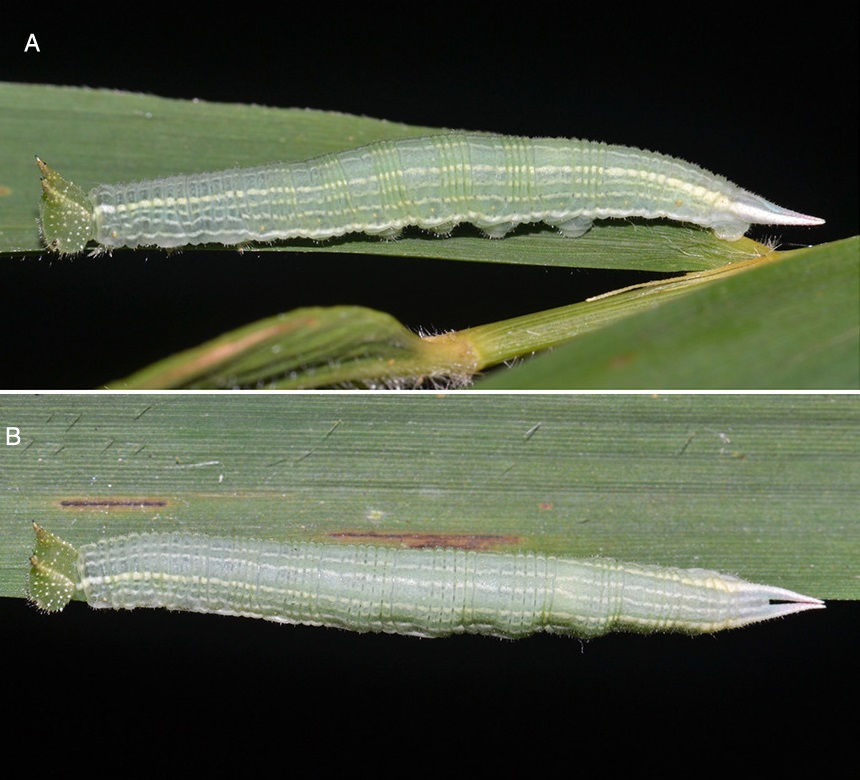
Fig. 5. Immature stages of Cristalinaia vitoria gen. et sp. nov. Last instar: (A) lateral, (B) dorsal, (C) frontal view of last instar head capsule. Pupa: (D) dorsal, (E) lateral.

Cristalinaia vitoria Mota, Zacca & Freitas sp. nov.

Diagnosis. Cristalinaia vitoria sp. nov. superficially resembles several other species of Euptychiina (e.g. Pareuptychia species, Pseudeuptychia species, Splendeuptychia toynei Willmott & Hall, 1995, S. aurigera (Weymer, [1911]), S. triangula (Aurivillius, 1929)) by the white ground color on the wings, but it can be easily distinguished from them by the incomplete median line and four tiny ocelli from M1 to CuA2 on the VFW, by the five VHW ocelli between M1 to 2A that have a very broad orange ocellar ring and black ocellar spot in the distal half of ring plus a very small ocelli in Rs-M1, and the broadened VHW reddish brown marginal line forming crescents in each cell.

Distribution. Cristalinaia vitoria sp. nov. is known only from its type locality in the region of Cristalino Lodge, Alta Floresta, northern Mato Grosso. The site is a private protected area (the “Reserva Particular do Patrimônio Natural Cristalino”).


Etymology. The specific name is after Vitoria da Riva Carvalho, in recognition of her pioneering work on the conservation of the southern Amazon, and founder of the Cristalino group (which includes the “Fundação Ecológica Cristalino”, Cristalino Lodge and Cristalino Private Natural Heritage Reserves). The specific epithet should be considered feminine and indeclinable in accordance to the Article 31.2.3 (ICZN, 1999).


 André V.L. Freitas, Luísa L. Mota, Thamara Zacca and Eduardo P. Barbosa. 2019. Description of A New and Highly Distinctive Genus and Species of Euptychiina (Lepidoptera: Nymphalidae: Satyrinae) from the Brazilian southern Amazon. Revista Brasileira de Entomologia. In Press. DOI: 10.1016/j.rbe.2019.05.004 

Tuesday, February 5, 2019

[Entomology • 2019] Amiga gen. n. • A Revision of the New Genus Amiga, described for Papilio arnaca Fabricius, 1776 (Lepidoptera, Nymphalidae, Satyrinae)


Amiga Nakahara, Willmott & Espeland

[upper] Amiga arnaca indianacristoi ssp. n. in nature, Altos de Pipe, Miranda, Venezuela

[lower] 
A. arnaca adela from Costa Rica, male; j A. arnaca adela from Costa Rica, female; 
A. arnaca adela from W Ecuador, holotype male; l A. arnaca adela from W Ecuador, female;

A. arnaca sericeella, male from Mexico; n A. arnaca sericeella from Mexico, female; 

o A. arnaca indianacristoi from NW Venezuela, paratype male; p A. arnaca indianacristoi from N Venezuela, paratype female.


in Nakahara, Lamas, Tyler, Marín, Huertas, et al., 2019. 

Abstract
We here propose a new, monotypic genusAmiga Nakahara, Willmott & Espeland, gen. n., to harbor a common Neotropical butterfly, described as Papilio arnaca Fabricius, 1776, and hitherto placed in the genus Chloreuptychia Forster, 1964. Recent and ongoing molecular phylogenetic research has shown Chloreuptychia to be polyphyletic, with C. arnaca proving to be unrelated to remaining species and not readily placed in any other described genus. Amiga arnaca gen. n. et comb. n. as treated here is a widely distributed and very common species ranging from southern Mexico to southern Brazil. A neotype is designated for the names Papilio arnaca and its junior synonym, Papilio ebusa Cramer, 1780, resulting in the treatment of the latter name as a junior objective synonym of the former. A lectotype is designated for Euptychia sericeella Bates, 1865, which is treated as a subspecies, Amiga arnaca sericeella (Bates, 1865), comb. n. et stat. n., based on molecular and morphological evidence. We also describe two new taxaAmiga arnaca adela Nakahara & Espeland, ssp. n. and Amiga arnaca indianacristoi Nakahara & Marín, ssp. n.new subspecies from the western Andes and eastern Central America, and northern Venezuela, respectively.

Keywords: DNA barcodes, Euptychiina, species delimitation, subspecies, systematics, taxonomy

Figure 2. Amiga arnaca spp. specimens spanning its range (dorsal on left, ventral on right):
a nominotypical subspecies from Suriname, neotype male (USNM) b nominotypical subspecies from Guyana, female (FLMNH-MGCL 263373) c nominotypical subspecies from E Ecuador, male (FLMNH-MGCL 257121) d nominotypical subspecies from Peru, female (FLMNH-MGCL 262953); e nominotypical subspecies from N Brazil, male (FLMNH-MGCL1036223) f Nominotypical subspecies from N Brazil, female (FLMNH-MGCL 207984) g Nominotypical subspecies from SE Brazil, male (FLMNH-MGCL 1036213); h nominotypical subspecies from SE Brazil, female (FLMNH-MGCL 1036218)

A. arnaca adela from Costa Rica, male (FLMNH-MGCL 207991) j A. arnaca adela from Costa Rica, female (FLMNH-MGCL 207992) k A. arnaca adela from W Ecuador, holotype male (FLMNH-MGCL 151127) l A. arnaca adela from W Ecuador, female (FLMNH-MGCL 257087) m A. arnaca sericeella, male from Mexico (FLMNH-MGCL 207900) n A. arnaca sericeella from Mexico, female (FLMNH-MGCL 207896) o A. arnaca indianacristoi from NW Venezuela, paratype male (FLMNH-MGCL 263107) p A. arnaca indianacristoi from N Venezuela, paratype female (FLMNH-MGCL 1036235).

Amiga Nakahara, Willmott & Espeland, gen. n.

Papilio arnaca Fabricius, 1776, 
by present designation

Systematic placement and diagnosis: 
Espeland et al. (2019) recovered Amiga arnaca comb. n. as sister to the “Pareuptychia clade”, whose composition partially corresponded to that found in Peña et al. (2010), with a high support (BS and PP > 0.95). The “Pareuptychia clade” itself was also well supported (BS and PP > 0.95), including Satyrotaygetis satyrina (Bates, 1865), Magneuptychia inani (Staudinger, [1886]), Euptychoides albofasciata (Hewitson, 1869), Neonympha areolatus (Smith, 1797), Erichthodes antonina (C. Felder & R. Felder, 1867), Pareuptychia ocirrhoe (Fabricius, 1776), Megeuptychia antonoe (Cramer, 1775), Splendeuptychia doxes (Godart, [1824]), Nhambikuara mima (Butler, 1867), and Euptychoides eugenia (C. Felder & R. Felder, 1867). Amiga gen. n. is distinguished from all members of the “Pareuptychia clade” by the presence of bluish-lilac coloration on the dorsal hindwing and by the purplish sheen in the tornal half of the VHW. Furthermore, the absence of cornuti and membranous lamella antevaginalis of Amiga gen. n. appear to be unusual character states among the clade. The type species of Chloreuptychia, Papilio chloris Cramer, 1780 (= Chloreuptychia chlorimene) was recovered as sister to a moderately supported (BS and PP > 0. 75 < 0. 95), clade including the “Pareuptychia clade”, “Taygetis clade”, “Splendeuptychia clade” and “Archeuptychia clade”.

Etymology: The new generic name is derived from the feminine Spanish noun “amiga”, meaning “a (female) friend”, alluding to the fact that this is a common, familiar butterfly. The generic name is regarded as feminine.

Distribution: This genus ranges from southern Mexico throughout virtually all of tropical Central and South America, where its southernmost distribution appears to be southern Brazil.


Taxonomy: 
Amiga gen. n. is regarded as monotypic, with total of four subspecies recognized, of which two are named and described herein.

Amiga Nakahara, Willmott & Espeland, gen. n.
(– denotes a subspecies, – – denotes a synonym)

Amiga arnaca (Fabricius, 1776) comb. n.
– –ebusa (Cramer, 1780)
– –priamis (D’Almeida, 1922)

Amiga arnaca adela Nakahara & Espeland, ssp. n.

Amiga arnaca sericeella (Bates, 1865) comb. n. et stat. n.

Amiga arnaca indianacristoi Nakahara & Marín, ssp. n.

Figure 7. Amiga arnaca indianacristoi ssp. n. in nature, Altos de Pipe, Miranda, Venezuela

(photographed by Indiana Cristóbal Ríos-Málaver,
 on 11 September 2011). 

Amiga arnaca indianacristoi Nakahara & Marín, subsp. n.

Etymology: This new species-group name is proposed in recognition of our friend and colleague, Indiana Cristóbal Ríos-Málaver, known as “Indiana Cristo”, who studied the butterflies of the area where this taxon occurs. Indiana Cristo has contributed to Neotropical lepidopterology in various ways, especially through social media, where he is bringing lepidopterology to the public. This species-group name is treated as a latinized masculine noun in the genitive case.

Distribution: This taxon occurs in the Venezuelan Cordillera de la Costa and northwestern Cordillera de Mérida, and possibly also into the Serranía de Perijá.


 Shinichi Nakahara, Gerardo Lamas, Stephanie Tyler, Mario Alejandro Marín, Blanca Huertas, Keith R. Willmott, Olaf H. H. Mielke and Marianne Espeland. 2019. A Revision of the New Genus Amiga Nakahara, Willmott & Espeland, gen. n., described for Papilio arnaca Fabricius, 1776 (Lepidoptera, Nymphalidae, Satyrinae). ZooKeys. 821: 85-152. DOI: 10.3897/zookeys.821.31782

Monday, February 5, 2018

[Entomology • 2018] Molecular Systematics of the Subfamily Limenitidinae (Lepidoptera: Nymphalidae)


  Subfamily Limenitidinae

 Examples of butterflies; 
Parthenos sylviaCymothoe caenisEuriphene tademaEuphaedra herbertiPseudacraea poggeiLebadea marthaNeptis idaLimenitis reducta and Adelpha californica

in Dhungel & Wahlberg,. 2018.

Abstract
 We studied the systematics of the subfamily Limenitidinae (Lepidoptera: Nymphalidae) using molecular methods to reconstruct a robust phylogenetic hypothesis. The molecular data matrix comprised 205 Limenitidinae species, four outgroups, and 11,327 aligned nucleotide sites using up to 18 genes per species of which seven genes (CycY, Exp1, Nex9, PolII, ProSup, PSb and UDPG6DH) have not previously been used in phylogenetic studies. We recovered the monophyly of the subfamily Limenitidinae and seven higher clades corresponding to four traditional tribes Parthenini, Adoliadini, Neptini, Limenitidini as well as three additional independent lineages. [CymothoiniPseudoneptini and Pseudacraeini] One contains the genera Harma Cymothoe and likely a third, Bhagadatta, and the other two independent lineages lead to Pseudoneptis and to Pseudacraea. These independent lineages are circumscribed as new tribes. Parthenini was recovered as sister to rest of Limenitidinae, but the relationships of the remaining six lineages were ambiguous. A number of genera were found to be non-monophyletic, with Pantoporia, Euthalia, Athyma, and Parasarpa being polyphyletic, whereas Limenitis, Neptis, Bebearia, Euryphura, and Adelpha were paraphyletic.

Figure 1: The Maximum Likelihood topology for Limenitidinae with associated bootstrap values. Major lineages that are considered tribes in this paper are coloured.
Examples of butterflies (voucher specimens for this work) from top: Parthenos sylviaCymothoe caenisEuriphene tademaEuphaedra herbertiPseudacraea poggeiLebadea marthaNeptis idaLimenitis reducta and Adelpha californica.

Conclusion: 
This study presents the most comprehensive phylogenetic analysis to date for the “trash-can” subfamily Limenitidinae. Based on fragments of up to 18 genes per species, 205 species and four outgroups, our results recovered Limenitidinae as a monophyletic clade and which comprises seven major lineages that deserve tribal status. Four tribes have been traditionally recognized: Parthenini, Neptini, Adoliadini, and Limenitidini, while three lineages are placed in new tribes here: Cymothoini, Pseudoneptini and Pseudacraeini. The new Cymothoini tribe includes two African genera Cymothoe and Harma, and quite likely an Asian genus Baghadatta. The latter two new tribes are monogeneric. At the genus level, we found several traditionally recognized genera to be either poly- or paraphyletic, i.e., Neptis, Euryphura, Pantoporia, Athyma, Parasarpa, Limenitis, and Adelpha. Further work increasing the taxon sampling is necessary to test the monophyly of these genera and revise their limits.


Bidur Dhungel and Niklas Wahlberg​. 2018. Molecular Systematics of the Subfamily Limenitidinae (Lepidoptera: Nymphalidae).    PeerJ. 6:e4311.  DOI: 10.7717/peerj.4311

Tuesday, August 1, 2017

[Entomology • 2017] Remarkable Sexual Dimorphism, Rarity and Cryptic Species: A Revision of the ‘aegrota species group’ of the Neotropical Butterfly Genus Caeruleuptychia Forster, 1964 (Lepidoptera, Nymphalidae, Satyrinae) with the Description of Three New Species


male Sunburst Cerulean-Satyr, Caeruleuptychia helios  (Weymer, 1911)


Abstract

The ‘aegrota species group’ of the Neotropical nymphalid genus Caeruleuptychia Forster, 1964, in addition to three other superficially similar, enigmatic species in the genus, are revised. A lectotype is designated for Euptychia aegrota Butler, 1867, E. aetherialis Butler, 1877 stat. rev.E. helios Weymer, 1911 and E. pilata Butler, 1867, and C. aetherialis is resurrected from its synonymy with C. aegrotaCaeruleuptychia helios caelestissima Brévignon, 2010, syn. nov., and Magneuptychia keltoumae Brévignon & Benmesbah, 2012, syn. nov. are both regarded as junior subjective synonyms of C. helios (Weymer, 1911), as a result of the discovery and first illustration of the female of this taxon. The female of C. aegrota is also described and illustrated for the first time, and three new speciesCaeruleuptychia trembathi Willmott, Nakahara, Hall & Neild, sp. nov.C. scripta Nakahara, Zacca & Huertas, sp. nov., and C. maryzenderae Lamas & Nakahara, sp. nov. are described and named. We analyze morphological and molecular data separately, in addition to combining morphological data with molecular data, to provide the first phylogenetic hypothesis for the taxa treated in this revision.

Keywords: eastern Andes; Amazonian forest; DNA barcode; synonym; taxonomy; Euptychiina; lectotype; Magneuptychia

   
The iridescent blue male sunburst cerulean-satyr, Caeruleuptychia helios, top, was not linked with its female counterpart until DNA bar codes showed they were the same species.
 photos by Shinichi Nakahara, Florida Museum of Natural History

This iridescent blue male sunburst cerulean-satyr, Caeruleuptychia helios, was found at Villa Carmen Biological Station in Peru. Researchers attracted the butterfly with fermented fish and human urine.
Photo: Andrew Neild 

Caeruleuptychia trembathi  Willmott, Nakahara, Hall & Neild, 2017

DNA barcoding also revealed a new species: Trembath’s cerulean-satyr, or Caeruleuptychia trembathi. The male, top, is also strikingly different than the female.
 photos of male by Keith Willmott; photos of female by Andrew Neild 
  

Shinichi Nakahara, Thamara Zacca, Blanca Huertas, Andrew F. E. Neild, Jason P. W. Hall, Gerardo Lamas, Lauren A. Holian, Marianne Espeland and Keith R. Willmott. 2017. Remarkable Sexual Dimorphism, Rarity and Cryptic Species: A Revision of the ‘aegrota species group’ of the Neotropical Butterfly Genus Caeruleuptychia Forster, 1964 with the Description of Three New Species (Lepidoptera, Nymphalidae, Satyrinae).  Insect Systematics & Evolution. DOI: 10.1163/1876312x-00002167

A case of mistaken identity: DNA links male, female butterfly thought to be distinct species.

Monday, May 22, 2017

[Entomology • 2017] Phylogeny and Diversification of the Cloud Forest Morpho sulkowskyi Group (Lepidoptera, Nymphalidae) in the Evolving Andes


Abstract

The monophyletic Morpho sulkowskyi butterfly group, endemic of Andean cloud forests, was studied to test the respective contributions of Mio-Pliocene intense uplift period and Pleistocene glacial cycles on Andean biodiversity. We sampled nine taxa covering the whole geographical range of the group. Two mitochondrial and two nuclear genes were analysed using a Bayesian method. We established a dated phylogeny of the group using a relaxed clock method and a wide-outgroup approach. To discriminate between two hypotheses, we used a biogeographical probabilistic method. Results suggest that the ancestor of the M. sulkowskyi group originated during the Middle–Late Miocene uplift of the Eastern Cordillera in northern Peru. Biogeographical inference suggests that the M. sulkowskyi and Morpho lympharis clades diverged in the northern Peruvian Andes. The subsequent divergences, from the Late Miocene to the Late Pliocene, should have resulted from a dispersal towards the Northern Andes (M. sulkowskyi clade), after the closure of the West Andean Portal separating the Central and Northern Andes, and a southwards dispersal along the Peruvian and Bolivian Eastern Cordilleras (M. lympharis clade). Only a few divergences occurred at the very end of the Pliocene or during the Pleistocene, a period when the more recent uplifts interfered with Pleistocene glacial cycles.

Figure 1.  Map of the region where field studies were carried out, with habitus of the taxa calderoni, zachi and nieva (m: male; f: female; f1 and f2: female morphs within the calderoni population). N1 and N2: sampling areas along the upper Río Nieva. Other localities where specimens were collected: AP: Abra Patricia; EF: El Afluente; OP: Oso Perdido; PM: Abra Pardo Miguel; V: Venceremos. Two specimens of nieva were also collected at Santa Cruz del Mirador (M), at ca. 20 km ESE from El Afluente. 

Conclusions
Simple relationships between Andean uplift and the diversification of various plant and animal groups, implying pre-Pleistocene driving processes, have been supposed by various authors. Doan (2003), for example, proposed the south-to-north speciation hypothesis, where the process of speciation should be related to the south-to-north progression of uplift throughout the Andes. Other authors emphasized the possible role of a rapid uplift that occurred during the Late Miocene and Early Pliocene, but often without establishing clear links between dated divergences and local geologic events (e.g. Casner & Pyrcz 2010; Mulch et al. 2010; Matos-Maraví et al. 2013; Lagomarsino et al. 2016). From a geological point of view, the concept of a progressive, general south-to-north uplift is an oversimplified view of a much more complex reality (Sempere et al. 2008). In the Central Andes, palaeo-elevation histories differ not only between the south and the north, but also between the western and the eastern cordilleras, notably in northern Peru (Picard et al. 2008; Eude et al. 2015; Margirier et al. 2015). The idea that the Northern Andes, as a whole, uplifted later than the Central Andes, as suggested by Doan (2003), and often admitted by other authors, is not supported by geological studies that also demonstrate that the timing of palaeo-elevation differed between the three Colombian Cordilleras (Restrepo- Moreno et al. 2009). Consistent with many other examples, notably the clearwing Oleriina butterflies (De-Silva et al. 2016), the M. sulkowskyi group illustrates the diversity of diversification histories throughout the Andes. It also demonstrates that Mio-Pliocene orogenic and Pleistocene climatic diversification drivers should not be opposed.


Romain Nattier, Claire Capdevielle-Dulac, Catherine Cassildé, Arnaud Couloux, Corinne Cruaud, Gilbert Lachaume, Gerardo Lamas, Jean-François Silvain and Patrick Blandin. 2017. Phylogeny and Diversification of the Cloud Forest Morpho sulkowskyi Group (Lepidoptera, Nymphalidae) in the Evolving Andes.  Zoologica Scripta.  DOI: 10.1111/zsc.12226