Showing posts with label Author: V. Suteethorn. Show all posts

Sunday, March 23, 2025

[Paleontology • 2021] Yakemys multiporcata • A large Macrobaenid Turtle (Cryptodira: Macrobaenidae) from the Basal Cretaceous of Thailand, with a Review of the Turtle Fauna from the Phu Kradung Formation and Its Stratigraphical Implications


Yakemys multiporcata 
 Tong, Chanthasit, Naksri, Ditbanjong, S. Suteethorn, Buffetaut, V. Suteethorn, Wongko, Deesri & Claude. 2021 
  
ยักษ์คีมิส มัลติพอร์คาตา  | เต่ายักษ์ หมวดหินภูกระดึง  ||  DOI: doi.org/10.3390/d13120630 

Abstract
Yakemys multiporcata n. g. n. sp. is described on the basis of shell elements from the upper part of the Phu Kradung Formation (basal Cretaceous), Khorat Plateau, NE Thailand and assigned to Macrobaenidae. The new taxon is unusually large for an early macrobaenid (with an estimated carapace length about 70 cm) and is characterized by a large, rounded, low shell, the presence of a midline keel and numerous additional strong ridges on the carapace, the anterolateral margin upturned to form a gutter, posterolateral peripherals mesiolaterally expanded, narrow vertebrals, the vertebral 4 triangular and narrowed posteriorly, a greatly reduced plastron with a short bridge, an oval and elongate entoplastron with reduced ventral exposure, and strip-shaped epiplastra. The discovery of a macrobaenid turtle provides further support for an Early Cretaceous age for the upper part of the Phu Kradung Formation.  

Keywords: Testudines; Macrobaenidae; Yakemys multiporcata; Phu Kradung Formation; Early Cretaceous; Khorat Plateau; Thailand
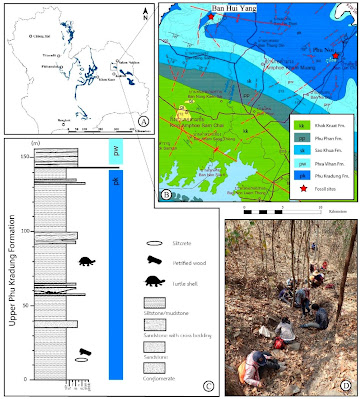
  (A), Map of northern Thailand showing location of Sam Chai area, and outcrops of the Phu Kradung Formation; (B): Geological map of Sam Chai area (modified from [Bumrungsong & Yamunsabideen, 2009]; (C): Stratigraphical column of Ban Hui Yang site; (D): Field work.


 Yakemys multiporcata n. g. n. sp. from the upper part of the Phu Kradung Formation (basal Cretaceous) of Khorat Plateau, NE Thailand. Holotype (SM KS39) from Ban Hui Yang locality, Sam Chai District, Kalasin Province.
(A, B) Carapace in dorsal view; (C, D) shell in ventral view; (E) detail of ornamentation of the carapace surface (on costal 2, indicated by a white rectangle on A), and (F) neural 6–8 with adjacent costal fragments in ventral view.
 Scale bar = 10 cm for (A–D,F) and 2 cm for (E). 
Abbreviations: co, costal plate; Ma, marginal scute; n, neural plate; pe, peripheral plate; py, pygal plate; spy, suprapygal plate; V, vertebral scute.

Testudines Linnaeus, 1758
Cryptodira Cope, 1868
Macrobaenidae Sukhanov, 1964

Yakemys multiporcata n. gen. n. sp.

Diagnosis: A genus of Macrobaenidae of large size, with the carapace length about 70 cm and a combination of characters that differs from all other Macrobaenidae as follows: narrow vertebral scutes; vertebral 4 triangular and narrowed posteriorly, strong midline keel extending to the suprapygal 2, large lateral longitudinal keels on the vertebral region, and additional ridges on the pleural region; plastron reduced, with a triangular short anterior lobe, epiplastron reduced to a strip-shaped plate, entoplastron oval in dorsal view but with a much reduced ventral exposure and an extremely reduced bridge that is shorter than the anterior lobe.

Etymology: Genus name from Yak, giant in Thai (ยักษ์); species name from Latin “multi”: multiple; porcata: from Latin “porca”, ridge.


Conclusions: 
Yakemys multiporcata n. g. n. sp. represents one of the earliest Macrobaenidae hitherto known, and this finding extends the paleogeographical distribution of the group to SE Asia. The discovery of a macrobaenid turtle in Thailand provides further support for the Early Cretaceous age of the upper part of the Phu Kradung Formation and the new evidence of faunal exchange between the SE Asia and more northern parts of mainland Asia at the very beginning of the Cretaceous. Yakemys multiporcata commonly occurs together with Basilochelys macrobios, although both turtles were likely aquatic animals as indicated by their low shell; the different morphology of the shell, especially the plastron, suggests that these turtles had different modes of life. Further discovery of more complete material, especially skull and limb bones, is expected for a better understanding of the phylogenetic relationships and the lifestyle of this strange turtle.


Haiyan Tong, Phornphen Chanthasit, Wilailuck Naksri, Pitaksit Ditbanjong, Suravech Suteethorn, Eric Buffetaut, Varavudh Suteethorn, Kamonlak Wongko, Uthumporn Deesri and Julien Claude. 2021. Yakemys multiporcata n. g. n. sp., a large Macrobaenid Turtle from the Basal Cretaceous of Thailand, with a Review of the Turtle Fauna from the Phu Kradung Formation and Its Stratigraphical Implications. Diversity. 13(12), 630. DOI: doi.org/10.3390/d13120630 
    facebook.com/fossilworld/posts/4864491833572637  ยักษ์คีมิส มัลติพอร์คาตา

Thursday, July 13, 2023

[Paleontology • 2023] Minimocursor phunoiensis • A New Basal Neornithischian Dinosaur from the Phu Kradung Formation (Upper Jurassic) of Northeastern Thailand


Minimocursor phunoiensis  
Manitkoon, Deesri, Khalloufi, Nonsrirach, Suteethorn, Chanthasit, Boonla & Buffetaut, 2023

มินิโมเคอร์เซอร์ ภูน้อยเอนซิส  ||  DOI: 10.3390/d15070851
Drawings by Wongwech Chowchuvech and Sita Manitkoon. 

Abstract
An exceptional articulated skeleton of a new basal neornithischian dinosaur, Minimocursor phunoiensis gen. et sp. nov., was discovered in the Late Jurassic Phu Kradung Formation at the Phu Noi locality, Kalasin Province, Thailand, a highly productive non-marine fossil vertebrate locality of the Khorat Plateau. It is one of the best-preserved dinosaurs ever found in Southeast Asia. Minimocursor phunoiensis gen. et sp. nov. shows a combination of both plesiomorphic and apomorphic characters resembling those of Late Jurassic to Early Cretaceous small-bodied ornithischians from China: a low subtriangular boss is projected laterally on the surface of the jugal, the brevis shelf of the ilium is visible in lateral view along its entire length, a distinct supraacetabular flange is present on the pubic peduncle of the ilium, the prepubis tip extends beyond the distal end of the preacetabular process of the ilium, and the manus digit formula is ?-3-4-3-2. The phylogenetic analysis shows that this dinosaur is among the most basal neornithischians. This study provides a better understanding of the early evolution and taxonomic diversity of ornithischians in Southeast Asia.

Keywords: ornithischia; Southeast Asia; Khorat Plateau; Late Jurassic; Minimocursor phunoiensis


Skull of Minimocursor phunoiensis gen. et sp. nov. based on PRC 150 in left lateral view. Outline reconstruction of the skull (A); outline reconstruction of the skull with photos of the jugal (reversed), surangular, and angular (B); right jugal (C); and left surangular and angular (D). Scale bars: 1 cm.

Left dentary (PRC 149) referred to Minimocursor phunoiensis gen. et sp. nov. from Phu Noi locality in labial (A), dorsal (B), and lingual views (C). Dentary teeth in labial (D) and lingual (E) views.

Holotype of Minimocursor phunoiensis gen. et sp. nov., PRC 150, in left lateral view.
Photograph (A) and interpretative drawing (B).

Reconstruction of Minimocursor phunoiensis gen. et sp. nov. (PRC 150) in left lateral view (except reversed images of the right jugal). Recovered elements of the holotype shown in white (A); holotype with referred materials, which are not to scale, shown in light purple (B); and life restoration (C).
Drawings by Wongwech Chowchuvech (A, B) and Sita Manitkoon (B).


Systematic Palaeontology

Dinosauria Owen, 1842 
Ornithischia Seeley, 1888  
Neornithischia Cooper, 1985  
 
Minimocursor gen. nov.
 
Minimocursor phunoiensis gen. et sp. nov.

Diagnosis. Ornithischian dinosaur distinguished by a unique combination of plesiomorphic and apomorphic characters resembling those of basal neornithischians: jugal posterior process bifurcated distally (present in Lesothosaurus, Jeholosaurus, Psittacosaurus, and some early thyreophorans including Emausaurus and Scelidosaurus); a low flattened subtriangular boss projects laterally on the surface of the jugal (report in Changchunsaurus, and some early ornithischians including Manidens and Lioceratops); the pre-caudal axial skeleton is composed of 15 dorsals and 5 sacrals (presente in Lesothosaurus, Agilisaurus and Hexinlusaurus); the brevis shelf of the ilium is visible in lateral view along its entire length (present in Agilisaurus, Sanxiasaurus and Lesothosaurus); a distinct supraacetabular flange is present on the pubic peduncle of the ilium (present in Agilisaurus, Sanxiasaurus, and some early thyreophorans including Scutellosaurus and Scelidosaurus).

Type locality and horizon. Phu Noi locality (a small hill as the Thai name indicates), Ban Din Chi Sub-district, Kham Muang District, Kalasin Province, Thailand; Upper Jurassic Phu Kradung Formation, Khorat Group. This locality is part of the Kalasin Geopark area.

Etymology. The generic name is from the Latin ‘minimus’, ‘the smallest’, referring to the holotype individual, which is smaller than any other neornithischians from the site, combined with the suffix ‘-cursor’, the Latin word for runner. The specific epithet is derived from the excavation site, Phu Noi.

Articulated dorsal vertebrae of Minimocursor phunoiensis gen. et sp. nov., PRC 150, with close-up on the ossified tendons, under UV light.

Locality map and stratigraphy of Phu Noi locality, which has yielded the holotype of Minimocursor phunoiensis gen. et sp. nov. Map of Thailand, showing the location of Bangkok and Kalasin Province (A); map of Khorat Plateau, showing the distribution of the Lower Phu Kradung Formation and the location of Phu Noi locality (red star) (B); stratigraphic column of Phu Noi (modified from [26]) (C); photograph of the excavation site in 2023 (D).


Palaeoenvironmental interpretation of the Late Jurassic Phu Kradung Formation of northeastern Thailand, including
hybodont indet. with egg capsules (A), Acrodus kalasinensis (B), ptycholepid indet. (C), Isanichthys lertboosi (D), Ferganoceratodus annekempae (E), brachyopid indet. (F), Phunoichelys thirakupti (G), Kalasinemys prasarttongosothi (H), Indosinosuchus potamosiamensis (I), mamenchisaurid indet. (J), metriacanthosaurid indet. (K), stegosaur indet. (L), Minimocursor phunoiensis (M), and rhamphorhynchoid indet. (N).
 Drawing by Sakka Weerataweemat.

Conclusions
The Phu Noi locality contains a wealth of specimens and has yielded an exceptionally articulated skeleton, which represents one of the best-preserved dinosaurs ever found in Southeast Asia. This is the earliest record of neornithischians in Southeast Asia, and the first dinosaur taxon named from the Phu Kradung Formation of Thailand. This finding increases diversity and helps to elucidate the evolution of basal neornithischian dinosaurs in this region. Many of the remaining bones are still under preparation, including another skull. These unpublished specimens may provide a better understanding of the biology of Minimocursor phunoiensis gen. et sp. nov. in the future.
This study also provides new palaeontological data to illustrate the palaeoecosystem to the general public, as well as improving the academic value of the Kalasin Geopark.


  Sita Manitkoon, Uthumporn Deesri, Bouziane Khalloufi, Thanit Nonsrirach, Varavudh Suteethorn, Phornphen Chanthasit,Wansiri Boonla and Eric Buffetaut. 2023. A New Basal Neornithischian Dinosaur from the Phu Kradung Formation (Upper Jurassic) of Northeastern Thailand. Diversity. 15(7), 851. DOI: 10.3390/d15070851
  facebook.com/PaleoToon/posts/787863516672516
 (This article belongs to the Collection Feature Papers in Phylogeny and Evolution)


Friday, February 17, 2023

[Paleontology • 2023] The First Fossil Coelacanth from Thailand (Cretaceous, Phu Kradung Formation)


A left angular (PRC 160)
Mawsoniidae indeterminate

in Cavin, Tong, Buffetaut, Wongko, Suteethorn & Deesri, 2023. 

Abstract
Mawsoniidae is a family of coelacanths restricted to the Mesozoic. During the Cretaceous, mawsoniids were mainly represented by the Mawsonia/Axelrodichthy complex, long known to be from western Gondwana only (South America and Africa). This apparent biogeographical distribution then faded following the discovery of representatives in the Late Cretaceous of Laurasia (Europe and North America). We report here the presence, in the Lower Cretaceous site of Kham Phok, NE Thailand, of an angular bone referred to the Mawsonia/Axelrodichthys complex. A comparison with angulars referring to both genera found in various regions of the world between the Late Jurassic and the Late Cretaceous indicated that the distinctions between these genera, and even more so between their constituent species, are unclear. This discovery is further confirmation of the very slow morphological evolution within this lineage, which may explain why their evolutionary history appears to be disconnected, at least in part, from their geographical distribution over time.

Keywords: Actinistia; Mawsoniidae; paleobiogeography; angular; Khorat Plateau; Early Cretaceous; AxelrodichthysMawsonia

 Systematic Paleontology
Actinistia Cope, 1871 
Latimerioidei Schultze, 1993 
Mawsoniidae Schultze, 1993  

Mawsoniidae indeterminate

Referred material: A left angular associated with a dermal skull bone (supraorbital?) (PRC 160) from the Kham Phok fossil site.

Locality and horizon: Kham Phok, Khamcha-i district, Mukdahan Province, upper part of the Phu Kradung Formation, basal Cretaceous.

 Comparison in labial (a–k) and lingual (a’–k’) views between left angular PRC 160, Kham Phok locality ((g), framed in red), and other angulars referred to the Mawsonia/Axelrodichthys complex, discovered in various parts of the world dated between the Late Jurassic and the Late Cretaceous (red spots). Remark: Specimens i and j, figured by Cupello et al. [2016] and Batista et al. [2019] are both from a formation called Missão Velha and Brejo Santo, respectively, with an uncertain age of the Late Jurassic or Late Cretaceous. (a) A. megadromos, Southern France, terminal Cretaceous (inverted); (b) M. sp., USA, Woodbine Fm. (inverted); (c), A. lavocati, Northern Africa, ‘Continental Intercalaire’; (d) A. araripensis, Brazil, Santana Fm. (inverted); (e) M. gigas, Brazil, Marfim Fm.; (f) M. gigas, Brazil, Sanfranciscana Fm. (inverted); (h) mawsoniid indet., UK, Kimmeridge Clay; (i) mawsoniid indet., Brazil, MissãoVelha/Brejo Santo Fm.; (j) M. gigas, Brazil, MissãoVelha/Brejo Santo Fm. (inverted); (k) M. gigas, Brazil, Taruarembó Fm. Data from Cavin et al. (2021). Orange spots indicate other mawsoniid remains, not detailed here. The main anatomical structures are figured with colored areas.
Abbreviations: a.f, adductor fossa (blue); con.Part, contact surface with prearticular (red); gr.VII.m.ext groove for external mandibular ramus of VII (green); l.f, longitudinal fossa (orange); m.s.c, mandibular sensory canal (yellow); sut.p.Co, sutural contact surface with principal coronoid (purple); sut.De: sutural surface for dentary (pink); sut.Spl: sutural surface for splenial (grey).

Conclusions: 
The discovery of a mawsoniid coelacanth in the Lower Cretaceous of Thailand is an important new addition to the already rich vertebrate assemblages of the Phu Kradung Formation and, more generally, the Jurassic–Early Cretaceous assemblages of the Khorat Group. On a global scale and on the scale of tens of millions of years, this new occurrence blurs the palaeobiogeographical model previously proposed for this clade. It questions both the vicariance and dispersal events previously proposed to explain the observed distribution. The recognition of the coelacanths as forming a slowly evolving clade, in particular the mawsoniid clade, can explain the disconnection between the phylogenetic pattern and the paleobiogeographical framework, whereas such a connection is normally expected in biogeographical studies. One way to test this scenario is (1) to attempt to build a stronger phylogeny based on a re-study of known and hopefully new material and (2) to better decipher the Cenozoic evolutionary history of the extant coelacanth, Latimeria, which shows a split of species between 30 and 40 million years ago associated with almost no morphological differentiation and therefore represents a good model to better understand the Cretaceous mawsoniid case.


 Lionel Cavin, Haiyan Tong, Eric Buffetaut, Kamonlak Wongko, Varavudh Suteethorn  and Uthumporn Deesri. 2023. The First Fossil Coelacanth from Thailand. Diversity. 15(2), 286. DOI: 10.3390/d15020286  (This article belongs to the Special Issue Evolution and Diversity of Fishes in Deep Time)

Tuesday, May 5, 2020

[Paleontology • 2019] Kalasinemys prasarttongosothi • A New Xinjiangchelyid Turtle (Cryptodira: Xinjiangchelyidae) from the Late Jurassic of NE Thailand


Kalasinemys prasarttongosothi  
Tong, Naksri, Buffetaut, S. Suteethorn, V. Suteethorn, Chantasit & Claude, 2019

‘กาฬสินธุ์นีมิส ปราสาททองโอสถถิ’ DOI: 10.1017/S0016756818000791

Abstract
A new xinjiangchelyid turtle, Kalasinemys prasarttongosothi n. gen. n. sp., is described on the basis of skull and shell material from the Upper Jurassic Phu Kradung Formation at Phu Noi locality, Kalasin Province, in NE Thailand. This second xinjiangchelyid turtle from Phu Noi is distinct from Phunoichelys thirakhupti by the smooth shell surface, the presence of a cervical notch, and vertebral 1 narrower than nuchal. The skull presents an arterial system characteristic of the Xinjiangchelyidae (basal Eucryptodira), and its outline is similar to that of Annemys spp. known from the Middle–Late Jurassic of China and Mongolia, but distinct from the latter mainly by the wider triturating surface, smaller foramen palatinum posterius and the shape of the prefrontal and frontal, as well as that of the basisphenoid and basioccipital. Based on the turtle assemblages, the correlation with mainland Asia further supports a Late Jurassic age for the lower part of the Phu Kradung Formation where Phu Noi site is located stratigraphically. Our study provides new insight on the evolution of the basal eucryptodiran turtles in Asia.

Keywords: Testudines; Xinjiangchelyidae; Kalasinemys; systematic; Phu Kradung Formation; Late Jurassic; Thailand


Fig. 1. Kalasinemys prasarttongosothi n. gen. n. sp. (KS34-190, holotype) from the Phu Kradung Formation, Phu Noi locality, Kalasin Province, Thailand.
Carapace and skull in dorsal view (a, b); plastron in ventral view (c, d).
Scale bar = 5 cm.

Fig. 2. Kalasinemys prasarttongosothi n. gen. n. sp. (KS34-190, holotype) from the Phu Kradung Formation, Phu Noi locality, Kalasin Province, Thailand.
 Skull in dorsal (a, b), ventral (c, d), left lateral (e, f) and right lateral (g, h) views.
Scale bar = 2 cm. 
Abbreviations: bo, basioccipital; bpp, basipterygoid process; bs, basisphenoid; cm, condylus mandibularis; co, condylus occipitalis; ex, exoccipital; facci, foramen anterius canalis carotici interni; fpccc, foramen posterius canalis carotici cerebralis; fpcci, foramen posterius canalis carotici interni; fpccp, foramen posterius canalis carotici palatinum; fr, frontal; ju, jugal; ma, maxilla; op, opisthotic; pa, parietal; pal, palatine; pf, prefrontal; pm, premaxilla; po, postorbital; ppe, processus pterygoideus externus; pr, prootic; pt, pterygoid; qj, quadratojugal; qu, quadrate; sc, sulcus caroticus; so, supraoccipital; sq, squamosal; vo, vomer.


Testudines Linnaeus, 1758
Cryptodira Cope, 1868
Xinjiangchelyidae Nessov in Kaznyshkin et al., 1990

Kalasinemys prasarttongosothi gen. and sp. nov.

Etymology: The genus name is from Kalasin Province, where the Phu Noi site is located. The
species name is in honour of Dr Prasert Prasarttong-Osoth who supports palaeontological
research and education in Thailand.


Conclusion: 
A new genus and new species of Xinjiangchelyidae, Kalasinemys pasarttongosothi n. gen. n. sp., is erected on the basis of skull and shell material from the Phu Kradung Formation of the Khorat Plateau, NE Thailand. The skull presents an arterial system characteristic of the Xinjiangchelyidae (basal Eucryptodira), and its outline is similar to that of Annemys spp. However the skull of Kalasinemys is distinct from that of Annemys in having the more parallel lateral edges; the prefrontals extending posteriorly and forming most of the medial edge of the orbit; the reduced frontals with a long anterior process, short main body and small contribution to the orbital margin; the wider triturating surface; smaller foramen palatinum posterius; a scalene triangular-shaped basipterygoid process and a shorter basioccipital. Kalasinemys is the second taxon of Xinjiangchelyidae from the Phu Noi locality. It was a freshwater turtle as indicated by its morphology and the depositional environment.

 The turtle assemblage from Phu Noi has close affinities with those from the Middle–Late Jurassic of China and Central Asia. The correlation based on the turtle faunas supports a Late Jurassic age for the lower part of the Phu Kradung Formation to which the Phu Noi locality belongs. From a palaeobiogeographical point of view, it suggests a marked faunal interchange between SE Asia and more northern parts of Asia (China and Central Asia) at the time of deposition of the lower part of the Phu Kradung Formation. This discovery adds a new element to the still poorly known turtle fauna from the lower part of the Phu Kradung Formation in NE Thailand, and provides new insight on the evolution of the basal eucryptodiran turtles.


Haiyan Tong, Wilailuck Naksri, Eric Buffetaut, Suravech Suteethorn, Varavudh Suteethorn, Phornphen Chantasit and Julien Claude. 2019. Kalasinemys, A New Xinjiangchelyid Turtle from the Late Jurassic of NE Thailand. Geological Magazine. 156(1); 1645-1656. DOI: 10.1017/S0016756818000791

Thursday, October 27, 2016

[Paleontology • 2009] Basilochelys macrobios ‘เต่าทรงพระเจริญ’ • A Large Cryptodiran Turtle from the Phu Kradung Formation (latest Jurassic-earliest Cretaceous) of the Khorat Plateau, Northeastern Thailand


Basilochelys macrobios  
Tong, Claude, Naksri, Suteethorn, Buffetaut, Khansubha, Wongko, & Yuangdetkla, 2009 

 ‘บาซิโลเชลิส มาโครไบออส - เต่าทรงพระเจริญ’  ||  MNRE.go.th 
  DOI: 10.1144/SP315.12

Abstract
 A large cryptodiran turtle, Basilochelys macrobios n. gen. n. sp. is described from the latest Jurassic–earliest Cretaceous Phu Kradung Formation of NE Thailand, on the basis of skull, shell and other postcranial elements. Basilochelys presents a combination of primitive and derived characters. The derived characters include sculptured skull roof and shell surface; deeply embedded canalis caroticus internus; foramen posterius canalis carotici interni completely surrounded by pterygoid; neural formula of 6 > 4 < 6 < 6 < 6 < 6; anteroposteriorly expanded eleventh and twelfth marginal scutes extending onto the suprapygal and costal plates; narrow vertebral scutes; plastron sutured to the carapace, with large and wide anterior and posterior lobes, long and narrow bridge, very narrow axillary and inguinal notch; wide entoplastron; humeropectoral sulcus located on the posterior part of the entoplastron; anal notch absent. This taxon is placed in Trionychoidae and considered as the most basal member of that group.


Systematic palaeontology
Megaorder Cryptodira Cope
Parvorder Eucryptodira Gaffney

Epifamily Trionychoidae Fitzinger (fide Meylan & Gaffney 1989)

Genus Basilochelys new genus


Type species. Basilochelys macrobios sp. nov.

Etymology. Basileus: Greek, kingchelys: Greek, turtle. In honour of His Majesty King Bhumibol of Thailand; Macrobios: Greek, long life. In honour of His Majesty King Rama IX’s eightieth birthday.

Holotype. A nearly complete carapace articulated with a partial plastron, pelvic girdle and a cervical vertebra (MD8-2, collection of the Sirindhorn Museum, Phu Kum Khao, Sahatsakhan, Kalasin Province, Thailand).

Type locality. Kham Phok, Mukdahan Province, Khorat Plateau, NE Thailand.

Horizon. Phu Kradung Formation, terminal Jurassic–basal Cretaceous.


Conclusion: The large turtles from the terminal Jurassic–earliest Cretaceous Phu Kradung Formation of the Khorat Group, NE Thailand, described herein represent anew genus and new species of Eucryptodira, Basilochelys macrobios n. gen. n. sp. This taxon is placed in Trionychoidae and considered as the most basal member of that group. The combination of primitive and derived characters of Basilochelys suggests that the group Trionychoidae may have originated from xinjiangchelyids and their close relatives. Siamochelys from the Middle Jurassic of the southern peninsula of Thailand may represent the sister taxon of Trionychoidae, because of its ligamentous carapace–plastron attachment, sculptured shell surface and wide entoplastron. These new discoveries add significantly to the still poorly known turtle fauna from the Late Jurassic–Early Cretaceous of SE Asia and provide important information about the origin and early evolution of modern cryptodiran turtles.


Haiyan Tong, Julien Claude, Wilailuck Naksri, Varavudh Suteethorn, Eric Buffetaut, Sasidhorn Khansubha, Kamonrak Wongko and Phisit Yuangdetkla. 2009.  Basilochelys macrobios n. gen. and n. sp., A Large Cryptodiran Turtle from the Phu Kradung Formation (latest Jurassic-earliest Cretaceous) of the Khorat Plateau, NE Thailand. In: Buffetaut, E.; Cuny, G.; Le Loeuff, J. & Suteethorn, V. (eds.). Late Palaeozoic and Mesozoic Ecosystems in SE Asia. Geological Society, London, Special Publications. 315: 229-243.  DOI: 10.1144/SP315.12

เต่าทรงพระเจริญ ‘บาซิโลเชลิส มาโครไบออส Basilochelys macrobios n. gen. and n. sp., a large cryptodiran turtle from the Phu Kradung Formation ซึ่งผู้ศึกษาตั้งใจให้ชื่อเพื่อ เฉลิมพระเกียรติพระบาทสมเด็จพระปรมินทรมหาภูมิพลอดุลยเดช ในวโรกาสมหามงคลเฉลิมพระชนพรรษา 80 พรรษา
ต้นตระกูลเต่าน้ำจืดชนิดใหม่โลก อายุ150ล้านปี แถมพบกระดูกไดโนเสาร์"ซอโรพอด"สมบูรณ์สุดในโลก

       อธิบดีกรมทรัพยากรธรณี ยังเปิดเผยถึงการค้นพบฟอสซิลของสัตว์โบราณหลายชนิดกระจายอยู่ตามผิวหน้าหินเนินเขาเล็กๆ ประกอบไปด้วย ฟอสซิลจระเข้ ปลาเลปิโดเทส กระดูกไดโนเสาร์ และฟอสซิลเต่าขนาดใหญ่คู่หนึ่งอยู่ใกล้ๆกัน แหล่งฟอสซิลเต่ายักษ์คู่อยู่ในพื้นที่บ้านคำพอก อ.หนองสูง จ.มุกดาหาร ขนาดของเต่าตัวที่ 1 ยาว 96 ซม. ตัวที่ 2 ยาว 90 ซม. กว้าง 80 ซม.โดยคณะผู้วิจัยไทย-ฝรั่งเศล นำโดย ดร.ไฮยั่น ตง ได้ทำการอนุรักษ์ตัวอย่างเต่า และศึกษาวิจัยรายละเอียดจนพบลักษณะของหัวกะโหลก กระดองหลัง กระดองท้อง กระดูกคอ กระดูกสันหลัง กระดูกซี่โครง กระดูกขาหน้า และขาหลังที่ชัดเจนระบุว่าเป็นเต่าชนิดใหม่ สกุลใหม่ จึงได้ส่งพิมพ์ในวารสาร Geological Society, London, Special Publications ในปี 2552 โดยตั้งชื่อว่า "Basilochelys macrobios” เพื่อเฉลิมพระเกียรติพระบาทสมเด็จพระปรมินทรมหาภูมิพลอดุลยเดช ในวโรกาสมหามงคลเฉลิมพระชนมพรรษา 80 พรรษา โดยชื่อเป็นภาษากรีก มีความหมายว่า "ขอให้พระมหากษัตริย์ไทยทรงมีพระชนมายุยิ่งยืนนาน”

Wednesday, February 3, 2016

[Paleontology • 2009] Kinnareemimus khonkaenensis | กินรีไมมัส ขอนแก่นเอนซิส • An Early 'Ostrich Dinosaur' (Theropoda: Ornithomimosauria) from the Early Cretaceous Sao Khua Formation of NE Thailand


Kinnareemimus khonkaenensis
Buffetaut, Suteethorn & Tong, 2009
Illustration: N. Puttapipat himmapaan.wordpress.com

Abstract
Postcranial remains of a small theropod dinosaur, including vertebrae, incomplete pubes, tibiae, an incomplete fibula, metatarsals and phalanges, from the Early Cretaceous Sao Khua Formation of Phu Wiang, Khon Kaen Province, NE Thailand, are described as a new taxon of ornithomimosaur, Kinnareemimus khonkaenensis, gen. et sp. nov. This early ‘ostrich dinosaur’ is characterized by a fairly advanced metatarsus, in which metatarsal III, although still visible proximally between metatarsals II and IV in cranial view, is markedly ‘pinched’ more distally and becomes triangular in cross-section. The condition of its metatarsus shows that Kinnareemimus khonkaenensis is more derived than the geologically younger primitive ornithomimosaurs Harpymimus and Garudimimus, but less derived than Archaeornithomimus. Its occurrence in the Early Cretaceous of Thailand suggests that advanced ornithomimosaurs may have originated in Asia.


Buffetaut, E., Suteethorn, V. and Tong, H. 2009. An Early 'Ostrich Dinosaur' (Theropoda: Ornithomimosauria) from the Early Cretaceous Sao Khua Formation of NE Thailand. 229-243, IN E. Buffetaut, G. Cuny, J. Le Loeuff & V. Suteethorn (eds.), Late Palaeozoic and Mesozoic Ecosystems in SE Asia. Geological Society, London, Special Publications 315: 229-243. doi:  10.1144/SP315.16


Friday, July 31, 2015

[Paleontology • 2015] Evidence of Egg Diversity in Squamate Evolution from Cretaceous Anguimorph Embryos


Fig 1. Material and geological settings.
  A, map of Thailand showing outcrops of the Sao Khua Formation (in green) and B, close-up on north-eastern-Thailand with location of Phu Phok; C, and photograph of 4 of the eggs from Phu Phok (SK1-1, SK1-2, SK1-3 and SK1-4).
Scale bar, 1 cm. DOI: 10.1371/journal.pone.0128610

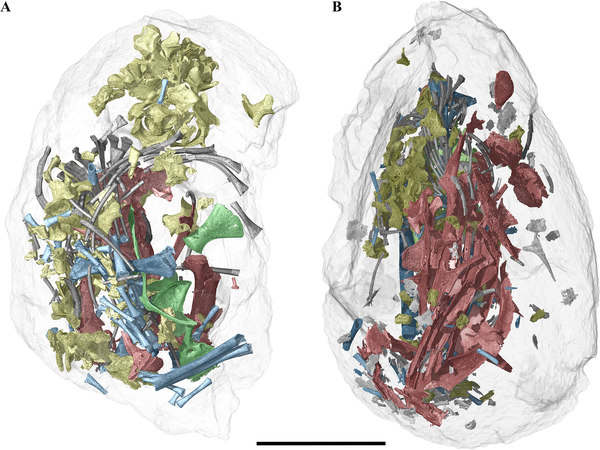
Fig 2. Three-dimensional rendering of two fossil eggs and their enclosed embryonic bones from Phu Phok.
A, SK1-2. B, SK1-1. Colours: red, skull and mandible; yellow, vertebrae; grey, ribs; green, pectoral and pelvic girdle; blue, limbs.
Scale bar, 5 mm.  DOI: 10.1371/journal.pone.0128610

4 of the eggs from Phu Phok (SK1-1, SK1-2, SK1-3 and SK1-4)

Abstract

Lizards are remarkable amongst amniotes, for they display a unique mosaic of reproduction modes ranging from egg-laying to live-bearing. Within this patchwork, geckoes are believed to represent the only group to ever have produced fully calcified rigid-shelled eggs, contrasting with the ubiquitous parchment shelled-eggs observed in other lineages. However, this hypothesis relies only on observations of modern taxa and fossilised gecko-like eggshells which have never been found in association with any embryonic or parental remains. We report here the first attested fossil eggs of lizards from the Early Cretaceous of Thailand, combining hard eggshells with exquisitely preserved embryos of anguimoph (e.g. Komodo dragons, mosasaurs). These fossils shed light on an apparently rare reproduction strategy of squamates, demonstrate that the evolution of rigid-shelled eggs are not an exclusive specialization of geckoes, and suggest a high plasticity in the reproductive organs mineralizing eggshells.


Fig 4. Skull and mandible of the anguimorph embryos from Phu Phok.

Fig 6. Comparison of the ossification extension of several postcranial components from the embryos SK1-1 and SK1-2.
The vertebral elements compared (both pre- and post-sacral), as well as the rib, are the largest ones from the eggs SK1-1 and SK1-2. In the pectoral girdle, SK1-1 shows an advance degree of ossification notably in the extension of the procoracoid, the ventral margin of the glenoid fossa and the blade of the scapula. Ossification toward epiphyses of the humerus is more advanced in SK1-1.
Scale bar, 1 mm.  DOI: 10.1371/journal.pone.0128610

Material and Geological Setting: 
The fossilized eggs presented here were surface collected by an international team led by one of us (V.S), from red siltstones of the Sao Khua Formation at the locality of Phu Phok (SK1), Sakhon Nakhorn Province, north-eastern Thailand (Fig 1). In total seven eggs have been discovered from this locality during the course of different official field campaigns of the Royal Thai Department of Mineral Resources (DMR): five eggs were discovered in 2002 and 2003 (specimen SK1-1 to SK1-5); specimen SK1-6 and SK1-7 were discovered in 2007 and 2008 respectively. As it was poorly preserved, specimen SK1-5 was thin sectioned for characterization of the eggshell. No nesting structure was observable although the eggs were scattered in the sediment over a relatively small area (about 2 sq.m). No permits were necessary. The DMR is a governmental organisation which has permission to do fieldwork upon acceptance of the land owner. The locality of Phu Phok belongs to the Thai government and therefore no permit was necessary for prospection and collection at the site. While the current legislation stipulates the necessity of permits to transport fossils out of Thailand, it was not the case at the time the fossils were collected (in 2005). Since then, the fossils have been returned to the collection of the Sirindhorn Museum in Phu Kum Khao (Sahatsakhan District, Kalasin Province, Thailand). Therefore no permits were necessary for prospection or for transportation which complied with all relevant regulations.

The Sao Khua formation is mainly characterised by floodplain deposits including sandstone, siltstone and mudstone, together with common calcretes which reflects a low-energy fluvial environment. The Sao Khua Formation is part of the Khorat Group, the latter consisting of a series of five non-marine formations deposited in a thermal sag basin during the Late Jurassic-Early Cretaceous. The accompanying fauna includes fishes, turtles, crocodilians and dinosaurs. Palynological evidence suggested a Berriasian-Barremian age for the Sao Khua Formation. A late Barremian age is indicated by freshwater bivalves. While the fauna from the older Phu Kradung Formation and the younger Khok Kruat Formation show some resemblance with their contemporaneous counterparts from Asia, the peculiar fauna of the Sao Khua Formation suggests that the Khorat region was somehow isolated from the main Eurasian continent.

Conclusions: 
The discovery of anguimorph embryos inside rigid-shelled eggs was rather unexpected as this mode of reproduction was thought to be an exclusive specialisation of gekkonid among squamates (Fig 9). The similarities observed between the rigid-shelled eggs of modern gekkonids and the Phu Phok anguimorphs are likely the result of an evolutionary convergence as leathery-shelled eggs are predominant in all other squamate clades (Fig 9). Unlike rigid-shelled eggs, eggs of most oviparous squamates present a leathery aspect which consists of a variable and thin coating of calcite overlying a fibrous shell membrane. The rigid type of eggshell presents a similar pattern but differs in having a thicker calcitic layer, allowing notably oviposition in drier environments. The squamate oviduct is known to produce eggs with variable amount of calcite, even at the intraspecific level. This modularity in calcite secretion is considered as one of the key aspects that lead to egg retention through thinning of the calcitic layer, in most major squamate clades. The Phu Phok anguimorphs, on the other hand, demonstrate that the plasticity of the oviduct bears the possibility to increase the calcitic component which occurred at least twice over the evolution of squamates. Consequently, while rigid-shelled eggs produced by squamates present a unique microstructure among amniotes, it is currently impossible to retrieve more detailed taxonomical information from fossilised isolated eggshell of squamates.

Taxonomical interpretation of isolated eggs based on eggshell microstructure has lead to misidentification on several occasions. More recently, a new approach based on egg geometry also concluded that taxonomical identification of fossil eggs based on the shape could be problematic. While the presence of embryonic remains seems the less questionable way to address a taxonomical identification, poorly ossified embryonic material can lead to a limited taxonomical identification or misinterpretation. Eventually, only exceptional preservation of well-ossified embryonic material provides adequate taxonomical information to address questions on the evolution of squamate reproduction modes.

Fig 7. Eggshell morphology and microstructure of the eggs from Phu Phok.
A, 3D rendering of a portion of the surface of the eggshell of SK1-2 showing the distribution of nodes. B, tomogram of SK1-1 showing two eggshell fragments that slid in the egg, outer surfaces oriented to the top of the figure. The inner half of both shell fragments is displayed in darker shades of grey indicating the shell is less dense than the whiter outer half. Unlike micrographed thin sections (Fig 7), the funnel-shaped depression (d) do not seem to be obstructed. The pore canals (p) are highlighted by the edge interference resulting from the phase contrast effect (black and white fringes). C-D, SEM photographs of an eggshell fragment showing the fan-shaped pattern of crystal at the level of a surface node (n). Not the fibrous layer (f) underlining the eggshell. D, close up from C.
Scale bars (A, B), 500 μm.  DOI: 10.1371/journal.pone.0128610

Fig 9. Known eggshell types across a simplified time-calibrated lepidosaur phylogeny based after morphological studies.
APhu Phok embryos are tentatively placed in an unresolved trichotomy with shinisaurids and varanoids. B-E, schemas of known lepidosaur eggshell types: semi-rigid, loosely connected calcite columns embedded in the shell membrane (B, modified from Packard et al.). Examples: Tuatara (Rhynchocephalia: Sphenodon punctatus) and Bearded lizard (Agamidae: Pogona barbata); leathery, shell membrane often covered with thin calcitic elements. Examples: the wall lizard (Scincomorpha: Lacerta lepida), zebra-tailed lizard (Iguania: Callisaurus draconoides); (C); rigid, well-connected adjacent calcitic columns covering a thin shell membrane. Example: Gekko gecko; (D); Phu Phok, similar to the rigid type, developed in an undulatory pattern, covering a thin structure interpreted as the shell membrane (E).
Abbreviations: a, amorphous layer; c, calcite component; p, pore canal; sm, shell membrane.


Vincent Fernandez , Eric Buffetaut, Varavudh Suteethorn, Jean-Claude Rage, Paul Tafforeau and Martin Kundrát. 2015. Evidence of Egg Diversity in Squamate Evolution from Cretaceous Anguimorph Embryos. PLoS ONE. DOI: 10.1371/journal.pone.0128610


Friday, August 8, 2014

[Paleontology • 2014] 'เต่าภูน้อย' ภูน้อยเซลีส ธีรคุปติ | Phunoichelys thirakhupti • A New Primitive Eucryptodiran Turtle from the Upper Jurassic Phu Kradung Formation of the Khorat Plateau, Northeastern Thailand


Figure 1. Phunoichelys thirakhupti gen. et sp. nov. from the Phu Kradung Formation (latest Jurassic) of Phu Noi Locality, NE Thailand.
(a–c) PRC 230 (holotype), shell in dorsal (a, b) views, and detail of ornamentation on carapace (c);
(g–m) PRC 232, (g–i) right costal 1 (PRC232-1) in dorsal (g, h) and ventral (i) views; (j, k) left costal 4 (PRC232-5), (l, m) left costal 6 (PRC232-6).
Scale bar = 5 cm for (a), (b), (d), (e) and (g–m), 1 cm for (c) and (f).
Figure 3. Reconstruction of the shell of Phunoichelys thirakhupti gen. et sp. nov. from the Phu Kradung Formation (latest Jurassic) of Phu Noi Locality, NE Thailand. (a) Carapace in dorsal view; (b) plastron in ventral view.


Abstract
A new genus and new species of primitive eucryptodiran turtle, Phunoichelys thirakhupti gen. et sp. nov., is described on the basis of shell remains from the lower part of the Phu Kradung Formation, at Phu Noi locality, Kalasin Province, NE Thailand. It is assigned to Xinjiangchelyidae on the basis of the marginals covering the lateral end of the costals and the anal scutes invading the hypoplastra. The new taxon is further characterized by a low and rounded carapace without a cervical notch; the whole carapace and plastron covered with a clear ornamentation consisting of tiny irregular vermiculated furrows; a complete neural series that reaches the suprapygal; a very wide and short cervical scute; relatively wide vertebral scutes; and a long first thoracic rib that extends along the full width of the first costal. The sutured plastron/carapace connection and the marginals covering the lateral end of the second to seventh costals suggest that the turtles from Phu Noi may be related to some primitive xinjiangchelyids from the Sichuan Basin. The discovery of a xinjiangchelyid turtle in the lower part of the Phu Kradung Formation supports a Late Jurassic age for that part of the formation.

Keywords: Testudines; Eucryptodira; Xinjiangchelyidae; Phunoichelys thirakhupti; Late Jurassic; Phu Kradung Formation; NE Thailand

Figure 3. Reconstruction of the shell of Phunoichelys thirakhupti gen. et sp. nov. from the Phu Kradung Formation (latest Jurassic) of Phu Noi Locality, NE Thailand. (a) Carapace in dorsal view; (b) plastron in ventral view.


Haiyan Tong, Wilailuck Naksri, Eric Buffetaut, Varavudh Suteethorn, Suravech Suteethorn, Uthumporn Deesri, Saitong Sila, Phornphen Chanthasit and Julien Claude. 2014. A New Primitive Eucryptodiran Turtle from the Upper Jurassic Phu Kradung Formation of the Khorat Plateau, NE Thailand. Geological Magazine. in press. doi: dx.doi.org/10.1017/S0016756814000223

A xinjiangchelyid eucryptodiran. The type species is Phunoichelys thirakhupti box.com