Showing posts with label Northern Thailand. Show all posts

Wednesday, March 25, 2026

[Invertebrate • 2026] Helobdella viridoclypus • A New free-living Leech Species (Hirudinea: Rhynchobdellida: Glossiphoniidae) from Chiang Mai, Thailand


 Helobdella viridoclypus
 K, Trivalairat, P. Trivalairat, Raquib & Purivirojkul, 2026

Emerald-charm leech | ปลิงสร้อยมรกต || 
 RAFFLES BULLETIN OF ZOOLOGY. 74

 Abstract
 A new species of glossiphoniid leech, Helobdella viridoclypus, is described from the northern region of Thailand, representing the first record of the genus Helobdella from the country and Southeast Asia. Its characteristics are similar to those of the type species, H. stagnalis, but can be distinguished by its transparent rice-shaped and triannulated body, cephalisation, a single pair of dark eyes, a smooth dorsal surface without papillae, rich darkgreen pigmentation on the dorsum, six pairs of crop caeca with less developed first pair and unbranched second to sixth pairs (posterior caeca), male and female gonopore separated by a single annulus, and a triangular nuchal scute pointed backwards with yellowish-green colouring around the mid-dorsal region. The phylogenetic relationships of H. viridoclypus, new species, are clarified, showing that it is monophyletic within the stagnalis species-complex clade which includes H. adiastola, H. octatestisaca, H. modesta, and the type species H. stagnalis. The new species is a free-living leech that specifically preys on invertebrates and not on humans. 

Key words. Annelida, Glossiphoniidae, Haementeriinae, jawless leech, freshwater, Huai Tueng Thao Reservoir

Order Rhynchobdellida Blanchard, 1894 
Suborder Glossiphoniiformes Tessler & de Carle, 2018 in Tessler et al., 2018 

Family Glossiphoniidae Vaillant, 1890 
Subfamily Haementeriinae Autrum, 1939 

Genus Helobdella Blanchard, 1896

Diagnosis. Small, two eyes, transparent papillae on segment, nuchal gland or scute on dorsum on VIIIa1/a2, gonopores separated by one annulus, compact salivary glands, crop with less developed first pair and unbranched second to sixth pairs of caeca, liquidosomatophagous (Blanchard, 1896; Sawyer, 1986).

 Helobdella viridoclypus, new species, live holotype (ZRC.ANN.1623).
 A, dorsal view; B, ventral view.

Helobdella viridoclypus, new species

Diagnosis. Rice-shaped, transparent body; cephalisation; a pair of large, distinctly separated, dark eyes on somite III; anterior sucker twice as large as prostomium without pits inside; central mouth in anterior sucker; triangular nuchal scute pointed backward with yellowish-green colouring around mid-dorsal region (VIIa1–a3, annuli 11–13); smooth surface without dorsal papillae; rich dark-green pigmentation on dorsum, particularly around crop caeca; lesser or almost absent pigmentation along crop; one male gonopore on XIIa1/XIIa2 (annuli 26/27); one female gonopore on XIIa2/ a3 (annuli 27/28); six pairs of crop caeca with unbranched posterior caeca; maximum body width wider than anterior and posterior suckers by four and two times, respectively.
 
Etymology. The species epithet refers to the description of the nuchal scute on the neck region, which resembles a shield and is a yellowish green colour. 
The following common names are suggested: “Emerald-charm leech” (English), “Pling soi mor ra kot” (ปลิงสร้อยมรกต) (Thai), and “Der Smaragdt-charm Plattegel” (German).


 Krittiya TRIVALAIRAT, Poramad TRIVALAIRAT, Tashfia RAQUIB and Watchariya PURIVIROJKUL. 2026. Helobdella viridoclypus (Hirudinea: Rhynchobdellida: Glossiphoniidae), A New free-living Leech Species from Chiang Mai, Thailand. RAFFLES BULLETIN OF ZOOLOGY. 74: 124–141. [23 March 2026]

Tuesday, March 3, 2026

[Botany • 2026] Peliosanthes siamensis (Asparagaceae) • A New Species from northern Thailand


Peliosanthes siamensis Thammar. & Rakarcha, 

in Thammarong, La-ongsri, Tanming et Rakarcha. 2026. 
นางแลวสยาม  ||  DOI: doi.org/10.20531/tfb.2026.54.1.02 

Abstract 
Peliosanthes siamensis (Asparagaceae) is described from northern Thailand. A description, distribution, ecology, phenology, notes and illustration are provided. A provisional conservation status of the species in Thailand is also given.

 Keywords: conservation status, flora, limestone, threatened plant

Peliosanthes siamensis Thammar. & Rakarcha:
A. Habit; B. Flowers; C. Inflorescence; D. Adaxial leaf surface; E. Abaxial leaf surface.
Photos A–C. by W. Tanming; D–E. by W. Thammarong from Rakarcha et al. 1087 (QBG).

Peliosanthes siamensis Thammar. & Rakarcha sp. nov. 
นางแลวสยาม

Woranart Thammarong, Woranuch La-ongsri, Wattana Tanming and Sarayut Rakarcha. 2026. Peliosanthes siamensis (Asparagaceae), A New Species from northern Thailand. Thai Forest Bulletin (Botany). 54(1), 13–17. DOI: doi.org/10.20531/tfb.2026.54.1.02 

Sunday, January 4, 2026

[Botany • 2026] Argyreia elegans (Convolvulaceae) • A New Species from Northern Thailand


Argyreia elegans Traiperm, Tetsana & Chitchak,

in Chitchak, Tetsana, Srisombat et Traiperm, 2026. 
พู่ม่วงดิสสกุล  ||  DOI: doi.org/10.3390/taxonomy6010006 

Abstract
Argyreia elegans Traiperm, Tetsana & Chitchak, sp. nov., from northern Thailand is described and illustrated. The new species resembles A. kerrii Craib but differs in terms of having lanceolate to oblong leaves, up to two inflorescences (each bearing 1–3 flowers emerging from an axillary bud), and outer sepals that are densely velvety-pubescent on the abaxial side. A detailed description, an updated key to the species for the Flora of Thailand, as well as anatomical, micromorphological, and taxonomic notes are provided.

Keywords: biodiversity; Chiang Mai; conservation; new species; Flora of Thailand; species complex; morning glory

 Argyreia elegans Traiperm, Tetsana & Chitchak, sp. nov.—habit, inflorescence, and corolla.
 (A) Flowering branch showing inflorescence with side view of corolla and leaf shape. (B) Front view of flower and the abaxial surface of leaf with pale green color. (C) Flower in back-side angle, showing bract attachment and their undulation and calyx. (D) Flowering branch showing pairs of inflorescences emerging from axillary buds (red arrowheads).
(voucher: N. Tetsana et al. 1904) Photographs (A–C) by N. Tetsana; (D) by N. Chitchak.

  Argyreia elegans Traiperm, Tetsana & Chitchak, sp. nov.
 (A) Flowering branch. (B) Leaf shapes. (C) Leaf apex. (D) Adaxial surface of leaf. (E) Abaxial surface of leaf. (F) Bracts. (G) Sepals from outer (upper row from left to right) to innermost (lower row from left to right). (H) Opened corolla. (I) Single stamen in the adaxial view (left) and lateral view (right) showing the attachment point to corolla. (J) Close-up of lower part of stamen, showing trichomes at the filament base. (K) Multicellular uniseriate hair with a single apical gland. (L) Pistil composed of bi-globose stigmas with nectary disc surrounding ovary.
 All drawn by N. Chitchak from voucher specimens N. Tetsana et al. 1904 (BKF).

 Argyreia elegans Traiperm, Tetsana & Chitchak, sp. nov., with its two most morphologically similar species in Thailand, A. kerrii and A. ankylophlebia; a comparison of leaves, inflorescences, bracts, and sepals.
(A,B) A. elegans. (C–E) A. kerrii. (F–H) A. ankylophlebia.
(A,C,F) Leaves. (B,D,G) Inflorescences. (B,E,H) Close-up of inflorescences showing details of bracts and sepals.
Photographs (A,B) by N. Tetsana; (C–H) by P. Traiperm.

Argyreia elegans Traiperm, Tetsana & Chitchak, sp. nov.

Diagnosis. Similar to Argyreia kerrii in having a purple tubular-funnelform corolla, but differs in its lanceolate to oblong leaf shape (versus ovate or broadly ovate), 1–2 inflorescences emerging from an axillary bud (versus strictly 1 inflorescence), and inflorescences containing 1–3 flowers (versus several flowers); outer sepals densely velvet pubescence abaxially (versus abaxial side appressed pilose medially or glabrous).

Etymology. The specific epithet refers to the beautiful flower with its perfectly shaped and eye-catching colored corolla.
Vernacular name. Phu Muang Dissakul (พู่ม่วงดิสสกุล); the name is given by the authors to honor Mr. Dissakul Thammasanukul, the former Chief of the Om Koi Wildlife Sanctuary.


Natthaphong Chitchak, Naiyana Tetsana, Poompat Srisombat and Paweena Traiperm. 2026. A New Argyreia Lour. (Convolvulaceae) from Northern Thailand. Taxonomy. 6(1), 6; DOI: doi.org/10.3390/taxonomy6010006 [2 January 2026]

Sunday, August 17, 2025

[Botany • 2025] Microchirita maxima (Gesneriaceae) • A New Species from Thailand


Microchirita maxima Triboun, Thamwanna & Kaewkarn, 

in Triboun, Kaewkarn, Thamwanna, Khorngton et Middleton, 2025. 
หยาดไวยบุตร  ||  https://journal.NSM.or.th  

Abstract
A new species of Microchirita from Northern Thailand, Microchirita maxima Triboun, Thamwanna & Kaewkarn, is described and illustrated. It is diagnosed against the other species in Thailand with axillary bracteate inflorescences. Their seed morphologies are also provided.
 
Keywords: new species, limestone, Microchirita, Gesneriaceae, Thailand


Microchirita maxima Triboun, Thamwanna & Kaewkarn sp. nov.

Diagnosis: Microchirita maxima is similar to M. glandulosa C.Puglisi, M. involucrata (Craib) Yin Z.Wang and M. rupestris (Ridl.) A.Weber & Rafidah in having bracteate inflorescences. It differs from M. glandulosa and M. rupestris by having a generally taller stem, the bracts are free (vs joined across the stem at the very base in M. glandulosa and fused into a tube in M. rupestris), often longer pedicels (5–35 mm long in M. maxima vs 8–12 mm long in M. glandulosa and 0.1–15 mm long in M. rupestris), and a yellow stripe on the ventral surface of the corolla (vs lacking in M. glandulosa and M. rupestris). It also differs from Microchirita involucrata in the bract margin (serrate or serrulate in M. maxima vs entire in M. involucrata), wider calyx lobes (1.4–1.5 mm wide in M. maxima vs 0.7–1.4 mm in M.
involucrata) and the paler purplish flowers. 

Etymology. The specific epithet refers to the large size of the plant and the rather tall stem.
Vernacular. Yad wai ya but (หยาดไวยบุตร), name given here. 


Pramote Triboun, Theerawat Kaewkarn, Supitcha Thamwanna, Sirinan Khorngton and David J. Middleton. 2025. Microchirita maxima, A New Species of Microchirita (Gesneriaceae) from Thailand. Thailand Natural History Museum Journal. 19(1): 1–7. https://journal.NSM.or.th/en/node/262 


Saturday, July 12, 2025

[Funga • 2025] Lentinus saisamorniae (Polyporales: Polyporaceae) • A New edible macrofungus from northern Thailand


Lentinus saisamorniae  Kumla & N. Suwannar.,

in Kumla, Kaewnunta et Suwannarach, 2025. 
เห็ดขอนขาวสายสมร  ||  DOI: doi.org/10.11646/phytotaxa.705.2.2 
 
Abstract
A new edible Lentinus species, described herein as L. saisamorniae, was collected from local markets and natural habitats in northern Thailand between 2019 and 2021. This species is characterized by its small to medium-sized basidiomata, white to yellowish-white pileus, broadly ellipsoid to elongate-shaped basidiospores, dimitic hyphal system, and hyphal pegs. Nonetheless, its longer basidia and smaller basidiospores make it distinguishable from L. cladopus. A molecular phylogenetic analysis of the combined internal transcribed spacer (ITS) large subunit (nrLSU) of nuclear ribosomal DNA, and RNA polymerase II large subunit (rpb1) sequences supported the monophyly of L. saisamorniae as a distinct lineage within the genus Lentinus. Therefore, this new species was introduced based on both morphological characteristics and molecular phylogeny. A full description, illustrations, color photographs, and a phylogenetic tree to show the placement of L. saisamorniae are provided. Comparisons between the new species and morphologically similar and related species are discussed.

Edible fungus, lentinoid fungus, phylogeny, saprotrophic fungus, taxonomy, tropical area, Fungi


Jaturong KUMLA, Atsadawat KAEWNUNTA and Nakarin SUWANNARACH. 2025. Lentinus saisamorniae (Polyporaceae, Polyporales), A New edible macrofungus from northern Thailand. Phytotaxa. 705(2); 149-161. DOI: doi.org/10.11646/phytotaxa.705.2.2 [2025-06-13]


Wednesday, June 18, 2025

[Arachnida • 2025] Scorpiops doiphukha • A Newly discovered Species of the Genus Scorpiops Peters, 1861, subgenus Euscorpiops Vachon, 1980 (Scorpiones: Scorpiopidae) from Doi Phu Kha National Park, Thailand


Scorpiops (Euscorpiopsdoiphukha  

 Ythier, Košulič, Nawanetiwong & Lourenço, 2025

Abstract
A new scorpion speciesScorpiops (Euscorpiopsdoiphukha sp. nov., belonging to the family Scorpiopidae Kraepelin, 1905, is described based on 12 specimens of both sexes (three adults and nine immatures) collected in Doi Phu Kha National Park, Nan Province, Thailand. The new species presents key features exhibited by scorpions of the subgenus Euscorpiops and can be characterized notably by a large size, a sexual dimorphism strongly marked with male pedipalps elongated, a distinct trichobothrial pattern and other morphological features. This new taxon represents the 115th species among the currently recognized species for the genus Scorpiops Peters, 1861, and the 44th species described for the subgenus Euscorpiops Vachon, 1980. It is likely an endemic element of Thailand’s scorpion fauna, raising the number of known Scorpiops (Euscorpiops) species in the country to 13. Ecological and distributional aspects of the new species are discussed and compared with closely related Scorpiops species, highlighting its distinctiveness within the genus.

Key words: Description, ecology, forest, morphology, scorpion, Southeast Asia, taxonomy

Scorpiops (Euscorpiopsdoiphukha sp. nov. 
 A, B. Male holotype, habitus, dorsal and ventral aspects, respectively;
C, D. Female paratype, habitus, dorsal and ventral aspects, respectively. Scale bar: 2 cm.

Scorpiops (Euscorpiopsdoiphukha sp. nov., alive.
A. Male holotype and female paratype, in their natural habitat; B. Female, alive with pre-juveniles (instar I).
 
Natural habitat of Scorpiops (Euscorpiopsdoiphukha sp. nov. in Doi Phu Kha National Park, Nan Province, Thailand.
A. Track trail near a small stream; B. Rock wall where the male holotype and female paratype were discovered. Both specimens were found hiding in small rock crevices.


 Eric Ythier, Ondřej Košulič, Wasin Nawanetiwong and Wilson R. Lourenço. 2025. A Newly discovered Species of the Genus Scorpiops Peters, 1861, subgenus Euscorpiops Vachon, 1980 from Doi Phu Kha National Park, Thailand (Scorpiones, Scorpiopidae). ZooKeys. 1241: 171-184. DOI: doi.org/10.3897/zookeys.1241.142549 [12-06-2025]
 

Tuesday, June 17, 2025

[Entomology • 2025] Ceraphron chularoipaad • Review of the Subgenus Larsoceraphron Dessart, 1981 of the Genus Ceraphron Jurine, 1807 (Hymenoptera: Ceraphronidae) with the Description of A New Species from Thailand


Ceraphron (Larsoceraphronchularoipaad   
Ghafouri Moghaddam, Salden & Butcher,

in Moghaddam, Salden, Latibari et Butcher, 2025. 

Abstract
The subgenus Larsoceraphron Dessart, 1981 of the genus Ceraphron Jurine, 1807 is reviewed, and a new species, Ceraphron (Larsoceraphron) chularoipaad sp. nov., from Thailand is described and illustrated. This represents the first species-level record of the genus Ceraphron in Thailand. Additionally, we provide the redescriptions and illustrations of three previously known species viz., C. (L.) huggertiC. (L.) sylviae, and C. (L.) tobiasi. We also include two identification keys for all known subgenera of Ceraphron and species of the subgenus Larsoceraphron.

Keywords: Identification key, Oriental, redescription, species discovery, Taxonomy 
 
Ceraphron (Larsoceraphronchularoipaad sp. nov., female holotype from Thailand (CUMZ)
A habitus and antenna, lateral view B fore and hind wing C head, dorsofrontal view D head, lateral view E head, dorsal view F mesosoma, dorsal view G posterior mesosoma and anterior syntergum, dorsal view H syntergum, dorsal view I head and mesosoma, lateral view J metasoma, lateral view K posterior metasoma, dorsal view.

 Ceraphron (Larsoceraphronchularoipaad 
Ghafouri Moghaddam, Salden & Butcher, sp. nov.

Etymology. The specific epithet chularoipaad is derived from “Chula”, referring to Chulalongkorn University, and “roi paad”, which means “one hundred and eight” in Thai, commemorating the 108th anniversary of Chulalongkorn University in 2025. The name is treated as a noun in apposition.


 Mostafa Ghafouri Moghaddam, Tobias Salden, Minoo Heidari Latibari and Buntika A. Butcher. 2025. Review of the Subgenus Larsoceraphron Dessart, 1981 of the Genus Ceraphron Jurine, 1807 (Hymenoptera, Ceraphronidae) with the Description of A New Species from Thailand. Journal of Hymenoptera Research. 98: 579-602. DOI: doi.org/10.3897/jhr.98.151607 

Wednesday, May 28, 2025

[Entomology • 2025] Protosticta jirapornae • A New Species of Protosticta (Odonata: Platystictidae) from northern Thailand


Protosticta jirapornae Makbun, 2025

 
Abstract
Protosticta jirapornae sp. nov. is described and illustrated based on specimens of both sexes collected from Chiang Mai Province, Thailand. This taxon was previously recognised as the northern population of P. khaosoidaoensis Asahina, 1984, which is geographically isolated from its type locality in Chanthaburi Province, eastern Thailand. The new species can be distinguished from P. khaosoidaoensis and other closely related congeners by the distinctive markings on the prothorax and synthorax in both sexes, as well as the structure of the male anal appendages and the morphology of the genital ligula.

Odonata, dragonfly, Zygoptera, Protosticta , new species, Protosticta khaosoidaoensis 


Noppadon MAKBUN. 2025. Description of Protosticta jirapornae sp. nov. from northern Thailand (Odonata: Platystictidae).   Zootaxa. 5642(1); 59-67. DOI: doi.org/10.11646/zootaxa.5642.1.6 [2025-05-27] 

Thursday, February 27, 2025

[Botany • 2025] Cornukaempferia puangpeniae & C. aurantiiflora var. vespera (Zingiberaceae) • New Taxa from northern Thailand


Cornukaempferia puangpeniae P. Saensouk, Saensouk, Boonma & Techa, 

in P. Saensouk, S. Saensouk, Boonma, Techa, Rakarcha, Ragsasilp et Nguyen, 2025. 
เปราะทองอาจารย์พวงเพ็ญ  ||  DOI: doi.org/10.1016/j.heliyon.2024.e41603  

Abstract
Thailand hosts a diverse array of plants in the Zingiberaceae family, with over 150 endemic species, highlighting its significance in global biodiversity. The genus Cornukaempferia stands out for its ornamental and medicinal value. During a research expedition in Northern Thailand, a previously unknown Cornukaempferia species was discovered in Sukhothai province, expanding the known distribution range. It was confirmed through comprehensive taxonomic analysis as a new species, Cornukaempferia puangpeniae. Additionally, a new variety, C. aurantiiflora var. vespera, was identified in Uttaradit Province. The genus now encompasses eight species and two varieties with the addition of these taxa, exhibiting a notable prevalence in Thailand and highlighting its significant endemism. Particularly, C. larsenii is noteworthy for being native to Thailand and Laos. Detailed morphological descriptions, including diagnoses with related taxa, were provided. The species' ecological characteristics, pollen morphology, traditional uses, and conservation status were documented. A revised key to species and varieties in the genus Cornukaempferia, including a UPGMA cluster analysis dendrogram elucidating morphological relationships within the genus, was presented. These discoveries contribute to the botanical knowledge of the region, underscoring the importance of continued exploration and conservation efforts in preserving its rich flora.
 
Keywords: Cornukaempferia, new species, Sukhothai, Taxonomy, Uttaradit, Zingiberaceae

Cornukaempferia puangpeniae P. Saensouk, Saensouk, Boonma & Techa sp. nov.;
 (A) young leaf is rolled and erect before unfurling; (B) flower; (C) habit; (D) habitat
 (Photographs: A–B by T. Boonma, C by S. Saensouk, D by C. Techa).

 Cornukaempferia puangpeniae P.Saensouk, Saensouk, Boonma & Techa sp. nov

Diagnosis: Similar to C. kamolwaniae Picheans., Yupparach & Wongsuwan, but differs, particularly in dormancy characteristics, in having a tuberous root with two layers: a light brown core and an outer yellow layer (vs. C. kamolwaniae, which have a brownish inner core, followed by an orange-brownish middle layer, and finally an outer layer in yellow-oak); leaf sheath 5–7 cm long (vs. 3.5–4 cm long); lamina adaxially dark green with a dark reddish-purple tinge (vs. dark green without a dark reddish-purple tinge); bracts pubescent (vs. glabrous with a pubescent apex); floral tube sparsely hairy (vs. glabrous); staminodes apex acute (vs. apex rounded); labellum apex acute without incision (vs. apex rounded with an incision 2–3 mm long); filament 4.5–5 mm long, sparsely hairy (vs. 7–9 mm long, glabrous); anther 2.5–2.8 cm long (vs. 1.5–1.8 cm long); epigynous glands measure approximately 4 mm in length (vs. 1–2 mm in length).

Etymology: The specific epithet “puangpeniae” is a tribute to Prof. Dr. Puangpen Sirirugsa, a renowned botanist with expertise in Zingiberaceae. She holds the distinction of being the first Thai researcher to conduct extensive studies on the Zingiberaceae family in Thailand.

Cornukaempferia aurantiiflora var. vespera P. Saensouk, Saensouk & Boonma var. nov.;
(A) habit in natural habitat; (B) top view of flower; (C) top view of habit
(Photographs: A by T. Boonma, B–C by S. Saensouk).

 Cornukaempferia aurantiiflora var. vespera P.Saensouk, Saensouk & Boonma var. nov

Etymology: vespera” is derived from the Latin word “vesperum”, meaning “evening”, which refers to its flower blooming in the evening.


Piyaporn Saensouk, Surapon Saensouk, Thawatphong Boonma, Chainarong Techa, Sarayut Rakarcha, Areerat Ragsasilp and Danh Duc Nguyen. 2025. Cornukaempferia puangpeniae sp. nov. and C. aurantiiflora var. vespera var. nov. (Zingiberaceae) from Northern Thailand.  Heliyon. 11(2), e41603. DOI: doi.org/10.1016/j.heliyon.2024.e41603  
  facebook.com/SaensoukLab/posts/122203363100172160


Thursday, December 26, 2024

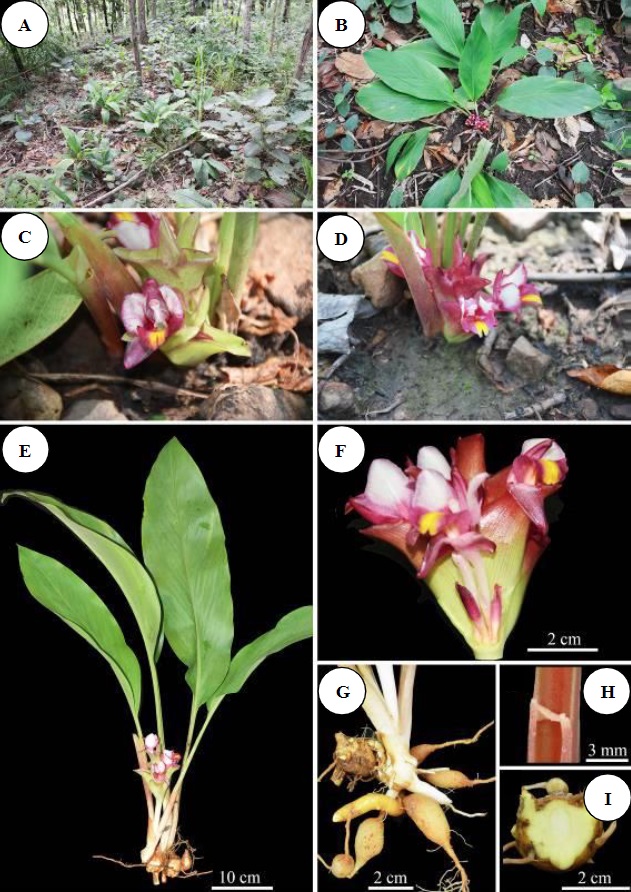
[Botany • 2024] Curcuma sumonii & C. wanchaii (Curcuma subg. Curcuma, Zingiberaceae: Zingibereae) • A New Taxa from Thailand

 
Curcuma sumonii Saensouk, P.Saensouk, Boonma & Techa 
C. wanchaii Saensouk, P.Saensouk, Maknoi & Boonma, 

in P. Saensouk, S. Saensouk, Boonma, Ragsasilp, Maknoi, Techa, Srisuk et Souladeth, 2024. 
(Photographs by T. Boonma).

Abstract 
This research presents the discovery of two novel taxaCurcuma sumonii Saensouk, P.Saensouk, Boonma & Techa, and C. wanchaii Saensouk, P.Saensouk, Maknoi & Boonma, belonging to the Curcuma subgenus CurcumaCurcuma sumonii was collected in Sukhothai Province, Northern Thailand, while C. wanchaii was found in Kanchanaburi Province, Southwestern Thailand. Our study provides a comprehensive documentation of their morphological attributes, including detailed descriptions supported by visual aids. In addition to morphological data, we offer insights into vernacular names, ecological characteristics, phenology, traditional uses, conservation status, and distribution maps. Morphological comparison Tables 1 and 2 are provided to differentiate between these newly discovered taxa and their allied species. Furthermore, we present an identification key to facilitate the differentiation of these taxa from their allied species. The findings of this study contribute to the understanding of biodiversity within the Curcuma genus and offer valuable information for further conservation efforts and taxonomic research.

Keywords: Curcuma, Critically endangered, Kanchanaburi, Sukhothai, Taxonomy, Zingiberales 

Curcuma sumonii Saensouk, P.Saensouk, Boonma & Techa sp. nov.
 (A) habit in natural habitat, and (B) side view of inflorescence with flowers.
(Photographed by Surapon Saensouk).

 Curcuma sumonii Saensouk, P.Saensouk, Boonma & Techa, sp. nov. 

Curcuma wanchaii Saensouk, P.Saensouk, Maknoi & Boonma sp. nov.
(A) inflorescences, (B) flower, (C) side and front view of anther, (D) habits in the natural habitat, growing along with Globba substrigosa King ex Baker.
(Photographs by Thawatphong Boonma).

C. wanchaii Saensouk, P.Saensouk, Maknoi & Boonma, sp. nov. 

  
Piyaporn Saensouk, Surapon Saensouk, Thawatphong Boonma, Areerat Ragsasilp, Charan Maknoi, Chainarong Techa, Pathomthat Srisuk and Phetlasy Souladeth. 2024.  Curcuma sumonii sp. nov., and C. wanchaii sp. nov. (Zingiberaceae), Two New Taxa of Curcuma subgen. Curcuma from Thailand. Scientific Reports. 14: 27541. DOI: doi.org/10.1038/s41598-024-79261-x 
 

Saturday, November 23, 2024

[Botany • 2024] Curcuma diversicolor (Curcuma subg. Curcuma, Zingiberaceae: Zingibereae) • A New Species from northern Thailand, and Notes on C. sirirugsae


Curcuma diversicolor Soonthornk.,

in Soonthornkalump. 2024.
 
Abstract
Curcuma diversicolor Soonthornk., a new species of subgen. Curcuma (Zingiberaceae, Zingiberoideae) from northern Thailand, is described and illustrated. It differs from its morphologically closest species C. globulifera by e.g. having larger flowers and the presence of coma bracts. Detailed descriptions based on living flowering material, images, and notes on distribution, habitat, and phenology are provided. Its conservation status is provisionally assessed as Data Deficient (DD). In addition, notes are provided on the distribution of the recently described C. sirirugsae, and its conservation status is reassessed based on new collections.


Sutthinut Soonthornkalump. 2024. Curcuma diversicolor (Zingiberaceae), A New Species from Northern Thailand, and Notes on C. sirirugsae. Annales Botanici Fennici. 61(1); 263-270. DOI: doi.org/10.5735/085.061.0136

กระเจียวสรรพสี มีลักษณะพิเศษที่ยากจะพบในกระเจียวชนิดอื่นคือ ใบประดับที่มีที่สีสันหลากหลาย จึงเป็นที่มาของชื่อ กระเจียวสรรพสี และมีชื่อสามัญภาษาอังกฤษว่า Harlequin curcuma  ซึ่งสอดคล้องกับชื่อวิทยาศาสตร์คือ Curcuma diversicolor ซึ่งมีความหมายว่ามีหลายสี เช่นเดียวกัน

Researchgate.net/publication/384946440_Curcuma_diversicolor_a_New_Species_from_Northern_Thailand

Wednesday, November 6, 2024

[Botany • 2022] Curcuma lampangensis & C. sabhasrii (Curcuma subg. Ecomatae, Zingiberaceae: Zingibereae) • Two New Species from northern Thailand


Curcuma sabhasrii Saensouk, Maknoi, Wongnak & Rakarcha, 

in Rakarcha, S. Saensouk, Maknoi, Wongnak, Thammarong et P. Saensouk, 2022. 
Photographed by S. Rakarcha

Abstract
Curcuma lampangensis Saensouk, Maknoi & Rakarcha and C. sabhasrii Saensouk, Maknoi, Wongnak & Rakarcha, two new species of ginger family (Zingiberaceae) from northern Thailand, are described, illustrated and photographed. Additionally, the authors provide their detailed morphological descriptions, as well as illustrations, color photographs, distributions, ecology, etymology, phenology, vernacular, conservation status and its closely related species. The two new species are assignable to the Curcuma subgenus Ecomatae. Curcuma lampangensis and C. sabhasrii are endemic to Lampang and Phitsanulok provinces of northern Thailand, respectively. The morphological characteristics of C. lampangensis are compared to C. rhomba J. Mood & K. Larsen while C. sabhasrii is compared to C. peramoena Souvann. & Maknoi. Curcuma lampangensis is recognized by its glabrous on nearly all parts of the plant, creeping rhizome and the inflorescence usually arises from a new rhizome branch next to the existing pseudostem, flowers that are white to pale pink and white to pale yellow labellum with 2 dark yellow bands at the center and reddish tinge at the base. Curcuma sabhasrii is recognized by having 8-15 greenish to reddish-purple bracts, reddish-purple corolla lobes, white with reddish-purple mottling to reddish-purple staminodes and labellum which is reddish-purple with an embossed yellow path along the midrib from base to apex and reddish-purple mottling on yellow mid-band of lower half. A key to 24 species of Curcuma subgenus Ecomatae in Thailand is presented.


Curcuma sabhasrii Saensouk, Maknoi, Wongnak & Rakarcha:
A.–B. habitat; C.–D. inflorescences; E. habit; F. cincinnus with 4 flowers; G. rhizome and root tubers; H. ligule; I. colour of rhizome.
Photographed by S. Rakarcha


Curcuma lampangensis Saensouk, Maknoi & Rakarcha  
กระเจียวลำปาง

Curcuma sabhasrii Saensouk, Maknoi, Wongnak & Rakarcha,
 กระเจียวสรรพศรี


 Sarayut Rakarcha, Surapon Saensouk, Charun Maknoi, Mathee Wongnak, Woranart Thammarong and Piyaporn Saensouk. 2022.  Curcuma lampangensis and C. sabhasrii, Two New Species of the Family Zingiberaceae from northern Thailand. Biodiversitas. 23: 4448-4459. https://smujo.id/biodiv/article/view/11720

Friday, October 11, 2024

[Botany • 2024] Chiloschista breviseta (Orchidaceae: Epidendroideae) • A New Species from Northern Thailand


Chiloschista breviseta Chanokkhun, Watthana & Schuit.,

in Chanokkhun, Muangsan, Suwanwaree, Malaiphis, Schuiteman et Watthana, 2024.
เอื้องพญาไร้ใบดอกขาว  ||  taiwania.NTU.edu.tw/abstract/2022 

Abstract
A new species, Chiloschista breviseta (Orchidaceae: Epidendroideae: Aeridinae) from Northern Thailand is described and illustrated, and notes on ecology and conservation status are provided. Chiloschista breviseta is morphologically similar to C. usneoides but differs in having much shorter seta on each side of the anther cap. Previous records of C. usneoides from Thailand refer to C. breviseta.

Keyword: Aeridinae, Chiloschista, Chiloschista usneoides, Chiloschista viridiflava, Flora of Thailand, new taxon

Chiloschista breviseta.
A. Habit. B. Flowers. front and side views. C. Dorsal sepal, petal and lateral sepal (from left to right). D. Labellum, front view and longitudinal half cut showing inside. E. Operculum. F. Pollinarium.
(Drawn by T. Chanokkhun).

Chiloschista breviseta.
 A. Inflorescence. B. Flowers. C. Dorsal sepal, petal and lateral sepal (from left to right). D. labellum, showing front, side and back views. E. Labellum with longitudinal half cut showing inside. F. Operculums. G. Pollinarium
 (Pictured by T. Chanokkhun).

Chiloschista breviseta Chanokkhun, Watthana & Schuit., sp. nov.

Diagnosis: Chiloschista breviseta is similar to C. usneoides in the largely white flower and the shorts accate lip with a rudimentary mid-lobe, but differs in having a short seta (<0.3 mm long) on each side of the anther cap (vs. a long, thread-like seta, >1.7 mm long) and in the Y-shaped callus apex (vs. T-shaped). It can be distinguished from C. viridiflava Seidenf. in having a glabrous abaxial surface of sepals and petal (vs. pubescent), margin of petals entire (vs. erose), and white sepals and petals, sometimes with a purplish pink median line abaxially (vs. pure pale green), and in having short setae (vs. setae > 1.9 mm long).

Etymology: From the Latin brevis, short, and seta, a bristle-like hair, referring to the short appendages on the anther cap, unlike the long wiry appendages seen in species like C. usneoides


Thotsaporn Chanokkhun, Nooduan Muangsan, Pongthep Suwanwaree, Rungtip Malaiphis, André Schuiteman and Santi Watthana. 2024. Chiloschista breviseta (Orchidaceae), A New Species from Thailand. Taiwania. 69(4);  449 - 453. DOI: 10.6165/tai.2024.69.449