Showing posts with label Neotropical Amphibian. Show all posts

Tuesday, July 21, 2026

[Herpetology • 2026] Isthmohyla nacientes • A New Species of Stream-Breeding Isthmohyla (Anura: Hylidae) from Costa Rica


Isthmohyla nacientes  
Chaves-Acuña, Abarca, Navarro-Picado, Hidalgo-Mora, Ureña-Chaves, Valverde-Castillo, Chaves, Bolaños & Faivovich, 2026
   

Abstract
We describe a new species of the Isthmohyla tica group that occurs along the montane regions of the central Pacific of Costa Rica, between 1,400 and 2,000 masl. Although the new species is the sister taxon of a clade including an unde-scribed species and I. rivularis, it is more similar to I. tica. However, the new species can be distinguished because the flanks have scattered, distinct, round and irregular dark blotches or spots and because the advertisement call is comprised by a single, tonal note, typically emitted singly or in series, at dominant frequencies of 4,048–4,909 Hz, with a duration of 10–50 ms. The new species exhibits a broad acoustic repertoire composed of advertisement, release, and courtship calls, with the latter being emitted underwater. We discuss our findings with respect to adult and larval morphology, reproductive biology, and bioacoustics of the I. tica group.

Isthmohyla nacientes in life.
 (A) Holotype (UCR 24345), dorsal coloration at night. (B) Lateral view of male paratype (UCR 24367). (C) Ventral view of male paratype (UCR 24367), showing orange coloration on the hidden and ventral surfaces of the thighs and shank. (D) Male paratype (UCR 23770) showing bilobate, translucent vocal sac. (E) Lateral view of female paratype (UCR 24368).
Photos: B, C, and E by Gabriel Ureña

Isthmohyla nacientes, new species  
 
Etymology.—The specific epithet “nacientes” refers to the crucial role of headwaters and springs (nacientes in Spanish) in the habitat and life cycle of the new species and its stream-breeding congeners. This name highlights the species’ association with aquatic environments, particularly the springs found in its range, acknowledging the ecological significance of these water sources.


Wagner Chaves-Acuña, Juan Abarca, Jonathan Navarro-Picado, Esteban Hidalgo-Mora, Marilyn Ureña-Chaves, Alejandro Valverde-Castillo, Gerardo Chaves, Federico Bolaños and Julián Faivovich. 2026. A New Species of Stream-Breeding Isthmohyla (Anura: Hylidae) from Costa Rica. Ichthyology & Herpetology. 114(2); 337-356. DOI: doi.org/10.1643/h2024066 (3 July 2026) x.com/IchsAndHerps/status/2076689784525717838
  
We describe a new species of the Isthmohyla tica group that occurs along the montane regions of the central Pacific of Costa Rica, between 1,400 and 2,000 masl. Although the new species is the sister taxon of a clade including an undescribed species and I. rivularis, it is more similar to I. tica. However, the new species can be distinguished because the flanks have scattered, distinct, round and irregular dark blotches or spots and because the advertisement call is comprised by a single, tonal note, typically emitted singly or in series, at dominant frequencies of 4,048–4,909 Hz, with a duration of 10–50 ms. The new species exhibits a broad acoustic repertoire composed of advertisement, release, and courtship calls, with the latter being emitted underwater. We discuss our findings with respect to adult and larval morphology, reproductive biology, and bioacoustics of the I. tica group.

Friday, October 24, 2025

[Herpetology • 2025] Bolitoglossa chirripoensis • A New Species of Salamander of the Genus Bolitoglossa (Caudata: Plethodontidae) from the highest massif of the Cordillera de Talamanca, Costa Rica


Bolitoglossa chirripoensis
Klank, Chaves, Castro & Arias, 2025


Abstract
The mountains of Isthmian Central America (ICA) are biodiversity hotspot and contain a high number of endemic amphibians, many of which have been described from the region in recent decades. Neotropical salamanders of the genus Bolitoglossa have undergone an extensive diversification in the mountains of ICA, specifically in the Cordillera de Talamanca The páramo of the Cordillera de Talamanca, despite being only 1.5% of its total area, harbors six species of Bolitoglossa, which represents 14.2% of the species of the genus in the region. Based on molecular and morphological analyses, we describe a new species of the Bolitoglossa subpalmata species group from the highest massif of ICA, the páramo of the Chirripó National Park. This new species emphasizes the importance of the Cordillera de Talamanca for the speciation of salamanders in ICA and as an important site for their conservation and study.

Amphibia, Isthmian Central America, Neotropics, Páramo, Phylogenetics, Taxonomy


Bolitoglossa chirripoensis sp. nov.


Jeremy KLANK, Gerardo CHAVES, Kimberly CASTRO and Erick ARIAS. 2025. A New Species of Salamander of the Genus Bolitoglossa (Caudata: Plethodontidae) from the highest massif of the Cordillera de Talamanca, Costa Rica.  Zootaxa. 5642(5); 427-450. DOI: doi.org/10.11646/zootaxa.5642.5.2 [2025-06-03] 

Saturday, February 15, 2025

[Herpetology • 2025] Epipedobates currulao (Anura: Dendrobatidae) • Honoring the Afro-Colombian Musical Culture with the Naming of A Frog from the Pacific Rainforests


 Epipedobates currulao  
Betancourth-Cundar, Ríos-Orjuela, Crawford, Cannatella & Tarvin, 2025

Currulao Nurse Frog | Rana nodriza de currulao  ||  DOI: doi.org/10.3897/zookeys.1226.123803  

Abstract
The number of amphibian species described yearly shows no signs of slowing down, especially in tropical regions, implying that the biodiversity of amphibians remains woefully underestimated. A new species of poison frog is described from the Pacific lowlands of southwestern Colombia: Epipedobates currulao sp. nov., named for the Pacific music and dance genre known as "currulao" or "bambuco viejo". This species inhabits lowland forests from 0–260 m a.s.l. This taxon differs from congeners by having a combination of bright yellow blotches in the dorsal anterior region of the thigh and upper arm, homogenous dark-brown dorsal coloration, and advertisement calls of long duration and many pulses. We also describe the courtship call of E. currulao sp. nov., which is lower in frequency and shorter in duration than its advertisement call. Molecular phylogenetic analyses confirm the monophyly of the populations sampled and its position as the sister species of Epipedobates narinensis, which occurs in southwestern Colombia. Among species of Epipedobates, the new species has been previously confused with E. boulengeri, but the two species are allopatric and represent two divergent clades (1.77% divergent for 12S–16S and 5.39% for CYTB). These species can be distinguished by the presence of a bright yellow blotch on the dorsal anterior region of the thigh and on the upper arm of E. currulao sp. nov., blotches that are either more white than yellow or absent in E. boulengeri. In addition, the advertisement calls are distinct, with E. currulao sp. nov. having a single but long call in each call series while E. boulengeri has 2–6 calls in a series with each call being much shorter in length. Epipedobates currulao sp. nov. is the most northern species of Epipedobates, which extends southwards along the western edge of the Andes. Known as the Chocó, this biogeographic region has been largely converted to agriculture in Ecuador and is experiencing widespread transformation in Colombia, which may endanger E. currulao sp. nov. and biodiversity in the region.  

Key words: Alpha taxonomy, bioacoustics, Chocó, DNA barcoding, megadiverse, music, new species, poison frogs


Images in life and in preservative of the holotype of Epipedobates currulao sp. nov.
A full specimen in life B dorsal view in life C ventral view in life D lateral view in life E dorsal view in preservative (70% ethanol) F ventral view in preservative G lateral view in preservative H dorsal hand in preservative I ventral hand in preservative J dorsal foot in preservative K ventral foot in preservative.
Scale bars: 5 mm (B–G); 2.5 mm (H–K).

Images in life of  Epipedobates currulao sp. nov. in comparison with close congeners and sympatric species
A  Epipedobates currulao sp. nov. from the type locality of Ladrilleros, Valle de Cauca, Colombia (ANDES:A:5261; SVL = 20.0 mm; adult male; paratype) B E. narinensis from Biotopo, Nariño, Colombia (ANDES:A:3704; 16.39 mm; adult male); C. Andinobates minutus from Ladrilleros, Valle de Cauca, Colombia (ANDES:A:5266; 13 mm; sex not determined)
D E. boulengeri from Isla Gorgona, Cauca, Colombia (individual not captured) E E. espinosai from Río Palenque, Santo Domingo de los Tsáchilas, Ecuador (individual not captured) F E. aff. espinosai from La Nutria, Nariño, Colombia (ANDES:A:2476; 17.77 mm; sex not determined)
G E. boulengeri from Maragrícola, Nariño, Colombia (ANDES:A:2472; 18.96 mm; adult female) H A side-by-side image of E. boulengeri from Isla Gorgona (ANDES:A:3695; 20.65 mm; adult female) and E. currulao sp. nov. from Pianguita, Valle de Cauca, Colombia (ANDES:A:3690; 16.42 mm; adult female) demonstrating the large size difference between the two species.
All images were taken by Rebecca D. Tarvin except for A and C, which were taken by Juan Camilo Ríos-Orjuela. Photos are not to scale.

 Epipedobates currulao sp. nov.
  Proposed English common name: Currulao Nurse Frog 
Proposed Spanish common name: Rana nodriza de currulao

Diagnosis: Epipedobates currulao is a small dendrobatid frog (SVL mean = 17.99 mm and SD = 0.95 mm, n = 16 frogs; Tables 1, 2) with uniformly brown dorsal coloration, black sides, a white to yellow oblique lateral stripe, a bright yellow blotch on the anteriodorsal side of thigh and on the upper arm, and a pale-blue or turquoise venter with black mottling (Fig. 2, Suppl. material 3). Calls of E. currulao sp. nov. are long with a call duration of 0.67–3.88 s (mean = 2.21, SD = 0.54 s, n = 15) and 22–122 pulses per call (mean = 73.98, SD = 18.77, n = 15). They occur in call series of only one call (Tables 3, 4).

Etymology: The specific epithet "currulao" is a noun in apposition of masculine gender. It refers to the musical genre that originated on the southern Pacific coast of Colombia and Ecuador, where E. currulao occurs and also contributes to the local soundscape. Currulao, also known as bambuco viejo, is an Afro-Colombian sounded practice that inspires dancing and transmits the happiness and cultural tradition of this region. It is a symbol of resilience in the face of racial and regional oppression (Abadía 1973; Aristizabal 2002; Birenbaum Quintero 2006, 2019). We named this species in honor of, and as an homage to, this musical genre that represents the culture of the southern Colombian Pacific because: “la música, como la vida, no se pueden dejar perder”, which translates to “music, like life, cannot be allowed to be lost” (Cruz Hoyos 2016).
  
Habitat structure of Epipedobates currulao sp. nov. at two localities
A–C images of the type locality at Ladrilleros, Buenaventura, Valle del Cauca, Colombia. Usually, this species is found on roadsides near streams formed by rainfall
D–F at the type locality, we observed frogs in habitats contaminated with garbage or agricultural waste. Note the frog in F (red circle)
G–J habitat characteristics in Anchicayá, Dagua, Valle del Cauca, Colombia.
Images B, C, and E were taken by Rebecca D. Tarvin, all others by Mileidy Betancourth-Cundar.


Mileidy Betancourth-Cundar, Juan Camilo Ríos-Orjuela, Andrew J. Crawford, David C. Cannatella and Rebecca D. Tarvin. 2025. Honoring the Afro-Colombian Musical Culture with the Naming of Epipedobates currulao sp. nov. (Anura, Dendrobatidae), A Frog from the Pacific Rainforests. ZooKeys. 1226: 139-170. DOI: doi.org/10.3897/zookeys.1226.123803  

Resumen: El número de especies de anfibios descritas cada año continúa aumentando, especialmente en las regiones tropicales, lo que implica que la biodiversidad de anfibios sigue siendo subestimada. Se describe una nueva especie de rana venenosa de las tierras bajas del Pacífico del suroccidente de Colombia: Epipedobates currulao sp. nov., nombrada así por el género de música y danza del Pacífico conocido como "currulao" o "bambuco viejo". Las ranas de esta especie habitan en bosques de tierras bajas desde el nivel del mar hasta los 260 m. Este taxón se diferencia de sus congéneres por tener una combinación de manchas amarillas brillantes en la región dorsal anterior del muslo y los brazos, una coloración dorsal homogénea marrón oscuro y cantos de advertencia más largos y en consecuencia con mayor número de pulsos. También describimos la llamada de cortejo de E. currulao, con menor frecuencia pico y duración que la llamada de advertencia. Los análisis filogenéticos confirman la monofilia de la especie y su posición como hermana de Epipedobates narinensis, la cual se distribuye en el suroccidente de Colombia. Entre las especies de Epipedobates, la nueva especie ha sido previamente asignada a E. boulengeri, pero las dos especies son alopátricas y representan dos clados filogenéticamente divergentes (1.77% divergentes para 12S–16S y 5.39% para CYTB). Estas especies se pueden distinguir fenotípicamente por la presencia de una mancha amarilla brillante en la región dorsal anterior del muslo y en la parte superior del brazo en E. currulao sp. nov., que son más blancas que amarillas o están ausentes en E. boulengeri. Además, los cantos de advertencia son distintos, E. currulao sp. nov. tiene una única y larga llamada en una serie de llamadas, mientras que E. boulengeri tiene de 2 a 6 llamadas por serie, siendo cada llamada mucho más corta. Epipedobates currulao es la especie distribuida más al norte del género Epipedobates, el cual se extiende hacia el sur a lo largo del flanco occidental de la cordillera de los Andes. Esta región conocida como el Chocó biogeográfico, ha sido fuertemente transformada por agricultura en Ecuador y está experimentando una transformación generalizada de sus bosques en Colombia, lo cual pone en peligro a E. currulao sp. nov. y toda su biodiversidad en un futuro cercano. Una traducción del texto principal al español está disponible en el material suplementario 8.

Thursday, January 23, 2025

[Herpetology • 2025] Deep Cryptic Diversity in the Craugastor podiciferus Species Group (Anura: Craugastoridae) of Isthmian Central America revealed by mitochondrial and nuclear data


 (A) Craugastor aenigmaticus (UCR 22961) from Cerro Arbolado, Puntarenas, CR, (B) C. blairi (SMF 104032) from Fortuna, PA, (C) C. sagui (SMF 104018) from La Nevera, PA,
 (D) C. zunigai (UCR 20389) from Potrero Grande, Puntarenas, CR, (E-F) C. podiciferus (UCR 23155, 23159) from Caribbean slopes of Cerro Kamuk, Limón, CR,
 (J) Craugastor sp. Pico Blanco (UCR 24466) from Escazú, San José, CR, (K) Craugastor sp. Chumacera (UCR 23011) from Chumacera, San José, CR, (L) Craugastor sp. Siola (UCR 23169) from Siola, Limón, CR, 
(M) C. bransfordii from Siquirres, Limón, CR, (O) C. underwoodi from Cascajal, San José, CR, (V) C. rearki from Siquirres, Limón, CR.

in Arias, Crawford, Hertz et Olea,. 2025. 

Abstract 
The Craugastor podiciferus Species Group contains eleven species of terraranan frogs distributed from eastern Honduras to eastern Panama. All species have remarkable color pattern polymorphisms, which may contribute to potential taxonomic problems. We performed exhaustive sampling throughout the geographic distribution of the group to evaluate the phylogenetic relationships and biogeographic history of all named species based on two mitochondrial markers and nuclear ddRAD loci. We also implemented various species delimitation methods to test for the presence of unconfirmed candidate species within the group. Molecular phylogenetic analyses showed that the group contains four major clades. All currently named species are supported by molecular data, yet species richness within the group is clearly underestimated. Species delimitation was discordant between the mitochondrial and nuclear datasets and among analytical methods. Adopting a conservative approach, we propose that the C. podiciferus species group contains at least 12 unconfirmed candidate species. Ancestral area reconstruction showed that the group originated and diversified in the highlands of the Talamancan montane forest ecoregion of Costa Rica and western Panama.

Photographs in life of Craugastor podiciferus species complex.
 (A) Craugastor aenigmaticus (UCR 22961) from Cerro Arbolado, Puntarenas, CR, (B) C. blairi (SMF 104032) from Fortuna, PA, (C) C. sagui (SMF 104018) from La Nevera, PA, (D) C. zunigai (UCR 20389) from Potrero Grande, Puntarenas, CR, 
(E-F) C. podiciferus (UCR 23155, 23159) from Caribbean slopes of Cerro Kamuk, Limón, CR, (G) Craugastor sp. Monte Verde (UCR 24613) from Monte Verde, Puntarenas, CR, (H) Craugastor sp. San Gerardo (CRARC 0247) from San Gerardo, Guanacaste, CR,
(I) Craugastor sp. Fila Costeña (UCR 23028) from Quebradas, San José, CR, (J) Craugastor sp. Pico Blanco (UCR 24466) from Escazú, San José, CR, (K) Craugastor sp. Chumacera (UCR 23011) from Chumacera, San José, CR, (L) Craugastor sp. Siola (UCR 23169) from Siola, Limón, CR, 
 (M) C. bransfordii from Siquirres, Limón, CR, (N) Craugastor sp. Fila Carbon (UCR 23127) from Amubri, Limón, CR, (O) C. underwoodi from Cascajal, San José, CR, (P) Craugastor sp. Quebradas from Fila Costeña, Puntarenas, CR,
(Q) Craugastor sp. Vereh (UCR 23040) from Vereh, Cartago, CR, (R) Craugastor sp. Panama (SMF 104010) from Rambala. PA, (S) C. stejnegerianus (UCR 22976) from Palmar Norte, Puntarenas, CR, (T) C. gabbi (UCR 22998) from San Vito, Puntarenas, CR,
(U) C. persimilis from Siquirres, Limón, CR, (V) C. rearki from Siquirres, Limón, CR, (W) Craugastor sp. Neilly (UCR 22985) from Río Claro, Puntarenas, CR, and (X) Craugastor sp. Quepos (UCR 24612) from Montes de Oca, San José CR.
Photos by E. Arias (A, E, F, G, I, J, K, L, N, Q, S, T, W, and X), Andreas Hertz (B,C, and R), Eduardo Boza-Oviedo (D and O), Brian Kubicki (H, M, U, and V), and Raby Nuñez (P).


Conclusions: 
The diversity within the Craugastor podiciferus Species Group is vastly underestimated, as revealed by the presence of several undescribed species recovered from the phylogenetic and species delimitation analyses. An exhaustive morphological review of the genetic lineages may show morphological characteristics that would allow for the differentiation of the molecular lineages. Comprehensive studies are needed on habitat use, acoustics, behavior, and other data to corroborate and better understand the taxonomy of all lineages revealed here.

Based on our mitochondrial and nuclear analyses, morphological evidence, and previous information we recovered 23 lineages, 11 with names and 12 unconfirmed candidate species. Based on our results, we propose the following changes:

• We restrict C. podiciferus to populations of Cordillera Volcánica Central from Costa Rica and the Cordillera de Talamanca of Costa Rica and western Panama. In the Cordillera de Talamanca, C. podiciferus is restricted to the Caribbean slopes.
 •Craugastor polyptychus is referred to as a junior synonym of C. bransfordii.
 • Craugastor rearki is resurrected to include wide-ranging populations from the Caribbean versant of Costa Rica, Nicaragua, and Honduras.
 • Craugastor lauraster is referred to as a junior synonym of the older name, C. rearki.

Finally, we want to highlight the need to continue exploring remote areas in the ICA, especially in the Talamanca Mountain Range. The fieldwork performed in this area has resulted in the discovery of several new species or new records for the region. Therefore, more fieldwork and laboratory work are necessary to improve the knowledge of biodiversity in this region to perform informed strategies of conservation.


Erick Arias, Andrew J. Crawford, Andreas Hertz and Gabriela Parra Olea​. 2025. Deep Cryptic Diversity in the Craugastor podiciferus Species Group (Anura: Craugastoridae) of Isthmian Central America revealed by mitochondrial and nuclear data. PeerJ. 13:e18212. DOI: doi.org/10.7717/peerj.18212

Thursday, November 14, 2024

[Herpetology • 2024] Bolitoglossa silentium & B. chiquitica • Taxonomic Assessment of the Bolitoglossa (Eladinea) Subgenus (Caudata: Plethodontidae) with the Description of Two New Species from the Cordillera de Talamanca, Costa Rica


Holotype of Bolitoglossa silentium sp. nov. (UCR20489) in life.

(B) Bolitoglossa bramei (UCR21930) from Valledel Silencio, (C) B. bramei (UCR23698) from Cerro Fábregas, 
(E) B. pygmaea (UCR23697) from Cerro Fábregas, and (F) B. pygmaea (no collected) from Cerro Echandi. 

Arias, Chaves, Kubicki & Parra-Olea, 2024
Photos by E. Arias (A,C,E), Victor Acosta (B), Brian Kubicki (D), and Omar zúñiga (F). 

Abstract
Isthmian Central America boasts a diverse array of salamanders, with a total of 72 species spanning three genera. Among these, a subset of the subgenus Bolitoglossa (Eladinea), stands out as particularly rare within the Cordillera de Talamanca. Many of its species have been discovered since 2009, with the majority documented from fewer than five specimens. In our endeavor to elucidate the taxonomy of this species group, we conducted fieldwork at Tapantí and the summits of Utyum, Echandi, and Fábregas, aiming to locate specimens. Our efforts have led to the expansion of the distributional range and the elucidation of the known body size of Bolitoglossa bramei, while Bolitoglossa robinsoni underwent redefinition. Furthermore, we describe two additional species herein, including a miniature salamander from Cerro Utyum and another salamander of moderate size from Valle del Silencio. As result of this study, the Bolitoglossa diminuta species group is now recognized to encompass seven species, all confined within the limits of the Cordillera de Talamanca.

Amphibia, caudate, Central America, Costa Rica, Panama 


Photograph in preservation of (A) Bolitoglossa robinsoni (UCR11216), holotype from Cerro Echandi and in-life photographs of species found in the Talamanca Mountain range during this study. (B) B. bramei (UCR21930) from Valledel Silencio, (C) B. bramei (UCR23698) from Cerro Fábregas, (D) B. diminuta (UCR24413) from Tapantí, (E) B. pygmaea (UCR23697) from Cerro Fábregas, and (F) B. pygmaea (no collected) from Cerro Echandi.
 Photos by E. Arias (A,C,E), Victor Acosta (B), Brian Kubicki (D), and Omar zúñiga (F). 


Bolitoglossa chiquitica sp. nov.
Costa Rican Miniaturized Salamander

Etymology. The specific epithet is a noun in apposition, it is from the Spanish word “chiquitica”, a popular diminutive used by Costa Rican people to refer to especially small things or animals. This name is given in reference to the small size of this species and its restricted distribution to Costa Rica. 

Holotype of Bolitoglossa silentium sp. nov. (UCR20489) in life.
Photograph by Luis G. Artavia.

Bolitoglossa silentium sp. nov.
Valle del Silencio Web-footed Salamander

Etymology. The specific epithet, silentium, is a noun in apposition and is from Latin, meaning silence. The Spanish meaning of silence is “silencio”, this name was chosen in recognition of the site where this species was found, Valle del Silencio (Silent Valley). 


Erick Arias, Gerardo Chaves, Brian Kubicki and Gabriela Parra-Olea. 2024. Taxonomic Assessment of the Bolitoglossa (Eladinea) Subgenus (Caudata: Plethodontidae) with the Description of Two New Species from the Cordillera de Talamanca, Costa Rica.  Zootaxa. 5537(2); 211-233. DOI: doi.org/10.11646/zootaxa.5537.2.3

Wednesday, September 18, 2024

[Herpetology • 2024] Phyllobates samperi & P. bezosi • Molecular Phylogenetics uncovers Two New Species in the Genus Phyllobates (Anura: Dendrobatidae): the terrible frog gets two new sisters


 Phyllobates samperi & P. bezosi
 Amézquita, Vargas-Salinas, Ramos, Palacios-Rodríguez, Salazar, Quiroz, Bolívar, Galindo-Uribe & Mazariegos-H, 2024.
  

Abstract
True poison-dart frogs (Phyllobates, Dendrobatidae) evolved the ability to secrete batrachotoxins, the most powerful alkaloids known to date. The genus comprises five species whose systematics, at first glance, appeared clear. The most derived clade would include two Colombian species (P. terribilis and P. bicolor) with the highest toxicity, the largest body size, and predominantly yellow body colouration. The other three species (P. aurotaenia, P. vittatus, and P. lugubris) are less toxic on average, have smaller size, and are predominantly black with bright dorsolateral stripes. Recent research has revealed the existence of two major lineages among the three Colombian species. The northern lineage appears to result from a complex evolutionary history, including perhaps introgression among yellow and black taxa. The southern lineage instead revealed the existence of new clades closely related to P. terribilis, black and yellow, that arguably deserve their recognition as new species. Here, available evidence is combined to support the erection of southern populations of P. aurotaenia as a new highly toxic species, sister to P. terribilis, and much closer to it than to any other yellow or black-bodied species, Phyllobates samperi sp. nov. Their common ancestor is sister to an additional yellow species, which we also describe here as Phyllobates bezosi sp. nov. Both new species can be externally diagnosed using colouration. Our previous and current analyses also suggest the existence of additional taxa and corroborate multiple transitions in colouration across these hypertoxic taxa.

Key words: Chocoan region, Colombia, hypertoxic frogs, molecular phylogenetics, Phyllobates


Dorsal and ventral view of Phyllobates species in Colombia, including the narrow-banded (P. aurotaenia AT, Atrato in Fig. 1) and broad-banded (P. aurotaenia SJ, San Juan in Fig. 1) morphs of P. aurotaenia. The tree topology follows the results depicted in Fig. 1.

Colour variation among individuals of Phyllobates bezosi sp. nov. (HT: holotype) including A dorsal and B ventral images for adult individuals and C three froglets, which exhibit the typical colouration with dorsolateral lines that characterises juvenile Phyllobates. To compare with juveniles of this species, we add a single image D of P. samperi sp. nov.

 Phyllobates samperi sp. nov.

Diagnosis: Phyllobates samperi sp. nov. is a small to medium-sized dendrobatid with an adult SVL of 21–27 mm (24.5 ± 1.6 mm, mean ± SD, n = 17). It is mostly pitch-black, with a narrow golden yellow/orange complete dorsolateral stripe (sensu Grant et al. 2006) extending from the snout, along the outer margin of the upper eyelid, to the dorsum near the dorsal base of the thigh. The ends of the stripe do not meet at the urostyle. Some individuals exhibit a few yellow/orange specks on the forearms, legs and/or venter. We assign this species to Phyllobates based on other studies with more extensive outgroup sampling, including molecular (Santos et al. 2009) and combined (with morphological traits) phylogenetic analyses (Fig. 1; Grant et al. 2006, 2017; Márquez et al. 2020). We also use the following combination of traits: finger I longer than finger II, maxillary teeth present, call of the trill type (Myers and Daly 1976; Myers et al. 1978), and the ability to secrete batrachotoxin (T. Escovar, M.C. González, and A. Amézquita, pers. obs.).

Etymology: The species is named honouring Colombian biologist Cristian Samper, for his lasting impact on the world of conservation science and environmental stewardship. As founding director of the Alexander von Humboldt Biodiversity Institute of Colombia, President and CEO of the Wildlife Conservation Society, Director of the Smithsonian National Museum of Natural History and Managing Director of the Bezos Earth Fund, Samper is a leading voice in global conservation efforts, overseeing initiatives that span across 65 countries to protect 11.6 million square kilometres of wild places. Samper’s expertise in biodiversity and policy has been instrumental in shaping international dialogues around conservation, making him a respected figure in the intersection of science, governance, and activism.


Systematics and estimated distribution of the seven Phyllobates species. Distribution was estimated from GBIF records (GBIF2023a–f), some of which were excluded based on well-acknowledged information (e.g., the genus distribution in South America is cis-Andean and not trans-Andean) as well as studies addressing distribution with the support of molecular data (Márquez et al. 2012; Márquez et al. 2020; González-Santoro et al. 2023). Dots with a point in the middle denote the localities in western Colombia that were sampled for molecular phylogenetic analyses in the current and previous studies (Márquez et al. 2020). Squares denote type localities for all species except P. bicolor. The tree topology follows the results depicted in Fig. 1. Frog icon colouration is approximate and should not be used to obtain diagnostic traits. See Fig. 4 for a colour diagnosis of the Colombian species.

 Phyllobates bezosi sp. nov.

Diagnosis: Phyllobates bezosi sp. nov. is a medium-sized dendrobatid with an adult snout-to-vent length (SVL) of 31–36 mm (33.6 ± 1.7 mm, mean ± SD, n = 9). Body dorsal colouration is predominantly orange to yellow, with mid-dorsal black bands or blotches, usually incomplete and poorly defined, more frequently near the urostyle or between the eyes (Fig. 7). Laterally, the trunk shows suffusion of yellow into black. Dorsal surface of the limbs with irregular orange-to-yellow blotches on a predominantly black background. More yellow is generally found near the limb insertions. We also assign this species to Phyllobates based on other studies with more extensive outgroup sampling, including molecular (Santos et al. 2009) and combined (with morphological traits) phylogenetic analyses (Fig. 1; Grant et al. 2006, 2017; Márquez et al. 2020). We also use the following combination of traits: finger I longer than finger II, maxillary teeth present, and call of the trill type (Myers and Daly 1976; Myers et al. 1978).

Etymology: The species is named honouring American entrepreneur Jeff Bezos, for his contributions to environmental conservation, particularly through the Bezos Earth Fund. The fund aims to combat climate change and preserve the natural world by funding scientists, NGOs, and other local communities dedicated to environmental action. The fund’s investments in conservation, restoration initiatives, food systems, clean energy, and sustainable development reflect a commitment to stewarding the planet for future generations. The considerable financial resources allocated for environmental causes symbolise an important step in mobilising private capital for public good, particularly in an era urgently demanding climate solutions. The name of this new remarkable species is expected to highlight this hallmark decision.


 Adolfo Amézquita, Fernando Vargas-Salinas, Iván Ramos, Pablo Palacios-Rodríguez, Erika Nathalia Salazar, Michelle Quiroz, Wilmar Bolívar, Diana M. Galindo-Uribe and Luis A. Mazariegos-H. 2024. Molecular Phylogenetics uncovers Two New Species in the Genus Phyllobates (Anura: Dendrobatidae): the terrible frog gets two new sisters. ZooKeys. 1212: 217-240. DOI: doi.org/10.3897/zookeys.1212.126733

Thursday, January 4, 2024

[Herpetology • 2023] Bolitoglossa bolanosi • A New Species of Salamander (Caudata: Plethodontidae: Bolitoglossa) from the Subalpine Rain Páramo of the Cordillera de Talamanca, Costa Rica


 Bolitoglossa bolanosi
Arias, Chaves & Parra-Olea, 2023

Bolaños’ Web-footed Salamander ||  facebook.com/eapiedra

Abstract
The subalpine rain páramo of Isthmian Central America is an area with a high level of endemism. The salamanders of the Bolitoglossa subpalmata Species Group are restricted to the highlands of Costa Rica and Panama, including the subalpine rain páramo. During explorations of the páramos in the Cordillera de Talamanca, we found populations of Bolitoglossa that were referred to B. subpalmata S.G. These new populations were compared phylogenetically with all species within the species group using the 16S and cyt b mitochondrial genes; and they were also compared morphometrically with B. kamuk and B. pesrubra. Herein we described a new species of the B. subpalmata Species Group, which inhabits the subalpine rain páramo and montane forest surrounding the páramo in the Southeastern region in Costa Rica. This new species highlights the role of the subalpine rain páramo in the speciation of salamanders in the highlands of Isthmian Central America, as well as the need to protect this unique and vulnerable habitat. 

Keywords. Amphibia, caudate, Central America, páramo, phylogenetics, Plethodontidae

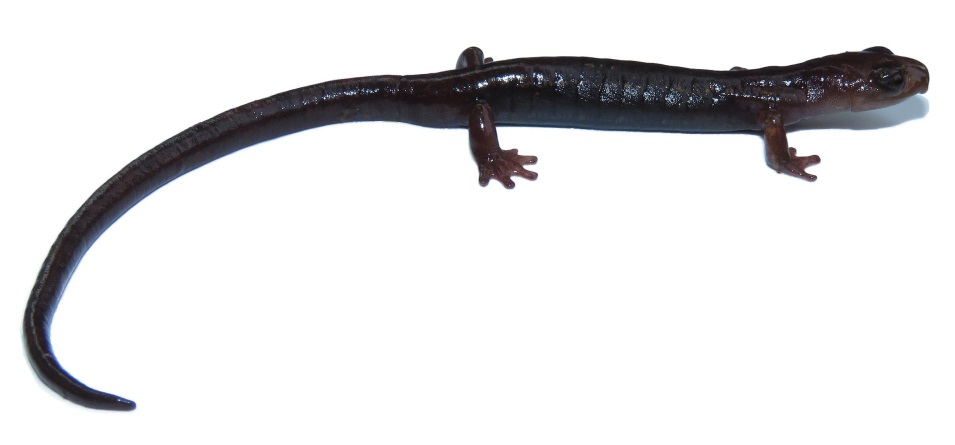
Holotype of Bolitoglossa bolanosi sp. nov. (UCR 22965) in life on a white background.
Photograph by Erick Arias.

In-life photographs of variations within  Bolitoglossa bolanosi sp. nov. 
 (A) Paratopotype male subadult UCR 22966, (B) paratype juvenile UCR 24247, (C) paratype adult female UCR 22421, and (D) paratype adult female UCR 24245.
 Photographs A and C by Erick Arias, B and D by Omar Zúñiga.

Bolitoglossa bolanosi sp. nov. 
Bolaños’ Web-footed Salamander 

Diagnosis. The combination of the following characteristics can be used to distinguish Bolitoglossa bolanosi from the other described species of the genus Bolitoglossa: (1) having broad hands and feet, with the distal phalanges on the fngers and toes free of palmar and plantar tissue; (2) dorsal coloration highly variable, rarely black brownish uniform and usually mottled with yellow spots, but never with red on hind limbs or forelimbs; and (3) 16S and cyt b mtDNA distances.

Etymology. The name “bolanosi” is a patronym honoring the Costa Rican herpetologist Federico Bolaños, and is used as a noun in the genitive case. We name this species after our dear friend in recognition of his scientifc contributions to the knowledge of the herpetology of Costa Rica, as curator of the Herpetology section at Museo de Zoología of Universidad de Costa Rica, and as the mentor of most herpetologists present in the country. 
 

Erick Arias, Gerardo Chaves and Gabriela Parra-Olea. 2023. A New Species of Salamander (Caudata: Plethodontidae: Bolitoglossa) from the Subalpine Rain Páramo of the Cordillera de Talamanca, Costa Rica. Amphibian & Reptile Conservation. 17(1 & 2) [General Section]: 143–160 (e327).

Wednesday, January 3, 2024

[Herpetology • 2023] Pseudopaludicola javae • A New Species of Pseudopaludicola Miranda-Ribeiro, 1926 (Anura: Leptodactylidae) from Tocantins State, Brazil


Pseudopaludicola javae
Silva, Andrade, Neto, Dantas, Haga & Garda, 2023


Abstract
The number of described species of Pseudopaludicola has increased at unprecedented rates over the past two decades. This increase was mainly driven by the sampling effort in regions historically neglected and the use of evidence from bioacoustic, genetic, and morphological datasets combined. Here, we describe a new species of Pseudopaludicola from a transitional zone between Amazonia and Cerrado in western Tocantins State as revealed through morphological, molecular, and bioacoustic analysis. Pseudopaludicola javae sp. nov. is distinguished from its congeners by its small size; knobbed terminal phalanges; smooth upper eyelids and heel; relatively short hind limbs; smooth, whitish, and subgular inflated vocal sac with few melanophores around the jaw; and advertisement call composed of an irregular series of multipulsed notes with 10–17 nonconcatenated pulses separated by intervals of 3–55 ms, emitted at a rate of 27–51 pulses/sec. The new species occurs in four Tocantins municipalities, all in the Araguaia–Tocantins interfluve. We also provide the first records of Pseudopaludicola jazmynmcdonaldae outside the type locality (Caseara Municipality, Tocantins State), extending its distribution nearly 245 km southward from Caseara. Pseudopaludicola javae sp. nov. is the second species of Pseudopaludicola described recently from western Tocantins.


 Variation in life of Pseudopaludicola javae sp. nov.
(A) Male CHUFPB31055 (SVL = 13.8), (B) holotype male CHUFPB31044 (SVL = 15.1), (C) male CHUFPB31056 (SVL = 13.2), (D) unvouchered male,
(E) male CHUFPB31043 (SVL = 14.3), (F) male CHUFPB31059 (SVL = 15.4), (G) male CHUFPB31062 (SVL = 14.0), and (H) female CHUFPB31042 (SVL = 14.8).
Specimens A, D, and E are from Lagoa da Confusã o; the remaining specimens are from Marianópolis Municipality, all Tocantins State.

Pseudopaludicola javae sp. nov.

Etymology.—The Javaé are an ethnic group that has been historically present in the regions surrounding the middle Araguaia River, primarily on the world’s largest fluvial island, Bananal Island. This island is flanked on its west side by the Araguaia River and to the east by the Javaés River, which is an anabranch of the Araguaia, also known as ‘‘Braço Menor do Araguaia.’’ Besides the Javaé, Bananal Island is also home to two other indigenous groups, as follows: Karaja ́ and Xambioa ́ . The Javaé people refer to themselves as Iñy, meaning ‘‘human being.’’More than 10 Javaé villages are present on Bananal Island, and the closest village to the type locality is ‘‘Boto Velho’’ village (Inãwébohona in the Iñy language), about 100 km away. Thus, the specific name is in recognition of this singular Brazilian ethnic group that historically occupied the region where the new speciesis found.

 
Leandro Alves Silva, Felipe Silva De Andrade, Ennio Painkow Neto, Silionamã Pereira Dantas, Isabelle Aquemi Haga and Adrian Antonio Garda. 2023. A New Species of Pseudopaludicola Miranda-Ribeiro, 1926 (Anura, Leptodactylidae) from Tocantins State, Brazil. J. of Herpetology. 57(3):297-314. DOI: 10.1670/22-062 
O número de espécies de Pseudopaludicola descritas cresceu a taxas sem precedentes nas últimas duas décadas. Esse aumento foi impulsionado principalmente pelo esforço de amostragem em regiões historicamente negligenciadas e pelo uso de evidências bioacústicas, genéticas e morfológicas. Nós descrevemos uma nova espécie de Pseudopaludicola de uma zona de transição entre a Amazônia e o Cerrado no oeste do estado do Tocantins revelada através de análises morfológicas, moleculares e bioacústicas. Pseudopaludicola javae sp. nov. é diagnosticada de seus congêneres por seu pequeno tamanho, falanges terminais simples, pálpebras superiores e calcanhar lisos, membros posteriores relativamente curtos, saco vocal subgular, liso e esbranquiçado quando inflado com poucos melanóforos ao redor da mandíbula, e canto de anúncio composto por séries irregulares de notas com 10–17 pulsos não concatenados separados por intervalos de 3–55 ms, emitidos a uma taxa de 27–51 pulsos/s. A nova espécie ocorre em quatro municípios do Tocantins, todos no interflúvio Araguaia-Tocantins. Também fornecemos aqui os primeiros registros de P. jazmynmcdonaldae fora da localidade tipo (município de Caseara, estado do Tocantins), estendendo sua distribuição em cerca de 245 km em linha reta ao sul de Caseara. Pseudopaludicola javae sp. nov. é a segunda espécie de Pseudopaludicola descrita para o oeste do Tocantins nos últimos anos.

Wednesday, December 27, 2023

[Herpetology • 2023] Rhinella kuka • Misjudged for Long: A New toad of the Rhinella veraguensis species group (Anura: Bufonidae) from the Yungas Forests of Bolivia


Rhinella kuka 
Köhler, Vences, Padial, Plewnia & Lötters, 2023


Abstract
We re-evaluate the taxonomic status of specimens of Rhinella collected from rainforests on the eastern Andean slopes and foothills of central Bolivia. The respective populations have been allocated to different nominal taxa, namely Rhinella fissipes and R. leptoscelis, in the past. By detailed morphological comparisons, including the type specimens of crucial taxa, as well as a phylogenetic analysis based on the mitochondrial 16S rRNA gene, we here demonstrate that the focal populations represent a divergent lineage within the Rhinella veraguensis species group, being apparently closely related to R. rumbolli from northern Argentina, but only distantly related to R. leptoscelis, with which they share several morphological character states. Also, the specimens of the focal lineage differ by a unique combination of morphological character states from all known nominal species currently assigned to the R. veraguensis group. Consequently, we describe this lineage as a new species. We discuss the history of its changing taxonomic allocations and demonstrate that former conclusions were barely justified and wrong. We also provide a description of the osteology of this species using computer tomography (micro-CT). Furthermore, we discuss the status of the nominal taxon Bufo pleuropterus Schmidt, 1857, currently considered to represent a junior synonym of Rhinella margaritifera (Laurenti, 1768), and provide arguments for the specific distinctness of these two taxa. Consequently, we regard Rhinella pleuroptera (Schmidt, 1857) a valid species. Based on its external morphology, which is rather similar to that of R. inca, we speculate that R. pleuroptera is possibly related to species in the R. veraguensis group, although this remains in need of further research. 

Key words. Amphibia, Bufo pleuropterus, computer tomography (micro-CT), molecular genetics, morphology, osteology, Peru, taxonomy, systematics


Rhinella kuka sp. n.
Dorsolateral views (left column) and ventral views (right column) of paratypes in life:
 (A, B) female ZFMK 72670; (C, D) female ZFMK 80036; and (E, F) male ZFMK 80035.

Rhinella kuka sp. n. 
 
Definition: A large-sized species in the Rhinella veraguensis species group, based on morphological similarities and phylogenetic relationships. The new species is characterized by (1) large size, SVL 62.8 mm in adult male (n = 1), SVL 66.0–72.1 mm in adult females (n = 5); (2) eight presacral vertebrae, presacrals I and II (atlas and axis) fused; skull hyperossified; (3) snout short, acuminate in dorsal view, rounded in lateral profile; (4) canthal, preorbital, supraorbital, and postorbital crests distinct and continuous; pretympanic crest present; supratympanic crest distinct, short; occipital crests prominent, elevated; (5) tympanic membrane and tympanic annulus distinct; tympanum slightly higher than wide, its diameter slightly more than ...


Etymology: The specific epithet kuka is the Quechuan word for the coca plant (Erythroxylum coca). It refers to the fact that the known distribution of the new species is largely equivalent to the major range of coca plantations in the Bolivian Yungas. The name is treated as a noun in apposition.

 
Jörn Köhler, Miguel Vences, José M. Padial, Amadeus Plewnia and Stefan Lötters. 2023. Misjudged for Long: A New toad of the Rhinella veraguensis species group (Anura: Bufonidae) from the Yungas Forests of Bolivia. SALAMANDRA. 59(4): 307–326. 


Thursday, November 30, 2023

[Herpetology • 2020] Rhinella parecis • A New Species of the Rhinella margaritifera (Laurenti 1768) Species Group (Anura: Bufonidae) from southern Brazilian Amazonia


Rhinella parecis
 Ávila, Morais, Perez, Pansonato, de Carvalho, Rojas, Gordo & Farias, 2020


Abstract
Neotropical toads from the Rhinella margaritifera species group have been considered a taxonomic puzzle for a long time. Because of the high morphological similarity and an unknown number of undescribed taxa among the species of this group, we did an extensive search for character distribution within all nominal taxa. Herein we describe Rhinella parecis sp. nov. a new species from Southern Brazilian Amazon. We provide a morphological diagnosis, morphometric comparisons with similar species, and a molecular phylogenetic hypothesis on the relationships of the new species. Rhinella parecis sp. nov. is assigned to the R. margaritifera group and differs from others species by snout-vent length ranging 40.7–53.5 mm in males (n=12) and 44.9–54.8 mm in females (n=4), snout rounded in dorsal view, acute with fleshy ridge extending to tip of snout in lateral view, canthal and pre-orbital crests absent, supra-orbital, parietal and supra-tympanic crests present and low, dorsolateral row of tubercles present, bony protrusion at the angle of jaws absent, tympanum evident, vertebral apophyses absent and toes half-webbed. The new species is the 20th species associated to the R. margaritifera group distributed in the Chapada dos Parecis, a probable center of endemism in states of Rondônia and Mato Grosso, Brazil.

Keywords: Amphibia, Neotropical, Rainforest, Systematics, Taxonomy


 Rhinella parecis sp. nov.

Diagnosis. Rhinella parecis sp. nov. is diagnosed by the following combination of characters: (1) snout-vent length range 40.7–53.5 mm in males and 44.9–54.8 mm in females; (2) snout rounded in dorsal view, acute with fleshy ridge extending to the tip of the snout in lateral view; (3) canthal and pre-orbital crests absent; (4) supra-orbital, parietal and supra-tympanic crests present and low; (5) dorsolateral row of tubercles present; (6) bony protrusion at the angle of jaws absent; (7) tympanum evident; (8) vertebral apophyses absent; (9) toes half-webbed.

Etymology. The specific name parecis, a noun in apposition, refers to the Chapada dos Parecis, a plateau occupying large portions of the Brazilian states of Mato Grosso and Rondônia, Brazil.


Robson Waldemar Ávila, Drausio Honorio Morais, Renata Perez, André Pansonato, Vinicius Tadeu de Carvalho, Rommel R. Rojas, Marcelo Gordo and Izeni Pires Farias. 2020. A New Species of the Rhinella margaritifera (Laurenti 1768) Species Group (Anura, Bufonidae) from southern Brazilian Amazonia.  Zootaxa. 4868(3); 368–388. DOI: 10.11646/zootaxa.4868.3.3