Showing posts with label Author: Deepak. Show all posts

Wednesday, March 11, 2026

[Herpetology • 2026] Takydromus ultapaniensis • A New Species of Takydromus (Squamata: Lacertidae) from northeast India


Takydromus ultapaniensis
Chettri, Mothey, Ghatani, Deepak & Rai, 2026


Abstract
The diversity of lizards in the northeast Indian biodiversity hotspot is underestimated, as evidenced by many new species recorded in recent years. Here, we describe a new species of Takydromus from Ultapani, Kokrajhar District, Assam, India. This newly identified species is distinguished from its relatives in its distinctive morphological features and significant genetic variation in the mitochondrial 12S rRNA and COI genes. We have also added the missing molecular data for T. sikkimensis and T. khasiensis. In the light of these new data, we discuss the phylogenetic relationships of Takydromus species from the Indian subcontinent with their congeners.

Reptilia, Asian grass lizard, genetic divergence, phylogeny, range expansion, Takydromus, Ultapani


Takydromus ultapaniensis sp. nov. 


BASUNDHARA CHETTRI, RABINA MOTHEY, SUDEEP GHATANI, V. DEEPAK and ANANTA RAI. 2026. A New Species of Takydromus (Squamata: Lacertidae) from northeast India.  Zootaxa. 5763(2); 205-224. DOI: doi.org/10.11646/zootaxa.5763.2.2 [2026-03-03] 


Saturday, November 22, 2025

[Herpetology • 2025] Raorchestes magnus, R. monolithus, R. nasuta, R. orientalis ... • Revision of Bush Frogs, Raorchestes and Philautus (Anura: Rhacophoridae) from the northeast Indian Biodiversity Hotspot with Description of Thirteen New Species


Raorchestes nasuta, R. monolithusR. orientalis,
R. khonoma, R. arunachalensis, R. magnus, ...
 Boruah, Deepak & Das, 2025 


Abstract
Bush frogs currently in the genera Raorchestes and Philautus are poorly documented from northeast India when compared to the Western Ghats of southwestern India. They are morphologically cryptic, but variable in their acoustic repertoire and genetic divergence. We present a long-overdue revision of the bush frogs of northeast India by sampling 81 localities in eight Indian States (including nine type localities of known species) and by comparing historical (especially, type) material. Using an integrative approach that combines levels of divergence in mitochondrial DNA, a nuclear-encoded gene and comparing morphological and bioacoustic data, we demonstrate the existence of 13 new species, which are formally described here. In addition, based on the evidence from molecular and morphological data we synonymise four previously described species from this region. We resolve the taxonomic identities of three other frog species found in northeast India. After extensive survey across northeast India, we did not find a single specimen of the genus Philautus. The only species in this genus with ambiguous generic identity is P. dubius which requires further taxonomic investigation.

Keywords: Bioacoustics, cryptic species, Indo-Burma, Indochina, morphology, phylogeny, redescription, taxonomy 


Raorchestes orientalis sp. nov.
Raorchestes mawsynramensis sp. nov.
Raorchestes boulengeri sp. nov.

Raorchestes barakensis sp. nov.
Raorchestes narpuhensis sp. nov.
Raorchestes lawngtlaiensis sp. nov.

Raorchestes nasuta sp. nov.
Raorchestes dibangensis sp. nov.
Raorchestes monolithus sp. nov.

Raorchestes khonoma sp. nov.
Raorchestes eaglenestensis sp. nov.
Raorchestes arunachalensis sp. nov.
Raorchestes magnus sp. nov.


Raorchestes cinerascens  comb. nov.
Raorchestes tytthus  comb. nov.,
 Liurana kempii  comb. nov.
Nasutixalus microdiscus comb. nov.


 Bitupan Boruah, V. Deepak and Abhijit Das. 2025. Revision of Bush Frogs, Raorchestes and Philautus (Amphibia: Anura: Rhacophoridae) from the northeast Indian Biodiversity Hotspot with Description of Thirteen New Species. Vertebrate Zoology. 75: 517-625. DOI: doi.org/10.3897/vz.75.e148133 

Tuesday, November 18, 2025

[Herpetology • 2025] Ptyctolaemus namdaphaensis & P. siangensis • Two New Species of Ptyctolaemus (Squamata: Agamidae) from northeast India


Ptyctolaemus namdaphaensis 
Ptyctolaemus siangensis 
 

 Balan, Das, Boruah, Tillack, Lalronunga & Deepak, 2025

Ptyctolaemus gularis (Peters, 1864)


Abstract 
The genus Ptyctolaemus Peters, 1864 is currently represented by three species; P. gularis, P. collicristatus and P. chindwinensis. Previous molecular phylogenetic studies have highlighted additional lineages within P. gularis. Phylogenetic analysis using the ND2 mitochondrial gene recovered three distinct lineages in India. Multivariate analyses using morphological data placed the type specimen of P. gularis (ZMB 5004) with the samples collected from Meghalaya. We assign this lineage as P. gularis and describe the other two lineages as new species. Ptyctolaemus siangensis sp. nov. found west of Siang River in Arunachal Pradesh and Ptyctolaemus namdaphaensis sp. nov. found in Namdapha, Changlang district of Arunachal Pradesh. Although phenotypically similar the two new species differ from its congeners in gular colouration and subtle morphological differences.

Keywords: Agamids, Arunachal Pradesh, DNA, molecular, morphology, multivariate analysis


Ptyctolaemus siangensis sp. nov.

Ptyctolaemus namdaphaensis sp. nov.


 Amirtha Balan, Abhijit Das, Bitupan Boruah, Frank Tillack, Samuel Lalronunga and Veerappan Deepak. 2025. Description of Two New Species of Ptyctolaemus (Squamata: Agamidae) from northeast India. Vertebrate Zoology. 75: 487-516. DOI: doi.org/10.3897/vz.75.e162650 [11-11-2025]


Friday, August 1, 2025

[Herpetology • 2025] Xylophis chenkaruppanHidden in the Sky Islands: A New Species of Xylophis Beddome, 1878 (Serpentes: Pareidae: Xylophiinae) from montane habitats of Wayanad in the Western Ghats of India

 
 Xylophis chenkaruppan
 Narayanan, Das, Ghosh, Palot, Umesh, Gower & Deepak, 2025 
 

Abstract
A new species of the snake genus Xylophis is described from the Wayanad region in the Western Ghats of India. The new species, X. chenkaruppan sp. nov., is described based on six specimens collected from Vellarimala and Kurichyarmala Hills. Molecular genetic analysis based on three mitochondrial (16s, cytb & nd4) and one nuclear (cmos) marker recovered this lineage as sister to X. perroteti. Although also phenotypically generally similar to X. perroteti from Nilgiri Hills (north of the lowland Palghat Gap), the ventral head morphology of X. chenkaruppan sp. nov. differs from the former in that the posterior genial shields are in midline contact, a condition found also in X. mosaicus occurring only south of the Palghat Gap. An updated key to the identification of the species of the genus Xylophis is provided herein.

Reptilia, vellarimala, kurichyarmala, Nilgiri hills, taxonomy, wayanad, woodsnake


 Xylophis chenkaruppan sp. nov.


Surya NARAYANAN, Sandeep DAS, Avrajjal GHOSH, Muhamed Jaffer PALOT, P. UMESH, David J. GOWER and V. DEEPAK. 2025. Hidden in the Sky Islands: A New Species of Xylophis Beddome, 1878 (Serpentes: Pareidae: Xylophiinae) from montane habitats of Wayanad in the Western Ghats of India. Zootaxa. 5666(4); 509-528. DOI: doi.org/10.11646/zootaxa.5666.4.3 [2025-07-30]


Saturday, June 14, 2025

[Herpetology • 2025] Riopa deccanensis • A New Species of Riopa Gray, 1839 (Reptilia: Scincidae) from the Eastern Ghats, India


Riopa deccanensis
Bhupathi, Ray, Karuthapandi, Jaiswal, Deepak & Mohapatra, 2025


Abstract
We describe a new species of Riopa from the Eastern Ghats in Andhra Pradesh and Telangana states, India. The new species is diagnosed by the following suite of characters: lower eyelid with a semi-transparent disk, 108–109 paravertebral scale rows, 8 or 9 lamellae on the 4th toe, dorsum with 16 distinct longitudinal lines, five fingers and five toes, preanal scales not enlarged, and ear opening covered by scales. Our mitochondrial molecular data supports the placement of the species in the genus Riopa and the new species is 4.1–9.2 % divergent from genetically sampled congeners. This study adds in understanding the cryptic diversity of lizard fauna in the Eastern Ghats in peninsular India. Based on our findings we provide a dichotomous key to the genus Riopa

Reptilia, Andhra Pradesh, Deccan Peninsula, Eastern Ghats, endemic, skink, taxonomy, Telangana


Riopa deccanensis
 Deccan Gracile Skink
 

Bharath BHUPATHI, Sumidh RAY, M. KARUTHAPANDI, Deepa JAISWAL, V. DEEPAK and Pratyush  P. MOHAPATRA. 2025. A New Species of Riopa Gray, 1839 (Reptilia: Squamata: Scincidae) from the Eastern Ghats, India.  Zootaxa. 5647(2); 117-130. DOI: doi.org/10.11646/zootaxa.5647.2.2 [2025-06-13]

Thursday, November 16, 2023

[Herpetology • 2023] Nidirana noadihingMusicians in the Marsh: A New Species of Music Frog (Anura: Ranidae: Nidirana) from Arunachal Pradesh, India


Nidirana noadihing 
Boruah, Deepak & Das, 2023

 
Abstract
We describe a new species of ranid frog of the genus Nidirana from northeast India based on morphological, molecular and acoustic evidence. The new species is phenotypically distinct from its congeners by a combination of morphological characters: body robust with SVL 46.5–59.1 mm (n= 3) in adult males and SVL 60.6–66.0 mm (n= 2) in adult females; a pair of subgular vocal sacs and two patches of nuptial pad on the first finger in adult males; toe tips slightly dilated and oval; circum-marginal grooves present on all toes; dorsal skin with scattered small tubercles. A pale cream-coloured mid-dorsal line from the snout tip to the vent is present. Phylogenetically, the new species differs from its congeners by a genetic divergence of 3.4–8.0% and 7.7–12.4% in 16S and COI genes respectively. Furthermore, the new species can be differentiated from its congeners by its advertisement call, which consists of two different types of notes, call duration (0.58–0.92 s) and dominant frequency of the call (473.7 Hz). The discovery of a new species validates the presence of the genus Nidirana from India and emphasizes the importance of exploring specialized habitats such as marshlands, which are often overlooked.

Keywords: Amphibia, Indo-Burma biodiversity hotspot, Northeast India, phylogeny, taxonomy


Nidirana noadihing 

 Bitupan Boruah, V. Deepak and Abhijit Das. 2023. Musicians in the Marsh: A New Species of Music Frog (Anura: Ranidae: Nidirana) from Arunachal Pradesh, India. Zootaxa. 5374(1); 51-73. DOI: 10.11646/zootaxa.5374.1.3
 twitter.com/Bitupan81035978/status/1724663212979998819

Nidirana noadihing are found in marshes along the Noa-Dihing River in #ArunachalPradesh, NE #India.


Saturday, August 20, 2022

[Herpetology • 2022] Cyrtodactylus aravindi • A New Species of Cyrtodactylus (Reptilia: Gekkonidae) from the southern Western Ghats of India


Cyrtodactylus aravindi  
Narayanan, Das, Balan, Tom, Divakar, Kp, Hopeland & Deepak, 2022


Abstract
A new species of Cyrtodactylus is described from the southern Western Ghats of India. It is distinguished from all species of the ­Cyrtodactylus collegalensis species complex in colour pattern and resembles the Srilankan endemic C. yakhuna in overall colouration. Phylogenetic analysis of mitochondrial ND2 DNA sequences indicates that the new species is most closely related to species in the C. collegalensis complex and differs from them by an uncorrected pairwise genetic distance of 10.5–12.9%.

Keywords: Colour pattern, Cyrtodactylus, phylogeny, Tamil Nadu, Western Ghats

Live images of Cyrtodactylus aravindi sp. nov.
A Holotype (ZSI-R 28275), B Paratype (ZSI-R 28280),
C uncollected juvenile female from the type locality.

Cyrtodactylus aravindi sp. nov.

Diagnosis: A small-sized Cyrtodactylus, SVL less than 45 mm (n=6); body moderately stout, limbs and digits short, slender; dorsal pholidosis on trunk homogeneous with smooth and granular scales; 16–20 dorsal midbody scale rows across trunk contained within one eye diameter; 33–36 ventral scales across belly; precloacal groove, enlarged precloacal and femoral scales, precloacal or femoral pores absent in both the sexes. Tail without a series of enlarged median subcaudal scales. Subdigital scansors smooth, entire (except one or two on some digits divided), unnotched; 5 or 7 basal 7 or 8 distal on digit IV of the manus. Dorsal pattern with a single thick band medially between the fore and hind limb insertions and a single moderatly sized spot posterior to the band. Post-occipital collar complete extending from the posterior margin of one orbit to the other, no regular spots on the flanks. Venter tan brown with irregular dark mottling.

Etymology: The specific epithet is a patronym honouring Dr N. A. Aravind, Senior Fellow at ATREE, Bengaluru, India for his support towards herpetological research. Aravind is a malacologist who has also contributed to amphibian systematics and his lab support has been instrumental in our research for the past few years. We suggest a common name for the new species as Aravind’s ground gecko.


  Surya Narayanan, Sandeep Das, Amirtha Balan, Roshin Tom, Nitin Divakar, Rajkumar Kp, P. Hopeland and V. Deepak. 2022. A New Species of Cyrtodactylus (Reptilia: Gekkonidae) from the southern Western Ghats of India.  Vertebrate Zoology. 72: 729-743.  DOI: 10.3897/vz.72.e89660


Thursday, May 19, 2022

[Herpetology • 2022] Rediscovery and Systematics of the rarely encountered Blue-bellied Kukri Snake Oligodon melaneus Wall, 1909 (Serpentes: Colubridae) from Assam, India


Oligodon melaneus Wall, 1909 

in Das, Gower, Narayanan, Pal, ... et Deepak, 2022. 
 
Abstract
We report the rediscovery of Oligodon melaneus 112 years after its original description and document the third, and only non-type, specimen for the species. The new specimen was found 267 km east of the type locality (Tindharia, West Bengal state) from Assam state, India. We designate a lectotype for the species, and provide an extended description of a freshly collected male specimen. Phylogenetic analyses of 16s and cytb mitochondrial genes provide support for O. melaneus being closely related to the widespread South Asian endemic O. arnensis.

Keywords: Reptilia, Colubridae, Northeast India, phylogeny, rediscovery, Reptilia Serpentes, systematics, taxonomy

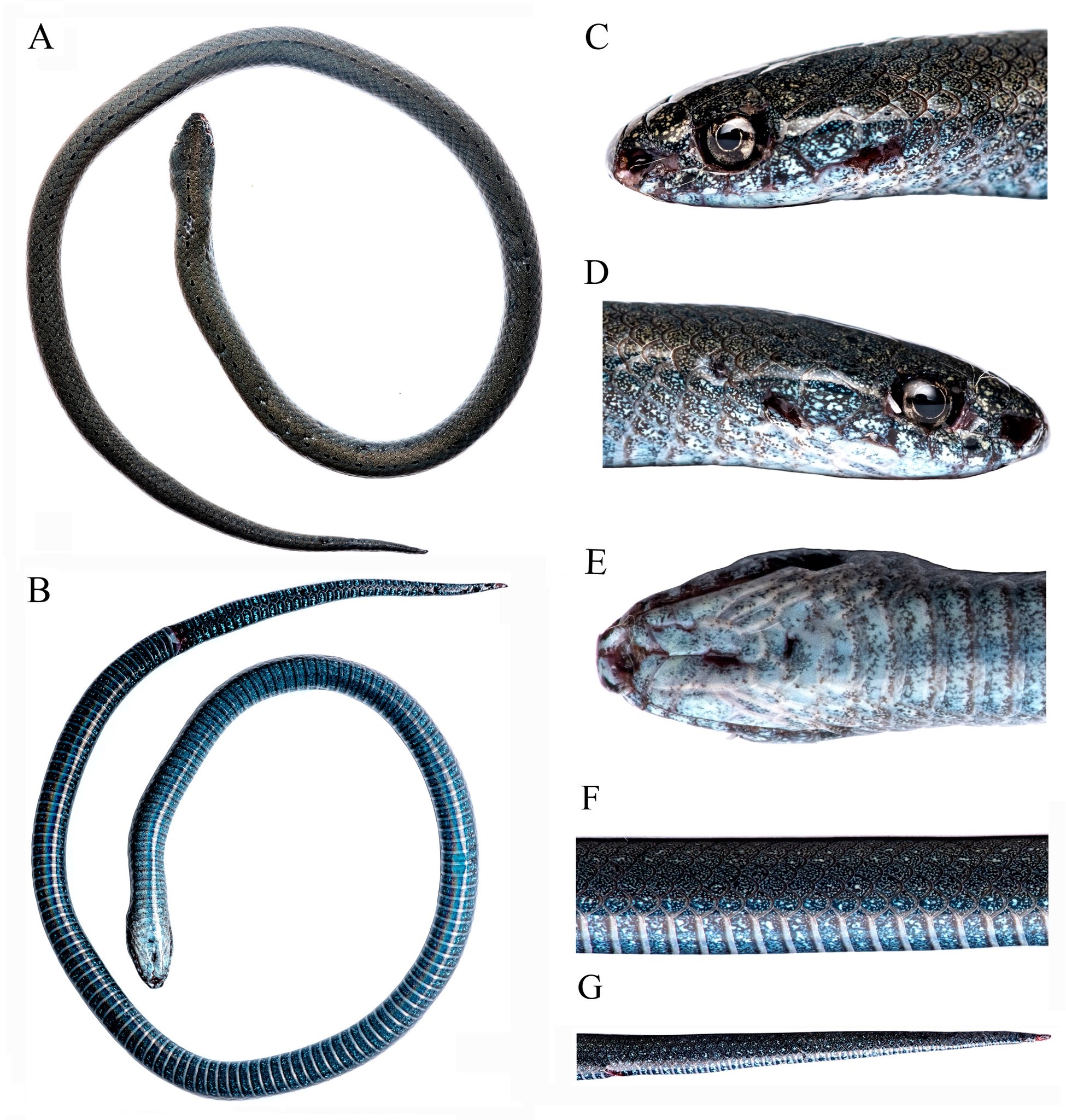
Newly reported, roadkill specimen of Oligodon melaneus (WII-ADR980) photographed soon after collection.
(A)dorsal view, (B) ventral view, (C) left lateral view of head, (D) ventrolateral aspect of midbody and (E) ventrolateral aspect of subcaudals.
 Images not to scale.  

Oligodon melaneus Wall, 1909 


Abhijit Das, David J. Gower, Surya Narayanan, Saunak Pal, Bitupan Boruah, Sanjay Magar, Sanjib Das, Soumabrata Moulick and V. Deepak. 2022. Rediscovery and Systematics of the rarely encountered Blue-bellied Kukri Snake (Oligodon melaneus Wall, 1909) from Assam, India. Zootaxa. 5138(4); 417-430. DOI: 10.11646/zootaxa.5138.4.4

Saturday, December 18, 2021

[Herpetology • 2021] Paraxenodermus borneensis • Phylogenetic Relationships of Xenodermid Snakes (Serpentes: Xenodermidae), with the Description of A New Genus


Paraxenodermus borneensis (Boulenger, 1899) 

(ZRC 2.5731), from Crocker Range, Sabah, in the north-western Borneo.

in Deepak, Lalronunga, Lalhmingliani, et al. 2021.
Photograph by Indraneil Das.

Abstract
Xenodermidae is a generally poorly known lineage of caenophidian snakes found in South, East and Southeast Asia. We report molecular phylogenetic analyses for a multilocus data set comprising all five currently recognised genera and including new mitochondrial and nuclear gene sequence data for the recently described Stoliczkia vanhnuailianai. Our phylogenetic results provide very strong support for the non-monophyly of Stoliczkia, as presently constituted, with S. borneensis being more closely related to Xenodermus than to the Northeast Indian S. vanhnuailianai. Based on phylogenetic relationships and morphological distinctiveness, we transfer Stoliczkia borneensis to a new monotypic genus endemic to Borneo, Paraxenodermus gen. nov. We also present new morphological data for P. borneensis.

Key words: Borneo, endemic, morphology, Paraxenodermus gen. nov., phylogeny, taxonomy


Line drawings of Stoliczkia khasiensis (A, B),
Stoliczkia vanhnuailianai
(C, D) and
Paraxenodermus borneensis (E, F)
based on ZSIK 14945, BNHS 3656 and BMNH 1946.1.15.58 respectively.

Genus characteristics are highlighted in different colours: 1) some supralabials in contact with eye in Stoliczkia, separated by circumorbital scales in Paraxenodermus; 2) fewer supra- and infralabials in Stoliczkia than in Paraxenodermus; 3) single prefrontal in Stoliczkia versus 2–3 in Paraxenodermus, 4) fewer scales between parietal and supralabials immediately behind eye in Stoliczkia than in Paraxenodermus, and 5) small row of scales between frontal and prefrontals absent in Stoliczkia, present in Paraxenodermus.
Note small scales behind the temporals are indicative rather than precisely accurate. Pale grey coloured areas are bare skin exposed between scales.
Illustrations by V. Deepak and Surya Narayanan. Scale bars = 10 mm.


Systematics
Stoliczkia — (Jerdon, 1870)

Content— S. khasiensis (Fig. 3A–B) and S. vanhnuailianai (Fig. 3C–D)

Diagnosis: This genus can be diagnosed based on the combination of the following features: (1) maxillary teeth small and subequal, (2) head very distinct from (much wider than) ‘neck’, with large shields on dorsal aspect, (3) posterior one-third of the head and posterior temporal region covered with small scales like those of the anterior end of the body, (4) 3 small scales between parietal and supralabial shields immediately behind eye (5) 8–9 supralabials, (6) nostril in a large concave nasal, (7) body slender and somewhat laterally compressed, (8) ventrals large, and (9) dark dorsum and pale venter meet along a regular straight line ventrolaterally and subcaudals partially or completely darker than venter.

Distribution: This genus is restricted to Northeast India (Fig. 1). Stoliczkia khasiensis is thus far known only from Khasi hills, Meghalaya state, India and the recently described Stoliczkia vanhnuailianai is known only from Mizoram state, India.

Etymology: The genus is named after the Moravian-born Ferdinand Stoliczka (1838–1874). A geologist-natural historian, he was appointed as a palaeontologist with the Geological Survey of India in 1863. Stoliczka collected vertebrates and molluscs from northern India, Andaman and Nicobar Islands, Myanmar and the Malay Peninsula. He served as the official Naturalist with the Second Mission to Yarkand, in central Asia. A biography and a list of published works and reports by Stoliczka can be found in Kolmaš (1982).


Paraxenodermus borneensis in life (ZRC 2.5731), from Crocker Range, Sabah, in the north-western Borneo. Sequences for this specimen was published in Vidal and Hedges (2002) and used in this study.
Photograph by Indraneil Das.

Paraxenodermus, gen. nov. 
 
Type species: Paraxenodermus borneensis (Boulenger, 1899).

Type locality: Mount Kinabalu, North Borneo (4,200 ft / 1,280 m); the holotype is deposited in the Natural History Museum, London as BMNH 1946.1.15.58; collected by Richard Hanitsch in March, 1899.

Diagnosis: This genus can be diagnosed based on the combination of the following features: (1) maxillary teeth small and subequal, (2) head very distinct from (much wider than) ‘neck’, with large shields on dorsal aspect, (3) posterior one-third of the head and posterior temporal region covered with small scales like those of the anterior of the body, (4) numerous small scales between parietal and supralabial shields immediately behind eye, (5) a row of 4–6 small scales between the frontal and prefrontal shields, (6) 10–11 supralabials, (7) nostril in a large concave nasal, (8) body slender and somewhat laterally compressed, (9) ventrals large, and (10) dorsum with numerous dorsolateral and middorsal pale blotches, venter pale with brown patches and subcaudals dark grey.

Etymology: The generic name Paraxenodermus is composed of the modern Latin generic name Xenodermus and the Latin adjective par (paris), meaning, among other possibilities, “similar to”.

Paraxenodermus borneensis (Boulenger, 1899).


 V. Deepak, Samuel Lalronunga, Esther Lalhmingliani, Abhijit Das, Surya Narayanan, Indraneil Das and David J. Gower. 2021. Phylogenetic Relationships of Xenodermid Snakes (Squamata: Serpentes: Xenodermidae), with the Description of A New Genus. Vertebrate Zoology. 71: 747-763. DOI: 10.3897/vz.71.e75967


Friday, August 13, 2021

[Herpetology • 2021] Rhabdophis bindi Hidden in the Plain Sight: A New Species of Rhabdophis (Serpentes: Colubridae: Natricinae) from the Rhabdophis himalayanus complex


 Rhabdophis bindi 
Das, Smith, Sidik, Sarker, Boruah, Patel, Murthy & Deepak, 2021

 
Abstract
A new species of natricine snake of the genus Rhabdophis is described from Northeast India. Morphologically the new species is similar to Rhabdophis himalayanus but it can be distinguished from it by lacking a nuchal groove and nuchal glands, being relatively smaller, and having a distinct neck, ventral, and subcaudal coloration. In overall coloration it resembles R. chrysargos, from which it is distinguished by several aspects of its morphology and genetic differences. The discovery of Rhabdophis bindi sp. nov. reveals that forested regions in the northeastern part of India needs further biological exploration.

Keywords: Reptilia, Biodiversity Hotspot, cryptic, Northeast India, nuchal gland, Rhabdophis sp. nov., systematics, taxonomy, rare


A: Bindee Keelback Rhabdophis bindi;
B: Himalayan Keelback Rhabdophis himalayanus

Rhabdophis bindi sp. nov. 


Abhijit Das, Eric N. Smith, Irvan Sidik, Goutam C. Sarker, Bitupan Boruah, Naitik G. Patel, B.H.C.K Murthy and V. Deepak. 2021. Hidden in the Plain Sight: A New Species of Rhabdophis (Serpentes: Natricinae) from the Rhabdophis himalayanus complex. Zootaxa. 5020(3); 401-433. DOI: 10.11646/zootaxa.5020.3.1


Thursday, July 8, 2021

[Herpetology • 2021] Stoliczkia vanhnuailianai • A New Species of Stoliczkia Jerdon, 1870 (Serpentes: Xenodermidae) from Mizoram, India


 Stoliczkia vanhnuailianai 
 Lalronunga, Lalhmangaiha, Zosangliana, Lalhmingliani, Gower, Das & Deepak, 2021

 
Abstract
We describe a new species of Stoliczkia from Mizoram, India. Stoliczkia vanhnuailianai sp. nov. is identified as a member of the genus Stoliczkia by distinct scale arrangements on the posterior of the head, and by scales on the body being separated by scaleless skin, and it differs from the two known congeners in body and head scalation. This is only the third specimen of Stoliczkia collected from India, and the sixth reported specimen for the genus. A revised key to the identification of the species of Stoliczkia is provided.

Keywords: Reptilia, Northeast India, Snakes, Squamata, systematics, taxonomy 


Stoliczkia vanhnuailianai sp. nov.


Samuel Lalronunga, K. Lalhmangaiha, Isaac Zosangliana, Esther Lalhmingliani, David J. Gower, Abhijit Das and V. Deepak. 2021. A New Species of Stoliczkia Jerdon, 1870 (Serpentes: Xenodermidae) from Mizoram, India. Zootaxa. 4996(3); 555-568.  DOI: 10.11646/zootaxa.4996.3.9