Showing posts with label Pteridophyta. Show all posts

Friday, May 15, 2026

[Botany • 2026] Leptochilus yangjiangensis (Polypodiaceae) • A New Fern Species From Guangdong, China


Leptochilus yangjiangensis F. G. Wang, Y. Huang & H. J. Zhou,

in Zhou, T. Wang, Huang, Fang, Zhang, G.-D. Chen, H.-F. Chen et F.-G. Wang, 2026. 
阳江线蕨  ||  DOI: doi.org/10.1002/ece3.73621

ABSTRACT
A new fern species, Leptochilus yangjiangensis (Polypodiaceae), was discovered during field surveys in Ziluo Mountain, Yangjiang City, Guangdong Province, China. This study provides a detailed morphological description and illustrations of the new species. Morphologically, this species resembles Leptochilus pedunculatus and L. ovatus in plant height, petiole morphology, and soral morphology, but differs from them in its coriaceous laminae and lanceolate fertile fronds. To confirm its taxonomic status, phylogenetic analyses based on three plastid genome regions (rbcL, trnL-F, and rps4+rps4-trnS) indicated that the new species forms a distinct and well-supported monophyletic clade and is sister to L. dolichophyllus. Furthermore, the complete plastid genome of this new species is reported for the first time. Preliminarily assessed as Data Deficient (DD) according to IUCN guidelines, this new species enriches the diversity of Leptochilus.

Keywords: Leptochilus, morphology, new species, phylogenetic analysis, plastid genome

Habitat and morphology of Leptochilus yangjiangensis.
(A) Habitat. (B) Whole plant. (C) Habit. (D) Close-up of fronds with sori. (E) Scale structure under a biological microscope. (F) Spore morphology under a scanning electron microscope.
Photographs by Guo-Di Chen (A–D).

Leptochilus yangjiangensis F. G. Wang, Y. Huang & H. J. Zhou, sp. nov. 

Diagnosis: Leptochilus yangjiangensis is similar to both L. pedunculatus and L. ovatus, but can be distinguished by the following diagnostic characters (Table 2): (1) lamina coriaceous (vs. herbaceous in both L. pedunculatus and L. ovatus); (2) fertile fronds lanceolate (vs. ovate-lanceolate in both L. pedunculatus and L. ovatus); (3) life form lithophytic (vs. lithophytic in L. pedunculatus and hemiepiphytic in L. ovatus). Additionally, it can be distinguished from its sister species L. dolichophyllus by the smaller plant size (fertile fronds 26.0–43.0 cm long vs. 43.0–60.0 cm long in L. dolichophyllus) and distinct life form (lithophytic vs. hemiepiphytic in L. dolichophyllus).


Hua-Jing Zhou, Ting Wang, Yi Huang, Yu-Han Fang, Bin Zhang, Guo-Di Chen, Hong-Feng Chen and Fa-Guo Wang. 2026. Leptochilus yangjiangensis (Polypodiaceae), a New Fern Species From Guangdong, China. Ecology and Evolution. DOI: doi.org/10.1002/ece3.73621 [14 May 2026]
 

Sunday, April 12, 2026

[Botany • 2026] Asplenium paucipinnatum (Aspleniaceae) • A New fern Species from southern Thailand, based on morphological and molecular data


Asplenium paucipinnatum  K.W.Xu, Li Bing Zhang & Pollawatn, 

in Xu, Pollawatn, L. Zhang, Zhou et L.-B. Zhang, 2026.   

Abstract
Asplenium paucipinnatum, a new fern species from Nakhon Si Thammarat, Thailand, is described. Morphologically, it closely resembles A. micantifrons in having short-creeping and radial rhizome steles, 1-pinnate laminae, deeply incised pinnae on the basiscopic margin, and sori arranged in two rows close to the costae. However, A. paucipinnatum is readily distinguished by having fewer lateral pinnae (< 14 pairs), obliquely rhombic pinnae with acute apices and obtuse marginal teeth, contrasting the more numerous pinnae (> 15 pairs), lanceolate pinnae with acuminate apices, and acute teeth in A. micantifrons. Phylogenetic analyses based on multiple plastid DNA regions (atpB, rbcL, rps4, rps4-trnS, trnL, and trnL-F) support A. paucipinnatum as a distinct lineage, forming a sister relationship with a clade containing A. lepturus and A. contiguum. The combination of morphological and molecular evidence supports the recognition of this new taxon. Ecological notes, geographic distribution, and a comparison with related species are also provided.

Key words: Asplenium aethiopicum clade, fern phylogeny, Southeast Asian fern flora, taxonomy

Asplenium paucipinnatum. A. Habit; B. Abaxial view of lamina; C. Abaxial view of pinnae showing the venation on the pinnae; D. Showing the lamina apices deeply pinnatifid and becoming gradually decrescent upwards; E. Adaxial view of Pinnae at middle portion of the laminae; F. Short-creeping rhizome; G. Rhizome scales.
(Voucher specimen: Li Bing Zhang, Liang Zhang, R. Pollawatn & X. M. Zhou 10976).

Asplenium paucipinnatum K.W.Xu, Li Bing Zhang & Pollawatn, sp. nov.
 
Description. Asplenium paucipinnatum resembles A. micantifrons (Tuyama) Tuyama ex H.Ohba by its short creeping and radial rhizomes, 1-pinnate laminae, pinnae deeply incised at basiscopic side of margin, and sori borne in 2 rows closely set along to the costa, but the former has lateral pinnae fewer than 14 pairs, pinnae oblique rhombic, pinna apex acute, and marginal teeth obtuse. In contrast, A. micantifrons has lateral pinnae more than 15 pairs, pinnae lanceolate, pinna apex acuminate, and marginal teeth acute.


Ke-Wang Xu, Rossarin Pollawatn, Liang Zhang, Xin-Mao Zhou and Li-Bing Zhang. 2026. Asplenium paucipinnatum (Aspleniaceae), A New fern Species from southern Thailand, based on morphological and molecular data. PhytoKeys. 272: 159-167. DOI: doi.org/10.3897/phytokeys.272.173645 [02 Apr 2026]

Thursday, December 4, 2025

[Botany • 2025] Angiopteris guangdongensis (Marattiaceae) • A New Species From Guangdong, China


Angiopteris guangdongensis Wufeng Chen and Y.H. Yan,  

in W.-F. Chen, Sun, L.-J. Chen, Shu, Liang, Zheng et Yan, 2025.  
 广东观音座莲  ||  DOI: doi.org/10.1002/ece3.72447 

ABSTRACT
In this study, we confirm that the population of Angiopteris from Guangdong Province represents a distinct new species, which we describe as Angiopteris guangdongensis. Morphologically, A. guangdongensis resembles Angiopteris fokiensis but can be distinguished by its arborescent habit (reaching up to 5 m in height), robust scaly stipes, linear-lanceolate pinnules, abaxially scaly slender pinnules, sori with 7–16 sporangia, and a higher basal pinnule aspect ratio. Plastid phylogenomic analyses place A. guangdongensis as a monophyletic lineage sister to A. fokiensis. According to IUCN guidelines, the species is preliminarily assessed as ‘Data Deficient (DD)’. In addition, we report the complete plastid genome of this new species. This discovery not only provides important insights into the evolution and speciation of Angiopteris but also highlights the taxonomic oversimplification within the genus.

Keywords: ferns, Marattiaceae, morphology, phylogeny, plastid genome, taxonomy

Angiopteris guangdongensis Wufeng Chen and Y.H. Yan, sp. nov.
 (A) Habit; (B) pinnule; (C) detail of pinnule; (D) spore; (E) scale on the abaxial surface of the pinnule; (F) scale on the abaxial surface of the pinna rachis.

Angiopteris guangdongensis Wufeng Chen and Y.H. Yan, sp. nov.
(A) Habitat; (B) lamina; (C) pinnae; (D) rhizome and stipe; (E) sporangia.
Photographs by Jin-Gang Liu (A–E).

Angiopteris guangdongensis Wufeng Chen and Y.H. Yan, sp. nov. 

Diagnosis: Angiopteris guangdongensis is similar to both A. fokiensis (type locality: Fujian Province, China) and A. muralis (type locality: Guangdong Province, China), but it can be distinguished by the following diagnostic characters: (1) arborescent habit, 3–5 m tall (vs. 2–4 m in A. fokiensis and 2–3 m in A. muralis); (2) robust stipes, 9 cm in diameter, densely scaly (vs. 6 cm, sparsely scaly in both species); (3) linear-lanceolate pinnules (vs. lanceolate in A. fokiensis; ovate, lanceolate, acuminate in A. muralis); (4) pinnules densely scaly on the abaxial surface (vs. glabrous in A. fokiensis and sparsely scaly in A. muralis); (5) higher basal pinnule AR (Figures 5-8; Table 2).

Etymology: The specific epithet guangdongensis refers to Guangdong Province, China, the geographical origin of the type specimen. The species shows narrow endemism, being restricted to this region based on current distribution records.

Vernacular name: 广东观音座莲 (guang dong guan yin zuo lian).

 
Wu-Feng Chen, Wei-Yue Sun, Li-Jun Chen, Jiang-Ping Shu, Jun-Jie Liang, Yue-Bing Zheng and Yue-Hong Yan. 2025. Angiopteris guangdongensis (Marattiaceae): A New Species From Guangdong, China. Ecology and Evolution.15(11) DOI: doi.org/10.1002/ece3.72447 [09 November 2025]


Thursday, May 8, 2025

[Botany • 2022] Elaphoglossum matogrossense (Dryopteridaceae) • A New and Threatened Species from Chapada dos Guimarães, Mato Grosso, Brazil


Elaphoglossum matogrossense F.B.Matos & A.Vasco, 

in Matos et Vasco, 2022. 

Summary
Elaphoglossum matogrossense, a new species from central-western Brazil, is here described and illustrated. It belongs to Elaphoglossum section Lepidoglossa, which is often characterised by conspicuously scaly leaves and non-subulate scales with acicular, one-celled, non-glandular teeth. The new species was first collected c. 35 years ago. It is characterised by short-creeping stems, orangish to brown stem scales, moderately to densely scaly leaves, short petioles, and narrowly elliptic to oblanceolate laminae with round apices and gradually decurrent bases. Elaphoglossum matogrossense is known only from the Chapada dos Guimarães National Park and is here considered critically endangered. We provide a description, taxonomic and ecological comments, conservation status assessment, geographic distribution, phenology, and illustrations for this new species. 

Key Words: Cerrado, endangered, fern, Lepidoglossa, new species, pteridophyte, taxonomy

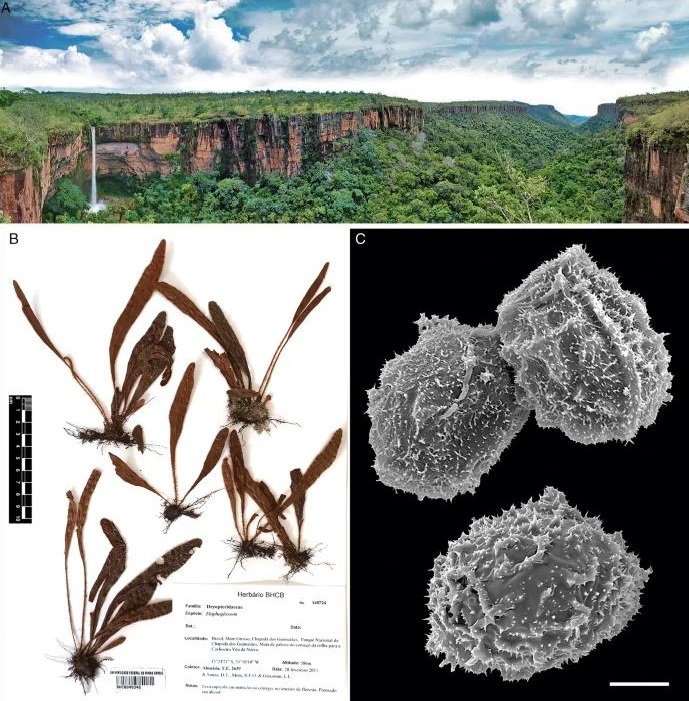
Elaphoglossum matogrossense.
A type locality, Véu de Noiva (Bridal Veil) Waterfall (at left), Chapada dos Guimarães National Park, Municipio de Cuiabá, Mato Grosso, Brazil (photo: robert dona);
B holotype (Almeida et al. 2639, BHCB); C spores (Salino 387, UPCB), scale bar = 10 μm.

Elaphoglossum matogrossense F.B.Matos & A.Vasco sp. nov.

Etymology. The specific epithet matogrossense refers to the Brazilian state of Mato Grosso, from where the new species was discovered.

 
Fernando B. Matos and Alejandra Vasco. 2022. Elaphoglossum matogrossense (Dryopteridaceae), A New and Threatened Species from Chapada dos Guimarães, Mato Grosso, Brazil. Kew Bulletin. 77; 721–728. DOI: doi.org/10.1007/s12225-022-10043-2 [29 July 2022]

Wednesday, January 1, 2025

[Botany • 2024] Ophioglossum hongii (Ophioglossaceae) • A New Species from Xizang, China


Ophioglossum hongii   

 in Li, Yang, Yan, Chen,... et Qin, 2024. 
 
Abstract
Ophioglossum hongii (Ophioglossaceae) is described as a new species from the plateau area of Xizang, China. It was recorded as the species O. nudicaule previously, but obviously differs in its shorter sporophores and the conspicuous persistent petiole bases at the top of rhizome. O. hongii is similar to O. polyphyllum in morphology, but it can be distinguished from the latter by plant size, trophophyll shape, fertile stalk and exospore ornamentation. O. hongii is the sister to the clade (O. polyphyllum, O. engelmannii) according to molecular phylogenetic analysis of seven plastid fragments (atpB, matK, psbA-trnH, rbcL, rps4, rps4-trnS, and trnL-F). Detailed taxonomic description, distribution, ecology, conservation status and chloroplast genome resources are provided.

chloroplast genome, Himalayas, phylogeny, pteridophytes, taxonomy


Min-Yu LI, Fu-Sheng YANG, Yue-Hong YAN, Li-Jun CHEN, Zhi-Cong HUANG, Jiang-Ping SHU and Xin-Sheng QIN. 2024. Ophioglossum hongii (Ophioglossaceae), A New Species from Xizang, China.  Phytotaxa. 676(2); 169-180. [2024-12-10] DOI: doi.org/10.11646/phytotaxa.676.2.5

Saturday, December 14, 2024

[Botany • 2024] Whittieria hengduanensis (Ophioglossaceae) • A New fern Species from Southwest China demonstrates a unique intercontinental disjunct pattern in plants between the Himalaya and the Americas

 
Whittieria hengduanensis Z.L.Liang & Li Bing Zhang, 

in Liang et Zhang. 2024. 

Abstract
A new fern species, Whittieria hengduanensis (Ophioglossaceae), from Sichuan, Xizang, and Yunnan, Southwest China (eastern Himalaya), is described and illustrated. This species is similar to W. engelmannii in the Americas in having a cylindrical rhizome and complex-reticulate venation. In addition, both species grow in open habitat on basic soil. However, the two species are distinguishable in root number per rhizome and the number of the larger areolae per trophophore. Our molecular study also supports that they are sister to each other but divergent at the molecular level. The discovery of W. hengduanensis shows that the genus is intercontinentally disjunct between the Himalaya and the Americas, a unique pattern not having been documented in the literature.

Key words: Adder’s tongues, fern biogeography, intercontinental disjunctions

Whittieria hengduanensis
A, B habitat C lower portion of plant showing stem and roots D individuals in different sizes E trophophores and sporophore stalks F sporophore G veins showing complex-reticulate venation.

Whittieria hengduanensis 
A, B habit C trophophore and base of sporophore D sporophore spike E veins showing complex-reticulate venation.

 Whittieria hengduanensis Z.L.Liang & Li Bing Zhang, sp. nov.

Diagnosis: Whittieria hengduanensis is similar to W. engelmannii but the former has up to 25 (–50) roots per rhizome and 10–20 large areolae per trophophore, whereas the latter has fewer than 15 roots per rhizome and 0–8 areolae per trophophore.

Etymology: The species epithet henduanensis is based on the distribution of this species in the Hengduan Mountain.


Zhen-Long Liang, Li-Bing Zhang. 2024. Discovery of Whittieria hengduanensis sp. nov. (Ophioglossaceae) from Southwest China demonstrates a unique intercontinental disjunct pattern in plants between the Himalaya and the Americas. PhytoKeys 249: 27-36. DOI: doi.org/10.3897/phytokeys.249.135379 

Wednesday, August 14, 2024

[Botany • 2022] Lindsaea kohkongensis (Lindsaeaceae) • A New Species from Cambodia and Malaysia


Lindsaea kohkongensis I. C. Hwang, M.-O. Moon & B.- Y. Sun, 

in Yun, Moon, Sun et Hwang, 2023.

Abstract
A new species, Lindsaea kohkongensis (Lindsaeaceae), is described from the near Chamnar village of valleys of Koh Kong Province of Cambodia. This species is characterized by continuous marginal frond sorus and trilete spores, classifying it taxonomically within the genus Lindsaea. This species is distinct from other species of Lindsaea, such as L. walkerae, L. ensifolia, and L. heterophylla, in terms of different habitats and morphological characteristics. Lindsaea kohkongensis occurs in subaquatic environment and has pinnate fronds with distinct petiolules and terminal pinnae, and free, 1–2-forked veinlets except within the indusium. Detailed illustrations, photographs, and a distribution map of L. kohkongensis, along with morphological comparisons with the closely related species, are provided.

Keywords: biodiversity, Cambodia, fern, Lindsaeaceae, Lindsaea, Lindsaea kohkongensis, Malaysia

Illustration of Lindsaea kohkongensis.
 A. Habit. B. Abaxial side of a pinna showing indusiate sori along the margin. C. Creeping rhizome with scales. D. Scale on the rhizome.  

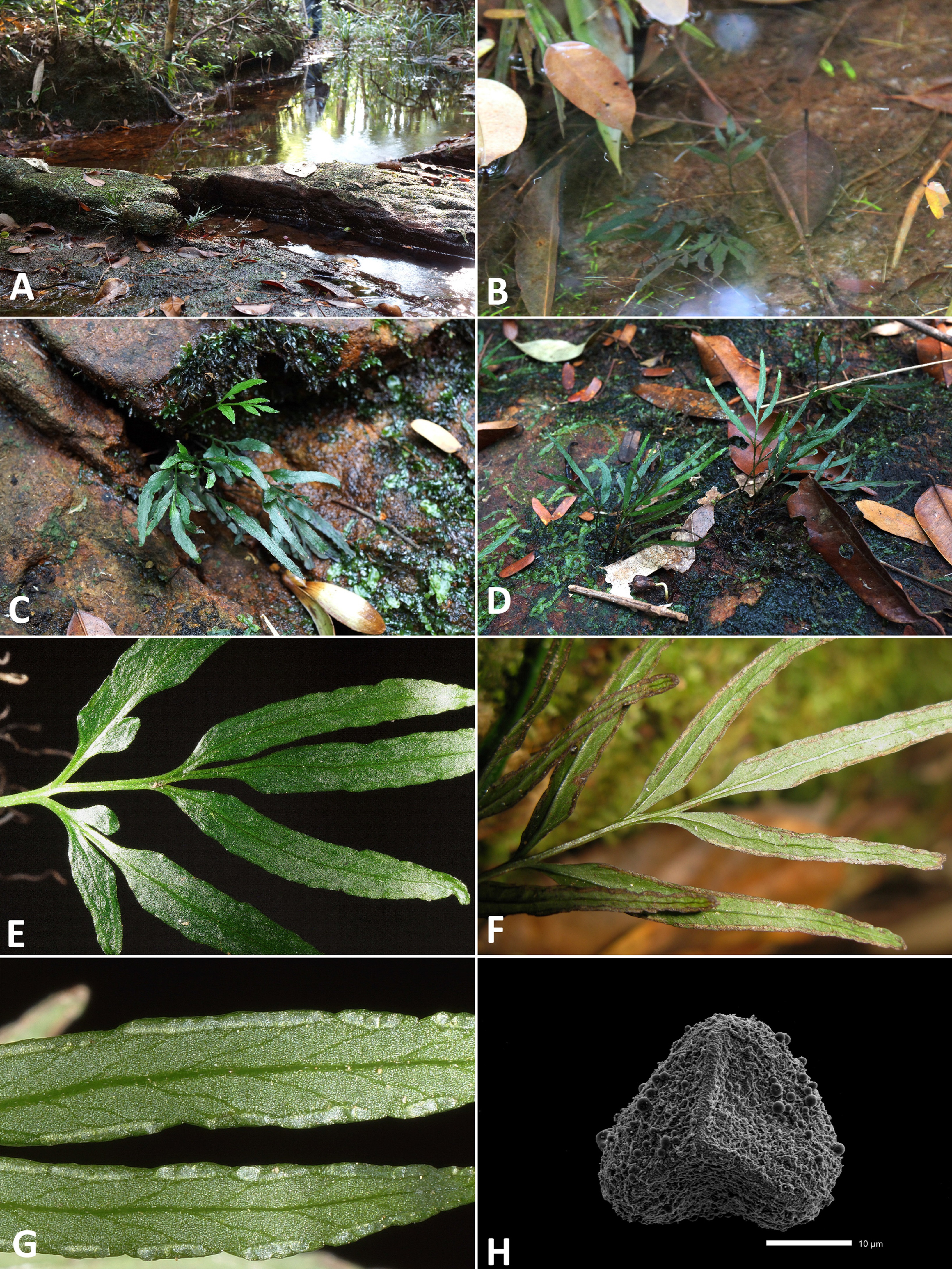
Photographs of Lindsaea kohkongensis.
A–D. Subaquatic habitat. E. Adaxial side of a pinna. F. Abaxial side of a pinna with mature sori. G. Enlarged view of the abaxial side of a pinna. F. SEM photographs of spore. Scale bars = 10μm.

 Lindsaea kohkongensis I. C. Hwang, M.-O. Moon & B.- Y. Sun, sp. nov. 

Plants herbs, perennial, epipetric, subaquatic, 5–16 cm tall, close to the water in valley or sometimes in water. Rhizomes terete, creeping or long creeping, 1.1–1.5 mm diam., sparsely scaly, densely end point; scales slightly spreading or appressed, castaneous, glossy, 0.9–1.6 mm long, 0.1–0.3 mm wide, 2–6 cells at base, apex aciculate. Fronds monomorphic; petiole stramineous, brownish or dark brownish at base, glossy or lusterless, 5–10 cm long, 0.4–0.9 mm in diam., trigonal or subquadrangle in cross-section, shallowly sulcate adaxially, 2 ridged distinct, sparsely scaly at base; ...


Narae YUN, Myung-Ok MOON, Byung-Yun Sun and In Chun HWANG. 2023. Lindsaea kohkongensis (Lindsaeaceae), A New Species from Cambodia and Malaysia.  Korean J. Pl. Taxon. 53(4); 288-293. DOI: doi.org/10.11110/kjpt.2023.53.4.288

Friday, June 28, 2024

[Botany • 2024] Cyrtomium adenotrichum (Dryopteridaceae) • A New Species from Guangxi, China


Cyrtomium adenotrichum Y. Nong & R.H. Jiang, 

in Nong, Lei, Zhao, Wei, Xu, Feng, Qu et Jiang, 2024. 
腺毛贯众  ||  DOI: 10.3897/phytokeys.243.127579

Abstract
Cyrtomium adenotrichum Y. Nong & R.H. Jiang (Dryopteridaceae), a new species from Guangxi, China, is described and illustrated. This new species is similar to C. nephrolepioides (Christ) Copel., C. obliquum Ching & K. H. Shing ex K. H. Shing, C. sinningense Ching & K. H. Shing ex K. H. Shing and C. calcis Liang Zhang, N.T.Lu & Li Bing Zhang in having erect rhizomes, dense, leathery lamina and rounded sori, but it can be easily distinguishable by its stipe sparsely glandular, base obvious oblique, basiscopic base truncate, acroscopic base auriculate or ovate.

Key words: Gully, limestone, Nandan, new species, taxonomy


Line drawing of Cyrtomium adenotrichum Y. Nong & R.H. Jiang
 A plant B scale C indusium (Drawn by Xin–Cheng Qu).

Habitat of Cyrtomium adenotrichum Y. Nong & R.H. Jiang on cliffs at a gully
(Photographed by You Nong).

Cyrtomium adenotrichum Y. Nong & R.H. Jiang
A, B plant C, D lamina (adaxially and abaxially view) E, F sori and indusia G, H terminal pinna (adaxially and abaxially view) I lateral pinnae (abaxially view, showing: margins entire and often slightly reflexed) J stipe (sparsely glandular) K curled leaves L, M, N scales O curled leaves (sparsely glandular)
(Photographed and edited by You Nong).

 Cyrtomium adenotrichum Y.Nong & R.H.Jiang, sp. nov.
 
Chinese name: xiàn máo guàn zhòng (腺毛贯众)

Diagnosis: Cyrtomium adenotrichum is similar to C. nephrolepioides, C. obliquum, C. sinningense and C. calcis, but differs in its stipe sparsely glandular (vs. glabrous). In addition, it can be distinguished from C. sinningense by its scale margins fimbriate (vs. dentate), lateral pinnae 5–10 pairs (vs. 1–4 pairs), indusia margins dentate (vs. subentire); it can also be distinguished from C. nephrolepioides by its lateral pinnae 5–10 pairs (vs. 10–26 pairs), base obvious oblique (vs. cordate or sometimes obliquely cordate). It differs from C. obliquum by its scale margins fimbriate (vs. dentate), lateral pinnae 5–10 pairs (vs. 12–21 pairs), indusia margins dentate (vs. entire). It can be distinguished from C. calcis by its base obvious oblique (vs. cordate to hastate), lateral pinnae thin leathery (vs. thick leathery). Comparative morphological differences among all five species are presented in Table 1.

Etymology: The specific epithet refers to the stipe sparsely glandular of the new species.


 You Nong, Li-Qun Lei, Zi-Yi Zhao, Gui-Yuan Wei, Chuan-Gui Xu, Bin Feng, Xin-Cheng Qu and Ri-Hong Jiang. 2024. Cyrtomium adenotrichum (Dryopteridaceae), A New Species from Guangxi, China. PhytoKeys. 243: 199-207. DOI: 10.3897/phytokeys.243.127579

Friday, May 31, 2024

[Entomology • 2024] Cuprina inferna, Calicotis obsoleta, Thylacosceloides sanctigemma, Petala shida, Pediformis fushana, ... • Systematics and Evolutionary Dynamics of Insect-Fern Interactions in the specialized Fern-Spore Feeding Cuprininae (Lepidoptera: Stathmopodidae)


  The evolutionary history of Fern-spore-feeding (FSF) in Stathmopodidae.
 Calicotis attiei (Cuprininae)
Stathmopoda fusciumeraris (Stathmopodinae)
Atkinsonia beijingana (Atkinsoniinae)

in Shen, Terada, Landry, Hoare, Kuo, Chou, Hsu et Huang, 2024.

Highlights: 
• The most comprehensive Stathmopodidae phylogeny to date, focusing on fern-spore-feeding Cuprininae.
• Systematic revision of Cuprininae enhances understanding of insect-fern interactions, diverging from angiosperm-centric studies.
• Despite fern spores being rare niche for Lepidoptera, no significant differences in Speciation/Extinction/State-transition rates between fern-spore feeders and others.
• State-transition rate differs between specialists and oligophages; faster transition from oligophages to specialists observed.

Abstract
Fern-spore-feeding (FSF) is rare and found in only four families of Lepidoptera. Stathmopodidae is the most speciose family that contains FSF species, and its subfamily Cuprininae exclusively specializes on FSF. However, three species of Stathmopodinae also specialize on FSF. To better understand the evolutionary history of FSF and, more generally, the significance of specialization on a peculiar host, a phylogenetic and taxonomic revision for this group is necessary. We reconstructed the most comprehensive molecular phylogeny, including one mitochondrial and four nuclear genes, of Stathmopodidae to date, including 137 samples representing 62 species, with a particular focus on the FSF subfamily, Cuprininae, including 33 species (41% of named species) from 6 of the 7 Cuprininae genera. Species from two other subfamilies, Stathmopodinae and Atkinsoniinae, were also included. We found that FSF evolved only once in Stathmopodidae and that the previous hypothesis of multiple origins of FSF was misled by inadequate taxonomy. Moreover, we showed that (1) speciation/extinction rates do not differ significantly between FSF and non-FSF groups and that (2) oligophage is the ancestral character state in Cuprininae. We further revealed that a faster rate of accumulating specialists over time, and thus a higher number of specialists, was achieved by a higher transition rate from oligophagages to specialists compared to the transition rate in the opposite direction. We finish by describing three new generaTrigonoda gen. nov., Petala gen. nov., and Pediformis gen. nov., and revalidating five generaCuprinaCalicotisThylacoscelesActinoscelisThylacosceloides in Cuprininae, and we provide an updated taxonomic key to genera and a revised global checklist of Cuprininae.
 
Keywords: Ancestral state reconstruction, Fern-spore-feeding (FSF), Gelechioidea, Phylogeny, New Genus, New Species


  The evolutionary history of Fern-spore-feeding (FSF) in Stathmopodidae.
(a) Ancestral state reconstruction of FSF evolution based on ER model. Blue-labeled taxa represent FSF species, and orange-labeled taxa represent non-FSF species. Coloured bars after taxa names correspond to the subfamily that the species belong to: Stathmopodinae, Atkinsoniinae, Cuprininae and outgroups.
(b) The adult resting posture of Calicotis attiei (Cuprininae). (c) The larval shelter of C. attiei on Nephrolepis biserrata.
(d) The adult resting posture of Stathmopoda fusciumeraris (Stathmopodinae). (e) The larva of S. fusciumeraris in Ficus fistulosa.
 (f) The adult resting posture of Atkinsonia beijingana (Atkinsoniinae). (g) The larva of A. beijingana in Castanopsis kawakamii

 The phylogeny of Cuprininae.
Phylogenetic result based on Bayesian inference analysis. Coloured bars after taxa names correspond to genus delimitation based on morphological and phylogenetic results.

...
Based on morphological data congruent with the molecular results, we propose to divide the Cuprininae into eight genera: Cuprina, Calicotis, Thylacosceles, Actinoscelis, Thylacosceloides, Trigonoda gen. nov., Petala gen. nov. and Pediformis gen. nov. ...
...
Nine new species are named and described below, including: Calicotis bipunctella sp. nov., Ca. zhanglini sp. nov., Ca. obsoleta sp. nov., Ca. candida sp. nov., Cuprina inferna sp. nov., Thylacosceloides sanctigemma sp. nov., Thylacosceloides chihweii sp. nov., Petala shida sp. nov.. and Pedifomis fushana sp. nov..


Cuprininae Sinev, 2015.

Distribution: Eastern Palearctic, Oriental, Oceanian, Australasian, and Afrotropical; 8 genera and 81 species.


Cuprina Sinev, 1988

Cuprina inferna Shen & Hsu, sp. nov.
Etymology: An adjective of Latin origin, from infernus = of the underground, infernal, referring to the dark appearance reminiscent of clothing worn at a funeral.

Calicotis Meyrick, 1889 

Calicotis bipunctella Shen & Hsu, sp. nov.
Etymology: A noun of Latin origin, from the prefix bi- = two, double, plus punctum = dot, referring to the two small, brown markings on the forewing upperside.

Calicotis zhanglini Shen, Terada & Hsu, sp. nov.
Etymology: The species is dedicated to our collaborator Mr. Zhang-Lin Chen, who helped us collect this species in Taiwan.

Calicotis obsoleta Shen & Hsu, sp. nov.
Etymology: An adjective of Latin origin, from obsoletus = worn out, referring to the nearly invisible markings on the forewing upperside.

Calicotis candida Shen & Hsu, sp. nov.
Etymology: An adjective of Latin origin, from candidus = shining, white, referring the overall silvery white appearance of the moth.


Thylacosceles Meyrick, 1889 

Actinoscelis Meyrick, 1912

Thylacosceloides Sinev, 1988


Thylacosceloides sanctigemma Shen & Hsu, sp. nov.
Etymology: A noun in apposition, derived from the Latin adjective sanctus = holy, plus the Latin noun gemma = jewel, precious stone.

Thylacosceloides chihweii Shen & Hsu, sp. nov.
Etymology: This species is dedicated to our cooperator Mr. Chih-Wei Huang, who helped us to collect this species in Taiwan.


Trigonoda Shen, Terada & Hsu gen. nov.

Etymology: The generic epithet “Trigonoda” derives from the Greek trigonos = triangular, and refers to the triangular-shaped cucullus, which serves as an important diagnostic character for this genus. The ending -da is copied from the related genera Stathmopoda and Pachyrhabda (the latter now synonymised).


Petala Shen, Terada & Hsu gen. nov.  

Etymology: The generic name is from the Greek petalon = leaf, though the stem has later come to be used to mean ‘petal’, in allusion to the costa which is tapered toward the base making the valva petal-like.

Petala shida Shen & Hsu, sp. nov.
Etymology: The specific epithet “shida” is the Mandarin abbreviation for the National Taiwan Normal University, referring to the place where we collected the type material for this species. It is a noun in apposition.


Pediformis Shen & Hsu gen. nov. 

Etymology: The generic name originates from the Latin, and refers to the foot-shaped cucullus which is an important diagnostic character for this genus. Though pediformis in Latin is an adjective, it is to be treated as a feminine noun when used as a genus name.
 
Pediformis fushana Shen & Hsu, sp. nov.
Etymology: The specific epithet, an adjective, refers to the place where we collected the type material for this species.


  Zong-Yu Shen, Takeshi Terada, Jean-François Landry, Robert J.B. Hoare, Li-Yaung Kuo, Ming-Hsun Chou, Yu-Feng Hsu and Jen-Pan Huang. 2024. Systematics and Evolutionary Dynamics of Insect-Fern Interactions in the specialized Fern-Spore Feeding Cuprininae (Lepidoptera, Stathmopodidae). Molecular Phylogenetics and Evolution. 194, 108040. DOI: 10.1016/j.ympev.2024.108040 

Sunday, May 12, 2024

[Botany • 2024] Asplenium guodanum (Aspleniaceae) • A distinct New fern Species from northern Guangdong, China, based on morphological data and molecular phylogeny


Asplenium guodanum  

in Xu, Han, Dong, Guo, Mao et Liao, 2024.
国达铁角蕨  ||  DOI: 10.3897/phytokeys.241.122789

Abstract
A new spleenwort species, Asplenium guodanum, was found and described from Danxia landform region in Guangdong, China. The new species has close resemblance to A. subcrenatum Ching ex S.H.Wu in morphology, but can be distinguished by having plants small, stipes and rachises not covered with fibrous scales, relatively fewer pairs of pinnae, pinnae short, pinna margin weakly biserrate, pinna apex acute and lower pinnae obviously reduced. Phylogenetic analyses, based on six plastid markers (atpB, rbcL, rps4 & rps4-trnS and trnL & trnL-F) of the new species and its relatives, support a close relationship between A. guodanum and A. subcrenatum. Only one population with no more than 50 individuals were found and, therefore, it is recommended to be classified as Critically Endangered (CR) following IUCN Red List Criteria.

Key words: Conservation, Danxia landform, molecular phylogeny, species diversity, taxonomy

Macromorphology of Asplenium guodanum sp. nov.
 A habitat B habit C abaxial lamina D frond E adaxial lamina F rachis G abaxial view of pinna H adaxial view of pinna I reduced pinna base J scales at base stipe K rhizome L fiddlehead.

 Asplenium guodanum K.W.Xu & W.B.Liao, sp. nov.
 
Diagnosis: Asplenium guodanum is morphologically most similar to A. subcrenatum, but different by having small size (15–30 cm tall vs. 30–55 cm tall), rhizome scales brown to dark brown (vs. reddish-brown in A. subcrenatum), stipes and rachises not covered with fibrous scales (vs. densely covered with fibrous scales in A. subcrenatum), relatively fewer pairs of pinnae (10–15 pairs vs. 18–25 pairs), pinnae short (2–3.5 cm vs. 6–10 cm), pinna margins weakly biserrate (vs. almost entire to crenate-sinuate in A. subcrenatum), pinna apex acute (vs. acuminate in A. subcrenatum) and lower pinnae obviously reduced.


 Ke-Wang Xu, Yu-Tong Han, Yu-Ran Dong, Jian-Qiang Guo, Ling-Feng Mao and Wen-Bo Liao. 2024. Asplenium guodanum (Aspleniaceae), A distinct New fern Species from northern Guangdong, China, based on morphological data and molecular phylogeny. PhytoKeys. 241: 191-200. DOI: 10.3897/phytokeys.241.122789


Wednesday, April 17, 2024

[Botany • 2022] Dryopteris gaoligongensis • A Revision of Dryopteris sect. Diclisodon (Dryopteridaceae) based on Morphological and Molecular Evidence with Description of A New Species


 Dryopteris gaoligongensis Z.Y. Zuo, Jin Mei Lu & D.Z. Li, 

in Zuo, Zhao, Du, Xiong, Lu et Li, 2022.
 高黎贡山鳞毛蕨   ||  DOI: 10.1016/j.pld.2021.09.005
 
Highlights: 
• We reconstruct the first phylogeny of Dryopteris sect. Diclisodon using combined plastid regions and nuclear gene AK1.
• A revision of Dryopteris sect. Diclisodon in China is proposed based on morphological and phylogenetic evidence.
• Phylogenetic studies confirm the distinctiveness of Dryopteris gaoligongensis, D. renchangiana, and D. sinonepalensis.
• Our study show that the morphological characteristics of the rhizome should be taken into more account in Dryopteris.

Abstract
Dryopteris sect. Diclisodon is a small section of ferns with about 12 species mainly distributed in East Asia. Here, we carried out morphological and phylogenetic analyses of this section. A new species from southwest China, D. gaoligongensis, is described and illustrated. Dryopteris gaoligongensis resembles D. indonesiana and D. sparsa, but differs by having a creeping rhizome and large 4-pinnate fronds. We also show that D. glabrior Ching & Z.Y. Liu is a distinct species; however, because it is a later homonym of D. glabrior Copel., it should be renamed D. renchangiana. We conclude that a species previously known as D. nitidula, also an illegitimate homonym, should be recognized with a new name, D. sinonepalensis. We resolve the phylogenetic position of D. yoroii as sister to other sampled species of D. sect. Diclisodon. Our phylogenetic analyses confirm the distinctiveness of D. gaoligongensis, D. renchangiana, and D. sinonepalensis. A key to species of D. sect. Diclisodon in China is provided.
 
Keywords: Dryopteris gaoligongensis, Dryopteris renchangiana, Dryopteris sect. Nephrocystis, Dryopteris sinonepalensis, Molecular phylogeny, Nomenclatural novelties

 Dryopteris gaoligongensis Z.Y. Zuo, Jin Mei Lu & D.Z. Li.
A. Habitat and well-developed fronds. B. 4-pinnate lower pinnae. C. The bipinnate-pinnatifid fronds in a young plant. D. Rhizome. E. Sori on ultimate pinnules. F. Scales.

 Dryopteris gaoligongensis Z.Y. Zuo, Jin Mei Lu & D.Z. Li, sp. nov. 
 高黎贡山鳞毛蕨 
【gāo lí gòng shān lín máo jué】

Diagnosis: Dryopteris gaoligongensis is different from other species in D. sect. Diclisodon by being a large plant with a creeping rhizome. It is similar to some species of D. sect. Marginatae (e.g., D. subimpressa Loyal.) in leaf shape. However, it can be identified as a member of D. sect. Diclisodon by typical asymmetrical bases of pinnales, basiscopic pinnule of basal pair of pinnae elongated as pinnatifid.

Etymology: The specific epithet “gaoligongensis” refers to its type locality, the Gaoligong Mountains, on the border of Yunnan of China and Myanmar.


 Zheng-Yu Zuo, Ting Zhao, Xin-Yu Du, Yun Xiong, Jin-Mei Lu and De-Zhu Li. 2022. A Revision of Dryopteris sect. Diclisodon (Dryopteridaceae) based on Morphological and Molecular Evidence with Description of A New Species. Plant Diversity. 44(2); 181-190. DOI: 10.1016/j.pld.2021.09.005

Tuesday, April 16, 2024

[Botany • 2024] Dryopteris jinpingensis (Dryopteridaceae) • A Critically Endangered Diploid New Species from Yunnan, China


Dryopteris jinpingensis  Z.Y.Zuo, Jin Mei Lu & D.Z.Li, 

in Zuo, Lu, C.-Fu. Li et D.-Z. Li, 2024. 
  金平鳞毛蕨  ||  DOI: 10.3897/phytokeys.239.118655

Abstract
Dryopteris jinpingensis, a new species of diploid, sexually reproductive ferns of Dryopteridaceae from Yunnan, southwestern China, is described and illustrated. Morphologically, D. jinpingensis is similar to D. gaoligongensis but unique in elongated lanceolate laminae, sessile or subsessile pinna stalks, and overlapping membranous scales adnate to stipe base. Phylogenetic analyses based on both plastome and the nuclear AK1 gene sequences showed that D. jinpingensis is sister to D. gaoligongensis. A detailed taxonomic description with line drawings is provided, and its conservation status is evaluated to be critically endangered.

Key words: Dryopteris sect. Diclisodon, molecular phylogeny, new species, sexual diploid

 Dryopteris jinpingensis (Z.Y. Zuo 5378)
A habitat B plant C proximal part of the lamina D sori on ultimate pinnules E glandular hairs on the abaxial surface of pinnules F young plant G rhizome H portion of stipe base, showing adnate scale I scales of stipe.

 Dryopteris jinpingensis Z.Y.Zuo, Jin Mei Lu & D.Z.Li, sp. nov.
  金平鳞毛蕨 
(jīn píng lín máo jué)
 
Diagnosis: Dryopteris jinpingensis is similar to D. gaoligongensis with stout and creeping rhizome, 3- to 4-pinnate large frond, and largest and longest basal basiscopic pinnule. However, D. jinpingensis differs from it in the elongated lanceolate lamina, sessile or subsessile pinna stalks (less than 1 cm), and overlapping membranous and thin scales adnate to stipe base.

Etymology: The specific epithet “jinpingensis” refers to its type locality, Jinping County, in the border between south Yunnan of China and Vietnam.

 
 Zheng-Yu Zuo, Jin-Mei Lu, Cun-Fu Li, De-Zhu Li. 2024. Dryopteris jinpingensis, A Critically Endangered Diploid New Species of Dryopteridaceae from Yunnan, China.  PhytoKeys. 239: 195-204. DOI: 10.3897/phytokeys.239.118655