Showing posts with label Theaceae. Show all posts

Friday, September 4, 2026

[Botany • 2021] Camellia proensis (Theaceae) • A New Species from Southern Vietnam


Camellia proensis  V.D.Luong, Doudkin & V.H.Quach,

in Hoi, Dung, Doudkin, Averyanov, Thinh, Lieu et  Truong, 2021.

Abstract
A new species of the genus Camellia L. (Theaceae) from Southern Vietnam is described and illustrated under the name Camellia proensis. Morphological differences between C. proensis and closely related species in the genus Camellia L. (sect. Piquetia) were identified. C. proensis is easily distinguishable from C. honbaensis, C. piquetiana and C. longii by the yellow flowers; from C. dalatensis by the glabrous twigs and leaves; from C. dongnaiensis by light yellow flowers; from C. sonthaiensis by mature fruit flat-globose, 4.0–5.5 cm tall and 8.5–10.0 cm wide. Ecological environment and distribution were also provided for this new species. The images and type specimens of this species were processed and stored in Vietnam (holotype, isotypes, DLU).

Keywords: Camellia proensis, Lam Dong, taxonomy, Theaceae, Vietnam, Magnoliids

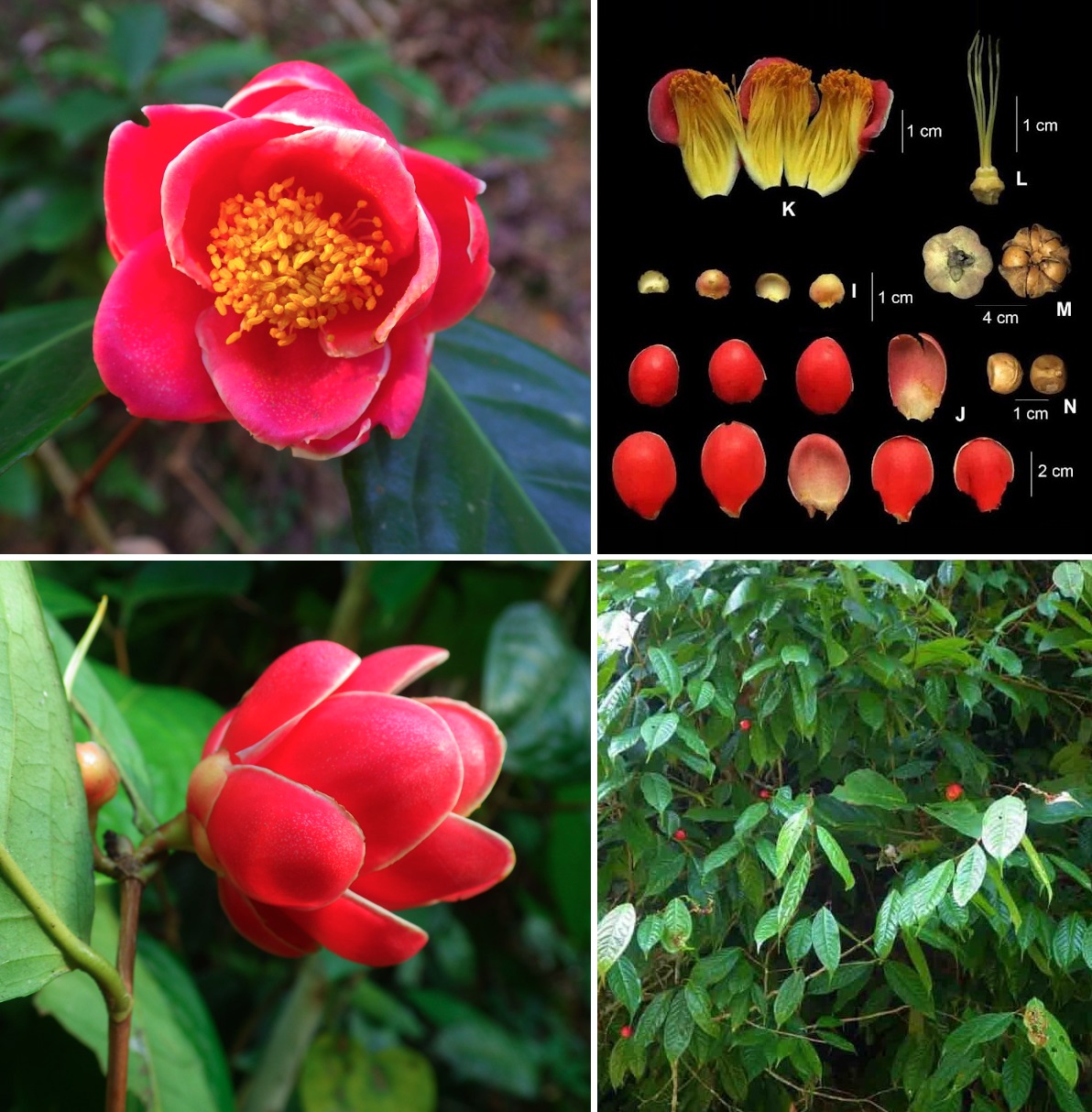
Camellia proensis.
A. Leaf. B. Venation of leaf (adaxial surface). C. Venation of leaf (abaxial surface). D. Flower bud. E, F. Flower. G. Sepals. H. Petals. I. Stamens. K. Styles and gynoecium. L. Fruit. M. Seed.
Drwaing by Luong Van Dung.

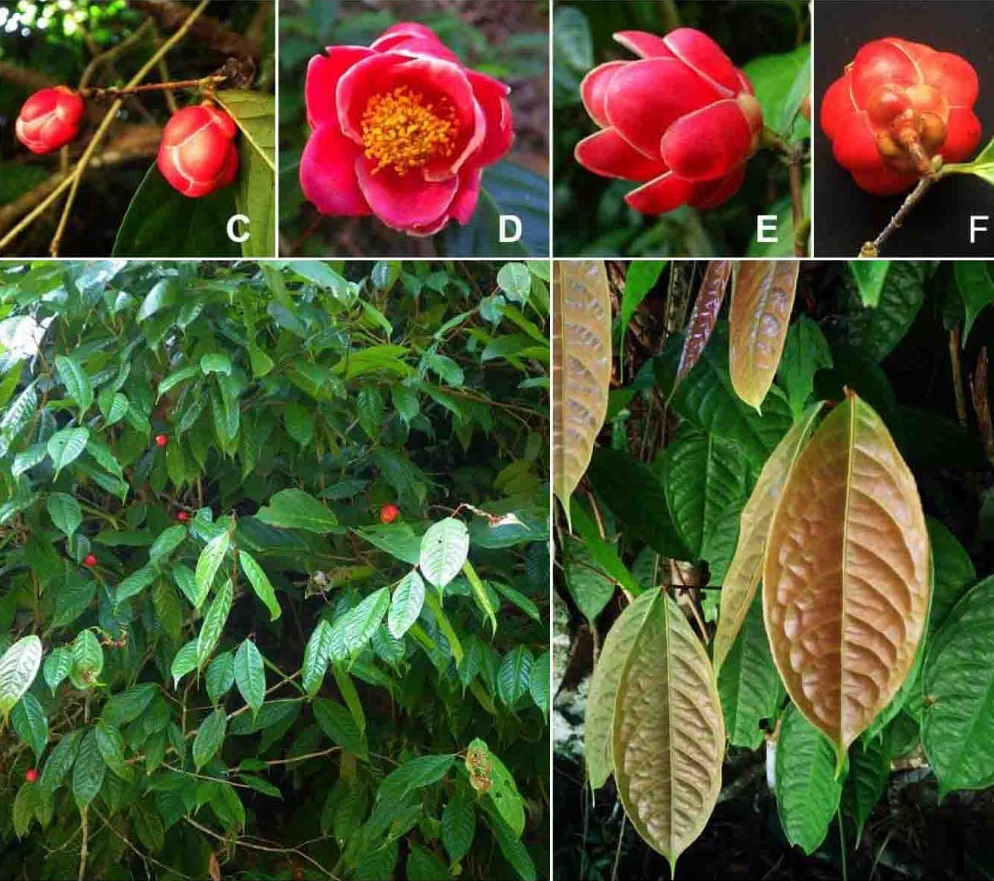
Camellia proensis.
A, B. Young twig. C, E. Flowering shoot and arrangement of petals. D. Open flower. F, G. Fruits. H. Seeds.
Photos by Quach Van Hoi.

Camellia proensis V.D.Luong, Doudkin & V.H.Quach, sp. nov.  

Affinity:—Camellia proensisis morphologically similar to C. sonthaiensis in glabrous young branches and leaves; sepals 5, hairy on the outside; petal light yellow, hairy on the outside, from which it is distinguished by the size of mature fruit, 3.0–3.5 cm in diameter, 1.5–2.0 cm deep (C. sonthaiensis), 4.0–5.5 cm tall, 8.5–10.0 cm wide (C. proensis). 

 Etymology:—The species is named after the location where the authors first found this plant. Pro is the name of Pro commune, Don Duong District, Lam Dong Province, Vietnam.


Quach Van Hoi, Luong Van Dung, Roman V. Doudkin, Leonid V. Averyanov, Bui Bao Thinh, Nguyen Thi Lieu and Luu Hong Truong. 2021. Camellia proensis (Theaceae, sect. Piquetia), A New Species from Southern Vietnam. Phytotaxa. 479(1); 137–141. DOI: doi.org/10.11646/phytotaxa.479.1.12

Tuesday, January 27, 2026

[Botany • 2026] Camellia shangshii (Theaceae) • A New Species endemic to Danxia landscape from Guangdong Province, China


Camellia shangshii  Shi Y.Wang & Q.Fan,

in Wang, Liu, Tan, Shen, Z. Chen, F. Chen et Fan, 2026. 

Abstract
Camellia shangshii, a new species discovered in the danxia landscape of Danxiashan Mountain, Guangdong Province, China, is formally described and illustrated here. Morphologically, C. shangshii is similar to C. grijsii but can be distinguished by its petals connate at the base, smaller leaves, and fewer bracteoles and sepals. Phylogenetic analysis based on chloroplast genomes indicated that C. shangshii is a sister species to C. grijsii. By integrating morphological and molecular data, we validate the recognition of C. shangshii as a new species of C. sect. Paracamellia.

Key words: Camellia, Danxia landscape, morphology, new species, phylogeny

Camellia shangshii sp. nov.
 A. Flowering and fruiting branch; B. Flowers; C. Bracteoles and sepals; D. Leaf; E. Stamens; F. Pistil; G. Pistil in longitudinal section and ovary in transverse section; H. Fruits and seeds.
Illustrated by Rong-En Wu.

Camellia shangshii. A. Flowering individual and habitat; B. Flowering branch; C. Fruiting branches; D. Leaves; E. Flower; F. Petals, bracteoles, and sepals, pubescent; G. Flower buds; H. Androecium; I. Pistil; J. Fruit and seed.
Photographed by Shiyang Wang, Yinyu Wu, and Xiaowei Yi.

Camellia shangshii Shi Y.Wang & Q.Fan, sp. nov.

Diagnosis. Camellia shangshii resembles C. grijsii, but it can be distinguished from the latter species by its petals connate at the base, smaller leaves, fewer bracteoles/sepals (6–8 vs. 9–10), and glabrous young branchlets (vs. puberulent).

Etymology. The specific epithet “shangshii” is dedicated in honor of Dr. Shangshi Wu (1904–1947), whose seminal work on the danxia landscape established its theoretical framework.


 Shiyang Wang, Hua Liu, Shimin Tan, Liran Shen, Zaixiong Chen, Fang Chen and Qiang Fan. 2026. Camellia shangshii (Theaceae), A New Species endemic to Danxia landscape from Guangdong Province, China. PhytoKeys. 270: 13-23. DOI: doi.org/10.3897/phytokeys.270.172597

Tuesday, June 17, 2025

[Botany • 2025] Camellia yangii (Theaceae) • A New Species of Tea Plants from Yunnan, China


Camellia yangii D.Wei Zhao,

in Zhao. 2025.

Abstract
Camellia sect. Thea contains plants of beverage sources with huge profits. Their natural germplasm resources have yet to be fully explored. Here, morphological, phenological and phylogenetic analyses were undertaken to reveal a new species of tea plants, C. yangii D.Wei Zhao. It is described with an illustration and photos of fresh characters provided. The new species is similar to C. fangchengensis and C. ptilophylla by the densely pubescent new branchlets, abaxial surface of leaves and pedicel, but differs from them in bearing a larger flower, fewer (3 vs. 5) but larger sepals, and the indumentum of the sepals. Molecular phylogenetic analysis using RPB2 introns 11–15 and 23 and waxy suggests that it is a member of C. sect. Thea and its phylogenetically closely related species are C. longissima and C. taliensis. Camellia yangii has a later flowering phase compared with other taxa of C. sect. Thea that occurred or were planted nearby, so it cannot naturally hybridize with other tea plants. The new species bears a red or purplish red and densely pubescent terminal bud, which suggests it is a rare germplasm resource of tea plants. Camellia yangii is only known from a single extremely vulnerable population and strict conservation and asexual propagations are urgently needed to avoid extinction.

Key words: Beverage, diversity, genetic resources, Yunnan

Illustration of Camellia yangii D.Wei Zhao, sp. nov. 
A. Branchlet with flowers; B. A node of branchlet, showing the indumenta of the branchlet, leaf, and bud; C. A part of androecium and a petal; D. Pedicel, receptacle and gynoecium of a flower; E. Capsule; F. Seed.
Drawn by Chen M.Q.

Camellia yangii D.Wei Zhao, sp. nov.
A. Habit; B, C. Branchlets; D. Abaxial surface of leaf; E. Flower buds; F. Flower; G. A dissected flower without bracteoles, 1-sepals, 2-petals, 3-androecium, 4-pedicel, receptacle and gynoecium; H. Bracteoles; I. Pedicel, receptacle and gynoecium of a flower; J, K. Capsule.
 Scale bars: 5 cm (C); 1 cm (E, I, J, K); 2 cm (F); 2 mm (H).
Photos: Zhao D.W. (A); Yang S.X. (B–K).

 Camellia yangii D.Wei Zhao, sp. nov. Diagnosis. Similar to C. fangchengensis and C. ptilophylla by the densely pubescent new branchlets, abaxial surface of leaves and pedicel, but differs from them in bearing a larger flower (4–5.5 cm in diam. vs. 2–3.5 cm in diam.), less (3 vs. 5) but larger (8–9 × 10–13 mm vs. 2.5–7 × 3.5–7 mm) sepals, and sericeous (vs. glabrous) adaxial surface of the sepals (Table 1).

Etymology. Camellia yangii is named after the leading collector of its type, Dr. Shixiong Yang, an expert of the family Theaceae at Kunming Institute of Botany, Chinese Academy of Sciences. The Chinese name of C. yangii is proposed as ”三萼茶” because it bears three sepals in the flower.


Dongwei Zhao. 2025. Camellia yangii (Theaceae), A New Species of Tea Plants (Camellia section Thea). PhytoKeys. 257: 247-256. DOI: doi.org/10.3897/phytokeys.257.152000


Friday, March 28, 2025

[Botany • 2025] Camellia shuangbaiensis (Theaceae) • A New Species from Yunnan, China


Camellia shuangbaiensis  G.P.Yang & B.H.Wu,   

in Z.-Y. Li, Wu, Qu, Du, H.-O. Liu, Duan, F.-F. Li et W.-H. Liu, 2025. 
 双柏山茶  ||  DOI: doi.org/10.3897/phytokeys.254.144891

Abstract
A new species of the genus Camellia (Theaceae), Camellia shuangbaiensis G.P.Yang & B.H.Wu, sp. nov., from the central region of Yunnan Province of China is described. Camellia shuangbaiensis is morphologically similar to C. mileensis and C. hongkongensis, but it can be distinguished by its smaller leaves with an ovate, abaxially tomentose lamina, and 14–16 bracteoles and sepals.

Key words: Camellia, Flora, new taxon, Shuangbai County, taxonomy

Camellia shuangbaiensis
A flowering individual and habitat B stem C flowering branch D fruiting branches E tomentose and punctate leaf abaxial surface F pubescent midvein on the leaf abaxial surface G leaves H branchlet I flower buds J fruits K bracteoles and sepals L pistil M androecium N petals.
Photographed by Shang Qu and Bao-Huan Wu. Scale bars: 1 cm.

 Camellia shuangbaiensis G.P.Yang & B.H.Wu, sp. nov.
 双柏山茶 (Shuang Bai Shan Cha)

Diagnosis. Camellia shuangbaiensis morphologically resembles C. mileensis T.L.Ming and C. hongkongensis Seem., but it can be distinguished from the latter two species by its leaves with ovate shape, tomentose abaxial surface and rounded leaf base and bracteoles/sepals 14–16.


Etymology. The specific epithet “shuangbaiensis” refers to Shuangbai County of Yunnan Province, the type locality of the new species.


Zi-Yuan Li, Bao-Huan Wu, Shang Qu, Le-Shan Du, Hai-Ou Liu, He-Xiang Duan, Fei-Fei Li and Wen-Hui Liu. 2025. Camellia shuangbaiensis (Theaceae), A New Species from Yunnan, China. PhytoKeys. 254: 143-149. DOI: doi.org/10.3897/phytokeys.254.144891


Sunday, April 21, 2024

[Botany • 2024] Camellia zijinica (Theaceae) • A New Species endemic to Danxia Landscape from Guangdong Province, China


Camellia zijinica  M.Lin, Q.L.Ye & Q.Fan,

in Lin, Ye, Zhang, Liao et Fan, 2024. 
 紫金短柱茶  ||  DOI: 10.3897/phytokeys.237.114768
Photographed by Zhi-Ming Zhong, Qiang Fan and Min Lin.
 
Abstract
A new species of the genus Camellia (Theaceae), Camellia zijinica, discovered in the Danxia landscape from Guangdong Province, China, is characterized and illustrated. Phylogenetic analysis based on chloroplast genomes suggested its affinity with C. drupifera, C. oleifera and C. fluviatilis, however, it morphologically differs from all of the latter by leaf shape and size. Phonologically, it most closely resembles C. microphylla, but can be distinguished from the latter by its young branchlets glabrous (vs. densely pubescent), fewer bracteoles and sepals, diverse leaf shape, midvein raised slightly with sparsely pubescent or glabrous (vs. prominently with densely pubescent) and leaf adaxially matt (vs. vernicose) when dried. By morphological and molecular analyses, Camellia zijinica represented a distinct new species of C. sect. Paracamellia.

Key words: Camellia, Danxia landscape, morphology, new species, phylogeny

Camellia zijinica sp. nov.
A habit B, C flowering branch D leaf shape E flower in front view F flower in back view G pistil and ovary H flowering branch, showing the stamens I flowering branch, showing the bracteoles and sepals J fruits, showing young to ripe (a-c) K bracteoles, sepals and petals.
Photographed by Zhi-Ming Zhong, Qiang Fan and Min Lin.

 Camellia zijinica M.Lin, Q.L.Ye & Q.Fan, sp. nov.
  Chinese name: 紫金短柱茶

Etymology: The specific epithet refers to Zijin County of Guangdong Province, the type locality of the new species.

 
Min Lin, Qin-Liang Ye, Zhi-Jian Zhang, Wen-Bo Liao and Qiang Fan. 2024. Camellia zijinica (Theaceae), A New Species endemic to Danxia Landscape from Guangdong Province, China. PhytoKeys. 237: 245-255. DOI: 10.3897/phytokeys.237.114768

Tuesday, November 28, 2023

[Botany • 2020] Camellia rostrata (Theaceae) • A New Species of Yellow Camellias from Southwest China


Camellia rostrata S.X.Yang & S.F.Chai, 

in Liu, Chai, Wu, Ye, Jiang, Zhang, Yu, Ma et Yang, 2020.
 
Abstract
Camellia rostrata S.X.Yang & S.F.Chai is described and illustrated as a new species from Guangxi, China. It is morphologically closest to C. debaoensis R.C.Hu & Y.Q.Liufu, but can be easily distinguished by its abaxially glabrous leaf surface, 1.0−1.5(−2.0) cm long pedicel, powdery puberulent inner surface of bracteoles, sepals, and petals, sparsely pubescent inner filaments base, and triangle globose or ellipsoid capsule with pointed beak. The conservation status of this new species was assessed as Critically Endangered (CR).

Keywords: endemism, morphology, plant conservation, taxonomy, Theaceae, Eudicots


Camellia rostrata S.X.Yang & S.F.Chai.
A. Habitat. B. Adaxial leaves. C. Abaxial leaves. D. Front view of the flower. E.Side view of the flower. F. Bracteoles and sepals. G. Petals. H, I. Ovary and variations of the connate styles. J. Stamens. K. Adaxiallypuberulent sepal. L. Seeds. M. Sparsely puberulent seed surface. N. Habit. Scale =1 cm. Image N supplied by Wei Wei.


Zhen-Wen Liu, Sheng-Feng Chai, Fang-Yuan Wu, Pin-Ming Ye, Chang-Jie Jiang, Zhi-Rong Zhang, Xiang-Qin Yu, Jin-Lin Ma and Shi-Xiong Yang. 2020. Camellia rostrata, A New Species of Yellow Camellias from Southwest China. Phytotaxa. 459(1); 61–68. DOI: 10.11646/phytotaxa.459.1.6


Monday, November 13, 2023

[Botany • 2023] Camellia vanlangensis (Theaceae) • A New Yellow-flowered Species from Vietnam


Camellia vanlangensis V.D. Luong & V.T. Pham,  

in Trinh, Luong, Le et Pham, 2023. 
Trà hoa vàng Văn Lang  || taiwania.ntu.edu.tw/abstract/1965

Abstract
A new plant species, Camellia vanlangensis, belonging to the Archecamellia section is described from Thanh Hoa Province, northern Vietnam. It grows up to 8 m tall and has big golden yellow flowers up to 8 cm wide. The flower is a solitary, subterminal, cup-shaped, with glabrous pedicel, 5–6 persistent bracteoles, 9–10 persistent orange-green sepals, and 10–11 petals. It has 130–150 stamens in 5 whorls, glabrous 3–5-loculed ovary, 3–5 distinct styles, 5-rigged and apex sunken of capsule. A detailed comparison between new species and two close related species, C. impressinervis and C. calcicola, is provided. Preliminary IUCN conservation status of this species is assigned as Critically Endangered (CR).

Keyword: Camellia calcicola, Camellia impressinervis, endangered species, flora, plant taxonomy, Van Lang, yellow flowers


Camellia vanlangensis V.D. Luong & V.T. Pham and its natural habitat
A. Branch with flower bud; B. Vegetative bud; C. Adaxial (left) and abaxial (right) leaf surfaces; D. Petiole; E. Leaf base; F. Part of abaxial leaf surface showing sparsely tomentose; G. Leaf blade margin; H. Flower bud (top view); I. Flower bud (lateral view); J. Flowering branch; K. Flower (top view); L. Flower (lateral view); M. Habitat.
Scale bars: A, C = 5 cm; B, D, G = 0.5 cm; E, H, I, K, L = 1 cm; F = 1 mm. 
Photos by N.B. Trinh and B.N. Pham, design by V.T. Pham 
(Trinh Ngoc Bon and Pham Binh Nguyen Bon 211101).

Camellia vanlangensis V.D. Luong & V.T. Pham, sp. nov. 

Diagnosis: The new species most differs from Camellia impressinervis Hung T.Chang & S.Ye Liang (1979) with its cordate leaves base (vs. rounded to obtuse), more secondary leaf veins (16–22 vs. 9–11 pairs), longer sepals (3.5–4.3 vs. 0.1–1.0 cm), and larger capsules 4–5 vs. 3 cm. It’s most distinct from C. calcicola T.L.Ming (1993) by its sparse tomentose on leaves (vs. glabrous in adaxial and pubescent in abaxial surfaces), longer sepals (3.5–4.3 vs. 0.9–1.4 cm), glabrous petals and filaments (vs. pubescent), and glabrous ovary and style (vs. pubescent)

Etymology: The epithet "vanlangensis" refers to an ancient name of Vietnam, Van Lang
Proposed Vietnamese name: Trà hoa vàng Văn Lang


Ngoc Bon Trinh, Van Dung Luong, Nguyet Hai Ninh Le and Van The Pham. 2023. Camellia vanlangensis (Theaceae, Sect. Archecamellia), A New Yellow-flowered Species from Vietnam. Taiwania. 68(4); 465-471. taiwania.ntu.edu.tw/abstract/1965

[Botany • 2023] Camellia wumingensis (Theaceae) • A neglected Species from Guangxi, China


Camellia wumingensis S.Ye Liang & C.R.Fu ex Hai L.Chen, 

in Chen, Wei, Tang et Liu, 2023.
武鸣金花茶  ||  taiwania.ntu.edu.tw/abstract/1966

Abstract
Camellia wumingensis, a neglected species known only from limestone areas of Guangxi, China, is formally described and illustrated here. It is morphologically similar to C. flavida var. patens in having current-year branchlets purplish red, petiole adaxially grooved, flowers axillary or terminal, ovary glabrous, capsule oblate, and seeds brown, but is readily distinguished by the leaf texture and size, number of secondary veins, flower size, flower bud shape and size, number of petals, degree of fusion of the outer filaments, and pericarp thickness. Other related species C. flavida and C. pinguoensis var. terminalis are also compared with C. wumingensis in the paper, and the differences between them are obvious. In addition to a diagnosis and detailed description, information on the geographical distribution, images of morphological characters and pollen grains, and a provisional conservation status assessment are provided for this species.

Keyword: Camellia flavidaCamellia pingguoensis var. terminalis, limestone areas, morphology, palynology, taxonomy

Morphological comparison of Camellia wumingensis (A–G) and C. flavida var. patens (H–N).
A, H: Leaves with angle between midvein and secondary veins indicated. B, C, I, J: Flower buds; D, K: Stamens; E, L: Petals. F, M: Capsule. G, N: Seeds. Scale bar =1 cm.

Camellia wumingensis S.Ye Liang & C.R.Fu ex Hai L.Chen.
A, B, D, E: Flowering branches. C: Face view of flower. F: Back view of flower. G: Androecium. H: Habit. I: Front and back view of sepals. J: Front and back view of petals. K: Gynoecium. Scale bar =1 cm.

Camellia wumingensis S.Ye Liang & C.R.Fu ex Hai L.Chen, sp. nov.

Diagnosis: Camellia wumingensis is morphologically similar to C. flavida var. patens in having petiole adaxially grooved, flowers axillary or terminal, ovary glabrous, capsule oblate, and seeds brown, but differs by its leaves thinly leathery, 7–11 × 2.5–5 cm (vs. leathery to thick leathery, 7.5–17 × 3–6.2 cm), secondary veins 5– 8, the angle of the midvein and secondary veins relatively narrow, 35°–45° (vs. 7–9, 60°–75°), flower bud ovate to long-ovate, 10–11 × 7–8 mm (vs. globose, 1.4–1.5 cm in diam.), androecium ca. 150 stamens (vs. ca. 250), outer filaments basally connate only 3–5 mm long (vs. 8–10 mm long), and petals 7–9 (vs. 10–14).

Etymology: The species epithet is derived from the name of the type locality Wuming District, Nanning City, Guangxi, China. Sheng Ye firstly provided the name ‘Camellia wumingensis S. Y. Liang & C. R. Fu’ on the herbarium label in the 1980s. At present, this name is still widely used in many fields, though it was invalidly published. Hence we propose to retain original epithet.
 Vernacular name: 武鸣金花茶 (wǔ míng jīn huā chá) in Chinese.


Hai-Ling Chen, Su-Juan Wei, Shao-Qing Tang and Yan Liu. 2023. Camellia wumingensis (Theaceae), A neglected Species from Guangxi, China. Taiwania. 68(4); 472-479. taiwania.ntu.edu.tw/abstract/1966


Wednesday, May 3, 2023

[Botany • 2023] Camellia suddeeana (Theaceae) • A New Species from northern Thailand


Camellia suddeeana D.Wei Zhao, 

in Zhao, 2023.
Photos by Wittawat Kiewbang (BKF) and Dongwei Zhao. 
 
Abstract
Camellia suddeeana, a new species endemic to northern Thailand that was previously misidentified as C. tenii, is described and illustrated here. It is similar to C. szemaoensis and C. hainingii for sharing the subsessile flower with white petals and distinct styles, but can be distinguished from the former by its glabrous abaxial surface of the sepals, ovary and seeds, leaves without cork-warts and a different flowering period, and from the latter by leaves without cork-warts and the longer styles. Based on its morphology, C. suddeeana may be placed in C. sect. Heterogena or C. sect. Furfuracea according to the classifications proposed by Ming and Chang, respectively.

Keywords: camellias, morphology, taxonomy, Eudicots


Camellia suddeeana D.Wei Zhao
A: branchlet; B–D: flowers; E: flower without petals and androecium; F: fragment of a dry flower, withsome sepals removed to show gynoecium; G: dry carpels and seeds.

A–E: the plant of S. Suddee et al. 4981 (type); F: Chermsirivathana1185 (BKF, paratype); G: niyomdham 4925 (BKF, paratype). 
The bars indicate 2 cm (in A and G) and 5 mm (in B–F). 
Photos A–E were taken by Wittawat Kiewbang (BKF) and F–G by Dongwei Zhao. 

Camellia suddeeana D.Wei Zhao sp. nov.

Etymology. Camellia suddeeana is named after the leading collector of its type, Dr. Somran Suddee at BKF. ItsChinese name is proposed as “泰北山茶” because it generally occurs in the northern Thailand.

 
Dongwei Zhao. 2023. Camellia suddeeana (Theaceae), A New Species from Thailand. Phytotaxa. 594(3); 232-236. DOI: 10.11646/phytotaxa.594.3.7 

Saturday, April 16, 2022

[Botany • 2022] Camellia annamensis (Theaceae) • A New Species from central Vietnam


Camellia annamensis N.S.Lý, V.D.Lương, N.Đ.Đỗ, T.H.Lê & T.L.Nguyễn, 

in , Lương, Lê, ... et Katayama, 2022. 

 Abstract
Camellia annamensis, a new species of Camellia sect. Piquetia (Theaceae) from central Vietnam is described and illustrated. It is most similar to Camellia longii, but differs by its mature leaves sparsely appressed puberulous abaxially and leaf margins shallowly and widely denticulate, lateral veins 10‒13 pairs, sparsely appressed puberulous petioles, sepals 5, petals 20‒22, flattened-globose ovary and styles tomentose and free to base. Information on distribution, ecology, phenology, vernacular name, uses and conservation assessment of this new taxon, along with a key to distinguish the species of Camellia sect. Piquetia in Vietnam are also provided.

Keyword: Annamite range, Camellia honbaensis, C. longii, C. piquetiana, endemism, sect. Piquetia, sect. Lecomtia, taxonomy


Camellia annamensis N.S.Lý, V.D.Lương, N.Đ.Đỗ, T.H.Lê & T.L.Nguyễn.
A. Leaf (adaxial view); B. Venation detail of leaf (abaxial view); C. Flower (lateral view); D. Flower (top view); E. Perules (adaxially shown); F. Petals (adaxially shown); G. Androecium; H. Gynoecium (other floral parts removed); I. Dried fruit. J. Seeds.
Drawn from type materials by Văn-Dũng Lương.


Camellia annamensis N.S.Lý, V.D.Lương, N.Đ.Đỗ, T.H.Lê & T.L.Nguyễn.
 A. Apical part of flowering plant in natural habit; B. Juvenile leaves; C. Flower buds; D. Flower (Front view); E. Flower (side view); F. Flower (bottom view); G. Dried fruit; H. Leaves (adaxial and abaxial views); I. Sepals (abaxially and adaxially); J. Petals (adaxially and abaxially); K. Cross-section of androecium showing stamens; L. Gynoecium with styles free to the base; M. Mature and dried fruits; N. Seeds.
Photos by Ngọc-Đài Đỗ, the color plate by Ngọc-Sâm Lý.

Camellia annamensis N.S.Lý, V.D.Lương, N.Đ.Đỗ, T.H.Lê & T.L.Nguyễn, sp. nov. 

Diagnosis: Most similar to C. longii in shape and coloration of leave and flower, glabrous stamens and hairy ovary, but differing in having mature leaves sparsely appressed puberulous abaxially with leaf margins shallowly and widely denticulate (vs. glabrous, somewhat serrate), lateral veins 10‒13 pairs (vs. 14–16(– 18)), petioles sparsely appressed puberulous (vs. glabrous), sepals 5 (vs. 2‒3), petals 20‒22 (vs. 5‒6), flattened-globose ovary (vs. diamond shape) and styles tomentose and free to base (vs. finely pubescent, distally glabrous, compound, proximally fused for ca. 5.0 mm).

Etymology: The specific epithet “annamensis” refers to the former name of central Vietnam.
 

Ngọc-Sâm , Văn-Dũng Lương, Thị-Hương Lê, Ngọc-Đài Đỗ, Ninh TRẦN, Anh-Đức Nguyễn, Thị-Liễu Nguyễn, Chiyomi Uematsu and Hironori Katayama. 2022. Camellia annamensis (Theaceae), A New Species from central Vietnam. Taiwania. 67(2); 243-249 DOI: 10.6165/tai.2022.67.243 


Friday, December 13, 2019

[Botany • 2019] Ternstroemia guineensis (Ternstroemiaceae) • A New Endangered Cloudforest Shrub with Neotropical Affinities from Kounounkan, Guinea, W Africa


Ternstroemia guineensis Cheek

in Cheek, Haba, Konomou & Van Der Burgt, 2019.
 DOI:  10.3372/wi.49.49306 
Abstract
Ternstroemia guineensis is described from a sandstone table mountain at Kounounkan, possibly the last in the Fouta Djallon (Guinea Highlands) to remain largely unimpacted by humans and to have mainly intact natural habitats. It occurs about 2400 km westward of the nearest existing record (Nigeria) of the genus in Africa. It is confined to cloud (submontane) forest in galleries along watercourses. Its conservation status is assessed as Endangered using the IUCN 2012 criteria. The species differs from the other two African highland species, T. cameroonensis and T. polypetala, in having hermaphrodite flowers with a long subcylindric style and punctiform stigmas, and petals connate at the base into a tube (not dioecious, with a short style and cone-like stigmas, and free petals) resembling in these features the neotropical Ternstroemia species, as does also the lowland wetland T. africana of Nigeria, Gabon and Angola.

KEYWORDS: amphi-Atlantic, conservation, Guinea, Guinea Highlands, Kounounkan, medicinal, new species, Pentaphylacaceae, relic, Ternstroemia, Ternstroemiaceae, Theaceae, West Africa


Fig. 1. Ternstroemia guineensis – A: habit, flowering leafy stems; B: detail of revolute margin of mature leaf, abaxial view, showing circular scars of fallen marginal setae; C: detail of one seta scar from B; D: detail of margin of immature leaf showing patent setae; E: flower, hydrated, side view; F: connate corolla with staminal ring, as self-detaching after anthesis; G: flower, with pistil exposed by removal of two sepals, two petals and several stamens; H: transverse section of ovary showing intruding placentas in both of two locules; I: side view of stamen, showing inward arching; J: adaxial view of stamen; K: inner view of two adherent petals, with adherent staminal ring; L: petal (flattened), adaxial surface showing slightly lacerate distal margins and longitudinal nerves; M: outer sepal (flattened); N: inner sepal (flattened).
 Scale bars: A = 5 cm; B–G, K–N = 5 mm; I, J = 2 mm; H = 1 mm. 
 All drawn from Pepe Haba 1060 (K) by Andrew Brown. 

Fig. 2. Ternstroemia guineensis – A: habitat, submontane gallery forest in sparsely wooded grassland; B: habit; C: flower; D: fruits; E: base of a multi-stemmed shrub; F: bark of a tree, trunk c. 18 cm in diam.
Photos: Republic of Guinea, Kounounkan Massif, Feb 2019, Xander van der Burgt.

Ternstroemia guineensis Cheek, sp. nov.
 Holotype: Guinea, Forécariah Préfecture, S part of Kounounkan Plateau, ..., 910 m, fl., 26 Nov 2017, P. M. Haba with X. M. van der Burgt, L. Jennings & G. Konomou 1060 (K K001286639; isotypes: HNG, MO, P, US, WAG).

Diagnosis — Similar to Ternstroemia africana Melch., differing in the smaller leaves (2.5–)3.7–6.1(–6.7) × (1.3–)1.6–2.5(–3) cm, secondary nerves not visible, (not (4–)8–10 × (2–)4–5 cm, secondary nerves visible, c. 7 pairs); petiole margins entire or with 1–2 setae (not densely glandular denticulate); peduncles 1.4–2.4 cm long (not 3–4.5 cm long).

Distribution — Ternstroemia guineensis is currently only known from the southernmost plateau of the Kounounkan Massif in Forécariah Prefecture, an uninhabited sandstone table mountain, where it is known from gallery forests along four streams.

Ecology — The species was found in species-rich submontane gallery (cloud) forest, on rocky soils, at 900–1100 m altitude.

Etymology — The specific epithet guineensis signifies from Guinea (Guinea-Conakry or the Republic of Guinea), which holds the only known global location for this species.


Martin Cheek, Pepe M. Haba, Gbamon Konomou and Xander M. Van Der Burgt. 2019. Ternstroemia guineensis (Ternstroemiaceae), A New Endangered Cloudforest Shrub with Neotropical Affinities from Kounounkan, Guinea, W Africa. Willdenowia. 49(3); 351-360. DOI:  10.3372/wi.49.49306 

Saturday, November 30, 2019

[Botany • 2019] Camellia debaoensis (Theaceae) • A New Species of Yellow Camellia from Limestone Karsts in southwestern China


Camellia debaoensis R.C.Hu & Y.Q.Liufu

in Hu, Wei, Liufu, et al., 2019. 

Abstract
Camellia debaoensis R.C.Hu & Y.Q.Liufu, sp. nov. is described and illustrated as a new species from southwestern Guangxi, China. It is morphologically similar to Camellia pubipetala Y. Wan & S. Z. Huang, C. mingii S.X. Yang and C. tuyenquangensis D.V. Luong, N.N.H. Le & N. Tran, but it differs from these species in having glabrous young branches, glabrous petiole, glabrous sepals, glabrous petals, glabrous stamens and glabrous ovary, 10 petals, cylindrical ovary and style 3-lobed to 1/6 style length.

Keywords: Camellia, China, limestone flora, taxonomy, Theaceae

Figure 1. Camellia debaoensis R.C.Hu & Y.Q.Liufu, sp. nov. A flowering branch B lateral view of flower C fruit and style D fruit, sepals and bracteoles E stamen F pistil. Drawn by Xincheng Qu. 

Figure 2. Camellia debaoensis R.C.Hu & Y.Q.Liufu, sp. nov. A habit B flowering branch C face view of flower D fruit, sepals and bracteoles E fruiting branch F pistil. Photographed by Renchuan Hu.

Camellia debaoensis R.C.Hu & Y.Q.Liufu, sp. nov.

Diagnosis: Morphologically, the new species is similar to Camellia pubipetala Y. Wan & S.Z. Huang, C. mingii S.X. Yang and C. tuyenquangensis D.V. Luong, N.N.H. Le & N. Tran, but it differs from these species in having glabrous young branches, glabrous petiole, glabrous sepals, glabrous petals, glabrous stamens and glabrous ovary, 10 petals, cylindrical ovary and 3-lobed to 1/6 style length.

Type: China. Guangxi Zhuang Autonomous Region: Debao County, Jingde Town, Tuoliang village, at the entrance of one of karst caves, rare, ..., 760 m a.s.l., 13 January 2017 (fl.), R.C. Hu HRC170113002 (holotype: GXMI!, isotypes: GXMI!, KUN!, NHMG! and IBK!).

Etymology: The specific epithet is derived from the type locality, Debao County, Guangxi.


Renchuan Hu, Sujuan Wei, Yongqing Liufu, Yunkai Nong, Wei Fang. 2019. Camellia debaoensis (Theaceae), A New Species of Yellow Camellia from Limestone Karsts in southwestern China. PhytoKeys. 135: 49-58.  DOI: 10.3897/phytokeys.135.38756

Thursday, July 25, 2019

[Botany • 2019] Camellia chinmeii (Theaceae) • A New Species of Camellia sect. Paracamellia in Taiwan


 Camellia chinmeii S.L. Lee & T.Y.A. Yang

in Lee & Yang, 2019.
 DOI: 10.6165/tai.2019.64.321
  
Abstract
A new species of Camellia chinmeii S.L. Lee & T.Y.A. Yang (Theaceae; sect. Paracamellia Sealy) is described. Camellia chinmeii has sessile flowers, six to ten perules, four or five white, early deciduous petals, yellow radiating stamens separate to the base or nearly so, style 6-7 mm long and fused 1/2 to 2/3 from the base, densely tomentose ovary. The fruit is a globose, beaked or unbeaked capsule.

Keyword: Camellia chinmeii, New species, Section Paracamellia, Theaceae, Taiwan

Fig. 1. Camellia chinmeii S.L. Lee & T.Y.A. Yang.
A. Habit; B. leaf, adaxial surface; C-G. perules; H-J. petals; K. stamens and carpel, moving out tepals; L. style and stigma; M-P. fruits, M. immatured, olive colour, N-P. matured, brown colour, P. seeds.

Fig. 2. Camellia chinmeii S.L. Lee & T.Y.A. Yang.
A. Ms. Chin-Mei Hung stood in front of the tree of C. chinmeii in field; B. flower; C. fruit opening with the seeds inside; D. fruit; E. style and stigma; F. stamens; G. perules, petals and stamens, from left to right. (Photos, A, B, C, D taken by Shih-Lin Lee, and E, F, G taken and arranged by Yi-Fu Wang)

Camellia chinmeii S.L. Lee & T.Y.A, Yang, sp. nov. 

Diagnosis: Similar to Camelia brevistyla, but differing in having fewer stamens, fewer filaments free from each other, longer styles and smaller fruit. It is also similar to Camellia confusa, but has smaller leaves and flowers, fewer stamens and smaller fruit. It is also similar to Camellia hengchuensis, but has thin leaves and globose fruit. It is also similar to Camellia kissi, but differs in having the filaments free from each, longer styles and globose fruit.

Distribution and ecology: Endemic to Taiwan. Camellia chinmeii mainly occurs in mountainous areas between 2000 and 2350 m on gentle slopes in forests on Mt. Weishangshan, Nantou County, in central Taiwan.

 Etymology: The specific epithet, chinmeii, honors Ms. Chin-Mei Hung, wife of the first author, who first recognized Camellia chinmeii as a new taxon in 2010; she passed away during a field trip on 6 December 2014.


Shih-Lin Lee and Tsung Yu Aleck Yang. 2019. Camellia chinmeii, A New Species of Camellia sect. Paracamellia in Taiwan. Taiwania. 64(3); 321-325.  DOI: 10.6165/tai.2019.64.321