Showing posts with label 1998. Show all posts

Thursday, July 9, 2026

[Paleontology • 2024] Cranial Osteology and Paleoneurology of Tarjadia ruthae: An erpetosuchid pseudosuchian from the Triassic Chañares Formation (late Ladinian-?early Carnian) of Argentina


Tarjadia ruthae Arcucci & Marsicano, 1998
 
in Desojo, von Baczko, Ezcurra, Fiorelli, Martinelli, ... et Lacerda, 2026. 
Reconstruction: Jorge Blanco
 
Abstract
Tarjadia ruthae is a quadrupedal terrestrial pseudosuchian from the Middle-early Upper Triassic of the Chañares Formation, La Rioja Province, Argentina. Originally, this species was identified as an indeterminate archosaur and later as a doswelliid archosauriform based on very fragmentary specimens characterized by the ornamentation of the skull roof and osteoderms. Additional specimens (including skulls and postcrania) recovered in the last decade show that Tarjadia is an erpetosuchid, an enigmatic pseudosuchian group composed of six species registered in Middle-Upper Triassic continental units of Tanzania, Germany, Scotland, North America, Brazil, and Argentina. Tarjadia ruthae from Argentina and Parringtonia gracilis from Tanzania are the best preserved and more abundant species. Although the monophyly of Erpetosuchidae is well supported, alternative high-level positions within Archosauria have been suggested, such as sister taxon to Crocodylomorpha, Aetosauria, or Ornithosuchidae. In order to improve the knowledge about the erpetosuchids, we performed a detailed description and paleoneurological reconstruction of the skull of Tarjadia ruthae, based on two articulated partial skulls (CRILAR-Pv 478 and CRILAR-Pv 495) and other fragmentary specimens. We analyzed the stratigraphic and geographic occurrence of historical and new specimens of Tarjadia and provided a new emended diagnosis (the same for the genus as for the species, due to monotypy) along with a comparative description of the cranial endocast. The skull of Tarjadia is robust, with a thick and strongly ornamented skull roof, triangular in dorsal view, with concave lateral margins at mid-length that form an abrupt widened posterior region. The external nares are the smallest openings of the skull. The antorbital fossa is deeply excavated and has a small heart-shaped fenestra with both lobes pointing anteriorly. The supratemporal fenestrae are as large and rounded as the orbits, and the infratemporal fenestrae are L-shaped with an extensive excavation along the jugal, quadratojugal and quadrate. The hemimandibles are low, slightly concave on the dentigerous region and strongly convex on the posterior region, conferring them a S-shaped profile in dorsal view. The external mandibular fenestra is small and elliptic, being twice longer than high. The maxillary dentition is restricted to the anterior to mid region of the rostrum. Since the braincase of both specimens is partially damaged, the dorsal surface of the brain could not be entirely reconstructed. As a result, the endocast is anteroposteriorly elongated and seemingly flat, and the cephalic flexure seems to be lower than expected for a suchian. The labyrinth is twice wider than high, the semicircular canals are remarkably straight, and the anterior canal is longer than the posterior one.

Keywords: anatomy, Archosauria, Erpetosuchidae, neuroanatomy, skull

Systematic paleontology
Archosauriformes Gauthier et al., 1988.
Archosauria Cope, 1869 sensu Gauthier & Padian, 1985.
Pseudosuchia von Zittel, 1887–1890 sensu Gauthier & Padian, 1985.

Erpetosuchidae Watson, 1917 sensu Nesbitt & Butler, 2013.

Tarjadia ruthae Arcucci & Marsicano, 1998

Life reconstruction of Tarjadia ruthae by Jorge Blanco.


J. B. Desojo, M. B. von Baczko, M. D. Ezcurra, L. E. Fiorelli, A. G. Martinelli, P. Bona, M. J. Trotteyn and M. Lacerda. 2024. Cranial Osteology and Paleoneurology of Tarjadia ruthae: An erpetosuchid pseudosuchian from the Triassic Chañares Formation (late Ladinian-?early Carnian) of Argentina. The Anatomical Record. DOI: doi.org/10.1002/ar.25382 [23 January 2024]

Sunday, January 12, 2025

[Herpetology • 2024] Rediscovery and Revision of the Diagnostic Characters of Opisthotropis daovantieni (Squamata: Natricidae) from southern Vietnam, with notes on its hemipenial morphology and defensive behavior


Opisthotropis daovantieni Orlov, Darevsky & Murphy, 1998

in Gao, Zhang, V. Nguyen, Jiang, T. Nguyen, Li et Ren, 2024. 
Photographs by Jia-Tang Li.

Abstract
The Tien’s Mountain Stream Snake, Opisthotropis daovantieni Orlov, Darevsky, and Murphy, 1998, has been represented solely by its type series, with no additional specimens reported in the past two decades. As a result, limited data exist and O. daovantieni remains one of the least studied members of its genus. Based on a re-examination of the type series, analysis of newly collected topotypic specimens, and a review of museum collections, this study provides an updated and comprehensive morphological characterization of O. daovantieni including detailed descriptions of hemipenial morphology, revised diagnostic characters, phylogenetic positioning, and ecological insights. Based on morphological comparisons with congeners, we also define the informal Opisthotropis spenceri group to facilitate future taxonomic work. In addition, this study documents a previously unreported defensive behavior involving tail-poking, observed in the field and thus far unique within the genus Opisthotropis.

Keywords: diagnostic characters, hemipenis, Opisthotropis spenceri group, sulcus spermaticus, tail-poking behavior


Photographs of Opisthotropis daovantieni (CIB 109024) in life.
 (A) General view of body, (B) lateral head view, and (C) ventral view of body.
Photographs by Jia-Tang Li.

Habitat of Opisthotropis daovantieni in Vietnam.
(A) Macrohabitat, and (B) microhabitat.
Photographs by Jia-Tang Li.
 

Zong-Yuan Gao, Yong Zhang, Vu Nguyen, Ke Jiang, Tao Nguyen, Jia-Tang Li and Jin-Long Ren. 2024. Rediscovery and Revision of the Diagnostic Characters of Opisthotropis daovantieni Orlov, Darevsky, and Murphy, 1998 (Squamata: Natricidae) from southern Vietnam, with notes on its hemipenial morphology and defensive behavior. Asian Herpetological Research. DOI: doi.org/10.3724/ahr.2095-0357.2024.0048 


Saturday, May 8, 2021

[Paleontology • 2021] Shuvuuia deserti • Evolution of Vision and Hearing Modalities in Theropod Dinosaurs


Shuvuuia deserti  Chiappe, Norell, & Clark, 1998

in Choiniere, Neenan, Schmitz, ... et Benson, 2021. 
 
Abstract
Owls and nightbirds are nocturnal hunters of active prey that combine visual and hearing adaptations to overcome limits on sensory performance in low light. Such sensory innovations are unknown in nonavialan theropod dinosaurs and are poorly characterized on the line that leads to birds. We investigate morphofunctional proxies of vision and hearing in living and extinct theropods and demonstrate deep evolutionary divergences of sensory modalities. Nocturnal predation evolved early in the nonavialan lineage Alvarezsauroidea, signaled by extreme low-light vision and increases in hearing sensitivity. The Late Cretaceous alvarezsauroid Shuvuuia deserti had even further specialized hearing acuity, rivaling that of today’s barn owl. This combination of sensory adaptations evolved independently in dinosaurs long before the modern bird radiation and provides a notable example of convergence between dinosaurs and mammals.


 Jonah N. Choiniere, James M. Neenan, Lars Schmitz, David P. Ford, Kimberley E. J. Chapelle, Amy M. Balanoff, Justin S. Sipla, Justin A. Georgi, Stig A. Walsh, Mark A. Norell, Xing Xu, James M. Clark and Roger B. J. Benson. 2021. Evolution of Vision and Hearing Modalities in Theropod Dinosaurs. Science. 372, 6542; 610-613. DOI: 10.1126/science.abe7941
 
 Michael Hanson, Eva A. Hoffman, Mark A. Norell and Bhart-Anjan S. Bhullar. 2021. The Early Origin of A Birdlike Inner Ear and the Evolution of Dinosaurian Movement and Vocalization. Science. 372, 6542. 601-609. DOI: 10.1126/science.abb4305

 
Revealing behavioral secrets in extinct species
Extinct species had complex behaviors, just like modern species, but fossils generally reveal little of these details. New approaches that allow for the study of structures that relate directly to behavior are greatly improving our understanding of the lifestyles of extinct animals (see the Perspective by Witmer). Hanson et al. looked at three-dimensional scans of archosauromorph inner ears and found clear patterns relating these bones to complex movement, including flight. Choiniere et al. looked at inner ears and scleral eye rings and found a clear emergence of patterns relating to nocturnality in early theropod evolution. Together, these papers reveal behavioral complexity and evolutionary patterns in these groups.

Saturday, December 3, 2016

[Mammalogy • 1998] A Revision of the Genus Zaglossus (Monotremata, Tachyglossidae), with Description of New Species, Zaglossus attenboroughi, and Subspecies


Zaglossus attenboroughi 
Flannery & Groves, 1998  
 DOI:  
10.1515/mamm.1998.62.3.367  

Abstract
A systematic revision of monotremes of the genus Zaglossus has revealed unexpected morphological diversity. Statistical and non-metric analysis indicate that three species can be recognised: Zaglossus bruijnii (Peters and Doria, 1876), which inhabits the Vogelkop, Fak Fak and possibly the Charles Louis Mountains regions; Zaglossus bartoni Thomas, 1907, which occurs on the central cordillera between the Paniai Lakes and the Nanneau Range, as well as the Huon Peninsula; and Zaglossus attenboroughi n. sp. from the Cyclops Mountains. Four distinct subspecies of Z. bartoni can be discerned. The three subspecies inhabiting the central cordillera increase in size from east to west: Z. bartoni smeenki n. ssp. of the Nanneau Range being the smallest, the nominotypical form intermediate in size, and Z. bartoni diamondi n. ssp. the largest. Zaglossus b. clunius inhabits the Huon Peninsula.


 Flannery, T.F. and C.P. Groves. 1998. A Revision of the Genus Zaglossus (Monotremata, Tachyglossidae), with Description of New Species and Subspecies. Mammalia. 62(3); 387–390. DOI:  10.1515/mamm.1998.62.3.367 

Jonathan E.M. Baillie , S amuel T. Turvey and Carly Waterman. 2009. Survival of Attenborough’s long-beaked Echidna Zaglossus attenboroughi in New Guinea. Oryx. 43(1); 146–148. DOI:  10.1017/S0030605309002269


Monday, November 26, 2012

[Herpetology • 1998] Batrachoseps diabolicus, B. gregarius, B. kawia & B. regius | New species of slender salamanders, Batrachoseps (Amphibia: Plethodontidae), from the Sierra Nevada of California


Batrachoseps regius and B. diabolicus


Batrachoseps diabolicus Jockusch, Wake & Yanev, 1998 Hell Hollow slender salamander
Batrachoseps gregarius Jockusch, Wake & Yanev, 1998 Gregarious slender salamander
Batrachoseps kawia Jockusch, Wake & Yanev, 1998 Sequoia slender salamander
Batrachoseps regius Jockusch, Wake & Yanev, 1998 King's River slender salamander


Jockusch, E.L., Wake, D.B. and Yanev, K.P. 1998. New species of slender salamanders, Batrachoseps (Amphibia: Plethodontidae), from the Sierra Nevada of California. Natural History Museum of Los Angeles County - Contributions in Science: 1-17.


Sunday, September 9, 2012

[Paleontology • 1998] Variraptor mechinorum • A new dromaeosaurid theropod from the Upper Cretaceous of Southern France


Variraptor mechinorum The generic name is derived from Latin Varus, referring to the Var River in the Alpes-Maritimes department in the Provence region of southern France, and raptor meaning "thief". The specific name honours the Méchin couple.

Variraptor and Rhabdodon
art: ~dustdevil


Le Loeuff, J. and Buffetaut, E. 1999. A new dromaeosaurid theropod from the Upper Cretaceous of Southern France. Oryctos. 1, 105-112.
Allain, R. and Taquet, P., 2000, A new genus of Dromaeosauridae (Dinosauria, Theropoda) from the Upper Cretaceous of France. Journal of Vertebrate Paleontology. 20(2), 404-407.

Friday, August 31, 2012

[Botany • 1998] Emarhendia bettiana • new Genus (Gesneriaceae) from Peninsular Malaysia


Emarhendia bettiana (M.R.Hend.) R. Kiew, A.Weber & B.L.Burtt

Etymology: Named for M. [Murray] R. [Ross] Henderson (1899-1982), a Scottish botanist working mainly in Singapore and the Malay Peninsula.


Ecology: On damp limestone rocks, especially at cave entrances. 

Distribution: Malay Peninsula (Pahang: Bkt. Charas and vicinity). 

Notes: The genus is based on Paraboea bettiana M.R.Hend., which is discordant with the other species of Paraboea (Burtt 1984). A unique feature is the patch of glands on the upper lip of the corolla, also remarkable are the straight plagiocarpic fruits opening only on the upper side.


Kiew, A.Weber & B.L.Burtt.1998. Beitr. Biol. Pflanzen 70(2-3): 400. 

[Botany • 1998] Senyumia minutiflora • new Genus (Gesneriaceae) from Peninsular Malaysia


Senyumia minutiflora (Ridl.) Kiew, A.Weber & B.L.Burtt

Etymology: The name refers to the the locality of the only species, Gunung Senyum, in Peninsular Malaysia.


Ecology: On rock faces in damp limestone caves.

Distribution: Malay Peninsula (Pahang: Gunung Senyum and adjacent localities). 

Notes: The only species was originally described as Boea minutiflora Ridl. Remarkable is the resupinate white and widely open flower with a yellow anther cone in the center (syndrome of an oligandric pollen flower).

Kiew, A.Weber & B.L.Burtt.1998. Beitr. Biol. Pflanzen 70(2-3): 400. 

Friday, August 17, 2012

[Ornithology • 1998] Marsh Tapaculo | Scytalopus iraiensis • Description, ecology and conservation of a new Scytalopus tapaculo from southern Brazil, with comments regarding the morphology of the family


Marsh Tapaculo | Scytalopus iraiensis


Bornschein, M.R., Reinert, B.L. & Pichorim, M. 1998. Descrição, ecologia e conservação de umnovo Scytalopus (Rhinocryptidae) do sul do Brasil, com comentários sobre a morfologia dafamília. Ararajuba, 6, 3–36.
Description, ecology and conservation of a new Scytalopus tapaculo from southern Brazil, with comments regarding the morphology of the family

Wednesday, August 8, 2012

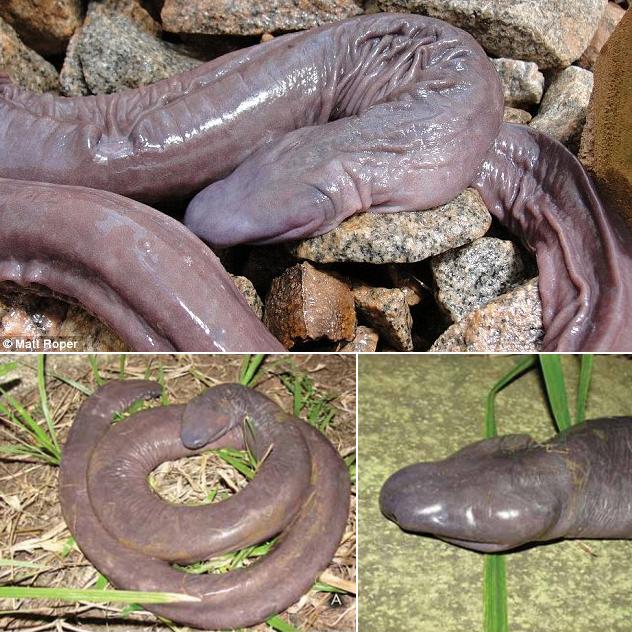
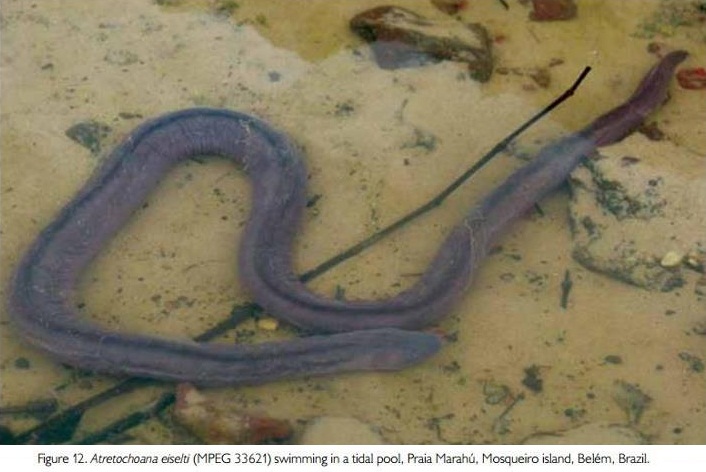
[Herpetology • 2011] Discovery of the largest lungless tetrapod, Atretochoana eiselti (Taylor, 1968) (Amphibia: Gymnophiona: Typhlonectidae) in its natural habitat in Brazilian Amazonia


Abstract
 We report the occurrence of the limbless and lungless tetrapod, Atretochoana eiselti, in two widely separated Brazilian Amazonian lowland localities, one (Mosqueiro island and Baía de Marajó, Belém) near the mouth of the Amazon river and another (Cachoeira Santo Antônio) near the border between Brazil and Bolivia in the Madeira river. It is shown that this species is not an inhabitant of cool, oxygen rich and fast running water in elevated localities as supposed until now, but on the contrary occurs in warm (24-30 °C), turbid, fast running water in the lowland Brazilian Amazon basin. We describe the probable habitat and three freshly preserved specimens (one male, two females) and compare them to the only two specimens known; some data are provided about the biology of this species, that seems to have a wide distribution in Brazilian Amazonia and possibly also occurs in other countries, like Bolivia.

Keywords: Atretochoana eiselti. Gymnophiona. Lungless vertebrate. Amazon Basin. Brazil.


Discovery of the largest lungless tetrapod, Atretochoana eiselti (Taylor, 1968) (Amphibia: Gymnophiona: Typhlonectidae), in its natural habitat in Brazilian Amazonia
Descoberta do maior Tetrapoda apulmonado, Atretochoana eiselti (Taylor, 1968) (Amphibia: Gymnophiona: Typhlonectidae), em seu habitat natural na Amazônia brasileira


Atretochoana : Nussbaum and Wilkinson gave this species its own genus when they reported on the results of their research in a 1995 issue of the Proceedings of the Royal Society of London Series B. The name they gave this genus was Atretochoana, from the Greek word atretos, meaning "imperforate", and the Greek word choana, referring to a funnel or tube.


 Nussbaum, Ronald A.; Wilkinson, Mark. 1995. A New Genus of Lungless Tetrapod: A Radically Divergent Caecilian (Amphibia: Gymnophiona). Proceedings of the Royal Society of London Series B Biological Sciences. 261 (1362): 331–339. DOI:10.1098/rspb.1995.0155.
Wilkinson, M.; Sebben, A.; Schwartz, E.N.F.; Schwartz, C.A. 1998. The largest lungless tetrapod: report on a second specimen of Atretochoana eiselti (Amphibia: Gymnophiona: Typhlonectidae) from Brazil. Journal of Natural History. 32 (4): 617–627. DOI:10.1516/Q417-21HR-6615-7217  bmnh.org/PDFs/MW_98_second.pdf

Hoogmoed, Marinus Steven; Coragem, Juliano Tupan. 2011. Discovery of the largest lungless tetrapod, Atretochoana eiselti (Taylor, 1968) (Amphibia: Gymnophiona: Typhlonectidae), in its natural habitat in Brazilian Amazonia. Boletim do Museu Paraense Emílio Goeldi : Ciências Naturais. 6 (3): 241–262.

[Herpetology • 1998] The largest lungless tetrapod: a second specimen of Atretochoana eiselti (Amphibia: Gymnophiona: Typhlonectidae) from Brazil


The discovery is reported of a second specimen  of the radically divergent lungless aquatic caecilian  Atretochoana eiselti (Taylor), previously known  only from the holotype. Aspects of the morphology of the second specimen  are described and compared to the holotype, allowing a minimal evaluation of variation within this enigmatic  species.  With a  total  length  of  805 mm, the second specimen is the largest known lungless  tetrapod. Most  of the  distinctive  morphological features reported for the holotype are  true  of the second specimen  also indicating  that the  holotype  is  not  a  'hopeful  monster'.  An  important  exception,  from  the perspective of species  identification, is  variation  in  the  form  of the  pattern  of denticulations about the cloacal disk.  Although precise  locality data  are lacking for both the holotype and  the second specimen,  the latter specimen was  almost certainly collected more recently and from within Brazil.  This justifies  increased expectation  that  this  remarkable  species  is  still  extant  and  that  it  will  be rediscovered. 
Keywords:  Atretochoana, Typhlonectidae, Gymnophiona, Caecilian, lunglessness, Neotropics, Brazil. 


 Nussbaum, Ronald A.; Wilkinson, Mark. 1995. A New Genus of Lungless Tetrapod: A Radically Divergent Caecilian (Amphibia: Gymnophiona). Proceedings of the Royal Society of London Series B Biological Sciences. 261 (1362): 331–339. DOI:10.1098/rspb.1995.0155 .

Wilkinson, M.; Sebben, A.; Schwartz, E.N.F.; Schwartz, C.A. 1998. The largest lungless tetrapod: report on a second specimen of Atretochoana eiselti (Amphibia: Gymnophiona: Typhlonectidae) from Brazil. Journal of Natural History. 32 (4): 617–627. DOI:10.1516/Q417-21HR-6615-7217

Hoogmoed, Marinus Steven; Coragem, Juliano Tupan. 2011. Discovery of the largest lungless tetrapod, Atretochoana eiselti (Taylor, 1968) (Amphibia: Gymnophiona: Typhlonectidae), in its natural habitat in Brazilian Amazonia. Boletim do Museu Paraense Emílio Goeldi : Ciências Naturais. 6 (3): 241–262.


[Herpetology • 1995] Atretochoana (originally Typhlonectes) eiselti • A New Genus of Lungless Tetrapod: A Radically Divergent Caecilian (Amphibia: Gymnophiona)


Abstract
Lunglessness is rare in the Tetrapoda and previously recorded only in salamanders (Amphibia: Caudata). Here we report lunglessness in another group of tetrapods, the poorly known tropical caecilians (Amphibia: Gymnophiona). Typhlonectes eiselti is a lungless, aquatic caecilian from South America known only from the single holotype specimen, NMW 9144 (Vienna Museum of Natural History). At a total length of 725 mm, NMW 9144 is by far the largest known lungless tetrapod. It also has a startling array of other radically divergent morphological features, many unique, and some correlated with lunglessness including: sealed choanae (paired internal nostrils); complete absence of pulmonary blood vessels; a repatterned skull with post-occipital jaw articulation; and a novel cranial muscle associated with an elongate and redirected stapes. This remarkable combination of highly derived characters sets Typhlonectes eiselti apart from all other caecilians and places it on a novel evolutionary trajectory. A new genus is described to accommodate this form.

Hoogmoed, Marinus Steven; Coragem, Juliano Tupan. 2011. Discovery of the largest lungless tetrapod, Atretochoana eiselti (Taylor, 1968) (Amphibia: Gymnophiona: Typhlonectidae), in its natural habitat in Brazilian Amazonia. Boletim do Museu Paraense Emílio Goeldi : Ciências Naturais. 6 (3): 241–262.

Wilkinson, M.; Sebben, A.; Schwartz, E.N.F.; Schwartz, C.A. 1998. The largest lungless tetrapod: report on a second specimen of Atretochoana eiselti (Amphibia: Gymnophiona: Typhlonectidae) from Brazil. Journal of Natural History 32 (4): 617–627. DOI:10.1516/Q417-21HR-6615-7217

 Nussbaum, Ronald A.; Wilkinson, Mark. 1995. A New Genus of Lungless Tetrapod: A Radically Divergent Caecilian (Amphibia: Gymnophiona). Proceedings of the Royal Society of London Series B Biological Sciences. 261 (1362): 331–339. DOI:10.1098/rspb.1995.0155 .

Sunday, July 22, 2012

[Paleontology] Preondactylus bufarinii • A pterosaur (Reptilia, Pterosauria) from the Upper Triassic (Norian) of Friuli, Italy

Preondactylus bufarinii (Wild 1983) 
Illustration: Robert Back

Preondactylus bufarinii (Wild 1983) Norian, Late Triassic, ~205 mya was considered by Unwin (2003) to be the most basal pterosaur. It is not. Derived from a sister to the Italian specimen of Austriadactylus, Preondactylus phylogenetically preceded Dimorphodon.


Dalla Vecchia FM 1998. New observations on the osteology and taxonomic status of Preondactylus buffarinii Wild, 1984 (Reptilia, Pterosauria), Boll. Soc. Paleont. It., 36(3, 1997): 355-366

Wild R 1984. A new pterosaur (Reptilia, Pterosauria) from the Upper Triassic (Norian) of Friuli, Italy, Gortiana — Atti Museo Friuliano di Storia Naturale 5:45-62.

Tuesday, June 19, 2012

[Herpetology • 1998] Adenomus dasi | Das's Toad • A synopsis of the Sri Lankan Bufonidae (Amphibia: Anura)


© 2009 Andreas & Christel Nöllert

Adenomus dasi 
Manamendra-Arachchi & Pethiyagoda, 1998

© 2011 Milivoje Krvavac

Manamendra-Arachchi, K. and Pethiyagoda, R. 1998. A synopsis of the Sri Lankan Bufonidae (Amphibia: Anura), with description of two new species. Journal of South Asian Natural History (J. South Asian nat. Hist.). 3(2): 213-246.

[Herpetology • 1998] Duttaphrynus noellerti | Noellert's Toad • A synopsis of the Sri Lankan Bufonidae (Amphibia: Anura)


© 2009 Andreas & Christel Nöllert

Noellert`s Toad |
Duttaphrynus noellerti (Manamendra-Arachchi and Pethiyagoda, 1998)
Synonym: Bufo noellerti Manamendra-Arachchi and Pethiyagoda, 1998


© 2009 Dr. Madhava Meegaskumbura

Manamendra-Arachchi, K. and Pethiyagoda, R. 1998. A synopsis of the Sri Lankan Bufonidae (Amphibia: Anura), with description of two new species. Journal of South Asian Natural History (J. South Asian nat. Hist.). 3(2): 213-246.