Showing posts with label Arthroleptidae. Show all posts

Sunday, November 30, 2025

[Herpetology • 2025] Arthroleptis mamiwakisaraensis • An Update on the Amphibian Assemblage of the Ukaguru Mountains, Tanzania, with the Description of A New giant Arthroleptis species (Amphibia: Anura)


Arthroleptis mamiwakisaraensis 
Lyakurwa, Liedtke, Mollel, Bittencourt-Silva, Jehle, Loader & Ngalason, 2025
 
 
Abstract
Effective conservation measures require accurate and complete species inventories, which are however often missing for particularly biodiverse regions of concern. The montane forests of the Eastern Arc Mountains (EAM) in East Africa represent fragmented relics of unique habitats that harbour remarkable levels of plant and animal diversity, including many endemic and threatened species most of which are poorly known. The present study focuses on the Ukaguru Mountains, an important mountain block in the central EAM, and expands on a recent study that summarized data from 30 years of amphibian surveys. Using systematic sampling (2022–2024) in localities that are less heavily impacted by anthropogenic activities than previously surveyed sites, we increase the number of documented amphibian species from 17 to 19, adding Xenopus cf. victorianus and a newly described species (see below). Among the three Ukaguru-endemic toads which have not been recorded since more than two decades, we re-discovered Nectophrynoides laticeps and N. paulae but failed to record the enigmatic Churamiti maridadi, which according to a dedicated extinction model has an updated probability of only 47.6% of still being extant. Based on genetic, morphological and bioacoustic evidence, we also describe a new large-bodied species of Arthroleptis (Arthroleptis mamiwakisaraensis sp. nov.), shedding further light into the evolution of ‘giant’ congeners which inhabit other mountain blocks in the EAM. Given the rapid deforestation of the EAM for which the Ukagurus are no exception, our findings give rise to concerns regarding current and future extinction risks within unique mountain amphibian assemblages, also affecting species which potentially still await description. 

Key words: Afromontane, biogeography, Churamiti, Eastern Arc Mountains, Nectophrynoides


 Arthroleptis mamiwakisaraensis sp. nov.


John Lyakurwa, H. Christoph Liedtke, Pius Mollel, Gabriela B. Bittencourt-Silva, Robert Jehle, Simon P. Loader and Wilirk Ngalason. 2025. An Update on the Amphibian Assemblage of the Ukaguru Mountains, Tanzania, with the Description of A New giant Arthroleptis species (Amphibia: Anura). Systematics and Biodiversity.  23(1); 2561124. DOI: doi.org/10.1080/14772000.2025.2561124 [03 Nov 2025]

Monday, November 13, 2023

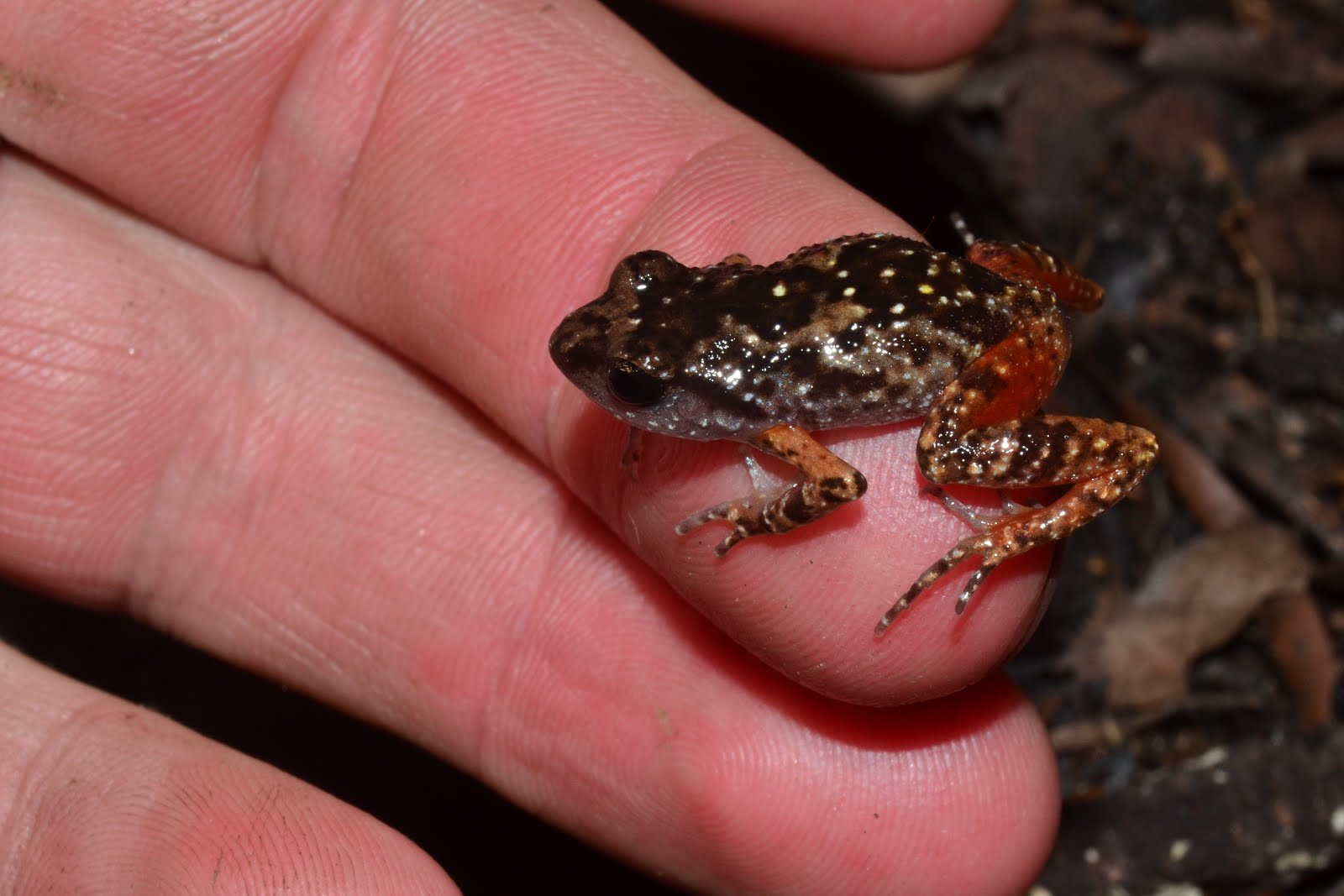
[Herpetology • 2023] Arthroleptis nyungwensis • A New Miniature Species of Arthroleptis (Anura: Arthroleptidae) from Nyungwe National Park, Rwanda


Arthroleptis nyungwensis
 Dehling, 2023

 
Abstract
A new, very small-sized species of Arthroleptis is described from western Rwanda. The new species occurs locally endemic in Nyungwe Forest and Cyamudongo Forest, where it inhabits the leaf litter of montane forests between 1800 and 2200 m a.s.l. It differs from all other members of the genus by a unique combination of morphological characters, including size (SVL of adult males 16.0–16.5 mm), skin texture, length of hindlimbs, and ventral colour pattern; by characteristics of its advertisement call that consists of a single note lasting 17.4 ± 6.4 [11–32] ms and has a dominant frequency of 5861 ± 188 [5531–6029] Hz; and also in the sequence of the 16S rRNA gene that differs from available homologous sequences of other species of the genus by an uncorrected p-distance of at least 4.6%. Details of the natural history as well as two additional call types are described.

Keywords: amphibians; diversity; bioacoustics; phylogenetics; Arthroleptis schubotzi; Nyungwe Forest; Cyamudongo Forest

Arthroleptis nyungwensis sp. nov.
(A) Dorsolateral view and (B) ventral view of the holotype (ZFMK 104075) in life.
(C) Dorsolateral view and (D) ventral view of an adult male (JMD 599) in life.
(E) Dorsolateral view and (F) ventral view of one of the subadult paratypes (SMNS 15743) in life.

Arthroleptis nyungwensis sp. nov.
Nyungwe Squeaker

Diagnosis: The species is assigned to the genus Arthroleptis for exhibiting the following morphological characteristics [28]: pedal webbing absent, median dorsal skin raphe present, third finger elongate in adult males, dermal spines present on third finger. The new species differs from all other members of the genus by the combination of the following characteristics: small size (SVL of adult males 16.0–16.5 mm); dorsal surfaces of head, trunk, and limbs and lateral surfaces of trunk finely shagreened; tympanum well visible externally; median lingual process absent; legs long, tibiotarsal joint reaching to eye; tibiofibular length equal to foot length; tip of third finger and tips of toes slightly enlarged; inner metatarsal tubercle very small and rounded, outer metatarsal tubercle absent; ventral colour reddish to orange with two slightly concave longitudinal yellow stripes and white dots; advertisement call consisting of single note, lasting 17.4 ± 6.4 [11–32] ms and dominant frequency at 5861 ± 188 [5531–6029] Hz; sequence of the 16S rRNA gene differing from available homologous sequences of other species by uncorrected p-distance of at least 4.6%.

Etymology: The species is named after Nyungwe Forest in southern Rwanda.


 J. Maximilian Dehling. 2023. A New Miniature Species of Arthroleptis (Anura: Arthroleptidae) from Nyungwe National Park, Rwanda.  Diversity. 15(10); 1104. DOI: 10.3390/d15101104

Sunday, November 13, 2022

[Herpetology • 2022] Leptopelis shebellensis & L. xeniaeGenetic and Morphometric Analyses of Historical Type Specimens Clarify the Taxonomy of the Ethiopian Leptopelis gramineus Species Complex (Anura, Arthroleptidae)


Leptopelis shebellensis & Leptopelis xeniae
Goutte, Reyes-Velasco, Kassie & Boissinot, 2022


Abstract
Frogs of the genus Leptopelis have diversified in the Ethiopian Highlands to occupy forests and montane grasslands both east and west of the Great Rift Valley. Genetic studies revealed that the endemic species Leptopelis gramineus (Boulenger, 1898) comprises multiple unnamed taxa. A careful examination of historical type specimens is, however, needed to fully resolve the taxonomy of the group. Here we use mitochondrial DNA and morphological analyses on a large sample of recently-collected Ethiopian Leptopelis, as well as century-old type specimens to demonstrate that the recently resurrected L. montanus Tiutenko & Zinenko, 2021 (previously Pseudocassina ocellata Ahl, 1924) is a junior synonym of L. rugosus (Ahl, 1924) and corresponds to the taxon found west of the Great Rift Valley, not east as previously thought. Our results show that populations inhabiting the mountains and plateaus east of the Rift constitute a distinct and undescribed species. We provide a re-description of L. rugosus and describe two new species inhabiting the Highlands east of the Great Rift Valley. We provide an identification key, as well as a description of the calls of the members of the Leptopelis gramineus species complex.

Keywords: African treefrogs, Afromontane, historical DNA, integrative taxonomy, Leptopelis shebellensis sp. nov., Leptopelis xeniae sp. nov., museomics, new species

 Leptopelis rugosus (Ahl, 1924)
Diagnosis: A large (male (n = 22) SVL 38.7 ± 2.7 mm, female (n = 2) SVL 52.4 ± 0.2 mm) species of the Leptopelis gramineus species complex (Figs 5, 6). Robust, semi-fossorial form. It differs from other members of the Leptopelis gramineus species complex by the following combination of characters: (1) large tympanum (male TD/ED 0.57 ± 0.11, female TD/ED 0.54), (2) long snout (male SL/HL 0.25 ± 0.02, female SL/HL 0.27 ± 0.01), (3) well-developed metatarsal tubercle (male MTL/FL 0.17 ± 0.02, female MTL/FL 0.18 ± 0.02), (4) ventrum lacking any brown spots, (5) yellow colouration on the side of the ventrum and the inner thighs almost always present.


 Leptopelis shebellensis Goutte, Reyes-Velasco, Kassie & Boissinot, sp. nov.
 Common name: Shebelle River burrowing African treefrog.

Diagnosis: Medium to large (male (n = 21) SVL 35.9 ± 3.5 mm, female (n = 5) SVL 53.4 ± 5.3 mm), robust semi-fossorial species of the Leptopelis gramineus species complex (Fig. 7). It differs from other members of the Leptopelis gramineus species complex by the following combination of characters: (1) short and robust hind-limbs (male TL/SVL 0.33 ± 0.03, female TL/SVL 0.30 ± 0.02), (2) well-developed metatarsal tubercle (male MTL/FL 0.17 ± 0.03, female MTL/FL 0.16 ± 0.02), (3) longer snout (male SL/HL 0.23 ± 0.03, female SL/HL 0.24 ± 0.02), (4) toe and fingertips not enlarged and (5) ventrum often with dark brown spots and/or yellowish sides.

Etymology: The specific name refers to the Shebelle River, as the distribution range of the species appears restricted to the Shebelle River Basin, with populations found both north and south of the source of the river (Fig. 1).


 Leptopelis xeniae Goutte, Reyes-Velasco, Kassie & Boissinot, sp. nov.
 Common name: English: Xenia’s African treefrog.
 
Diagnosis: Small to medium-sized (male (n = 20) SVL 27.6 ± 2.0 mm, female (n = 2) SVL 43.5 ± 5.7 mm), robust arboreal species of the Leptopelis gramineus species complex (Fig. 8). It differs from other members of the Leptopelis gramineus species complex by the following combination of characters: (1) thin, elongated hind-limbs (male TL/SVL 0.36 ± 0.02, female TL/SVL 0.37 ± 0.03), (2) small metatarsal tubercle (male MTL/SVL 0.07 ± 0.01, female MTL/SVL 0.06 ± 0.00) (2) inter-orbital distance very short (male IOD/ED 0.88 ± 0.16, female IOD/ED 0.69 ± 0.12), (3) dorsal skin always smooth, except in females where it may be slightly rugose, (4) absence of yellow colouration on the ventrum or inner thighs.

Etymology: Leptopelis xeniae sp. nov. is named after Xenia Freilich, who conducted her doctoral research on Ethiopian anurans, including the Leptopelis gramineus complex.


 Sandra Goutte, Jacobo Reyes-Velasco, Abeje Kassie and Stéphane Boissinot. 2022. Genetic and Morphometric Analyses of Historical Type Specimens Clarify the Taxonomy of the Ethiopian Leptopelis gramineus Species Complex (Anura, Arthroleptidae). ZooKeys. 1128: 63-97.  DOI: 10.3897/zookeys.1128.82176 

Friday, September 10, 2021

[Herpetology • 2021] Phylogeny of African Long-Fingered Frogs (Arthroleptidae: Cardioglossa) reveals Recent Allopatric Divergences in Coloration


Cardioglossa leucomystax 2

in Blackburn, Nielsen, Ghose, ... et Rödel, 2021. 
photo: Brian Freiermuth, DOI: 10.7479/3yje-r341 
 
Abstract
The African anuran genus Cardioglossa contains 19 described species, most of which are distinguished from one another by striking patterns and colors. We present a well-resolved phylogeny based on analyses of mitochondrial and nuclear loci for 18 species of Cardioglossa. This provides the basis for species-delimitation analyses and interpreting historical biogeography in the genus. Whereas much of the diversification within the genus occurred among Central African lineages during the Miocene following the origin of Cardioglossa in the latest Oligocene or earliest Miocene, most species-pairs in the genus diverged more recently during the Plio-Pleistocene. The two most geographically peripheral species—C. cyaneospila in the Albertine Rift Mountains and C. occidentalis in the Upper Guinean Forests of West Africa—both diverged from other lineages during the mid-late Miocene. Because our analyses do not support C. manengouba and C. oreas as distinct species, we recognize these geographically separate and phenotypically distinct populations as subspecies of C. oreas that diverged subsequent to the origin of Mount Manengouba during the past 1.5 million years. In contrast, we find that C. leucomystax likely represents two species found in the Lower Guinean and Congolian forests, respectively. We find recent divergences between several allopatric lineages (either species or populations) that differ in coloration and pattern, including in C. nigromaculata which varies in color across its range in Central Africa and Bioko Island. These recent divergences among allopatric lineages with distinctive coloration and pattern raise new questions about the significance of these traits in this genus for which little is known of its natural history and biology.


Maximum likelihood phylogeny of Cardioglossa based on the multilocus concatenated, partitioned dataset of mitochondrial and nuclear data. A black dot at each node indicates high support (e.g., Bayesian posterior probability >0.95, maximum likelihood bootstrap >70). Tip labels of individuals used for divergence time analysis are indicated in boldface. Photographs are not scaled to size.

(Photo credits: David C. Blackburn.: C. melanogaster, C. oreas manengouba, C. pulchra, C. schioetzi; Marius Burger: C. annulata, C. escalerae, C. leucomystax 1; Brian Freiermuth: C. leucomystax 2, C. oreas oreas; Eli Greenbaum: C. congolia, C. cyaneospila; Václav Gvoždík: C. alsco; Mareike Hirschfeld: C. nigromaculata, C. venusta; Greg Jongsma: C. gracilis; Patrick J. McLaughlin: C. nigromaculata ‘Bioko'; Dan Portik: C. elegans, C. occidentalis; Mark-Oliver Rödel: C. gratiosa, C. trifasciata.
 

David C. Blackburn, Stuart V. Nielsen, Sonia L. Ghose, Marius Burger, LeGrand Nono Gonwouo, Eli Greenbaum, Václav Gvoždík, Mareike Hirschfeld, Marcel T. Kouete, Chifundera Kusamba, Dwight Lawson, Patrick J. McLaughlin, Ange-Ghislain Zassi-Boulou and Mark-Oliver Rödel. 2021. Phylogeny of African Long-Fingered Frogs (Arthroleptidae: Cardioglossa) Reveals Recent Allopatric Divergences in Coloration. Ichthyology & Herpetology. 109(3); 728-742. DOI: 10.1643/h2020165 

Friday, July 2, 2021

[Herpetology • 2021] Leptopelis palmatus • New Evidence for Distinctiveness of the Island-endemic Príncipe Giant Tree Frog (Arthroleptidae)


 Leptopelis palmatus (Peters, 1868)

in Jaynes, Myers, Drewes et Bell, 2021. 
Photo: Rayna Bell.

Abstract
 The Príncipe giant tree frog Leptopelis palmatus is endemic to the small oceanic island of Príncipe in the Gulf of Guinea. For several decades, this charismatic but poorly known species was confused with another large tree frog species from continental Africa, L. rufus. Phylogenetic relationships within the African genus Leptopelis are poorly understood and consequently the evolutionary history of L. palmatus and its affinity to L. rufus remain unclear. In this study, we combined mitochondrial DNA (mtDNA), morphological, and acoustic data for L. palmatus and L. rufus to assess different axes of divergence between the species. Our mtDNA gene tree for the genus Leptopelis indicated that L. palmatus is not closely related to L. rufus or other large species of Leptopelis. Additionally, we found low mtDNA diversity in L. palmatus across its range on Príncipe. We found significant morphological differences between females of L. rufus and L. palmatus, but not between males. We characterised the advertisement call of L. palmatus for the first time, which is markedly distinct from L. rufus. Finally, we summarised our observations of L. palmatus habitats and additional notes on phenotypic variation and behaviour. Our study reinforces the distinctiveness of L. palmatus and provides information important for the conservation of this endangered species.

Keywords: bioacoustic, morphology, endemic, mitochondrial DNA, island, São Tomé and Príncipe

colour variation in Leptopelis palmatus 
(CAS 258958, CAS 258910,
USNM 591753, USNM 591758)
Photos A. Stanbridge and R. Bell.


Leptopelis palmatus (Peters, 1868)

. (a) Violin plots of adjusted Snout-Vent Length (SVL), Tympanum size (TMP), Tympanum-Eye ratio (TMP:EYE), and Disc-Tympanum ratio (DSC:TMP) in L. palmatus and L. rufus. Comparisons significant at an adjusted P < 0.05 with a Tukey Honest Significant Difference test are indicated with an asterisk.
 (b) Call parameter definitions and representative audio spectrograms of L. palmatus and L. rufus male advertisement calls.
 (c) colour variation in Leptopelis palmatus (from left to right: CAS 258958, CAS 258910, USNM 591753, USNM 591758)
Photos A. Stanbridge and R. Bell.


  Kyle E. Jaynes, Edward A. Myers, Robert C. Drewes and Rayna C. Bell. 2021. New Evidence for Distinctiveness of the Island-endemic Príncipe Giant Tree Frog (Arthroleptidae: Leptopelis palmatus). Herpetological Journal. 31; 162-169. DOI: 10.33256/31.3.162169

A rã gigante de Príncipe, Leptopelis palmatus, é endêmica da pequena ilha oceânica de Príncipe no Golfo da Guiné. Por várias décadas, esta espécie carismática mas pouco conhecida foi confundida com outra espécie grande de rã da África continental, L. rufus. As relações filogenéticas dentro do gênero africano Leptopelis são mal compreendidas e, conseqüentemente, a história evolutiva de L. palmatus e sua afinidade com L. rufus permanecem obscuras. Neste estudo, combinamos dados de DNA mitocondrial (mtDNA), morfológicos e acústicos de L. palmatus e L. rufus para avaliar diferentes eixos de divergência entre as espécies. Nossa árvore de genes de mtDNA para o gênero Leptopelis indicou que L. palmatus não está proximamente relacionada a L. rufus ou outras espécies grandes de Leptopelis, e encontramos baixa diversidade de mtDNA em L. palmatus em toda a sua distribuição em Príncipe. Encontramos diferenças morfológicas significativas entre as fêmeas de L. rufus e L. palmatus, mas não entre os machos. Caracterizamos o canto reprodutor de L. palmatus pela primeira vez, que é marcadamente distinto do de L. rufus. Finalmente, resumimos nossas observações dos habitats de L. palmatus e notas adicionais sobre variação fenotípica e comportamento. Nosso estudo fornece informações importantes para a conservação dessa espécie ameaçada de extinção

Friday, March 12, 2021

[Herpetology • 2021] Leptopelis diffidens • A New Species of Leptopelis (Anura, Arthroleptidae) from the south-eastern slope of the Ethiopian Highlands, with Notes on the Leptopelis gramineus Species Complex


 Leptopelis diffidens sp. nov., Harenna Forest (holotype, ZSM 81/2019) 
 Leptopelis montanus nom. nov., Gaysay Grasslands, Bale Mountains (not collected)

Tiutenko & Zinenko, 2021. 
 
Abstract
A new ground-dwelling species of treefrog in the genus Leptopelis is described from the Harenna Forest in south-eastern Ethiopia. The description is based on morphology and acoustics and is supported by molecular data. The new species has a small body size, and the digital discs on fingers and toes are significantly more conspicuous than in other semi-fossorial members of the L. gramineus complex. It occupies forest habitats at lower altitudes and is separated ecologically and geographically from high-altitude species of the complex. One of them, a parapatric cryptic species from Bale and Arsi Mountains, is resurrected from synonymy of L. gramineus and given a new name, L. montanus. Genetic barcoding of specimens from both populations showed that they belong to two distinct lineages that had been revealed by recent phylogenetic research. To confirm the geographic separation of the studied populations, the collection area of L. gramineus types was verified through analysis of the diary and the final report of the 2nd expedition of V. Bottego, and through matching of the route described in it with modern maps. The type locality of L. gramineus sensu stricto is restricted to Gamo Gofa, Ethiopia. Following the results of recent phylogenetic studies, the range of L. gramineus is limited to west of the Great Rift Valley. An identification key to the named Ethiopian species of the genus is provided.

Keywords: Bale Mountains, Ethiopia, Harenna Forest, Leptopelis diffidens sp. nov., Leptopelis montanus nom. nov., Leptopelis rugosus, Pseudocassina ocellata, Pseudocassina rugosa

Figure 3. Adult females of three species of the Leptopelis gramineus complex in life, shown to the same scale
Leptopelis diffidens sp. nov., Harenna Forest (holotype, ZSM 81/2019)
Leptopelis montanus nom. nov., Gaysay Grasslands, Bale Mountains (not collected)
C L. sp. ‘Shewa’, Menz-Guassa (not collected).

Leptopelis diffidens sp. nov.
 
Diagnosis: Medium-sized (SVL of males ca. 24–29 mm, females ca. 35–40 mm) ground-dwelling and burrowing frog with robust body, relatively wide and short head, and short limbs. Terminal phalanges of toes and fingers expanded to small, but distinct discs. Only base phalanges of toes II–IV with broad web; on toe V the web extends along phalanges 1 and 2. The rest of toe phalanges with feeble fringe. Fingers are free of web or fringe. Light-brown or light olive-green from above; either no dorsal pattern, or three indistinct broad longitudinal bands (one vertebral and two dorsolateral) present that are slightly darker than the ground colour. Males with pectoral glands. Advertisement call: quiet, high-pitched singleton ‘quack’, repeated at intervals of ca. 20 seconds.

Etymology: The Latin adjective diffidens (used here in nominative singular) means diffident, anxious, shy, mistrustful. This name refers to the behaviour of this frog that appears even more cryptic and defensive than L. gramineus from other populations. The vocalisation of a male is so quiet that the animal is very difficult to locate and to spot. When approached, at a distance of only 5 m, it stops calling and remains silent until the disturber has gone away or has not moved for at least 10 minutes. As a vernacular name for this species, we propose ‘Harenna Burrowing Treefrog’.

...

In accordance with Article 50 and Paragraph 3 of Article 60 of ICZN, we establish a substitute name Leptopelis montanus nom. nov. for Leptopelis ocellatus (Ahl, 1924) to resolve its homonymy with Leptopelis ocellatus (Mocquard, 1902).
 
 Etymology: The new specific name montanus (living in mountains, montane) refers to the fact that this species ranges into afromontane areas up to elevation of almost 4000 m a.s.l., thus being a Leptopelis with probably the highest altitudinal distribution. The name is an adjective in nominative singular.

a map showing the distribution of the Leptopelis gramineus species complex members:
L. gramineus (filled circle), L. sp. ‘Shewa’ (empty circle), L. montanus nom. nov. (empty triangle), L. diffidens sp. nov. (filled square), L. sp. ‘Borana/Sidamo’ (empty diamond).
Type localities of the described species are marked with a cross.

Figure 10. Habitats of three species of the Leptopelis gramineus complex
A, B Habitats of Leptopelis diffidens sp. nov. in the Harenna Forest – Segoba glade and Manyate village
C habitat of Leptopelis montanus nom. nov. in the Web Valley, Bale Mountains
D habitat of L. sp. ‘Shewa’ in Menz-Guassa.


Arthur Tiutenko and Oleksandr Zinenko. 2021. A New Species of Leptopelis (Anura, Arthroleptidae) from the south-eastern slope of the Ethiopian Highlands, with Notes on the Leptopelis gramineus Species Complex and the Revalidation of A previously Synonymised Species. ZooKeys 1023: 119-150. DOI: 10.3897/zookeys.1023.53404


Tuesday, December 12, 2017

[Herpetology • 2017] Arthroleptis troglodytes Poynton, 1963 • The Rediscovery of A Lost Frog


 Arthroleptis troglodytes  Poynton, 1963
Becker & Hopkins, 2017 


Abstract
The cave squeaker Arthroleptis troglodytes Poynton, 1963 was first collected in 1961/62, and not observed again for 54 years despite several attempts to locate it. We rediscovered this species near the type locality in the Chimanimani mountain range in eastern Zimbabwe. We describe for the first time the call and colour in life, and highlight several morphological and habitat features not previously recorded for this species.

Keywords: amphibian, Arthroleptis, high altitude, Possibly Extinct, taxonomy, Zimbabwe


Adult male Arthroleptis troglodytes.

Francois S. Becker and Robert W. Hopkins. 2017. The Rediscovery of A Lost Frog: Arthroleptis troglodytes Poynton, 1963.  African Zoology. 52(3); 183-187. DOI:  10.1080/15627020.2017.1370982

After 54 years in hiding, 'extinct' frog rediscovered in Zimbabwe   earthtouchnews.com/conservation/endangered/after-54-years-in-hiding-extinct-frog-rediscovered-in-zimbabwe/
Rare 'cave squeaker' frog seen in Zimbabwe for first time in 55 years  theguardian.com/environment/2017/feb/05/return-of-zimbabwes-cave-squeaker-as-rare-frog-found-fifty-years-on
The "cave squeaker," a tiny frog not seen in decades, has been found in Zimbabwe  huffingtonpost.com/entry/cave-squeaker-frog-zimbabwe  via @HuffPostGreen