Showing posts with label Speciation. Show all posts

Monday, August 26, 2024

[Herpetology • 2024] Evolutionary Bursts drive Morphological novelty in the World’s Largest Skinks


in Brennan, Chapple, Keogh ... et Donnellan, 2024.

Highlights: 
• A new and reliable species tree of Tiliquini skinks (bluetongues and relatives)
• Patterns of morphological trait evolution are heterogeneous
• Nested “bursts” in evolution lead to new phenotypes

Summary
Animal phenotypes evolve and diverge as a result of differing selective pressures and drift. These processes leave unique signatures in patterns of trait evolution, impacting the tempo and mode of morphological macroevolution. While there is a broad understanding of the history of some organismal traits (e.g., body size), there is little consensus about the evolutionary mode of most others. This includes the relative contribution of prolonged (Darwinian gradualist) and episodic (Simpsonian jump) changes toward the evolution of novel morphologies. Here, we use new exon-capture and linear morphological datasets to investigate the tempo and mode of morphological evolution in Australo-Melanesian Tiliquini skinks. We generate a well-supported time-calibrated phylogenomic tree from ∼400 nuclear markers for more than 100 specimens, including undescribed diversity, and provide unprecedented resolution of the rapid Miocene diversification of these lizards. By collecting a morphological dataset that encompasses the lizard body plan (19 traits across the head, body, limb, and tail), we are able to identify that most traits evolve conservatively, but infrequent evolutionary bursts result in morphological novelty. These phenotypic discontinuities occur via rapid rate increases along individual branches, inconsistent with both gradualistic and punctuated equilibrial evolutionary modes. Instead, this “punctuated gradualism” has resulted in the rapid evolution of blue-tongued giants and armored dwarves in the ∼20 million years since colonizing Australia. These results outline the evolutionary pathway toward new morphologies and highlight the heterogeneity of evolutionary tempo and mode, even within individual traits.
 
Keywords: morphological evolution, Simpsonian, skink phylogenomics, Tiliquini


Ian G. Brennan, David G. Chapple, J. Scott Keogh ... et Stephen Donnellan. 2024. Evolutionary Bursts drive Morphological novelty in the World’s Largest Skinks. Current Biology. In Press. DOI: doi.org/10.1016/j.cub.2024.07.039 


(a) Monkey-tailed skink (Corucia zebrata) (b) Western bluetongue (Tiliqua occipitalis
(c) Shingleback lizard (Tiliqua rugosa) (d) Yakka skink (Egernia rugosa
(e) Tree skink (Egernia striolata) (f) Pygmy spiny-tailed skink (Egernia depressa)
(g) Mainland She-oak skink (Cyclodomorphus michaeli) (h) Crocodile skink (Tribolonotus gracilis)
... These lizards represent some of the extremes of the diversity we see in the 'Social Skinks' a group mostly found in Australia.

Wednesday, May 15, 2024

[Ornithology • 2024] Patagona chaski • Extreme Elevational Migration spurred Cryptic Speciation in Giant Hummingbirds (Apodiformes: Trochilidae)


Patagona chaski   
Patagona gigas  (Vieillot, 1824)

in Williamson, Gyllenhaal, Bauernfeind, Baumann, Gadek, Marra, Ricote, Valqui, Bozinovic, Singh & Witt, 2024. 
 
Significance: 
Biodiversity varies from place to place because the range of climates suitable for any one species tends to be limited. The giant hummingbird appears to defy this tendency, occurring across the broadest range of environments of any hummingbird. We asked whether its migration, physiology, or genetics explain its climate generalism, potentially illuminating mechanisms of niche breadth evolution. Microtracking devices revealed an epic migration from the Chilean coast to the Peruvian Andes, with an extreme, >4,100-m elevational shift and corresponding performance trade-offs. Genomes revealed that migrant and resident populations diverged in the Pliocene and have since evolved under phenotypic stasis. A migratory shift enabled climatic niche expansion, leading to speciation and niche subdivision, consistent with diversification by niche breadth oscillation.

Abstract
The ecoevolutionary drivers of species niche expansion or contraction are critical for biodiversity but challenging to infer. Niche expansion may be promoted by local adaptation or constrained by physiological performance trade-offs. For birds, evolutionary shifts in migratory behavior permit the broadening of the climatic niche by expansion into varied, seasonal environments. Broader niches can be short-lived if diversifying selection and geography promote speciation and niche subdivision across climatic gradients. To illuminate niche breadth dynamics, we can ask how “outlier” species defy constraints. Of the 363 hummingbird species, the giant hummingbird (Patagona gigas) has the broadest climatic niche by a large margin. To test the roles of migratory behavior, performance trade-offs, and genetic structure in maintaining its exceptional niche breadth, we studied its movements, respiratory traits, and population genomics. Satellite and light-level geolocator tracks revealed an >8,300-km loop migration over the Central Andean Plateau. This migration included a 3-wk, ~4,100-m ascent punctuated by upward bursts and pauses, resembling the acclimatization routines of human mountain climbers, and accompanied by surging blood-hemoglobin concentrations. Extreme migration was accompanied by deep genomic divergence from high-elevation resident populations, with decisive postzygotic barriers to gene flow. The two forms occur side-by-side but differ almost imperceptibly in size, plumage, and respiratory traits. The high-elevation resident taxon is the world’s largest hummingbird, a previously undiscovered species that we describe and name here. The giant hummingbirds demonstrate evolutionary limits on niche breadth: when the ancestral niche expanded due to evolution (or loss) of an extreme migratory behavior, speciation followed.


Jessie L. Williamson, Ethan F. Gyllenhaal, Selina M. Bauernfeind, Matthew J. Baumann, Chauncey R. Gadek, Peter P. Marra, Natalia Ricote, Thomas Valqui, Francisco Bozinovic, Nadia D. Singh, and Christopher C. Witt. 2024.  Extreme Elevational Migration spurred Cryptic Speciation in Giant Hummingbirds. PNAS. 121 (21); e2313599121. DOI: 10.1073/pnas.2313599121 

The proposed scientific name for the resident northern population is Patagona chaski. “Chaski” is the word for messenger in Quechua, a family of Indigenous languages that spread from Peru to other neighboring countries.


Tuesday, December 5, 2023

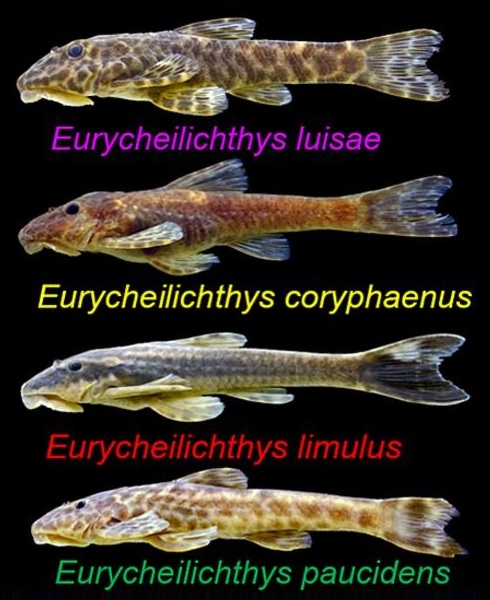
[Ichthyology • 2024] Phylogenomics of the narrowly endemic Eurycheilichthys (Siluriformes: Loricariidae): Sympatric Species with Non-sister Relationships suggest mainly Allopatric Speciation


Armored catfishes of the genus Eurycheilichthys

in Delapieve, Rocha & Reis, 2023. 

Highlights
• Phylogenomic inference for Eurycheilichthys based on ddRAD sequence data.
• Monophyly of most, but not all, morphospecies corroborated by genome-wide data.
• Most sympatric species are not sister lineages, suggesting allopatric diversification and secondary contact.
• Higher diversity among lineages in the Taquari-Antas basin indicates a more dynamic landscape.
• Eastern clade species should be target by future studies to assess the presence of cryptic species or hybridization.

Abstract
Armored catfishes of the genus Eurycheilichthys are endemic to Southern Brazil and Misiones (Argentina) comprising nine species of small size, with a high degree of sympatry and species diversity distributed in two river basins. Here we use new genome-wide data to infer a species phylogeny and test species boundaries for this poorly known group. We estimate 1) the phylogenetic relationships of the species of Eurycheilichthys based on 29,350 loci in 65 individuals of nine species plus outgroups, and 2) the population structure and differentiation based on 43,712 loci and 62 individuals to estimate how geography may have acted on speciation and formation of the sympatric species groups. Analyses support the monophyly of the genus and suggest two species-inclusive clades (East and West) with high support and very recently diverged species. Western clade contains E. limulus (from upper Jacuí River basin) that is sister to Western species of the Taquari-Antas basin plus E. paucidens. The Eastern clade contains E. pantherinus (from Uruguay River basin) sister to the Eastern species of the Taquari-Antas basin E. coryphaenus, plus the central-distributed species E. planus and E. vacariensis, and the more widely-distributed species E. luisae. Eurycheilichthys luisae is not monophyletic and may contain one or more cryptic species or hybrid individuals. A stronger diversity on structure of lineages on the Taquari-Antas, when compared to upper Uruguay and Jacuí River basins, and the fact that most of the sympatrically distributed taxa have non-sister relationships suggest a scenario of mainly allopatric speciation and may indicate a more dynamic landscape with headwater capture events among these tributaries.
 
Keywords: Neotropics, Biodiversity, Cascudinhos, ddRADseq, Phylogenetics


Maria Laura S. Delapieve, Luiz A. Rocha and Roberto E. Reis. 2023. Phylogenomics of the narrowly endemic Eurycheilichthys (Siluriformes: Loricariidae): Sympatric Species with Non-sister Relationships suggest mainly Allopatric Speciation. Molecular Phylogenetics and Evolution. 190, 107970. DOI: 10.1016/j.ympev.2023.107970

Saturday, September 9, 2023

[Ornithology • 2023] Molecular and Acoustic Evidence Support the Species Status of Anthus rubescens rubescens and Anthus [rubescens] japonicus (Passeriformes: Motacillidae)


Breeding, migrating and wintering distributions of Palearctic Anthus [rubescensjaponicus and Nearctic Anthus rubescens rubescens/alticola subspecies groups 

in Doniol-Valcroze, Coiffard, Alström, Robb, Dufour et Crochet, 2023. 
(from BirdLife International 2022; illustration @Andrew Birch)

Abstract
The Buff-bellied Pipit Anthus rubescens comprises two allopatric subspecies groups: A. r. rubescens and A. r. alticola in North America and A. [r.] japonicus in north-east Asia. Despite their great morphological resemblance in breeding plumage, most individuals can be assigned to one or the other subspecies group in non-breeding plumage. Allopatric distributions, morphological differentiation and previously reported molecular divergence suggested the need for additional taxonomic study to assess the rank of these two populations. To resolve the taxonomy of the Buff-bellied Pipit species complex we analysed i) two mitochondrial DNA (mtDNA) loci and ii) nine bioacoustic parameters across 69 sound recordings (338 flight calls) recovered from public databases using principal component analysis and Euclidean distance measures. By comparing our mtDNA and call divergence measures with similar values measured between long-recognised species pairs of the genus, we show that the level of mitochondrial and acoustic divergence between the two Buff-bellied Pipit subspecies groups is typical of species-level divergence in the genus Anthus. Therefore, we recommend splitting the Buff-bellied Pipit species complex into two species: Anthus rubescens (American Pipit) and Anthus japonicus (Siberian Pipit). Our results also suggest that the Water Pipit A. spinoletta deserves taxonomic reassessment as its lineages are highly divergent in acoustics and mtDNA, while mtDNA relationships suggest paraphyly relative to the Rock Pipit A. petrosus. Our work highlights the crucial importance of integrative approaches in taxonomy and the usefulness of bioacoustics in studying cryptic diversity.

Key­­words: American Pipit, Buff-bellied Pipit, Beringia, Bird, Speciation, Palearctic, Nearctic

Breeding, migrating and wintering distributions of Palearctic Anthus [rubescensjaponicus and Nearctic Anthus rubescens rubescens/alticola subspecies groups (from BirdLife International 2022; illustration @Andrew Birch). Circles indicate origins of sequenced individuals and triangles indicate origins of analysed recordings of calls. Localities outside of the usual range of the species complex (e.g., Ireland, Oman and Israel) are not figured here.


Paul Doniol-Valcroze, Paul Coiffard, Per Alström, Magnus Robb, Paul Dufour and Pierre-André Crochet. 2023. Molecular and Acoustic Evidence Support the Species Status of Anthus rubescens rubescens and Anthus [rubescensjaponicus (Passeriformes: Motacillidae).  Zootaxa. 5343(2); 173-192. DOI: 10.11646/zootaxa.5343.2.4
 www.birdguides.com/articles/research-shows-buff-bellied-pipit-is-two-species/

Sunday, March 26, 2023

[Herpetology • 2022] Hemidactylus almakhwah & H. farasani • Diversification of Hemidactylus Geckos (Squamata: Gekkonidae) in coastal Plains and Islands of southwestern Arabia with Descriptions and Complete Mitochondrial Genomes of Two Endemic Species to Saudi Arabia


  Hemidactylus farasani  
Šmíd, Uvizl, Shobrak, Busais, Salim, AlGethami, AlGethami, Alanazi, Alsubaie, Rovatsos, Nováková, Mazuch & Carranza, 2022


Abstract
The systematic, phylogenetic, and biogeographic aspects of the rich squamate fauna of the Arabian Peninsula are becoming increasingly well understood. The Arabian members of the gecko genus Hemidactylus, the most diverse genus among Arabian squamates, have been the subject of several phylogenetic revisions in recent years. However, large parts of the peninsula lacked thorough sampling, for example, the coastal hyper-arid plains along the Red Sea and some offshore islands. In this study, we examine the genetic, morphological, and ecological diversification of a Hemidactylus clade that straddles the Red Sea and contains ten Arabian and three African species. We compiled a genetic dataset of seven markers (two mitochondrial and five nuclear) to reconstruct their phylogenetic relationships and collected morphological data to assess the level of interspecific morphological disparification. Our results support the existence of four yet undescribed species within the clade – two from Arabia and two from Ethiopia. We provide taxonomic descriptions of the two new Arabian species, one from the western Asir Mountains foothills and one from the Farasan Islands. The new species from the Asir Mountains foothills highlights the role of the southern Arabian coastal desert as an important yet often overlooked local biodiversity hotspot. The new species from the Farasan Islands represents the second vertebrate species endemic to the archipelago. Together with the descriptions of the diagnostic features of both species, we provide complete annotated mitochondrial genomes of both holotypes and of holotypes of two other species from the clade to characterize their mitogenomic composition and architecture.
 
Keywords: Afro-Arabia, Genomics, Lizards, Mitogenome, Reptiles, Squamata

Holotype of Hemidactylus almakhwah sp. n. (NMP 76093/2) in life
A; lateral B, dorsal C, and ventral D view of the head; detail of dorsal scales and tubercles E; precloacal area showing four precloacal pores F; and detail of left foot F

Paratypes of H. almakhwah sp. n. in life and the species’ type locality.
 A – adult male NMP 76093/6; B – subadult NMP 76093/3; C – adult female NMP 76093/4; D – subadult NMP 76093/5;
E and F – the type locality, a dry wadi SW of Al Ju'aydah . 

Hemidactylus almakhwah sp. n.
Proposed English name: Al Makhwah gecko.
Proposed Arabic name: Burs Al Makhwah, بُرْصْ الـمَخْواة.

ChresonymyHemidactylus sp. 13  in Carranza et al. (2018); 
Vasconcelos and Carranza (2014)

Etymology: The species epithet refers to the city and governorate of Al Makhwah, in the vicinity of which most specimens were collected. It is a noun in apposition.

Paratypes of Hemidactylus farasani sp. n. in life and the species’ type locality.
 A and B – the type locality in the Sajid Island. Specimens were frequently encountered on or close to the abandoned rocky walls in B.
C – adult male NMP 76104/7; D – adult female NMP 76104/1, note the presence of eggs; E – juvenile NMP 76104/9; F – juvenile NMP 76103

Hemidactylus farasani sp. n.
Proposed English name: Farasan gecko.
Proposed Arabic name: Al Burs Al Farasani, الــبُرْصُ الفَرَسَّانِي.

ChresonymyHemidactylus turcicus in Cunningham (2010); 
Masseti (2014); 
Mertens (1965); 
Schätti and Gasperetti (1994)
 
Etymology: The species epithet is a noun in apposition and refers to the native inhabitants of the Farasan Islands, the Farasani people.

Conclusions: 
Southwestern Arabia supports a high richness of squamate reptiles, with Hemidactylus being the most diverse genus. We here identify and describe two new species from previously little explored regions – coastal deserts and the Red Sea islands. We show the phylogenetic positions of the new species within the SW Arabian radiation of the genus and assess the morphological and ecological disparification of the clade. As an important addition, we provide complete mitochondrial genomes for the holotypes of the newly described species as well as for holotypes of two other species from the clade to characterize their mitogenomic composition and architecture. Thus, the name-bearing specimens of the species will be permanently associated with their complete mitogenomic sequences, which will have key implications for future taxonomic and phylogenetic studies on the genus.


Jiří Šmíd, Marek Uvizl, Mohammed Shobrak, Salem Busais, Al Faqih Ali Salim, Raed Hamoud M. AlGethami, Abdulaziz Raqi AlGethami, Abdulkarim Saleh K. Alanazi, Saad Dasman Alsubaie, Michail Rovatsos, Lucie Nováková, Tomáš Mazuch and Salvador Carranza. 2022. Diversification of Hemidactylus Geckos (Squamata: Gekkonidae) in coastal Plains and Islands of southwestern Arabia with Descriptions and Complete Mitochondrial Genomes of Two Endemic Species to Saudi Arabia. Organisms Diversity & Evolution. DOI: 10.1007/s13127-022-00572-w 

Saturday, March 5, 2022

[Herpetology • 2022] Convergence and Vicariance: Speciation of Chameleons in the Cape Fold Mountains, South Africa, and the Description of Three New Species of Bradypodion Fitzinger, 1843 (Squamata: Chamaeleonidae)


Bradypodion spp.

Tolley, Tilbury & Burger, 2022

ABSTRACT
The mechanisms that underpin ecological speciation, morphological convergence and the evolution of ecological morphotypes (ecomorphs) in squamates have allowed for a better appreciation of the speciation process in chameleons. In particular, attention has been drawn to several populations of chameleons (Sauria, Chamaeleonidae, Bradypodion) from the Cape Fold Mountains, South Africa. Previous work suggested that these populations are genetically divergent, but with strong similarities in phenotype. Using an integrative taxonomic approach that accounts for genetic diversity, habitat and morphology, three of these populations are described as species. One population is from an isolated forest patch and is genetically different at the species level, but morphologically similar to Bradypodion damaranum (Boulenger, 1887) from forested areas in the Knysna region. Although not sister species, the two are in the same clade and probably diverged through vicariance of the forest. Two other populations are from fynbos habitat in adjacent mountain ranges (Tsitsikamma/Langkloof/Kouga mountains and Baviaansklo of Mountains) and are also morphologically similar, but genetically divergent at the species level. These two species are not sister taxa and are not in the same clade yet have a virtually identical phenotype presumably as the result of convergent evolution for the fynbos habitat. Within the context of morphological taxonomy, these populations have been difficult to evaluate. However, when viewed in the context of ecological speciation, convergence and morphological conservatism, the species boundaries are apparent, allowing for them to be described as new taxa.

KEYWORDS: adaptation, Africa, ecomorphology, habitat, new species, reptiles


Krystal A. Tolley, Colin R. Tilbury and Marius Burger. 2022. Convergence and Vicariance: Speciation of Chameleons in the Cape Fold Mountains, South Africa, and the Description of Three New Species of Bradypodion Fitzinger, 1843. African Journal of Herpetology.  DOI: 10.1080/21564574.2021.1998236 

A new paper uses an integrative taxonomic approach to assess four chameleon populations from the Cape Fold Mountains of South Africa that are genetically divergent from each other, but with stong phenotypic similarities, describing three new species. Two of those populations (Bradypodion damaranum and Bradypodion venustum sp. nov.) are morphologically similar and from the same clade, and are therefore hypothesized to have diverged through vicariance of the forest. The other two populations (Bradypodion barbatulum sp. nov. and Bradypodion baviaanense sp. nov.) are from different clades but have virtually identical phenotypes presumably as the result of convergent evolution for their fynbos habitat. 

Tuesday, November 30, 2021

[Ichthyology • 2021] Speciation Dynamics and Extent of Parallel Evolution along A Lake-Stream Environmental Contrast in African Cichlid Fishes


Astatotilapia burtoni, Haplochromis stappersii,
Ctenochromis horei, 
and Pseudocrenilabrus philander

in Weber, Rajkov, ... et Salzburger, 2021 
Artwork by    twitter.com/jehimes

Abstract
Understanding the dynamics of speciation is a central topic in evolutionary biology. Here, we investigated how morphological and genomic differentiation accumulated along the speciation continuum in the African cichlid fish Astatotilapia burtoni. While morphological differentiation was continuously distributed across different lake-stream population pairs, we found that there were two categories with respect to genomic differentiation, suggesting a “gray zone” of speciation at ~0.1% net nucleotide divergence. Genomic differentiation was increased in the presence of divergent selection and drift compared to drift alone. The quantification of phenotypic and genetic parallelism in four cichlid species occurring along a lake-stream environmental contrast revealed parallel and antiparallel components in rapid adaptive divergence, and morphological convergence in species replicates inhabiting the same environments. Furthermore, we show that the extent of parallelism was higher when ancestral populations were more similar. Our study highlights the complementary roles of divergent selection and drift on speciation and parallel evolution.

The study system comprising nine lake-stream population pairs in four cichlid fish species from African Lake Tanganyika and surroundings.
(A) Illustrations of the four species used in this study and a schematic representation of their phylogenetic relationships.
(B) Map of sampling localities and names of the different lake-stream population pairs, that is, systems. Astatotilapia burtoni, Ctenochromis horei, Haplochromis stappersii, and Pseudocrenilabrus philander.


CONCLUSION: 
By examining the dynamics of differentiation in the African cichlid A. burtoni, we found that morphological differentiation was continuous along the speciation continuum. Contrastingly, we detected a gap in genomic differentiation that was only partially explained by geographic patterns. Our results, therefore, provide additional support for the hypothesis that there is a tipping point in genomic differentiation during the speciation process (5), suggesting that there might be a threshold of genomic differentiation to delimit species. We further showed that genomic differentiation was accelerated in the presence of both divergent selection and genetic drift, highlighting the combined effect of selective and neutral processes in speciation.
To gain insights into the potential predictability of the speciation process, we investigated the extent of parallel evolution in nine population pairs from four cichlid species that diverged along a similar lake-stream environmental contrast. While pairwise comparisons failed to identify strong signatures of phenotypic and genomic parallelism, multivariate analyses uncovered major axes of shared evolutionary changes along the lake-stream contrast. Last, we found that levels of parallelism were higher between closely related and, hence, genetically more similar population pairs. While the speciation process is overall difficult to predict, our results support the view that evolution can be predictable to a certain extent if appropriate models and data are used (56). To conclude, our study corroborates that contingency plays an important role in speciation and that speciation is a complex product of differentiation trajectories through multivariate space and time.


Alexandra A.-T. Weber, Jelena Rajkov, Kolja Smailus, Bernd Egger and Walter Salzburger. 2021 Speciation Dynamics and Extent of Parallel Evolution along A Lake-Stream Environmental Contrast in African Cichlid Fishes. SCIENCE ADVANCES. 7: 45. DOI: 10.1126/sciadv.abg5391


Wednesday, June 16, 2021

[Mammalogy • 2021] Dendrohyrax interfluvialis • A New Species of Tree Hyrax (Hyracoidea: Procaviidae) from West Africa and the Significance of the Niger–Volta Interfluvium in Mammalian Biogeography


Dendrohyrax interfluvialis
 Oates, Woodman, Gaubert, Sargis, Wiafe, Lecompte, Dowsett-Lemaire, Dowsett, Bi, Ikemeh, Djagoun, Tomsett & Bearder, 2021

 
Abstract
Tree hyraxes (Dendrohyrax) are one of only three genera currently recognized in Procaviidae, the only extant family in the mammalian order Hyracoidea. Their taxonomy and natural history have received little attention in recent decades. All tree hyrax populations of Guineo-Congolian forests of Africa are currently treated as a single species, Dendrohyrax dorsalis, the western tree hyrax, but many other groups of mammals distributed across this large biome have been shown to consist of several different species, each restricted to a distinct biogeographical region. We analysed variation in loud-call structure, pelage colour, skull morphometrics and mitochondrial genomes in populations across much of the range of D. dorsalis. This integrative approach uncovered considerable cryptic variation. The population found between the Niger and Volta Rivers in West Africa is particularly distinctive, and we describe it herein as a new species. Our study highlights the need to revise the taxonomy of the genus Dendrohyrax in light of modern systematics and current understanding of its distribution. It also adds to a growing body of evidence that the Niger–Volta interfluvium has a distinct meso-mammal fauna. Unfortunately, the fauna of this region is under major threat and warrants much greater conservation attention.

Keywords: biogeography, cryptic species, Dahomey Gap, endemism, Mammalia, molecular systematics, morphometrics, skull, speciation, vocalizations


Dendrohyrax interfluvialis

Photo of tree hyrax habitat; Omo Forest Reserve W Nigeria


John F. Oates, Neal Woodman, Philippe Gaubert, Eric J. Sargis, Edward D. Wiafe, Emilie Lecompte, Françoise Dowsett-Lemaire, Robert J. Dowsett, Sery Gonedelé Bi, Rachel A. Ikemeh, Chabi A. M. S. Djagoun, Louise Tomsett and Simon K. Bearder. 2021. A New Species of Tree Hyrax (Procaviidae: Dendrohyrax) from West Africa and the Significance of the Niger–Volta Interfluvium in Mammalian Biogeography. Zoological Journal of the Linnean Society. zlab029.  DOI: 10.1093/zoolinnean/zlab029

A new study in the Zoological Journal of the Linnean Society co-authored by Yale anthropologist Eric Sargis finds that the barking hyraxes are a separate species from their shrieking neighbors. The newly described species, Dendrohyrax interfluvialis, populates the wet and dry forests that lie between the two rivers in coastal regions of southeastern Ghana, southern Togo and Benin, and southwestern Nigeria. 

Barks in the night lead to the discovery of new species


Thursday, March 25, 2021

[Mammalogy • 2020] Platanista gangetica & P. minor • Taxonomic Revision of the South Asian River Dolphins (Platanista): Indus and Ganges River Dolphins are Separate Species


Ganges River dolphin Platanista gangetica (Lebeck, 1801) & 
  Indus River dolphin Platanista minor Owen, 1853

in Braulik, Archer, Khan, .. et Graves, 2021.

photos: Mansur/WCS Bangladesh (top) & WWF‐Pakistan (bottom) 
 
Abstract
South Asian river dolphins (Platanista gangetica) are among the most endangered of the world's cetaceans. The two subspecies in the family Platanistidae, Indus, and Ganges river dolphins (P. g. minor and P. g. gangetica), are both threatened by dams and barrages, declining river flows, fisheries bycatch, and pollution. We examine differences in external and skull morphology between dolphins in each river system to clarify their taxonomic status. Skulls from each river system could easily be differentiated using diagnostic differences in the shape of the frontal bones behind the nasals. This feature was present in all individuals irrespective of size, age, and sex. Ganges river dolphins are sexually dimorphic with females larger than males, but there was no evidence of dimorphism in the small sample of Indus river dolphins. There were no mitochondrial DNA haplotypes shared between the two river systems, and five fixed differences suggested a long‐term (approximately 0.55 million years) absence of gene flow. Diagnosable differences in morphological and genetic characteristics indicate long‐term reproductive as well as geographic isolation of Indus and Ganges river dolphins. We conclude that Indus and Ganges river dolphins should each be recognized as distinct species, and elevate the Indus subspecies, Platanista gangetica minor, to species level, Platanista minor Owen, 1853. Formal redescriptions are provided for both species.

Keywords: endangered species, river dolphins, speciation, taxonomy

Close up images of three skulls from the Ganges and three from the Indus illustrating the extension anteriorly and to the left of the frontal suture in Ganges River dolphins and how it differs clearly from animals in the Indus.

Photograph of surfacing Indus River dolphin (Platanista minor) and 
  Ganges River dolphin (Platanista gangetica)

(photo credit: top - WWF‐Pakistan; bottom - Mansur/WCS Bangladesh).

Dorsal, ventral, and lateral photos of a Ganges River dolphin skull, SMNH45648 from the Stuttgart Germany Collection.

Order Cetartiodactyla Montgelard, Catzefils and Douzery, 1997
Cetacea Brisson, 1762
Odontoceti Flower, 1867

Superfamily Platanistoidea Gray, 1863
Family Platanistidae Gray, 1846

Genus Platanista Wagler, 1830

Platanista gangetica (Lebeck, 1801)

Diagnosis: The skulls can be differentiated from those of P. minor by the presence of a projection at the frontal suture above the nasals and behind the maxillary crests (Figure 4). While there is some overlap in tooth counts between Indus and Ganges river dolphins, all skulls with less than 30 teeth in the upper tooth rows are Ganges river dolphins. The Ganges river dolphin has three unique mtDNA haplotypes (HAP4‐6, see Braulik, Barnett, et al., 2015, GenBank accession numbers KJ629311‐13) with five fixed differences separating it from the Indus river dolphin.

Etymology: This species is known as the Ganges river dolphin after the river system from which it was described. We recommend the English common name Ganges river dolphin for this species.
 It is known by many different local names within its range including, Susu (popular), Soons/Soans/Soos (Hindi and dialects), Shushuk (Bengali), Hiho/Hihu (Assamese), Bhagirath, Socho (Hindi/Maithili: eastern Bihar), Shus or Suongsu (Nepali), Shishumar (probable medieval name in Sanskrit), Pani Suar (name during the Mughal period).


Dorsal, ventral, and lateral photos of an Indus River dolphin skull SMNH45643, the Platanista indi neotype (Pilleri & Gihr, 1977), from the Stuttgart Germany, Collection.

Platanista minor Owen, 1853

 Diagnosis: Indus river dolphin skulls can be differentiated from those of the Ganges river dolphin by the absence of a projection at the frontal suture above the nasals and behind the maxillary crests on the skull (Figure 4). While there is some overlap in tooth counts between Indus and Ganges river dolphins, all skulls with more than 33 teeth in the upper tooth rows are Indus river dolphins. The Indus river dolphin has three unique mtDNA haplotypes (HAP1‐3, see Braulik, Barnett, et al., 2015, GenBank accession numbers KJ629309, KJ629310 & AJ554058) with five fixed differences separating it from the Ganges river dolphin.

Etymology: We recommend the English common name Indus river dolphin for the species. It is known as bhulan in the local languages of Pakistan, and northwest India, where it occurs.


 CONCLUSIONS: 
Indus and Ganges river dolphins are the sole remaining relicts of the entire Platanistoidea cetacean superfamily and thus from the perspective of evolutionary distinctiveness their conservation is of key importance. The recognition of two species of Platanista detailed above requires a re‐evaluation of their conservation status. Both are currently listed as Endangered on the IUCN Red List and are already among the most endangered of all cetaceans. There is now an urgent need to elevate these species to a higher level of conservation concern and priority. This is especially true for the Indus river dolphin, which has declined drastically throughout most of its range due to its massive altered and degraded habitat (Braulik, Noureen et al., 2015). The Ganges river dolphin, although presently more numerous, is under great threat due to proposed and ongoing large infrastructure projects that have the potential to destroy large swaths of the most important habitat for the species (Kelkar, 2017).


Gill T. Braulik , Frederick I. Archer, Uzma Khan, Mohammad Imran, Ravindra K. Sinha, Thomas A. Jefferson, Carl Donovan and Jeff A. Graves. 2021. Taxonomic Revision of the South Asian River Dolphins (Platanista): Indus and Ganges River Dolphins are Separate Species. Marine Mammal Science. DOI: 10.1111/mms.12801

Thursday, December 31, 2020

[Herpetology • 2020] Leptotyphlops sylvicolus Broadley & Wallach, 1997 One Species hides Many: Molecular and Morphological Evidence for Cryptic Speciation in A Thread Snake (Serpentes: Leptotyphlopidae)


 Leptotyphlops sylvicolus Broadley & Wallach, 1997

in Busschau, Conradie & Daniels. 2020. 


Abstract
We investigate the phylogeographic structure of a fossorial forest‐living snake species, the forest thread snake, Leptotyphlops sylvicolus Broadley & Wallach, 1997 by sampling specimens from the Eastern Cape and KwaZulu‐Natal provinces of South Africa. Phylogenetic results, using Bayesian inferences and maximum likelihood, from the combined mitochondrial sequence data (cyt b and ND4), along with population genetic analyses suggest the presence of phylogeographic breaks broadly congruent to those exhibited by other forest‐living taxa. Divergence‐time estimates indicate that cladogenesis within the study taxon occurred during the late Miocene climatic shifts, suggesting that cladogenesis was driven by habitat fragmentation. We further investigate the species‐level divergence within L. sylvicolus by including two partial nuclear loci (PRLR and RAG1). The three species delimitation methods (ABGD, bGMYC, and STACEY), retrieved 10–12 putative species nested within the L. sylvicolus species complex. These results were corroborated by iBPP implementing molecular and morphological data in an integrative Bayesian framework. The morphological analyses exhibit large overlap among putative species but indicate differences between grassland and forest species. Due to the narrow distributions of these putative species, the results of the present study have further implications for the conservation status of the L. sylvicolus species complex and suggest that forest and grassland habitats along the east coast of South Africa may harbor significantly higher levels of diversity than currently recognized.


Theo Busschau, Werner Conradie and Savel R. Daniels. 2020. One Species hides Many: Molecular and Morphological Evidence for Cryptic Speciation in A Thread Snake (Leptotyphlopidae: Leptotyphlops sylvicolus Broadley & Wallach, 1997).  Journal of Zoological Systematics and Evolutionary Research. DOI: 10.1111/jzs.12401

We investigated the phylogeographic structure of a fossorial forest‐living snake species, Leptotyphlops sylvicolus. Phylogenetic and population genetic analyses suggest the presence of phylogeographic breaks broadly congruent to those exhibited by other forest‐living taxa. Divergence‐time estimates suggest that cladogenesis was driven by habitat fragmentation during the late Miocene climatic shifts. The species delimitation methods retrieved 10–12 putative species nested within L. sylvicolus. Morphological analyses exhibit large overlap among putative species but indicate differences between grassland and forest species.