Showing posts with label Author: Suetsugu. Show all posts

Friday, January 10, 2025

[Botany • 2024] Taxonomic Revision of the formerly monotypic Orchid Genus Dactylostalix (Orchidaceae)


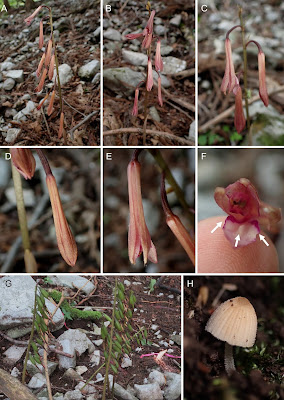
(A–C)  Dactylostalix ringens Reichenbach (1878) and 
(D–F) D. uniflora (Finet) Suetsugu,
  
in Suetsugu, Hirota, Yagame, Yukawa et Suyama, 2024. 
 
Abstract
The Calypsoinae orchid genus Dactylostalix, previously considered a monotypic genus endemic to Japan and the Russian Far East (the Kuril Islands and Sakhalin Island), is now redefined to encompass two species. This reclassification is based not only on the examination of type specimens and literature but also on molecular data. While Pergamena uniflora has long been regarded as a synonym of Dactylostalix ringens, it is distinguishable by its shorter scape, smaller flower, less spotted tepals, drooping sepals and lateral petals, labellum with smaller, narrowly triangular to ovate lateral lobes, more distinct keels on the adaxial surface of the lip, and a slender column with a smaller stigma and weakly developed clinandrium. We propose the new combination Dactylostalix uniflora, recognizing it as a distinct species within the genus Dactylostalix. Phylogenetic analysis utilizing genome-wide markers has also demonstrated that the two species are genetically distinct. Our findings, obtained through the integration of morphological data and molecular phylogenetics, indicate that D. uniflora represents a distinct evolutionary lineage from D. ringens. Examination of type specimens has led us to conclude that Calypso japonicaDactylostalix maculosa, and Dactylostalix ringens f. punctatus are junior synonyms of Dringens. Additionally, we designate the lectotypes for P. uniflora (= D. uniflora), C. japonica, and D. maculosa.

emended description, genetics, morphology, new combination, taxonomy, typification, Monocots

Morphological comparison of Dactylostalix ringens (A–C) and D. uniflora (D–F).
 (A) Flowering plant in Ena-shi, Gifu Pref. (B–C) Flower in Mt. Fuji, Fujinomiya-shi, Shizuoka Pref. (D) Flowering plant in the Akaishi Mountains, Yamanashi Pref. (E–F) Flower in Mt. Fuji, Fujinomiya-shi, Shizuoka Pref.
Scale bars: 30 mm (A, D) and 10 mm (B–C & E–F).

Dactylostalix Reichenbach (1878:74) 
Type:—Dactylostalix ringens Reichenbach (1878: 74).


Dactylostalix uniflora (Finet) Suetsugu, comb. nov. 


Kenji Suetsugu, Shun K. Hirota, Takahiro Yagame, Tomohisa Yukawa, Yoshihisa Suyama. 2024. Taxonomic Revision of the formerly monotypic Orchid Genus Dactylostalix.  Phytotaxa. 652(2); 83-99. DOI: doi.org/10.11646/phytotaxa.652.2.1
 

Friday, March 1, 2024

[Botany • 2024] Relictithismia kimotsukiensis (Thismiaceae) • A New Genus and Species from southern Japan with discussions on its phylogenetic relationship

 
Relictithismia Suetsugu & Tagane,
Relictithismia kimotsukiensis 
Suetsugu, Yas.Nakam. & Tagane, 

in Suetsugu, Nakamura, Nakano et Tagane, 2024. 

Abstract
The family Thismiaceae, known as “fairy lanterns” for their urn- or bell-shaped flowers with basally fused tepals, consists of non-photosynthetic flowering monocots mainly in tropical regions, extending into subtropical and temperate areas. Here, we propose a new mycoheterotrophic genus, Relictithismia Suetsugu & Tagane (Thismiaceae), with its monotypic species Relictithismia kimotsukiensis Suetsugu, Yas.Nakam. & Tagane from Kimotsuki Mountains in the Osumi Peninsula, Kagoshima Prefecture, Kyushu Island, southern Japan. Relictithismia resembles Haplothismia Airy Shaw in having a cluster of tuberous roots, a feature previously observed only in this genus within the family Thismiaceae. However, it differs in having solitary flowers (vs. 2–6-flowered pseudo-raceme in Haplothismia), anther thecae largely separated (vs. connate), and the presence of an annulus (vs. absent). Additionally, Relictithismia differs from the geographically overlapping genus Thismia Griff. in its stamen structure and the position of the annulus. In Relictithismia, the stamens lack connectives, and its free filaments arise from the annulus located inside the perianth mouth, while in Thismia, the stamens typically have connate connectives, forming a staminal tube pendulous from the annulus located at the mouth of the floral tube. Our morphological and phylogenetic data indicated that R. kimotsukiensis holds an early-diverging position within the family, situated outside the Old World Thismia clade. This paper offers an extensive description and color photographs of R. kimotsukiensis, complemented by notes on its phylogenetic relationship and evolutionary history.
 
Keywords: Angiosperms, Endemic, Flora, Dioscoreales, East Asia, Taxonomy

Relictithismia kimotsukiensis.
a Habit. b Close-up of root surface. c Longitudinal section of flower. d Anther. e Stigma surface. f Immature fruit.
Materials from Y. Nakamura & S. Tagane 23060901 (KAG). Drawn by S. Tagane

Relictithismia kimotsukiensis.
a Habit. b Flower, top view. c Flower, diagonal top view. d Flower, lateral view. e Tuberous roots. f Close-up of root. g Longitudinal section of floral tube showing stamens, style, and stigma. h Longitudinal section of floral tube with stamens. i Style and stigma. j Annulus and stamens. k Anthers. l Transverse section of ovary with three equal placentas and numerous ovules.
 Materials from Y. Nakamura & S. Tagane 23060901 (a–f, h–l for TNS, g for KAG). Scale bars: 10 mm (a), 5 mm (b–e and g–h), and 1 mm (f and i–l)

Relictithismia kimotsukiensis and its habitat at the type locality.
a & b A secondary evergreen broad-leaved forest where R. kimotsukiensis was found. c & e Flower, top view. d & f Flower, lateral view.
Scale bars: 10 mm. Photos (a & b) were taken by Yasunori Nakamura on 3 June 2022, and photos (c–f) were taken by Shuichiro Tagane on 9 June 2023. Photos (e & f) were captured after collection

Relictithismia Suetsugu & Tagane, gen. nov.

Diagnosis Relictithismia resembles Haplothismia in possessing a cluster of tuberous roots, yet it is clearly distinguished by its solitary flowers (vs. 2–6-flowered pseudo-raceme in Haplothismia), largely separate anther thecae (vs. connate), and the presence of an annulus (vs. absence).

Etymology: The name of the new genus, Relictithismia, is a combination of the Latin word “relictus”, meaning “left behind”, and the generic name Thismia. The name reflects its morphological characteristics that serve as a bridge between the early-diverging genera in Thismiaceae and the genus Thismia, showcasing the putative ancestral condition of these plant groups.


Relictithismia kimotsukiensis Suetsugu, Yas.Nakam. & Tagane, sp. nov.

Etymology: The species epithet refers to the type locality of the new species.

Vernacular name: Mujina-no-shokudai (in Japanese). The vernacular name is inspired by its apparent resemblance to and the distinct diffrences from species of Thismia, locally referred to as “tanuki-no-shokudai,” meaning a candlestick used by a raccoon dog. The term “mujina” is an old Japanese name for a badger, known as “anaguma” in Japanese, although historically and regionally, it has sometimes also been associated with raccoon dogs. Therefore, we consider that this name aptly represents the similarity and differences between Thismia and Relictithismia. Moreover, the name “mujina-no-shokudai” (= a candlestick used by a badger) fits its ecology, as the majority of the plant, even during the flowering stage, remains buried underground beneath fallen leaves, reminiscent of a badger burrowing underground.

Distribution Japan, Kagoshima Pref., Kimotsuki-gun, Kimotsuki-cho (currently known only from the type locality).


Kenji Suetsugu, Yasunori Nakamura, Takafumi Nakano and Shuichiro Tagane. 2024. Relictithismia kimotsukiensis, A New Genus and Species of Thismiaceae from southern Japan with discussions on its phylogenetic relationship.  Journal of Plant Research. DOI: 10.1007/s10265-024-01532-5

Friday, June 9, 2023

[Botany • 2023] Spiranthes minamitaniana (Orchidaceae) • A New Orchid Species from Japan based on Morphological and Phylogenetic Data


Spiranthes minamitaniana Suetsugu,

in Suetsugu, Hirota et Suyama, 2023. 
オスズネジバナ  ||  DOI: 10.11646/phytotaxa.599.3.1 
 
Abstract
The delimitation of species within the genus Spiranthes (Orchidaceae) is problematic due to the intricate interplay of phenotypic plasticity, ecological variation, and hybridization, making identification that relies solely on morphology inadequate. In light of morphological and phylogenetic data, we have described a self-pollinating species, Spiranthes minamitaniana within the Spiranthes sinensis species complex. Spiranthes minamitaniana shares several morphological features with S. hachijoensis, such as glabrous inflorescence rachis, ovaries, and sepals, a degenerated rostellum, pollinia without a viscidium, and papillate lip basal callosities. However, it can be distinguished by several morphological traits, including semicircular, weakly- or non-3-lobed stigma, and more conspicuous anther cap. Although S. minamitaniana is morphologically most similar to S. hachijoensis, phylogenetic analysis strongly suggested that S. minamitaniana has independently acquired a selfing reproductive mode and constitutes a separate genetic cluster from it. As such, this taxon is morphologically and phylogenetically distinct from other closely related species. Consequently, this taxon is morphologically and phylogenetically distinct from other closely related species.

Key words: Orchidaceae, integrative taxonomy, reproductive isolation, SNP data, species delimitation, Spiranthes sinensis species complex


 Spiranthes minamitaniana in its type locality.
(A) Habit. (B) Inflorescence with whitish cleistogamous flower. (C–D) Flower.
Scale bars: 30 mm (A) and 5 mm (B–D).

Spiranthes minamitaniana with reddish pink normal flower (Tadashi Minamitani Ss146, KYO).
(A) Inflorescence. (B) Flower, lateral view. (C) Flower, dorsal view. (D) Dorsal sepal. (E) Petal. (F) Lateral sepal. (G) Labellum. (H) Close-up of basal callosities of labellum. (I) Ovary and column. (J) Column, ventral view. (K) Column, dorsal view. (L) Pollinarium.
Scale bars: 20 mm (A), 3 mm (B–G), 0.5 mm (H) and 1 mm (I–M).

Spiranthes minamitaniana Suetsugu, sp. nov.

Japanese name. 「オスズネジバナ」 Osuzu-neji-bana 

Diagnosis. Spiranthes minamitaniana is morphologically most similar to S. hachijoensis but differs from S. hachijoensis by semicircular, weakly- or non-3-lobed stigma, and more conspicuous anther cap.

Comparison between Spiranthes hachijoensis (Nahoko Fukudome Ss203, KYO: left) and Spiranthes minamitaniana  (Tadashi Minamitani Ss204, KYO: right).
(A) Habit. (B) Inflorescence. (C) Flower. (D) Column, dorsal view. (E) Column, lateral view. (F) Column, ventral view.
Scale bars: 50 mm (A), 10 mm (B), 3 mm (C) and 1 mm (D–F). 
Photographed by Kenji Suetsugu


Kenji Suetsugu, Shun K. Hirota and Yoshihisa Suyama. 2023. Spiranthes minamitaniana (Orchidaceae), A New Orchid Species from Japan based on Morphological and Phylogenetic Data.  Phytotaxa. 599(3); 139-149. DOI: 10.11646/phytotaxa.599.3.1


Monday, March 20, 2023

[Botany • 2023] Spiranthes hachijoensis (Orchidaceae: Orchidoideae) • A New Species within the S. sinensis Species Complex in Japan, based on Morphological, Phylogenetic, and Ecological Evidence


Spiranthes hachijoensis Suetsugu, 

in Suetsugu, Hirota, Hayakawa, Fujimori, Ishibashi, Hsu & Suyama, 2023. 

Abstract
The systematics of the Old World Spiranthes sinensis (Pers.) Ames species complex (Orchidaceae) has been complicated by its wide distribution and morphological variations. Within the species complex, S. australis Lindl. has been generally accepted as the only Spiranthes Rich. species distributed on the Japanese mainland. The present study provides morphological, phylogenetic, and ecological evidence for the recognition of S. hachijoensis Suetsugu as a new species of the S. sinensis species complex on the Japanese mainland. Spiranthes hachijoensis is morphologically similar to S. hongkongensis S.Y. Hu & Barretto and S. nivea T.P. Lin & W.M. Lin, sharing a degenerated rostellum, pollinia without a viscidium, and distinctly trilobed stigma. However, the taxon can be morphologically distinguished from S. hongkongensis by its glabrous rachis, ovaries, and sepals, and from S. nivea by its papillate labellum disc, larger papillate basal labellum callosities, and glabrous rachis, ovaries, and sepals. The autogamy and flowering phenology (i.e., earlier flowering) of S. hachijoensis are most likely responsible for premating isolation from the sympatric S. australis. A MIG-seq-based high-throughput molecular analysis indicated that the genetic difference between S. hachijoensis and its putative sister species S. sinensis is comparable to, or even greater than, the genetic difference between pairs of other species within the S. sinensis species complex. Our multifaceted approach strongly supports the recognition of S. hachijoensis as a morphologically, phenologically, phylogenetically, and ecologically distinct species.
 
Keywords: Integrative taxonomy, Orchidaceae, Reproductive isolation, SNP data, Speciation, Species delimitation, Spiranthes sinensis species complex


Spiranthes hachijoensis in its natural habitat in Japan.
a–d Flowering individual observed on Hachijo Island.
e, f Flowering individual observed in Ichihara-shi, Chiba Pref. g Flowering individual observed in Kimitsu-shi, Chiba Pref. h Flowering individual observed in Nagoya-shi, Aichi Pref. i Flowering individual observed in Kagoshima-shi, Kagoshima Pref.
 Scale bars: 30 mm


Spiranthes hachijoensis Suetsugu, sp. nov.
 
Diagnosis: Spiranthes hachijoensis is most morphologically similar to S. hongkongensis but can be distinguished by its glabrous rachis, ovaries, and sepals.

Japanese name: Hachijo-neji-bana. ネジバナ


Kenji Suetsugu, Shun K. Hirota, Hiroshi Hayakawa, Shohei Fujimori, Masayuki Ishibashi, Tian-Chuan Hsu and Yoshihisa Suyama. 2023. Spiranthes hachijoensis (Orchidaceae), A New Species within the S. sinensis Species Complex in Japan, based on Morphological, Phylogenetic, and Ecological Evidence. Journal of Plant Research. DOI: 10.1007/s10265-023-01448-6

Thursday, March 2, 2023

[Botany • 2023] Rediscovery of the presumably Extinct Fairy Lantern Thismia kobensis (Thismiaceae)in Hyogo Prefecture, Japan, with Discussions on its Taxonomy, Evolutionary History, and Conservation


Thismia kobensis  Suetsugu 
 
in Suetsugu, Yamana & Okada, 2023. 
 
Abstract
Thismia (commonly known as fairy lanterns) is a genus of strange-looking, elusive, and non-photosynthetic plants. Thismia kobensis was first discovered in Kobe City, Hyogo Prefecture, Japan in 1992, but it was believed to be extinct, given that its type locality was destroyed during the construction of an industrial complex. Here, we have reported the rediscovery of T. kobensis in Sanda City, Hyogo Prefecture, which is located approximately 30 km from the type locality. The new locality of T. kobensis is the northernmost distributional limit of Asian Thismiaceae species. As the original description of the species was based on a single museum specimen that lacked two of the three inner perianth lobes, we have provided an amended description of T. kobensis, highlighting its differences from the morphologically similar species T. huangii. Specifically, our morphological re-examination has revealed that T. kobensis is distinguishable from T. huangii by its short but expanded annulus and many short hairs on each stigma lobe. We have also demonstrated that the genetic distance between these taxa is comparable to that between other closely related species pairs. Finally, we have provided brief notes on the taxonomy, biogeography, evolutionary history, and conservation of T. kobensis and its closely related species, including an enigmatic species T. americana.

Keywords: conservation, emended description, extinct species, fairy lanterns, mycoheterotrophy, phylogenetic relationship, rediscovery, taxonomic revision


Thismia kobensis at the new locality. (A–C) Flower, lateral view. (D–F) Flower, upper view. (G) Flower without perianth lobes. (H) Flower with broken perianth tube and exposed stigma.
 Scale bars: 5 mm. 
Photographed by Kenji Suetsugu.


Thismia kobensis (from the holotype).
A–B. Flowering plant. C. Flower, upper view. D. Flattened perianth tube. E. Stamens, inner view. F. Stamens, outer view. G. Style and stigma. Two broken inner perianth lobes are indicated by the dotted lines in A, B and D.
Drawn by Kumi Hamasaki. Bar = 1 mm.


Thismia kobensis Suetsugu emend. Suetsugu  


Kenji Suetsugu, Kohei Yamana and Hidehito Okada. 2023. Rediscovery of the presumably Extinct Fairy Lantern Thismia kobensis (Thismiaceae) in Hyogo Prefecture, Japan, with Discussions on its Taxonomy, Evolutionary History, and Conservation. Phytotaxa. 585(2); 102–112. DOI: 10.11646/phytotaxa.585.2.2
Kenji Suetsugu, Osamu Nakanishi, Tomiki Kobayashi and Nobuhira Kurosaki. 2018. Thismia kobensis (Burmanniaceae), A New and Presumably Extinct Species from Hyogo Prefecture, Japan.  Phytotaxa.  369(2); 121–125.
 DOI: 10.11646/phytotaxa.369.2.6


Wednesday, December 14, 2022

[Botany • 2022] Monotropastrum kirishimense (Ericaceae) • A New Mycoheterotrophic Plant from Japan based on Multifaceted Evidence


Monotropastrum kirishimense Suetsugu,

in Suetsugu, Hirota, Hsu, ... et Suyama, 2022. 
「キリシマギンリョウソウ」 DOI: 10.1007/s10265-022-01422-8

Abstract
Due to their reduced morphology, non-photosynthetic plants have been one of the most challenging groups to delimit to species level. The mycoheterotrophic genus Monotropastrum, with the monotypic species M. humile, has been a particularly taxonomically challenging group, owing to its highly reduced vegetative and root morphology. Using integrative species delimitation, we have focused on Japanese Monotropastrum, with a special focus on an unknown taxon with rosy pink petals and sepals. We investigated its flowering phenology, morphology, molecular identity, and associated fungi. Detailed morphological investigation has indicated that it can be distinguished from M. humile by its rosy pink tepals and sepals that are generally more numerous, elliptic, and constantly appressed to the petals throughout its flowering period, and by its obscure root balls that are unified with the surrounding soil, with root tips that hardly protrude. Based on genome-wide single-nucleotide polymorphisms, molecular data has provided clear genetic differentiation between this unknown taxon and M. humile. Monotropastrum humile and this taxon are associated with different Russula lineages, even when they are sympatric. Based on this multifaceted evidence, we describe this unknown taxon as the new species Monotropastrum kirishimense. Assortative mating resulting from phenological differences has likely contributed to the persistent sympatry between these two species, with distinct mycorrhizal specificity.

Keywords: Fungal association, Integrative taxonomy, Mycoheterotrophy, Mycorrhizas, Reproductive isolation, SNP data, Speciation, Species delimitation

Monotropastrum kirishimense and its monotropoid association (holotype).
 a Flowering scape with root ball. b, c Flowering plants. d Flowers, top view. e, f Magnification of the root ball. Root tips are not apparent, but white fungal hyphae are visible. Arrowheads indicate the root tip apices.
 Scale bars: 3 cm (a–‍c), 1 cm (d, e), and 5 mm (f). 
Photographed by Kenji Suetsugu

Monotropastrum humile and its monotropoid association found at the M. kirishimense type locality (on June 25, 2019, except for the flowering plants).
a Flowering plants (on May 17, 2019). Arrowheads indicate spreading sepals. b Fruiting plant. c Fruiting scapes with root ball. d, e Magnification of the root ball. Root tips and branching are easily recognizable. Arrowheads indicate root tip apices.
Scale bars: 3 cm (a–c), 1 cm (d), and 5 mm (e). 
Photographed by Hideo Shimada (a) and Kenji Suetsugu (b–e)


Morphological comparison of the aboveground parts of Monotropastrum kirishimense and M. humile.
 Monotropastrum kirishimense in a Fujieda-shi, Shizuoka Pref., b Ena-shi, Gifu Pref., and c Kirishima-shi, Kagoshima Pref. Monotropastrum humile in d Waga-gun, Iwate Pref. and e Tarumizu-shi, Kagoshima Pref., and f M. humile f. roseum in Sakyo-ku, Kyoto Pref. Arrowheads indicate spreading sepals.
 Scale bars: 3 cm. 
Photographed by Masayuki Sato (a), Katsumi Iwahori (b), Shuichi Kurogi (c), Shin Terui (d), Kazushige Uemori (e), and Kenji Suetsugu (f)

Monotropastrum kirishimense Suetsugu, sp. nov.

Diagnosis. Monotropastrum kirishimense is similar to M. humile but differs in its rosy pink tepals, more numerous (4–11) elliptic sepals constantly appressed to the petals throughout its flowering period, and obscure root balls unified with the surrounding soil, with little protrusion of the root tips.

Etymology. The species is named after the type locality, Kirishima. To distinguish it from Monotropastrum humile f. roseum (beni-bana-gin-ryo-so, in Japanese) described by Honda (1957), we use Kirishima-gin-ryo-so as a Japanese name, after the type locality.
Japanese name. Kirishima-gin-ryo-so
「キリシマギンリョウソウ」


 Kenji Suetsugu, Shun K. Hirota, Tian-Chuan Hsu, Shuichi Kurogi, Akio Imamura and Yoshihisa Suyama. 2022. Monotropastrum kirishimense (Ericaceae), A New Mycoheterotrophic Plant from Japan based on Multifaceted Evidence. Journal of Plant Research. DOI: 10.1007/s10265-022-01422-8

Monday, December 13, 2021

[Botany • 2021] Cremastra saprophytica (Orchidaceae: Epidendroideae: Calypsoinae) • A New Leafless Autonomously Self-pollinating Orchid Species from Gifu Prefecture, Japan


Cremastra saprophytica Suetsugu,

in Suetsugu, 2021.

Abstract
A new species of Cremastra (Orchidaceae), C. saprophytica, is described from Gifu Prefecture, Japan. The new species is similar to C. aphylla in having a leafless and mycoheterotrophic habit. However, it is distinguishable from C. aphylla by its green stem, more closed perianth tube, smaller lateral lobes of lip, smaller callus of lip positioned at base of the midlobe and absence of a rostellum and viscidium. An illustration and ecological information on the new species are provided. A key to the Cremastra species is also provided.

Keywords: Calypsoinae, Japanese flora, mycorrhiza, mycoheterotrophy, new species, self-pollination, taxonomy


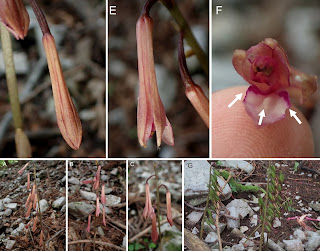
Cremastra saprophytica from the type locality.
A–C. Flowering plant.
D. Flower, dorsal view. E. Flower, lateral view. F. Flower, front view. Central arrow points to a small smooth callus of lip positioned at the base of midlobe, whereas the other arrows point to the inconspicuous lateral lobes.
G. Fruiting plants. H. Fruiting body of Coprinellus disseminates, one of the associated fungi of C. saprophytica.

Cremastra saprophytica Suetsugu, sp. nov.

 Type:—JAPAN. Gifu Pref.: Ibi County, Ibigawa Town, Kasugakawai, 5 Jun 2021, Suetsugu Sa52 (holotype: KYO!, spirit collection). 

Cremastra saprophytica is similar to C. aphylla but differs by its more closed perianth tube, smaller lateral lip lobes, smaller callus positioned at base of the midlobe and lack of rostellum and viscidium. 

Distribution and phenology:—Cremastra saprophytica is only known from the type locality. Flowering occurred from late May to early June, and fruiting from late June to early October. 


Kenji Suetsugu. 2021. Cremastra saprophytica (Orchidaceae: Epidendroideae), A New Leafless Autonomously Self-pollinating Orchid Species from Gifu Prefecture, Japan. Phytotaxa. 527(2); 89-96. DOI: 10.11646/phytotaxa.527.2.1