Showing posts with label Journal: Molecular Phylogenetics and Evolution. Show all posts

Monday, November 17, 2025

[Ornithology • 2026] Pulsatrix perspicillata & Pulsatrix pulsatrix • Museomics resolves 200 years of Taxonomic Uncertainty: Strix pulsatrix Wied, 1820 (Strigiformes: Strigidae) is A Valid Species


in Bolívar-Leguizamón, Corrêa, Bencke et Silveira. 2026.
Artwork by Eduardo Brettas
 instagram.com/EduardoBrettas
 
Highlights
Pulsatrix perspicillata is an owl found from Mexico to Argentina and Brazil.
• The taxonomic position of the P. p. pulsatrix subspecies is a matter of controversy.
• Historical DNA shows great divergence between the pulsatrix and perspicillata taxa.
• The pulsatrix-perspicillata clade is sister to a melanota-koeniswaldiana clade.
• Pleistocene climatic oscillations influenced the diversification of the genus.
• We proposed elevating the subspecies pulsatrix of P. perspicillata to species status.

Abstract
The identification of valid species is central to biology, and genetic data have been essential in uncovering new taxonomic units across groups. For polytypic taxa, genetics helps distinguish valid units from natural variation. Pulsatrix perspicillata (Spectacled Owl) is a widespread polytypic species with six recognized subspecies. We used genetic data and museomics techniques to: (i) test the validity of Strix pulsatrix Wied, 1820 (=Pulsatrix perspicillata pulsatrix) as a species distinct from Pulsatrix perspicillata; and (ii) estimate the phylogenetic relationships and divergence times within the genus Pulsatrix Kaup, 1848. We conducted population structure and phylogenetic analyses using SNPs matrices and alignments of Ultraconserved Elements (UCEs) from 16 individuals of Pulsatrix spp., including four historical samples of P. p. pulsatrix. Additionally, we sequenced the mtDNA-ND2 gene from 38 samples representing all known Pulsatrix species to further elucidate phylogenetic relationships and estimate divergence times. Our results indicate that Pulsatrix perspicillata pulsatrix represents an independent lineage from P. perspicillata, as supported by its reciprocal monophyly and distinct population structure. UCE analyses also grouped P. koeniswaldiana (Tawny-browed Owl) and P. melanota (Band-bellied Owl) into a distinct cluster. Phylogenetic analyses based on both UCEs and mtDNA-ND2 sequences support the monophyly of the genus Pulsatrix. Pulsatrix koeniswaldiana and P. melanota form a monophyletic group that is sister to P. perspicillata. Pulsatrix diverged in the Late Miocene and diversified in the Pliocene-Quaternary. The evolutionary history of Pulsatrix appears to have been influenced by (a) the final phase of the Andean uplift and (b) climatic oscillations during the Pleistocene. Pulsatrix p. pulsatrix shows genetic divergence consistent with a species-level split from P. perspicillata, and we henceforth recognize it as Pulsatrix pulsatrix (Wied 1820). We recommend future studies to assess its current distribution and inform the development of conservation strategies.
 
Keywords: Museomics, UCEsmt-ND2, Pulsatrix, Spectacled Owl, Neotropics, Systematics, Phylogeography 


Pulsatrix perspicillata 


Sergio D. Bolívar-Leguizamón, Aline Henrique Corrêa, Glayson Ariel Bencke and Luís F. Silveira. 2026. Museomics resolves 200 years of Taxonomic Uncertainty: Strix pulsatrix Wied, 1820 (Strigiformes, Strigidae) is A Valid Species. Molecular Phylogenetics and Evolution. 108488. DOI: doi.org/10.1016/j.ympev.2025.108488 [27 October 2025]

Tuesday, August 26, 2025

[Paleontology • 2025] Huashanosaurus qini • A New Eusauropod Dinosaur from the Lower and Middle Jurassic Wangmen Formation of Ningming County, Guangxi, South China


Huashanosaurus qini 
Mo, Zhou, Fu, Xiong, Hu & Xu, 2025
  

Abstract
We report a new eusauropod dinosaur, Huashanosaurus qini gen. et sp. nov., based on a partial skeleton recovered from a bed in the Lower to Middle Jurassic Wangmen Formation (Fm.) from Huqiu Quarry near Mingjiang River, Ningming County, Guangxi Zhuang Autonomous Region, southern China. The new taxon can be diagnosed by the following autapomorphies: posterior process of the ulna hook-shaped; the cross-section of the proximal part of the ulna crescent-shaped; groove structure present at the posterodistal surface of the fibula. Phylogenetic analysis reveals that H. qini is later-diverging than the Middle Jurassic Shunosaurus. Previous work showed that the Wangmen Fm. is early Early Jurassic in age whereas the new eusauropod discovery indicates that the Wangmen Fm. is probably somewhat younger Early–Middle Jurassic in age. The find increases the diversity of Jurassic eusauropods in China.

Key words: vertebrate paleontology, eusauropoda, Wangmen Formation, Early–Middle Jurassic, Guangxi


Huashanosaurus qini gen. et sp. nov.


MO Jinyou, ZHOU Xiuzhen, FU Qiongyao, XIONG Duo, HU Minhang and XU Xing. 2025. A New Eusauropod Dinosaur from the Lower and Middle Jurassic Wangmen Formation of Ningming County, Guangxi, South China. [J]. ACTA GEOLOGICA SINICA (English edition)99(4): 909-924. DOI: 10.1111/1755-6724.15331 

Sunday, August 17, 2025

[Ichthyology • 2025] Phylogenomics of African Labeo (Cypriniformes: Cyprinidae) emphasizing central African species


Live photographs of representative specimens of African Labeo species from the Congo and Lower Guinea ichthyofaunal provinces.
 a) Labeo nasus, b) Labeo falcipinnis, c) Labeo greenii, d) Labeo parvus,
e) Labeo weeksii, f) Labeo mbimbii, g) Labeo sp. 18, f) Labeo lukulae

Photos d, e, and g were taken in a photarium (photo tank) and the remaining photos were taken in plain air.
in Liyandja, Smith, Alter, Sidlauskas et Stiassny, 2025. 

Highlights: 
• A large-scale phylogenomic analysis of the genus Labeo using 2,697 UCEs is presented.
• The monophyly of African Labeo is supported, three main clades, & nine species groups are recovered.
• Interspecific relationships are well resolved & numerous previously unrecognized taxa identified.
• A time-calibrated tree & historical biogeography of the African Labeo are presented.
• Morphological synapomorphies are presented & discussed.

Abstract
Labeo constitutes the largest genus within the cyprinid tribe Labeonini with over 110 recognized species in Africa and Asia. The clade comprises a major component of the herbivore/detritivore guild with considerable socio-economic importance to artisanal and commercial fisheries. A pan-African distribution and wide variety of habitat occupancy make the group a model to investigate diversification patterns, eco-phenotypic variation, and biogeographical events underpinning their radiation at a continental scale. However, previous attempts to elucidate Labeo systematics using either molecular or morphological data have failed to produce congruent and robust results, and much taxonomic and nomenclatural confusion remains. Here we present the first phylogenomic analysis of the genus using 2,187 ultraconserved elements from 85 taxa, including 56 recognized species, 27 cryptic (candidate) species, and outgroups from the Asian Labeonini. Both concatenated and coalescence-based phylogenetic analyses strongly support monophyly of African Labeo and recover three major clades comprising at least nine species groups. Two main clades are pan-African, while the third is restricted to four ichthyofaunal provinces. With the single exception of the L. umbratus group, none of the previously proposed morphological groupings are resolved as monophyletic, suggesting rampant morphological convergence across the radiation. In this study, interspecific relationships are well resolved and time calibration results corroborate the key role of the Miocene in the radiation of African freshwater fishes. We identify numerous previously unrecognized taxa, and our study provides a much-needed framework for the taxonomic revision of Labeo, a task critical for the development of sound management of these important food fishes.
 
Keywords: African carps, Interspecific relationships, Ultraconserved elements (UCEs), Diversity, Classification (systematics)


Live photographs of representative specimens of African Labeo species from the Congo and Lower Guinea ichthyofaunal provinces.
 a) Labeo nasus, b) Labeo falcipinnis, c) Labeo greenii, d) Labeo parvus,
e) Labeo weeksii, f) Labeo mbimbii, g) Labeo sp. 18, f) Labeo lukulae.
Photos d, e, and g were taken in a photarium (photo tank) and the remaining photos were taken in plain air.


Tobit L.D. Liyandja, Brian T. Smith, S. Elizabeth Alter, Brian L. Sidlauskas and Melanie L.J. Stiassny. 2025. Phylogenomics of African Labeo (Cypriniformes: Cyprinidae) emphasizing central African species. Molecular Phylogenetics and Evolution. 108427. In Press. DOI: doi.org/10.1016/j.ympev.2025.108427 [5 August 2025]
 

Thursday, March 13, 2025

[Arachnida • 2025] Disconnecting Trapdoors: Phylogenomic Analyses reveal Evolutionary Contrasts in Trapdoor Spiders (Mygalomorphae: Idiopidae: Idiopinae) with Intercontinental Distribution


Neotropical Idiops form a monophyletic clade, while African Idiops and Titanidiops form a separate clade from the remaining African Idiopinae.

in Fonseca-Ferreira, Derkarabetian, Morales, Opatova, Belintani, Lyle et Guadanucci, 2025. 
 
Highlights: 
• This is the most comprehensive phylogenomic analysis of Idiopidae using UCEs.
• The subfamily Idiopinae is monophyletic and divided into Neotropical and Afrotropical groups.
• Neotropical Idiops form a monophyletic clade, while African Idiops and Titanidiops form a separate clade from the remaining African Idiopinae.
• The non-monophyly of Idiops is reinforced by congruent morphological evidence.
• Our results challenge Idiopidae’s monophyly, showing Neocteniza (Genysinae) as a sister lineage to Cteniza (Ctenizidae) and other Idiopidae subfamilies.

Abstract
Among Mygalomorphae spiders, the family Idiopidae is the second most diverse, consisting exclusively of trapdoor spiders and is divided into three subfamilies: Arbanitinae, Genysinae, and Idiopinae. The subfamily Idiopinae, distinguished mainly by anterior lateral eyes that project forward, includes 153 species across seven genera, distributed throughout South America, Africa, and parts of Asia. Within this subfamily, the genus Idiops includes the greatest diversity and is the only genus recorded in both the New and Old Worlds. Utilizing a taxon set from the Neotropical and Afrotropical regions, with specimens collected from 1947 to 2021, our study provides the first phylogenomic analysis of the family based on Ultraconserved Elements (UCEs). To assess the monophyly of Idiopinae and Idiops, as well as the relationships among genera within the subfamily, we conducted phylogenetic analyses employing maximum likelihood, Bayesian inference, and coalescent-based methods. The phylogenetic trees reveal that Idiopinae forms a monophyletic lineage, split into two geographically distinct groups: one with African species and the other with Neotropical species. We did not recover monophyly of the genus Idiops; Neotropical Idiops form a monophyletic lineage, while African Idiops species group with Titanidiops, forming a sister lineage to the remaining African Idiopinae. The relationship between the phylogenetic results obtained and the main morphological differences observed among the genera is discussed. Finally, our study challenges the monophyly of Idiopidae by including Neocteniza, which is found to be an independent lineage sister to Ctenizidae and the rest of Idiopidae.
 
Keywords: Mygalomorphae, Idiops, Ultraconserved Elements, Neotropical species, Afrotropical species, Neocteniza


R. Fonseca-Ferreira, S. Derkarabetian, M.J.A. Morales, V. Opatova, T. Belintani, R. Lyle and J.P.L. Guadanucci. 2025. Disconnecting Trapdoors: Phylogenomic Analyses reveal Evolutionary Contrasts in Trapdoor Spiders with Intercontinental Distribution (Idiopidae, Idiopinae). Molecular Phylogenetics and Evolution. 108323, In Press. DOI: doi.org/10.1016/j.ympev.2025.108323

Tuesday, February 18, 2025

[Herpetology • 2016] Reconciling Molecular Phylogeny, Morphological Divergence and Classification of Madagascan Narrow-mouthed Frogs (Amphibia: Microhylidae)


(A) Stumpffia tetradactyla (Nosy Boraha); (B) Anilany helenae (Ambohitantely); 
(C) Stumpffia’ sp. Ca34 (Tsaratanana); (D) Stumpffia’ sp. Ca15 (Manombo).

in Scherz, Vences, Rakotoarison, Andreone, Köhler, Glaw & Crottini, 2016.

Highlights: 
• A new phylogeny of Cophylinae provides strong support for previous genus-level relationships.
• Phylogenetic relationships are corroborated by new osteological data.
• Description of a new genus endemic to Madagascar: Anilany gen. nov.
• Cophyla and Platypelis are morphologically similar sister genera.
• Stumpffia and Rhombophryne are ecomorphologically distinct sister genera.

Abstract
A recent study clarified several aspects of microhylid phylogeny by combining DNA sequences from Sanger sequencing and anchored phylogenomics, although numerous aspects of tree topology proved highly susceptible to data partition and chosen model. Although the phylogenetic results of the study were in conflict with previous studies, the authors made several changes to the taxonomy of Madagascar’s cophyline microhylids. We re-analysed part of their data together with our own molecular and morphological data. Based on a supermatrix of 11 loci, we propose a new phylogeny of the Cophylinae, and discuss it in the context of a newly generated osteological dataset. We found several sample misidentifications, partially explaining their deviant results, and propose to resurrect the genera Platypelis and Stumpffia from the synonymy of Cophyla and Rhombophryne, respectively. We provide support for the previous genus-level taxonomy of this subfamily, and erect a new genusAnilany gen. nov., in order to eliminate paraphyly of Stumpffia and to account for the osteological differences observed among these groups. Deep nodes in our phylogeny remain poorly supported, and future works will certainly refine our classification, but we are confident that these will not produce large-scale rearrangements.

Keywords: Cophylinae; Anilany gen. nov; CophylaPlatypelisRhombophryneStumpffia

 Representatives of Stumpffia and Stumpffia-like clades.
(A) S. tetradactyla (Nosy Boraha; holotype, ZFMK 52547); (B) Anilany helenae (Ambohitantely; ZSM 370/2005); 
(C) Stumpffia’ sp. Ca34 (Tsaratanana; ZSM 636/2014); (D) Stumpffia’ sp. Ca15 (Manombo; ZMA 20172).


 Mark David Scherz, Miguel Vences, Andolalao Rakotoarison, Franco Andreone, Jörn Köhler, Frank Glaw and Angelica Crottini. 2016. Reconciling Molecular Phylogeny, Morphological Divergence and Classification of Madagascan Narrow-mouthed Frogs (Amphibia: Microhylidae).  Molecular Phylogenetics and Evolution. In Press.  DOI:  10.1016/j.ympev.2016.04.019 
 Researchgate.net/publication/301285050_Classification_of_Madagascan_Microhylidae

Friday, January 31, 2025

[Mollusca • 2022] Songkhlanaia gen. nov.; Songkhlanaia tamodienica, Sundadontina plugpomenica, Trapezoideus thachiadensis, ... • Diversity and Phylogenetics of Freshwater Mussels (Unionidae) from Southern Thailand with the Description of One New Genus and Five New Species-Group Taxa


 Songkhlanaia gen. nov.; Stamodienica gen. et sp. nov.; 
Sundadontina plugpomenica sp. nov.;
 Monodontina vondembuschiana tapienica ssp. nov.; Mv. thasaenica ssp. nov.
; and 
Trapezoideus thachiadensis sp. nov.
 

in Konopleva, Lheknim, Sriwoon, Kondakov, Tomilova, Gofarov, Vikhrev et Bolotov, 2022. 

Abstract 
Southern Thailand represents a region of unique freshwater biodiversity with many endemic taxa, including a number of freshwater mussel species (Bivalvia: Unionidae). In this study, we recognize 13 taxa in the tribes Contradentini, Rectidentini, Pseudodontini (subfamily Gonideinae), and Indochinellini (subfamily Parreysiinae) that inhabit different localities in the Songkhla Lake, Tapi River, and Tha Taphao River basins. Based on the results of morphological and phylogenetic analyses, we discovered among these mussels six taxa new to science, including one genus, three species, and two subspecies. New taxonomic names are introduced here as follows: Songkhlanaia gen. nov.; S. tamodienica gen. & sp. nov.; Sundadontina plugpomenica sp. nov.; Monodontina vondembuschiana tapienica ssp. nov.; Mvondembuschiana thasaenica ssp. nov. (Pseudodontini); and Trapezoideus thachiadensis sp. nov. (Contradentini). These new taxa confirm the high conservation priority of the Southern Thai freshwater mussel fauna.

Keywords: freshwater mussel fauna; new taxa; phylogenetics; Southern Thailand; Unionidae


 Songkhlanaia gen. nov.; S. tamodienica gen. & sp. nov.; 
Sundadontina plugpomenica sp. nov.; 
Monodontina vondembuschiana tapienica ssp. nov.; Mvondembuschiana thasaenica ssp. nov.; 
 Trapezoideus thachiadensis sp. nov.  


Ekaterina S. Konopleva, Vachira Lheknim, Rujinard Sriwoon, Alexander V. Kondakov, Alena A. Tomilova, Mikhail Y. Gofarov, Ilya V. Vikhrev and Ivan N. Bolotov. 2022. Diversity and Phylogenetics of Freshwater Mussels (Unionidae) from Southern Thailand with the Description of One New Genus and Five New Species-Group Taxa. Diversity. 2023, 15(1), 10. DOI: 10.3390/d15010010   

Friday, October 25, 2024

[Herpetology • 2024] A multi-gene Phylogeny of the Asian Kukri Snakes (Oligodon Fitzinger, 1826): Sharpening the Blade of the second largest Serpent Radiation (Squamata: Colubridae)


  Phylogeny of the Asian kukri snakes Oligodon Fitzinger, 1826 
 
in Lee, Yushchenko, Suwannapoom, Pawangkhanant, Grismer, Nguyen, Deepak, Narayanan, Das, Neang, Lalremsanga, Yang, Jablonski, Erkaya, Vogel, Bauer et Poyarkov, 2024.

Highlights
• We present the most comprehensive phylogeny of Oligodon assembled to date.
• Molecular phylogeny comprises nearly two-thirds of all currently recognized Oligodon species, with data from three mitochondrial and three nuclear genes.
• We propose an updated intrageneric classification of Oligodon, recognizing eight phylogenetically defined species groups.
• Oligodon likely originated in mainland Southeast Asia during the late Oligocene, with most species-level diversification starting in the Miocene.

Abstract
With 90 recognized species, kukri snakes in the genus Oligodon Fitzinger constitute the second largest snake radiation in the world. Oligodon species are collectively distributed across the Asian continent and possess several ecological and morphological attributes that are unique amongst other snakes. Despite their high levels of species richness, evolutionary relationships within Oligodon are poorly understood due to a limited number of samples and genetic markers available in earlier phylogenies. In this study, we assembled the largest molecular dataset of Oligodon to date, which we use to assess the systematics and biogeography of the entire genus. Based on a combination of maximum likelihood and Bayesian phylogenies using fragments of three mitochondrial genes (12 s, 16 s, CytB) and three nuclear genes (Rag1, C-mos, BDNF), we identify eight deeply divergent clades within Oligodon, of which only two correspond with species groupings that were recognized by previous morphological classifications. Four species delimitation methods employed on the mitochondrial portion of the dataset resulted in dramatically divergent estimations of molecular operational taxonomic units (mOTUs). When combined, all four methods support the existence of unrecognized species-level lineages, but also indicate that several other Oligodon species are poorly differentiated genetically and require additional integrative taxonomic research to properly resolve. Based on divergence dating, we demonstrate that Oligodon began to diversify during the early Neogene and hypothesize that the most recent common ancestor of the genus originated in mainland Southeast Asia. We conclude by recognizing eight phylogenetically defined species groups and identify sampling gaps that require further investigation once new data becomes available. This study contributes to a greater understanding of snake evolution on the Asian continent and acts as a baseline for future studies of this speciose genus.


Justin L. Lee, Platon V. Yushchenko, Chatmongkon Suwannapoom, Parinya Pawangkhanant, L. Lee Grismer, Tan Van Nguyen, V. Deepak, Surya Narayanan, Sandeep Das, Thy Neang, H.T. Lalremsanga, Jian-Huan Yang, Daniel Jablonski, Mustafa Erkaya, Gernot Vogel, Aaron M. Bauer and Nikolay A. Poyarkov. 2025. A multi-gene Phylogeny of the Asian Kukri Snakes (Oligodon Fitzinger, 1826): Sharpening the Blade of the second largest Serpent Radiation (Reptilia: Squamata: Colubridae). Molecular Phylogenetics and Evolution. In Press, 108215. DOI: doi.org/10.1016/j.ympev.2024.108215  

Tuesday, August 27, 2024

[Herpetology • 2024] The Last of their Kind: Is the Genus Scutiger (Anura: Megophryidae) a relict element of the paleo-Transhimalaya Biota?


Phylogeny of Scutiger

in Hofmann, Podsiadlowski, Andermann, Matschiner, Baniya, ... et Schmidt, 2024.


Highlights: 
• Phylogeny of Scutiger suggests an origin of the genus in paleo-Tibet.
• Himalayan taxa evolved probably on southern edges of paleo-Tibet (Transhimalaya).
• Divergence times indicate a Late Neogene age of the alpine in the Himalayan-Tibetan region.
• Results contrast with isotope-based paleoelevation models of the Tibetan Plateau.

Abstract
The orographic evolution of the Himalaya-Tibet Mountain system continues to be a subject of controversy, leading to considerable uncertainty regarding the environment and surface elevation of the Tibetan Plateau during the Cenozoic era. As many geoscientific (but not paleontological) studies suggest, elevations close to modern heights exist in vast areas of Tibet since at least the late Paleogene, implicating the presence of large-scale alpine environments for more than 30 million years. To explore a recently proposed alternative model that assumes a warm temperate environment across paleo-Tibet, we carried out a phylogeographic survey using genomic analyses of samples covering the range of endemic lazy toads (Scutiger) across the Himalaya-Tibet orogen. We identified two main clades, with several, geographically distinct subclades. The long temporal gap between the stem and crown age of Scutiger may suggest high extinction rates. Diversification within the crown group, depending on the calibration, occurred either from the Mid-Miocene or Late-Miocene and continued until the Holocene. The present-day Himalayan Scutiger fauna could have evolved from lineages that existed on the southern edges of the paleo-Tibetan area (the Transhimalaya = Gangdese Shan), while extant species living on the eastern edge of the Plateau originated probably from the eastern edges of northern parts of the ancestral Tibetan area (Hoh Xil, Tanggula Shan). Based on the Mid-Miocene divergence time estimation and ancestral area reconstruction, we propose that uplift-associated aridification of a warm temperate Miocene-Tibet, coupled with high extirpation rates of ancestral populations, and species range shifts along drainage systems and epigenetic transverse valleys of the rising mountains, is a plausible scenario explaining the phylogenetic structure of Scutiger. This hypothesis aligns with the fossil record but conflicts with geoscientific concepts of high elevated Tibetan Plateau since the late Paleogene. Considering a Late-Miocene/Pliocene divergence time, an alternative scenario of dispersal from SE Asia into the East, Central, and West Himalaya cannot be excluded, although essential evolutionary and biogeographic aspects remain unresolved within this model 

Keywords: Gangdese shan, Lazy toads, Miocene, Phylogenomic, Tibetan plateau, Uplift

 
Sylvia Hofmann, Lars Podsiadlowski, Tobias Andermann, Michael Matschiner, Chitra B. Baniya, Spartak N. Litvinchuk, Sebastian Martin, Rafaqat Masroor, Jianhuan Yang, Yuchi Zheng, Daniel Jablonski and Joachim Schmidt. 2024.  The Last of their Kind: Is the Genus Scutiger (Anura: Megophryidae) a relict element of the paleo-Transhimalaya Biota?  Molecular Phylogenetics and Evolution. In Press, 108166. DOI:  doi.org/10.1016/j.ympev.2024.108166

Friday, May 31, 2024

[Entomology • 2024] Cuprina inferna, Calicotis obsoleta, Thylacosceloides sanctigemma, Petala shida, Pediformis fushana, ... • Systematics and Evolutionary Dynamics of Insect-Fern Interactions in the specialized Fern-Spore Feeding Cuprininae (Lepidoptera: Stathmopodidae)


  The evolutionary history of Fern-spore-feeding (FSF) in Stathmopodidae.
 Calicotis attiei (Cuprininae)
Stathmopoda fusciumeraris (Stathmopodinae)
Atkinsonia beijingana (Atkinsoniinae)

in Shen, Terada, Landry, Hoare, Kuo, Chou, Hsu et Huang, 2024.

Highlights: 
• The most comprehensive Stathmopodidae phylogeny to date, focusing on fern-spore-feeding Cuprininae.
• Systematic revision of Cuprininae enhances understanding of insect-fern interactions, diverging from angiosperm-centric studies.
• Despite fern spores being rare niche for Lepidoptera, no significant differences in Speciation/Extinction/State-transition rates between fern-spore feeders and others.
• State-transition rate differs between specialists and oligophages; faster transition from oligophages to specialists observed.

Abstract
Fern-spore-feeding (FSF) is rare and found in only four families of Lepidoptera. Stathmopodidae is the most speciose family that contains FSF species, and its subfamily Cuprininae exclusively specializes on FSF. However, three species of Stathmopodinae also specialize on FSF. To better understand the evolutionary history of FSF and, more generally, the significance of specialization on a peculiar host, a phylogenetic and taxonomic revision for this group is necessary. We reconstructed the most comprehensive molecular phylogeny, including one mitochondrial and four nuclear genes, of Stathmopodidae to date, including 137 samples representing 62 species, with a particular focus on the FSF subfamily, Cuprininae, including 33 species (41% of named species) from 6 of the 7 Cuprininae genera. Species from two other subfamilies, Stathmopodinae and Atkinsoniinae, were also included. We found that FSF evolved only once in Stathmopodidae and that the previous hypothesis of multiple origins of FSF was misled by inadequate taxonomy. Moreover, we showed that (1) speciation/extinction rates do not differ significantly between FSF and non-FSF groups and that (2) oligophage is the ancestral character state in Cuprininae. We further revealed that a faster rate of accumulating specialists over time, and thus a higher number of specialists, was achieved by a higher transition rate from oligophagages to specialists compared to the transition rate in the opposite direction. We finish by describing three new generaTrigonoda gen. nov., Petala gen. nov., and Pediformis gen. nov., and revalidating five generaCuprinaCalicotisThylacoscelesActinoscelisThylacosceloides in Cuprininae, and we provide an updated taxonomic key to genera and a revised global checklist of Cuprininae.
 
Keywords: Ancestral state reconstruction, Fern-spore-feeding (FSF), Gelechioidea, Phylogeny, New Genus, New Species


  The evolutionary history of Fern-spore-feeding (FSF) in Stathmopodidae.
(a) Ancestral state reconstruction of FSF evolution based on ER model. Blue-labeled taxa represent FSF species, and orange-labeled taxa represent non-FSF species. Coloured bars after taxa names correspond to the subfamily that the species belong to: Stathmopodinae, Atkinsoniinae, Cuprininae and outgroups.
(b) The adult resting posture of Calicotis attiei (Cuprininae). (c) The larval shelter of C. attiei on Nephrolepis biserrata.
(d) The adult resting posture of Stathmopoda fusciumeraris (Stathmopodinae). (e) The larva of S. fusciumeraris in Ficus fistulosa.
 (f) The adult resting posture of Atkinsonia beijingana (Atkinsoniinae). (g) The larva of A. beijingana in Castanopsis kawakamii

 The phylogeny of Cuprininae.
Phylogenetic result based on Bayesian inference analysis. Coloured bars after taxa names correspond to genus delimitation based on morphological and phylogenetic results.

...
Based on morphological data congruent with the molecular results, we propose to divide the Cuprininae into eight genera: Cuprina, Calicotis, Thylacosceles, Actinoscelis, Thylacosceloides, Trigonoda gen. nov., Petala gen. nov. and Pediformis gen. nov. ...
...
Nine new species are named and described below, including: Calicotis bipunctella sp. nov., Ca. zhanglini sp. nov., Ca. obsoleta sp. nov., Ca. candida sp. nov., Cuprina inferna sp. nov., Thylacosceloides sanctigemma sp. nov., Thylacosceloides chihweii sp. nov., Petala shida sp. nov.. and Pedifomis fushana sp. nov..


Cuprininae Sinev, 2015.

Distribution: Eastern Palearctic, Oriental, Oceanian, Australasian, and Afrotropical; 8 genera and 81 species.


Cuprina Sinev, 1988

Cuprina inferna Shen & Hsu, sp. nov.
Etymology: An adjective of Latin origin, from infernus = of the underground, infernal, referring to the dark appearance reminiscent of clothing worn at a funeral.

Calicotis Meyrick, 1889 

Calicotis bipunctella Shen & Hsu, sp. nov.
Etymology: A noun of Latin origin, from the prefix bi- = two, double, plus punctum = dot, referring to the two small, brown markings on the forewing upperside.

Calicotis zhanglini Shen, Terada & Hsu, sp. nov.
Etymology: The species is dedicated to our collaborator Mr. Zhang-Lin Chen, who helped us collect this species in Taiwan.

Calicotis obsoleta Shen & Hsu, sp. nov.
Etymology: An adjective of Latin origin, from obsoletus = worn out, referring to the nearly invisible markings on the forewing upperside.

Calicotis candida Shen & Hsu, sp. nov.
Etymology: An adjective of Latin origin, from candidus = shining, white, referring the overall silvery white appearance of the moth.


Thylacosceles Meyrick, 1889 

Actinoscelis Meyrick, 1912

Thylacosceloides Sinev, 1988


Thylacosceloides sanctigemma Shen & Hsu, sp. nov.
Etymology: A noun in apposition, derived from the Latin adjective sanctus = holy, plus the Latin noun gemma = jewel, precious stone.

Thylacosceloides chihweii Shen & Hsu, sp. nov.
Etymology: This species is dedicated to our cooperator Mr. Chih-Wei Huang, who helped us to collect this species in Taiwan.


Trigonoda Shen, Terada & Hsu gen. nov.

Etymology: The generic epithet “Trigonoda” derives from the Greek trigonos = triangular, and refers to the triangular-shaped cucullus, which serves as an important diagnostic character for this genus. The ending -da is copied from the related genera Stathmopoda and Pachyrhabda (the latter now synonymised).


Petala Shen, Terada & Hsu gen. nov.  

Etymology: The generic name is from the Greek petalon = leaf, though the stem has later come to be used to mean ‘petal’, in allusion to the costa which is tapered toward the base making the valva petal-like.

Petala shida Shen & Hsu, sp. nov.
Etymology: The specific epithet “shida” is the Mandarin abbreviation for the National Taiwan Normal University, referring to the place where we collected the type material for this species. It is a noun in apposition.


Pediformis Shen & Hsu gen. nov. 

Etymology: The generic name originates from the Latin, and refers to the foot-shaped cucullus which is an important diagnostic character for this genus. Though pediformis in Latin is an adjective, it is to be treated as a feminine noun when used as a genus name.
 
Pediformis fushana Shen & Hsu, sp. nov.
Etymology: The specific epithet, an adjective, refers to the place where we collected the type material for this species.


  Zong-Yu Shen, Takeshi Terada, Jean-François Landry, Robert J.B. Hoare, Li-Yaung Kuo, Ming-Hsun Chou, Yu-Feng Hsu and Jen-Pan Huang. 2024. Systematics and Evolutionary Dynamics of Insect-Fern Interactions in the specialized Fern-Spore Feeding Cuprininae (Lepidoptera, Stathmopodidae). Molecular Phylogenetics and Evolution. 194, 108040. DOI: 10.1016/j.ympev.2024.108040 

Monday, April 8, 2024

[Mammalogy • 2024] Spermophilus vorontsovi • Traditional Multilocus Phylogeny fails to fully resolve Palearctic Ground Squirrels Genus Spermophilus (Rodentia: Sciuridae: Marmotini) Relationships but reveals A New Species endemic to West Siberia


Spermophilus vorontsovi
Simonov, Lopatina, Titov, Ivanova, Brandler, Surin, Matrosova, Dvilis, Oreshkova, Kapustina, Golenishchev & Ermakov, 2024


Highlights: 
• The first multi-locus and complete taxon sampling phylogeny of Palaearctic ground squirrels.
• Four major clades diverged during the Late Miocene.
• The main speciation events took place during the Calabrian stage of the Pleistocene.
• A new species from West Siberia is discovered and described.

Abstract
Previous efforts to reconstruct evolutionary history of Palearctic ground squirrels within the genus Spermophilus have primarily relied on a single mitochondrial marker for phylogenetic data. In this study, we present the first phylogeny with comprehensive taxon sampling of Spermophilus via a conventional multilocus approach utilizing five mitochondrial and five nuclear markers. Through application of the multispecies coalescent model, we constructed a species tree revealing four distinct clades that diverged during the Late Miocene. These clades are 1) S. alaschanicus and S. dauricus from East Asia; 2) S. musicus and S. pygmaeus from East Europe and northwestern Central Asia; 3) the subgenus Colobotis found across Central Asia and its adjacent regions and encompassing S. brevicauda, S. erythrogenys, S. fulvus, S. major, S. pallidicauda, S. ralli, S. relictus, S. selevini, and S. vorontsovi sp. nov.; and 4) a Central/Eastern Europe and Asia Minor clade comprising S. citellus, S. taurensis, S. xanthoprymnus, S. suslicus, and S. odessanus. The latter clade lacked strong support owing to uncertainty of taxonomic placement of S. odessanus and S. suslicus. Resolving relationships within the subgenus Colobotis, which radiated rapidly, remains challenging likely because of incomplete lineage sorting and introgressive hybridization. Most of modern Spermophilus species diversified during the Early–Middle Pleistocene (2.2–1.0 million years ago). We propose a revised taxonomic classification for the genus Spermophilus by recognizing 18 species including a newly identified one (S. vorontsovi sp. nov.), which is found only in a limited area in the southeast of West Siberia. Employing genome-wide single-nucleotide polymorphism genotyping, we substantiated the role of the Ob River as a major barrier ensuring robust isolation of this taxon from S. erythrogenys. Despite its inherent limitations, the traditional multilocus approach remains a valuable tool for resolving relationships and can provide important insights into otherwise poorly understood groups. It is imperative to recognize that additional efforts are needed to definitively determine phylogenetic relationships between certain species of Palearctic ground squirrels.
 
Keywords: Species tree, Riverine barrier, MIG-seq, Marmotini, North Eurasia


Spermophilus vorontsovi 


Evgeniy Simonov, Natalia V. Lopatina, Sergey V. Titov, Anastasiya D. Ivanova, Oleg V. Brandler, Vadim L. Surin, Vera A. Matrosova, Alisa E. Dvilis, Nataliya V. Oreshkova, Svetlana Yu. Kapustina, Fedor N. Golenishchev and Oleg A. Ermakov. 2024. Traditional Multilocus Phylogeny fails to fully resolve Palearctic Ground Squirrels (Spermophilus) Relationships but reveals A New Species endemic to West Siberia. Molecular Phylogenetics and Evolution. 195, 108057. DOI: 10.1016/j.ympev.2024.108057

Saturday, April 6, 2024

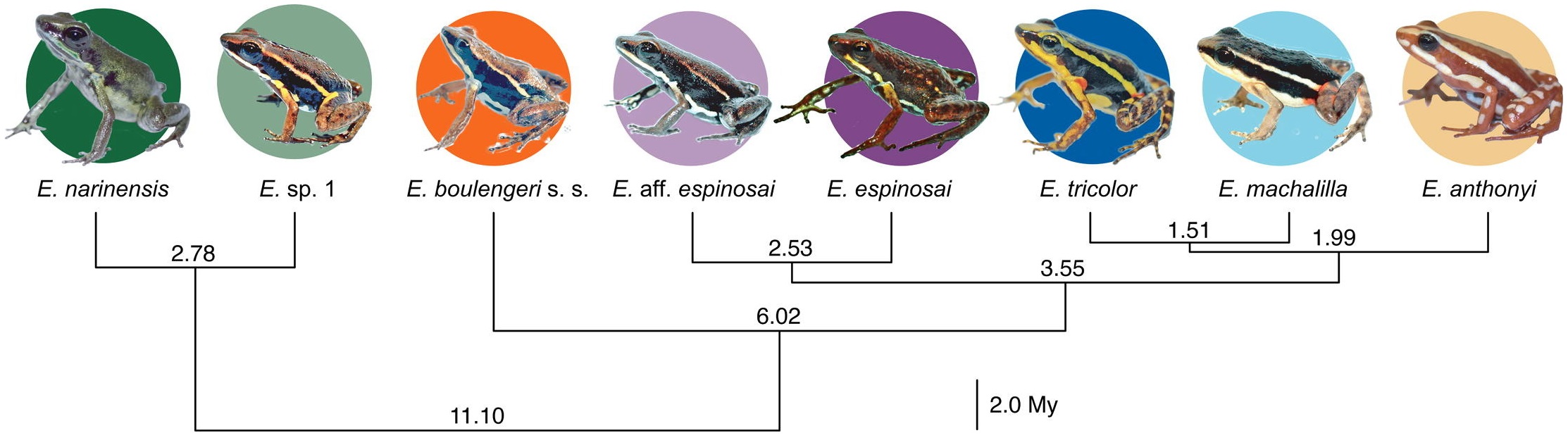
[Herpetology • 2024] Deep Divergences among inconspicuously colored Clades of Epipedobates Poison Frogs (Anura: Dendrobatidae)


Distribution of sequenced individuals of Epipedobates, their type localities (stars), and estimated divergence times.

in López-Hervas, Santos, Ron, Betancourth-Cundar, Cannatella et Tarvin, 2024. 
 
Highlights: 
• The poison frog genus Epipedobates is ∼11 My old and contains eight putative species.
• Inconspicuous Epipedobates spp. are more deeply diverged genetically than aposematic spp.
• We reorganize the E. boulengeri/espinosai species complex into four species.
• We synonymize E. darwinwallacei with E. espinosai.
• We provide the first genetic data for E. narinensis.

Abstract
Poison frogs (Dendrobatidae) are famous for their aposematic species, having a combination of diverse color patterns and defensive skin toxins, yet most species in this family are inconspicuously colored and considered non-aposematic. Epipedobates is among the youngest genus-level clades of Dendrobatidae that includes both aposematic and inconspicuous species. Using Sanger-sequenced mitochondrial and nuclear markers, we demonstrate deep genetic divergences among inconspicuous species of Epipedobates but relatively shallow genetic divergences among conspicuous species. Our phylogenetic analysis includes broad geographic sampling of the inconspicuous lineages typically identified as E. boulengeri and E. espinosai, which reveals two putative new species, one in west-central Colombia (E. sp. 1) and the other in north-central Ecuador (E. aff. espinosai). We conclude that E. darwinwallacei is a junior subjective synonym of E. espinosai. We also clarify the geographic distributions of inconspicuous Epipedobates species including the widespread E. boulengeri. We provide a qualitative assessment of the phenotypic diversity in each nominal species, with a focus on the color and pattern of inconspicuous species. We conclude that Epipedobates contains eight known valid species, six of which are inconspicuous. A relaxed molecular clock analysis suggests that the most recent common ancestor of Epipedobates is ∼ 11.1 million years old, which nearly doubles previous estimates. Last, genetic information points to a center of species diversity in the Chocó at the southwestern border of Colombia with Ecuador. A Spanish translation this text is available in the supplementary materials.
 
Keywords: Aposematism, Cryptic species, Genetic divergence, Polytypic species, Species delimitation, Phylogenetics

phylogeny of Epipedobates

Conclusion: 
Epipedobates forms a radiation of species on the west of the Andes in northern Peru, Ecuador, and Colombia. Epipedobates is a model clade for studying the relationship between phenotypic and genetic divergence. The boundaries between species pairs are difficult to assess. We found that the nominal species Epipedobates boulengeri” included cryptic and understudied diversity; i.e., individuals included in that species now correspond to E. espinosai, E. aff. espinosai, and E. sp. 1. In contrast, a relatively young clade contains three phenotypically distinctive species, E. anthonyi, E. machalilla and E. tricolor, with very low genetic divergence despite high levels of morphological divergence. Two of these species might have evolved conspicuous coloration independently, yet introgression and relatively recent divergence in less than 2 Mya might also explain such events. We found evidence of gene flow between E. machalilla and E. aff. espinosai, and we suggest that further sampling using highly variable markers from genome-wide data is needed to assess introgression between these and possibly other pairs of Epipedobates species.


Karem López-Hervas, Juan C. Santos, Santiago R. Ron, Mileidy Betancourth-Cundar, David C. Cannatella and Rebecca D. Tarvin. 2024. Deep Divergences among inconspicuously colored Clades of Epipedobates Poison Frogs. Molecular Phylogenetics and Evolution. In Press, 108065.  DOI: 10.1016/j.ympev.2024.108065

Resumen: Las ranas venenosas (Dendrobatidae) son famosas por sus especies aposemáticas, que se caracterizan por una combinación de diversos patrones de color y toxinas cutáneas defensivas. Sin embargo, la mayoría de las especies de esta familia tienen colores inconspicuos y no se consideran aposemáticas. Epipedobates se encuentra entre los clados más jóvenes a nivel de género de Dendrobatidae que incluye especies tanto aposemáticas como inconspicuos. Usando marcadores mitocondriales y nucleares, demostramos profundas divergencias genéticas entre especies inconspicuos de Epipedobates pero divergencias genéticas relativamente superficiales entre especies conspicuas. Nuestro análisis filogenético incluye un amplio muestreo geográfico de los linajes inconspicuos típicamente identificados como E. boulengeri y E. espinosai. Los resultados revelan dos nuevas especies putativas, una en el centro-oeste de Colombia (E. sp. 1) y la otra en el centro-norte de Ecuador (E. aff. espinosai). Determinamos que E. darwinwallacei es un sinónimo subjetivo menor de E. espinosai y aclaramos las distribuciones geográficas de las especies inconspicuos de Epipedobates, incluyendo E. boulengeri. Con una evaluación cualitativa enfocado en el color y el patrón de las especies inconspicuas describimos la diversidad fenotípica en cada especie nominal. Concluimos que el género Epipedobates contiene ocho especies válidas conocidas, seis de las cuales son en su mayoría inconspicuas. Un análisis de reloj molecular relajado nos sugiere que el ancestro común más reciente de Epipedobates tiene ∼ 11,1 millones de años, lo que casi duplica las estimaciones anteriores. Por último, la información genética apunta a un centro de diversidad de especies en el Chocó en la frontera suroeste de Colombia con Ecuador. Una traducción al español de este texto está disponible en los materiales suplementarios.