Showing posts with label Formation: Yixian. Show all posts

Wednesday, November 6, 2024

[Paleontology • 2024] Extremely rapid, yet noncatastrophic, Preservation of the Flattened-feathered and 3D Dinosaurs of the Early Cretaceous of China


 Extremely rapid preservation of the flattened-feathered and 3D Dinosaurs of the Early Cretaceous, Yixian Formation in China

in MacLennan, Sha, Olsen, Kinney, Chang, Fang, Liu, Slibeck, Chen et Schoene, 2024.

Significance: 
Traditionally, the spectacular preservation of fossils of feathered dinosaurs and early birds and other animals found in sedimentary strata of the Yixian Formation in northeast China has been attributed to Pompeii-like volcanic catastrophes. We provide high-resolution geochronology and sedimentological analysis challenging this model and show that these strata instead record normal life and death processes preserved in a succession of depositional environments that span less than 100 thousand years.

Abstract
Northeast China’s Early Cretaceous Yixian Formation preserves spectacular fossils that have proved extraordinarily important in testing evolutionary hypotheses involving the origin of birds and the distribution of feathers among nonavian dinosaurs. These fossils occur either flattened with soft tissue preservation (including feathers and color) in laminated lacustrine strata or as three-dimensional (3D) skeletons in “life-like” postures in more massive deposits. The relationships of these deposits to each other, their absolute ages, and the origin of the extraordinary fossil preservation have been vigorously debated for nearly a half century, with the prevailing view being that preservation was linked to violent volcanic eruptions or lahars, similar to processes that preserved human remains at Pompeii. We present high-precision zircon U-Pb geochronology from cores and outcrops, demonstrating that Yixian Formation accumulation rates are more than an order of magnitude higher than usually estimated. Additionally, we provide zircon provenance and sedimentological data from 3D dinosaur fossils, which imply that their death and burial occurred in collapsed burrows, rather than via a catastrophic volcanogenic mechanism. In the studied area, the three principal fossil-rich intervals of the Yixian occur as a cyclic sequence that correspond to periods of high precipitation. Using Bayesian–Markov Chain Monte Carlo approaches, we constrain the total duration of the sequence to less than ~93,000 y and suggest that climatic precession paced the expression of these cyclic sediments. Rather than representing multiple, Pompeii-like catastrophes, the Yixian Formation is instead a brief snapshot of normal life and death in an Early Cretaceous continental community.

Two perfectly articulated skeletons of the sheep-size dinosaur Psittacosaurus, found in China's Yixian Formation. New research suggests they died in burrow collapses, not via volcanism, as previously thought.
by Jun Liu, IVPP, Chinese Academy of Sciences

Artist's rendition of a Psittacosaurus dinosaur with babies being hunted by Repenomamus, a mammal. One fossil assemblage from the Yixian Formation preserved the remains of these species in mortal combat, frozen in mid-action. The dinosaur here is shown with bristly proto-feathers on its tail.
artwork by Alex Boersma


 Scott A. MacLennan, Jingeng Sha, Paul E. Olsen, Sean T. Kinney, Clara Chang, Yanan Fang, Jun Liu, Bennett B. Slibeck, Elaine Chen, and Blair Schoene. 2024. Extremely rapid, yet noncatastrophic, Preservation of the Flattened-feathered and 3D Dinosaurs of the Early Cretaceous of China. PNAS. 121 (47) e2322875121. DOI: doi.org/10.1073/pnas.2322875121

Wednesday, October 9, 2024

[PaleoEntomology • 2022] Magicivena sticta, M. elegans & M. antennalis • Early Cretaceous enigmatic Insect Group [Magicivenidae fam. nov.] showing unique Wing Venations and Antennal Sensilla


Magicivena sticta 
Yang, Shih, Rasnitsyn, Ren & Gao, 2022 


Abstract
A new extinct insect group, Magicivena gen. nov. in Magicivenidae fam. nov., with M. sticta sp. nov. (type species), M. elegans sp. nov., M. antennalis sp. nov. and M. sp., is reported as Insecta incertae ordinis based on four specimens from the Lower Cretaceous Yixian Formation of north-eastern China. Magicivenidae are characterized by special antennal structures, such as each flagellomere having two lateral transverse rows of setiferous pits, and forewing venations such as a very short subcostal anterior (Sc), the radial posterior (RS) apparently lost, a weak cubital posterior (CuP), and a single cross-vein crossing the CuP and joining the cubital anterior (CuA) to the first anal vein, all of which differ from those of any other fossil or extant insect taxa documented hitherto. According to the characters forewing with multibranched CuA, hind wing with several long anal veins, and segmented cerci, Magicivenidae should belong to Polyneoptera. The light constitution of a good flier, similar structure of the pterostigma in the hind wing, and transverse furrow on the pronotum all suggest the parallel evolution of Magicivenidae and a dictyopterid family, Alienopteridae. However, the advanced bimotory and loss of an identifiable RS make the possible affinity of Magicivenidae with Alienopteridae problematic, as the latter possess utmost posteromotory and a distinct RS. The antennae of Magicivenidae with their sophisticated sensory apparatus suggest that the four known specimens of Magicivena described here are all males; females are still to be discovered. This new finding enriches the known diversity of Cretaceous insect groups.

Keywords: Magicivena, Magicivenidae, flagellomere, flight, Yixian Formation, Alienopteridae


Magicivenidae fam. nov. 
 
Magicivena gen. nov.   

M. sticta sp. nov. (type species), M. elegans sp. nov., M. antennalis sp. nov


Hongru Yang, Chungkun Shih, Alexandr P. Rasnitsyn, Dong Ren and Taiping Gao. 2022. Early Cretaceous enigmatic Insect Group showing unique Wing Venations and Antennal Sensilla. Papers in Palaeontology. DOI: 10.1002/spp2.1402
  twitter.com/Dean_R_Lomax/status/1445391039439818764

Wednesday, June 26, 2024

[PaleoEntomology • 2018] Cretohister sinensis • Cretohisteridae, a new beetle family (Coleoptera) from the Early Cretaceous of China, and its implications for the early evolution of the basal group of Histeroidea


Cretohister sinensis
Zhou, Caterino, Ślipiński & Cai, 2018


Abstract
A new beetle family Cretohisteridae fam. n. is described from the Lower Cretaceous Yixian Formation (∼125 Ma) at Huangbanjigou of Beipiao City, Liaoning Province, Northeastern China based on a well preserved fossil beetle, Cretohister sinensis gen., sp. n. This discovery has established the oldest fossil record for the superfamily Histeroidea, backdating the minimum age of the group by 25 Ma from the earliest Cenomanian (∼99 Ma) to the Barremian of the Cretaceous Period. Based on cladistic analyses of a comprehensive morphological dataset, Cretohisteridae is unambiguously recovered as the sister group of Histeridae, exhibiting several character states that bridge the span between Sphaeritidae, Synteliidae and Histeridae. The discovery of the new fossil family sheds new light on the early evolution and diversity of the Histeroidea in the Early Cretaceous, and provides new clues to solving the long-ambiguous phylogenetic relationships among the modern families of Histeroidea.

Systematic palaeontology
Superfamily Histeroidea Gyllenhal, 1808

  Cretohisteridae fam. n.

  Cretohister gen. n.
 
 Cretohister sinensis sp. n.

Photographs and schematic drawings of holotype (NIGP166874a, b) of †Cretohister sinensis sp. n. of Cretohisteridae fam. n.:
dorsal habitus (A, C) and ventral habitus (B, D). Scale bar, 3 mm.


 Yu-Lingzi Zhou, Michael S. Caterino, Adam Ślipiński and Chen-Yang Cai. 2018. Cretohisteridae, a new beetle family from the Early Cretaceous of China, and its implications for the early evolution of the basal group of Histeroidea (Coleoptera). Systematic Entomology. DOI: 10.1111/syen.12300

Monday, June 12, 2017

[Paleontology • 2017] Daliansaurus liaoningensis • A New Troodontid Dinosaur from the Lower Cretaceous Yixian Formation of Liaoning Province, China


Daliansaurus liaoningensis 
Shen, Lü, Liu, Kundrát, Brusatte & Gao, 2017


Abstract
 A new troodontid dinosaur, Daliansaurus liaoningensis gen. et sp. nov., is erected based on a nearly complete specimen from the Lower Cretaceous Yixian Formation of Beipiao City, Liaoning Province, China. This well preserved skeleton provides important new details of the anatomy for Liaoning troodontids, and gives new insight into their phylogenetic relationships and evolution. Daliansaurus is distinguished from other troodontids by an enlarged ungual on pedal digit IV, which is approximately the same size as the sickle-shaped second ungual, and is differentiated from other Liaoning troodontids by a number of characters of the skull, manus, pelvis, and hindlimb. A phylogenetic analysis recovers Daliansaurus within a subclade of Liaoning troodontids that also includes SinovenatorSinusonasus, and Mei. We erect a name for this group — Sinovenatorinae — and argue that it reflects a localized radiation of small-bodied troodontids in the Early Cretaceous of eastern Asia, similar to previously recognized radiations of Liaoning dromaeosaurids and avialans. As more Liaoning theropods are discovered, it is becoming apparent that small, feathered paravians were particularly diverse during the Early Cretaceous, and future work is needed to clarify how this diversity arose, which species coexisted, and how these numerous species partitioned niches. 

Key words: Troodontids, Daliansaurus liaoningensis, Early Cretaceous, Yixian Formation, Liaoning


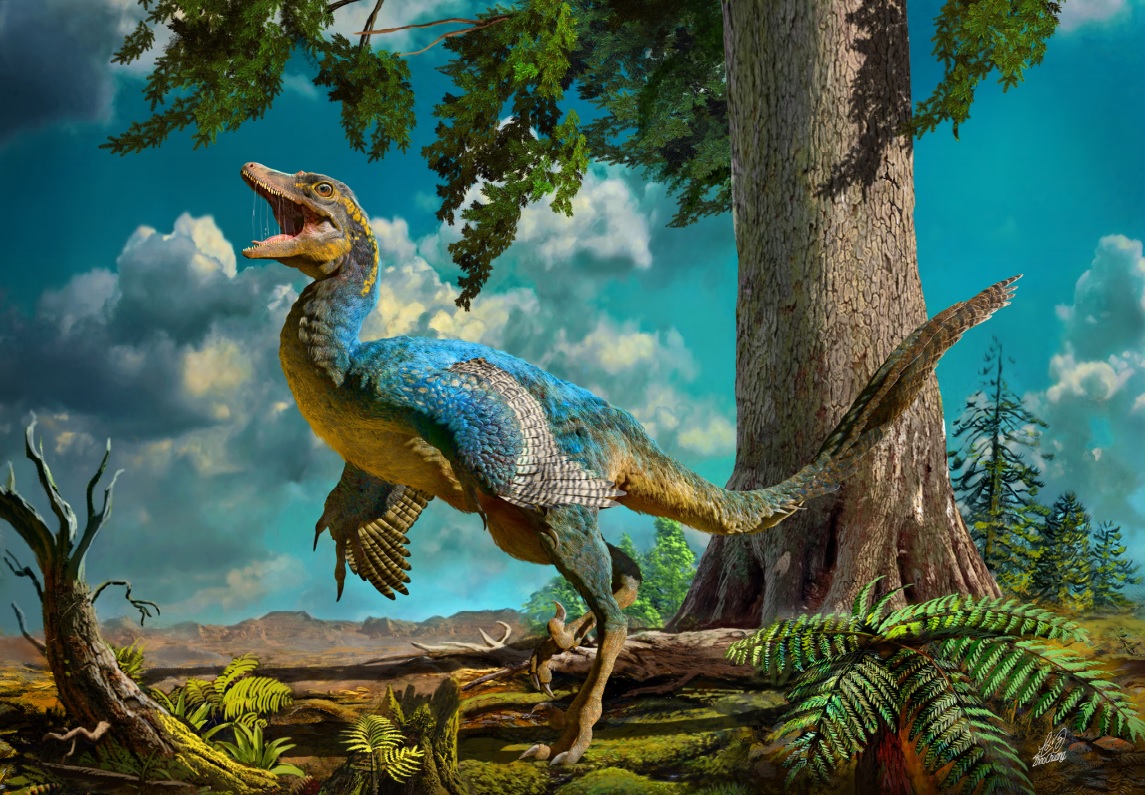
Fig. 15. The living scene of Daliansaurus liaoningensis gen. et sp. nov. (DNHM D 2885) (drawn by Zhao Chuang)
Fig. 2. Photograph of the holotype of Daliansaurus liaoningensis gen. et sp. nov. (DNHM D2885).

Theropoda Marsh, 1881
Maniraptora Gauthier, 1986

Troodontidae Gilmore, 1924 
 Sinovenatorinae subfamily nov. 

Definition: The most inclusive clade including Sinovenator changii but not Troodon formosus, Saurornithoides mongoliensis, Anchiornis huxleyi, Archaeopteryx lithographica, Gallus gallus, Unenlagia comahuensis, or Dromaeosaurus albertensis

  Diagnosis: Based on our phylogenetic analysis, this clade can be diagnosed with the following combination of characters (for further discussion, see below): a premaxilla whose anteroposterior length is less than 10% of the length of the maxilla along the ventral margin of the upper jaw; a premaxillary maxillary process that contacts the nasal ventral to the external naris; some maxillary and dentary teeth that lack serrations on the mesial carina; unfused zygapophyses on the sacral vertebrae; an antitrochanter that is posterodorsal to the acetabulum; and a metatarsal IV that is mediolaterally wide and flattened in cross section.

 Included species: Based on our phylogenetic analysis, this clade currently includes Sinovenator changiiSinusonasus magnodensMei long, and Daliansaurus liaoningensis gen. et sp. nov.


 Daliansaurus liaoningensis gen. et sp. nov.

Etymology: The generic name refers to the city of Dalian in the south of Liaoning province. The specific name “liaoningensis” refers to the province in which the specimen was discovered.

Locality and horizon: Lujiatun, Beipiao City, Liaoning Province; Yixian Formation, Lower Cretaceous.


Fig. 15. The living scene of Daliansaurus liaoningensis gen. et sp. nov. (DNHM D 2885) (drawn by Zhao Chuang) 

Conclusions
 It appears that small-bodied, feathered, winged paravian theropods from Liaoning—dromaeosaurids, avialans, and troodontids—were exceptionally diverse. Each group experienced its own local Early Cretaceous diversification, which produced a number of species that either coexisted or, perhaps more likely, replaced each other over time or partitioned niches and geographic ranges so that they did not extensively overlap in space. The discovery of Daliansaurus also demonstrates that Liaoning continues to produce new dinosaur taxa, and remains one of the world’s most productive sites for understanding paravian evolution, more than two decades after the first feathered dinosaurs were reported.


 SHEN Caizhi, LÜ Junchang, LIU Sizhao, Martin KUNDRÁT, Stephen L. BRUSATTE and GAO Hailong. 2017. A New Troodontid Dinosaur from the Lower Cretaceous Yixian Formation of Liaoning Province, China.  ACTA GEOLOGICA SINICA.  91(3); 763–780. 


Wednesday, June 7, 2017

[Paleontology • 2017] Liaoningvenator curriei • A New Troodontid Dinosaur from the Early Cretaceous Yixian Formation in Western Liaoning, China


Liaoningvenator curriei  
Shen, Zhao, Gao, Lü & Kundrát, 2017

reconstruction by Chuang ZHAO || DOI: 10.3975/cagsb.2017.03.06 

Abstract

      A new troodontidLiaoningvenator curriei gen. et sp. nov., is described based on a complete skeleton from the Early Cretaceous Yixian Formation of Beipiao City, Liaoning Province. It bears the following characteristics of Troodontidae: numerous and more closely appressed maxillary and dentary teeth; the teeth markedly constricted between the roots and crowns; the nutrient foramina in groove on the external surface of dentary; distal caudal vertebrae having a sulcus on the dorsal midline rather than a neural spine. Unlike other troodontids, Liaoningvenator exhibits a sub-triangular ischial boot in lateral view and slender ischial obturator process; transition point in caudal vertebrae starts from the seventh caudal vertebra. A phylogenetic analysis recovers Liaoningvenator and Eosinopteryx as sister taxa that belong to the same clade. These two taxa share the following three characteristics: (1) anterior maxillary and dentary teeth lack serrations along the anterior carina; (2) shafts of cervical ribs are longer than vertebral centra with which they articulate; and (3) anterior margin of ilium is straight. The histological study indicates that Liaoningvenator was attaining skeletal maturity and at least four years old when it perished. Liaoningvenator represents the fifth troodontid taxon from the Lower Cretaceous equivalent strata of western Liaoning. It provides much new anatomical information on basal troodontid dinosaurs in this region. It also enhances the diversity of the troodontids in Early Cretaceous of China currently known.

Keywords: troodontid, new genus and species, Early Cretaceous, phylogenetic analysis, western Liaoning

Fig. 1 Line drawing (A) and photograph (B) of Liaoningvenator curriei gen. et sp. nov. (DNHM D3012)
Systematic paleontology
Theropoda Marsh, 1881
Maniraptora Gauthier, 1986
Troodontidae Gilmore, 1924

Liaoningvenator curriei gen. et sp. nov.  

Etymology: The genus name refers to Liaoning, and “venator” meaning hunter; the specific name honors Professor Philip J. Currie for his outstanding contribution to the research on small theropod dinosaurs.

Holotype: A nearly complete, naturally articulated skeleton with skull and lower jaws (DNHM D3012), all bones are three dimensionally preserved. The type specimen is housed in the collections of the Dalian Natural History Museum (DNHM), Dalian City, Liaoning Province, China.

 Type locality and horizon: Lujiatun, Shangyuan, Beipiao City, Liaoning Province, China; fluvial and volcaniclastic beds of the basal Yixian Formation, Hauterivian, Lower Cretaceous (Xu et al., 2002).

The reconstruction of Liaoningvenator curriei gen. et sp. nov. (DNHM D3012)
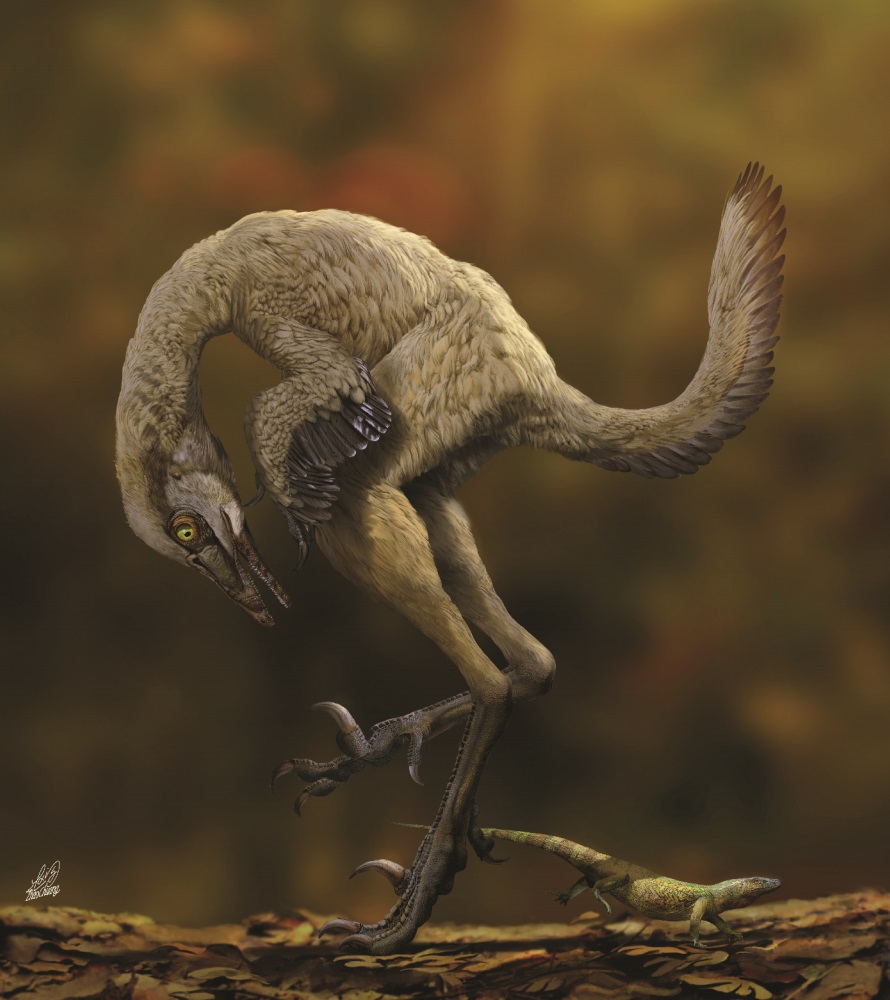
drawn by ZHAO Chuang


Cai-zhi Shen, Bo Zhao, Chun-ling Gao, Jun-chang Lü and Martin Kundrát. 2017. A New Troodontid Dinosaur (Liaoningvenator curriei gen. et sp. nov.) from the Early Cretaceous Yixian Formation in Western Liaoning Province. Acta Geoscientica Sinica. 38: 359-371.  DOI: 10.3975/cagsb.2017.03.06


Liaoningvenator, a new troodontid from China http://www.wildprehistory.com/abstract/liaoningvenator-a-new-troodontid-from-china/ @wildprehistory

Wednesday, September 14, 2016

[Paleontology • 2016] Beipiaognathus jii • A New Species of Compsognathid from the Early Cretaceous Yixian Formation of western Liaoning, China


Beipiaognathus jii 
 Hu, Wang & Huang, 2016 


The paper reports a new genus and species of compsognathids: Beipiaognathus jii (gen. et sp. nov.). It possesses not only the diagnostic characters of Compsognathidae,such as the fan-shaped dorsal neural spines and robust phalanx Ⅰ-1,but also some unique characteristics different from other compsognathids,including the un-serrated conical-shaped teeth,relatively long ulna,robust and long phalanx Ⅱ-1,and relatively short tail. The discovery further reveals the great diversity of Compsognathidae and provides more information for understanding the anatomical characters of compsognathids.

Key Words: Coelurosauria, Compsognathid, Early Cretaceous, Yixian Formation, Western Liaoning 


Yuanchao Hu, Xuri Wang and Jiandong Huang. 2016. A New Species of Compsognathid from the Early Cretaceous Yixian Formation of western Liaoning, China.
Journal of Geology. 40(2); DOI:  10.3969/j.issn.1674-3636.2016.02.191


Saturday, April 2, 2016

[PaleoOrnithology • 2013] Xinghaiornis lini (Aves: Ornithothoraces) from the Early Cretaceous of Liaoning: An Example of Evolutionary Mosaic in Early Birds


Xinghaiornis lini 
Wang, Chiappe, Teng & Ji, 2013 DOI: 10.1111/1755-6724.12080

      We describe a new species of Early Cretaceous bird from the Yixian Formation of Liaoning Province. Xinghaiornis lini gen. et sp. nov. is relatively large and characterized by a long, toothless rostrum and an elevated pedal digit I. The design of the skull and feet suggests that this bird was likely a mud-prober. This discovery provides strong support indicating that this avian trophic specialization originated at least 125 million years ago.

Keywords: Early Cretaceous, Xinghaiornis lini, Yixian Formation, avian trophic specialization


Xuri Wang, Luis M. Chiappe, Fangfang Teng and Qiang Ji. 2013. Xinghaiornis lini (Aves: Ornithothoraces) from the Early Cretaceous of Liaoning: An Example of Evolutionary Mosaic in Early Birds. Acta Geologica Sinica (English Edition). 87(3): 686–689.